


About this worksheet
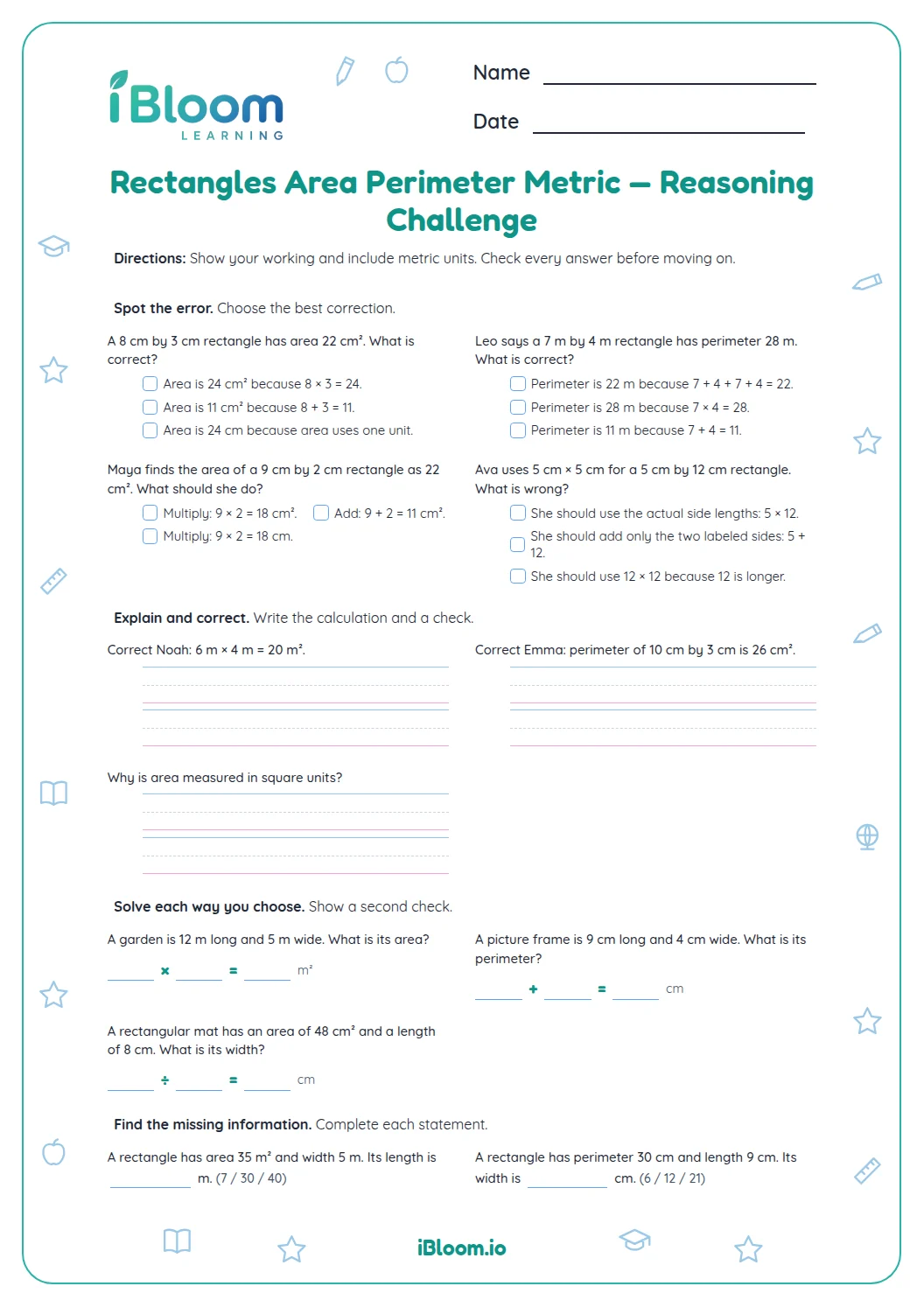
This Grade 5 worksheet practices rectangle area and perimeter in metric settings, matching the formula work in the earlier sheet while adding missing-side and joined-rectangle problems. Students write equations and include units. The answer key shows the expected measurements. The problems align with CCSS 4.MD.A.3, applying rectangle area and perimeter formulas in real-world and mathematical problems.
Aligned to 4.MD.A.3
What kinds of rectangle problems are included?
The 14 prompts use gardens, banners, rugs, floors, and other familiar settings. Students find area or perimeter, work backward from a missing side, compare areas, and reason about joined rectangles.
- Part A: calculate area and perimeter from side lengths
- Part B: identify the needed measure in a situation
- Part C: find missing dimensions and reason about joined rectangles
How do area and perimeter use side lengths?
For a rectangle, multiply length by width to find area. Add the four side lengths to find perimeter; because opposite sides match, this is twice the sum of length and width. Write square units for area and ordinary length units for perimeter.
- 1A 7 m by 3 m rug has area 7 × 3 = 21 m².
- 2Its perimeter is 7 + 3 + 7 + 3 = 20 m.
How can a missing side be found?
Use the known area or perimeter relationship to work backward. If area is 42 m² and width is 6 m, divide 42 by 6 to find a 7 m length. For a perimeter, subtract the two known side contributions before finding the missing matching sides.
What changes when rectangles are joined?
Add the areas of the two rectangles. For the outside perimeter, leave out the shared edge because it is inside the combined shape. Check that every measurement in the answer uses the right units.
How to solve each problem
- 1Underline the dimensions and the quantity the situation asks for.
- 2Choose area for a surface and perimeter for a boundary.
- 3Write the formula or a short equation before calculating.
- 4For a missing side, use the known area or perimeter to work backward.
- 5For joined rectangles, add the areas and omit the shared edge from the outside perimeter.
- 6Label area in square units and perimeter in length units.
Common mistakes and quick fixes
The mistake
Writing meters for an area answer.
The fix
Use square meters or square centimeters because area counts square units.
The mistake
Adding only length and width for a perimeter.
The fix
Include both matching sides: double the sum of length and width.
The mistake
Counting the shared edge of joined rectangles as part of the outside boundary.
The fix
Trace only the outside outline; the shared edge lies inside the combined shape.
Curriculum alignment
Students apply rectangle area and perimeter formulas to metric real-world problems.
Apply area and perimeter formulas to solve real-world problems.
On this sheet: The page revisits rectangle area and perimeter formulas in metric real-world problems.
Show the official wordingHide the official wording
Apply the area and perimeter formulas for rectangles in real world and mathematical problems.
What to practice next
Make more practice
Further reading
Questions parents and teachers ask
What is the difference between area and perimeter?
Area measures the surface inside a shape and is written in square units. Perimeter measures the distance around its outside edge and is written in length units. The worksheet asks students to identify which measurement a situation needs.
What formula finds a rectangle’s area?
Multiply the rectangle’s length by its width. A 7 m by 3 m rectangle has an area of 21 square meters. Keep the square unit in the answer because the result counts square units covering the surface, not a boundary length.
How do you find a missing rectangle side?
Use the given area or perimeter and the known side length. For area, divide by the known side. For perimeter, remember that opposite sides are equal and solve for the missing length after accounting for the known sides.
How do you find the perimeter of joined rectangles?
Trace the outside boundary of the combined shape. The side where the rectangles touch is inside the shape, so it is not part of the outside perimeter. The worksheet also asks students to add the two rectangle areas.
Why does the answer key include units?
Units show what a number measures. Area answers use square units such as m² or cm², while perimeter answers use meters or centimeters. Checking the unit is a useful final step after checking the calculation and matching the question.