


About this worksheet
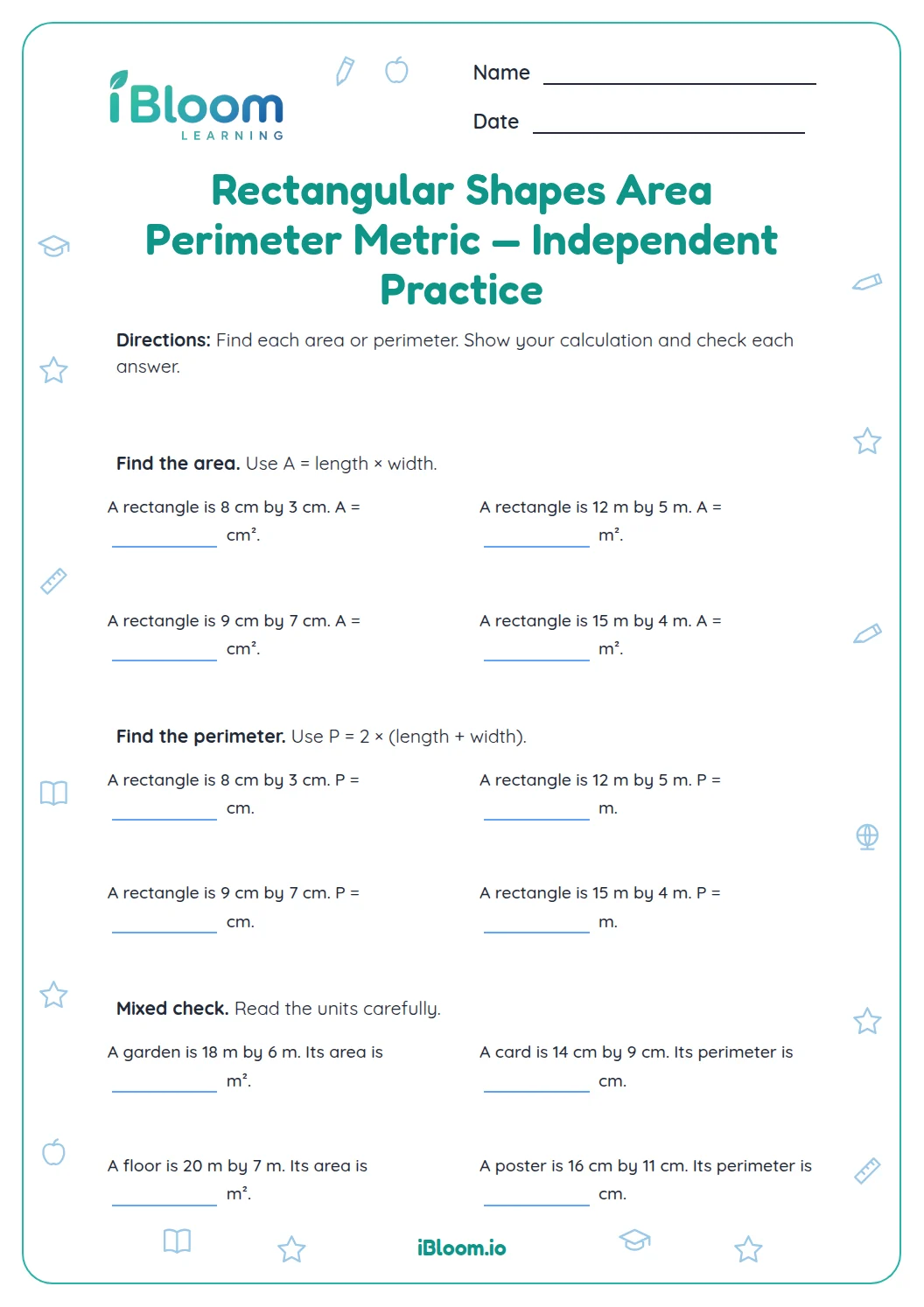
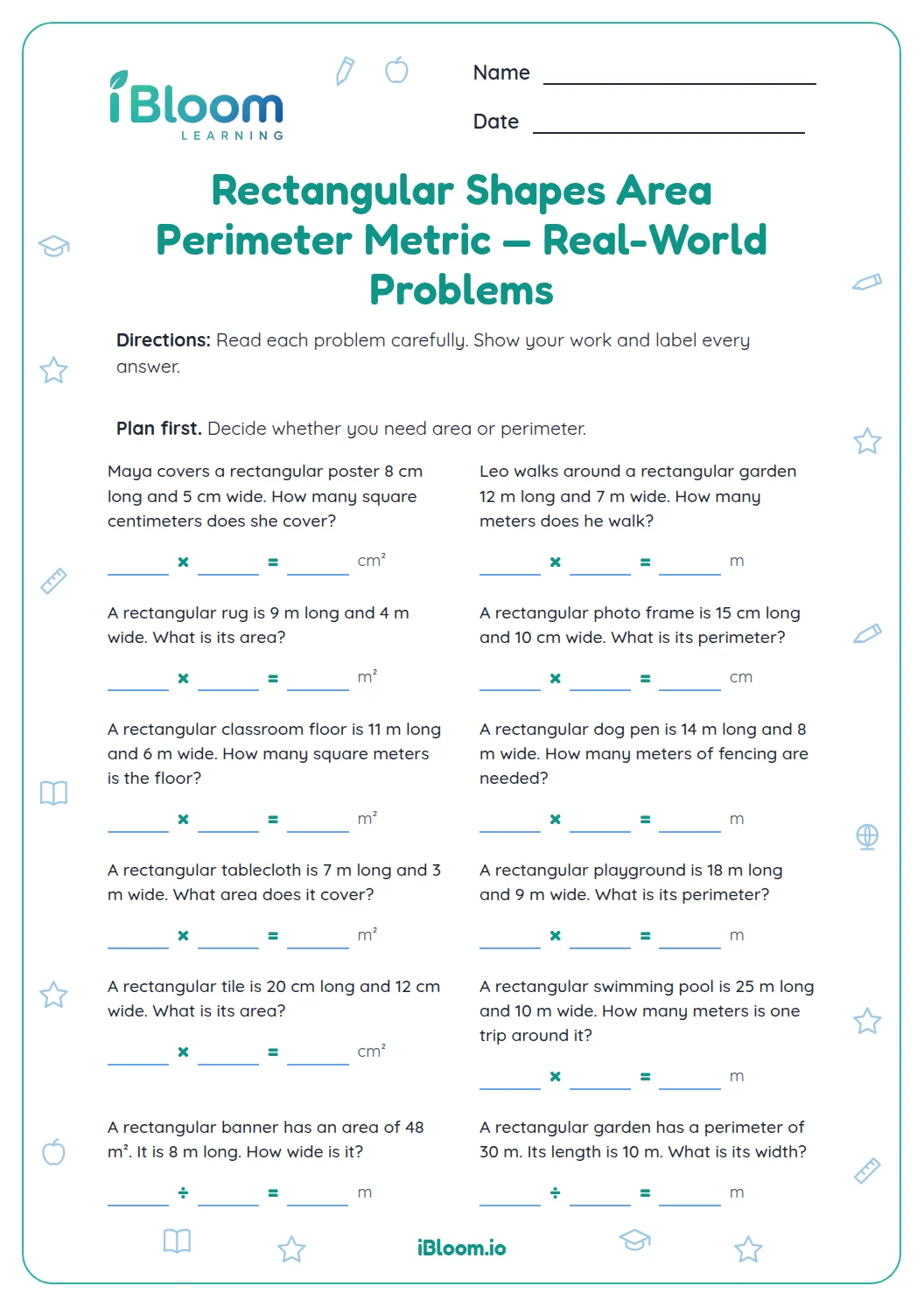
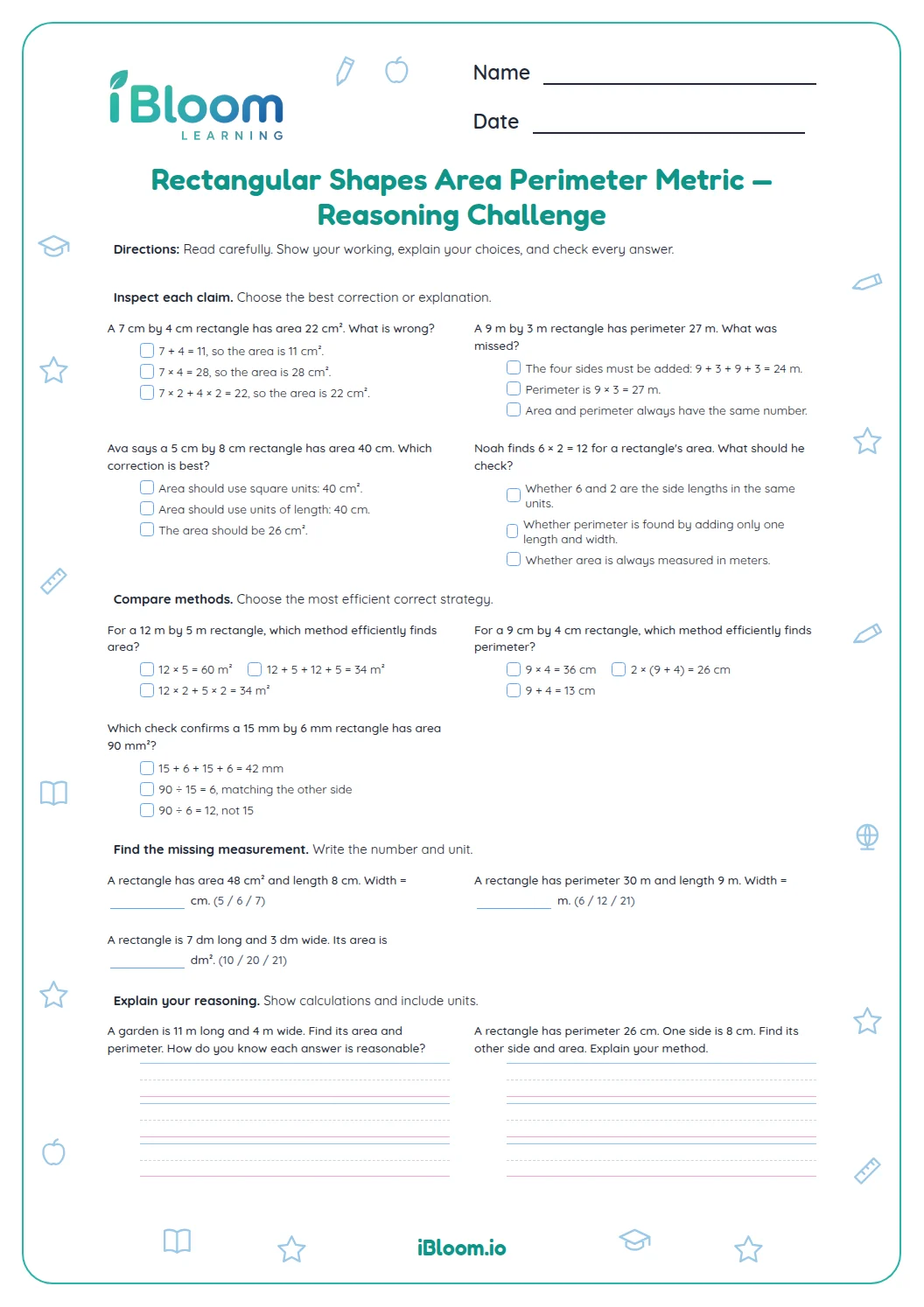
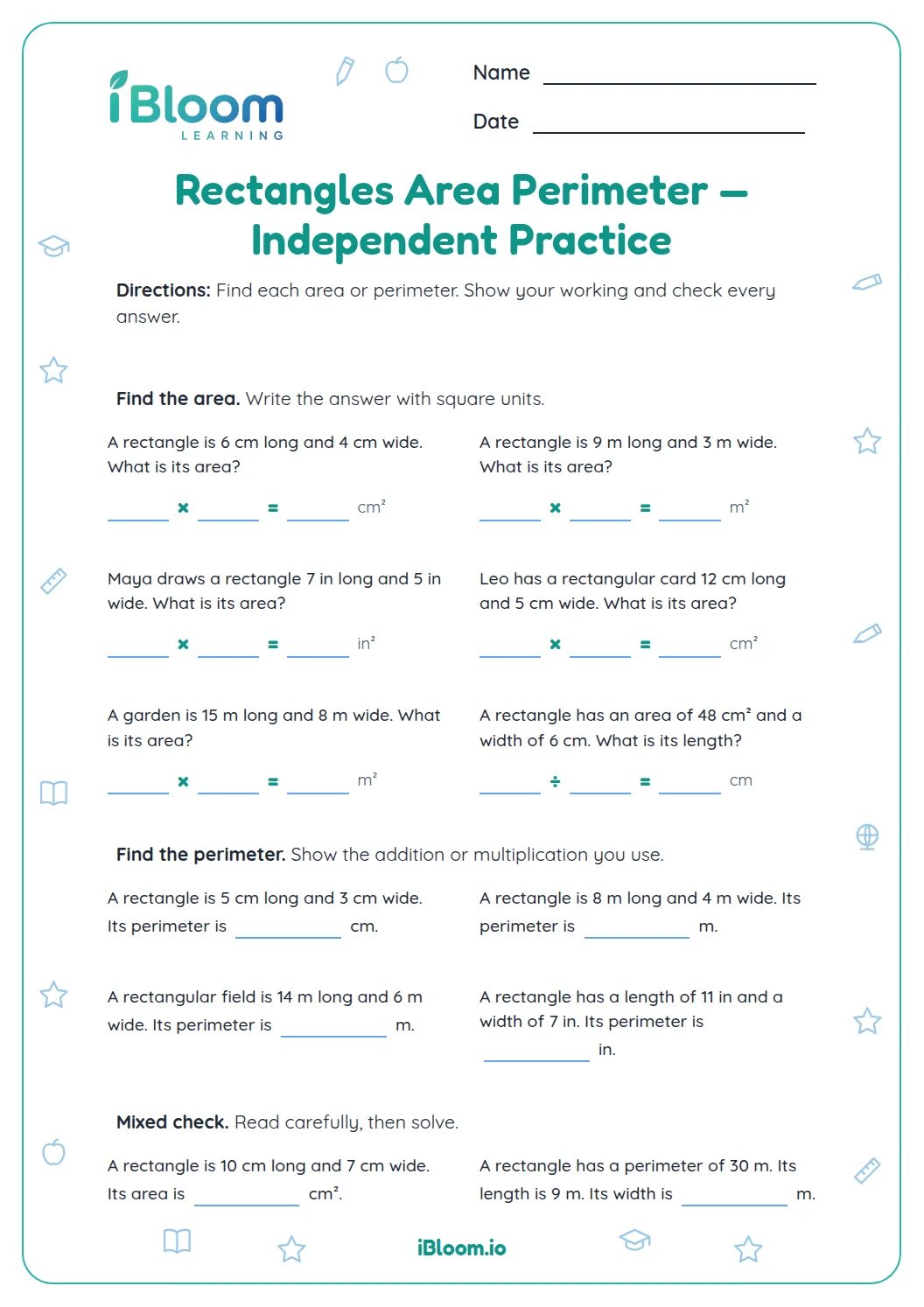
This printable gives Grade 5 students focused practice with rectangular area and perimeter in metric units. Its 18 problems move from direct area calculations to perimeter, missing-side reasoning and two applications. Students record each answer in its box and check the printed square or linear unit. The formulas practiced align with CCSS 4.MD.A.3. A separate answer key gives each result.
Aligned to 4.MD.A.3
How do you find rectangle area?
Area measures the space inside a rectangle. Multiply the length by the width and write a square unit, such as cm² or m².
- 1Question 1: 8 cm × 3 cm = 24 cm².
How do you find rectangle perimeter?
Perimeter is the total length around the outside. Add all four sides; because opposite sides match, double the sum of length and width.
- 1Question 5: 2 × (9 m + 4 m) = 26 m.
How can a known measure reveal a side?
For a missing length from area, divide area by the known width. For a missing side from perimeter, halve the perimeter and subtract the known side. Keep the unit type clear.
- 1Question 9: 40 m² ÷ 5 m = 8 m.
How do the formulas work in a situation?
For an application, identify the two side lengths and decide whether the question asks for the inside space or the distance around. Then choose the matching formula.
- 1Question 17: 16 cm × 3 cm = 48 cm².
How to use this worksheet
- 1Mark which measurement is length and which is width.
- 2Choose area or perimeter based on what the question asks.
- 3Write the formula and substitute the side lengths.
- 4For a missing side, undo the area multiplication or perimeter addition.
- 5Check the unit: square units for area, linear units for perimeter.
Common mistakes and fixes
The mistake
Writing cm instead of cm² for area.
The fix
Area counts square units, so include the exponent 2.
The mistake
Adding side lengths to find area.
The fix
Multiply length by width for the space inside the rectangle.
The mistake
Using square units for a border.
The fix
A border measures distance, so its answer uses linear units such as meters.
Common Core alignment
This page practices the reading and writing skills named below.
Use rectangle area and perimeter formulas to solve numeric and real-world problems.
On this sheet: The problems use metric measurements to apply rectangle area and perimeter formulas, including unknown side lengths.
Show the official wordingHide the official wording
Apply the area and perimeter formulas for rectangles in real world and mathematical problems. For example, find the width of a rectangular room given the area of the flooring and the length, by viewing the area formula as a multiplication equation with an unknown factor.
What to practice next
Make more practice
Further reading
Questions parents and teachers ask
What is the difference between area and perimeter?
Area measures the space inside a rectangle and is written in square units. Perimeter measures the distance around its edges and is written in linear units. This worksheet practices both with metric side lengths and asks students to choose the matching unit.
Why does area use square units?
Area uses square units because it counts equal square spaces covering a surface. A rectangle 8 cm long and 3 cm wide has 8 rows of 3 square centimeters, for a total of 24 cm². This is why the answer is written as cm², not cm.
How do I find a missing side from area?
Divide the known area by the known side length. For example, if the area is 40 m² and the width is 5 m, then 40 ÷ 5 gives a length of 8 m. This worksheet practices that reverse step with metric measurements.
How do I find a missing side from perimeter?
For a rectangle, divide the perimeter by two to get the length plus width. Subtract the known side. With a 30 cm perimeter and a 9 cm side, 15 − 9 gives the other side: 6 cm. The blank asks for a length, so write a linear unit.
Does the worksheet use metric measurements?
Yes. The problems use centimeters and meters. Keep the given unit with each side length, use square units for area, and use linear units for perimeter or a missing side. For example, perimeter answers use cm or m, not square units.
What is on the answer key?
The separate key lists answers for all 18 problems. It includes area and perimeter results, missing side lengths and answers to the two applications. Compare the number and unit with the blank in each question. It follows the same order as the numbered questions on the sheet.