
About this worksheet
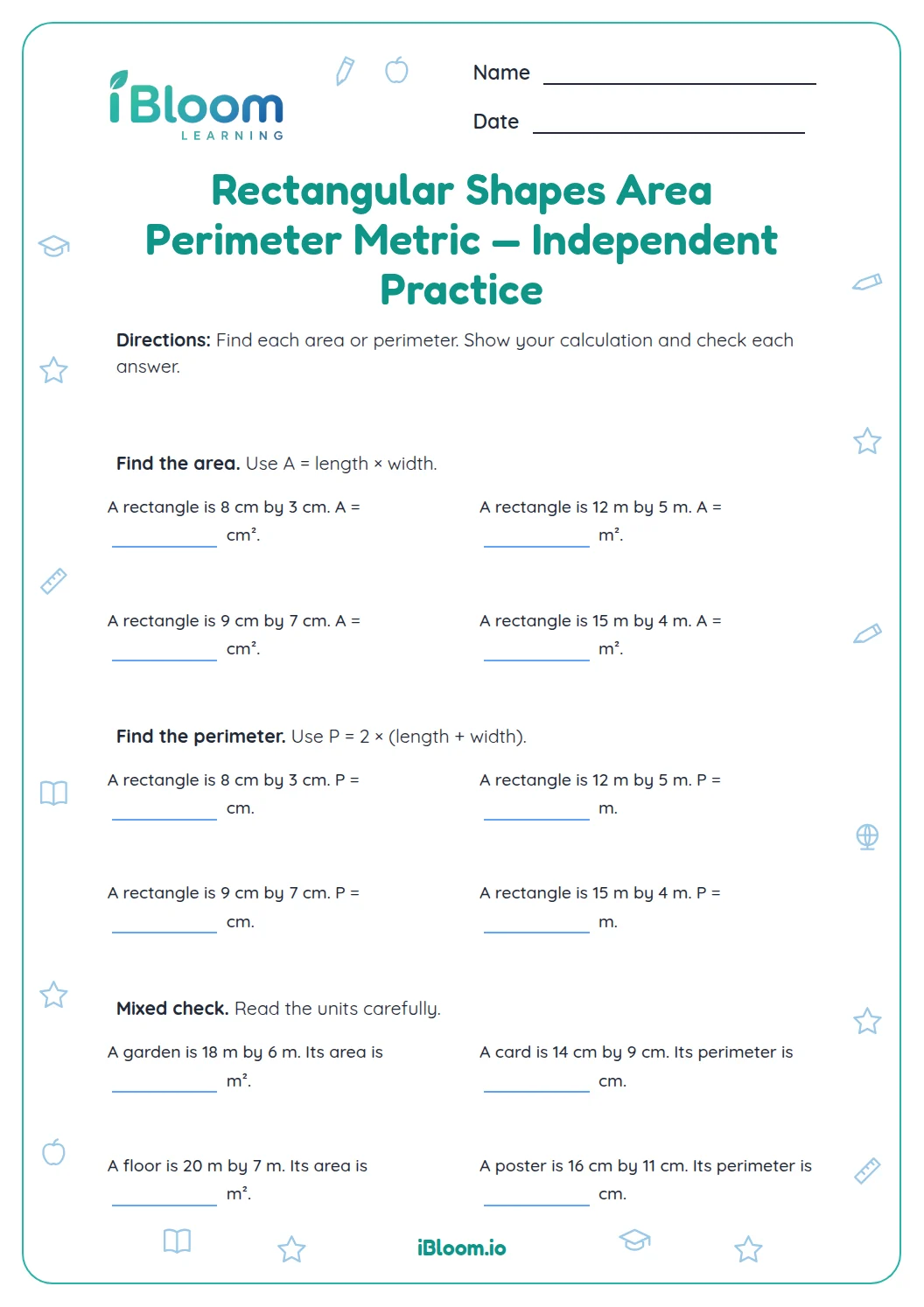
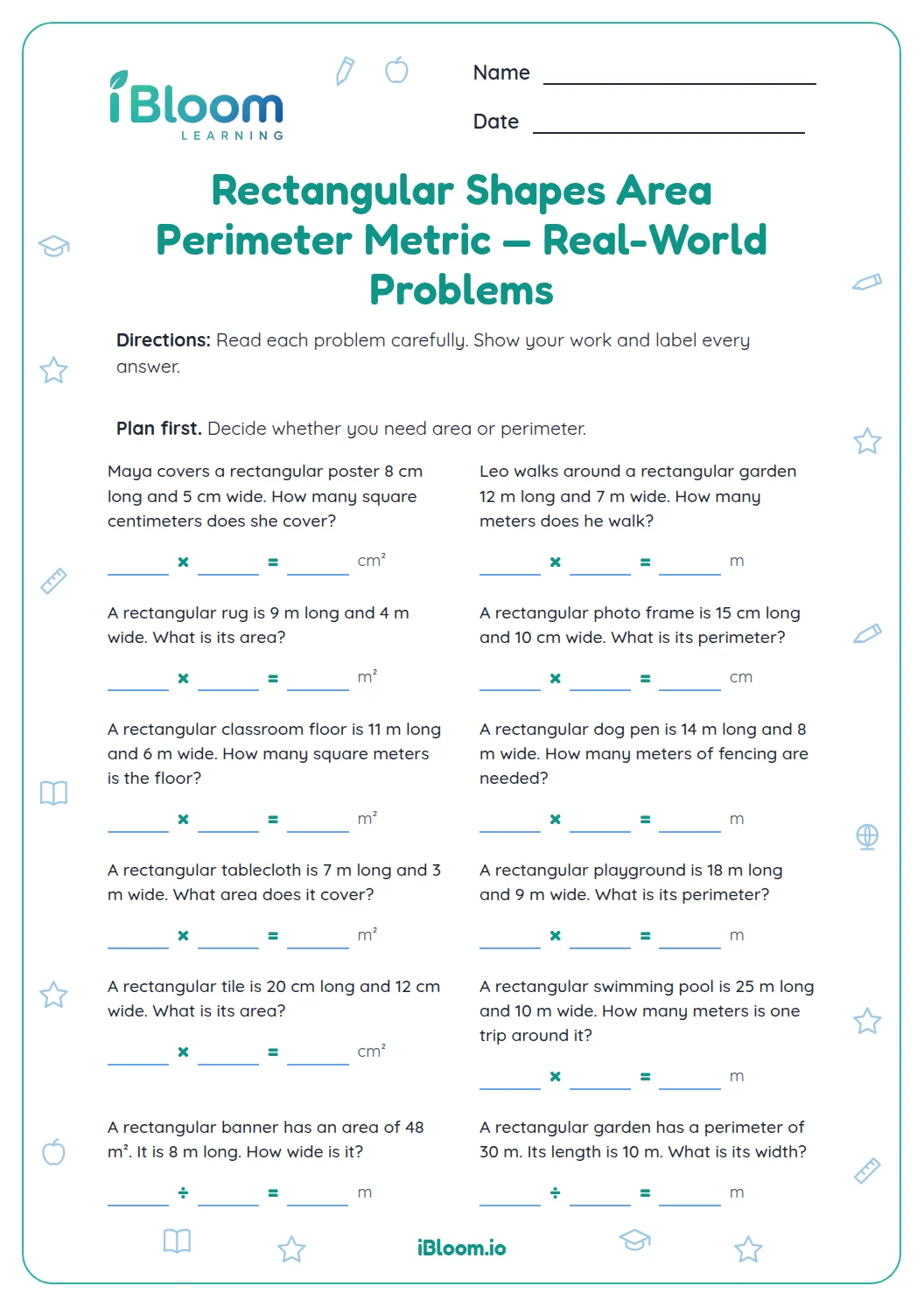
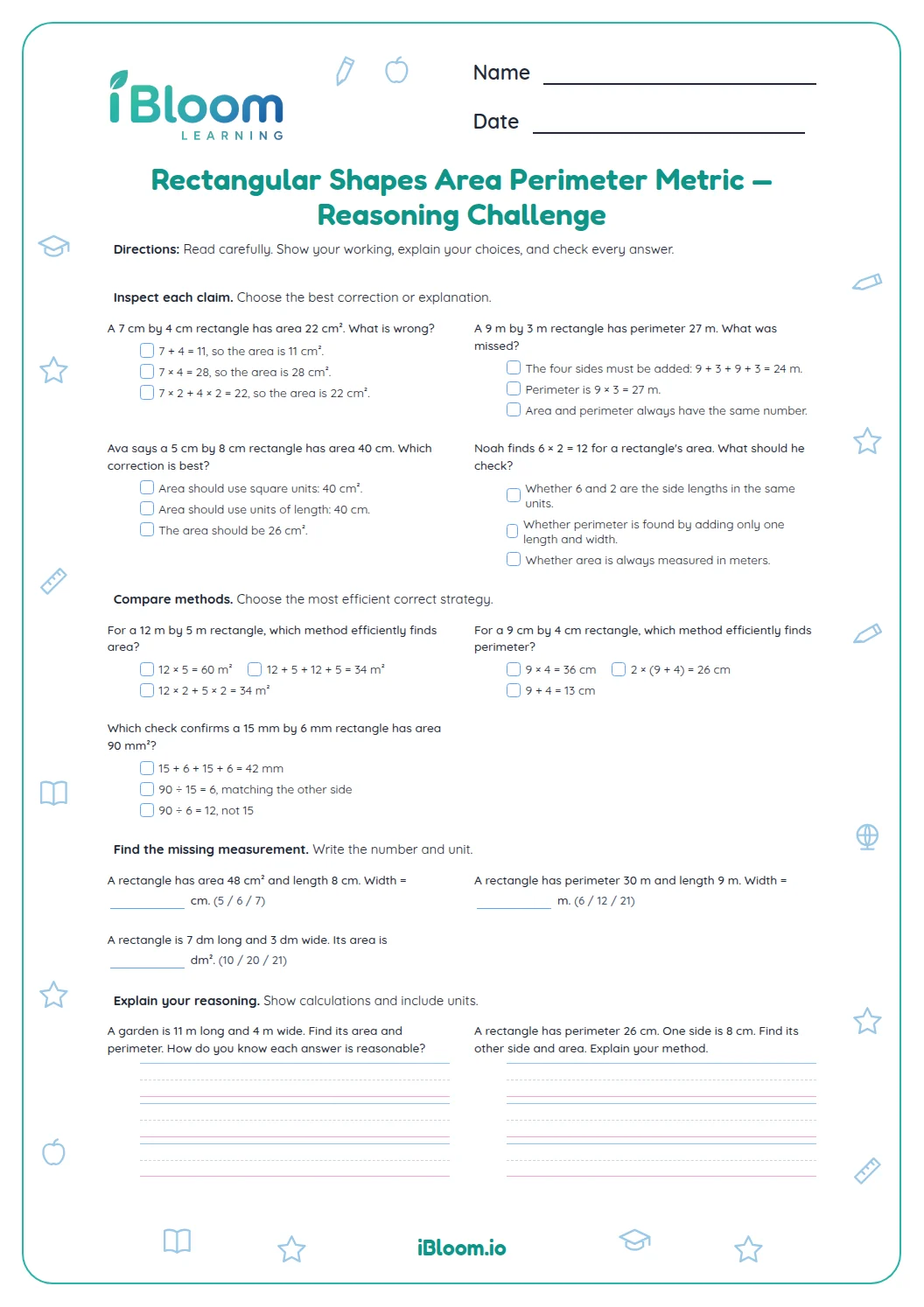
This Grade 5 printable gives learners 14 metric rectangle problems: seven ask for area and seven for perimeter. The page keeps the old sheet’s mix of choosing a true statement, completing a calculation, and solving a short situation, while making the side lengths and units clear. It connects to CCSS 4.MD.A.3, which asks students to apply rectangle area and perimeter formulas in mathematical and real-world problems.
Aligned to 4.MD.A.3
What will learners practice?
The first part mixes area and perimeter with side lengths in centimeters. The second part continues with rectangles in centimeters and meters, including short situations that ask learners to choose the correct operation.
- 1A rectangle is 4 cm long and 3 cm wide. Find its area.
- 2Area = length × width = 4 × 3 = 12.
- 3Write 12 square centimeters; area counts square units.
How does the practice progress?
The first part mixes area and perimeter with side lengths in centimeters. The second part continues with rectangles in centimeters and meters, including short situations that ask learners to choose the correct operation.
How can learners check their work?
Complete the full worksheet before opening the key. Check both the answer and the detail this skill depends on, such as units, punctuation, or the clock hands.
How to use this worksheet
- 1Read each prompt and name the skill it asks you to use.
- 2Work through the questions in order, showing a calculation or rereading the sentence when helpful.
- 3Check your answers with the separate key and correct any missed item.
Common mistakes and quick fixes
The mistake
Writing cm for area
The fix
Use square centimeters (cm²) because area counts square units.
The mistake
Adding sides to find area
The fix
Multiply length by width for area.
The mistake
Multiplying to find perimeter
The fix
Add all four side lengths, or double the sum of length and width.
Common Core alignment
This worksheet practices the stated Common Core skill.
Apply area and perimeter formulas to solve rectangle problems in metric units.
On this sheet: The rectangles use metric side lengths, and learners find area or perimeter.
Show the official wordingHide the official wording
Apply the area and perimeter formulas for rectangles in real world and mathematical problems. For example, find the width of a rectangular room given the area of the flooring and the length, by viewing the area formula as a multiplication equation with an unknown factor.
What to practice next
Make more practice
Further reading
Questions parents and teachers ask
What is the difference between area and perimeter?
Area measures the space covered inside a rectangle and uses square units. Perimeter measures the distance around its edge and uses units such as centimeters or meters. This worksheet asks learners to identify which measure each problem needs before calculating.
Are the measurements in metric units?
Yes. The questions use centimeters and meters, and learners include the matching unit with each answer. Area answers use square units, such as square centimeters; perimeter answers use linear units, such as meters. Ask the learner to name the measurement before choosing an operation.
Which formula should learners use for area?
Multiply the rectangle’s length by its width. For example, a 4 cm by 3 cm rectangle has an area of 12 square centimeters. The questions include direct calculations and short contexts for choosing the formula. Ask the learner to name the measurement before choosing an operation.
How do learners find a rectangle’s perimeter?
Add the lengths of all four sides. Since opposite sides of a rectangle are equal, learners can also add the length and width and double that sum. The answer uses the same linear unit as the side lengths. Ask the learner to name the measurement before choosing an operation.
Does the sheet include an answer key?
Yes. A separate two-page key gives the answers to all 14 worksheet questions. Have the learner finish a section first, then use the key to check the number and unit together. Ask the learner to name the measurement before choosing an operation.