

About this worksheet
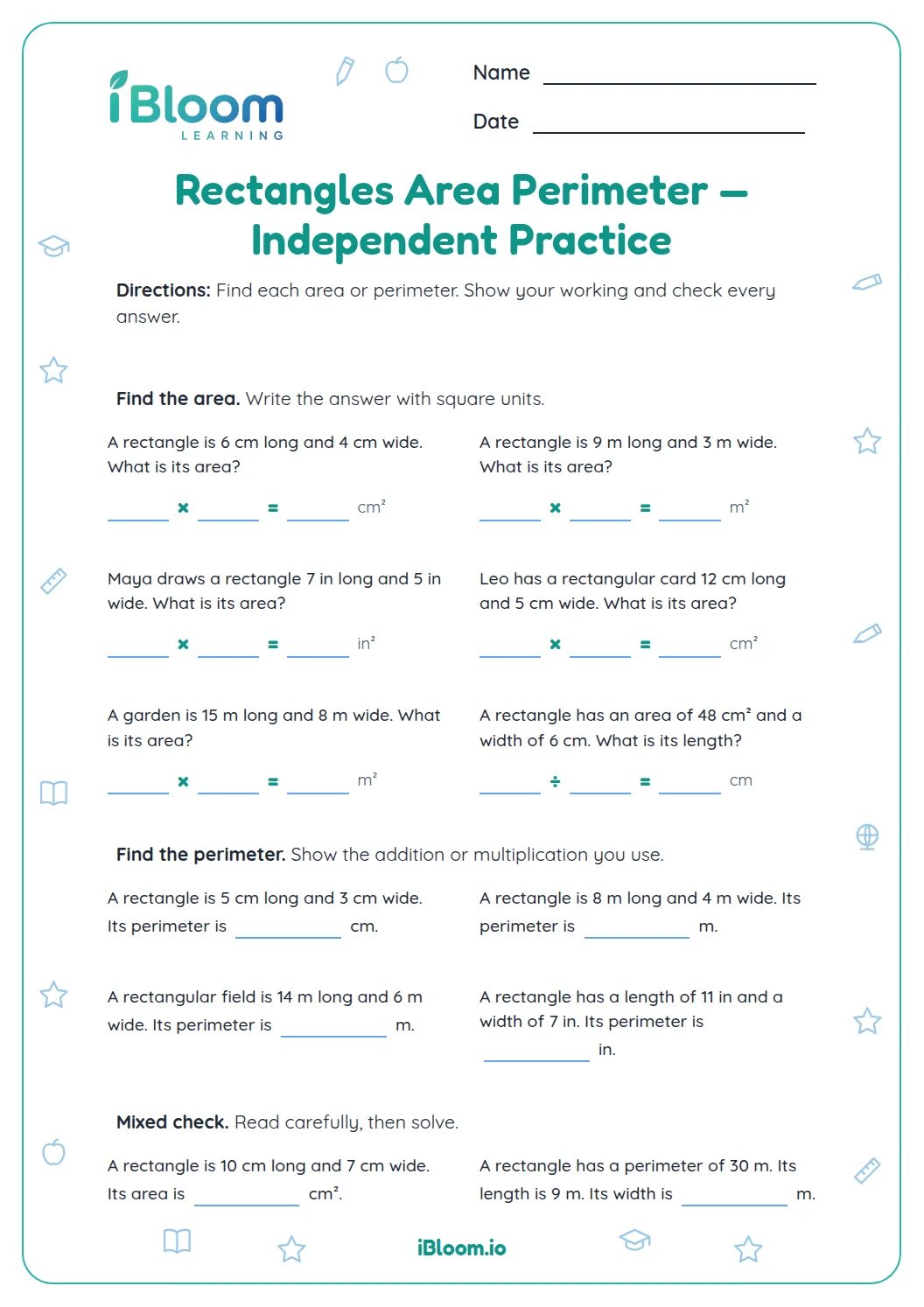
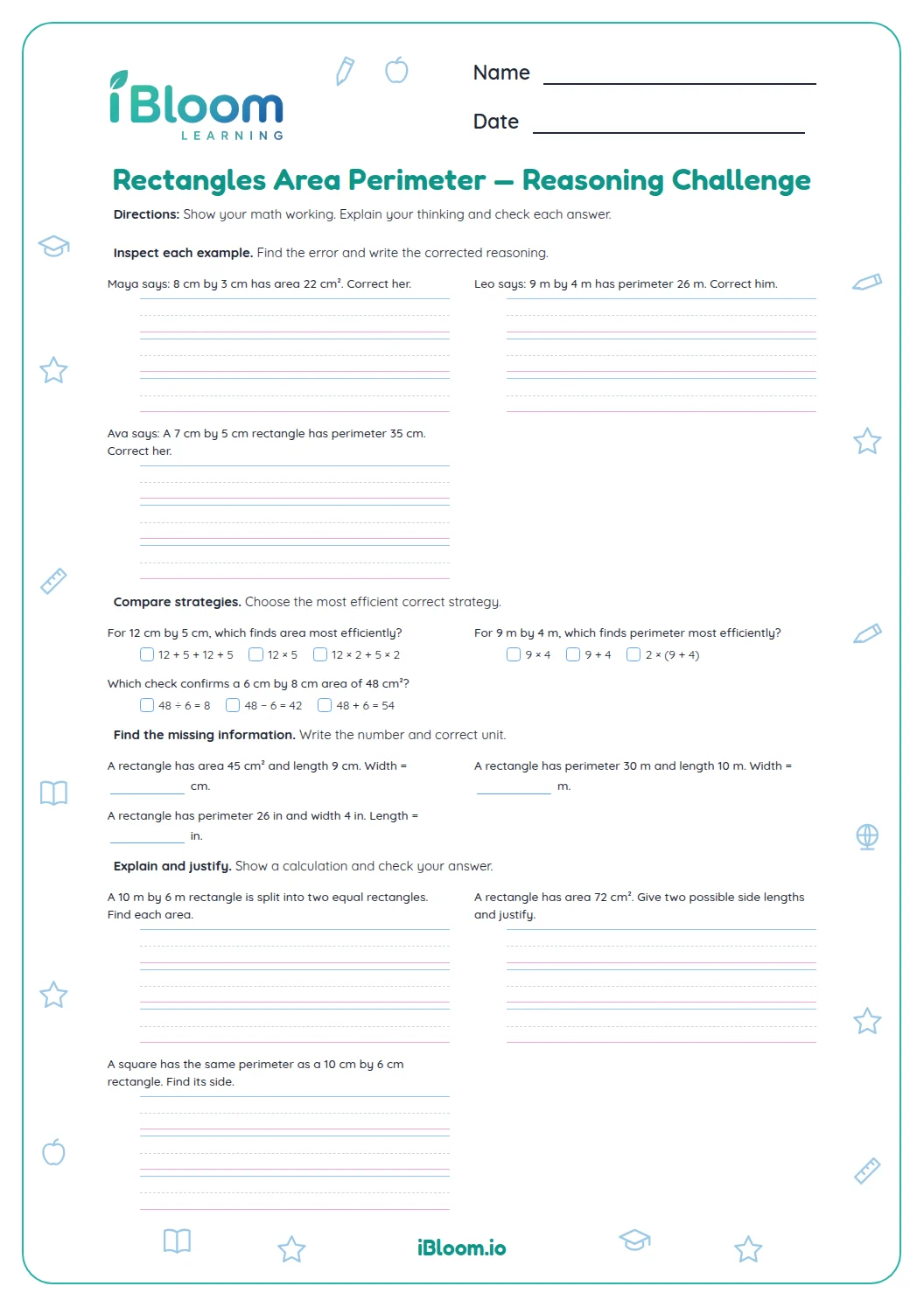
This free printable gives Grade 5 students practice finding rectangle area and perimeter in real situations. Fifteen questions ask students to choose the measure, calculate with dimensions, and work backward from an area or perimeter. The separate key includes the answer and unit for each item. The rectangle formulas practiced here align with Common Core 4.MD.A.3.
Aligned to 4.MD.A.3
How do you choose area or perimeter?
Area measures the square units covering a rectangle: length × width. Perimeter measures the distance around its edges: add both lengths and both widths, or use 2 × (length + width). Look for clues such as flooring, paint, fencing, or trim.
- 1A garden is 12 ft long and 7 ft wide.
- 2Area covers the inside, so multiply: 12 × 7 = 84.
- 3The garden area is 84 sq ft.
Which units belong in the answer?
Perimeter keeps the length unit, such as feet or meters. Area uses square units, such as square feet or square meters. The story clues and the unit label both help identify the requested measure.
How to use this worksheet
- 1Circle words that signal area or perimeter.
- 2Write the rectangle dimensions and the requested measure.
- 3For area, multiply length by width.
- 4For perimeter, add the four side lengths.
- 5Include the right units and check the operation.
Common mistakes and quick fixes
The mistake
Using multiplication for a border; a border goes around, so find perimeter.
The fix
Read the directions again, mark the important information, and check the answer against the model or operation.
The mistake
Writing feet instead of square feet for area; area counts square units.
The fix
Read the directions again, mark the important information, and check the answer against the model or operation.
The mistake
Adding only two sides for perimeter; include both pairs of equal sides.
The fix
Read the directions again, mark the important information, and check the answer against the model or operation.
Common Core alignment
This worksheet practices the following Common Core skill.
Apply area and perimeter formulas for rectangles in real-world problems.
On this sheet: The questions use rectangle dimensions to calculate area or perimeter and solve missing-measure situations.
Show the official wordingHide the official wording
Apply the area and perimeter formulas for rectangles in real world and mathematical problems.
What to practice next
Make more practice
Further reading
Questions parents and teachers ask
How can I tell whether a problem asks for area?
Area tells how much flat surface is covered. A floor, tabletop, garden bed, or mat often points to area. Multiply length by width and label the answer in square units, such as square feet. A border around that same rectangle instead asks for its perimeter.
How can I tell whether a problem asks for perimeter?
Perimeter measures the distance around a rectangle. Words such as border, fencing, trim, or one lap point to perimeter. Add all four sides, or double the sum of the length and width, and use the original length unit. Ask the learner to explain the clue they used so the answer connects back to the skill.
Why are the units different?
Perimeter measures the distance around a rectangle. Words such as border, fencing, trim, or one lap point to perimeter. Add all four sides, or double the sum of length and width, and use the original length unit. Say the unit aloud to check what the result measures.
How do I find a missing side from perimeter?
Use the known perimeter and subtract the sides you know. In a rectangle, opposite sides match. For perimeter 40 feet and width 8 feet, the two widths use 16 feet; the two lengths share the remaining 24 feet, so each length is 12 feet.
Does doubling a rectangle’s length double its area?
If the width stays the same, doubling the length doubles the area because area is length times width. For a 12-foot by 5-foot banner, the area is 60 square feet; at 24 by 5 feet it is 120 square feet.