




About this worksheet
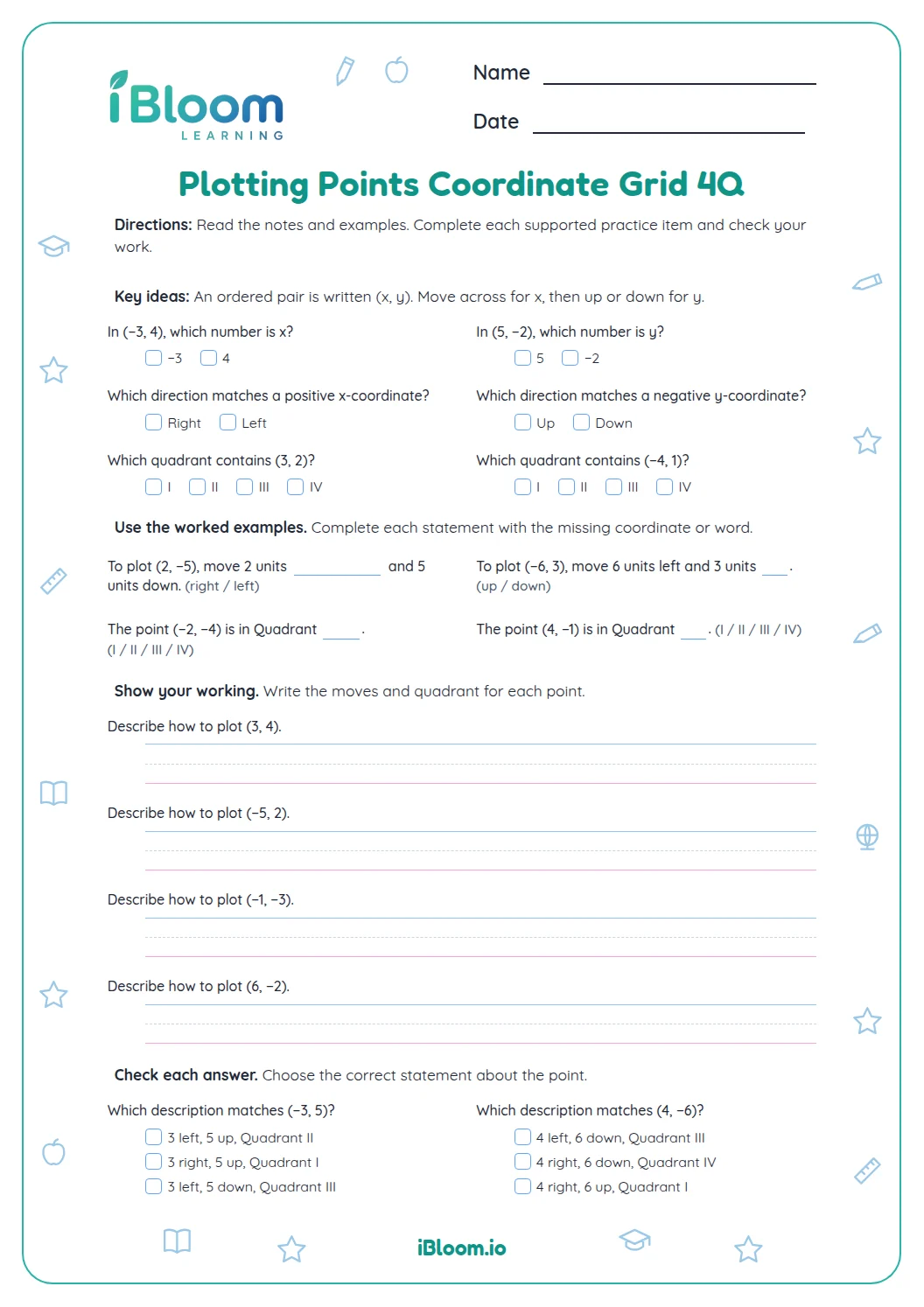
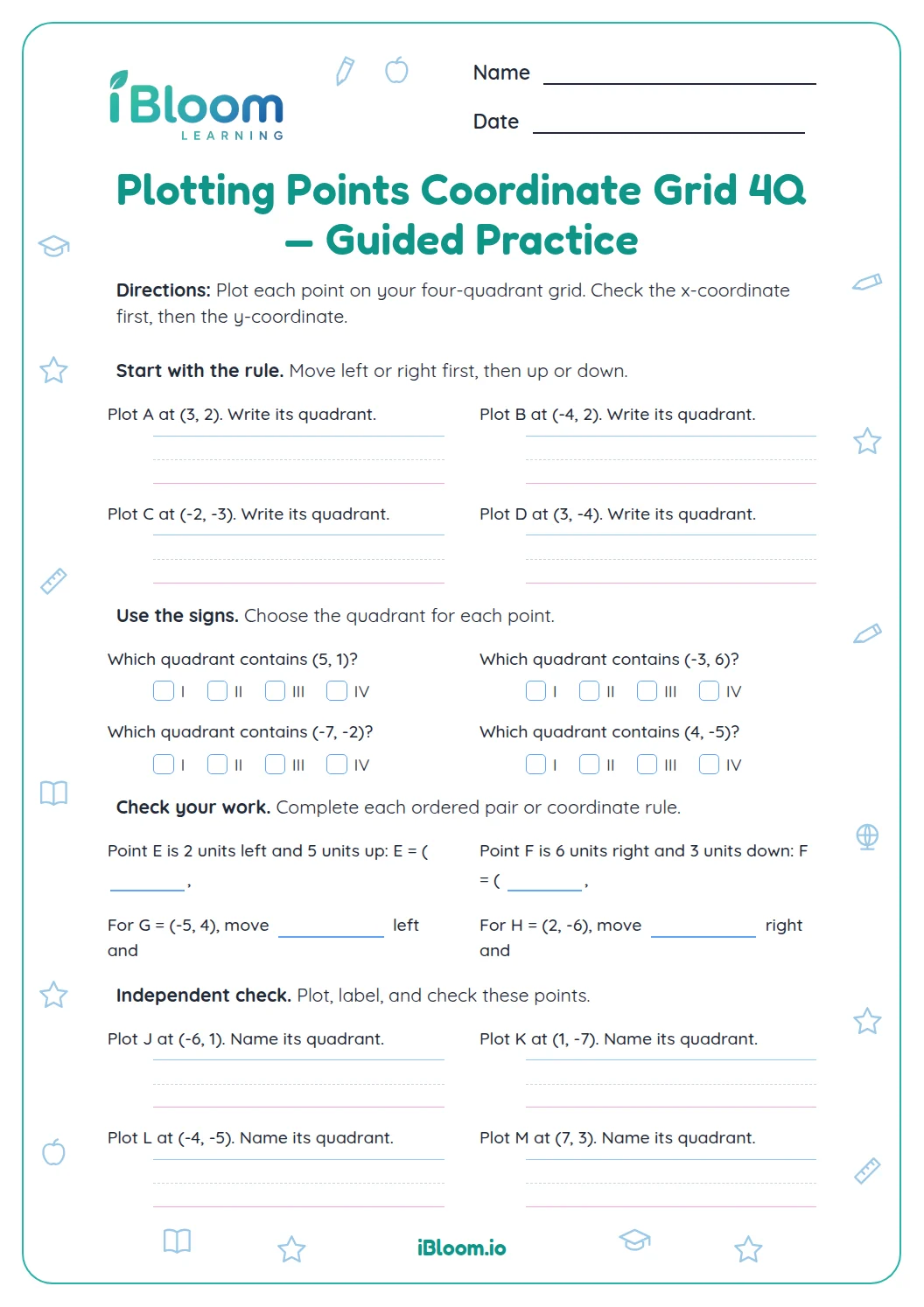
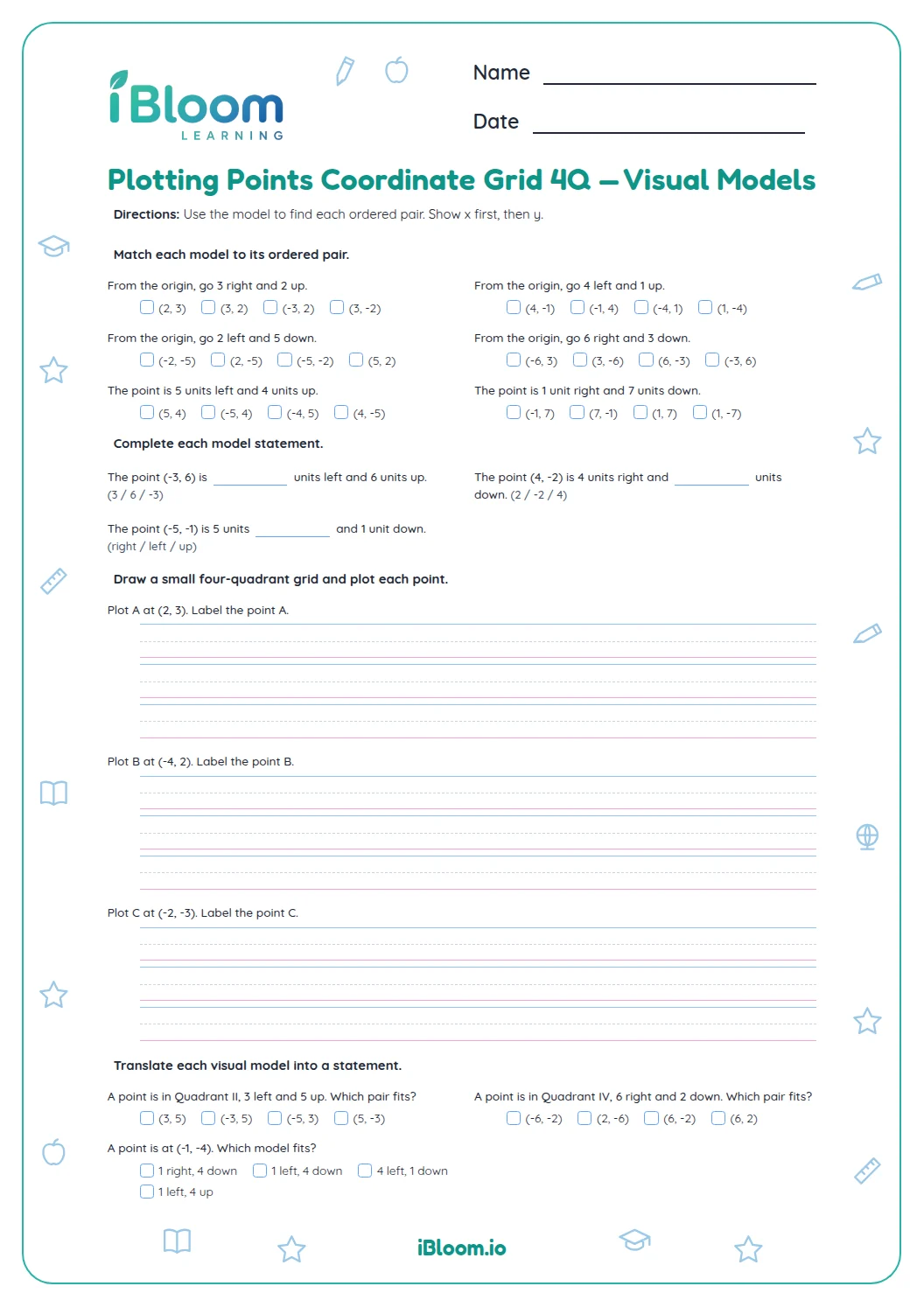
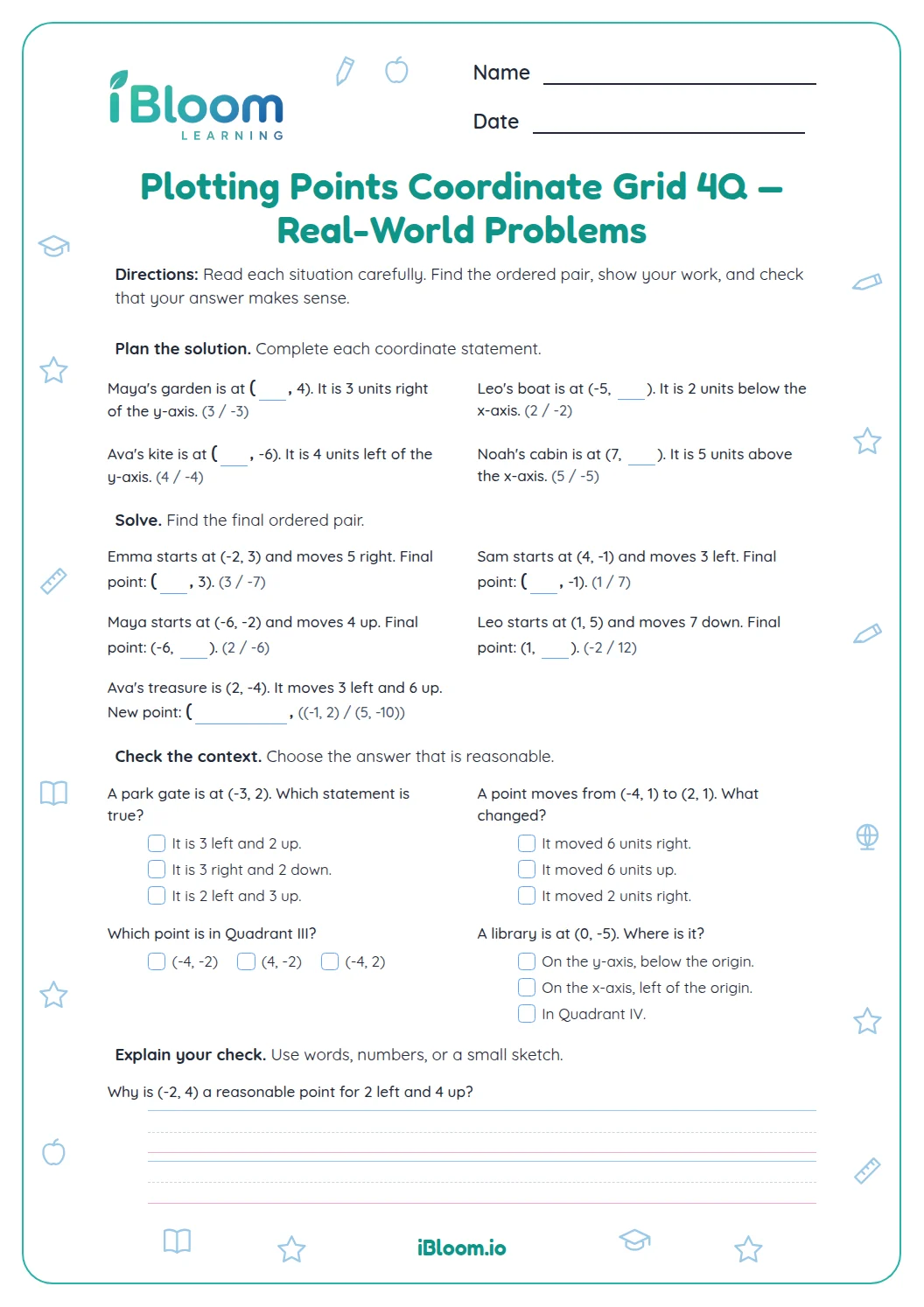
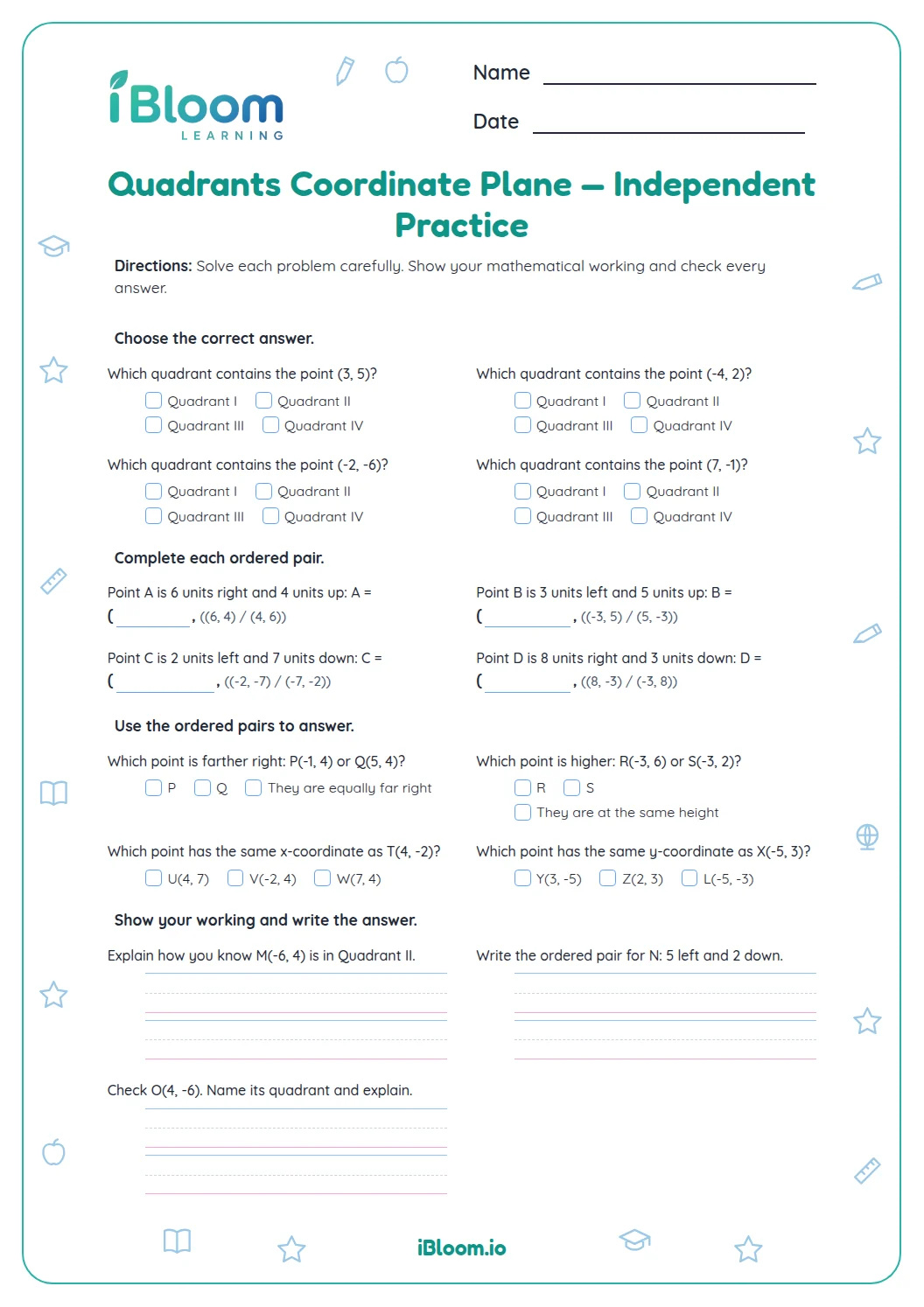
This Grade 5 printable worksheet gives students 14 questions on signed coordinate pairs across all four quadrants. They write ordered pairs from directional clues, read a plotted point on a coordinate grid, apply horizontal and vertical moves, and identify quadrants from coordinate signs. The separate answer key gives each pair and result. The practice aligns with CCSS 6.NS.C.8, which addresses problems involving points in all four quadrants.
Aligned to 6.NS.C.8
Why does coordinate order matter?
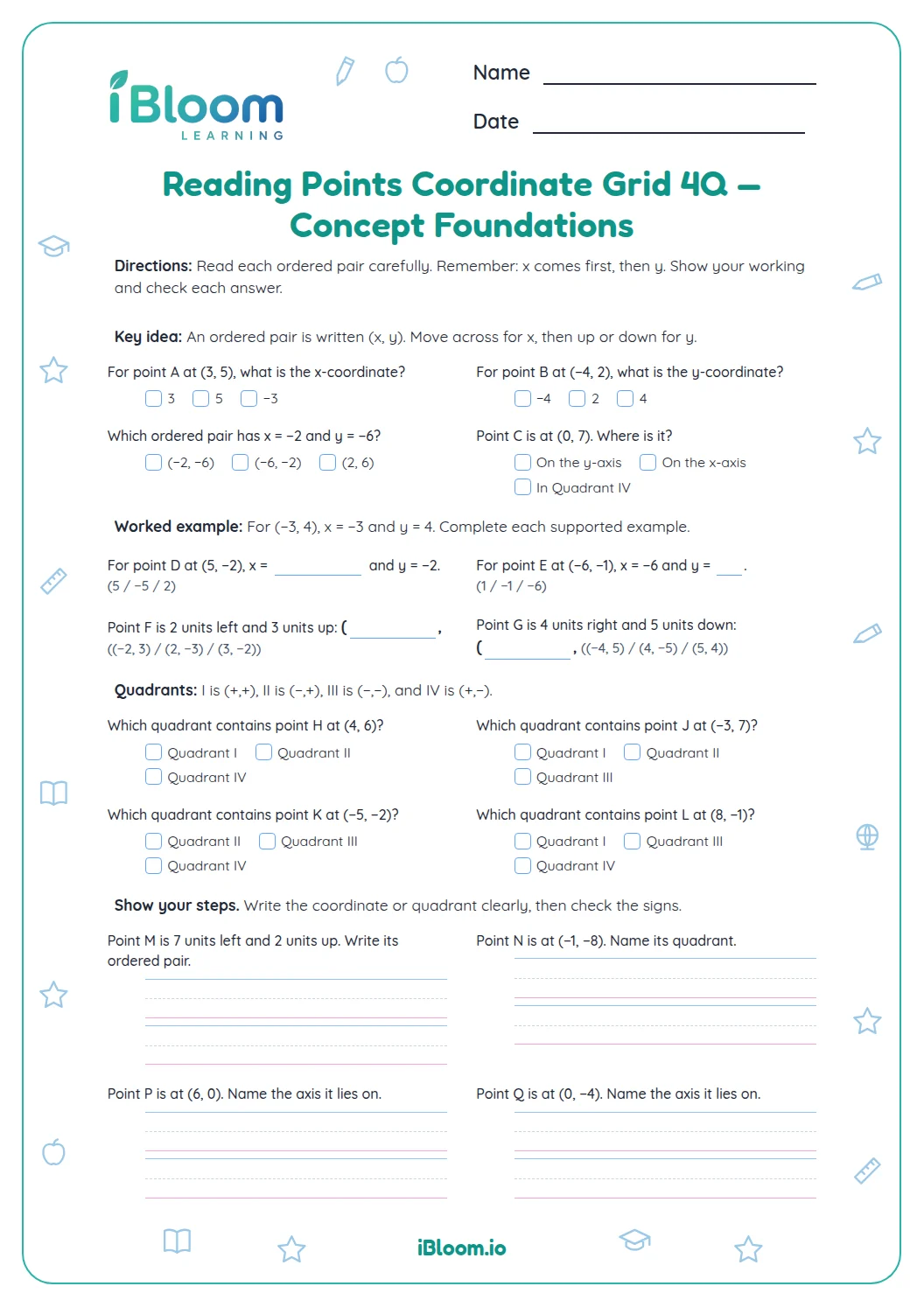
An ordered pair is written (x, y). Read the horizontal x-coordinate first, then the vertical y-coordinate. In (3, 5), move right 3 and up 5. Reversing the values would place the point elsewhere.
- 1Start at E = (3, 2).
- 2Move 2 right: x becomes 5.
- 3Move 3 up: y becomes 5.
- 4New point: (5, 5).
How do signs locate points in four quadrants?
The sign of x tells whether to move left or right, and the sign of y tells whether to move down or up. A negative x with a positive y places a point in Quadrant II. Check both signs to name the quadrant.
How can students check a plotted point?
Read the ordered pairs from the labeled grid, then apply the x-first, y-second rule to signed coordinates and movement.
How to use this worksheet
- 1Read the part heading and direction before you begin.
- 2Solve each item in order, showing work when it helps.
- 3Reread your answer and check that it answers the prompt.
- 4Use the separate key to review each response.
Common mistakes and quick fixes
The mistake
Reversing x and y.
The fix
Move horizontally using x before moving vertically using y.
The mistake
Using the wrong direction for a negative coordinate.
The fix
Negative x means left; negative y means down.
The mistake
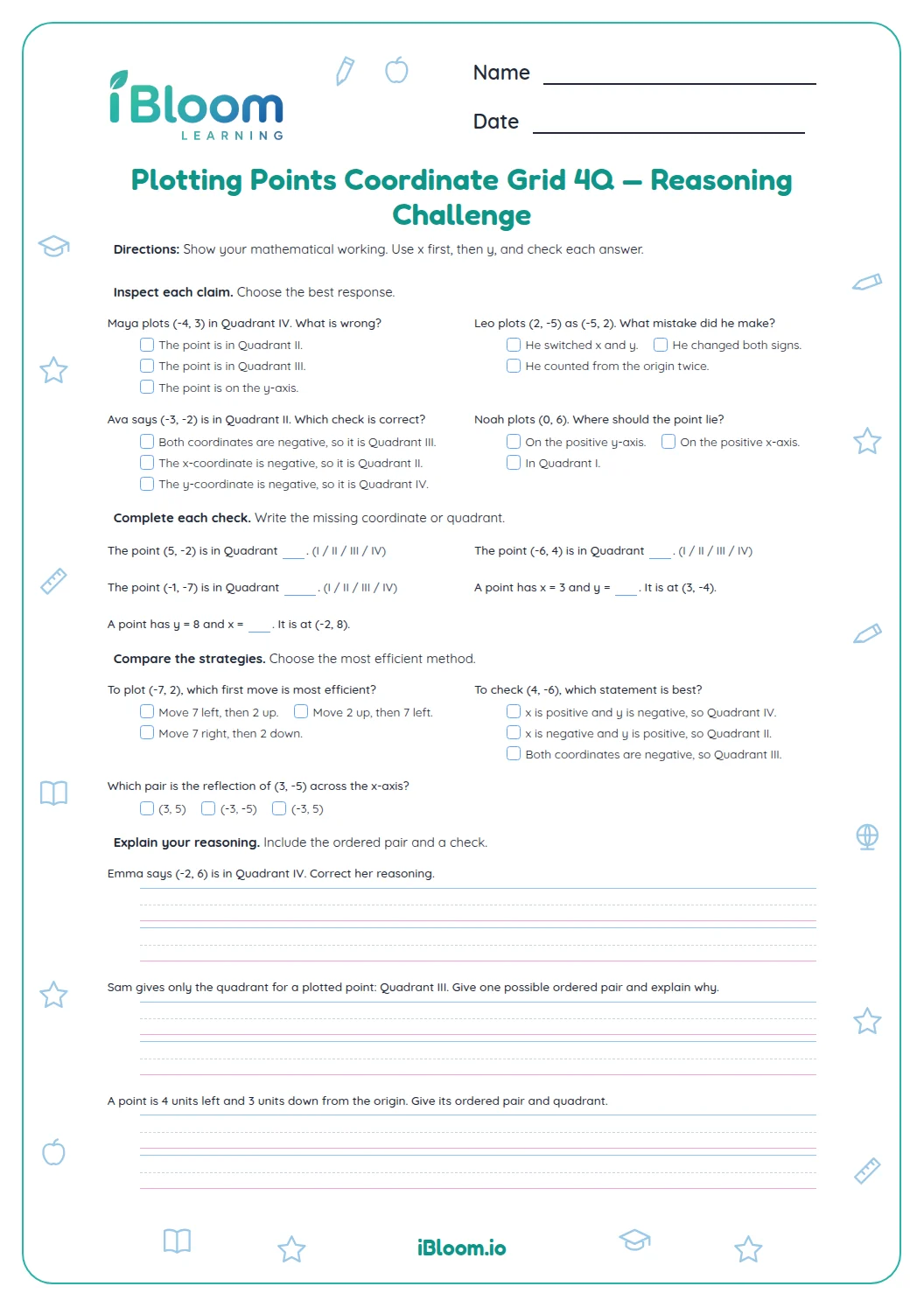
Naming a quadrant from only one sign.
The fix
Check both coordinates: x gives left or right, and y gives down or up.
Common Core alignment
This worksheet practices the standard named below through its questions.
Interpret and graph signed coordinate pairs in all four quadrants.
On this sheet: Students identify, interpret, and graph signed coordinate pairs and quadrants.
Show the official wordingHide the official wording
Solve real-world and mathematical problems by graphing points in all four quadrants of the coordinate plane. Include use of coordinates and absolute value to find distances between points with the same first coordinate or the same second coordinate.
What to practice next
Make more practice
Further reading
Questions parents and teachers ask
What does the first number in an ordered pair tell you?
The first number is the x-coordinate. It tells the horizontal position: move right for a positive x-value and left for a negative x-value. Then use the second number for vertical movement, up when positive and down when negative.
How can you identify a quadrant from signs?
Use the signs of both coordinates. (−3, 2) has negative x and positive y, so it is in Quadrant II. (4, −2) is in Quadrant IV, and (−2, −5) is in Quadrant III. Check each sign separately to confirm the location.
What does the grid question ask students to read?
The grid question asks students to read the ordered pairs for two labeled points. Other questions use signed coordinates to identify all four quadrants, interpret movement, and match directions to a coordinate pair. The answer key gives the coordinates and quadrant labels so learners can check both values in each pair.
How many questions are included?
There are 14 questions in four parts: eight coordinate-pair questions, one grid question, two moves, and three quadrant checks. The answer key gives the coordinates and quadrant labels. The grid shows two labeled first-quadrant points for students to read.
How do I check a move from an existing point?
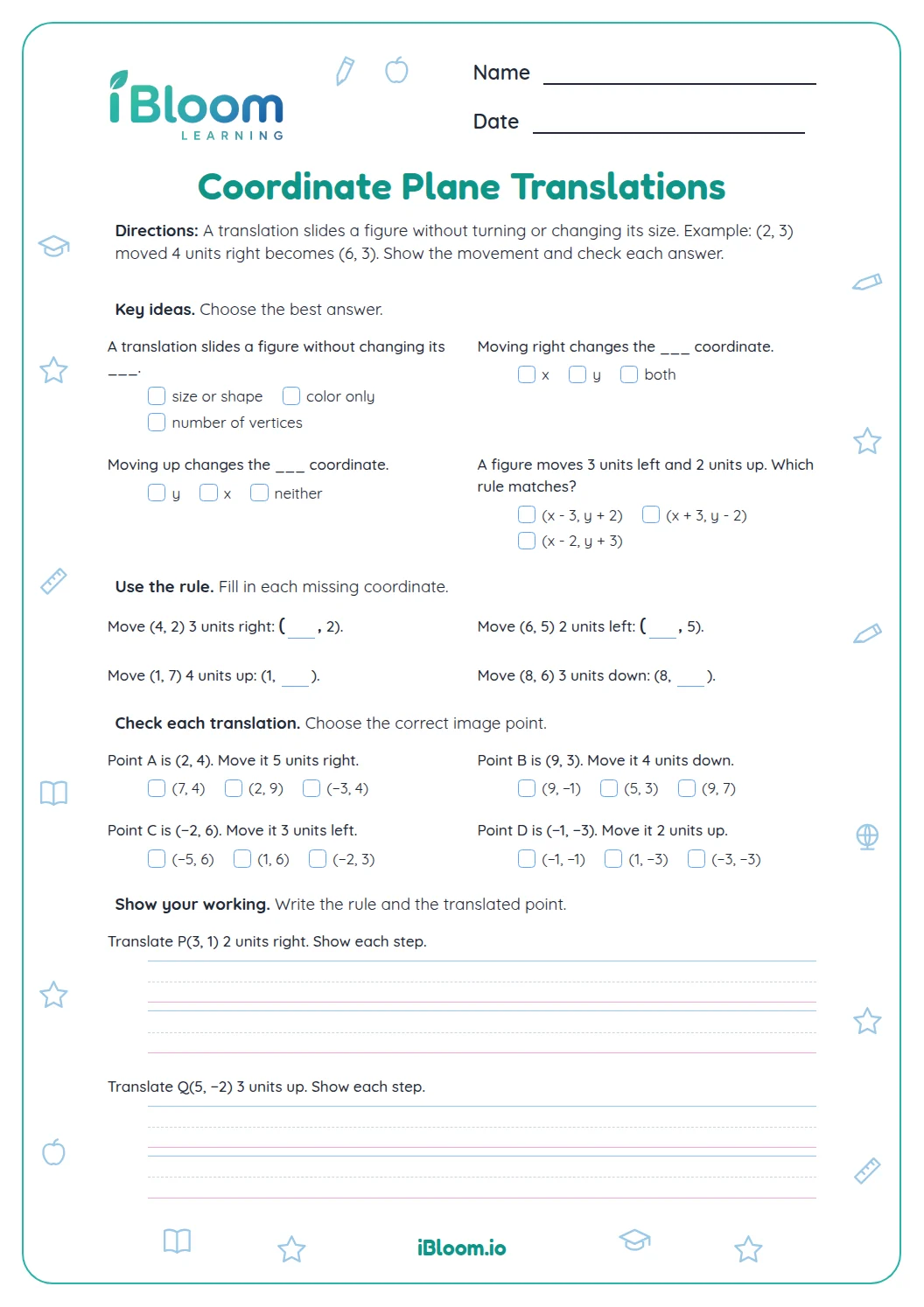
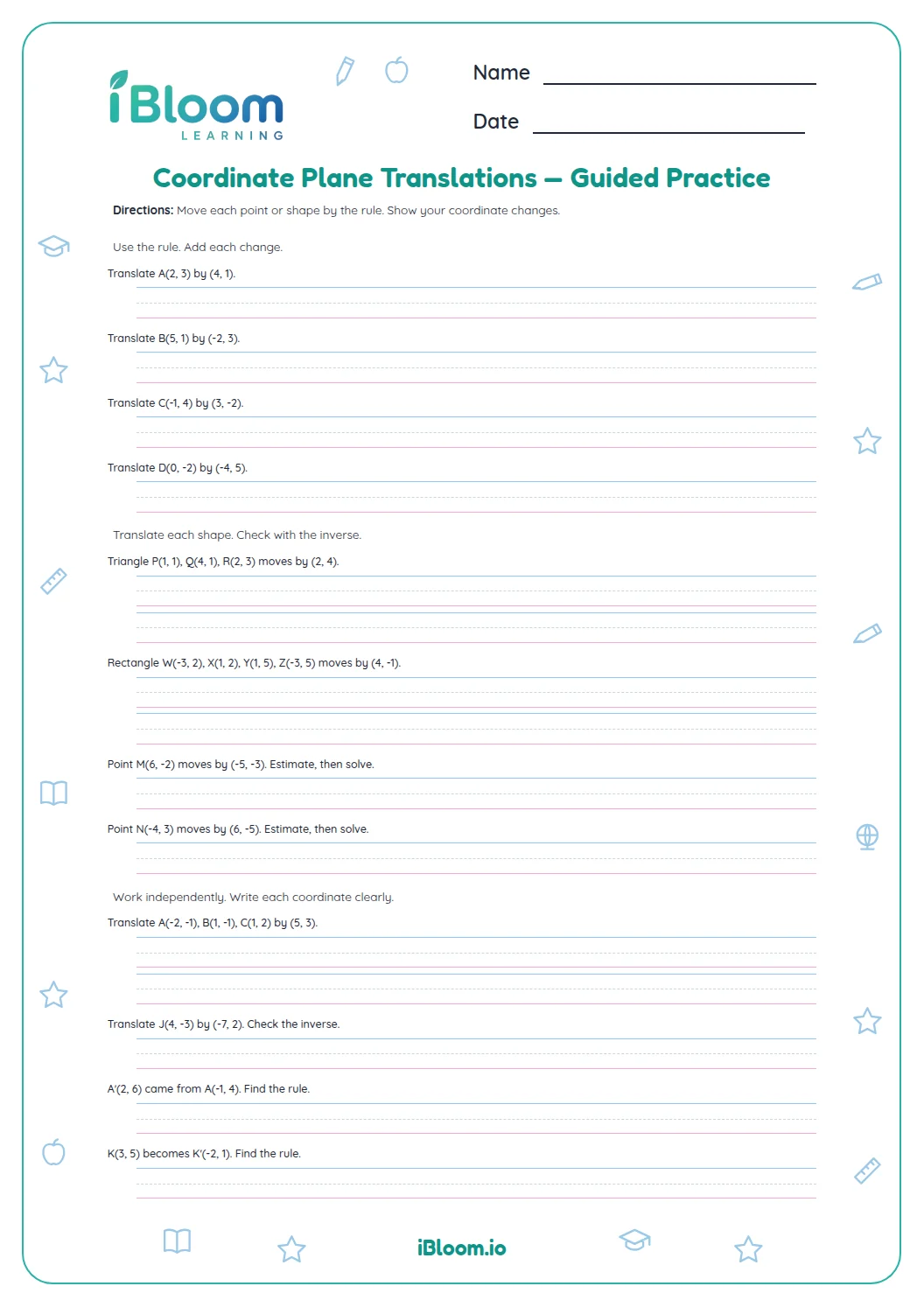
Change x for a left or right move and y for an up or down move. From E at (3, 2), moving 2 right and 3 up adds 2 to x and 3 to y, giving the new point (5, 5).