




About this worksheet
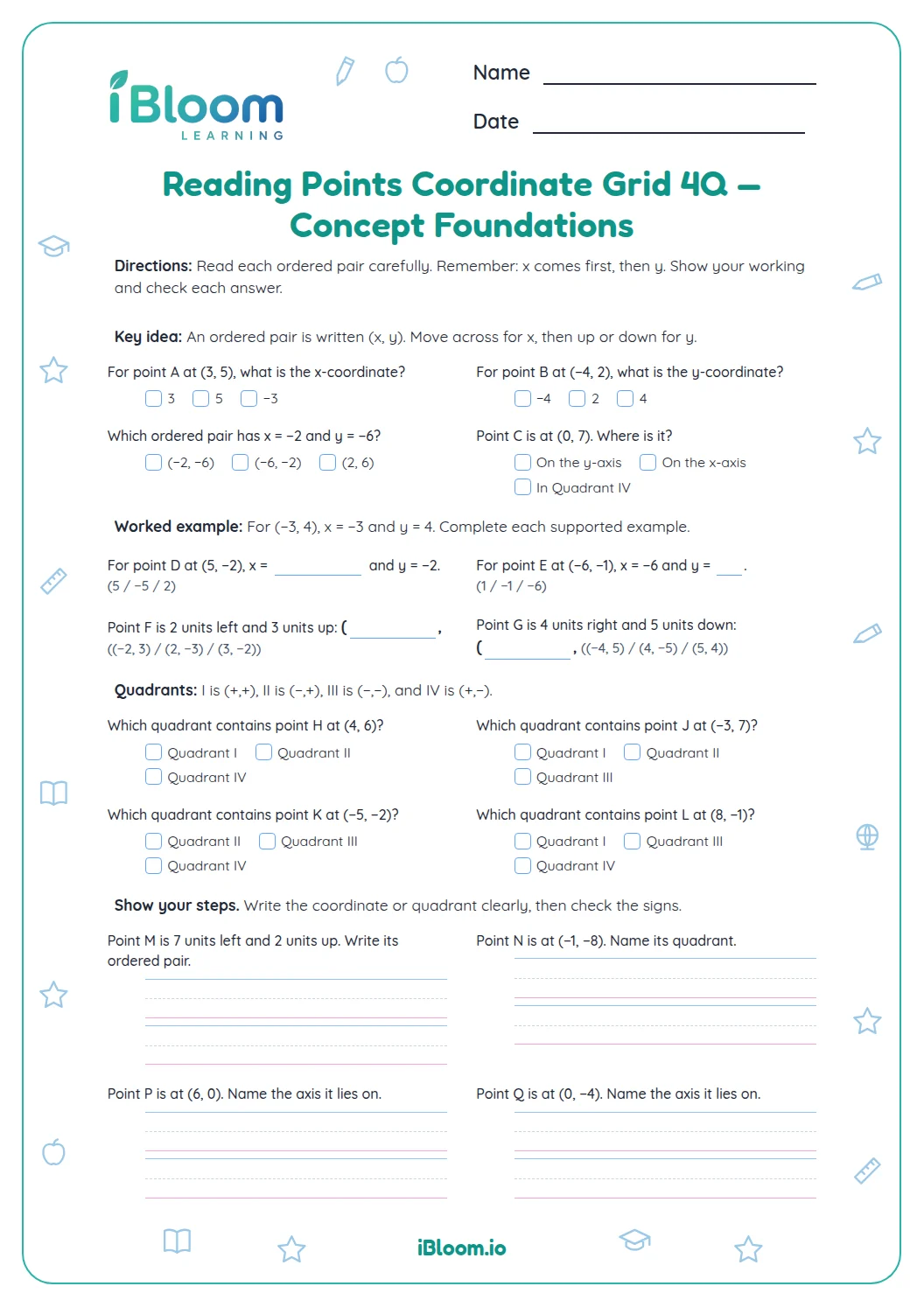
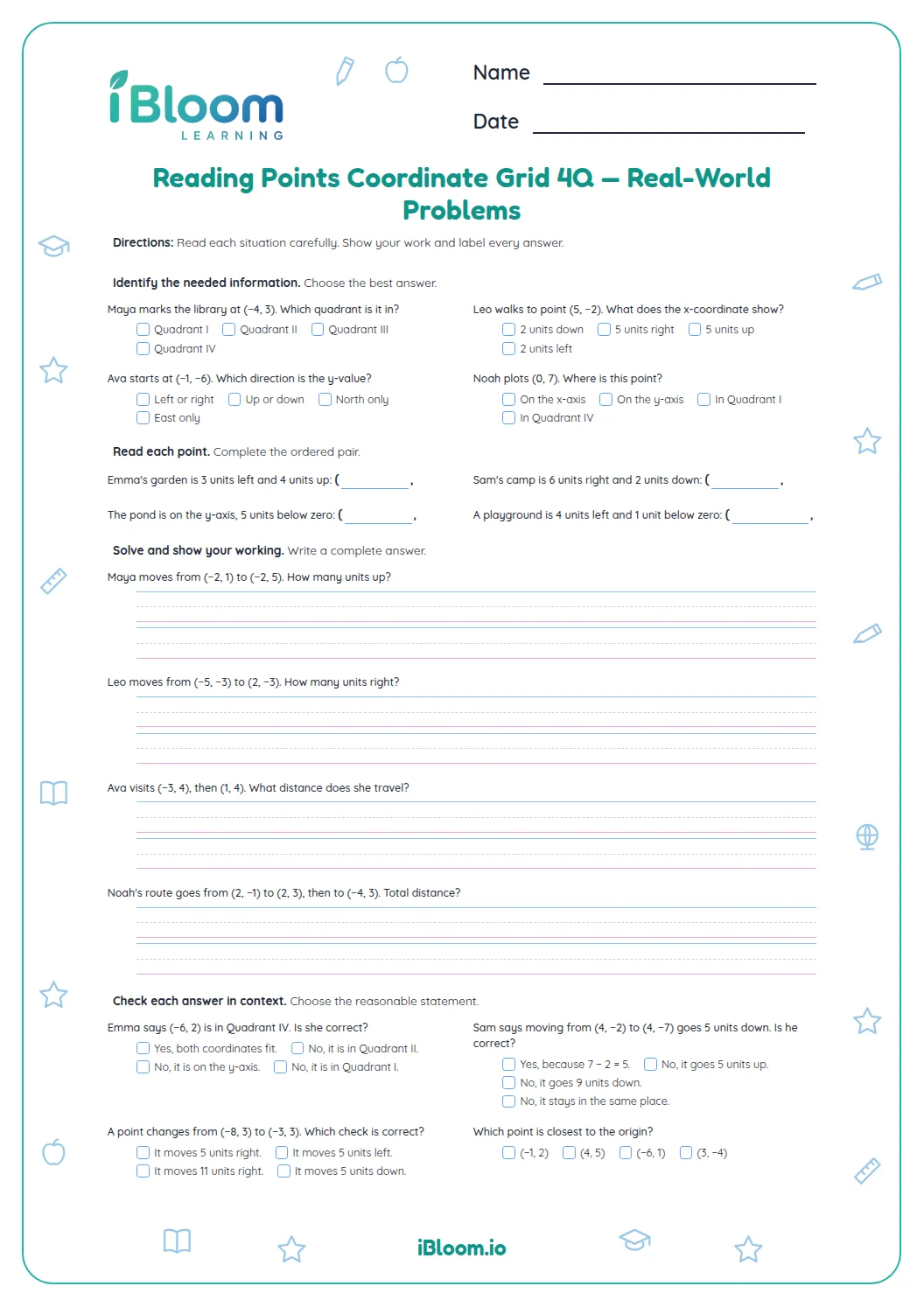
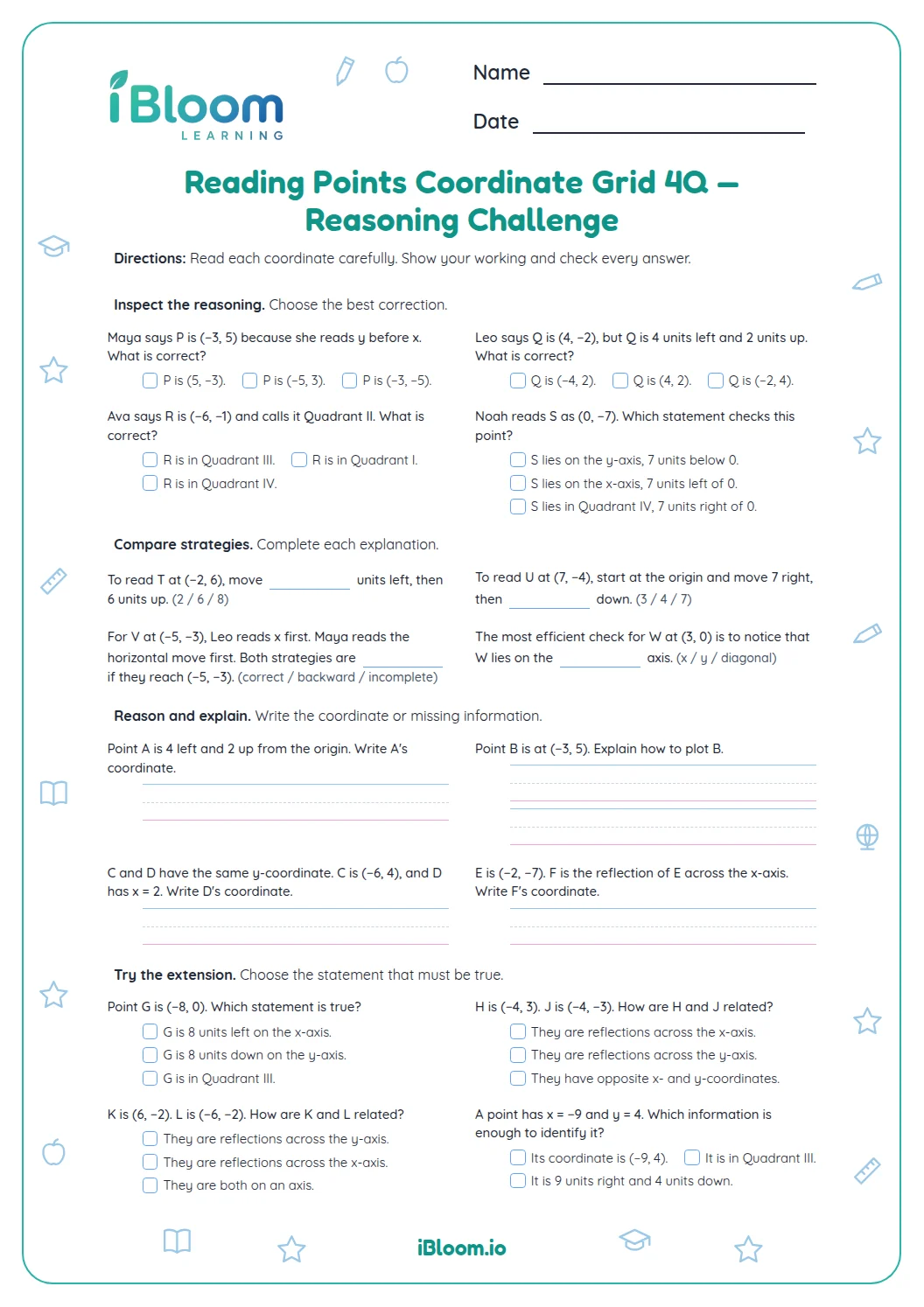
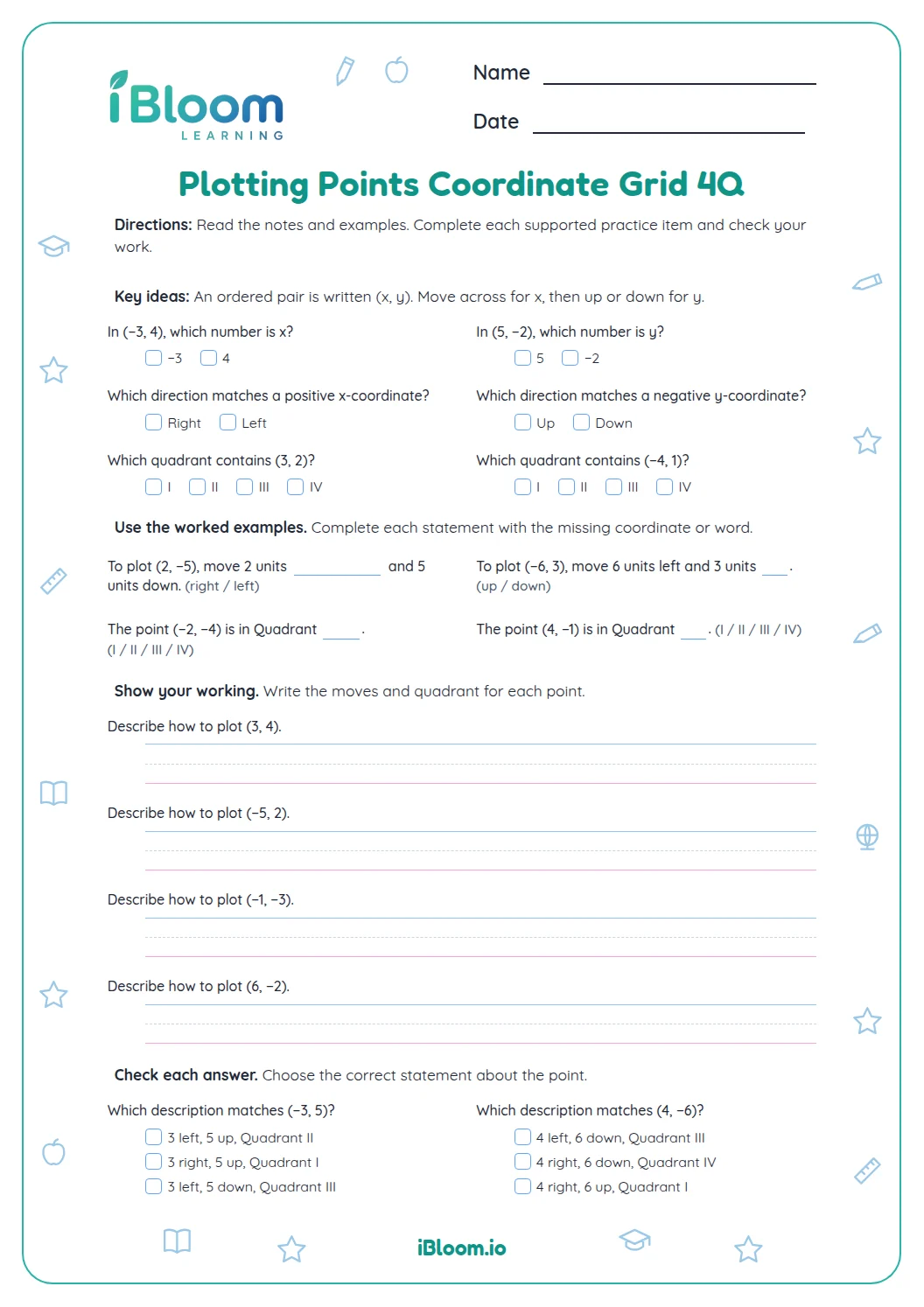
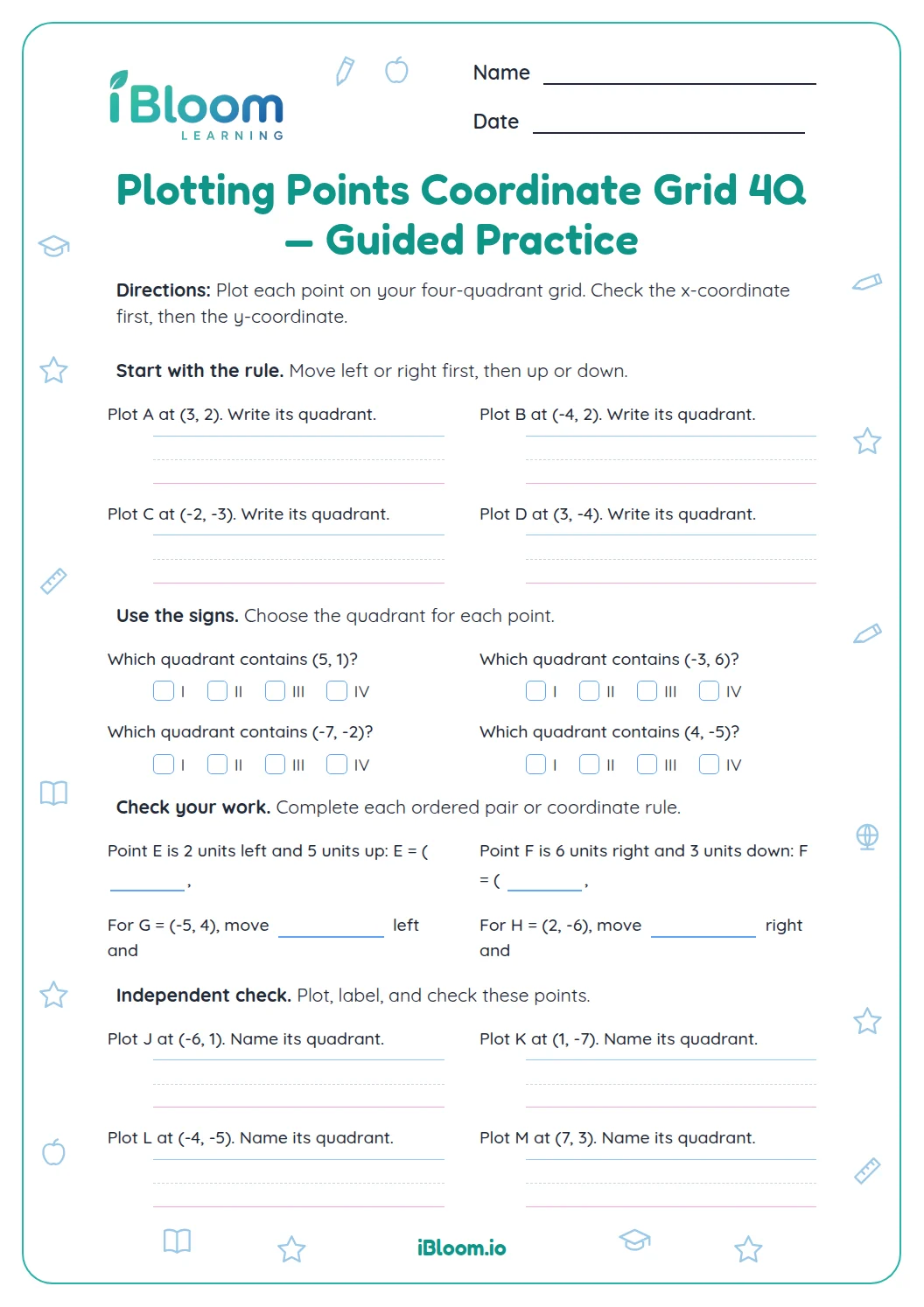
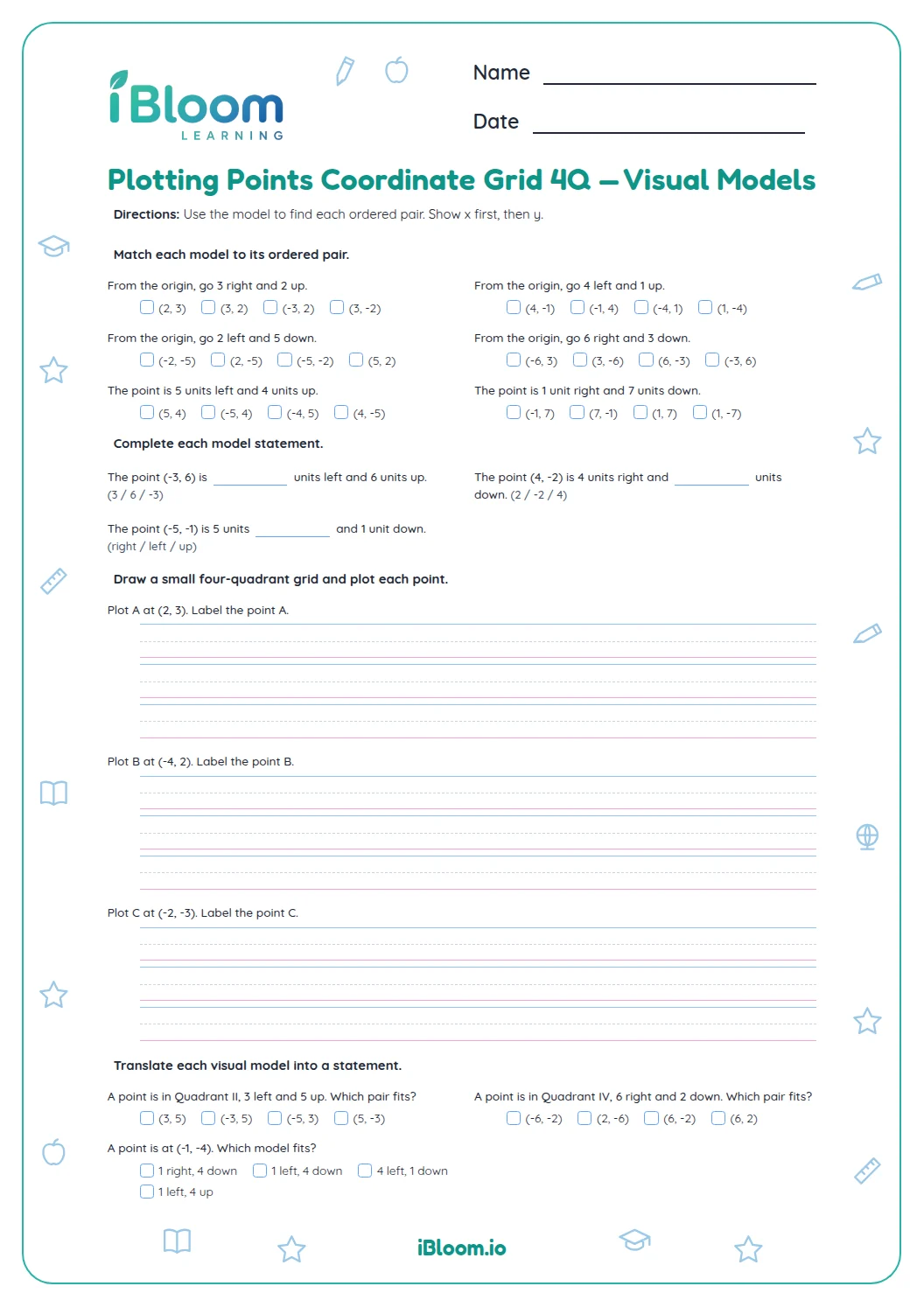
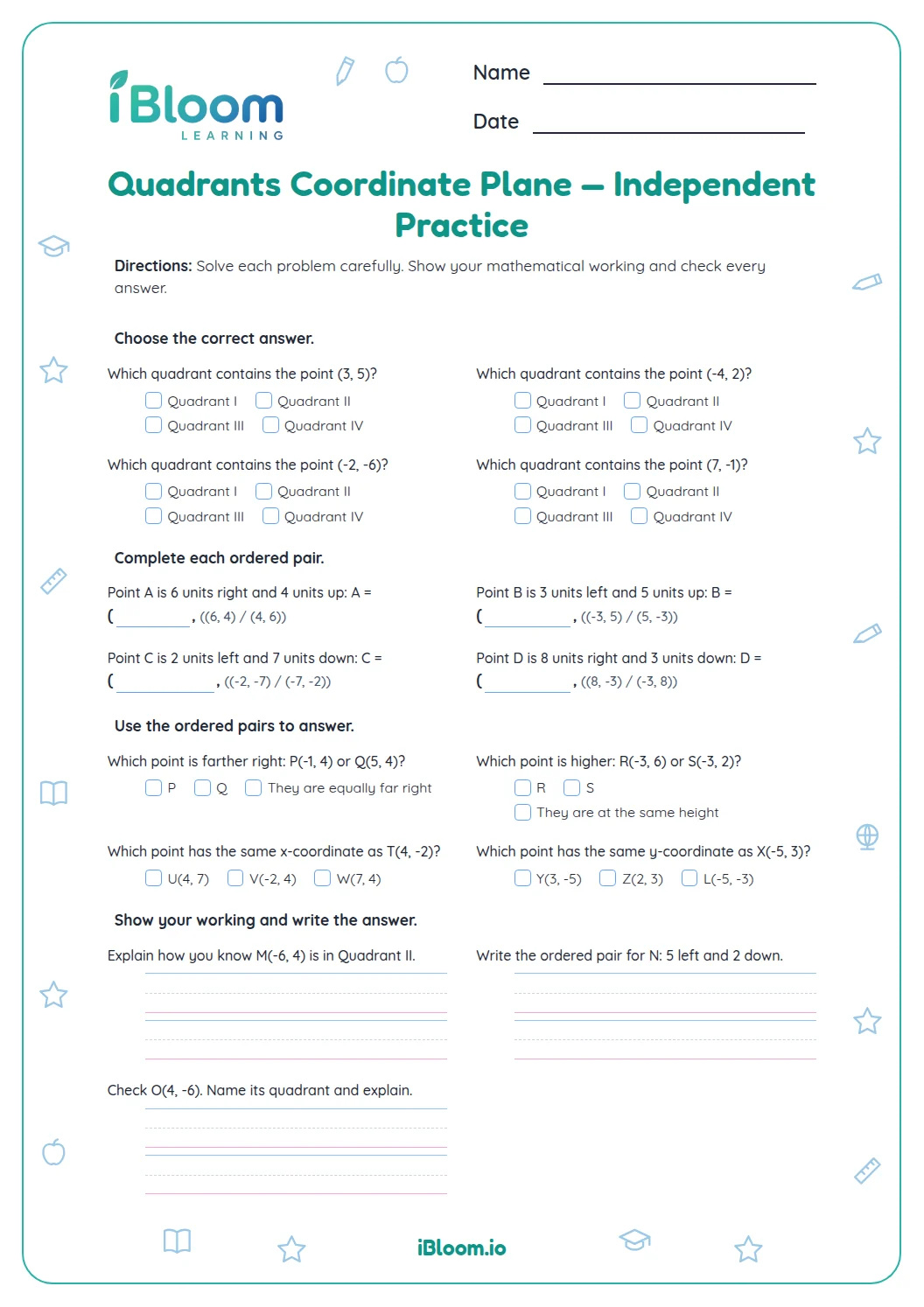
This Grade 5 geometry worksheet practices reading ordered pairs and connecting coordinate signs to locations in four quadrants. Students read four points from a plotted first-quadrant grid, then identify quadrants for signed ordered pairs that represent locations across the full plane. The template’s coordinate drawing shows the positive quadrant, so the remaining visual-model practice uses clear ordered-pair choices. A separate key is included.
Which number in the pair comes first?
An ordered pair is written (x, y). Read x along the horizontal axis first, then y along the vertical axis.
How do signs name the quadrant?
Positive x is right and negative x is left. Positive y is up and negative y is down. Together the signs identify the quadrant.
- 1For (−3, 2), x is negative and y is positive.
- 2That location is left of the y-axis and above the x-axis.
- 3It lies in Quadrant II.
How does the plotted model support the practice?
The plotted grid gives four labeled first-quadrant points to read directly. The remaining items extend the same coordinate reasoning to negative values and all four quadrants.
How to use this worksheet
- 1Find the origin and axes.
- 2Read x first, moving left or right.
- 3Read y second, moving up or down.
- 4Use the signs to name the quadrant.
- 5Check that the pair is written in x-then-y order.
Common mistakes and quick fixes
The mistake
Reversing x and y.
The fix
Say “across, then up” before writing the pair.
The mistake
Treating a negative coordinate as a smaller positive distance.
The fix
Use the sign to decide which side of the axis contains the point.
The mistake
Naming a quadrant from only one sign.
The fix
Check both signs: x tells left or right, and y tells up or down.
What to practice next
Make more practice
Questions parents and teachers ask
What order should an ordered pair use?
An ordered pair lists the horizontal coordinate first and the vertical coordinate second: (x, y). For example, a point 3 units right and 2 units up from the origin is (3, 2). Part A asks students to read four plotted points in that order.
How do negative signs help locate a point?
A negative x-coordinate places a point left of the vertical axis. A negative y-coordinate places it below the horizontal axis. Using both signs identifies one of the four quadrants. For instance, (−3, 2) is left and above the origin, so it lies in Quadrant II.
Why does the plotted grid show positive coordinates?
The grid drawing supports direct practice reading plotted points in the first quadrant. The other questions extend that visual work to signed coordinates using ordered pairs and quadrant choices, so learners practice identifying all four quadrants. The plotted-point questions do not show negative coordinates on the grid.
How many questions are on this page?
There are 14 total questions: four written ordered-pair responses from a plotted model and ten multiple-choice quadrant questions. The separate answer key shows the plotted coordinates and the quadrant for each signed pair. Students should check x before y when reading each ordered pair.
What should a student do if the signs are confusing?
Make a small sign map: (+,+) is Quadrant I, (−,+) is II, (−,−) is III, and (+,−) is IV. Then compare each ordered pair with the map. Remember that x gives left or right, while y gives down or up.