Free printable practice
Single Digit Division No Remainder Practice Activities
Grade 5 students practise single-digit divisors with exact quotients, using multiplication facts, place value, and long-division reasoning.
Free printable worksheet PDFs
Preview every available page, then download the free worksheet PDF for home, homeschool, tutoring, or classroom practice.
Preview the exact activity before downloading it.
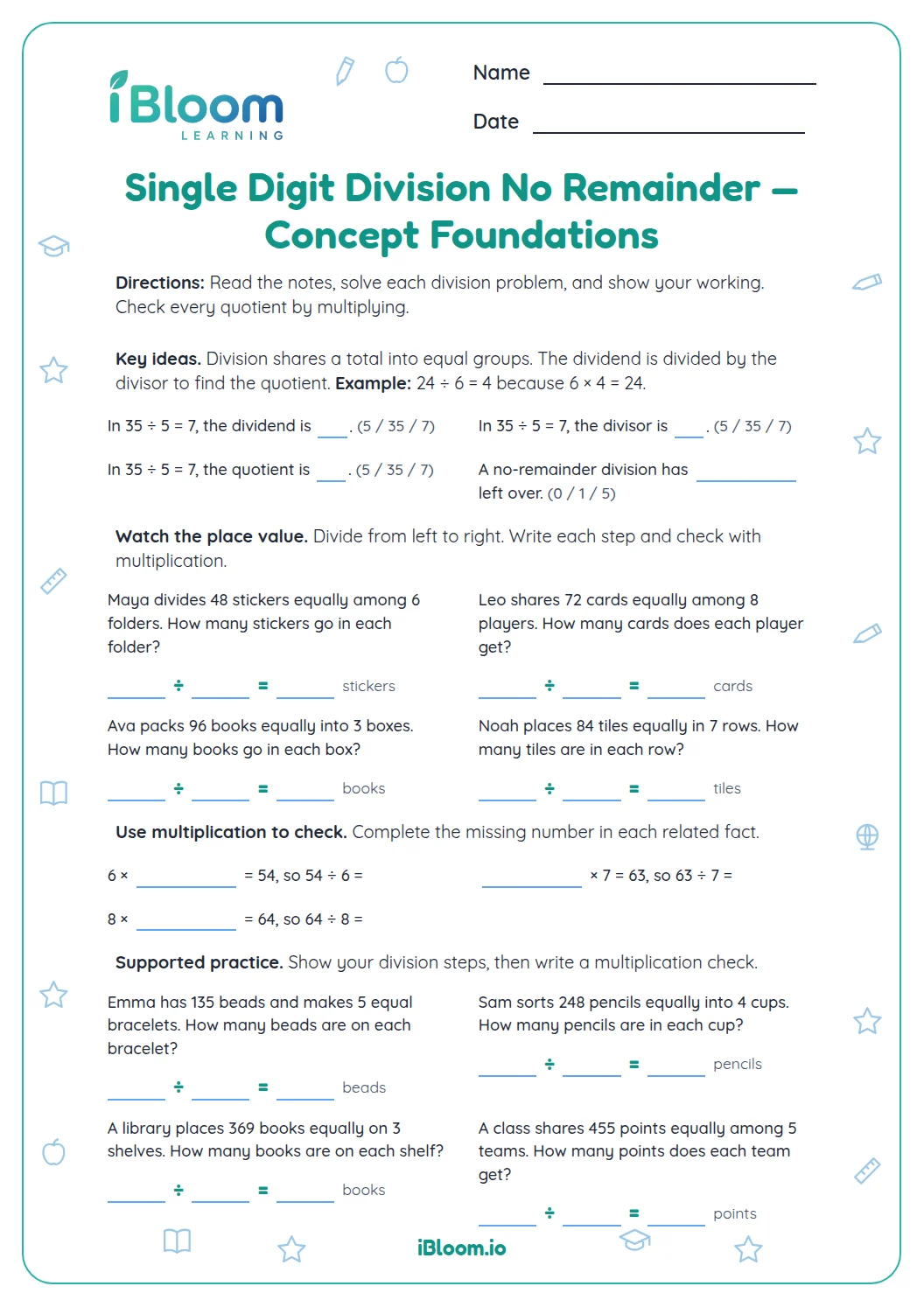 Single Digit Division No Remainder — Concept FoundationsGrade 5 students practise single-digit divisors with exact quotients, using multiplication facts, place value, and long-division reasoning. This Grade 5 foundations worksheet adds concise teaching notes, worked examples, and supported first attempts.Grade 5Free PDF preview
 Single Digit Division No Remainder — Guided PracticeGrade 5 students practise single-digit divisors with exact quotients, using multiplication facts, place value, and long-division reasoning. This Grade 5 guided-practice worksheet progresses from prompts and checkpoints to independent questions.Grade 5Free PDF preview
 Single Digit Division No Remainder — Visual ModelsGrade 5 students practise single-digit divisors with exact quotients, using multiplication facts, place value, and long-division reasoning. This Grade 5 visual-model worksheet connects suitable diagrams, tables, number lines, or place-value models to mathematical notation.Grade 5Free PDF preview
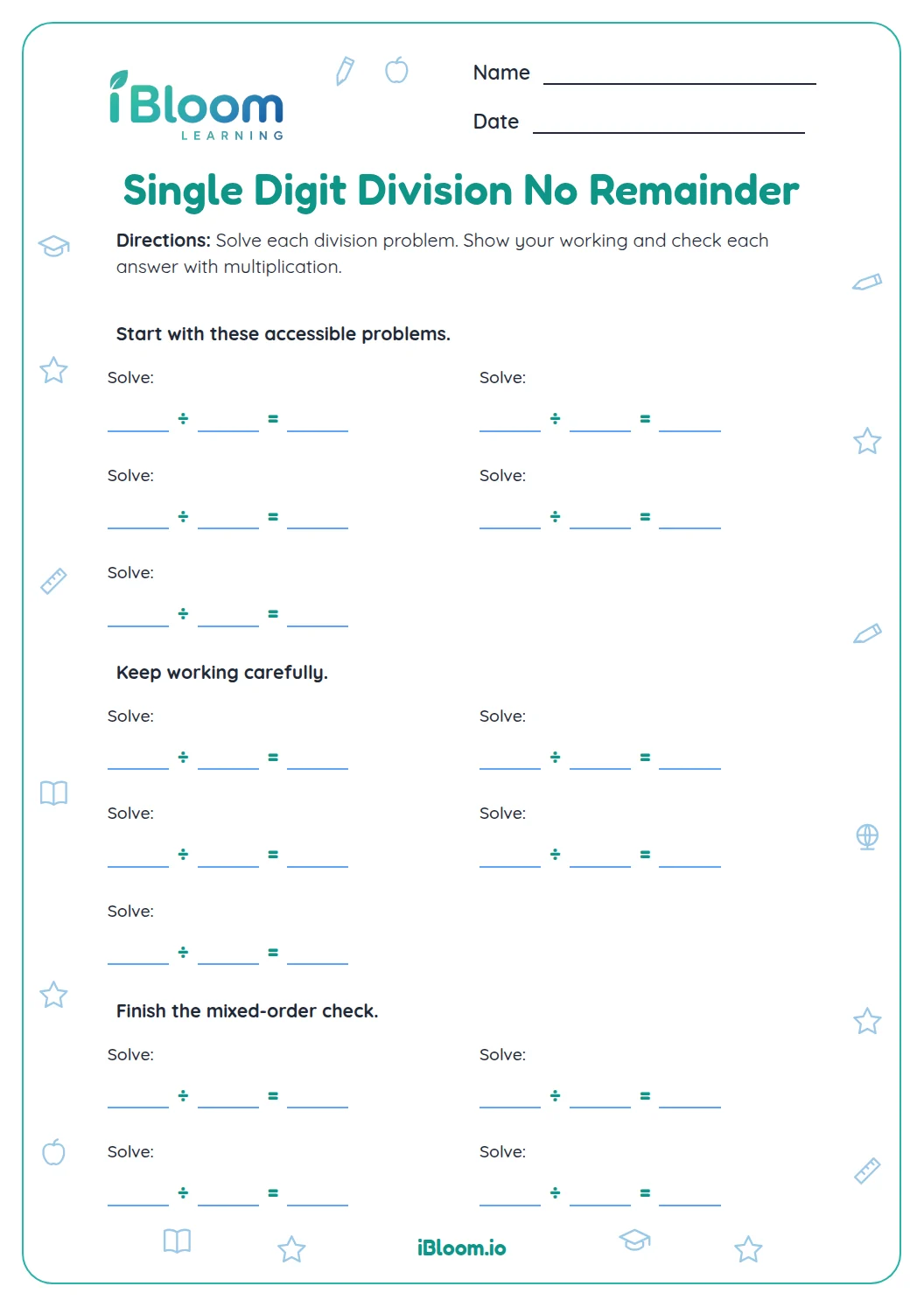 Single Digit Division No Remainder — Independent PracticeGrade 5 students practise single-digit divisors with exact quotients, using multiplication facts, place value, and long-division reasoning. This Grade 5 independent-practice worksheet provides a balanced sequence of accurate, grade-level exercises.Grade 5Free PDF preview
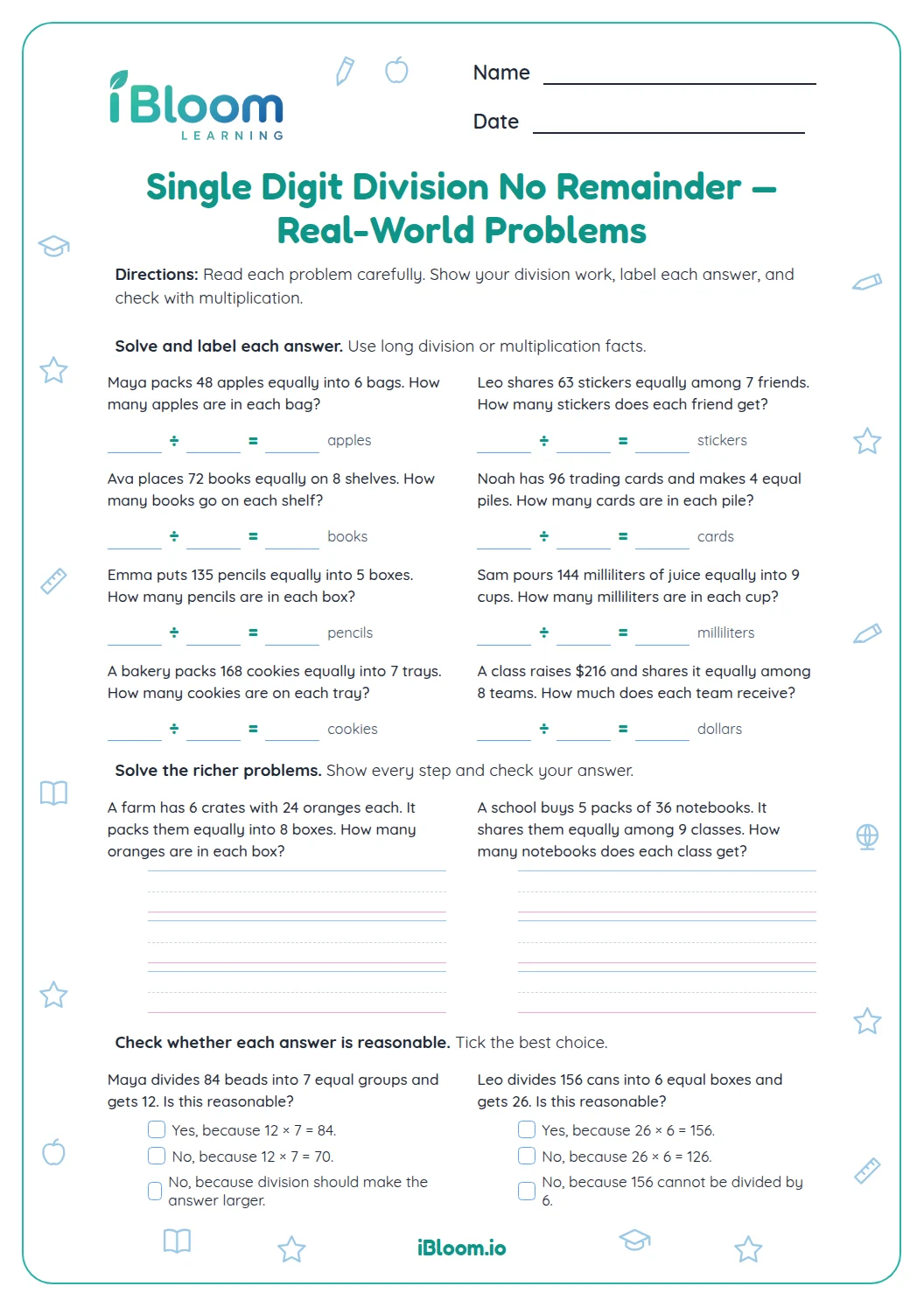 Single Digit Division No Remainder — Real-World ProblemsGrade 5 students practise single-digit divisors with exact quotients, using multiplication facts, place value, and long-division reasoning. This Grade 5 application worksheet uses realistic one-step and multi-step situations with room to model and solve.Grade 5Free PDF preview4 pages
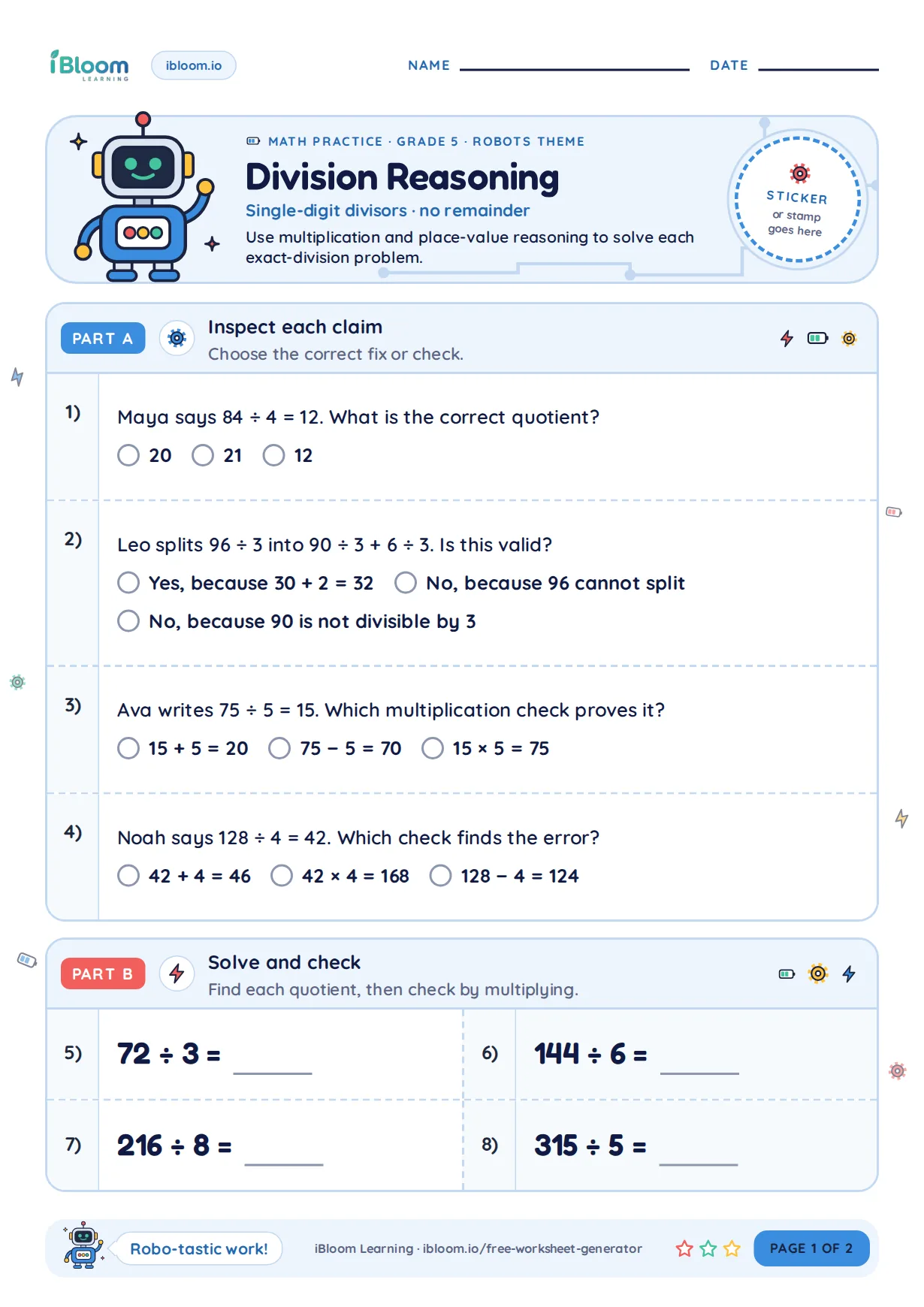 Single Digit Division No Remainder — Reasoning ChallengeGrade 5 students practise single-digit divisors with exact quotients, using multiplication facts, place value, and long-division reasoning. This Grade 5 reasoning worksheet combines error analysis, strategy comparison, missing information, and a gentle extension.Grade 5Free PDF preview
Practice that builds confidence
What students practise
These Grade 5 division worksheets focus on dividing by a single-digit number when the answer has no remainder. Children practise connecting division to multiplication facts, reading each digit carefully, and keeping place value aligned throughout the work.
The printable activities include clear problems for building fluency with exact division. Students meet single-digit divisors, multi-digit dividends, and quotients that divide evenly, helping them strengthen confidence before moving to problems with remainders or decimals.
Single digit division with no remainder helps Grade 5 learners see division as fair sharing, grouping, and the inverse of multiplication. Because every problem divides evenly, children can focus on the structure of the algorithm: divide, multiply, subtract, bring down, and check. They also practise vocabulary such as dividend, divisor, quotient, and exact division.

How the skill progresses
Students usually begin by using multiplication facts to divide smaller numbers, such as recognizing that 42 ÷ 7 = 6 because 7 × 6 = 42. The worksheets then support longer dividends where each step must be recorded neatly. Even without remainders, students still need to decide whether a digit can be divided, when to use a zero in the quotient, and how to keep columns in the correct place.
A simple parent routine
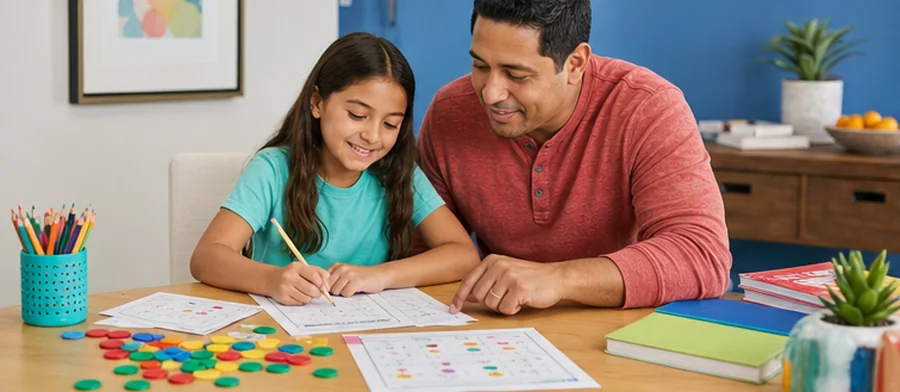
At home, ask your child to read the problem aloud first: “The dividend is ___ and the divisor is ___.” Have them estimate the size of the quotient before calculating. After solving, they should check by multiplying the quotient by the divisor. For example, if 624 ÷ 6 = 104, then 104 × 6 should return 624. This quick check builds accuracy without turning the work into guesswork.
Classroom uses
Teachers can use these printables for independent practice, math centers, small-group review, homework, or a quick fluency check after a division lesson. They are especially useful before introducing division with remainders, because students can strengthen the long-division routine while the numbers are still designed to divide exactly.

Common errors to watch for
Some students skip the multiplication check or forget to bring down the next digit. Others write quotient digits in the wrong column, especially when a zero is needed as a placeholder. Watch for children subtracting incorrectly after each partial quotient or choosing a multiplication fact that is close but not exact.
Free printable PDF download
Use this single digit division no remainder worksheets grade 5 page to preview the activity, print it, or download it as a PDF for quick practice. It works well for homework, homeschool lessons, tutoring, morning work, revision, and classroom centers.
Answers and answer key support
After the child completes the worksheet independently, parents and teachers can use the answer support or answer key information to check the work, review mistakes, and choose the next practice step.
Why iBloom worksheets help
The practice is focused on one clear goal: single-digit division without remainders. That narrow focus helps children build fluency step by step instead of juggling too many new ideas at once. A helpful strategy is: divide, multiply, subtract, bring down, then check by multiplying back. Saying the steps quietly can help students stay organized and confident.
Helpful answers
Frequently asked questions
What does single digit division with no remainder mean?
It means the divisor is a one-digit number and the dividend divides evenly, so the quotient is a whole number with nothing left over.
Why practise division without remainders in Grade 5?
It lets students focus on the long-division process, place value, and multiplication facts before adding the extra challenge of interpreting remainders.
How can my child check each answer?
They can multiply the quotient by the divisor. If the product equals the original dividend, the division answer is correct.
What is a common mistake in these worksheets?
A common mistake is placing a quotient digit in the wrong column, especially when the division step requires a zero as a placeholder.
Are these worksheets only for long division?
They are best used for building long-division fluency, but students also use multiplication facts and place-value reasoning to solve and check each problem.
Is this single digit division no remainder worksheets grade 5 free?
Yes. You can preview it for free and use the printable worksheet for home or classroom practice.
Can I download this single digit division no remainder worksheets grade 5 as a PDF?
Yes. Use the worksheet download option to save a printable PDF, or print the worksheet directly from the page.
Does this single digit division no remainder worksheets grade 5 include answers or an answer key?
When the activity has fixed answers, iBloom includes answer support so parents and teachers can check the completed worksheet.