




About this worksheet
This Grade 5 worksheet gives students 16 questions on exact whole-number division by one-digit divisors. Compact claim checks, quotient practice, and strategy choices lead into short written responses. Students use multiplication and place-value reasoning to explain their choices. A separate answer key is included. It practices the relationship between multiplication and division described in CCSS 5.NBT.B.6.
Aligned to 5.NBT.B.6
How can multiplication reveal a division error?
Multiply the proposed quotient by the divisor. If the product does not match the dividend, the quotient needs a correction. For question 1, 12 × 4 is 48, so it cannot be the quotient of 84 ÷ 4.
- 1Claim: 84 ÷ 4 = 12
- 2Check: 12 × 4 = 48
- 3Since 48 ≠ 84, find 84 ÷ 4 = 21.
How do you solve and check a quotient?
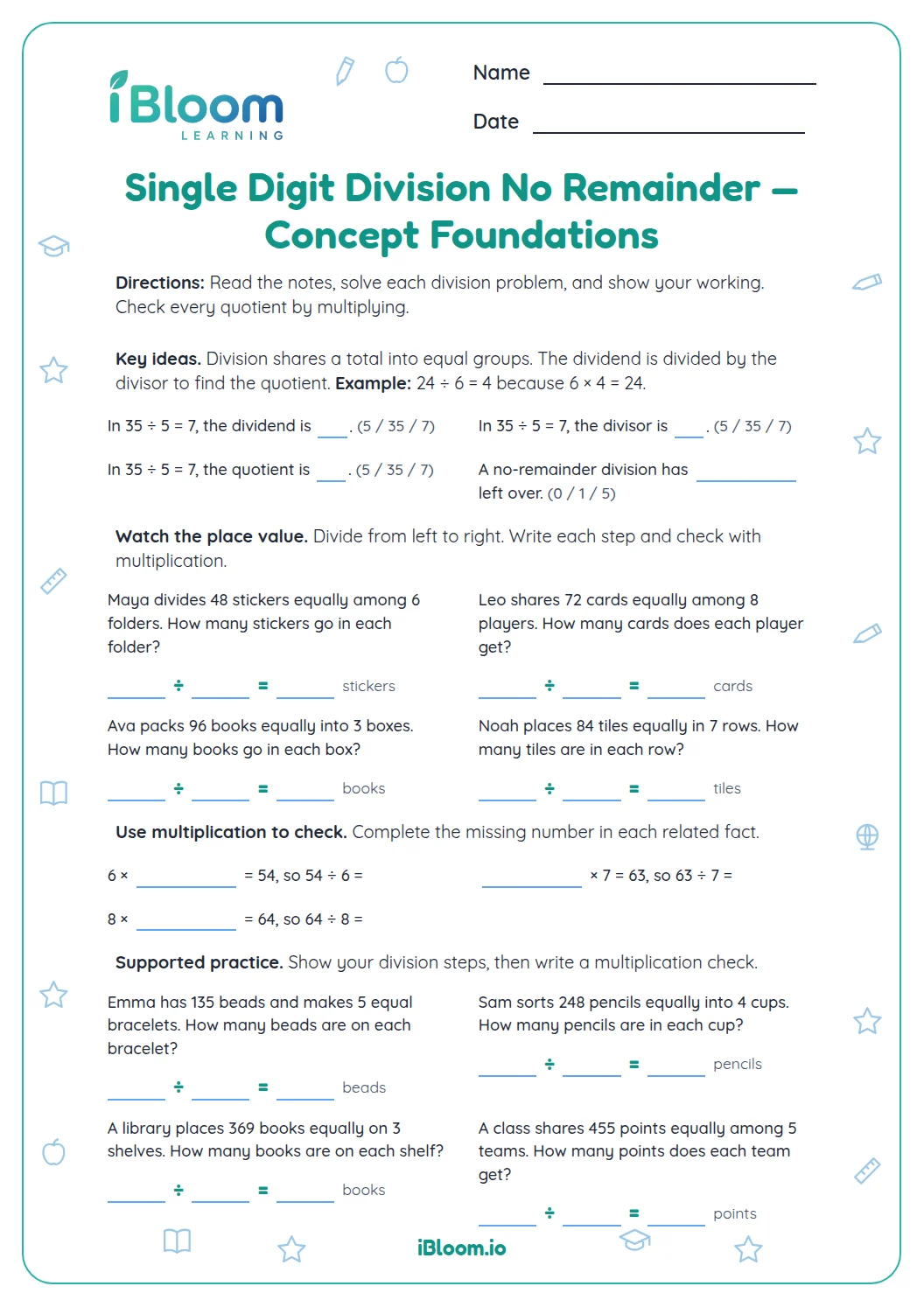
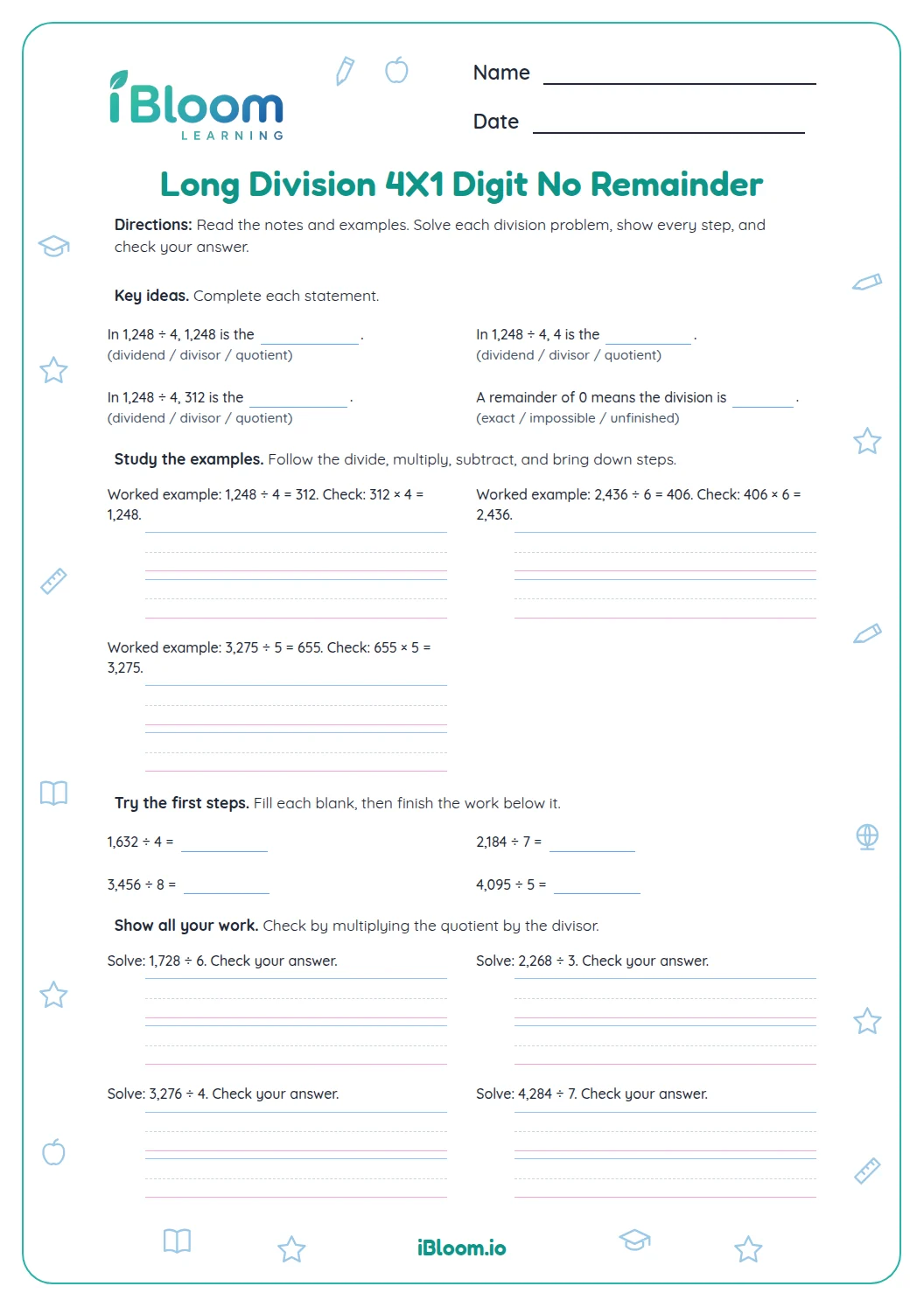
Use a known multiplication fact or split the dividend by place value. For 72 ÷ 3, the quotient is 24. Check it with 24 × 3 = 72.
How can you compare division strategies?
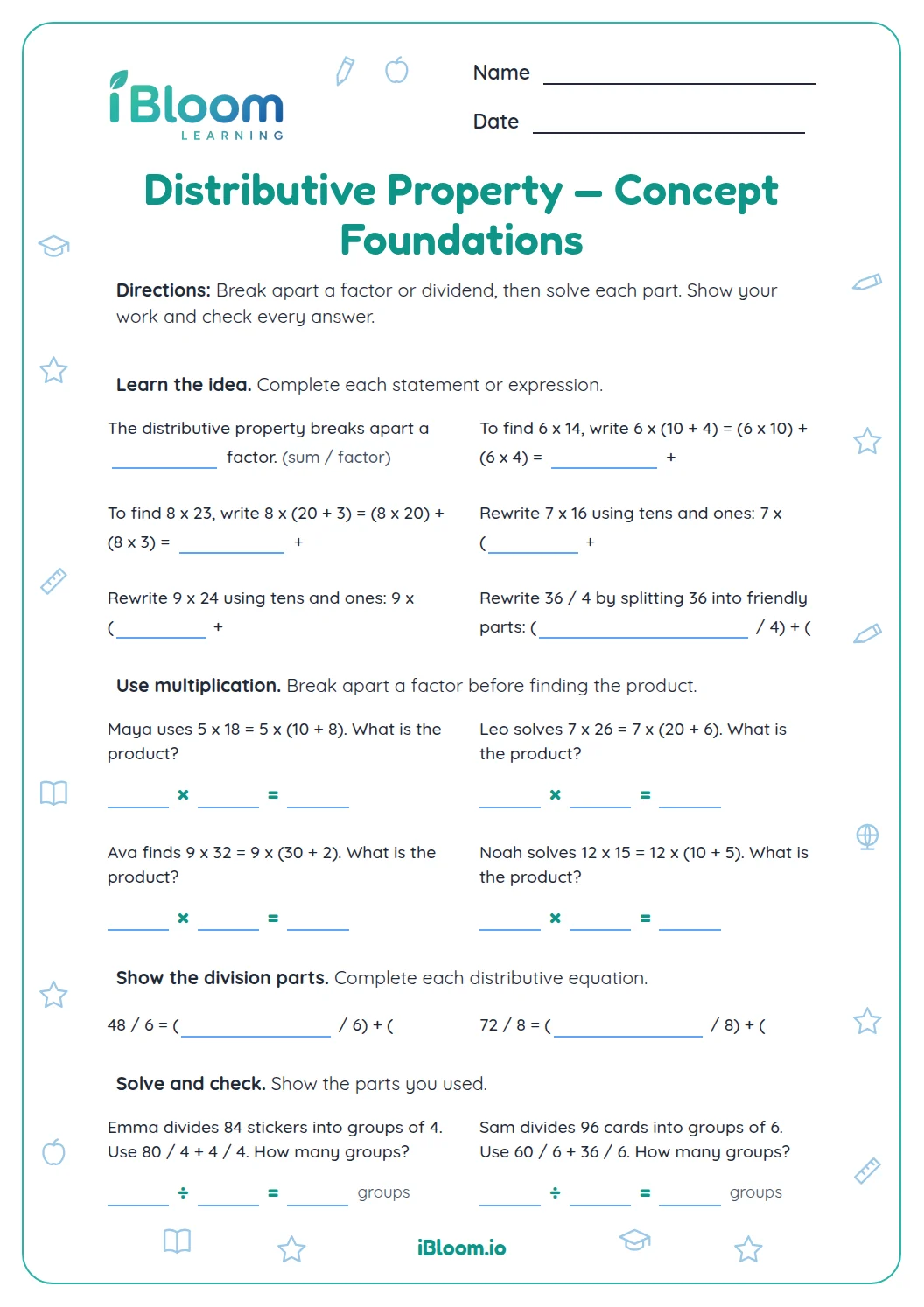
A useful split makes both parts easy to divide. For 248 ÷ 4, split 248 into 200 and 48; then 200 ÷ 4 + 48 ÷ 4 gives 50 + 12.
What does division look like in a sharing problem?
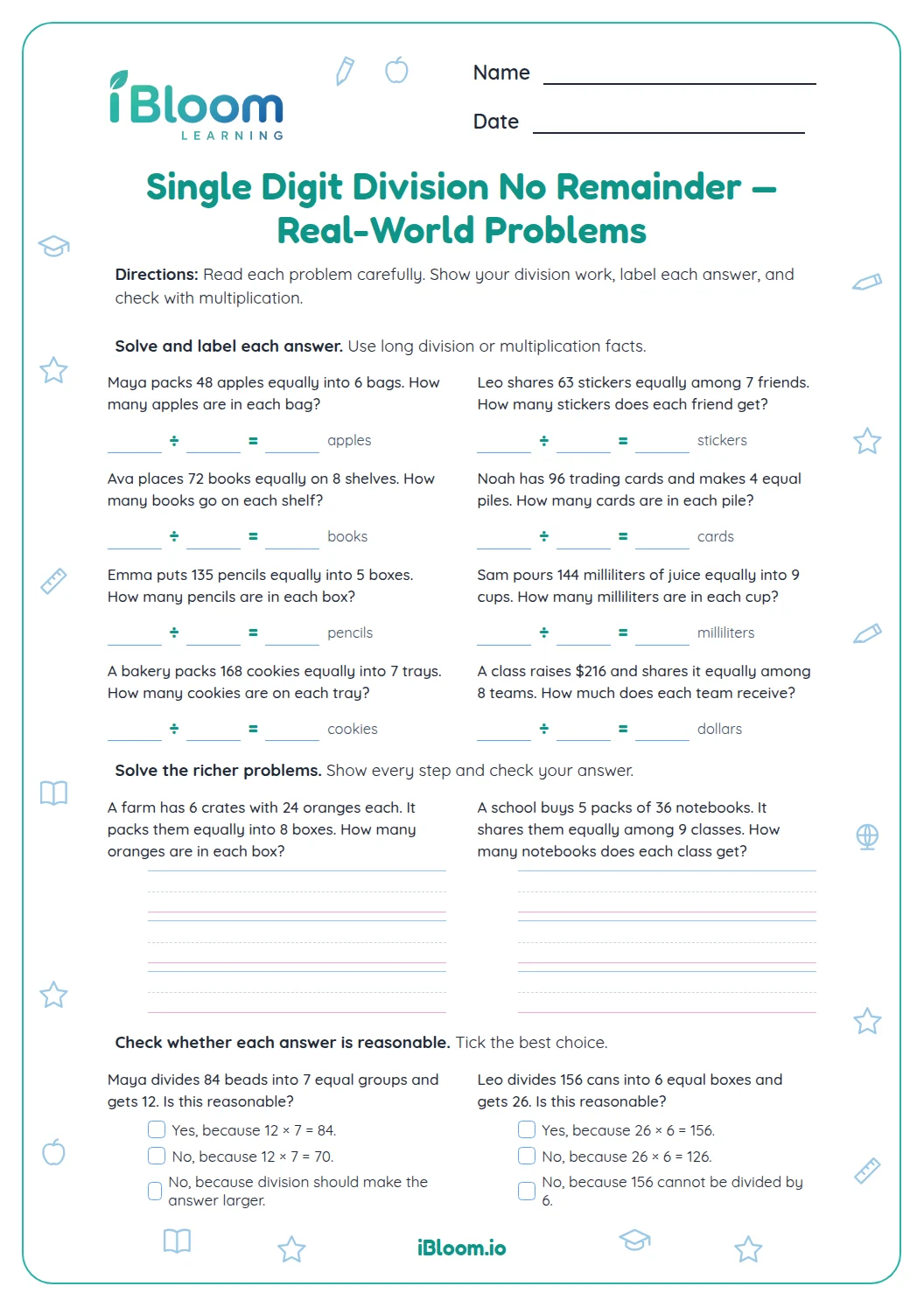
Find how many are in each equal group, then check by multiplying the group size by the number of groups. Question 14 shares 156 stickers among 6 groups, so 26 stickers go in each group because 26 × 6 = 156.
How to solve and check division
- 1Identify the dividend and divisor.
- 2Use a multiplication fact or place-value split to find the quotient.
- 3Multiply the quotient by the divisor.
- 4Check that the product equals the dividend.
- 5In a story problem, include the requested unit.
Common division mistakes
The mistake
Accepting a quotient without checking it.
The fix
Multiply the quotient by the divisor and compare the product with the dividend.
The mistake
Splitting a dividend into parts that are awkward to divide.
The fix
Choose place-value parts that divide evenly, such as 200 and 48 for 248 ÷ 4.
The mistake
Giving the number of groups when the question asks for the amount in each group.
The fix
Reread what one group represents, then include that unit in the answer.
Common Core alignment
This sheet practices the standard below through its word and number tasks.
Find whole-number quotients and explain with place value or multiplication.
On this sheet: The problems practice exact whole-number quotients and use multiplication equations to reason and check.
Show the official wordingHide the official wording
Find whole-number quotients of whole numbers with up to four-digit dividends and two-digit divisors, using strategies based on place value, the properties of operations, and/or the relationship between multiplication and division. Illustrate and explain the calculation by using equations, rectangular arrays, and/or area models.
What to practice next
Make more practice
Further reading
Questions parents and teachers ask
How can multiplication help check division?
Multiply the quotient by the divisor. If 84 ÷ 4 is 21, then 21 × 4 equals 84. The first part of the worksheet asks students to use checks like this to spot incorrect quotient claims and choose a correction. Try the same check on another quotient.
What kinds of problems are on the worksheet?
The 16 questions move through error checks, quotient practice, strategy comparisons, and equal-sharing situations. Students use multiplication and place-value splits to reason about exact division. The answer key gives the selected answers and model results for written problems. Ask students to explain which operation undoes division.
How can students divide by splitting a number?
Break the dividend into parts that are easy to divide, then add the partial quotients. For 248 ÷ 4, split 248 into 200 and 48. Divide each part by 4 to get 50 and 12, then add to find 62. Both parts divide evenly by four.
Do the division questions have remainders?
No. Every division problem has an exact whole-number quotient and a one-digit divisor. The questions include dividends up to three digits, quotient checks, place-value reasoning, and sharing situations. Students can verify each answer by multiplying the quotient by its divisor.
What should a student do after finding a quotient?
Multiply the quotient by the divisor and see whether the product matches the dividend. In a sharing story, reread the question to make sure the answer names the number in each group or the number of groups, then include the correct unit.