


About this worksheet
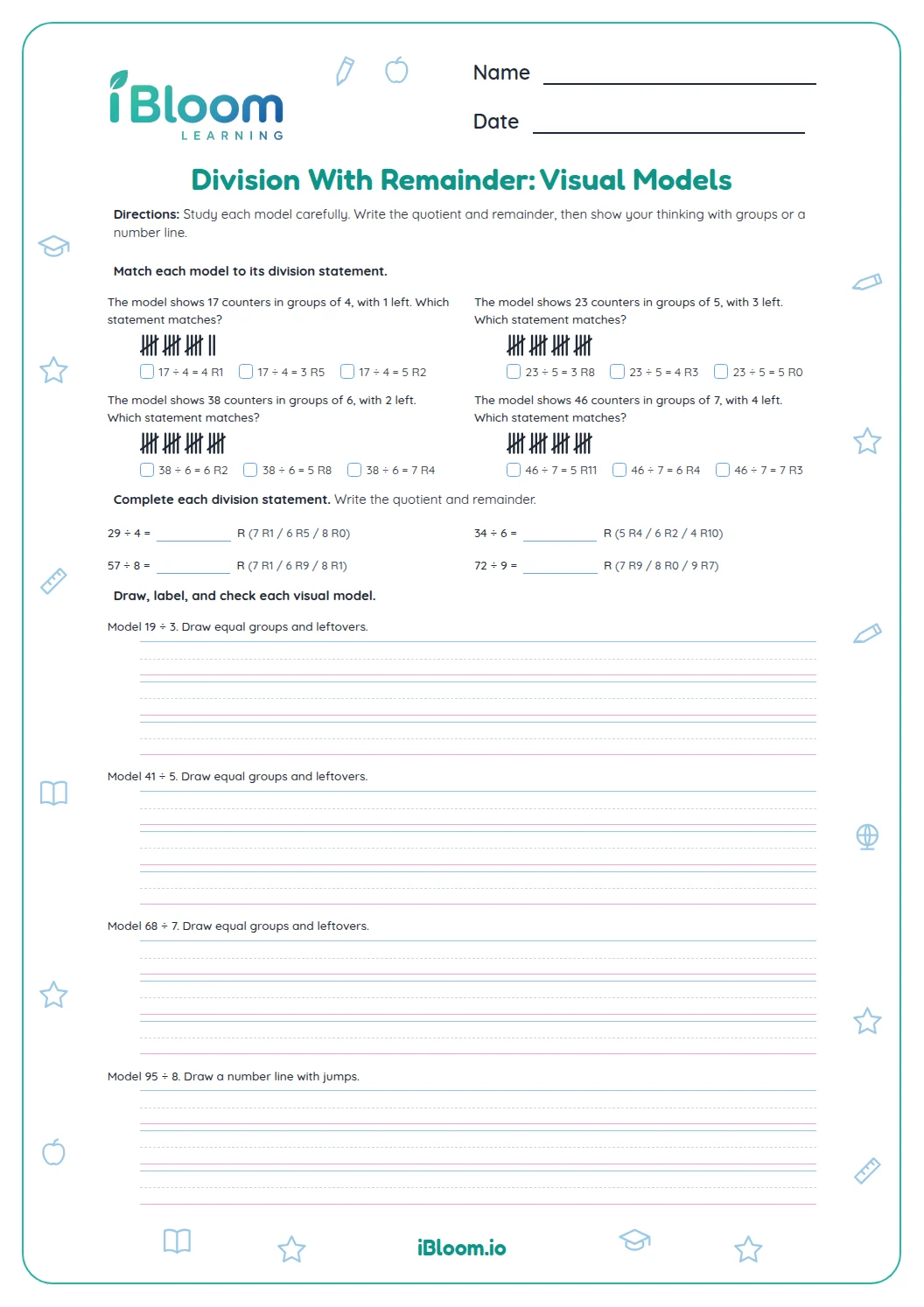
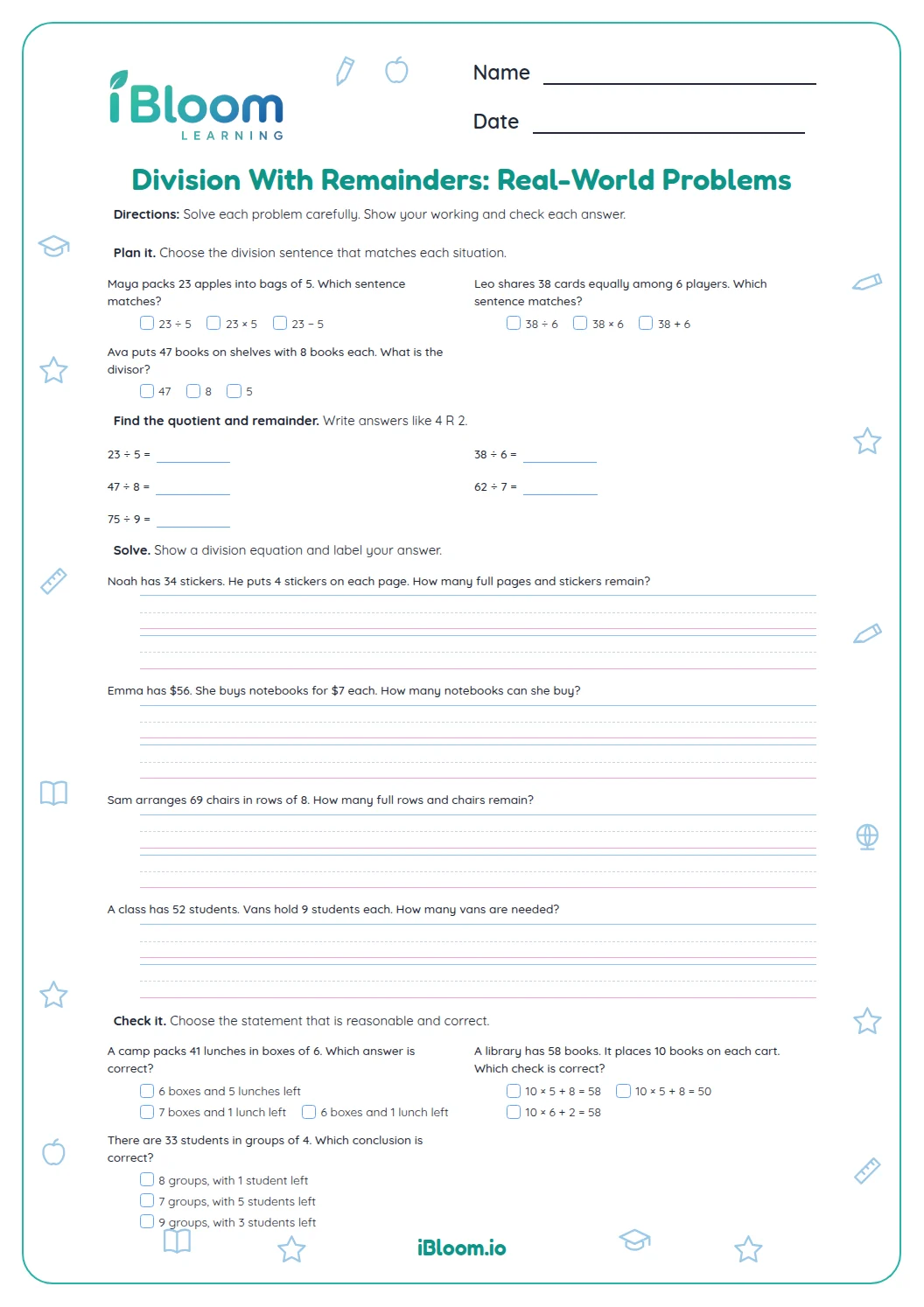
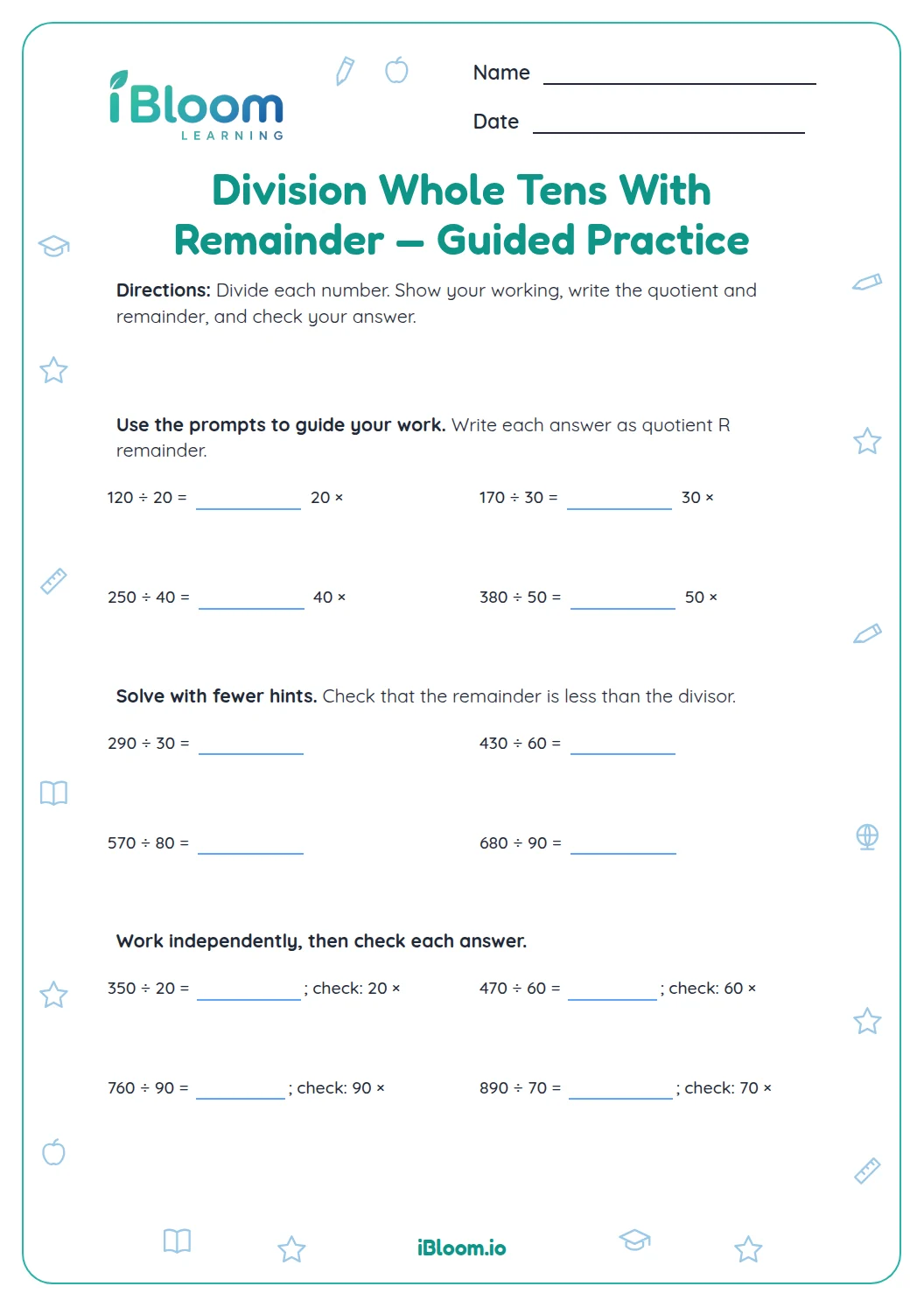
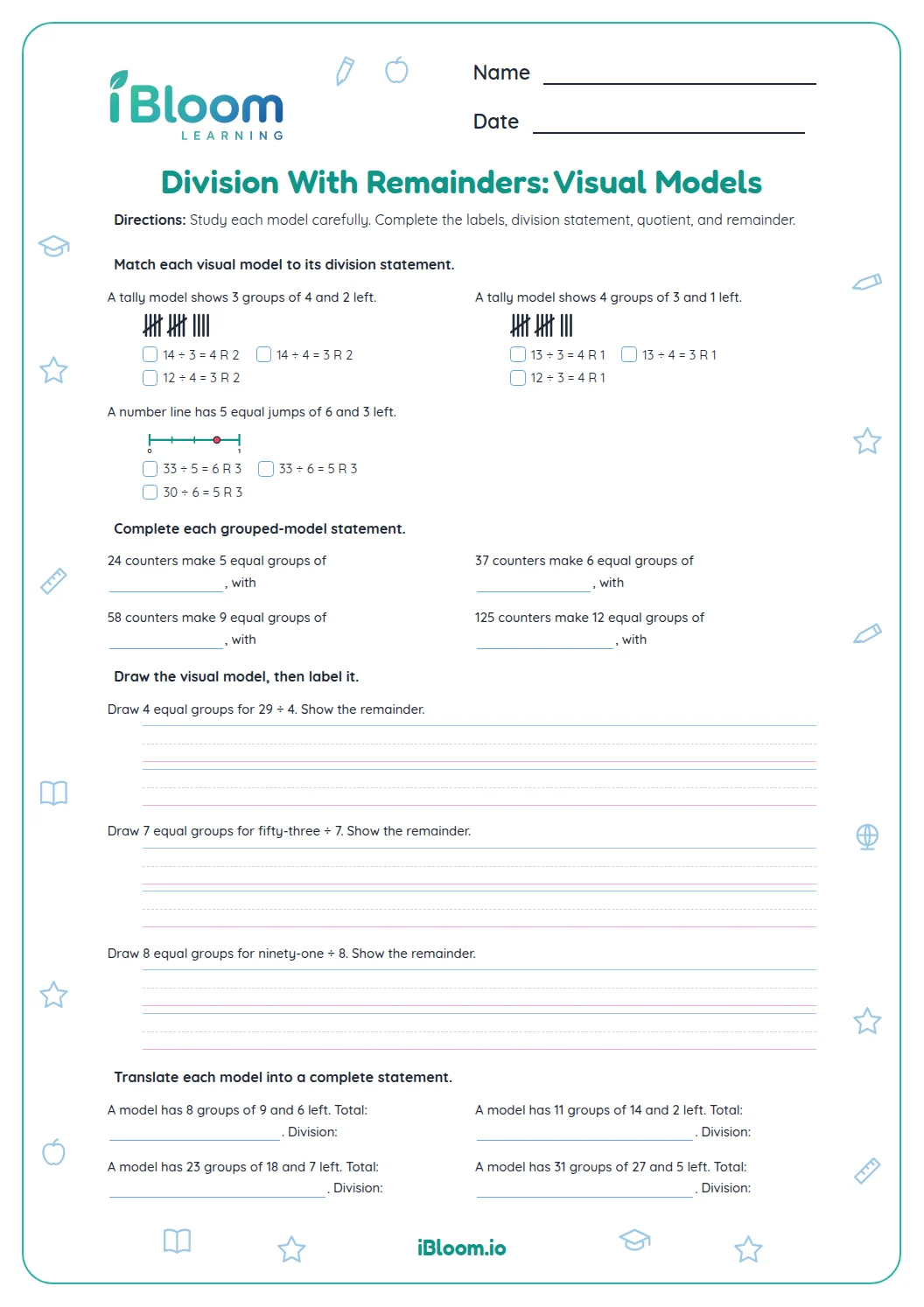
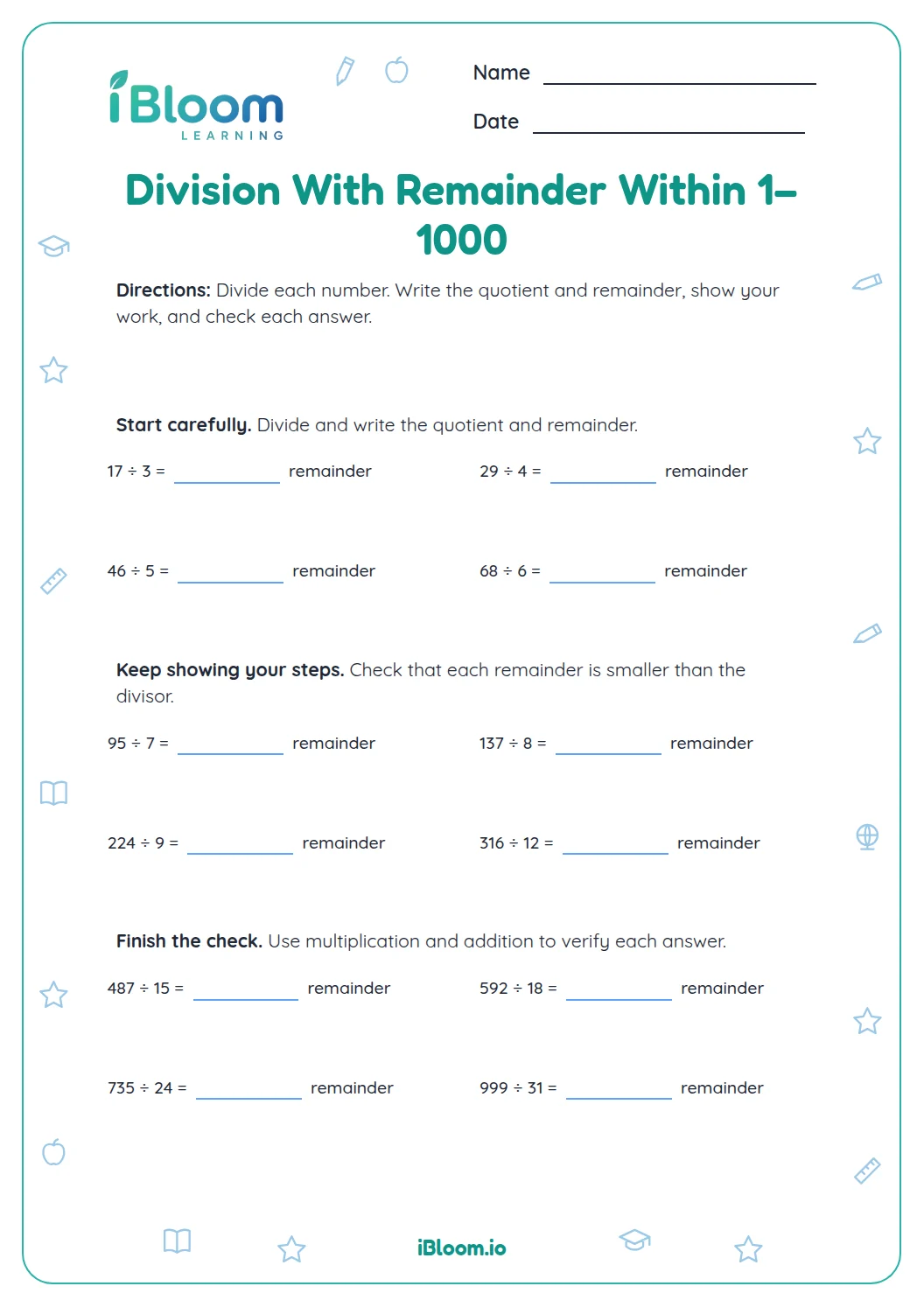
This Grade 5 worksheet gives guided practice dividing whole numbers within 100 and recording each quotient with its remainder. Children solve division sentences, check that each remainder is smaller than the divisor, and interpret results in everyday grouping situations. Sixteen questions build from calculations to context, with a separate answer key. The work aligns to CCSS 5.NBT.B.6.
Aligned to 5.NBT.B.6
What do quotient and remainder tell us?
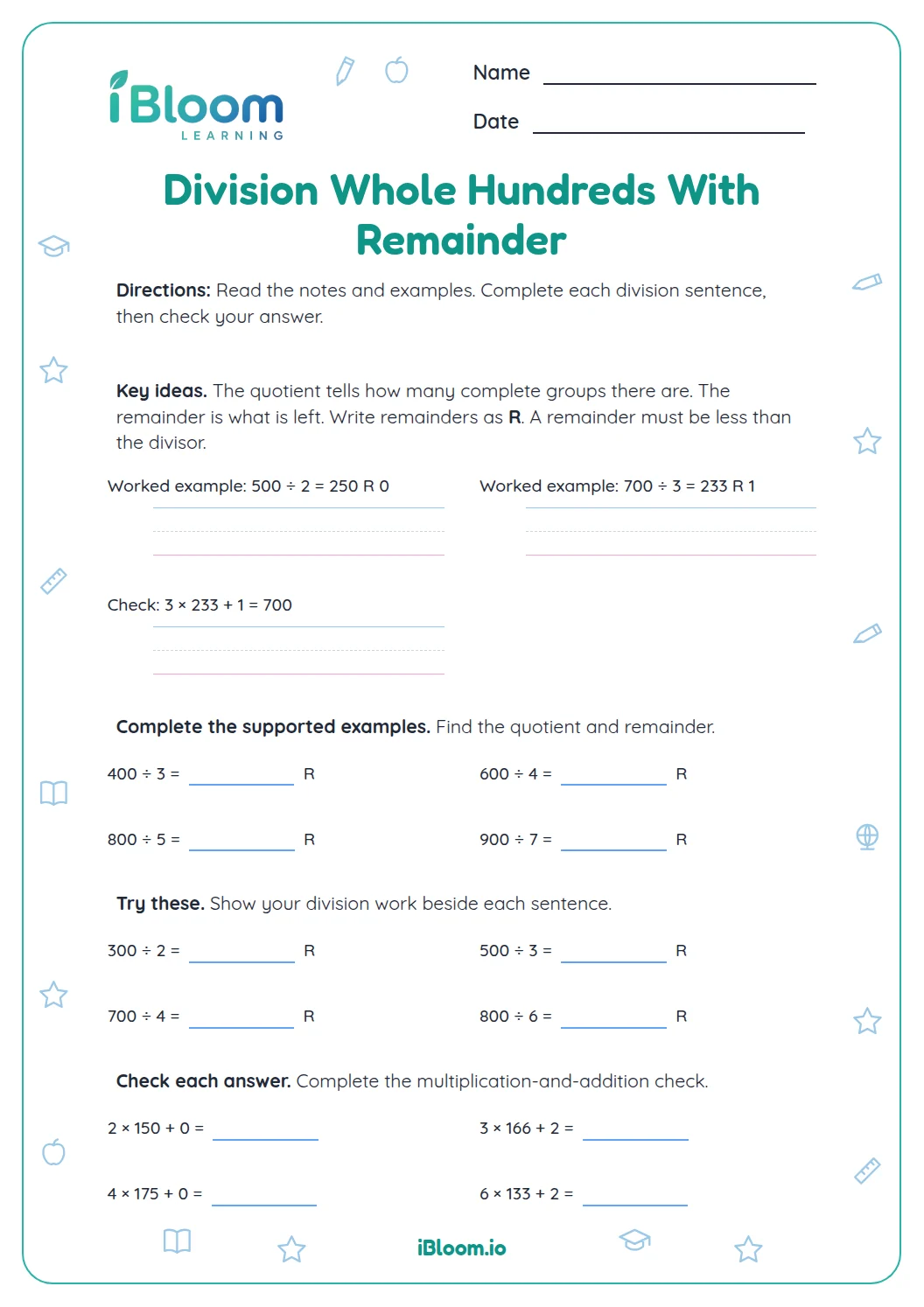
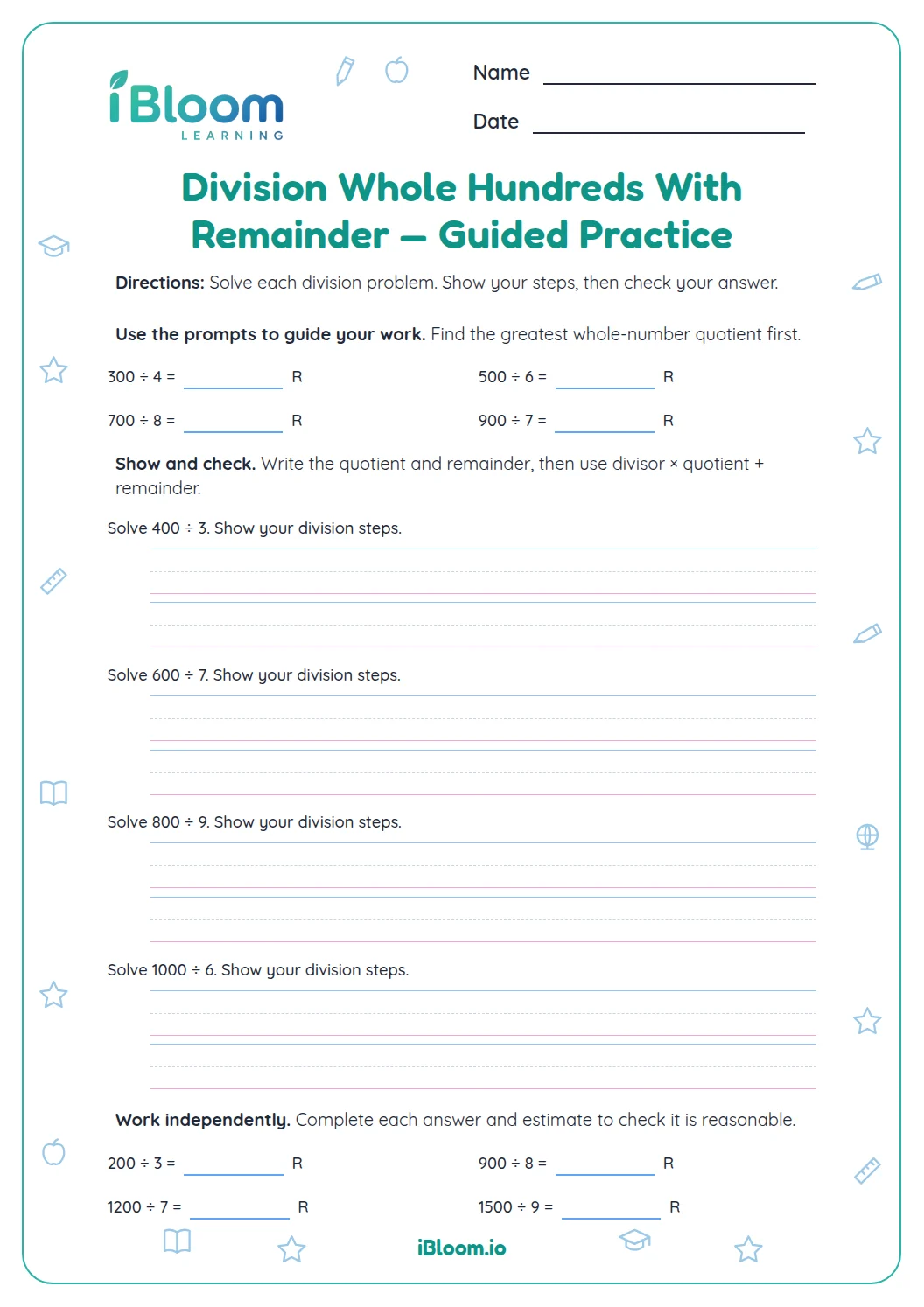
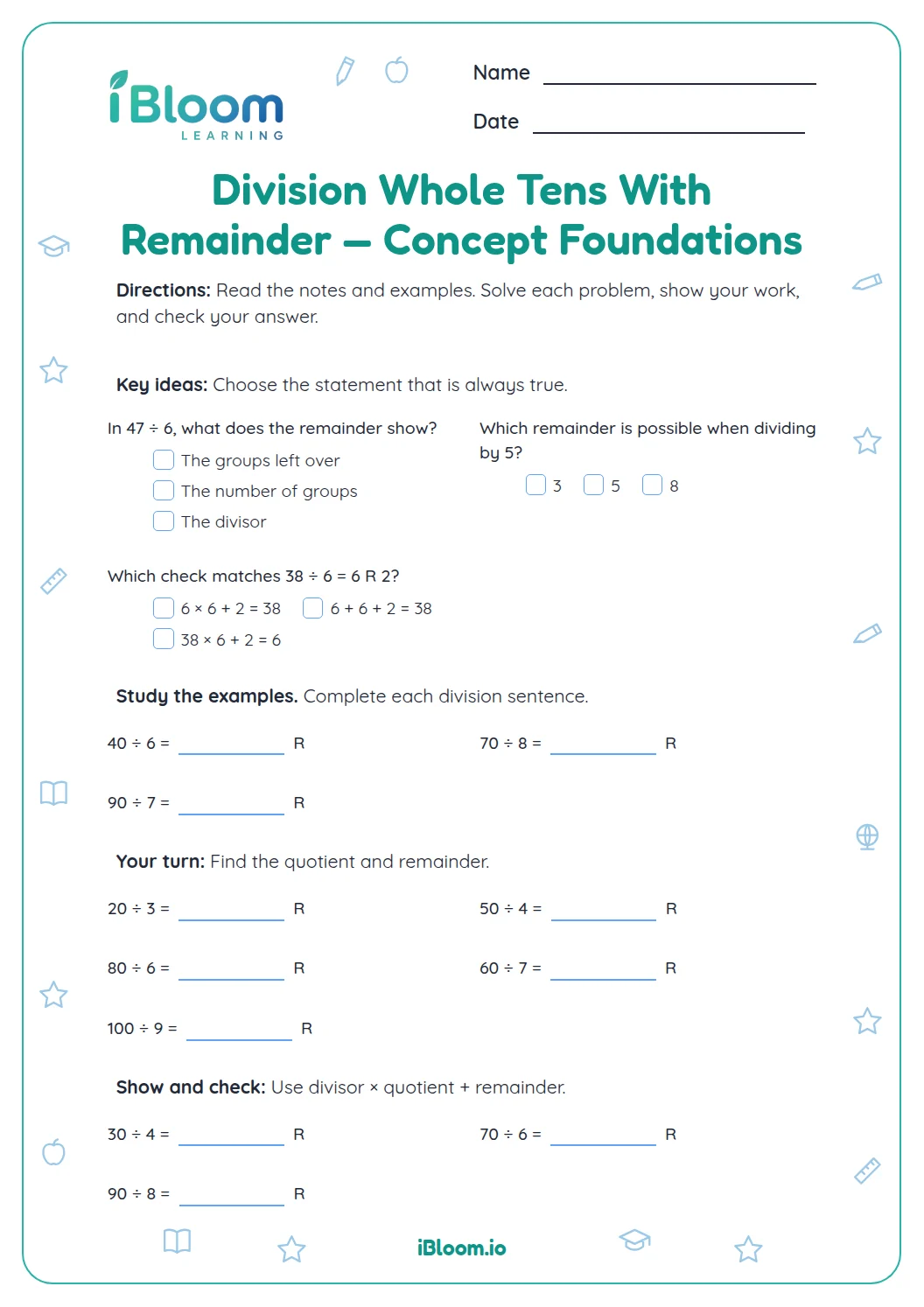
The quotient counts complete equal groups. The remainder counts what is left after those groups are made. In 37 ÷ 5, seven groups use 35, leaving 2.
- 137 ÷ 5
- 25 × 7 = 35
- 337 − 35 = 2
- 4Answer: 7 R 2
How can you check a remainder?
Use divisor × quotient + remainder = dividend. For 37 ÷ 5, 5 × 7 + 2 = 37. Also check that 2 is less than 5; otherwise another group of 5 could be made.
How do remainders work in a story?
Use the question to name what the quotient and remainder count. Cups and full groups count complete sets; leftover pencils or stickers count the remainder. If the question asks how many vehicles are needed, leftover people may require an additional vehicle.
How to use this worksheet
- 1Estimate how many complete groups fit.
- 2Multiply the divisor by that quotient.
- 3Subtract from the dividend to find what remains.
- 4Check that the remainder is smaller than the divisor.
- 5For a story, name what the quotient and remainder mean.
Common mistakes and quick fixes
The mistake
Writing a remainder equal to the divisor.
The fix
Make one more group whenever the leftover is at least the divisor.
The mistake
Forgetting to subtract the product from the dividend.
The fix
Check quotient × divisor + remainder = dividend.
The mistake
Reporting only full vans when every student needs a ride.
The fix
Use the context to decide whether leftover people need another van.
Common Core alignment
This sheet gives focused practice with the standard below.
Divide whole numbers and interpret the remainder in context.
On this sheet: The calculation practice uses whole-number division; story items interpret remaining quantities.
Show the official wordingHide the official wording
Find whole-number quotients of whole numbers with up to four-digit dividends and two-digit divisors, using strategies based on place value, the properties of operations, and/or the relationship between multiplication and division. Illustrate and explain the calculation by using equations, rectangular arrays, and/or area models.
What to practice next
Make more practice
Further reading
Questions parents and teachers ask
What does a remainder show?
A remainder is the amount left after making as many equal groups as possible. For 47 ÷ 5, nine groups use 45, leaving 2. Children record the quotient and remainder, then use context in the last four questions to explain what those numbers mean.
How can I check a division answer?
Multiply the quotient by the divisor, then add the remainder. The total should equal the dividend, and the remainder must be smaller than the divisor. For 47 ÷ 5, check 5 × 9 + 2 = 47; two is less than five.
Can a remainder equal the divisor?
No. If the remainder is as large as the divisor, one more full group can be made. Divide again until the remainder is smaller than the divisor, then check that the quotient and remainder rebuild the original dividend. The remainder is always smaller than its divisor.
How many questions are included?
There are 16 questions in four parts: quotient-and-remainder equations, additional divisions to check, two multiple-choice stories, and two problems with working space. The answer key lists the quotient and remainder or the context-specific result for each item. The written problems include room to work.
Why does the van problem ask how many vans are needed?
The problem has 41 students and seats groups of 9. Four full vans carry 36 students, leaving 5, so a fifth van is needed. The answer names both the total vans and the students in the last van to show how the remainder affects the situation.