



About this worksheet
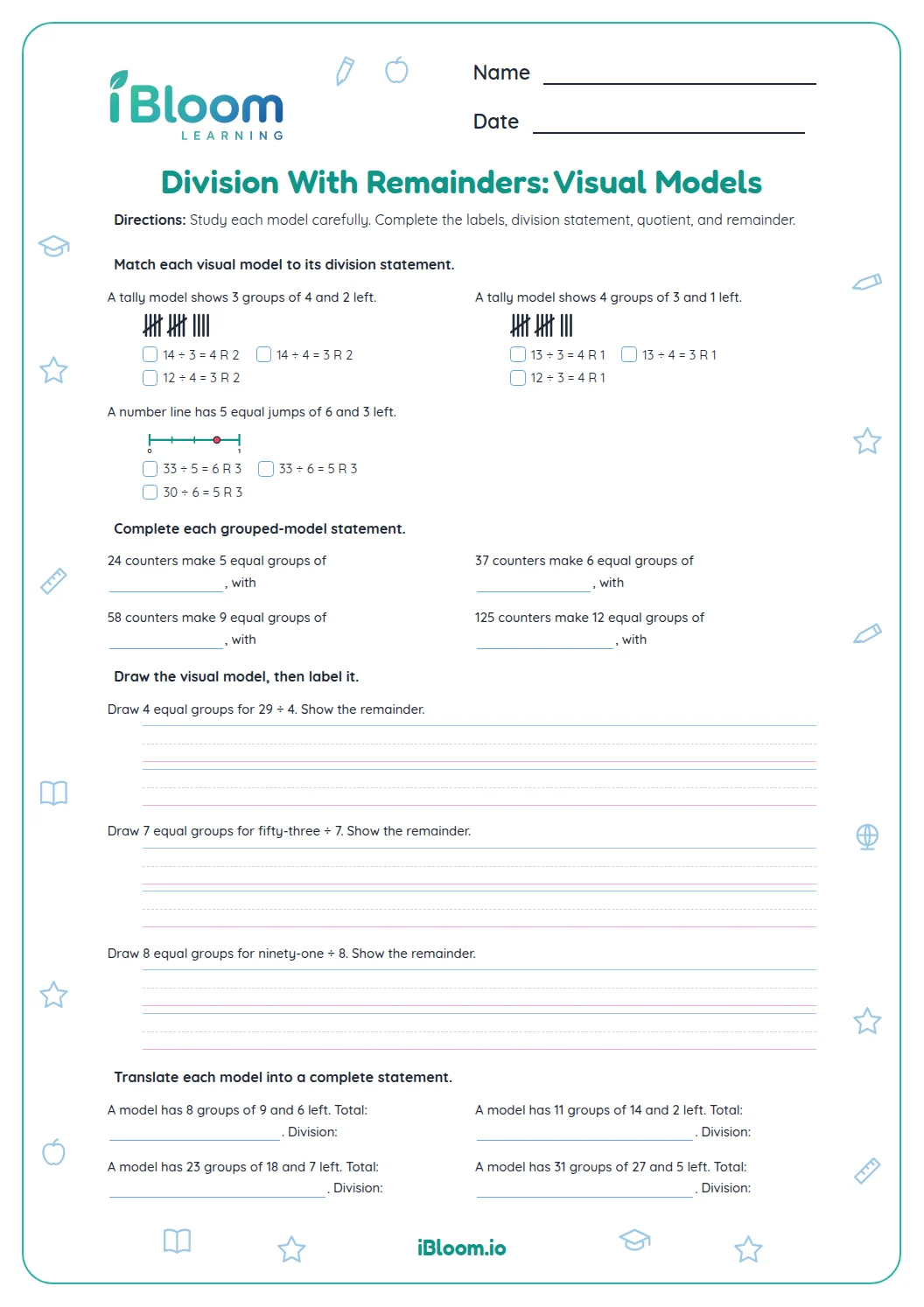
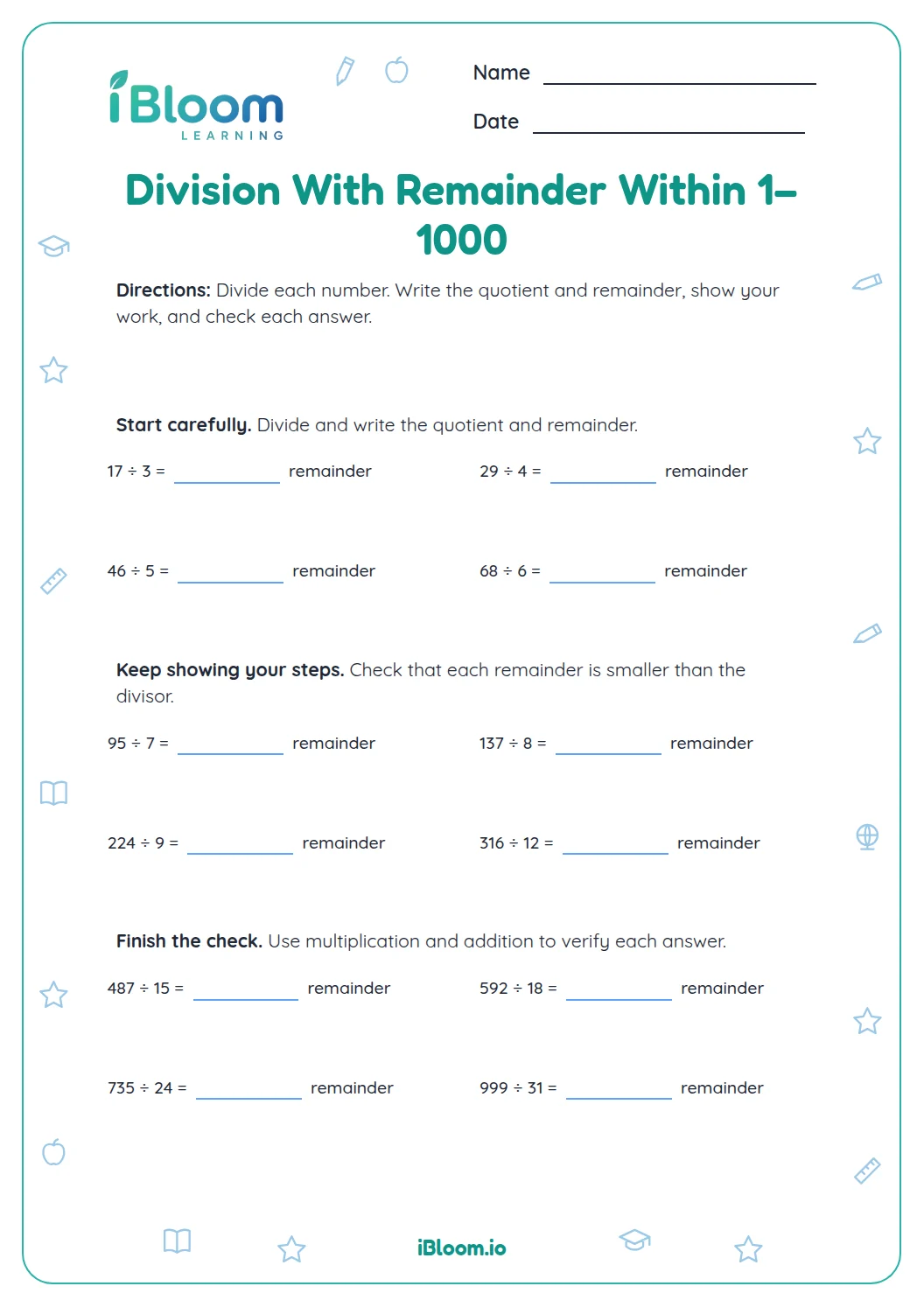
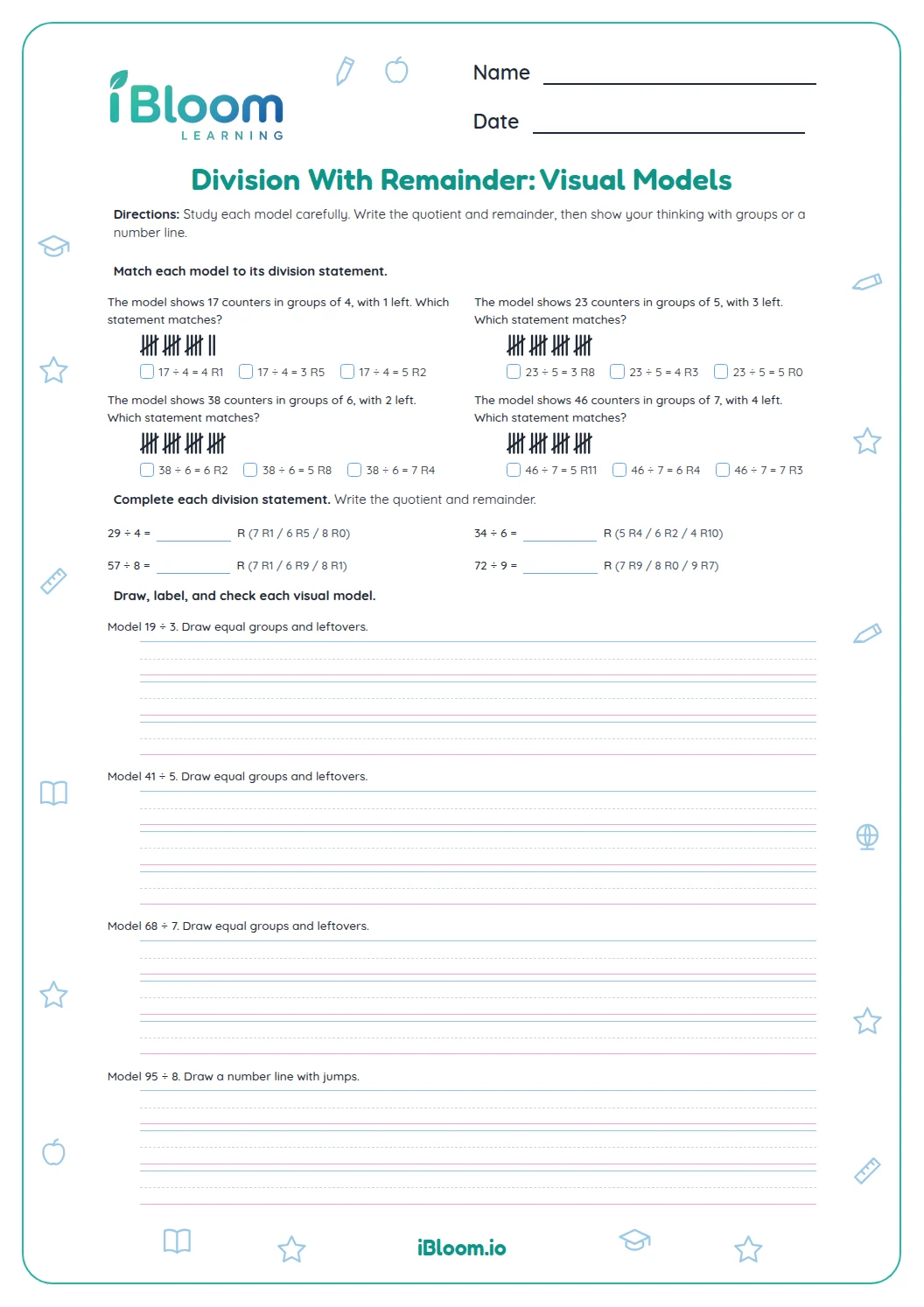
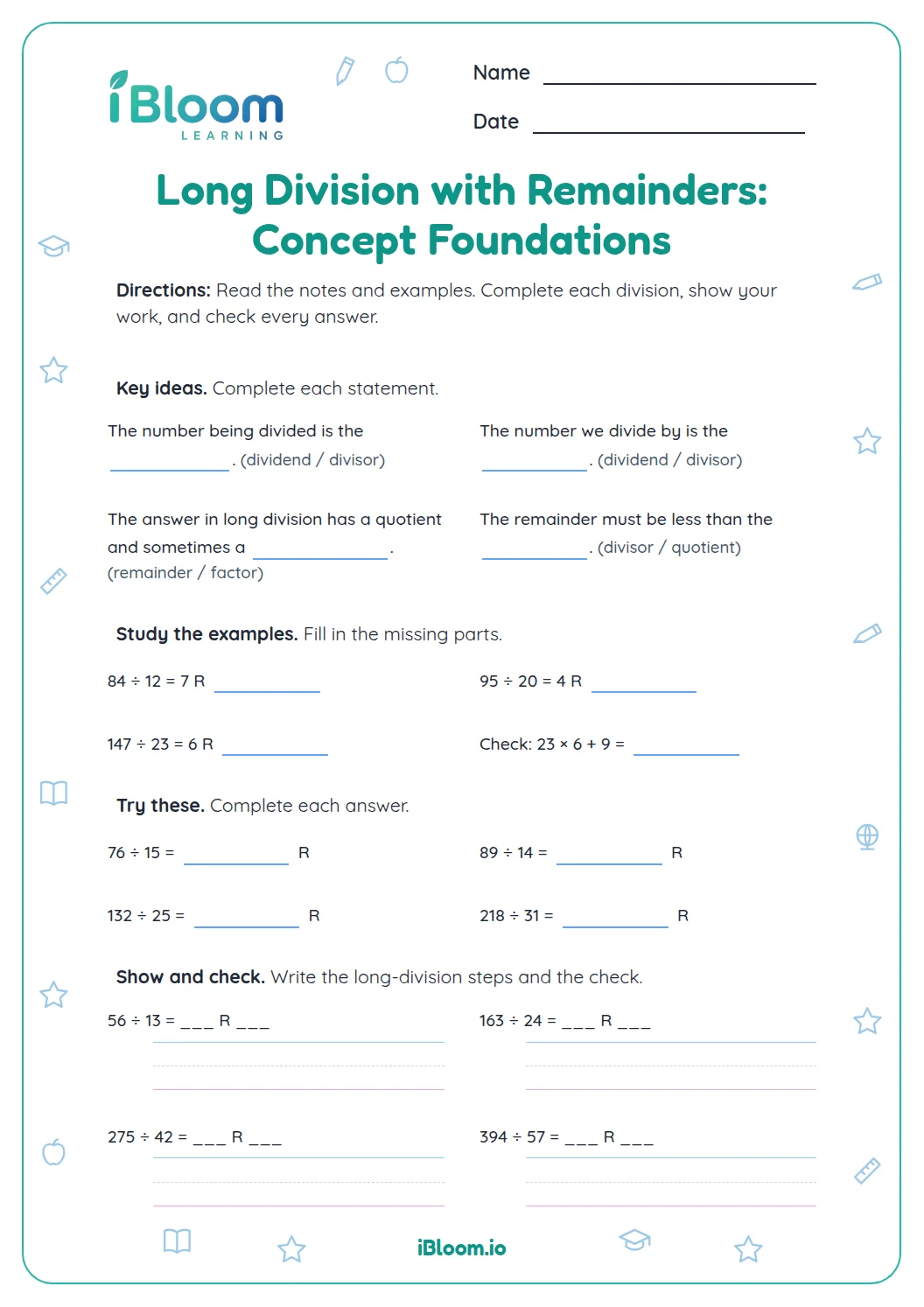
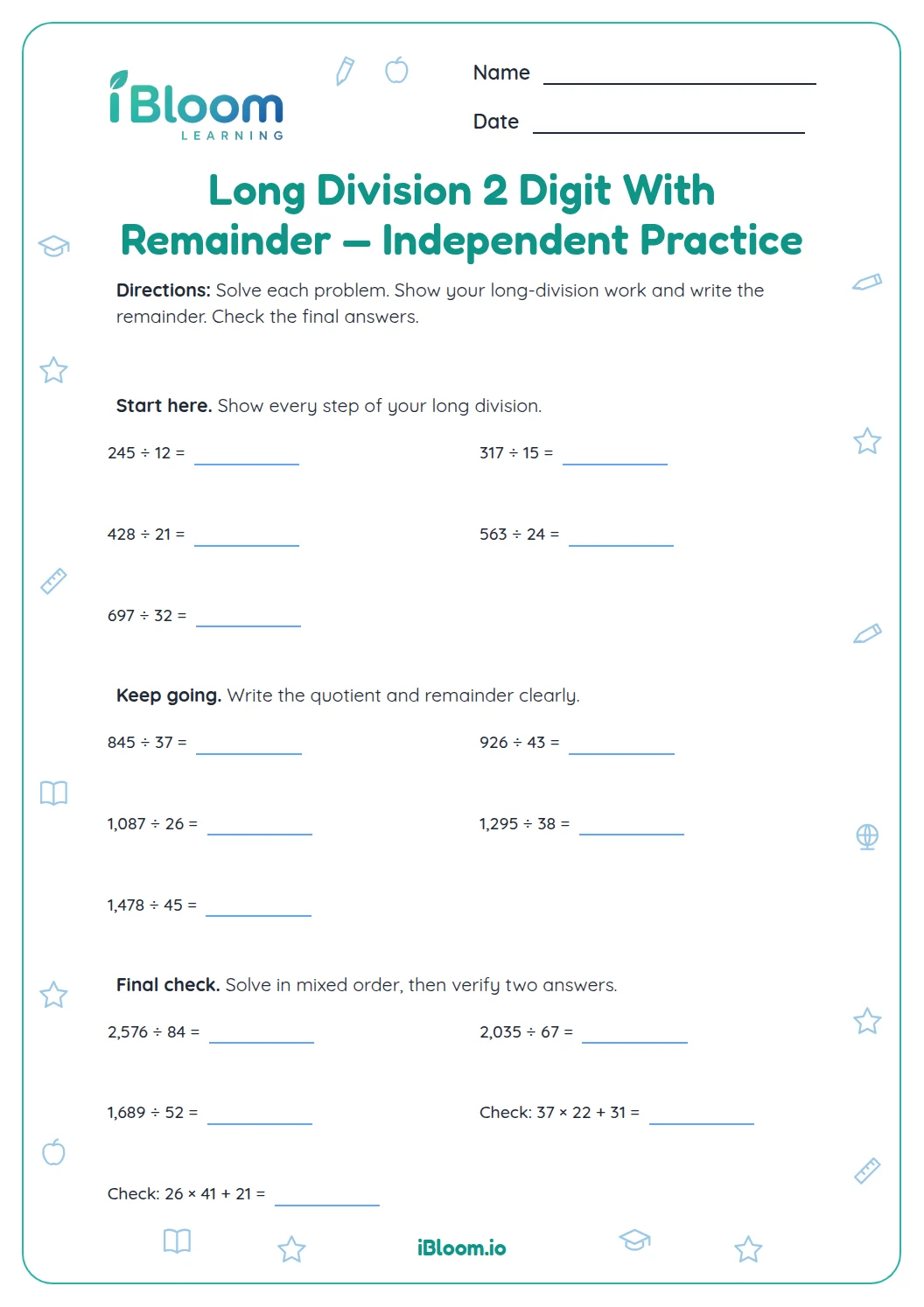
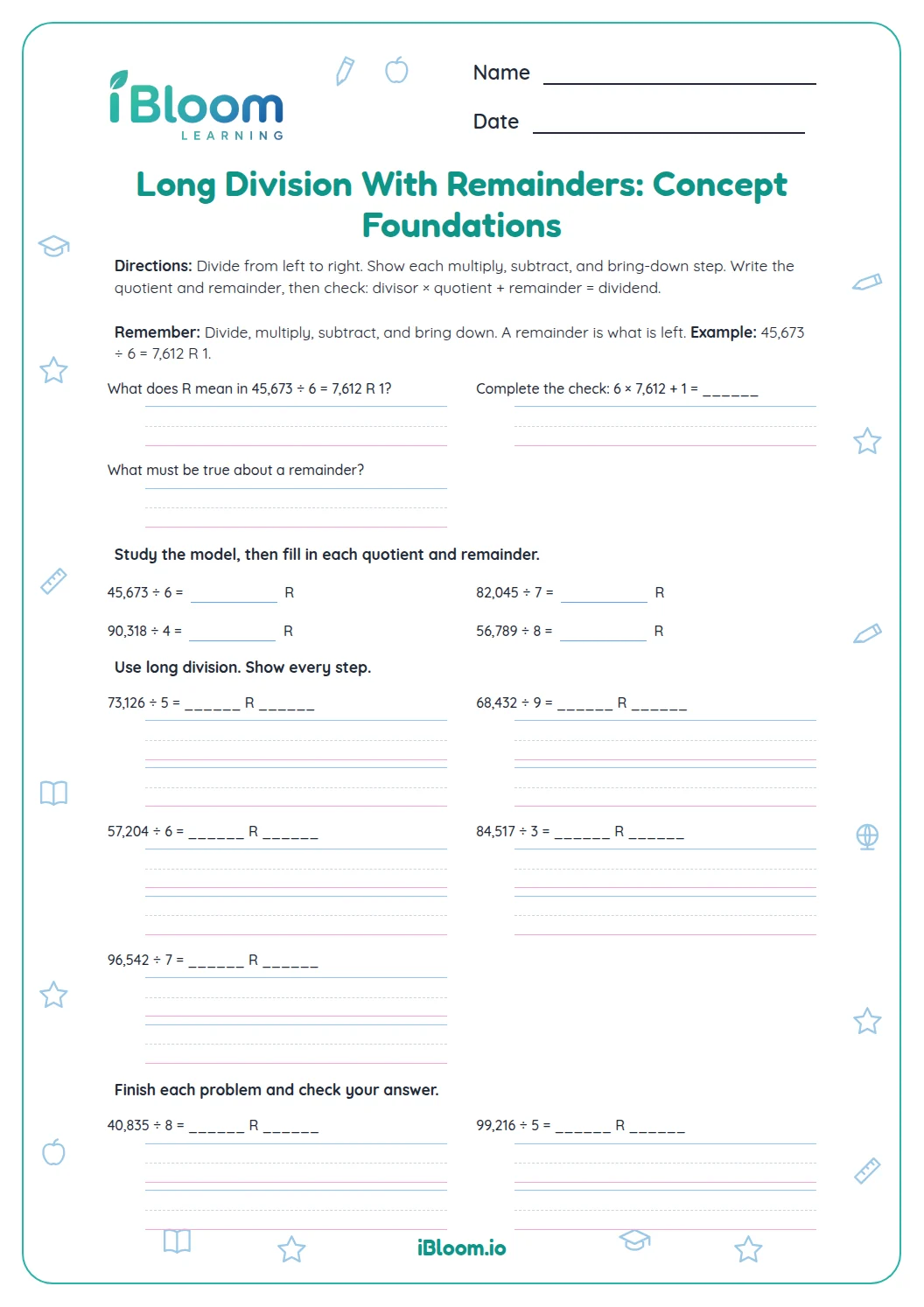
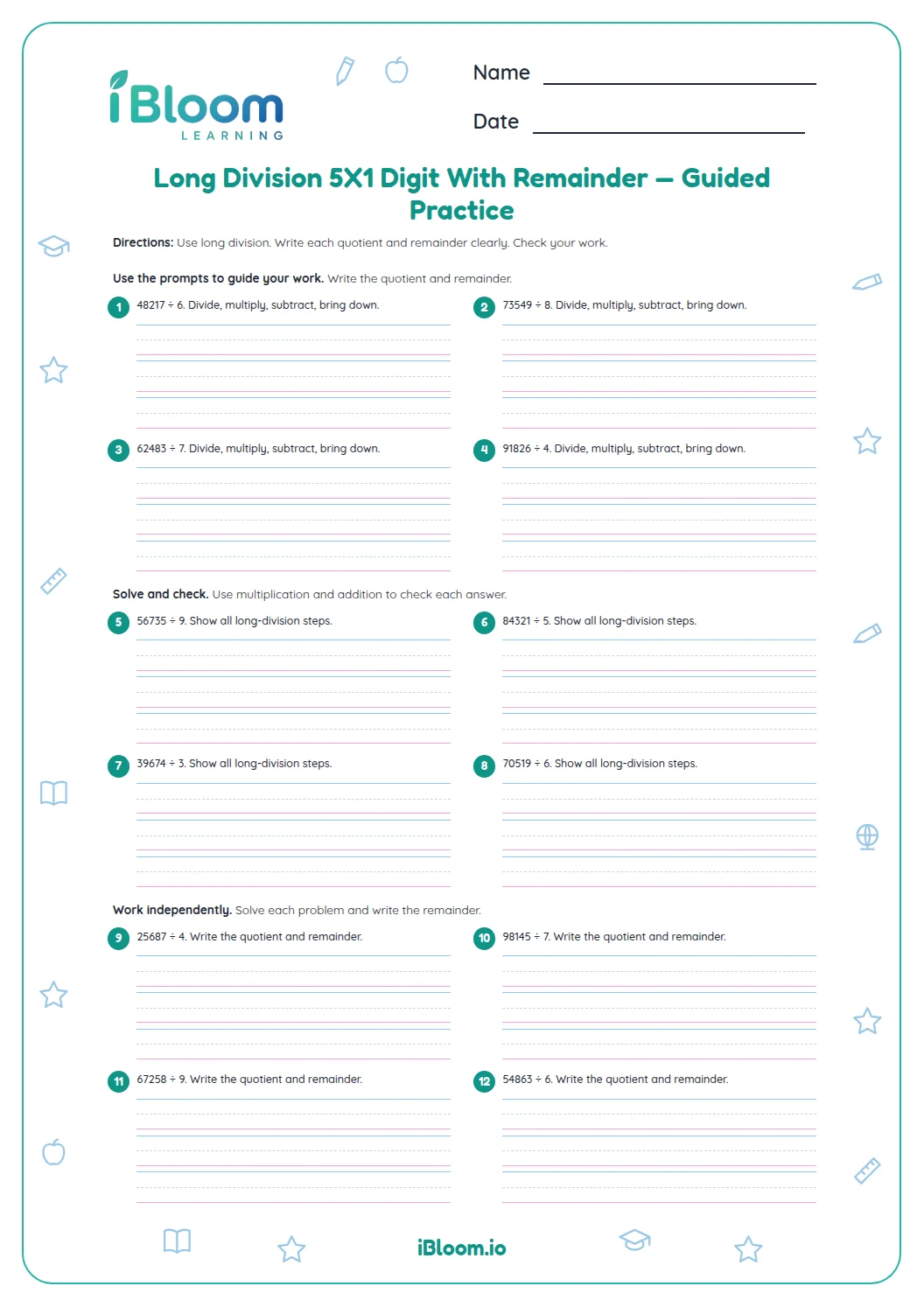
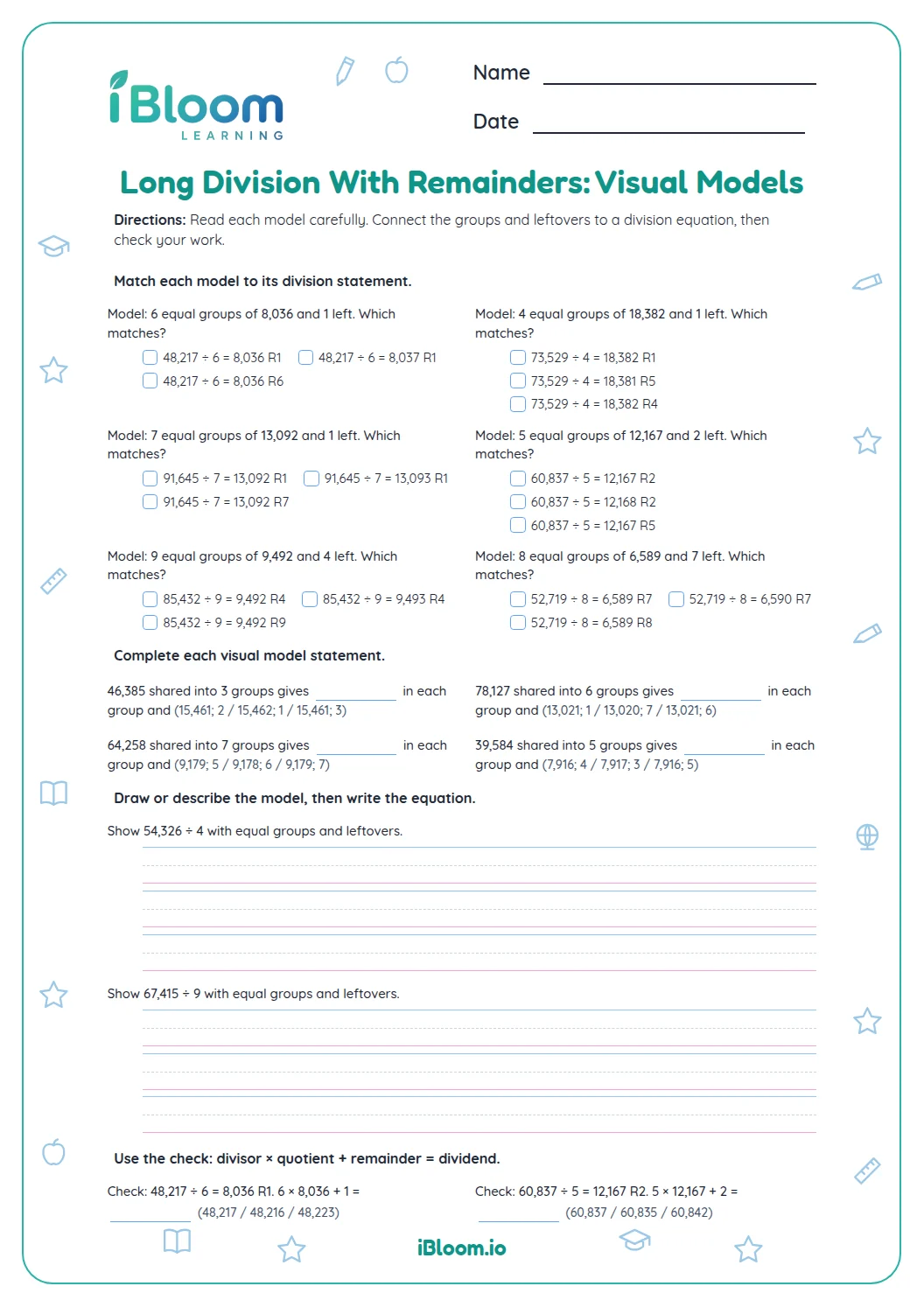
This Grade 5 division worksheet offers 16 guided problems with remainders and dividends under 1,000. The three parts move from two-digit dividends to larger three-digit dividends, with one-digit divisors throughout. Students write a quotient and remainder, then check using divisor × quotient + remainder = dividend. A separate answer key supports quick review. The practice aligns with Common Core 4.NBT.B.6 on whole-number quotients and the relationship between multiplication and division.
Aligned to 4.NBT.B.6
What does a remainder tell us?
A remainder is the number left after making as many equal groups as possible. It is always smaller than the divisor because a full group of that size would create another quotient group.
For question 1, 53 ÷ 4 makes 13 full groups, using 52 items, with 1 left. The check is 4 × 13 + 1 = 53.
- 153 ÷ 4
- 24 × 13 = 52
- 353 − 52 = 1 left
- 4Answer: 13 R1
- 5Check: 4 × 13 + 1 = 53
Which method can a student use?
Students may use partial quotients, equal groups, or the long-division steps taught in class. Whatever method they choose, they should record a quotient that makes a product close to the dividend without going over, then find the leftover amount.
The worksheet starts with shorter dividends and moves into three-digit dividends so students can apply the same reasoning with more place values.
How do the three parts build practice?
Part A begins with two-digit dividends, Part B uses three-digit dividends, and Part C mixes the sizes. Encourage students to check every answer with multiplication and make sure each remainder is smaller than its divisor.
How to use this worksheet
- 1Read the dividend and divisor carefully.
- 2Estimate a quotient using multiplication facts.
- 3Subtract the product from the dividend to find what is left.
- 4Write the result as quotient R remainder.
- 5Check divisor × quotient + remainder = dividend.
Common mistakes and quick fixes
The mistake
Writing a remainder as large as the divisor.
The fix
Make one more group; the quotient should increase and the remainder should shrink.
The mistake
Stopping after finding a product but not the leftover.
The fix
Subtract the product from the dividend to calculate the remainder.
The mistake
Multiplying the quotient by the wrong divisor.
The fix
Use the divisor printed in the problem for the multiplication check.
Curriculum alignment
This practice connects the worksheet tasks to the standard below.
Find whole-number quotients and remainders using place value and multiplication.
On this sheet: Each problem finds a quotient and remainder for a dividend under 1,000 with a one-digit divisor, then checks with multiplication.
Show the official wordingHide the official wording
Find whole-number quotients and remainders with up to four-digit dividends and one-digit divisors, using strategies based on place value, the properties of operations, and/or the relationship between multiplication and division. Illustrate and explain the calculation by using equations, rectangular arrays, and/or area models.
What to practice next
Make more practice
Further reading
Questions parents and teachers ask
How many division questions are included?
The worksheet has 16 division problems in three parts. The dividends range from two digits to three digits, and every problem has a one-digit divisor. The answer key gives each quotient and remainder, making it straightforward to check the calculation.
How can a student check a quotient and remainder?
Multiply the divisor by the quotient, then add the remainder. For example, 53 ÷ 4 = 13 R1 because 4 × 13 + 1 = 53. The remainder must also be smaller than the divisor; otherwise another group can be made.
What should the remainder be in 278 ÷ 7?
The quotient is 39 and the remainder is 5. Check by multiplying 7 × 39 to get 273, then add 5 to return to 278. Since 5 is less than 7, the remainder is small enough and the division statement is complete.
Is this practice limited to numbers under 1,000?
Yes. Every dividend on the sheet is a whole number less than 1,000, and the worksheet practices division with a remainder. Students can use equal groups, partial quotients, or the long-division method they are learning, then verify with multiplication.
Why must the remainder be less than the divisor?
A remainder counts how many objects are left after making as many full groups as possible. If the leftover number were as large as the group size, the student could make one more full group. That is why a valid remainder is always smaller than its divisor.