


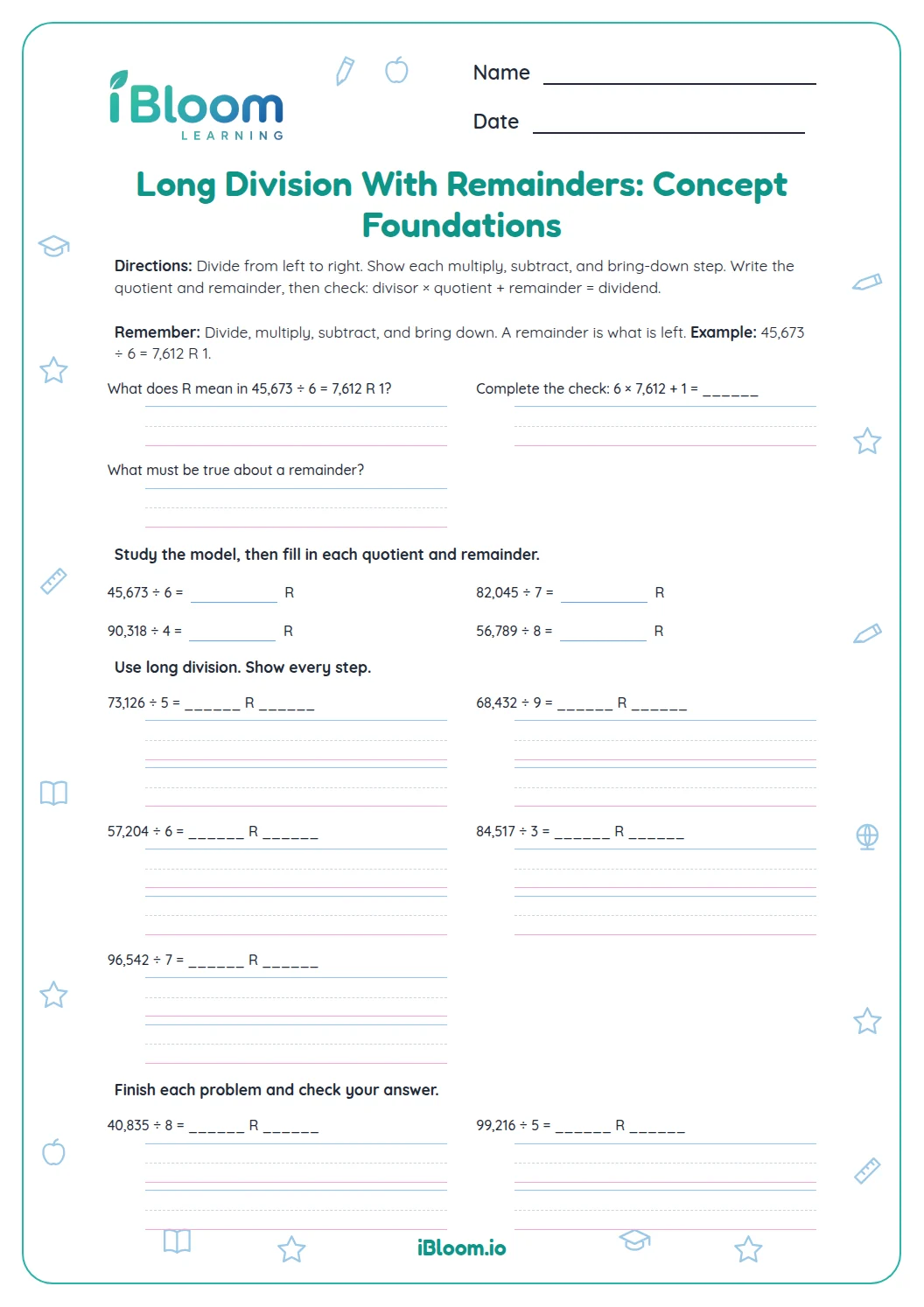
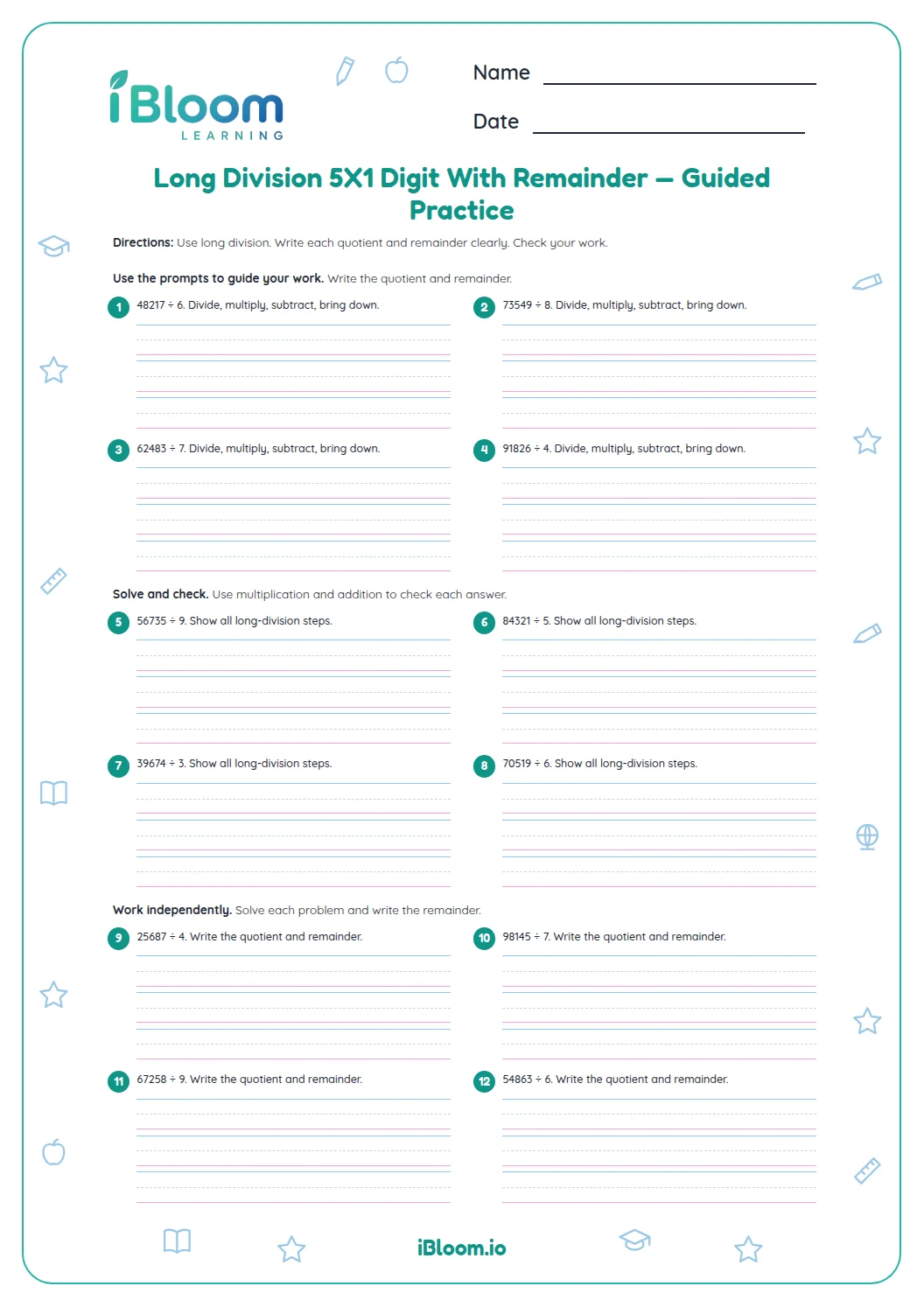
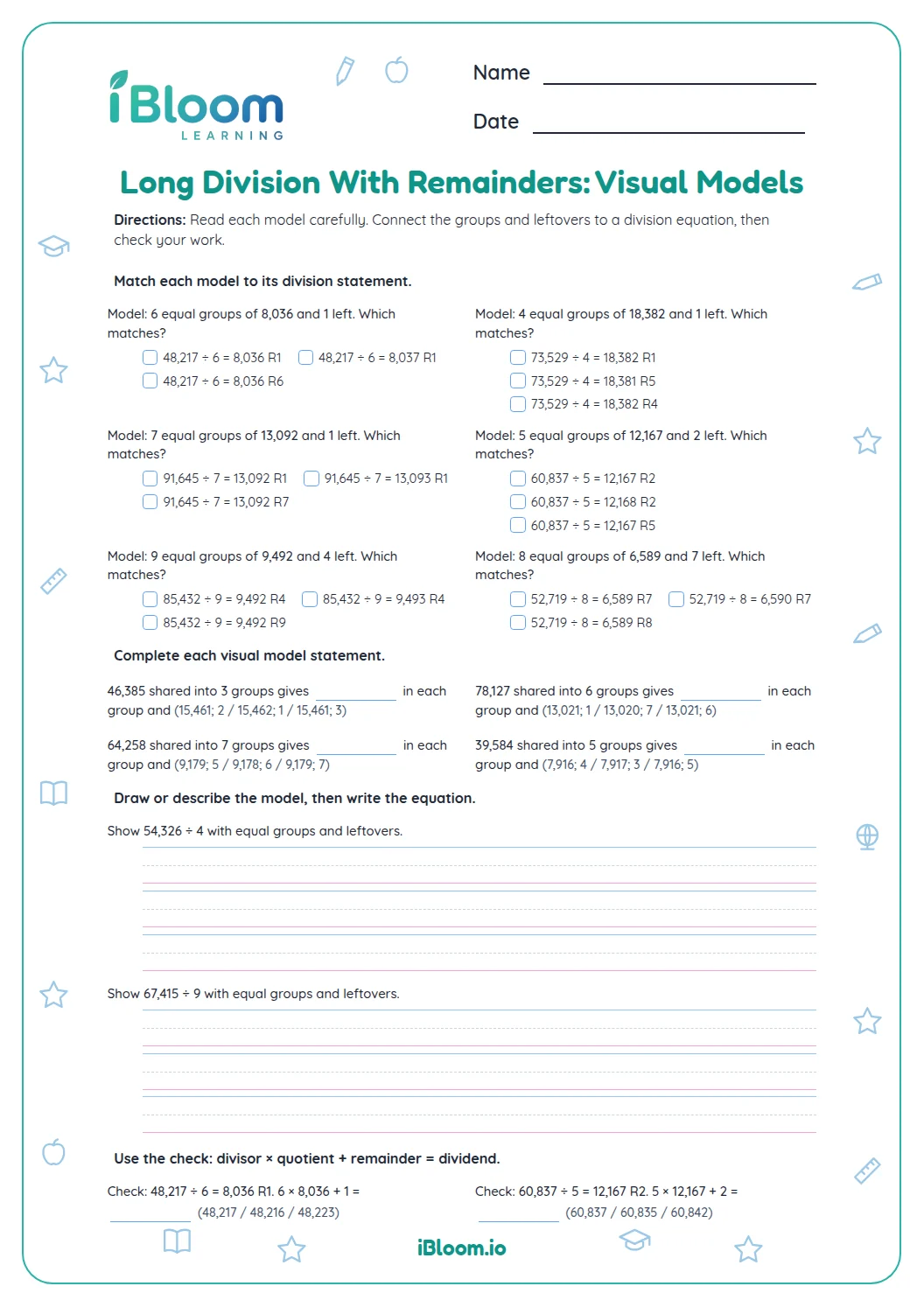
About this worksheet
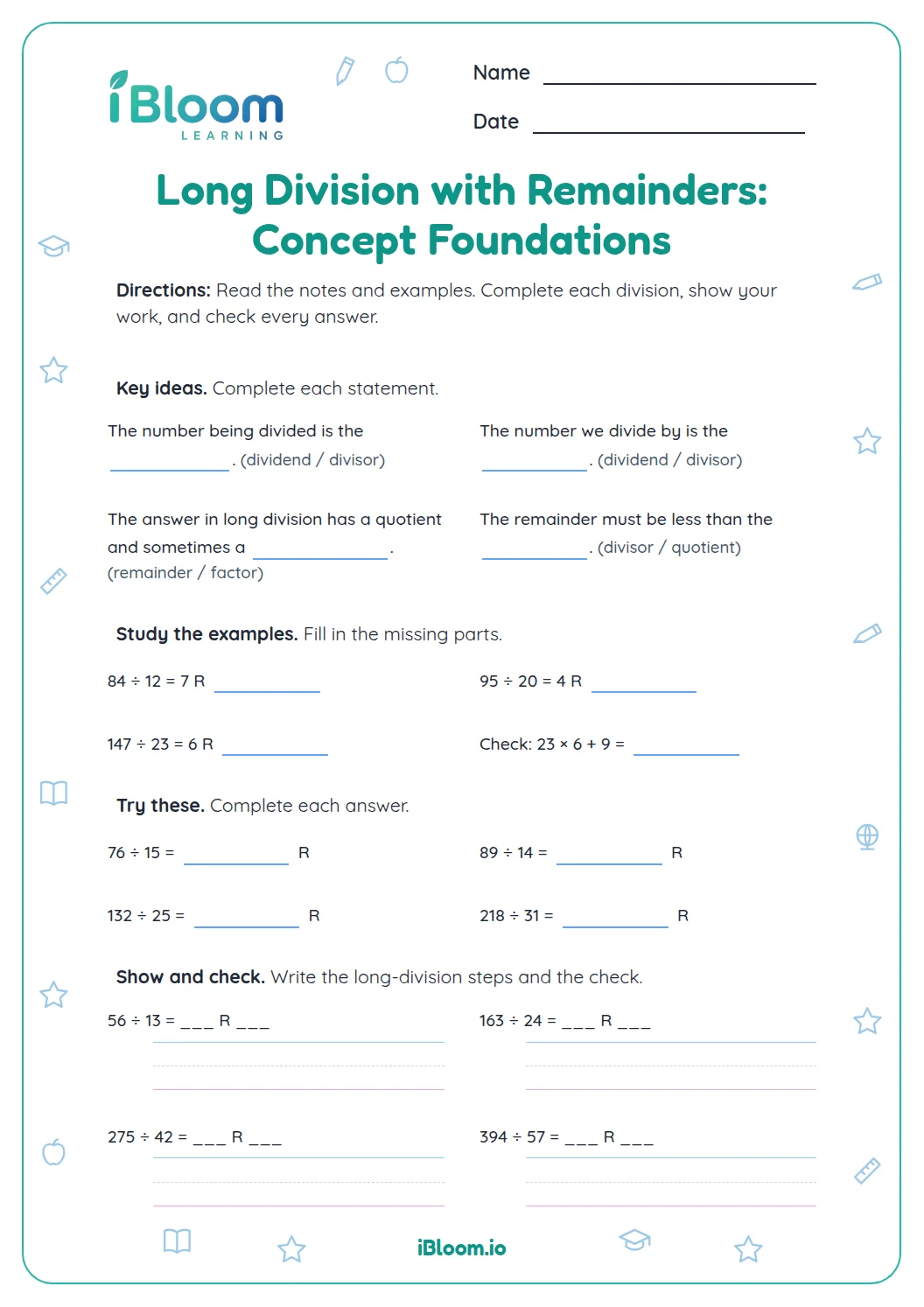
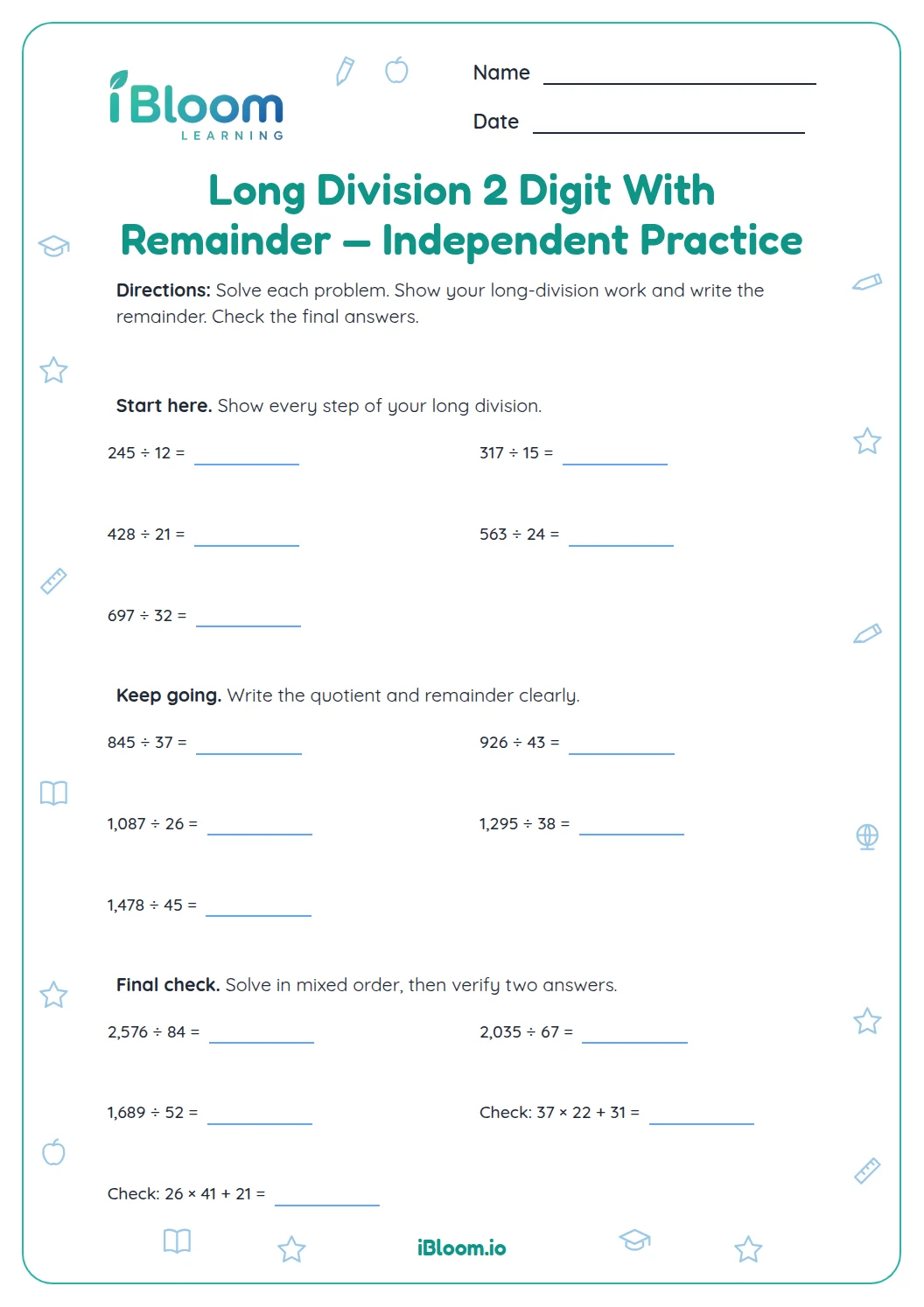
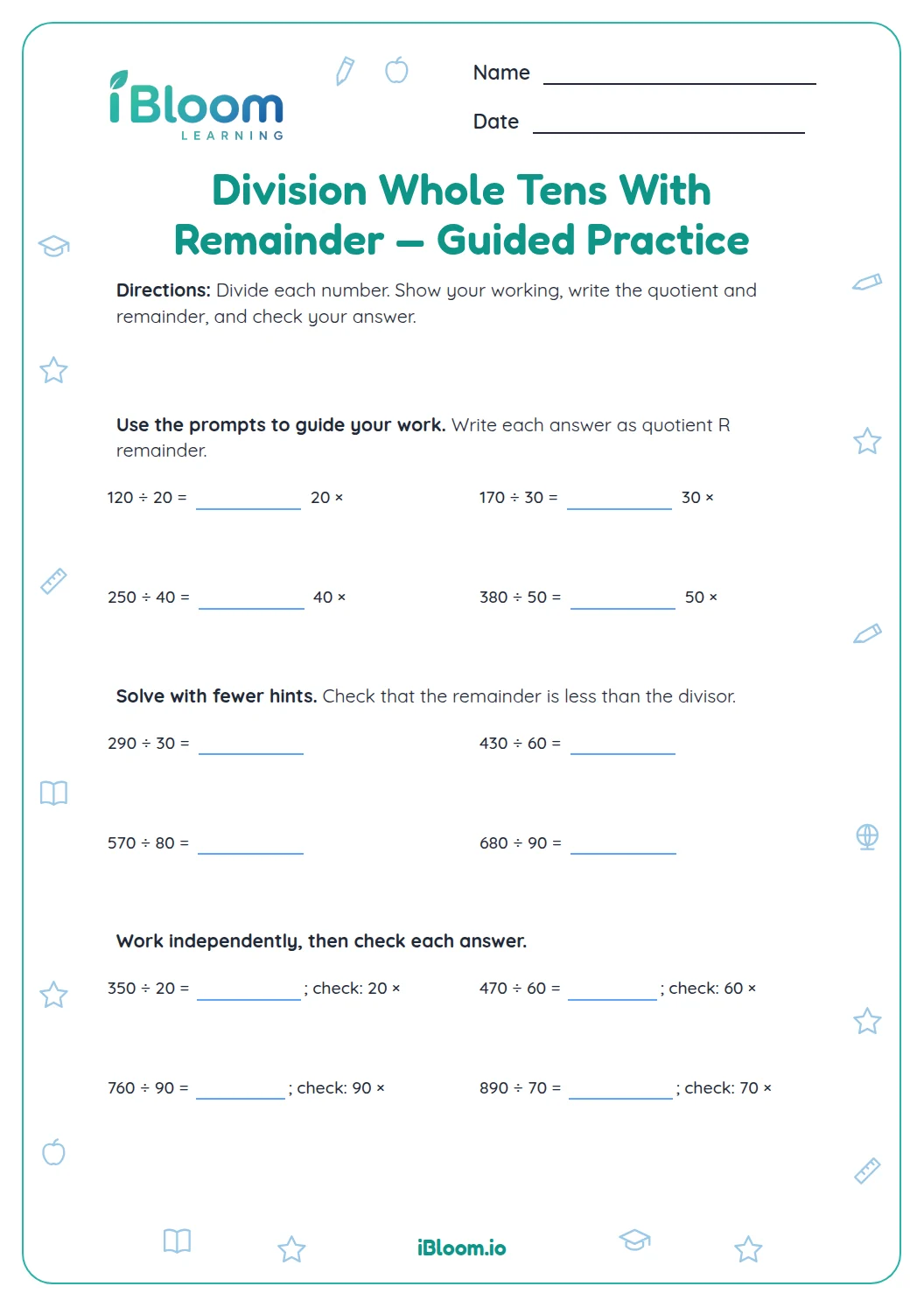
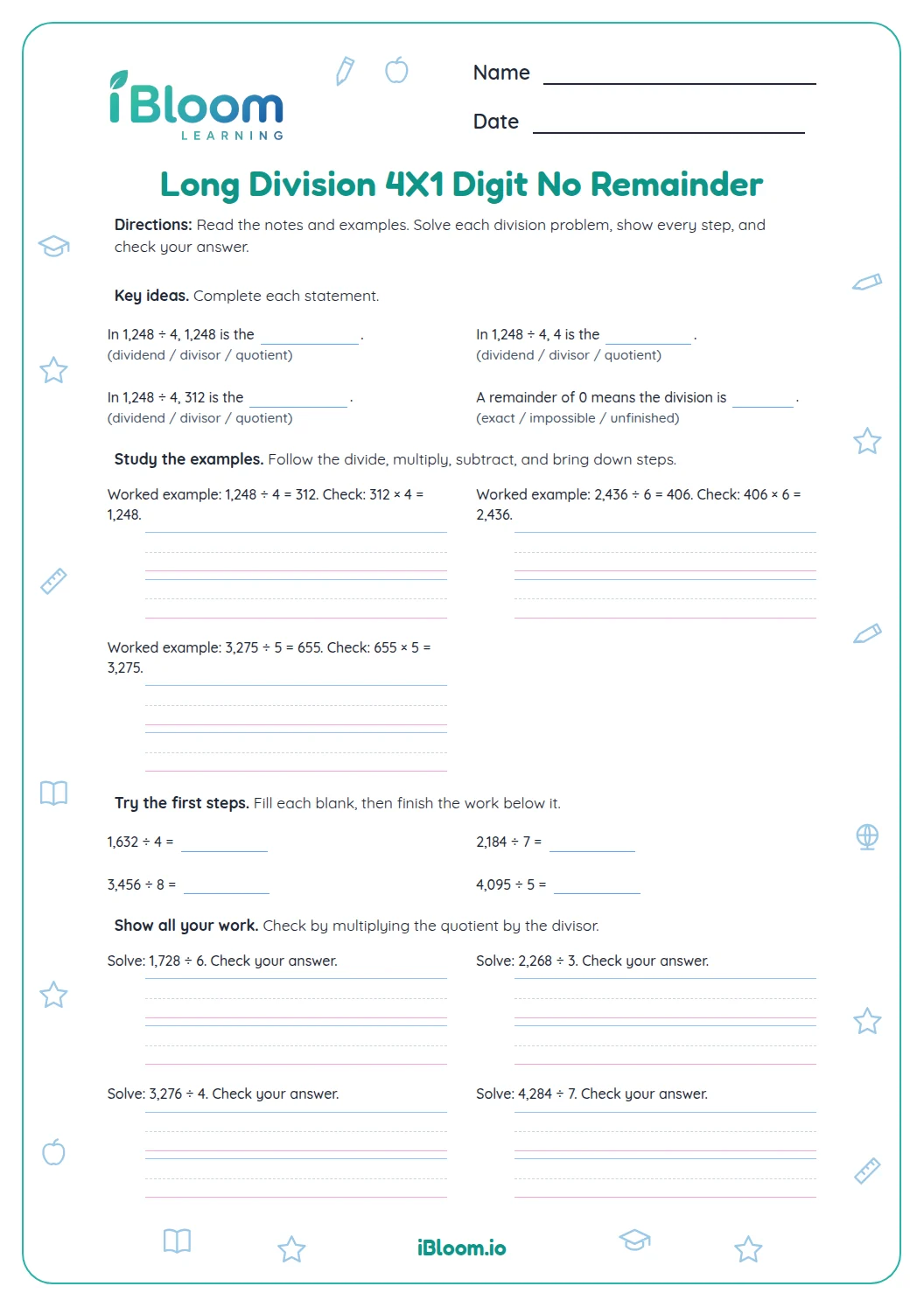
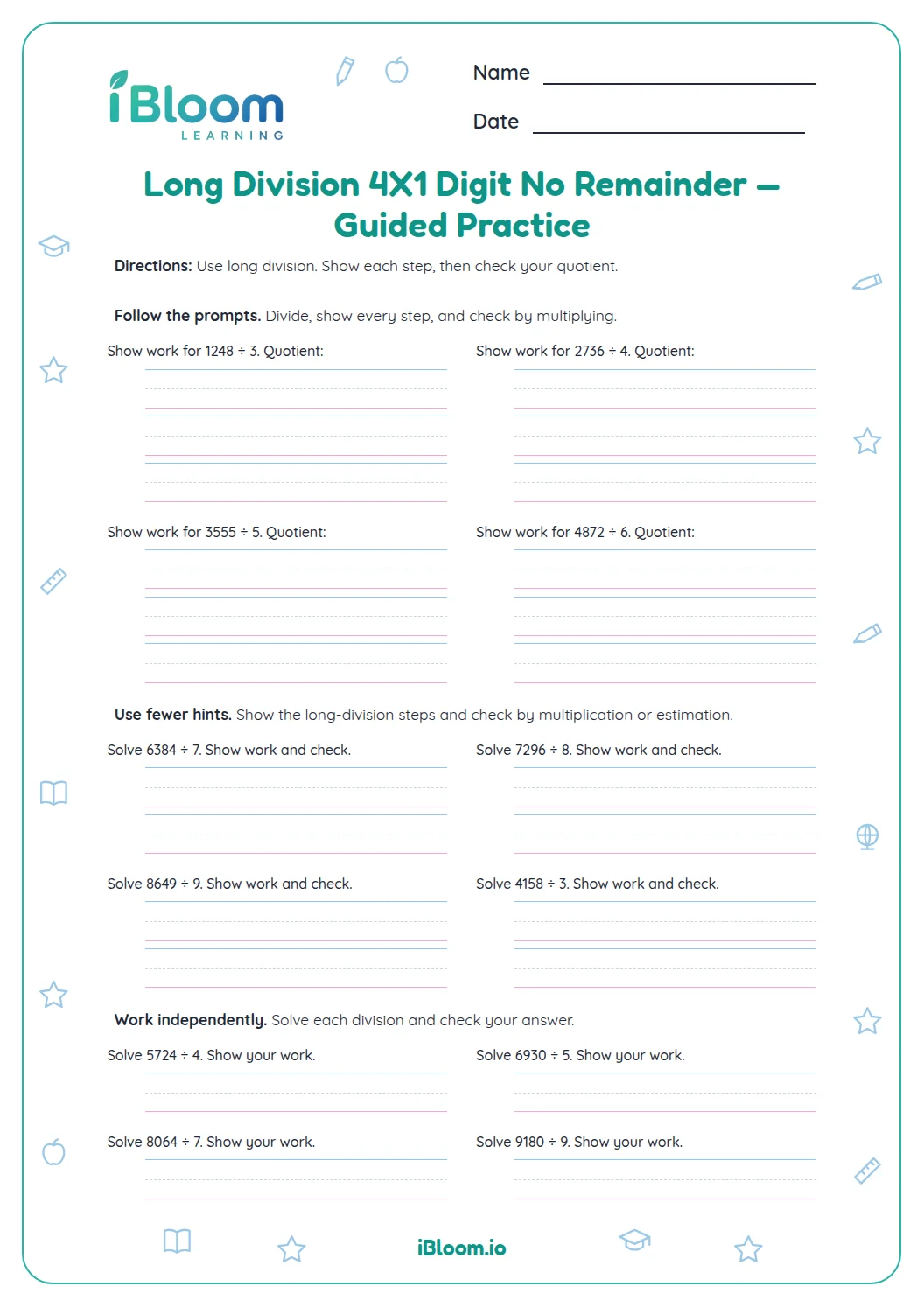
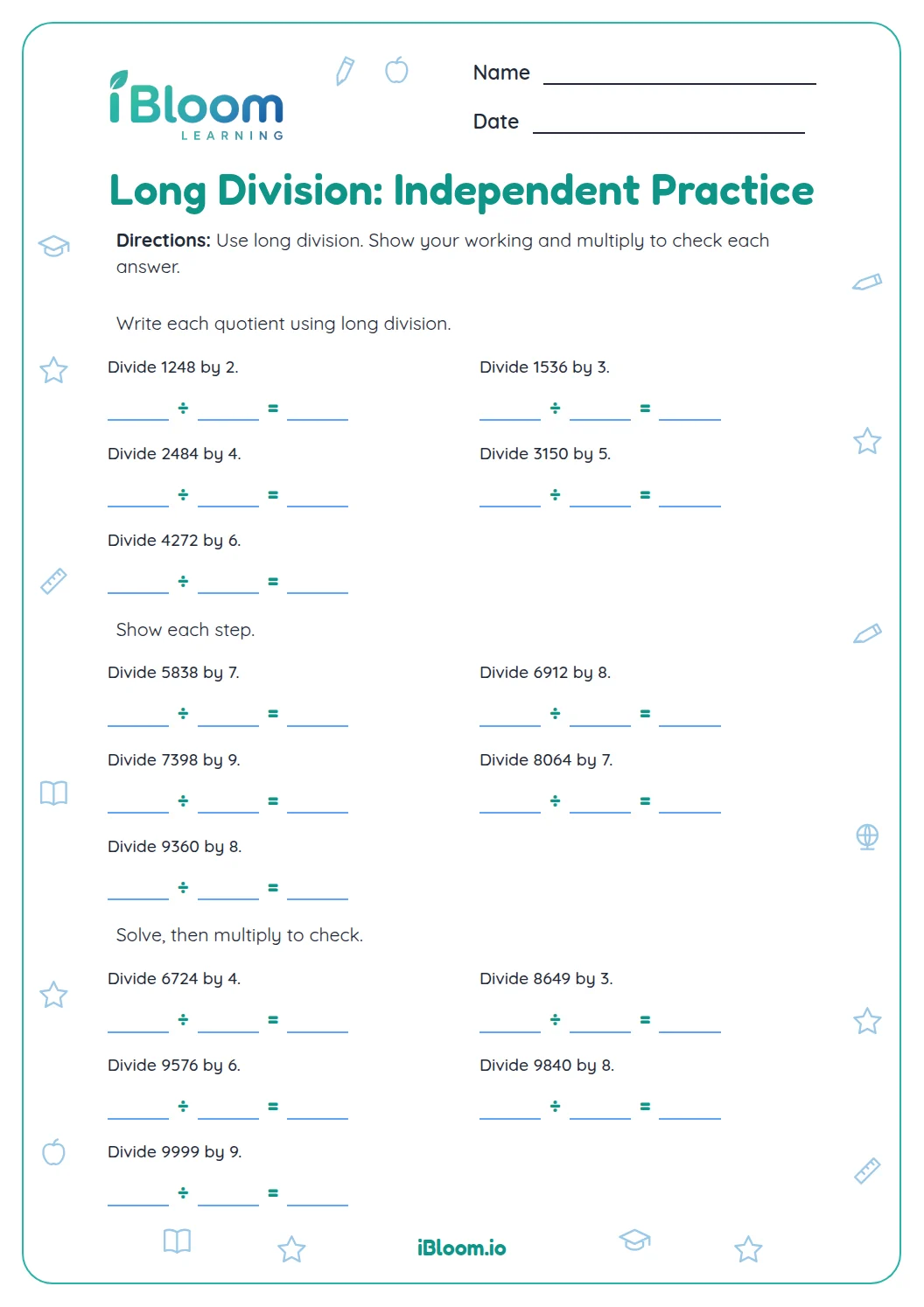
This Grade 5 worksheet gives students 14 long-division problems with two-digit divisors and dividends up to four digits. Students estimate, divide, multiply, subtract, and bring down digits as needed, then record a quotient and remainder. The final part asks students to solve independently. The answer key lists each result for checking with divisor × quotient + remainder = dividend. The work practices CCSS 5.NBT.B.6.
Aligned to 5.NBT.B.6
What is on the long-division worksheet?
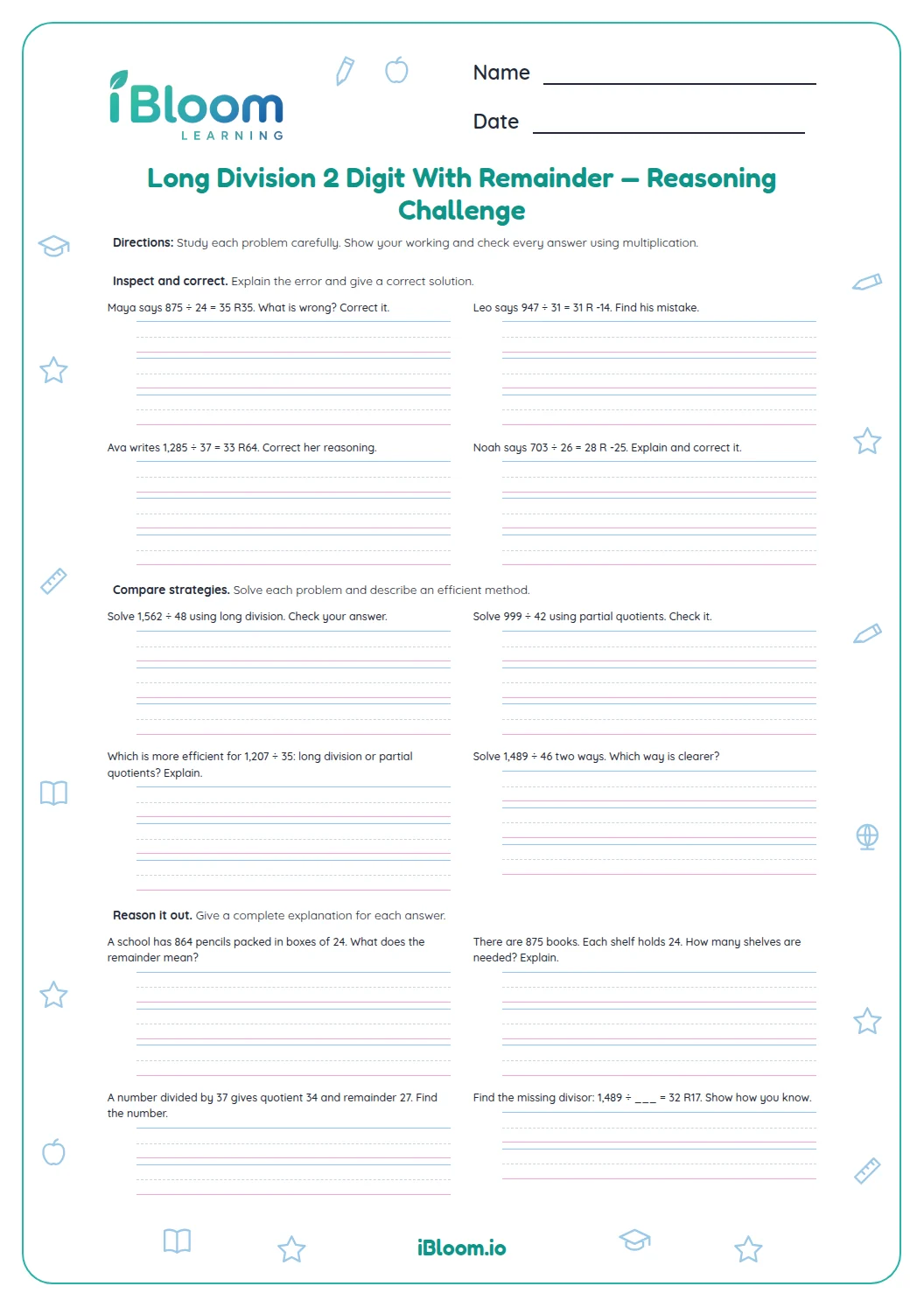
The 14 items all use two-digit divisors. Part A starts the practice; Part B adds problems with a remainder-size reminder; Part C asks students to work independently. Each response space is for long-division steps and the quotient with remainder.
The answer key lists each result. Check it two ways: divisor × quotient + remainder must equal the dividend, and the remainder must be smaller than the divisor.
- Part A: 5 quotient-and-remainder problems
- Part B: 7 problems with a remainder-size reminder
- Part C: 2 independent problems
How do you check a quotient and remainder?
Multiply the divisor by the quotient and add the remainder. Then compare the total with the dividend. The remainder must also be less than the divisor; otherwise another full group could be made.
- 1287 ÷ 14 = 20 R 7
- 214 × 20 + 7 = 287
- 37 is less than 14, so the quotient and remainder check.
What should students write for each problem?
The printed problems provide space for students to write the steps, then record a quotient and remainder such as 20 R 7. Begin by estimating, then use the long-division cycle of dividing, multiplying, subtracting, and bringing down as needed.
Why must the remainder be smaller than the divisor?
A remainder is what is left after making as many equal groups as possible. If 14 is the divisor and 15 remains, one more group of 14 still fits, so the quotient is not finished.
How to use this worksheet
- 1Read the dividend and divisor carefully.
- 2Estimate how many groups of the divisor fit.
- 3Use long division to find the quotient and what remains.
- 4Check divisor × quotient + remainder against the dividend.
- 5Confirm the remainder is less than the divisor, then compare with the key.
Common mistakes and quick fixes
The mistake
Writing a remainder as large as or larger than the divisor.
The fix
Make another group if the remainder is at least the divisor, then check again.
The mistake
Multiplying the quotient by the dividend during the check.
The fix
Multiply divisor × quotient, then add the remainder.
The mistake
Stopping before checking the subtraction.
The fix
Multiply back and confirm the result equals the original dividend.
Curriculum alignment
This page practices a grade-level skill named in the Common Core State Standards.
Find whole-number quotients with up to four-digit dividends and two-digit divisors.
On this sheet: Each problem practices division by a two-digit whole number and checking the quotient.
Show the official wordingHide the official wording
Find whole-number quotients of whole numbers with up to four-digit dividends and two-digit divisors, using strategies based on place value, the properties of operations, and/or the relationship between multiplication and division. Illustrate and explain the calculation by using equations, rectangular arrays, and/or area models.
What to practice next
Make more practice
Further reading
Questions parents and teachers ask
How does the answer key show each result?
The key writes the quotient followed by R and the remainder, such as 20 R 7. To check it, multiply 14 by 20 and add 7; the result is 287. The remainder must also be smaller than 14 so the quotient represents all full groups.
What does R mean in a division answer?
R means remainder: the amount left after making all possible equal groups. In 287 ÷ 14 = 20 R 7, twenty groups of fourteen use 280, leaving seven. Since seven is less than fourteen, no additional full group can be made.
Why does the worksheet use two-digit divisors?
Each problem asks students to divide by a two-digit whole number, matching the skill named in the worksheet title. Students work with dividends up to four digits and use quotient-and-remainder notation, then check the relationship between multiplication and division. A final check helps confirm the quotient is reasonable.
How can students catch a division error?
Use multiplication to check the answer: divisor times quotient, plus remainder, should equal the dividend. Then check that the remainder is smaller than the divisor. If either check fails, revisit the multiplication or subtraction steps in the long division. A quick estimate can reveal an answer that is far too large or small.
How many problems are on the printable?
There are 14 problems across the worksheet, followed by an answer key. The parts move from initial quotient practice to a final set students can solve independently. Students can show the long-division steps in the response space for each problem.