



About this worksheet
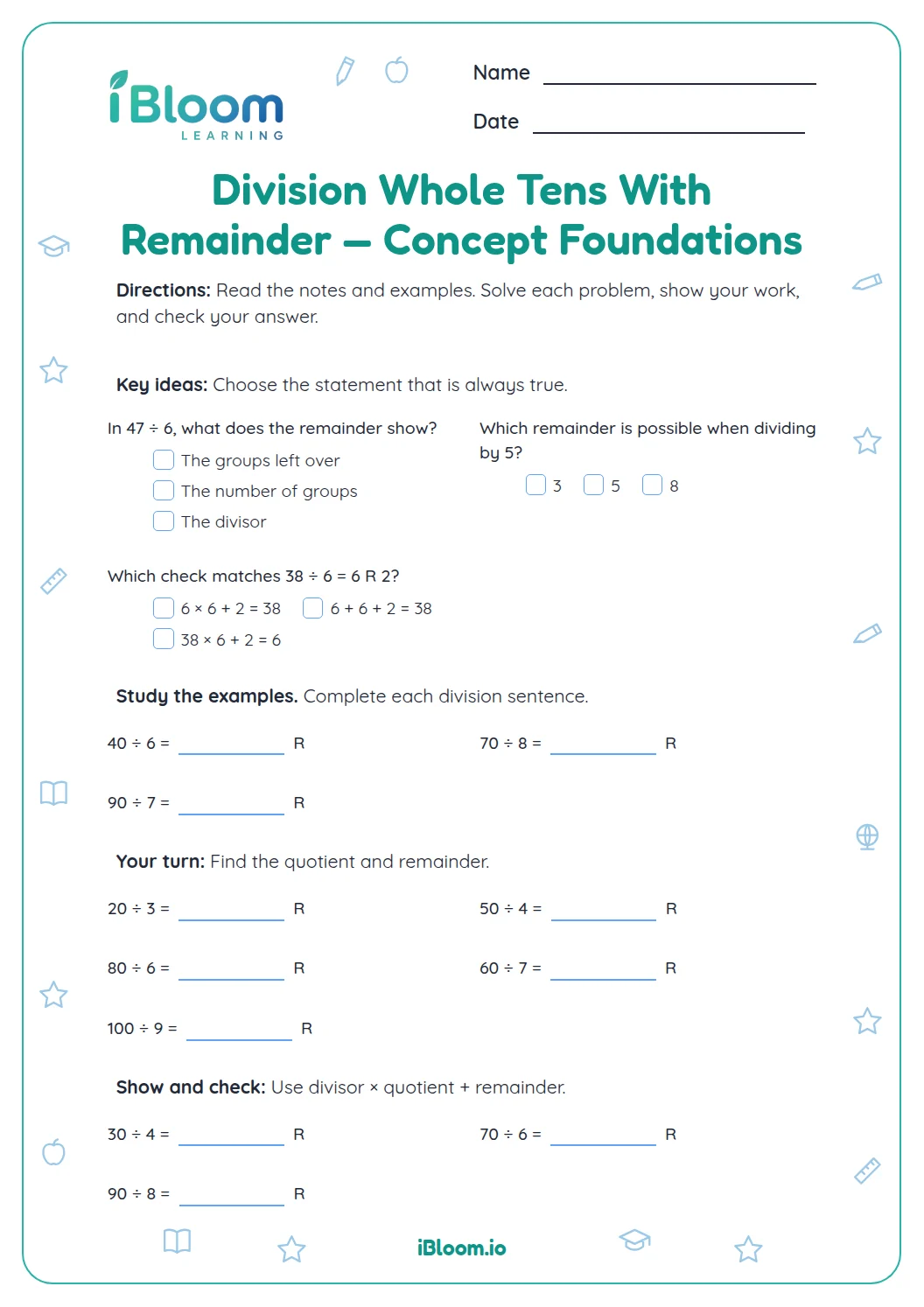
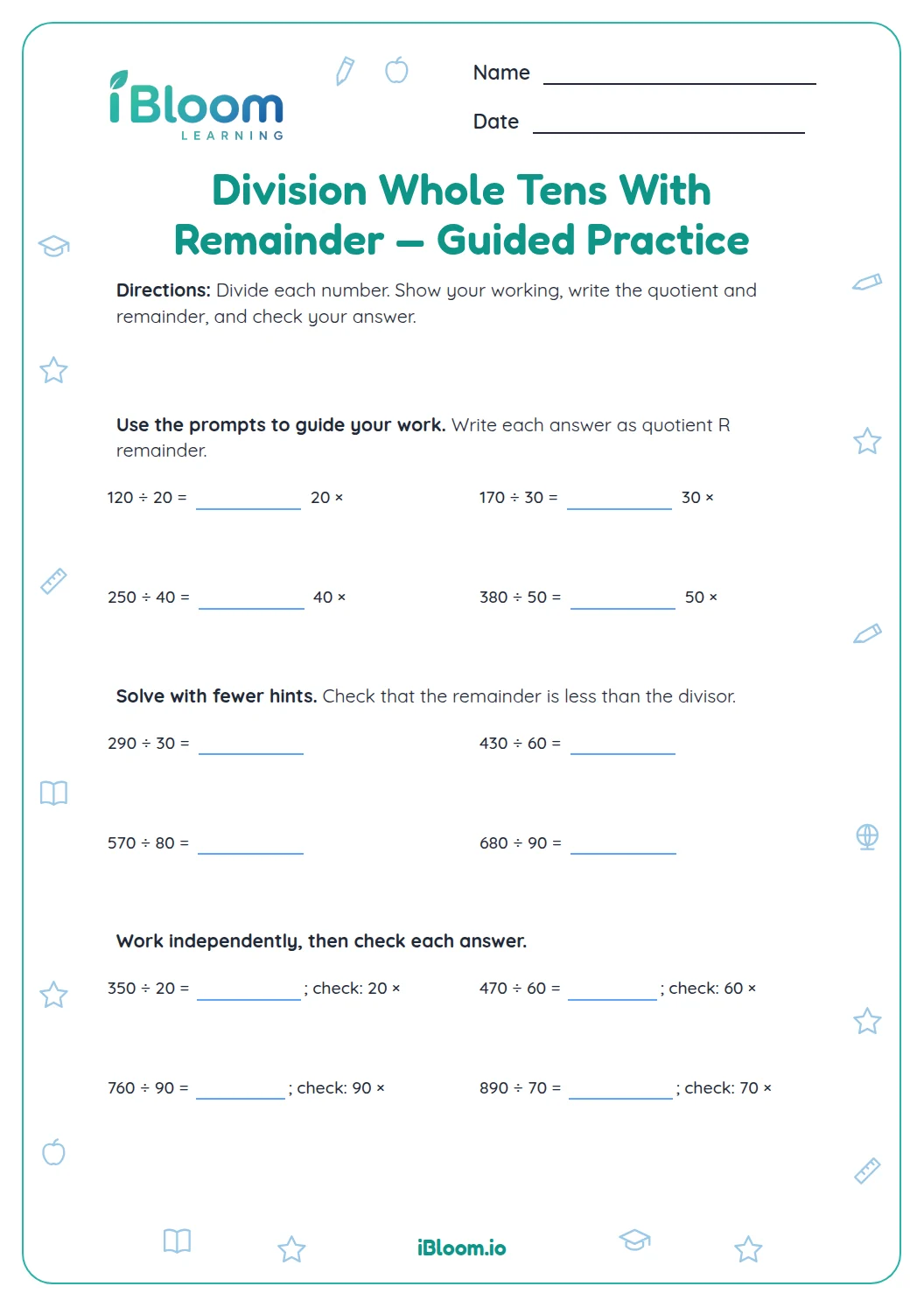
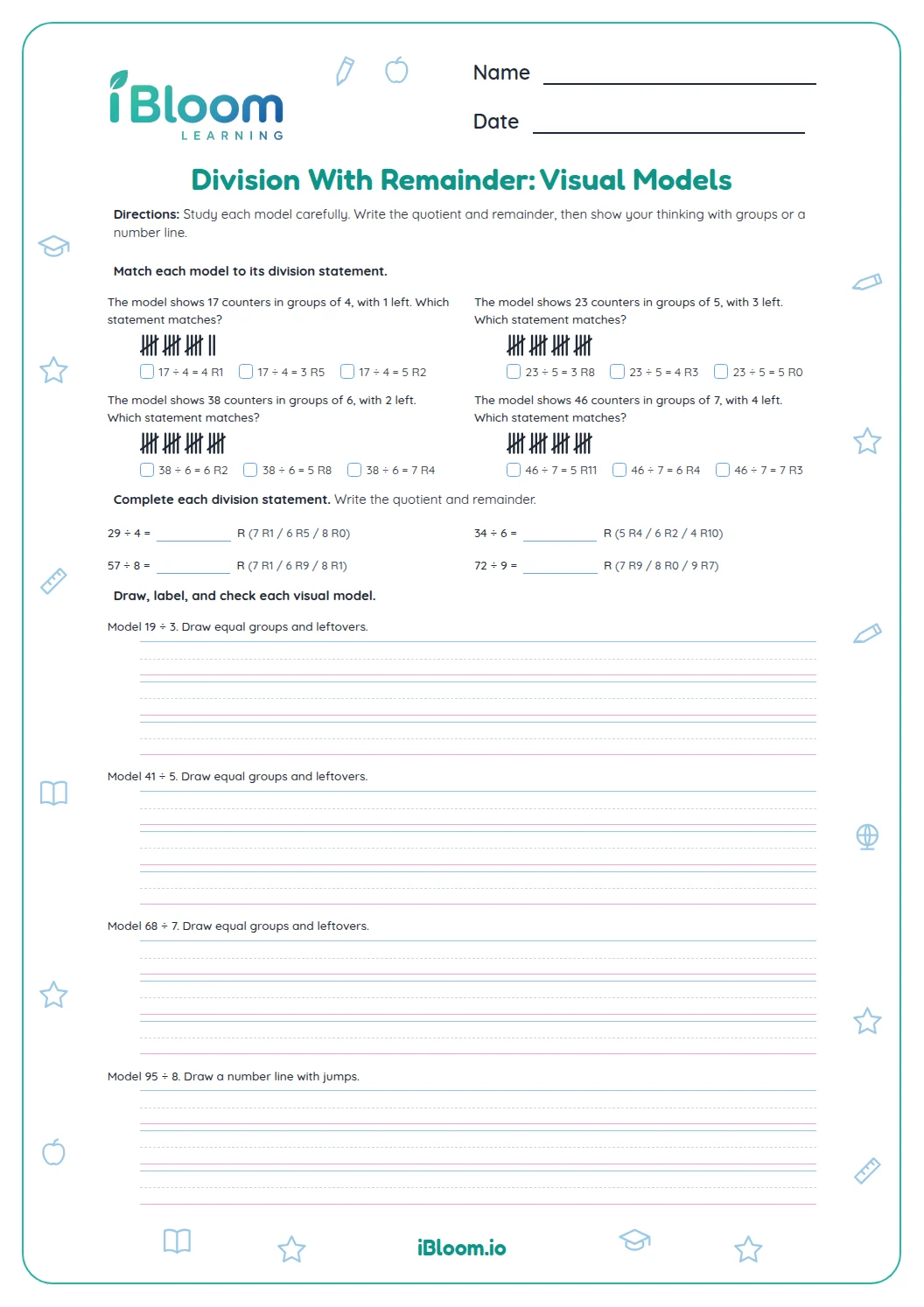
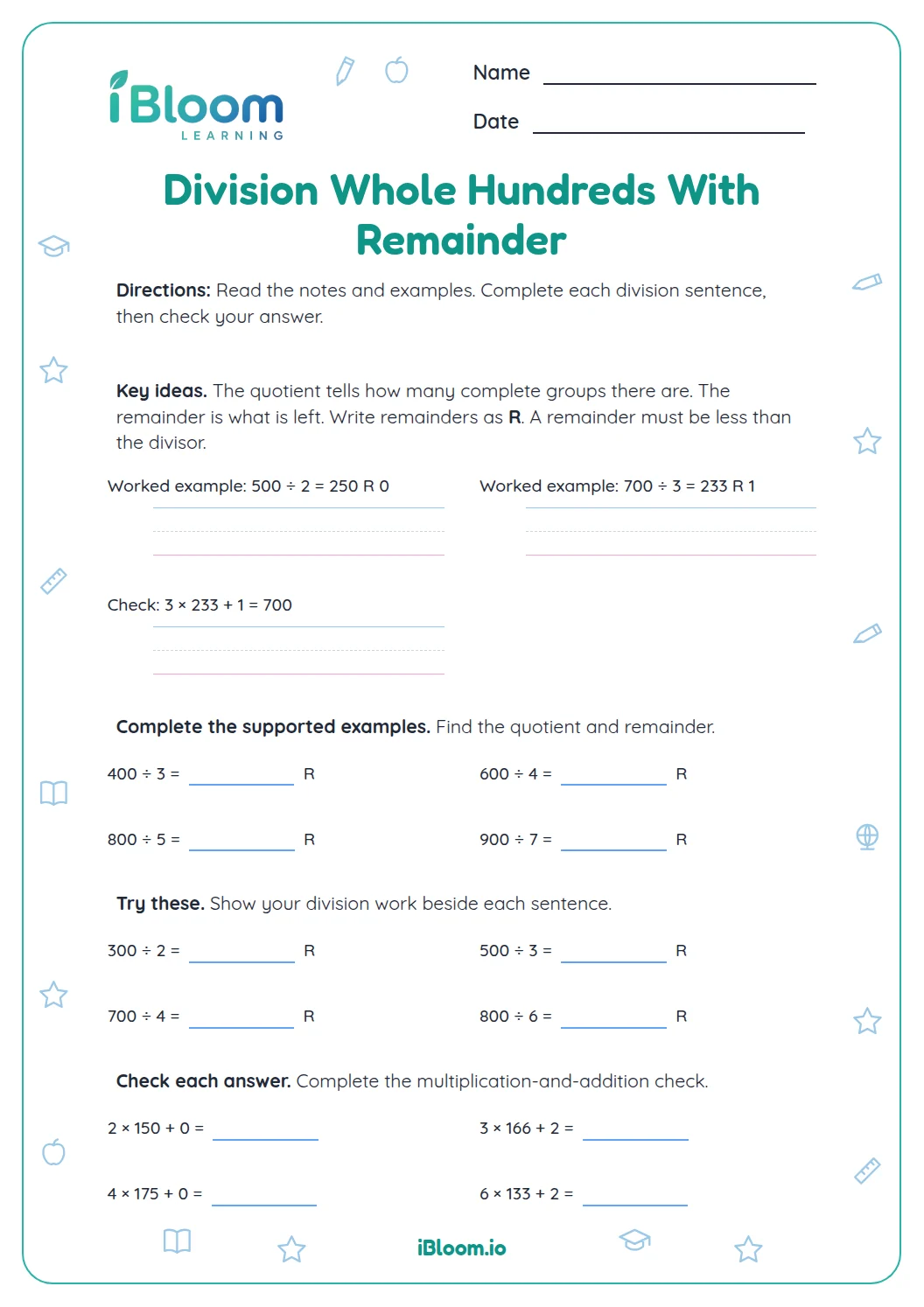
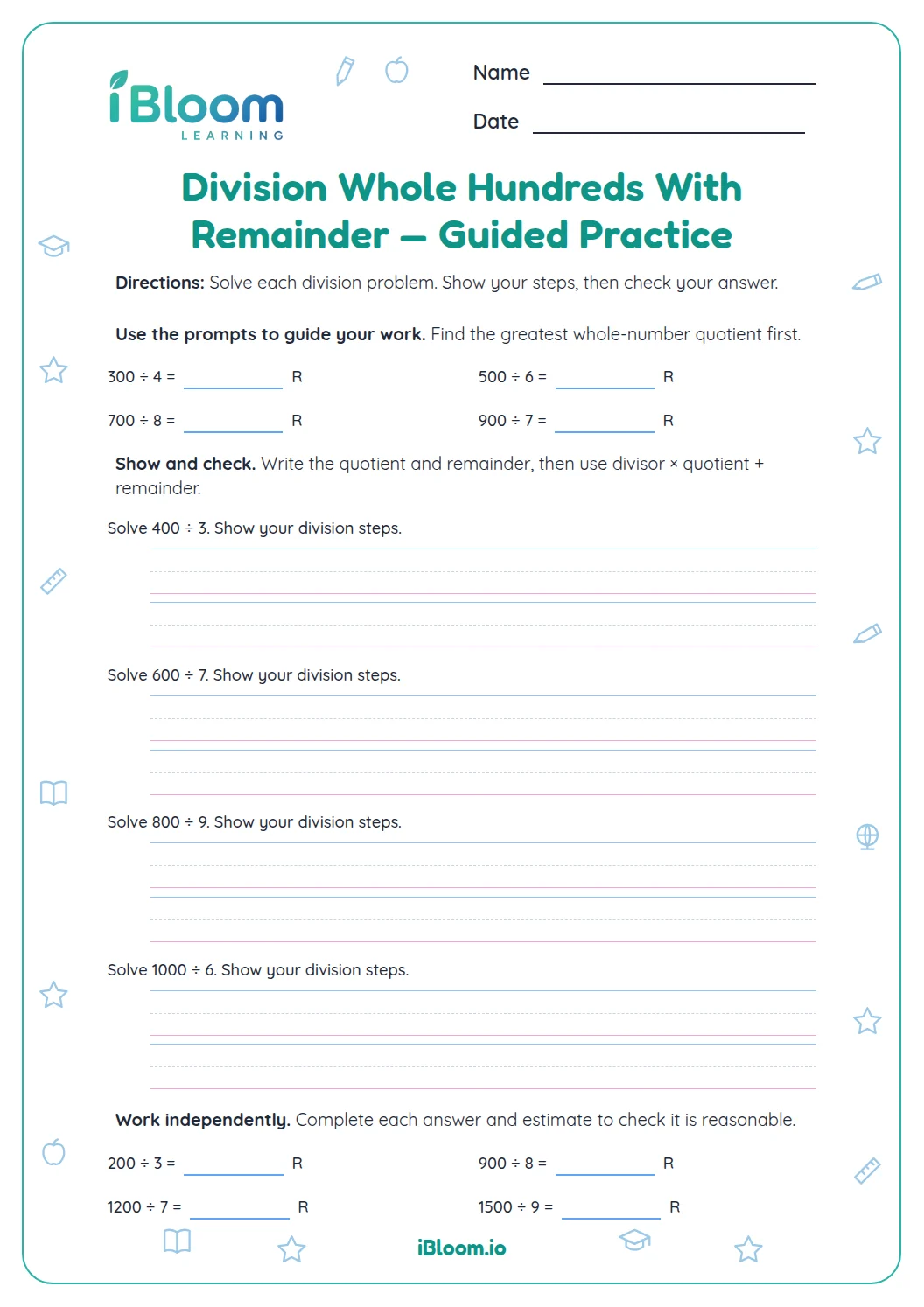
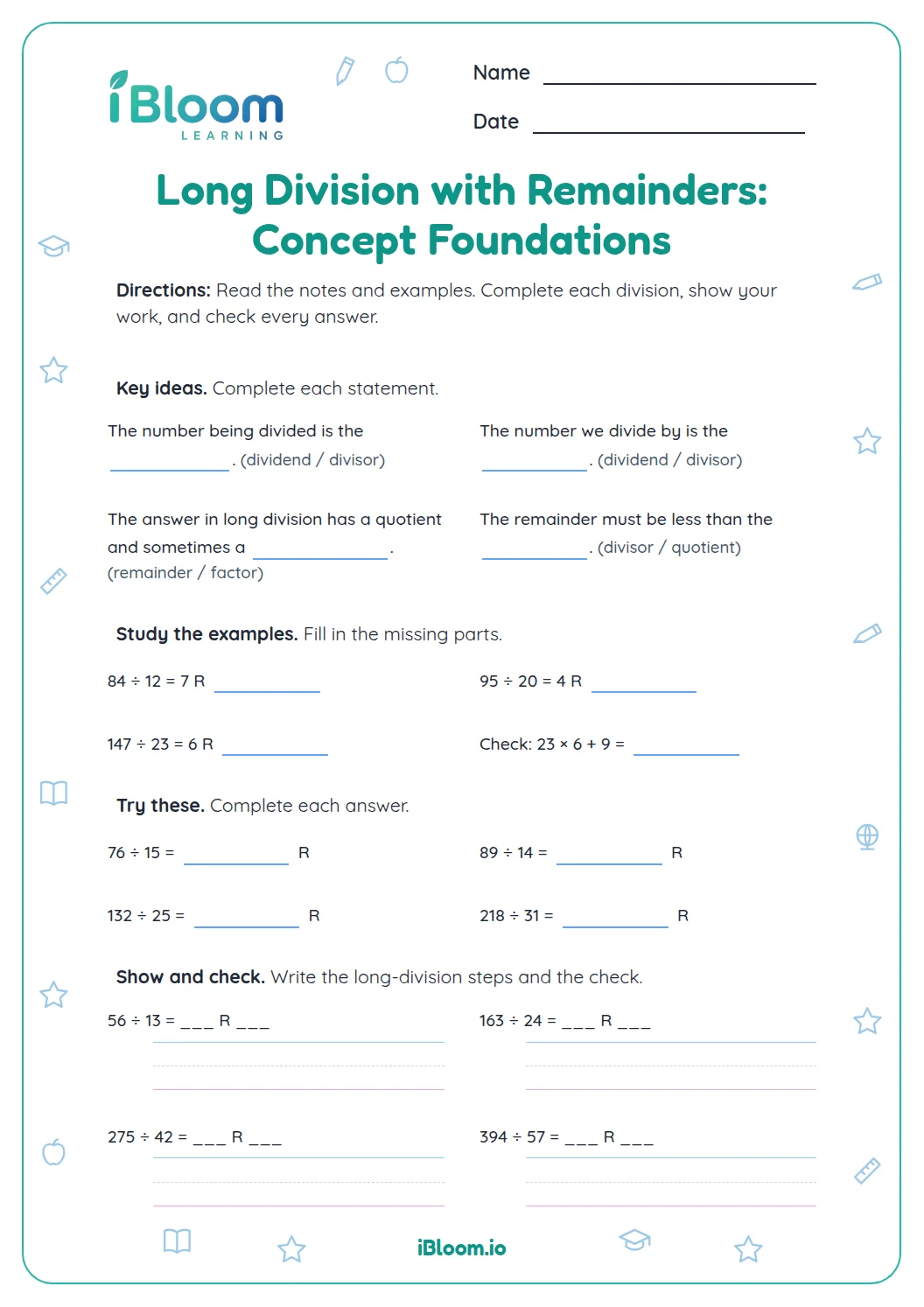
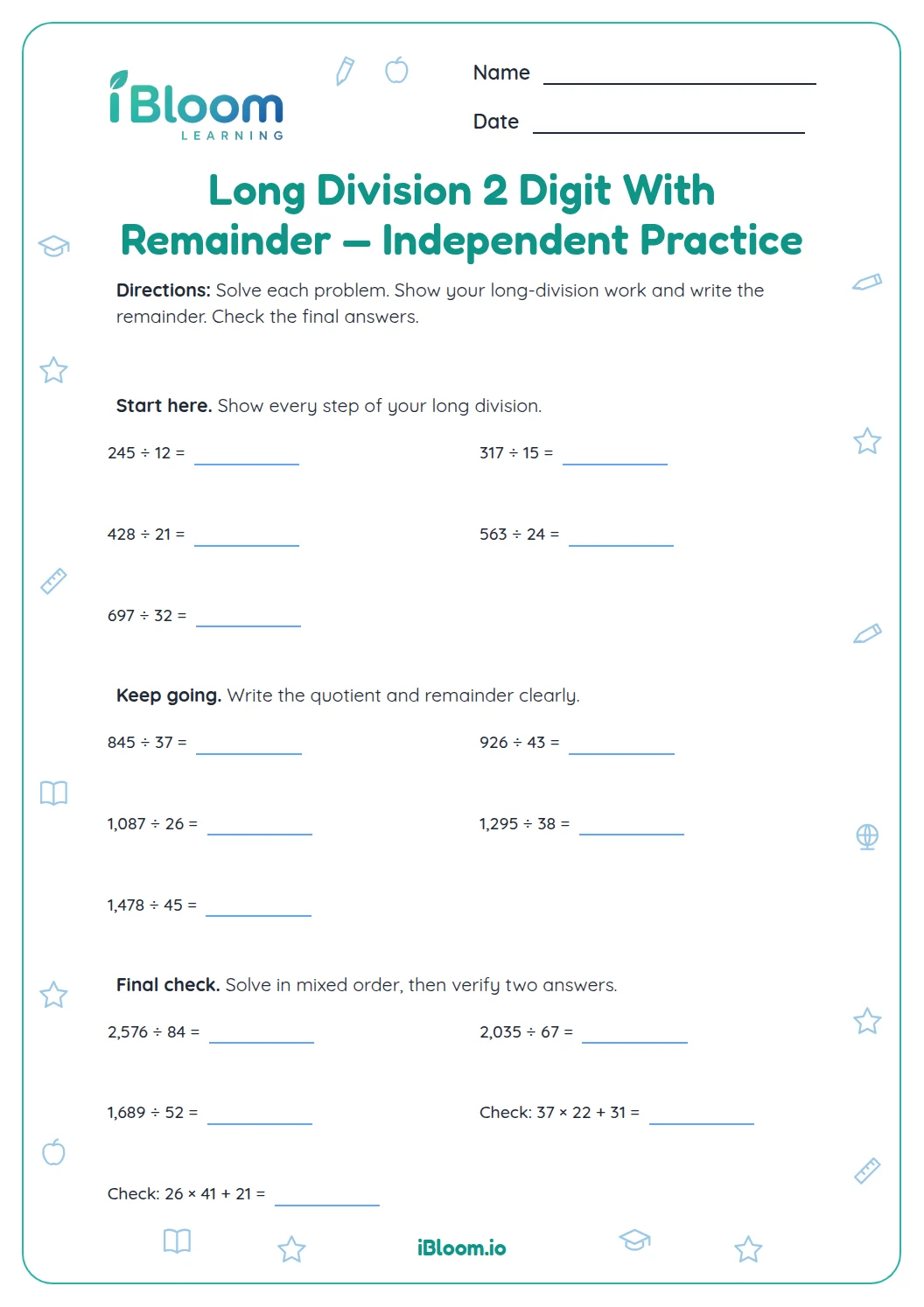
This Grade 5 worksheet practices dividing whole tens when a remainder may be left. Eight tens-array models show the dividend as countable tens; students group them by the divisor and report the quotient and remaining tens. Four contexts and four quotient-remainder checks extend the same reasoning. The set practices CCSS 5.NBT.B.6 and includes a separate answer key.
Aligned to 5.NBT.B.6
How can base-ten blocks support division?
Each array dot represents one ten. Group the tens according to the divisor, then count the complete groups and the leftover tens to write the quotient and remainder.
- 180 is 8 tens; group by 3 tens
- 22 full groups use 6 tens
- 32 tens remain
- 480 ÷ 30 = 2 R20
What does a remainder mean in a grouping story?
A remainder is the amount left after making as many complete groups as possible. Read the story to identify what one group contains, then state the number of full groups and leftover items.
How can multiplication verify the answer?
For a quotient q and remainder r, compute divisor × q + r. It should equal the dividend, and r must be less than the divisor.
How to use this worksheet
- 1Read the drawing as hundreds and tens.
- 2Choose the greatest number of complete equal groups.
- 3Subtract the grouped amount to find what remains.
- 4In each story, label the quotient as complete groups.
- 5Check divisor × quotient + remainder against the dividend.
Common mistakes and fixes
The mistake
Leaving a remainder as large as the divisor
The fix
Make one more group whenever the remainder is at least the divisor.
The mistake
Reporting only the remainder in a story
The fix
State both complete groups and leftover items.
The mistake
Forgetting the remainder in the check
The fix
Add the leftover amount after multiplying divisor and quotient.
Common Core alignment
This worksheet practices the following Common Core skill.
Use place value and the multiplication-division relationship to divide whole numbers.
On this sheet: Students divide whole tens, interpret remainders and verify with multiplication equations.
Show the official wordingHide the official wording
Find whole-number quotients of whole numbers with up to four-digit dividends and two-digit divisors, using strategies based on place value, the properties of operations, and/or the relationship between multiplication and division. Illustrate and explain the calculation by using equations, rectangular arrays, and/or area models.
What to practice next
Make more practice
Further reading
Questions parents and teachers ask
What does R mean in an answer such as 2 R20?
R means remainder. For 80 ÷ 30, eight tens make two full groups of three tens, with two tens left, so the answer is 2 R20. The remainder is smaller than the divisor. The worksheet uses this relationship in model items, grouping stories and checks.
How should students read the base-ten drawing?
Each base-ten drawing shows the dividend as hundreds and tens, and the prompt names the divisor. Use place value to reason how many full groups fit, then find the amount left. The drawing supports identifying the number being divided; the written division relationship makes the grouping explicit.
How do word problems use the remainder?
The quotient names the complete boxes, bins, cartons or groups. The remainder names the items left over after making as many complete groups as possible, so both numbers matter in each story answer. For example, 190 cards packed in groups of 40 make four full boxes with 30 cards remaining.
How can students check their answers?
Multiply the divisor by the quotient and add the remainder. The total should equal the dividend, and the remainder should be less than the divisor; these checks catch an extra or missing group. The worksheet includes both an incorrect quotient-remainder claim and a completed relationship to verify.
Does this worksheet include an answer key?
Yes. The separate key gives the quotient and remainder for all 16 items, including the four context problems and the final relationship checks. Eight model questions begin the worksheet, followed by grouping situations and checks that use the same division idea.