

About this worksheet
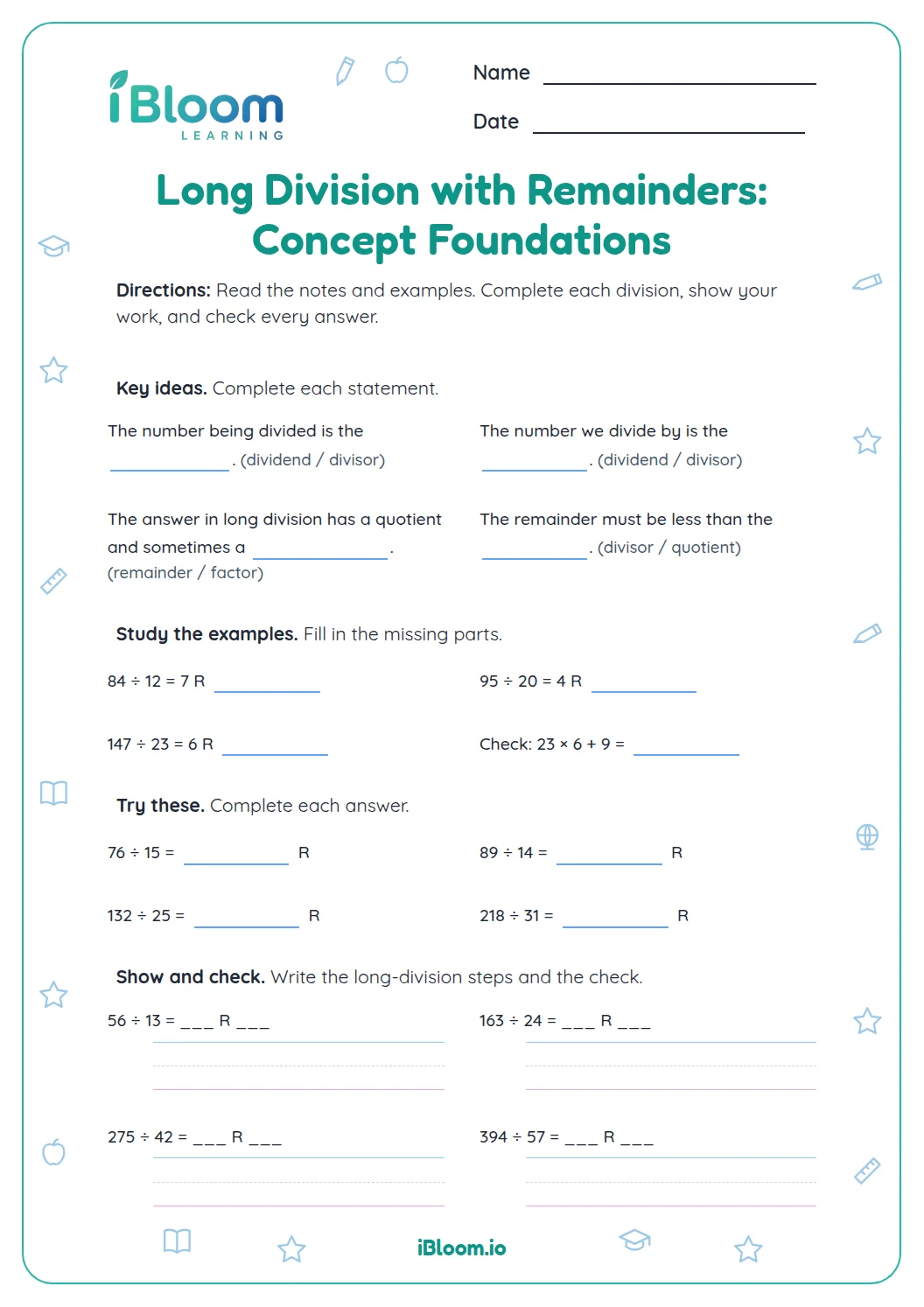
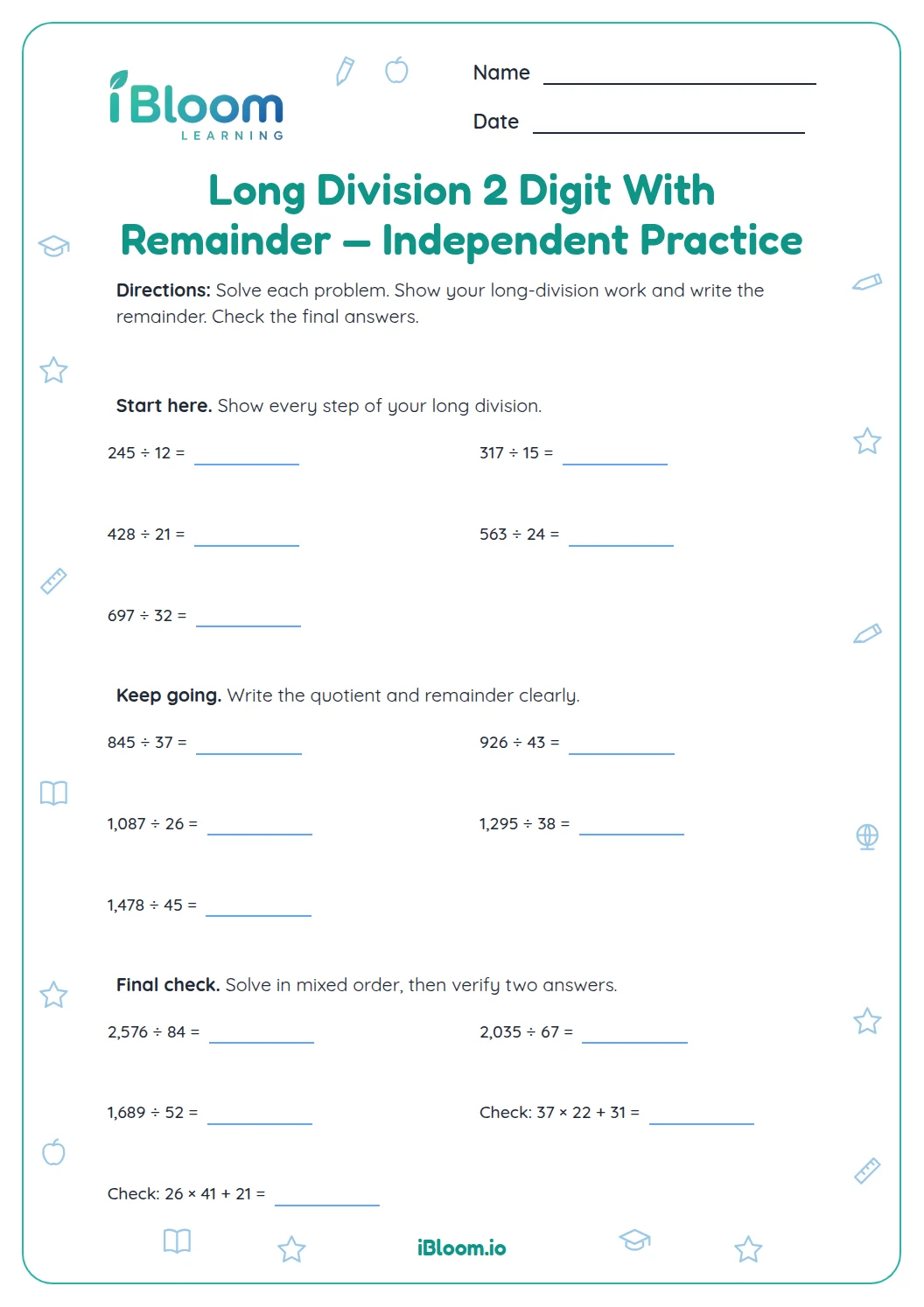
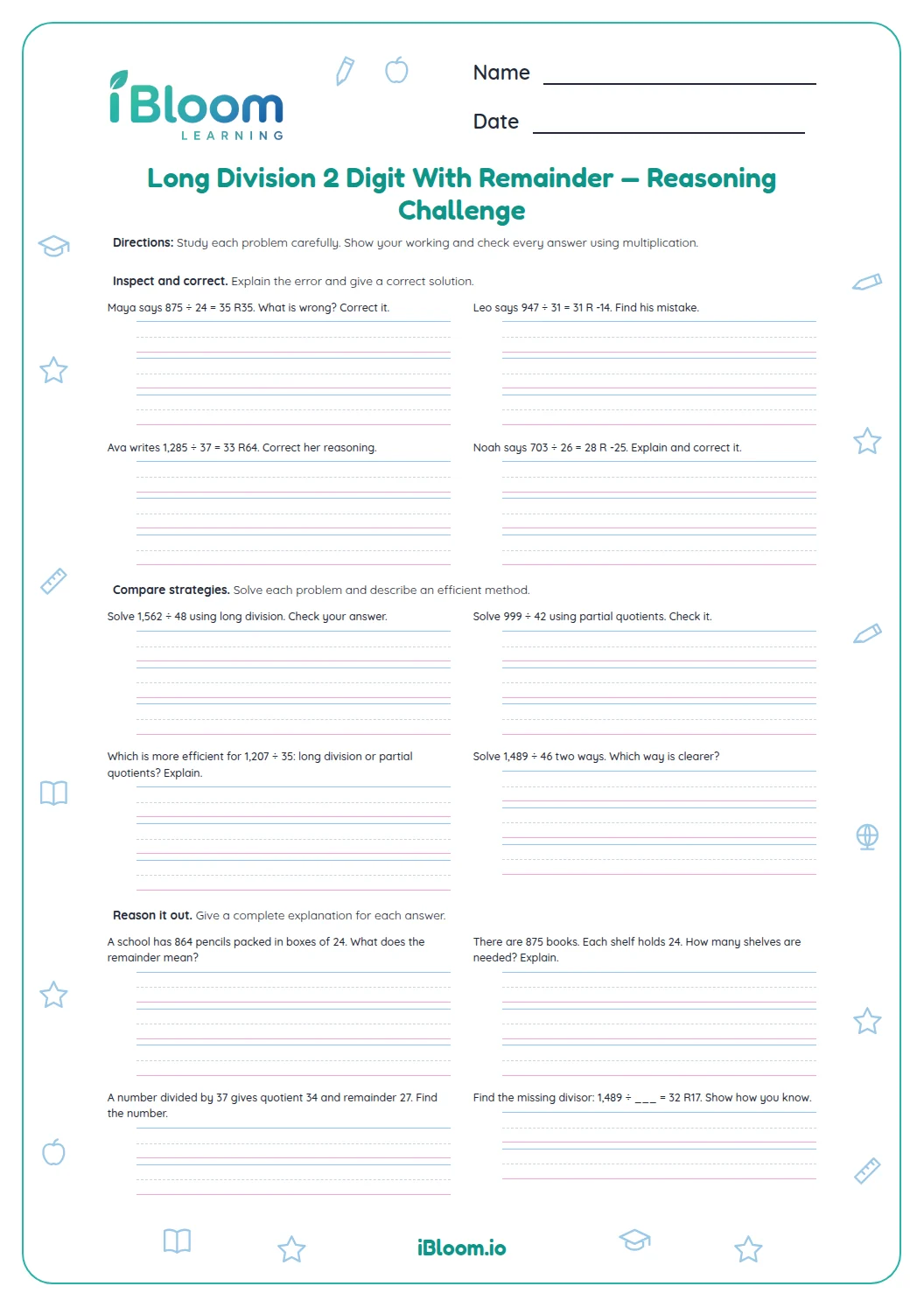
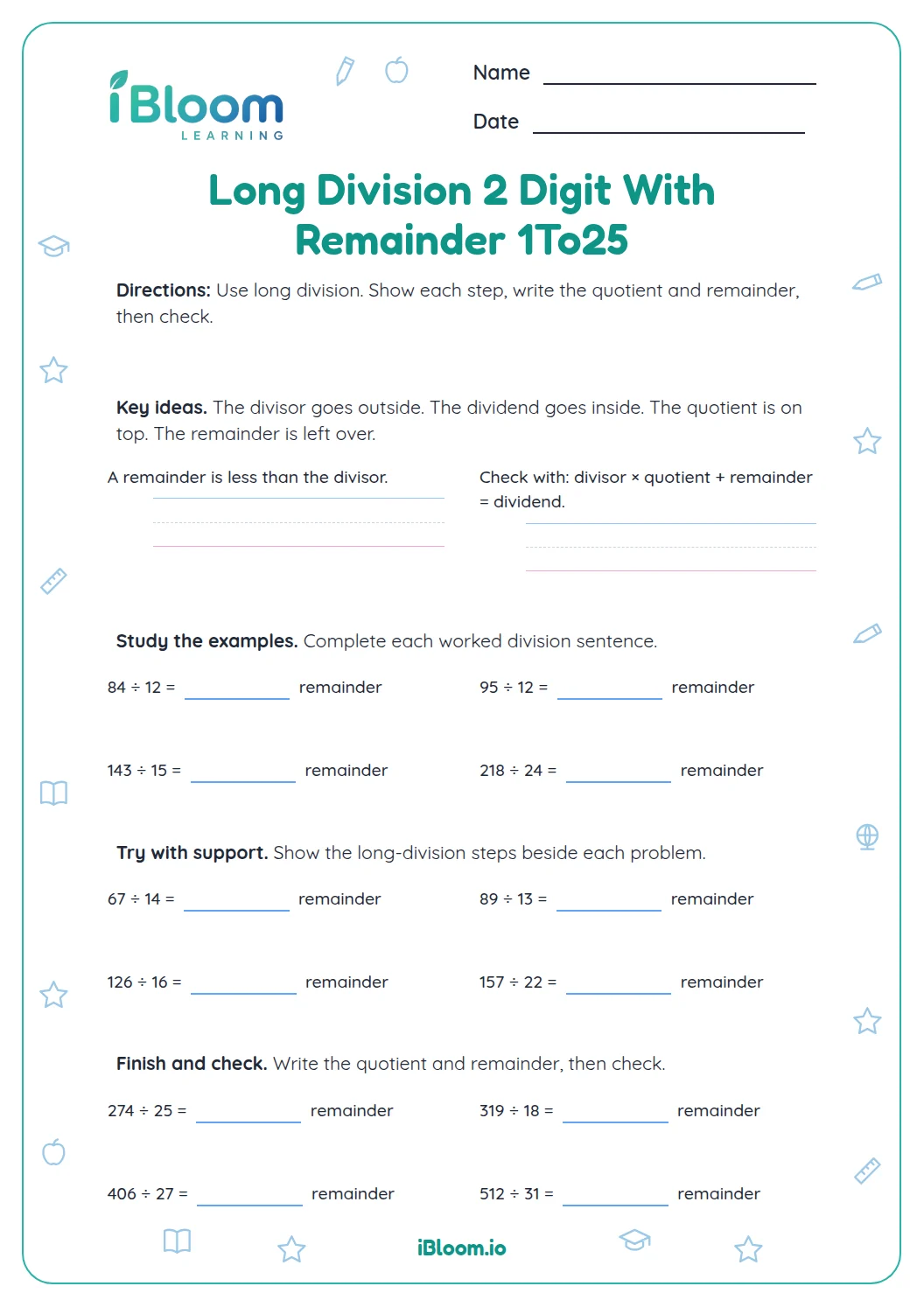
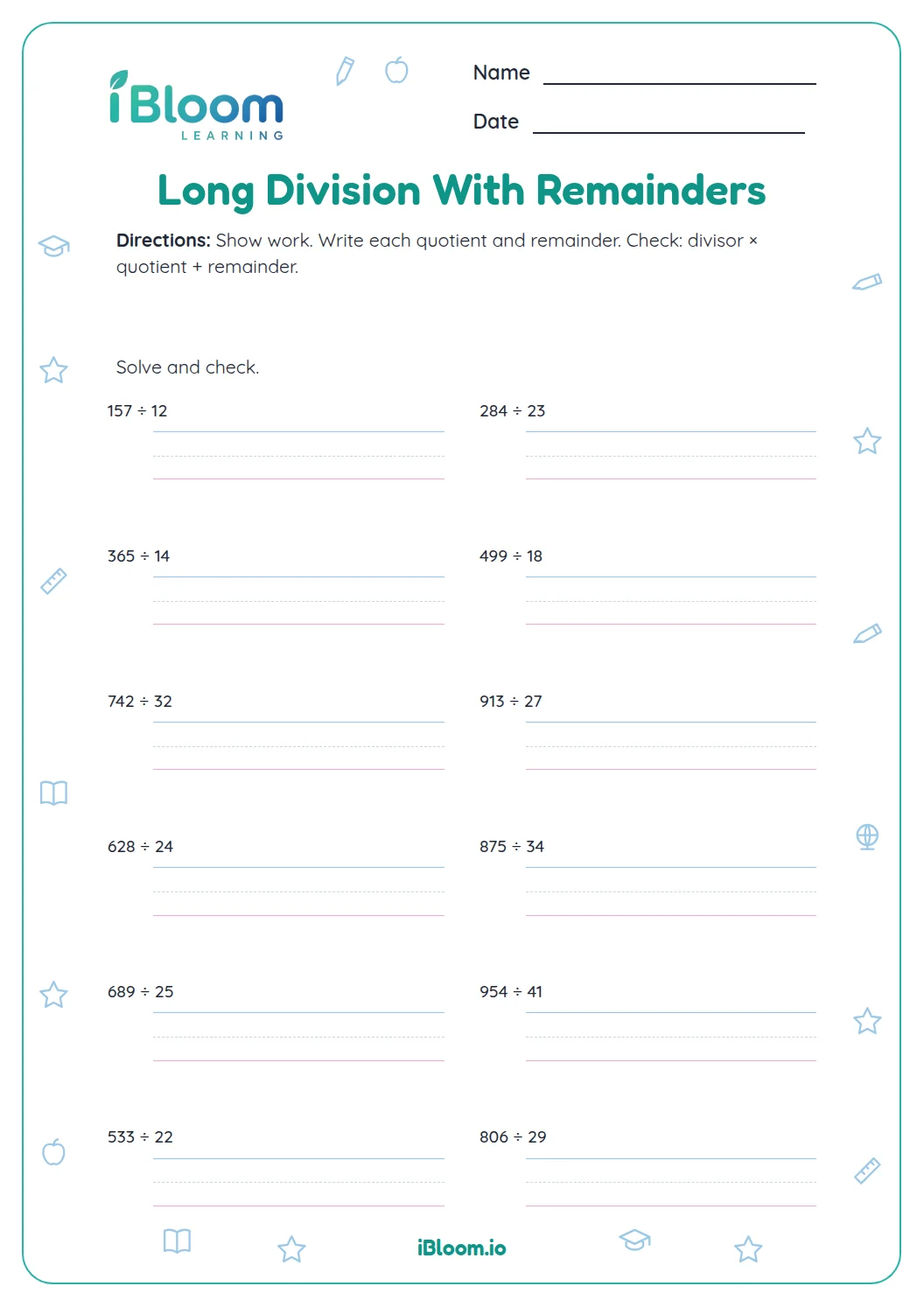
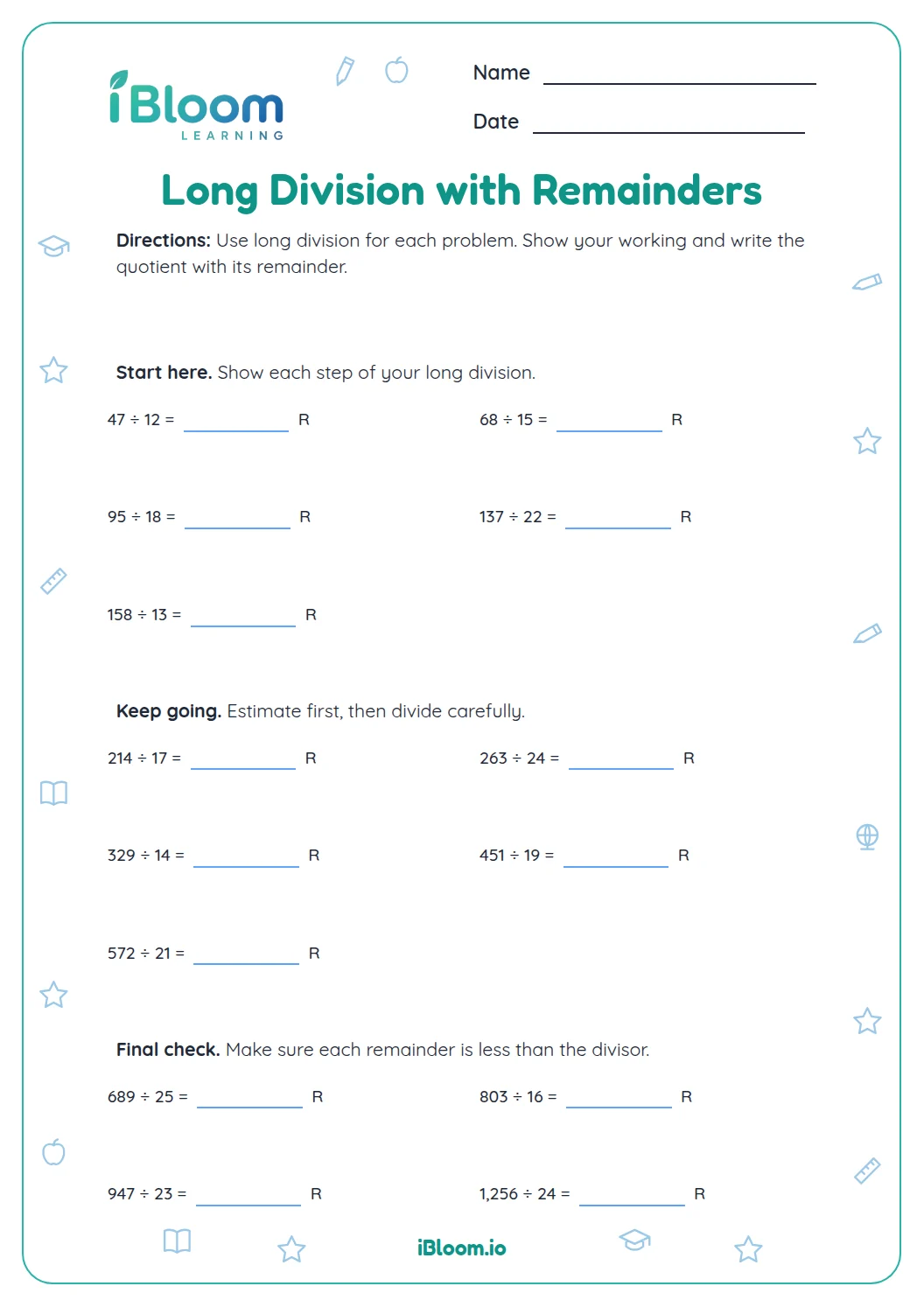
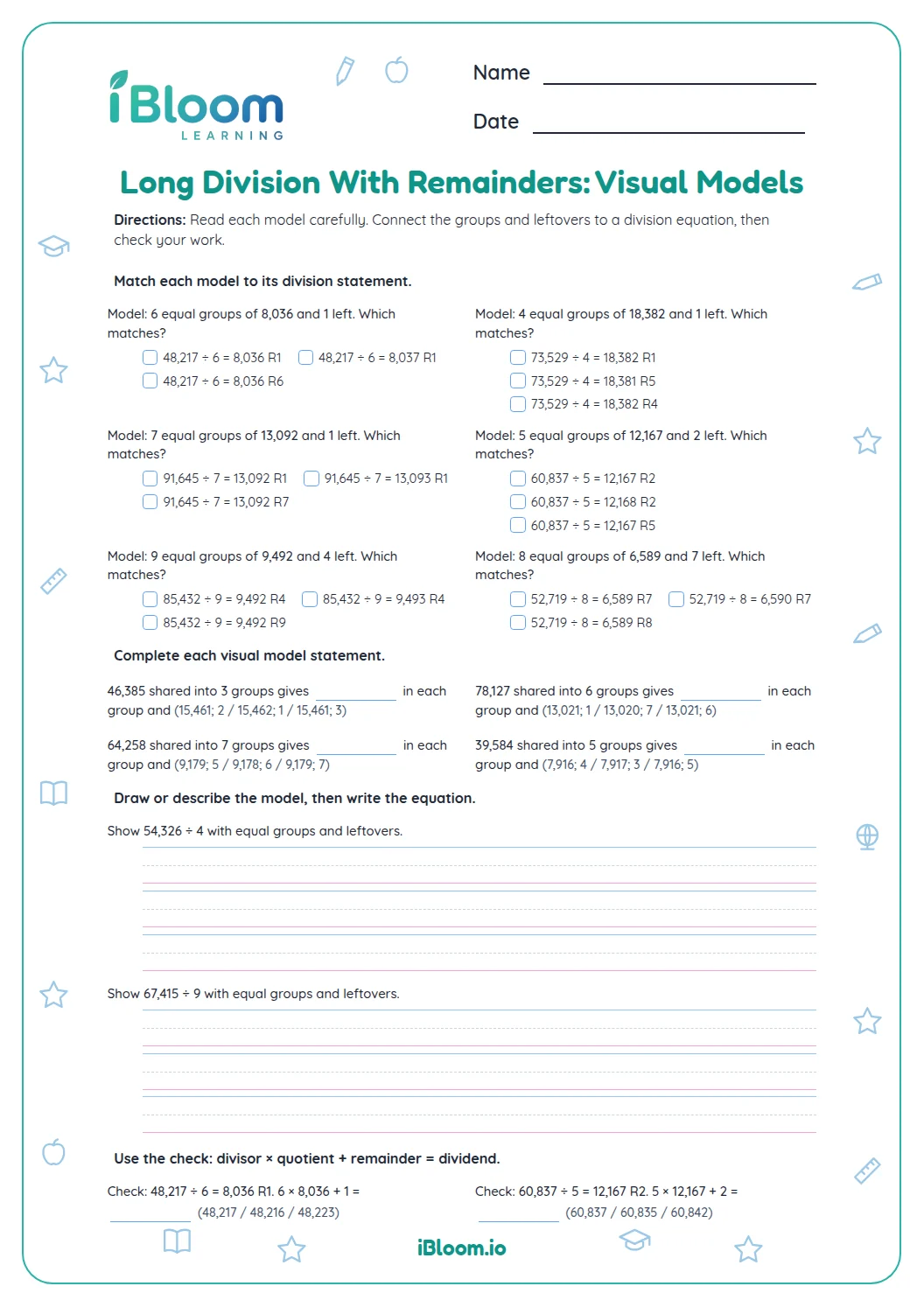
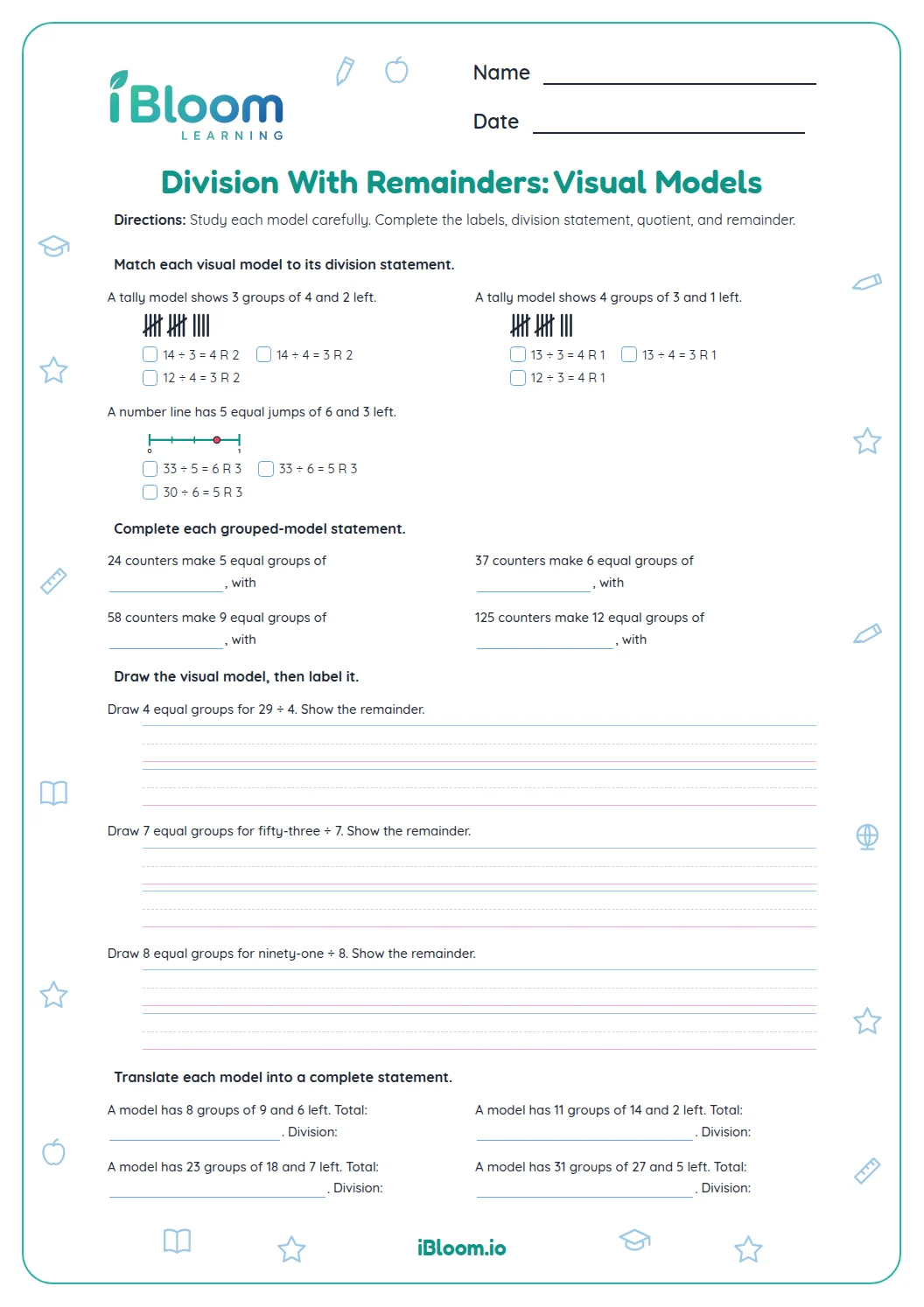
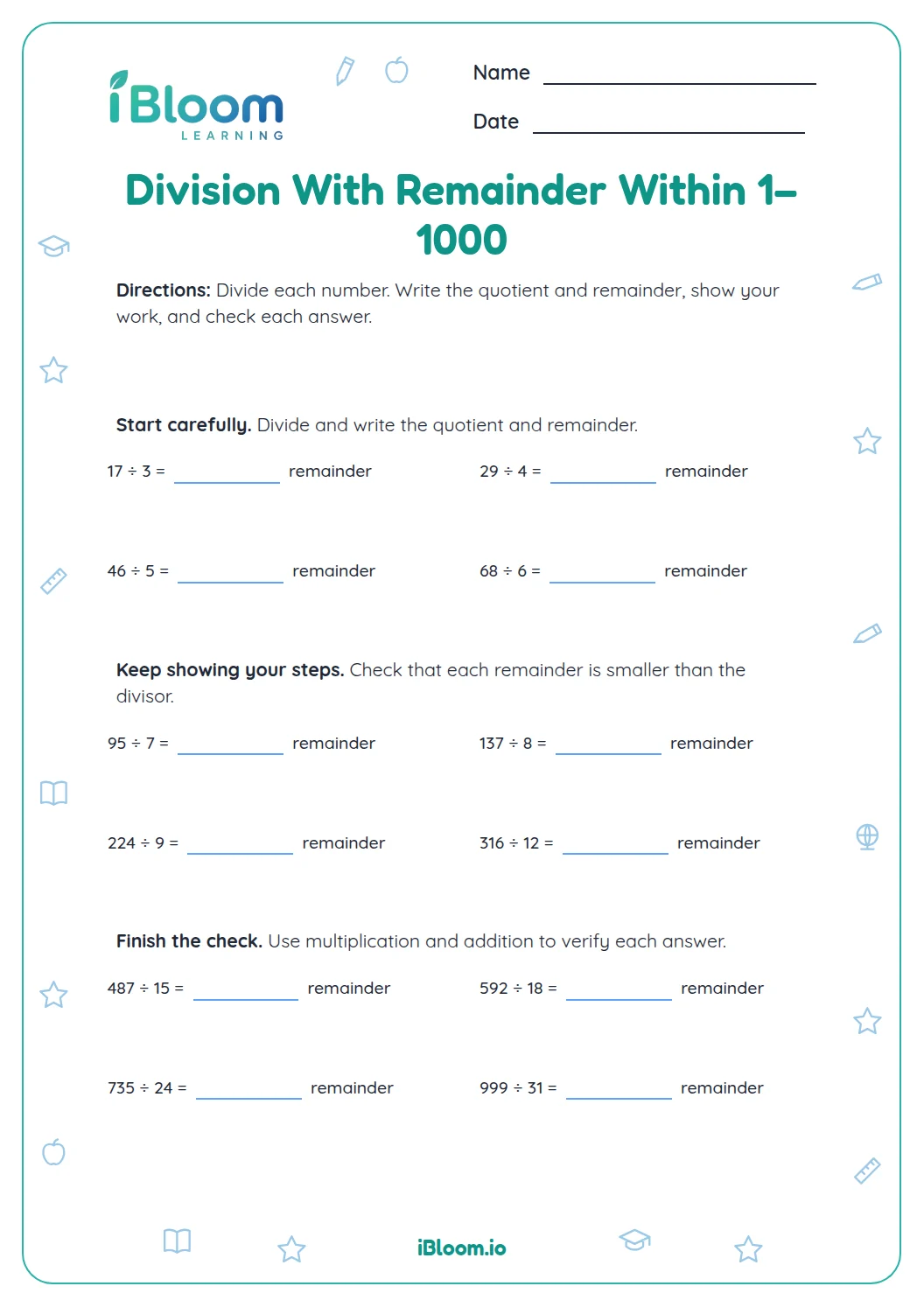
This free printable Grade 5 worksheet practices division with two-digit divisors and remainders. The first question uses a multiples table as a visual model: students find the largest multiple that fits the dividend, then determine the leftover amount. Thirteen more problems offer independent long-division practice. The work aligns with Common Core 5.NBT.B.6, which connects division strategies to multiplication and models. A separate answer key gives each quotient and remainder.
Aligned to 5.NBT.B.6
How does a multiples table help?
A multiples table lists equal groups of the divisor. Find the greatest multiple that is not more than the dividend. The group count gives the quotient; the amount left over is the remainder.
How can I check a remainder?
The first question lists multiples of 12. Find the greatest listed multiple no larger than the dividend. Its group count is the quotient, and the difference between the dividend and that multiple is the remainder. Later questions leave this search to the learner.
- 147 ÷ 12: the table shows 12, 24, 36, 48, 60.
- 236 is the greatest multiple no more than 47: 3 groups.
- 347 − 36 = 11, so the answer is 3 R 11.
- 4Check: 12 × 3 + 11 = 47.
What changes in the second part?
Part A begins with one multiples table to support the quotient search. Part B has 13 divisions without a printed table, so students can use long division or multiplication facts on their own. Every divisor has two digits.
- Part A: question 1, model-supported
- Part B: questions 2–14, independent practice
- Check every remainder against its divisor
How to use this worksheet
- 1Read the divisor and dividend carefully.
- 2For a model item, find the greatest listed multiple no larger than the dividend.
- 3Subtract that multiple to find the remainder.
- 4For the independent items, use long division or estimate with multiplication facts.
- 5Check divisor × quotient + remainder = dividend and verify the remainder is smaller than the divisor.
Common mistakes and quick fixes
The mistake
Choosing a multiple larger than the dividend.
The fix
Use only the greatest multiple that does not pass the dividend.
The mistake
Subtracting the divisor only once when more groups fit.
The fix
Look for the next multiple that still stays at or below the dividend.
The mistake
Writing a remainder equal to or larger than the divisor.
The fix
If the remainder is at least the divisor, one more group can be made.
Common Core alignment
This worksheet practices the listed Common Core skill through its questions.
Use multiples, equations, and place-value reasoning to divide with two-digit divisors.
On this sheet: Question 1 illustrates division with a multiples table; the remaining two-digit divisor problems ask for whole-number quotients and remainders.
Show the official wordingHide the official wording
Find whole-number quotients of whole numbers with up to four-digit dividends and two-digit divisors, using strategies based on place value, the properties of operations, and/or the relationship between multiplication and division. Illustrate and explain the calculation by using equations, rectangular arrays, and/or area models.
What to practice next
Make more practice
Further reading
Questions parents and teachers ask
What does R mean in an answer?
R means remainder: it is what is left after making as many full groups as possible. In 47 ÷ 12, three groups use 36, leaving 11, so the result is 3 R 11. The remainder must be smaller than the divisor.
How do the tables help with division?
The table in question 1 lists multiples of 12. Choose the greatest total that does not exceed 47; 36 is three groups of 12. Subtract 36 from 47 to find the remainder, 11. The later questions leave the multiple search to the learner.
How can I check a division answer with a remainder?
Multiply the divisor by the quotient, then add the remainder. For 47 ÷ 12 = 3 R 11, calculate 12 × 3 + 11 = 47. Also check that 11 is less than 12; otherwise another full group could be made.
How many problems are on the worksheet?
There are 14 questions: question 1 includes a multiples table, and questions 2–14 are 13 independent divisions. Every problem has a two-digit divisor and asks for a quotient and remainder, including zero remainder in question 2. The printed table appears only with the first question.
Is the answer key separate?
Yes. The separate key lists the quotient and remainder for all 14 problems. Students can check each result by multiplying the divisor by the quotient and adding the remainder, then confirming the remainder is smaller than the divisor. Each check uses the same quotient and remainder notation as the page.