






About this worksheet
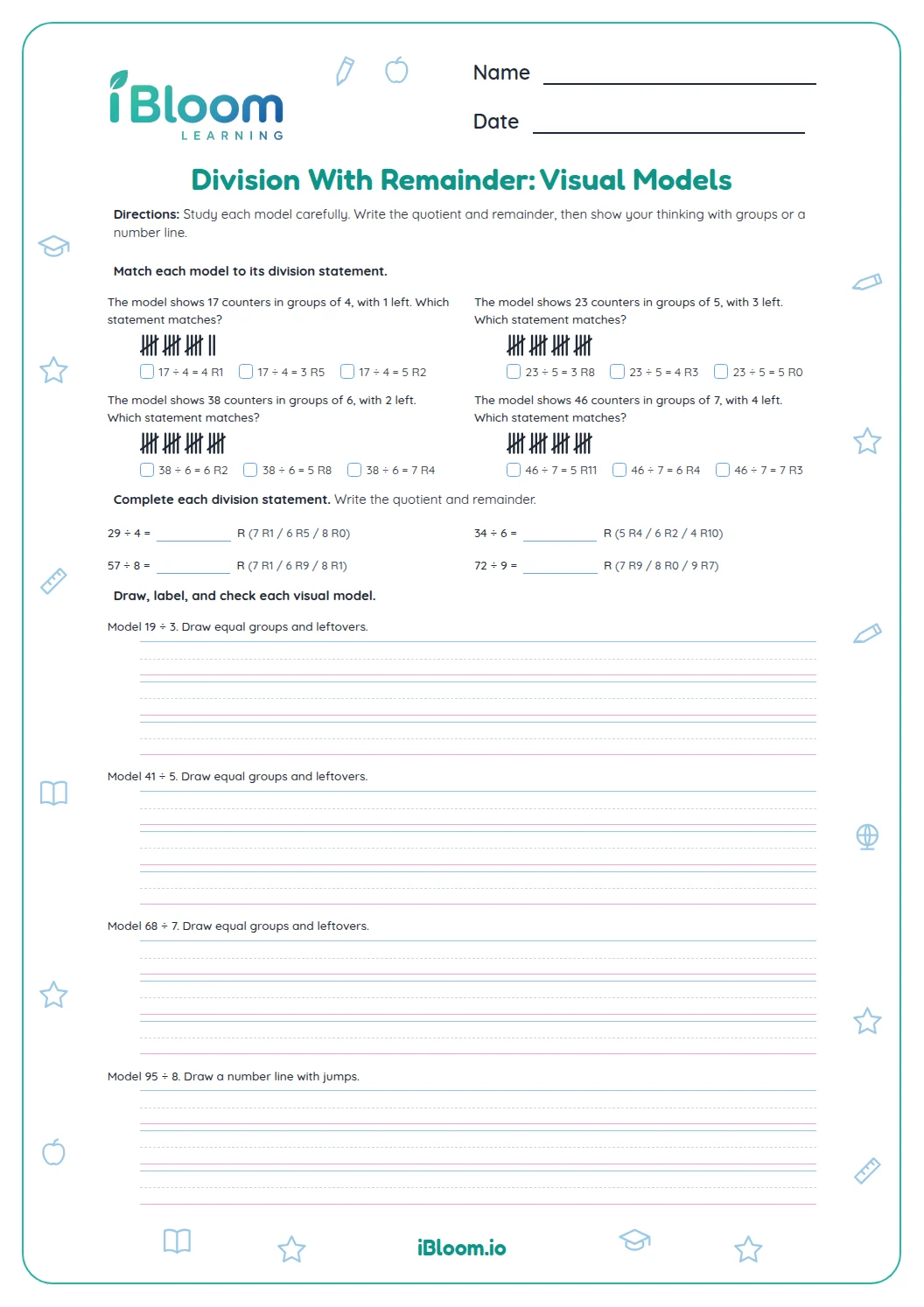
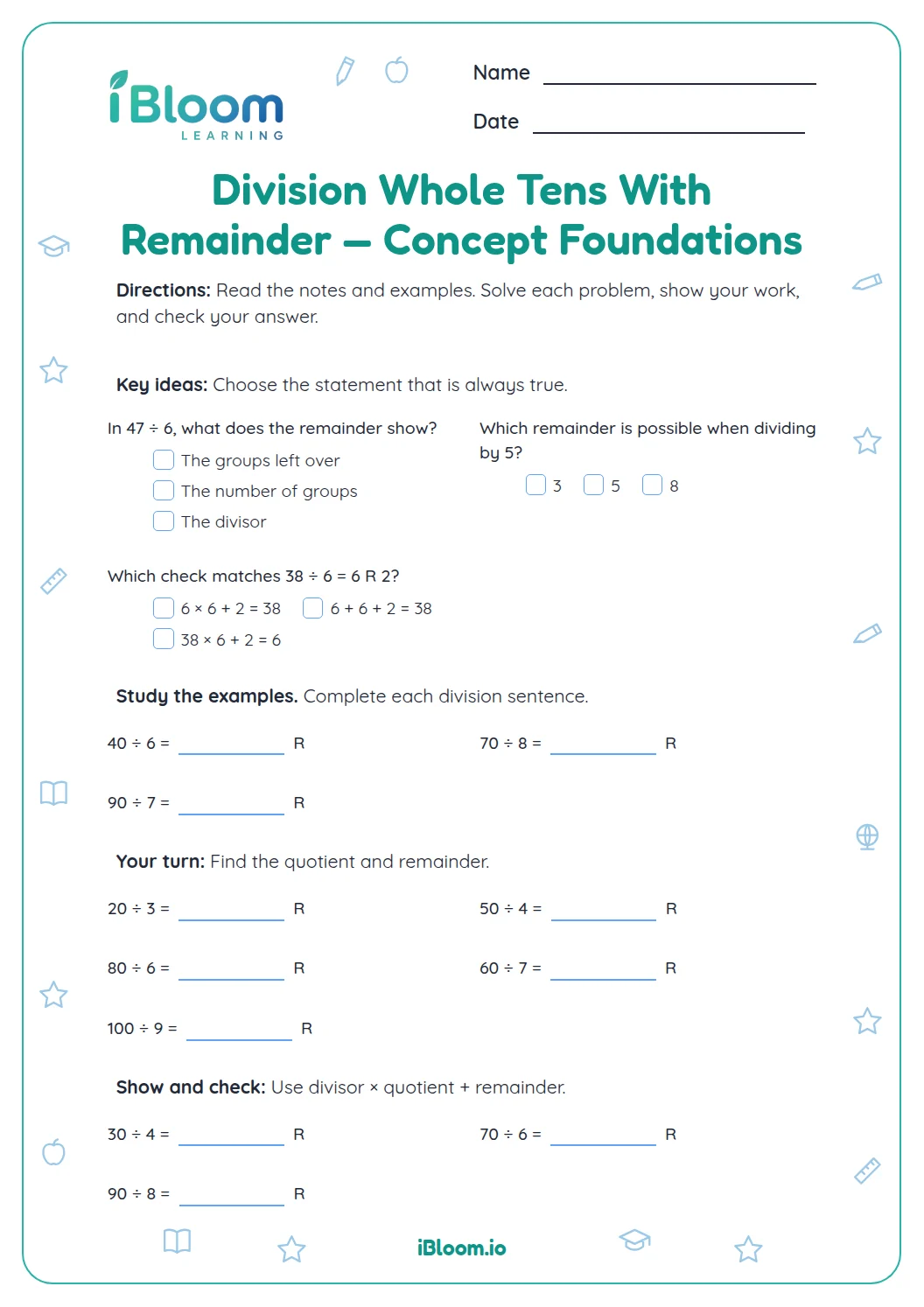
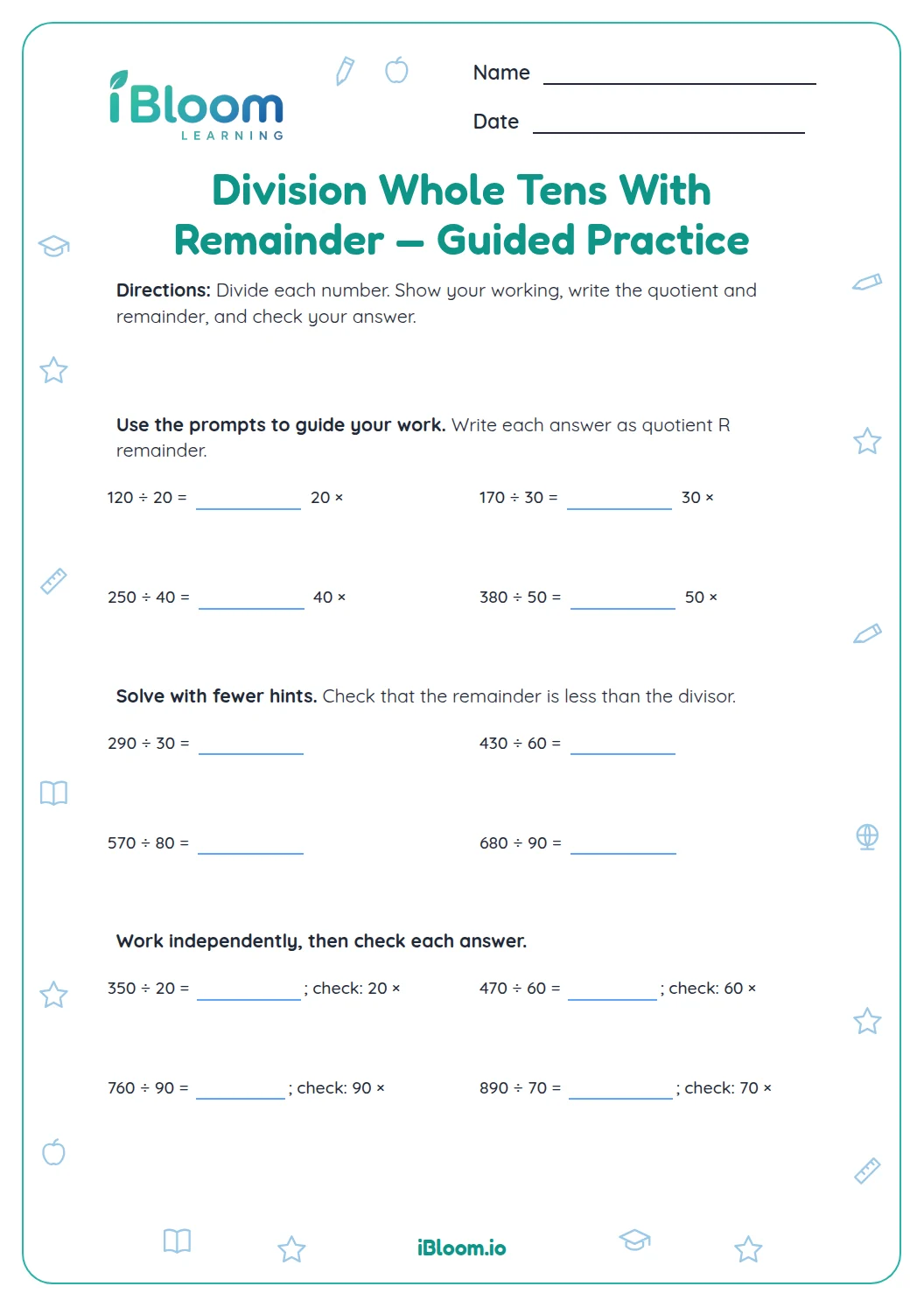
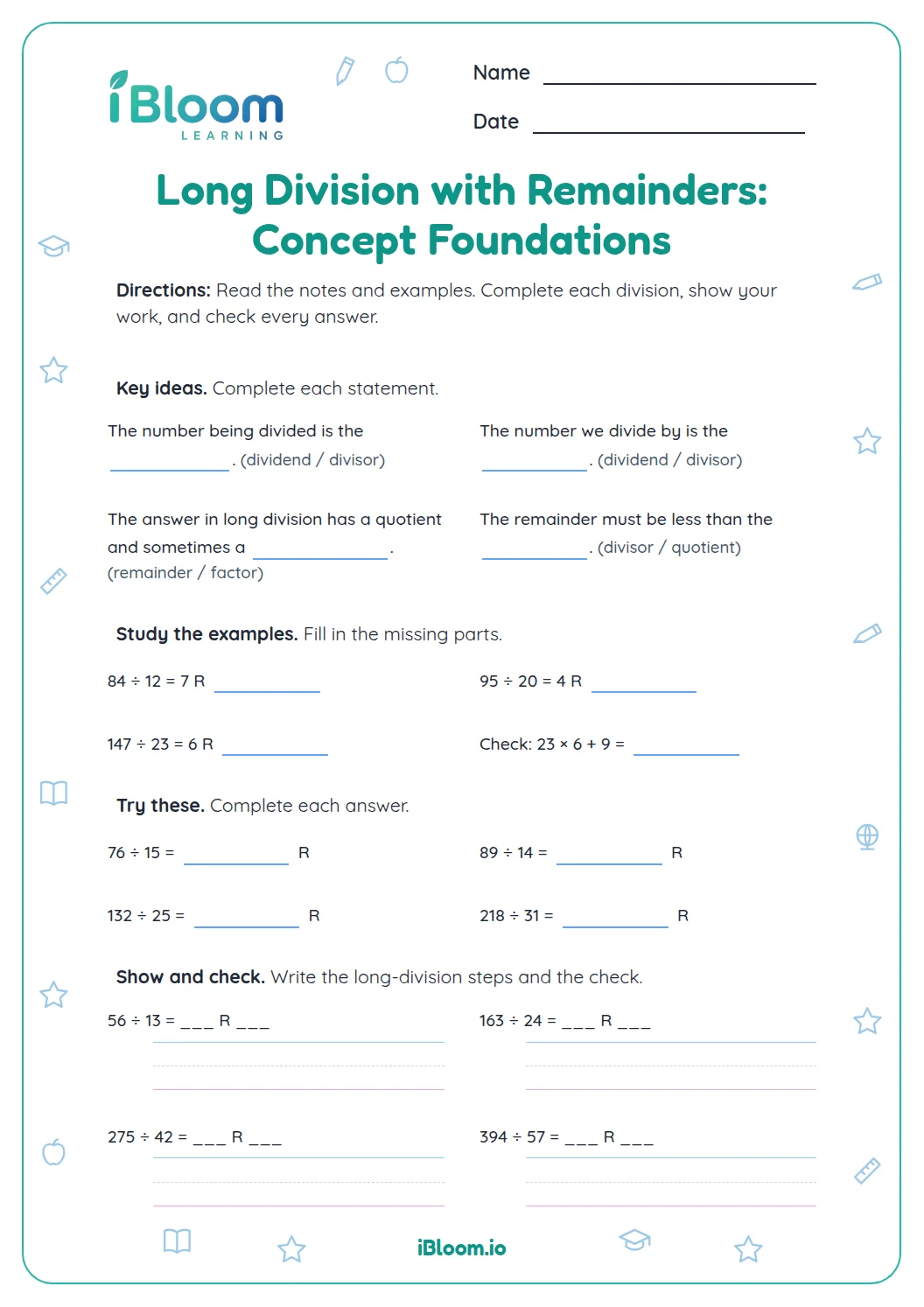
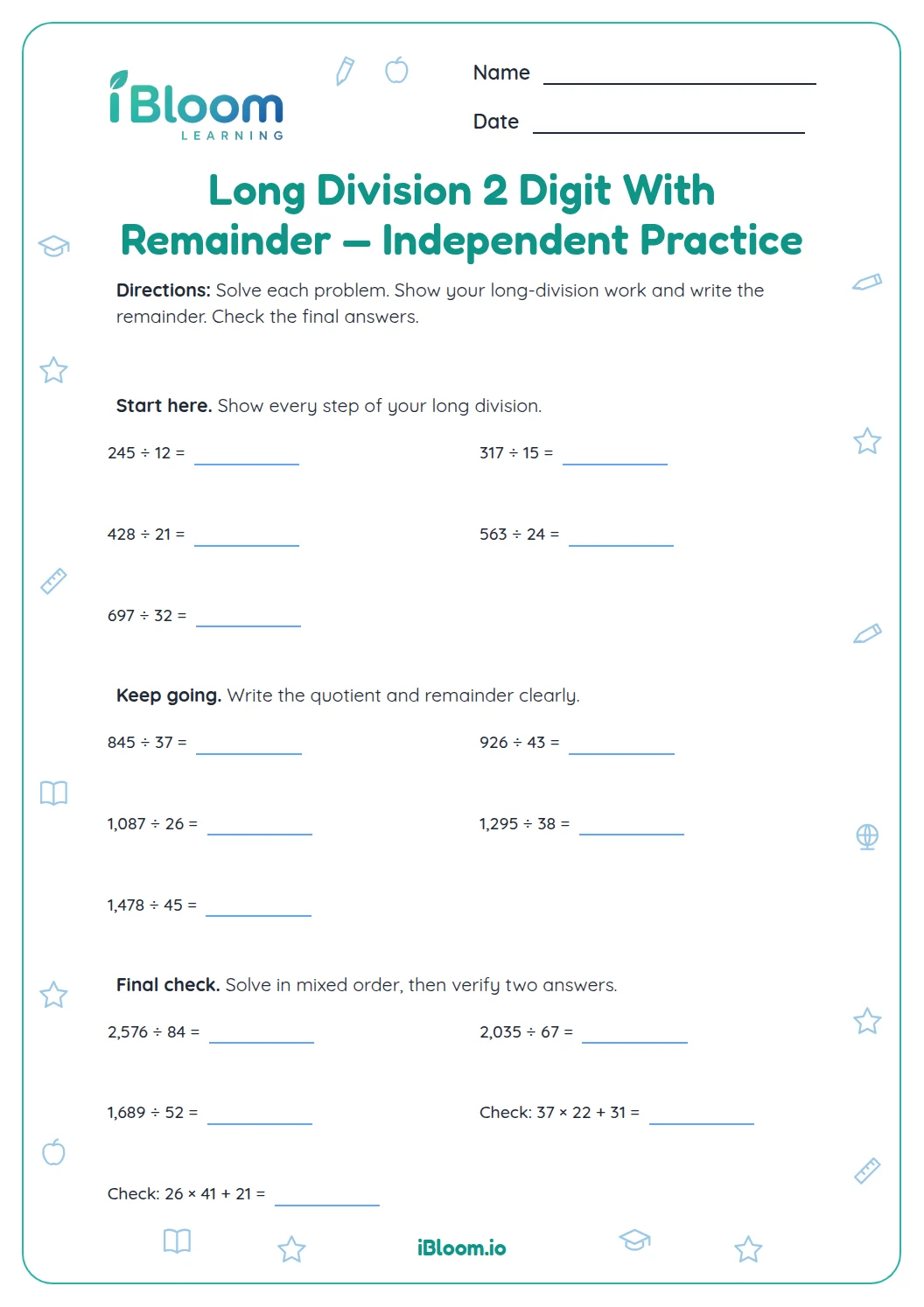
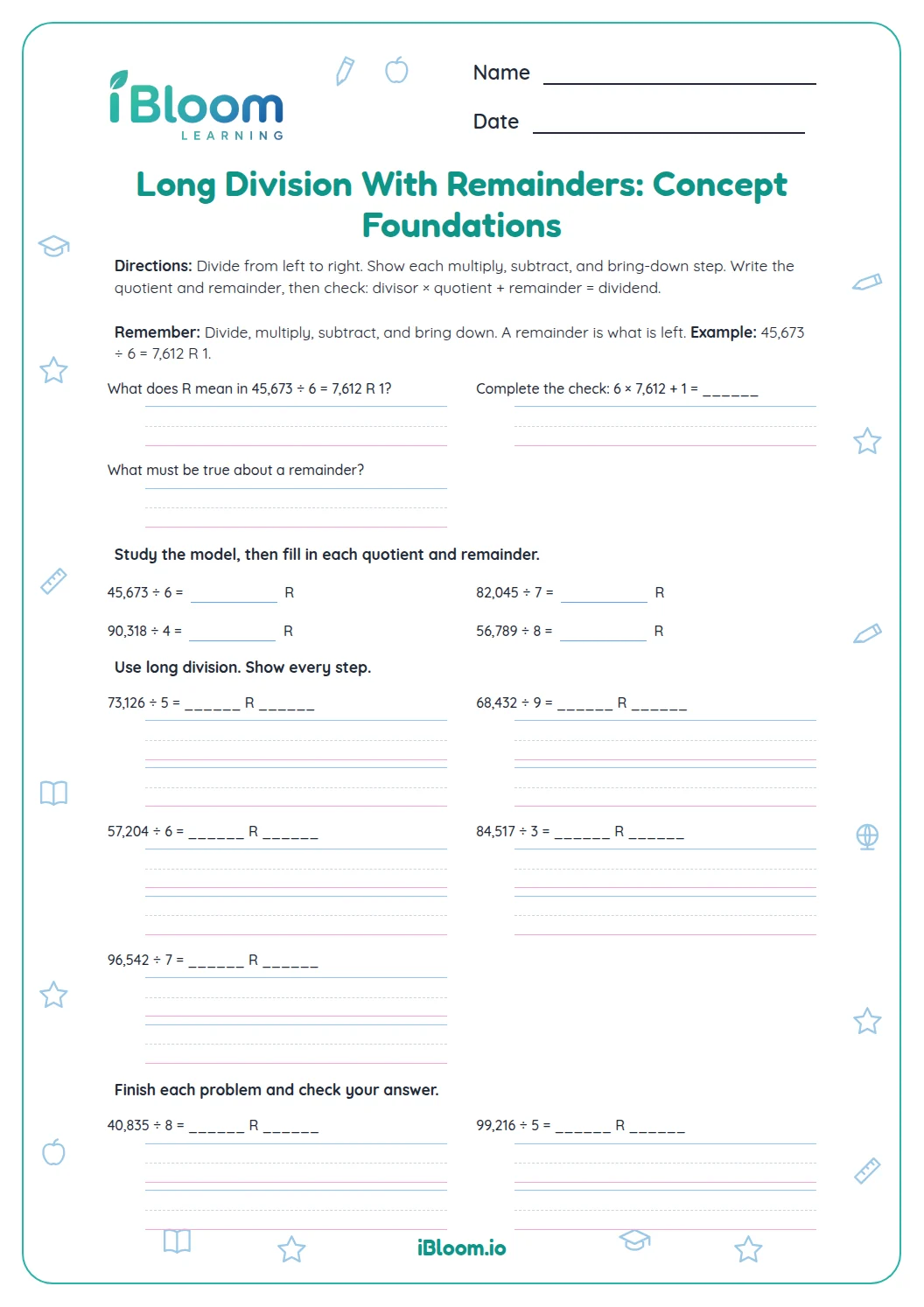
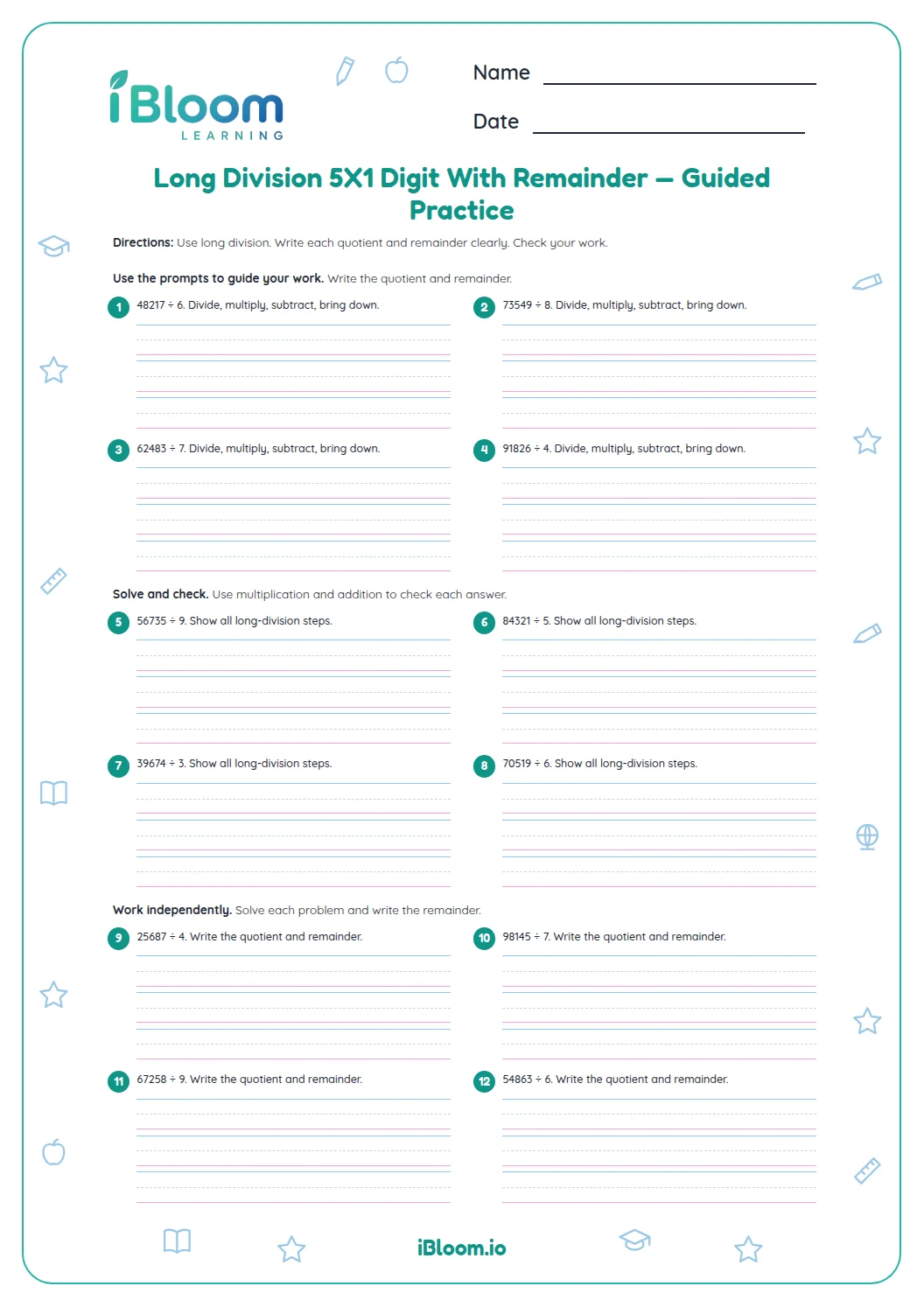
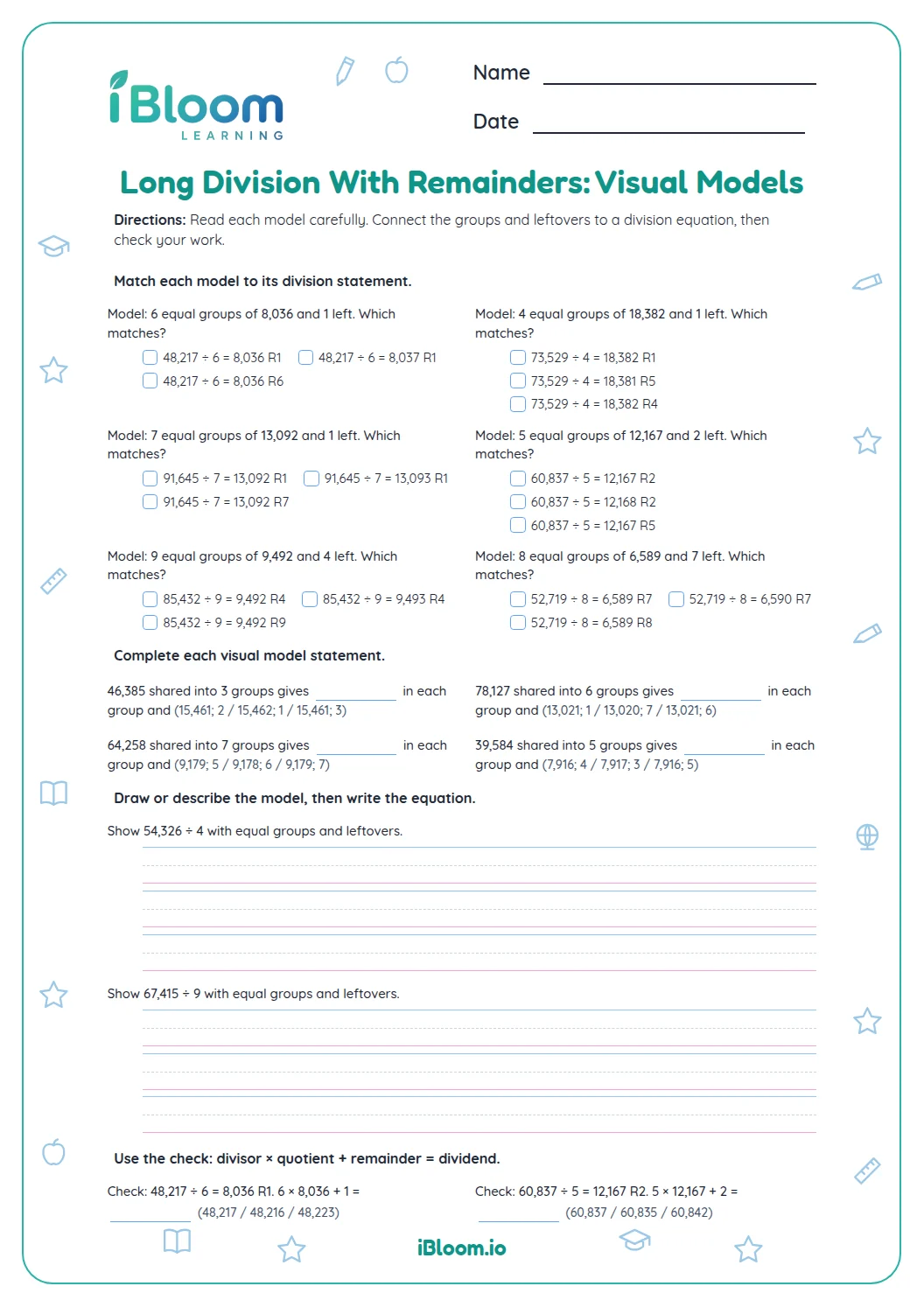
This free printable worksheet builds the ideas behind division with remainders for Grade 5. Part A asks for the quotient and remainder of 47 ÷ 6, the multiplication check for 58 ÷ 7 = 8 R 2, and which remainder is impossible when dividing by 8. Part B has four divisions with dividends from 29 to 453, including one with a two-digit divisor. Part C fills in the remainder to complete a check such as 12 × 83 + ___ = 999, and Part D asks what a remainder means in an egg problem and a tables problem. It practices CCSS 4.NBT.B.6 and 5.NBT.B.6. The answer key is on its own page.
Aligned to 4.NBT.B.6 and 5.NBT.B.6
What are the quotient, divisor and remainder?
In 47 ÷ 6 = 7 R 5, the number being divided (47) is the dividend and the number you divide by (6) is the divisor. The quotient (7) tells how many full groups of 6 fit into 47. The remainder (5) is what is left over after those 7 groups are made.
Part A turns each word into a question. Children find the quotient and the remainder of 47 ÷ 6, then choose the multiplication sentence that proves 58 ÷ 7 = 8 R 2. Naming the parts first makes the later steps easier to follow.
- 1453 ÷ 12 = ___
- 212 × 30 = 360, and 453 − 360 = 93
- 312 × 7 = 84, and 93 − 84 = 9
- 430 + 7 = 37 groups, with 9 left over
- 5Answer: 37 R 9
- 6Check: 12 × 37 + 9 = 444 + 9 = 453
Why must the remainder be smaller than the divisor?
If the leftover were as big as the divisor, another full group could be made. When you divide by 8, the leftovers can only be 0, 1, 2, 3, 4, 5, 6 or 7. Question 4 asks which remainder is not possible for division by 8, and the answer is 8, because a leftover of 8 would make one more group.
This is also a quick way to catch a mistake. If an answer like 29 ÷ 4 = 6 R 5 has a remainder bigger than 4, the quotient is too small and needs to go up by one.
What is on this worksheet?
There are 12 questions in four parts, and every division has a remainder that is not zero.
- Part A: 4 multiple-choice questions on the quotient, the remainder, the multiplication check and an impossible remainder
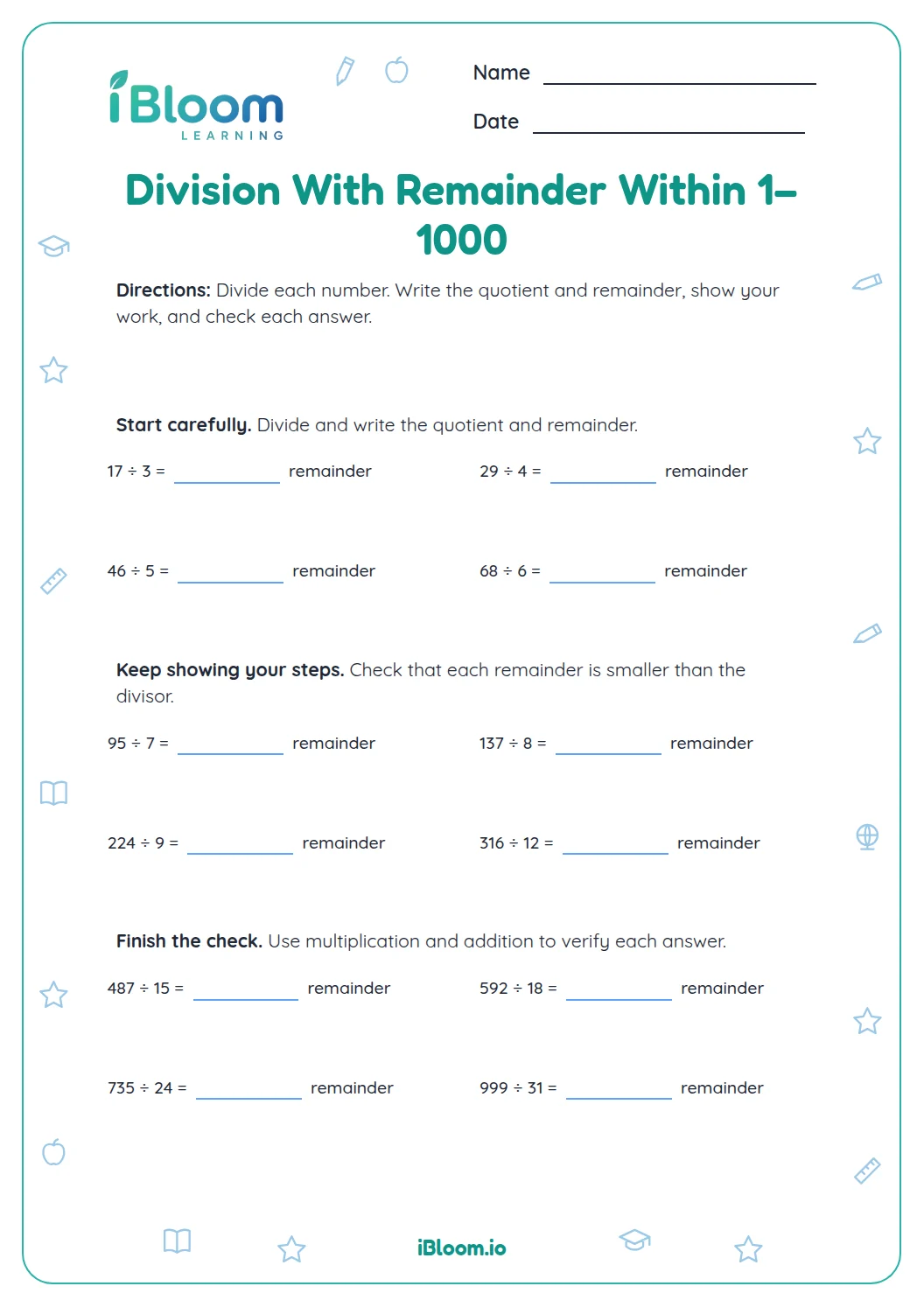
- Part B: 4 divisions to write as quotient and remainder (29 ÷ 4, 83 ÷ 9, 317 ÷ 8, 453 ÷ 12)
- Part C: 2 checks to complete by finding the missing remainder (12 × 83 + ___ = 999 and 5 × 136 + ___ = 684)
- Part D: 2 word problems with space to work (eggs in boxes, students at tables)
- Answer key on a separate page
What does the remainder mean in a word problem?
The same division can lead to different answers depending on the story. In question 11, 150 eggs packed 12 to a box gives 12 R 6. The question asks for full boxes, so the answer is 12 boxes and the extra 6 eggs do not fill another one.
In question 12, 28 students at tables of 6 gives 4 R 4. Those 4 students still need a seat, so the answer is 5 tables. Children need to ask what the question wants, not only compute the number.
How to use this worksheet at home or in class
- 1Warm up with counters or coins. Share 23 counters into groups of 5 and say the quotient and remainder aloud.
- 2Do question 1 together. Share 47 into groups of 6, then name the parts: 47 is the dividend, 6 the divisor, 7 the quotient and 5 the remainder.
- 3Let your child finish Part A, then talk through question 4 so the rule about remainders is clear.
- 4In Part B, ask for a quick estimate first: "About how many 8s are in 317?" Then divide and write R.
- 5In Part C, have your child multiply first and add last, then compare the result with the dividend.
- 6For Part D, ask your child to say what the remainder means before writing the final answer. Then check with the answer key.
Common mistakes and quick fixes
The mistake
Writing a remainder that is too big, like 29 ÷ 4 = 6 R 5.
The fix
Ask whether another group of 4 fits in the 5 left over. It does, so the quotient is 7 and the remainder is 1.
The mistake
Choosing a check with the numbers in the wrong places, such as 7 × 2 + 8 = 58 for 58 ÷ 7 = 8 R 2.
The fix
Say the check in words: divisor times quotient, plus remainder. Match each number to its name before writing: 7 × 8 + 2 = 58.
The mistake
Giving the remainder as the answer to a word problem, like 6 boxes in the eggs problem.
The fix
Underline what the question asks for. "How many full boxes" asks for the quotient. "How many tables are needed" means the leftover students need one more table.
Common Core alignment
The sheet practices the two Common Core standards below.
Divide by a one-digit number and find the quotient and remainder.
On this sheet: Parts A to C find quotients and remainders with one-digit divisors, such as 317 ÷ 8 = 39 R 5, and check them with multiplication.
Show the official wordingHide the official wording
Find whole-number quotients and remainders with up to four-digit dividends and one-digit divisors, using strategies based on place value, the properties of operations, and/or the relationship between multiplication and division. Illustrate and explain the calculation by using equations, rectangular arrays, and/or area models.
Divide up to four-digit numbers by two-digit divisors, using multiplication to check.
On this sheet: Questions 8, 9 and 11 divide by 12 and use the relationship between multiplication and division to check.
Show the official wordingHide the official wording
Find whole-number quotients of whole numbers with up to four-digit dividends and two-digit divisors, using strategies based on place value, the properties of operations, and/or the relationship between multiplication and division. Illustrate and explain the calculation by using equations, rectangular arrays, and/or area models.
What to practice next
Make more practice
Further reading
Questions parents and teachers ask
What is a remainder in division?
A remainder is the amount left over when a number cannot be divided into equal whole groups. In 47 ÷ 6, seven groups of 6 use 42, and 5 are left over, so the answer is 7 R 5. The remainder is always smaller than the number you divide by.
How do I check a division answer with a remainder?
Multiply the quotient by the divisor, then add the remainder. The total should match the first number. For 317 ÷ 8 = 39 R 5, check 8 × 39 = 312, and 312 + 5 = 317. Part C of this sheet practices the final step by asking for the missing remainder.
What are the answers to Part B?
29 ÷ 4 = 7 R 1, 83 ÷ 9 = 9 R 2, 317 ÷ 8 = 39 R 5 and 453 ÷ 12 = 37 R 9. Each remainder is smaller than its divisor, and each check works, such as 4 × 7 + 1 = 29. The answer key lists all 12 answers.
Why is the answer 5 tables and not 4 R 4?
The question asks how many tables are needed. After 4 full tables of 6, 4 students are still standing, and they need a table too, so the answer is 5. The remainder tells you more are needed. Reading what the question asks for decides whether you use the quotient or one more.
Can my child use long division on this sheet?
Yes. The sheet leaves space to work, and any method that works is fine, such as long division, repeated subtraction or multiples of the divisor. Question 8, 453 ÷ 12, is a good one for breaking apart: 12 × 30 = 360, then 12 × 7 = 84, with 9 left.
How long does the worksheet take, and is there an answer key?
Most fifth graders finish in about 20 minutes, a little longer if they check every answer with multiplication, which is a good habit. Yes, there is an answer key on a separate page with all 12 answers. Check each division by multiplying the quotient by the divisor and adding the remainder.