


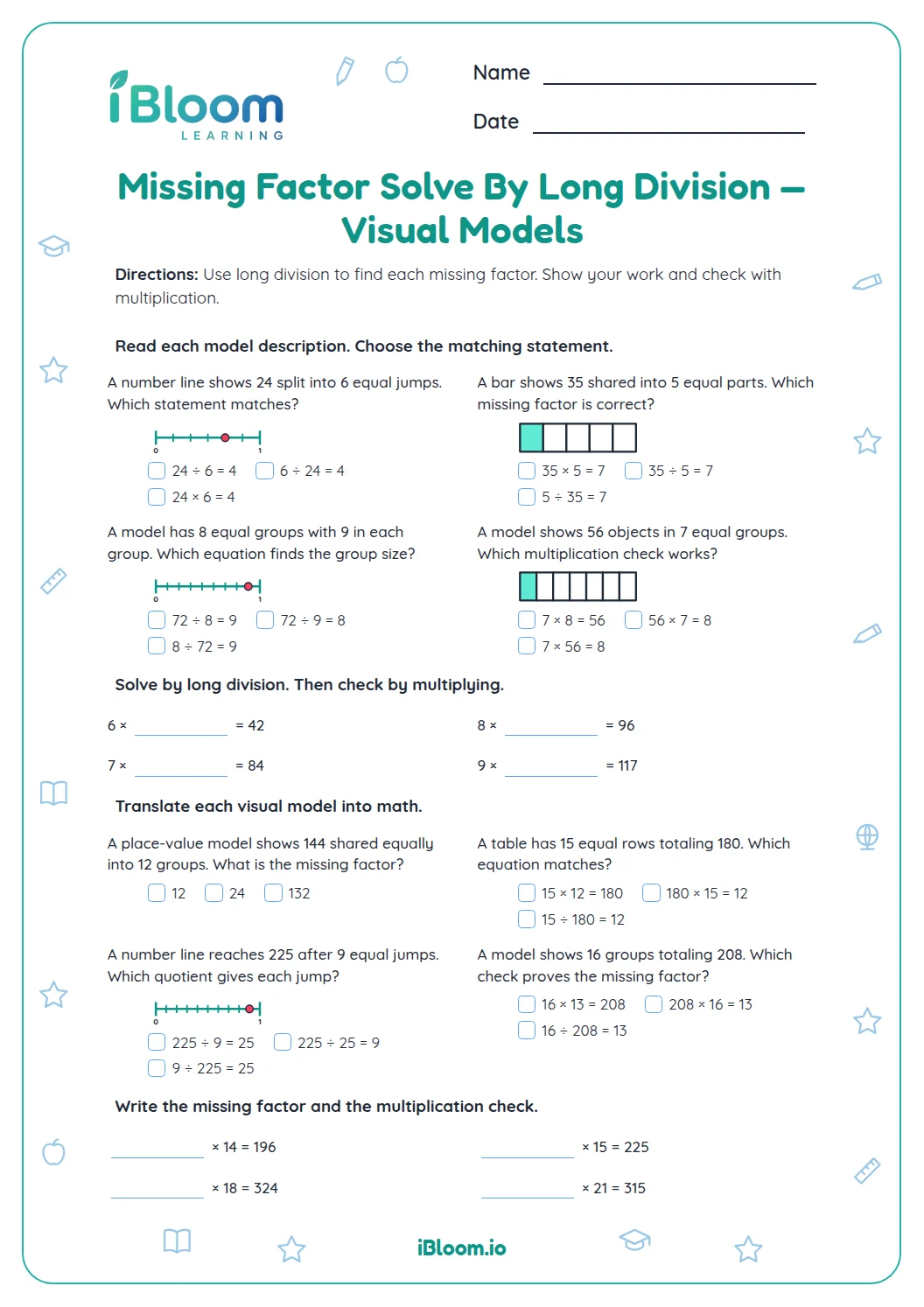
About this worksheet
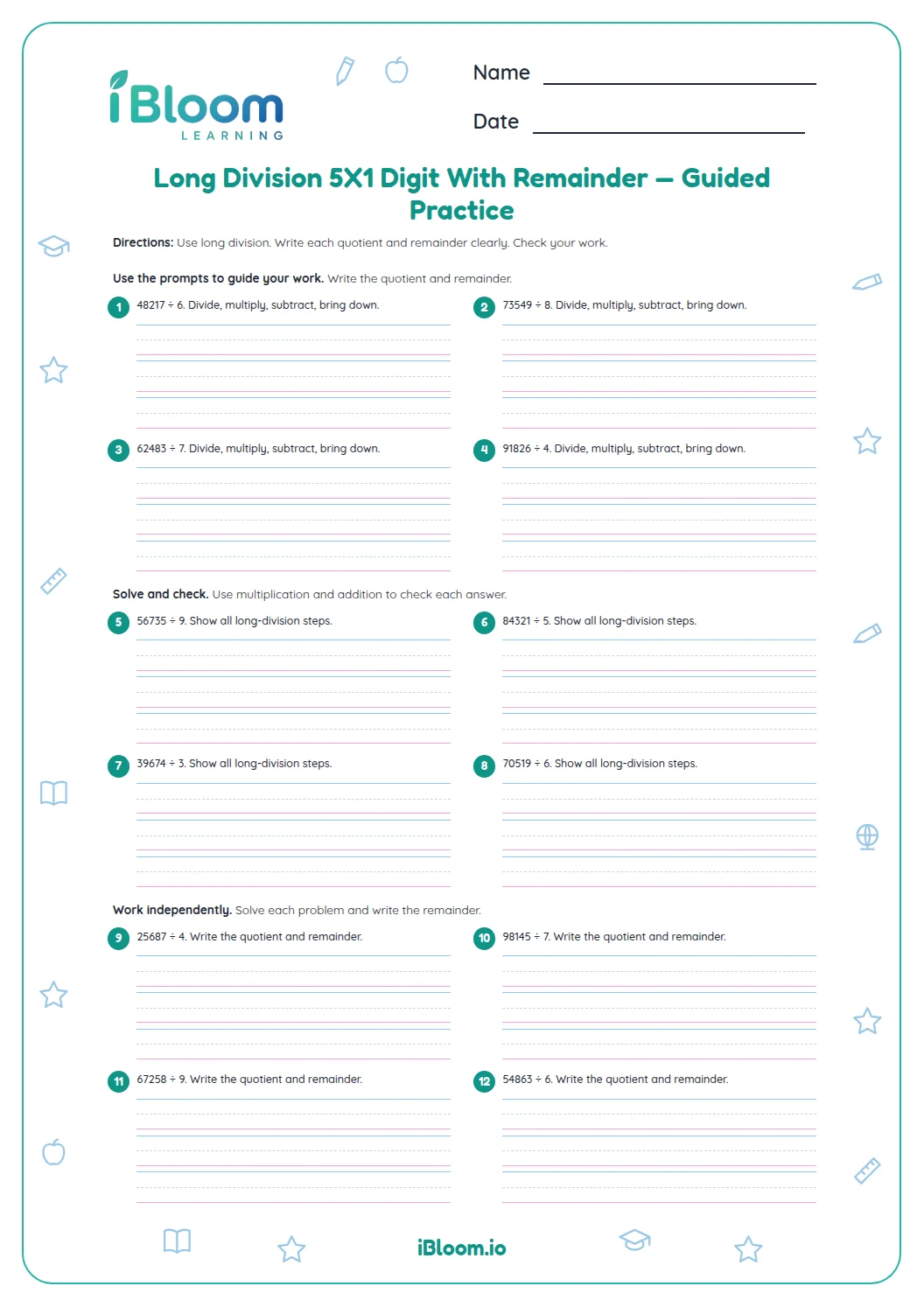
Solve 16 five-digit dividends divided by one-digit divisors. Each quotient and nonzero remainder is recorded in its own blank, then checked by multiplying the divisor by the quotient and adding the remainder. The answer key lists both parts of every result.
What steps keep long division organized?
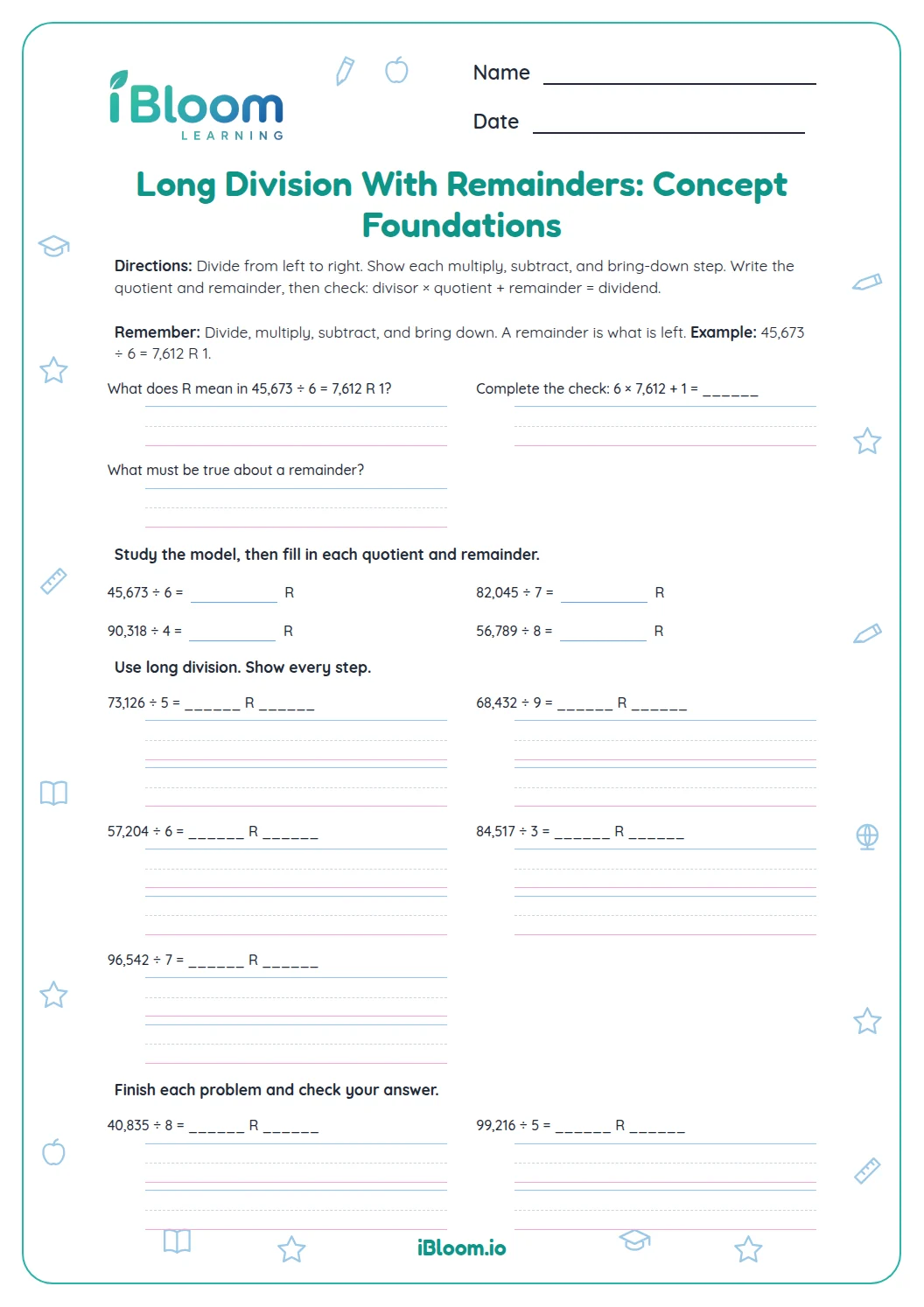
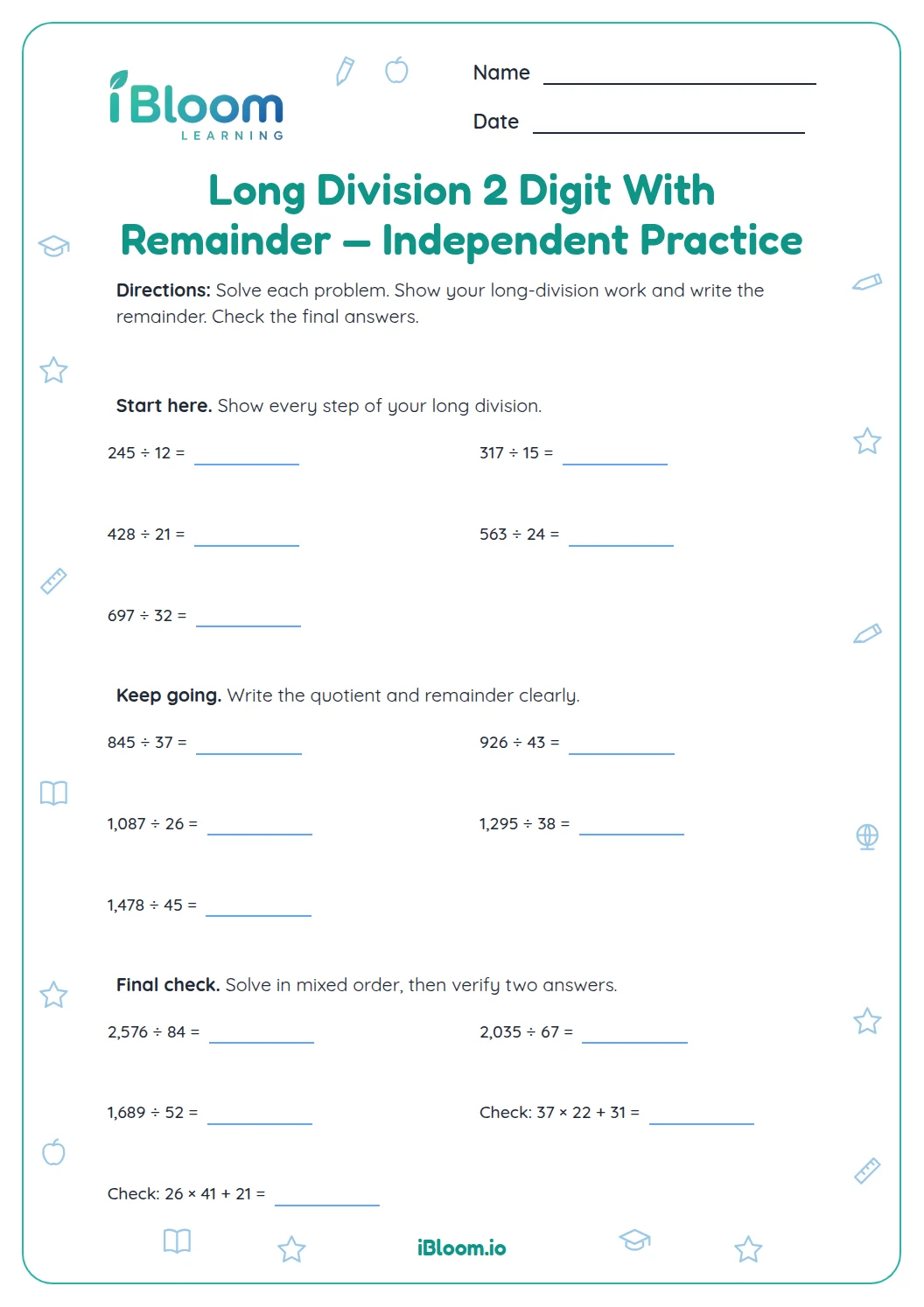
Work from left to right through the dividend. Divide the current amount, multiply, subtract, and bring down the next digit. Keep quotient digits above the place being divided.
- 148,317 ÷ 6 = 8,052 R 5
- 26 × 8,052 + 5 = 48,317
How can you tell whether a remainder is correct?
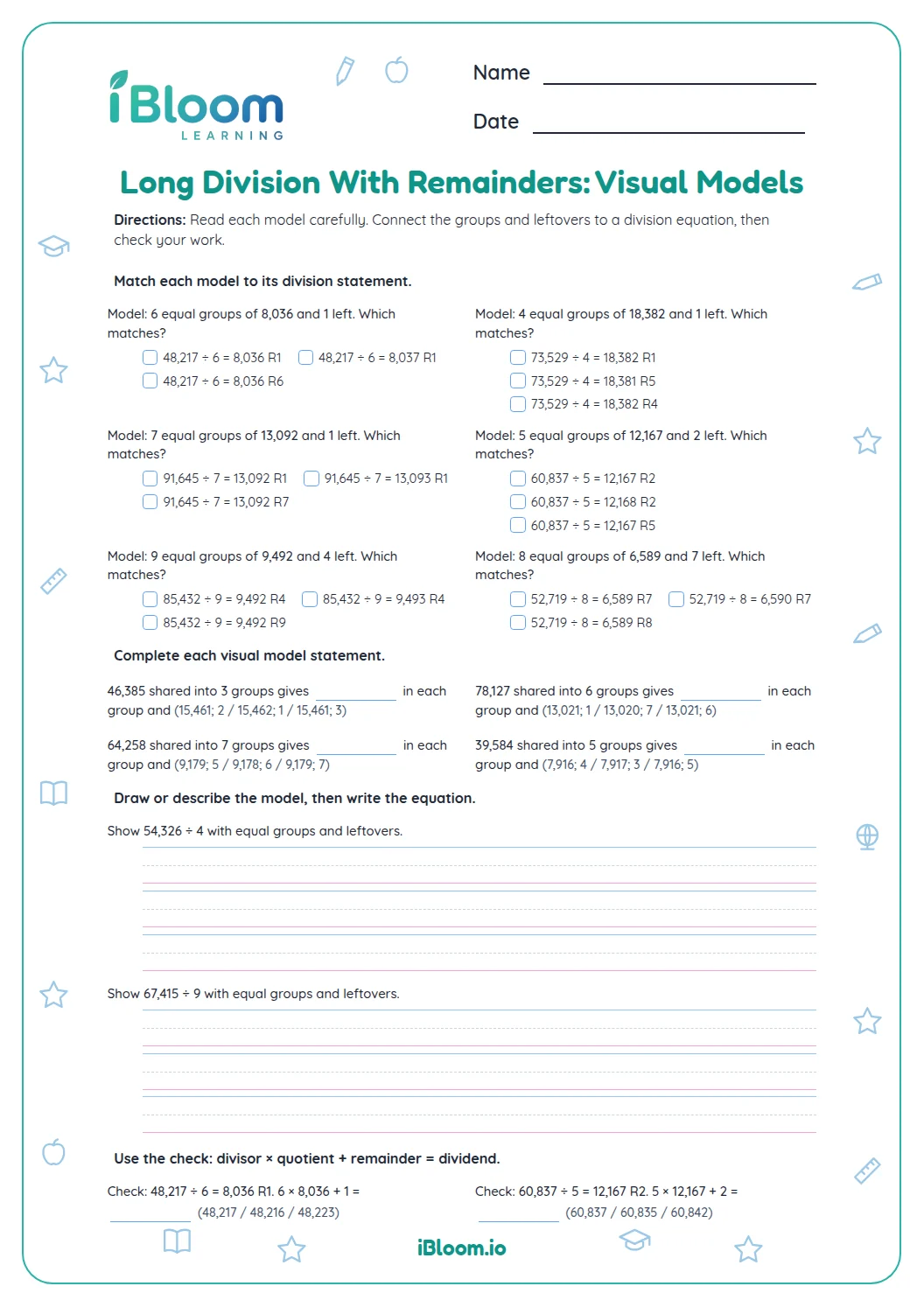
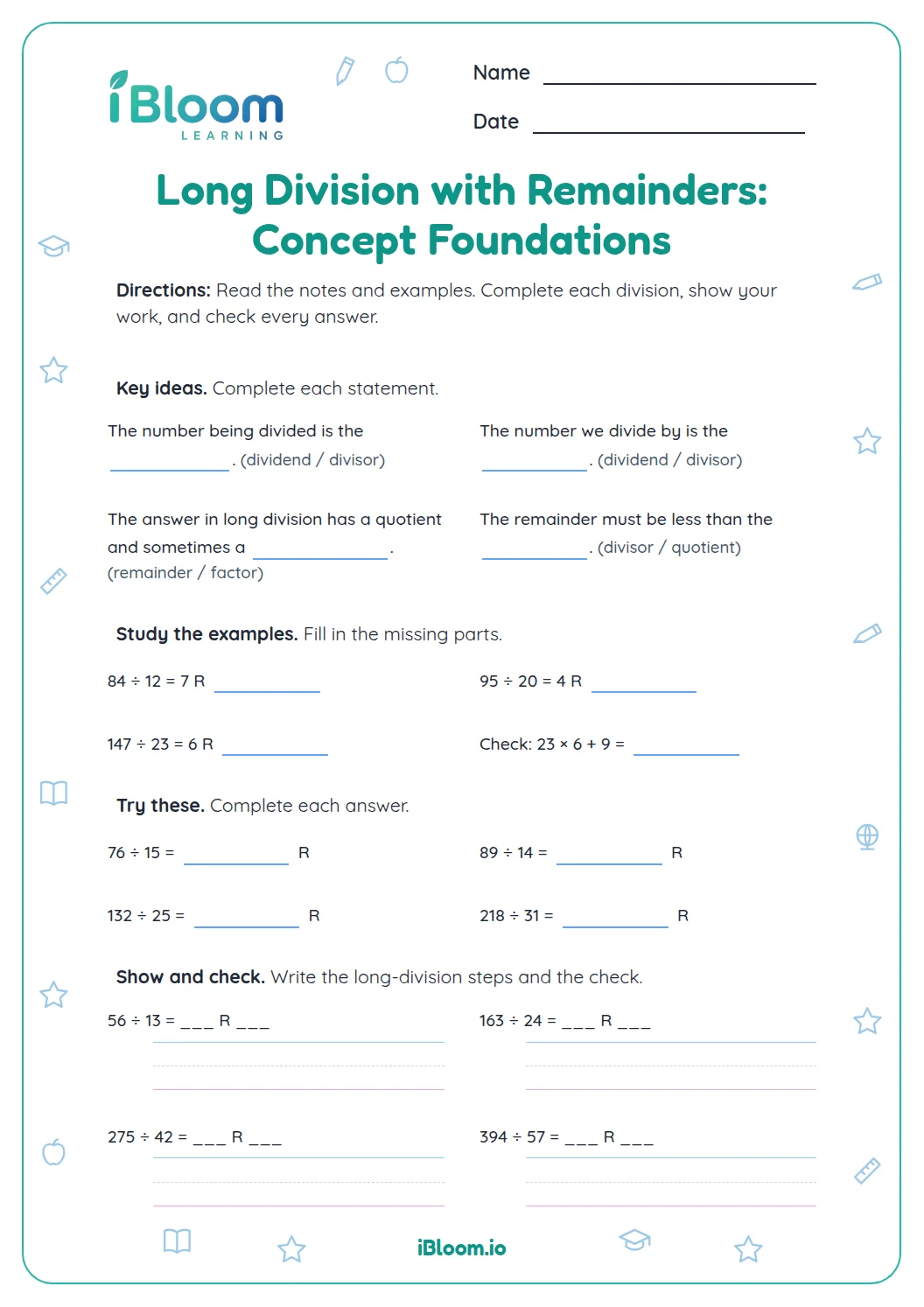
A remainder must be less than the divisor. Multiplying the quotient by the divisor and adding the remainder should rebuild the original dividend.
How can I use this worksheet?
- 1Set up the dividend and one-digit divisor.
- 2Divide the first place that gives a quotient digit.
- 3Multiply and subtract, then bring down the next digit.
- 4Continue until every digit has been used.
- 5Write the quotient and remainder, then check by multiplication.
What mistakes should learners check?
The mistake
Leaving a remainder equal to or greater than the divisor.
The fix
Divide that amount again and add the next quotient digit.
The mistake
Skipping a zero quotient digit in an intermediate place.
The fix
Write zero when the current amount is smaller than the divisor, then bring down.
The mistake
Forgetting the final remainder in the answer.
The fix
Write R and the leftover amount, then verify the dividend equation.
What to practice next
Make more practice
Further reading
Questions parents and teachers ask
How should a student show long division work?
Write each place-value step in order: divide, multiply, subtract, and bring down the next digit. Record the quotient above the dividend and keep each subtraction aligned so the remainder is carried into the next step. Have the student explain what each written digit represents in the quotient.
How do I check a quotient with a remainder?
Multiply the divisor by the quotient and add the remainder. The result should equal the dividend, and the remainder must be smaller than the divisor. For example, a remainder of 7 cannot be left when dividing by 6. Check both the multiplication equation and that the remainder is below the divisor.
Are all the quotients exact?
No. Each of the 16 problems leaves a nonzero remainder. The answer key gives the quotient and remainder in order. For example, 48,317 ÷ 6 = 8,052 R 5, and 5 is less than the divisor 6. Check the multiplication equation on every item.
What common error does this worksheet help catch?
A student may stop after dividing the first digits and forget to bring down the next digit. Keeping the steps in place-value order and checking divisor times quotient plus remainder helps reveal that error. Bring-down steps carry the unshared amount into the next place-value step.
What grade is this long-division practice for?
The page is labeled Grade 5 and gives independent practice with five-digit dividends divided by one-digit divisors. Students should be comfortable with multiplication facts and the divide, multiply, subtract, bring-down routine. The practice uses five-digit dividends and one-digit divisors throughout.
How can I help without doing the division for my child?
Ask the student to explain what each quotient digit represents and whether each remainder is smaller than the divisor. Then have them use multiplication and addition to check the result. Ask the learner to verify one answer aloud using multiplication and addition.