

About this worksheet
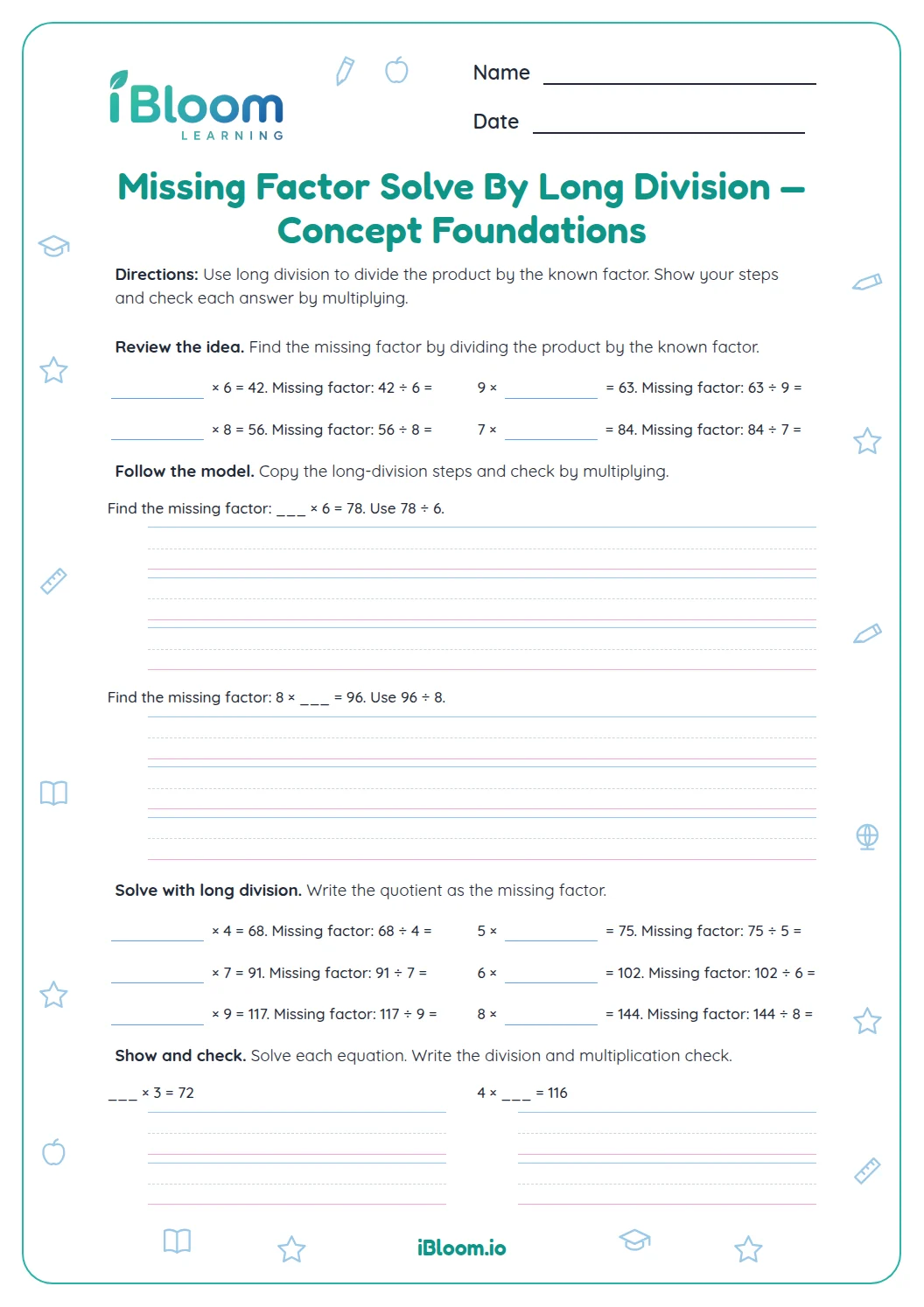
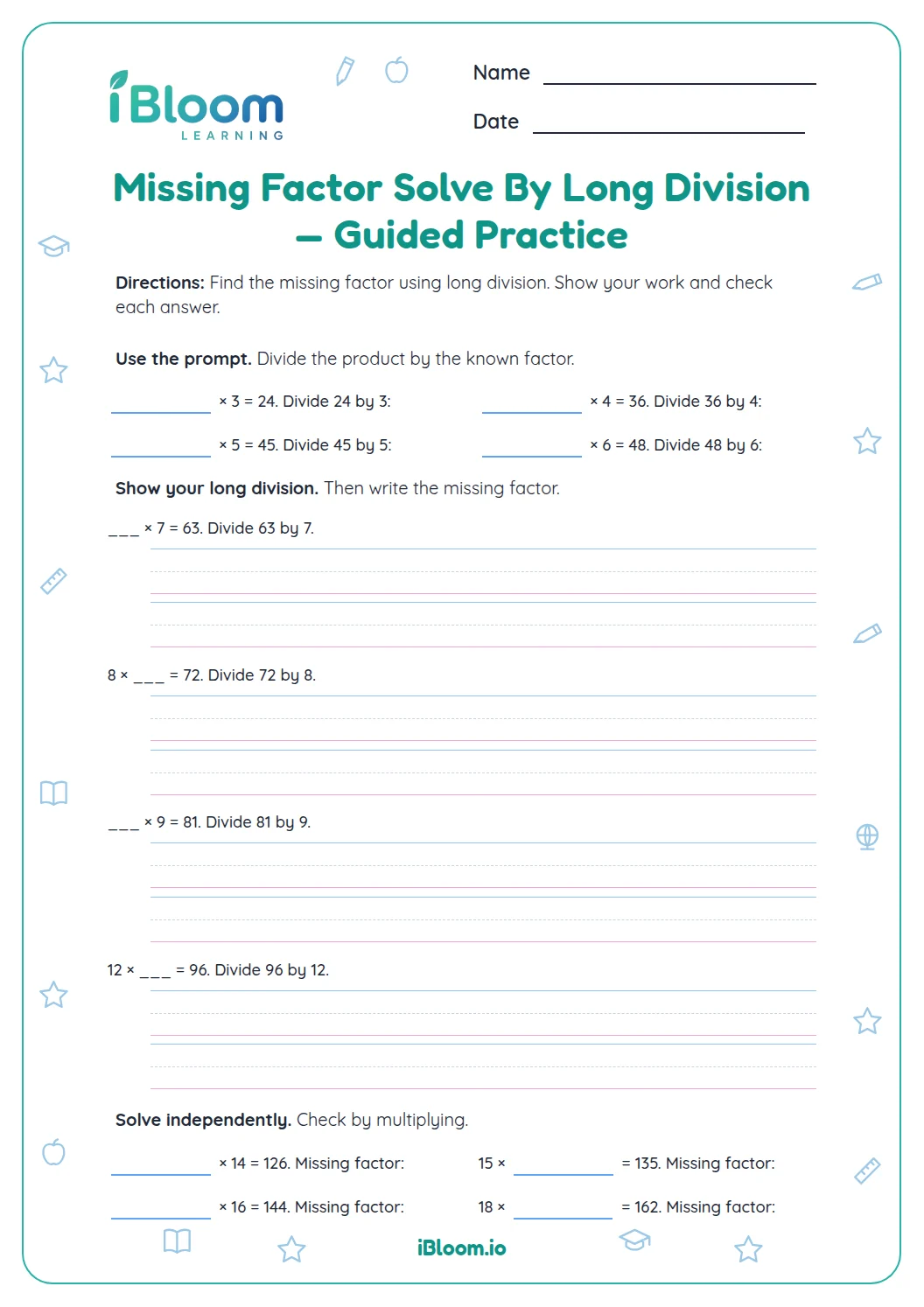
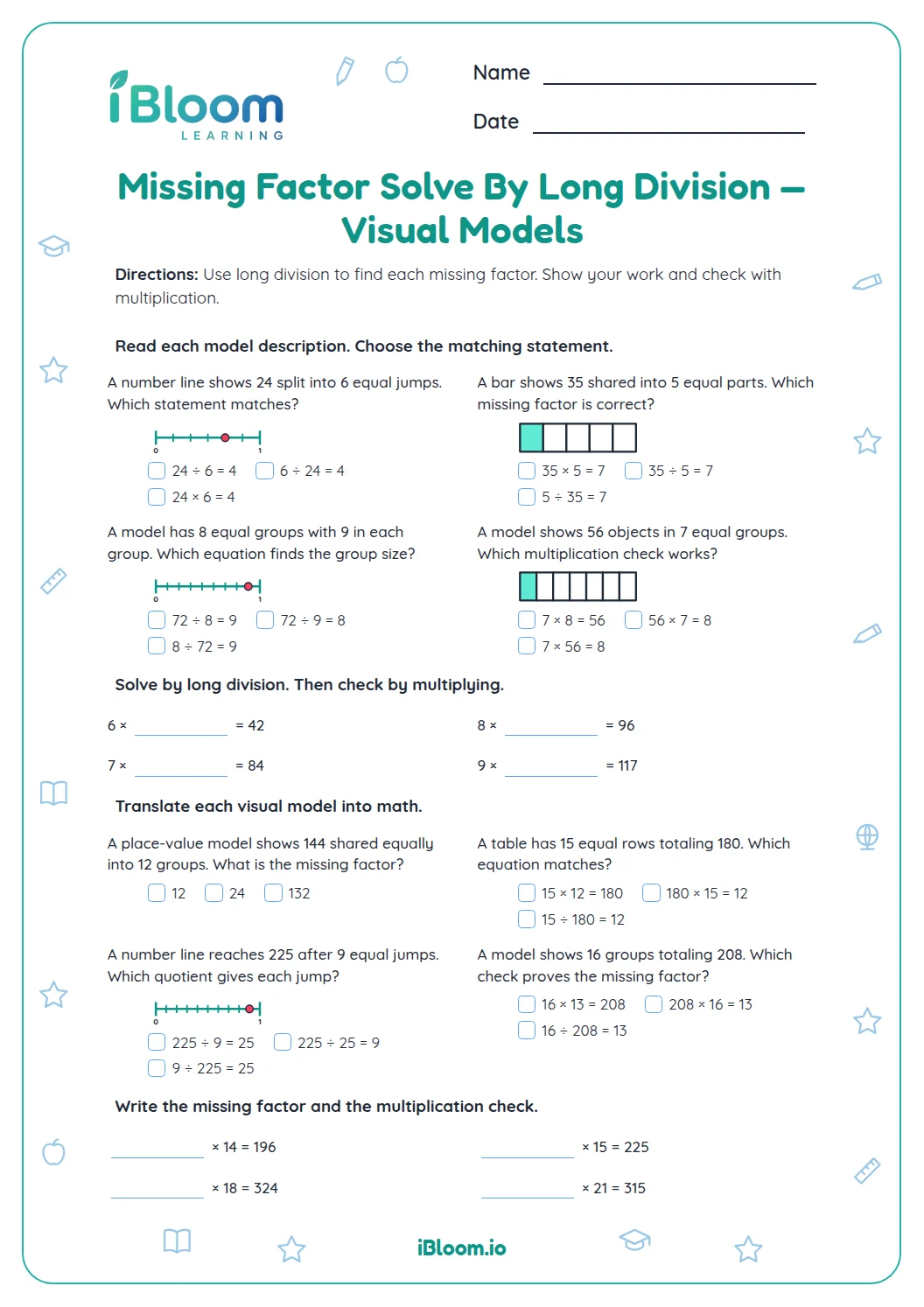
This free Grade 5 worksheet asks students to find missing factors by rewriting multiplication equations as division problems. Twelve equations provide focused practice, followed by a multiplication check and three application questions. The dividends and divisors give students opportunities to use the standard long-division process and verify with multiplication. A separate answer key is included. The work practices CCSS 5.NBT.B.6, which covers whole-number quotients and strategies based on place value and the multiplication-division relationship.
Aligned to 5.NBT.B.6
How do you find the missing factor?
A multiplication equation can be rewritten as a division equation. In question 1, 24 × ___ = 936 becomes 936 ÷ 24. The quotient, 39, is the missing factor because 24 × 39 returns 936.
- 124 × ___ = 936
- 2936 ÷ 24 = 39
- 3Check: 24 × 39 = 936
- 4The missing factor is 39.
Why check with multiplication?
Multiplication reverses the division used to find the quotient. For the check in question 13, 36 × 42 must equal 1,512. If the product differs, revisit the quotient and the place-value steps.
What is on the worksheet?
The worksheet has 16 questions in three parts: 12 missing-factor equations, one multiplication-check choice, and three division applications. It includes a school supply packing problem and questions that reverse the known quotient or factor. A separate key follows the two worksheet pages.
How to use this worksheet
- 1Identify the product and the known factor.
- 2Divide the product by the known factor using long division.
- 3Record the quotient as the missing factor.
- 4Multiply the known factor by your quotient.
- 5For a word problem, name what the quotient counts and check the units.
- 6Compare the result with the answer key after finishing.
Common mistakes and how to check
The mistake
Dividing the known factor by the product.
The fix
Use product ÷ known factor; that reverses the multiplication equation.
The mistake
Stopping after division without checking.
The fix
Multiply the quotient by the divisor and confirm you recover the original product.
The mistake
Giving a quotient without its meaning in a word problem.
The fix
Reread what is shared or counted and state the answer in that unit, such as markers per box.
Common Core alignment
This worksheet practices 5.NBT.B.6 through the reading or math tasks on the page.
Find whole-number quotients and verify them with multiplication.
On this sheet: Find whole-number quotients and verify them with multiplication.
Show the official wordingHide the official wording
Find whole-number quotients of whole numbers with up to four-digit dividends and two-digit divisors, using strategies based on place value, the properties of operations, and/or the relationship between multiplication and division. Illustrate and explain the calculation by using equations, rectangular arrays, and/or area models.
What to practice next
Make more practice
Further reading
Questions parents and teachers ask
How do you solve 24 × ___ = 936?
Rewrite the equation as 936 ÷ 24. Since 24 goes into 93 three times with 21 left, bring down 6 to make 216; 24 goes into 216 nine times. The quotient is 39, and 24 × 39 = 936 checks it.
Why does division find a missing factor?
Multiplication and division undo one another. If a known factor times an unknown factor equals a product, divide the product by the known factor to recover the unknown. The worksheet’s opening 12 questions use this relationship with different divisors and products.
What multiplication checks question 13?
The correct check is 36 × 42 = 1,512. The question gives a student’s quotient for 1,512 ÷ 36; multiplying the divisor by the quotient should recreate the dividend. The other choices use a nearby quotient and produce different products.
What is the answer to the marker-box problem?
The school packs 2,184 markers equally into 52 boxes. Divide 2,184 by 52 to get 42 markers in each box. The unit matters: 42 is the number of markers per box, not a total number of boxes. The divisor is 52 boxes, so the quotient is a count for each box.
Does the key show how to check answers?
The answer key gives the correct missing factors and the results for the applied questions. Students can use the multiplication relationship to verify each quotient themselves: multiply the known factor or divisor by the proposed answer and compare it with the original product or dividend.