
About this worksheet
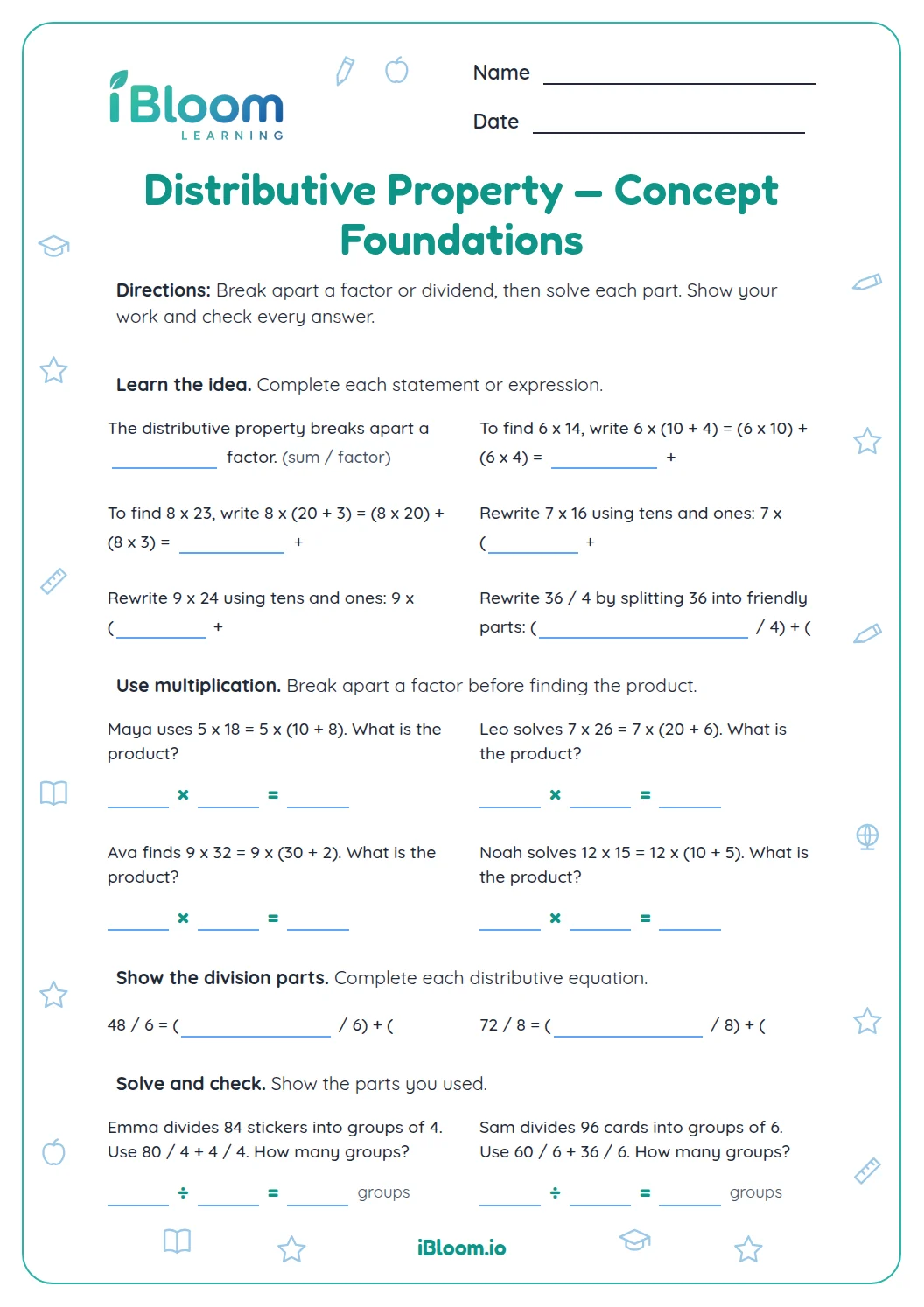
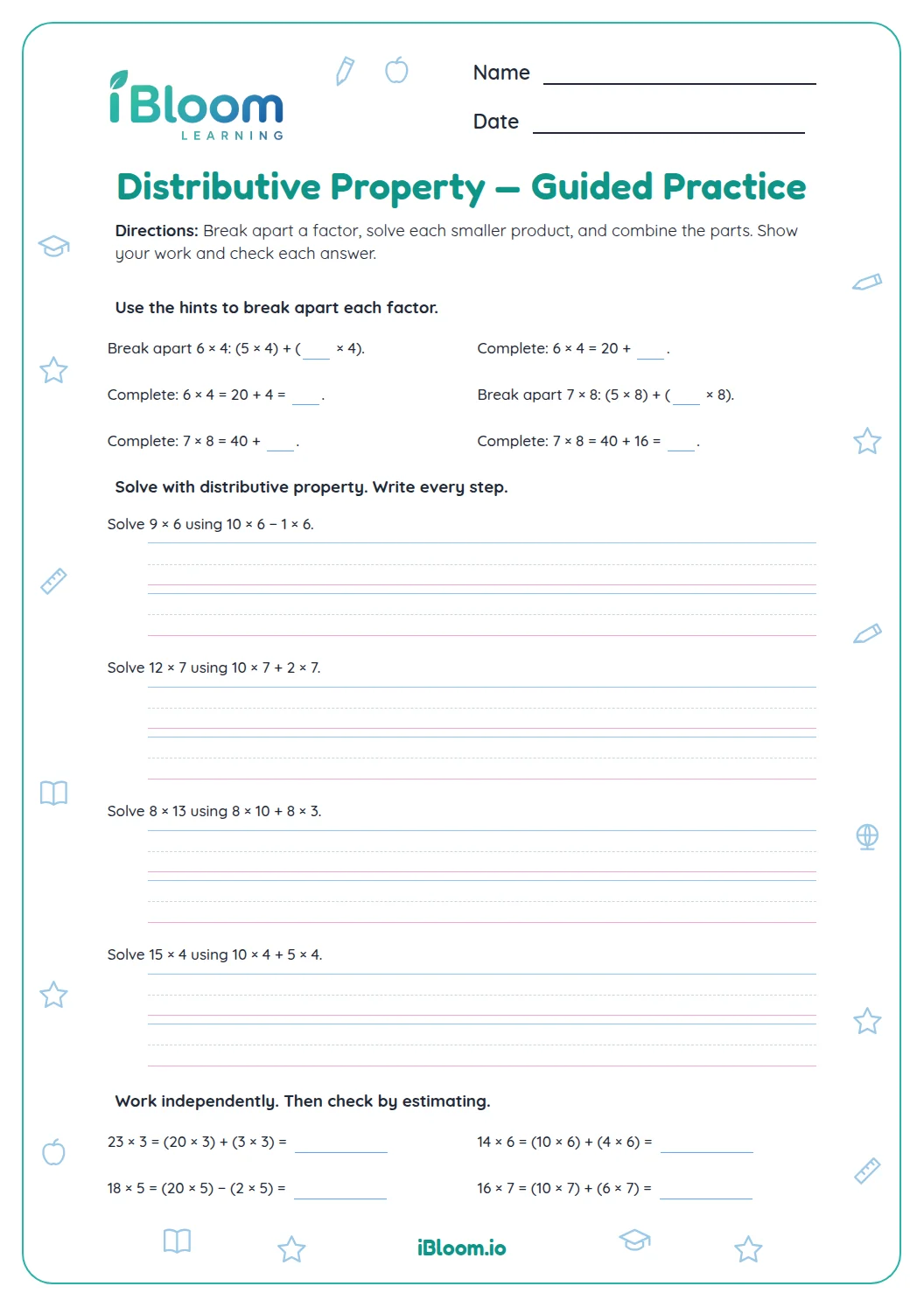
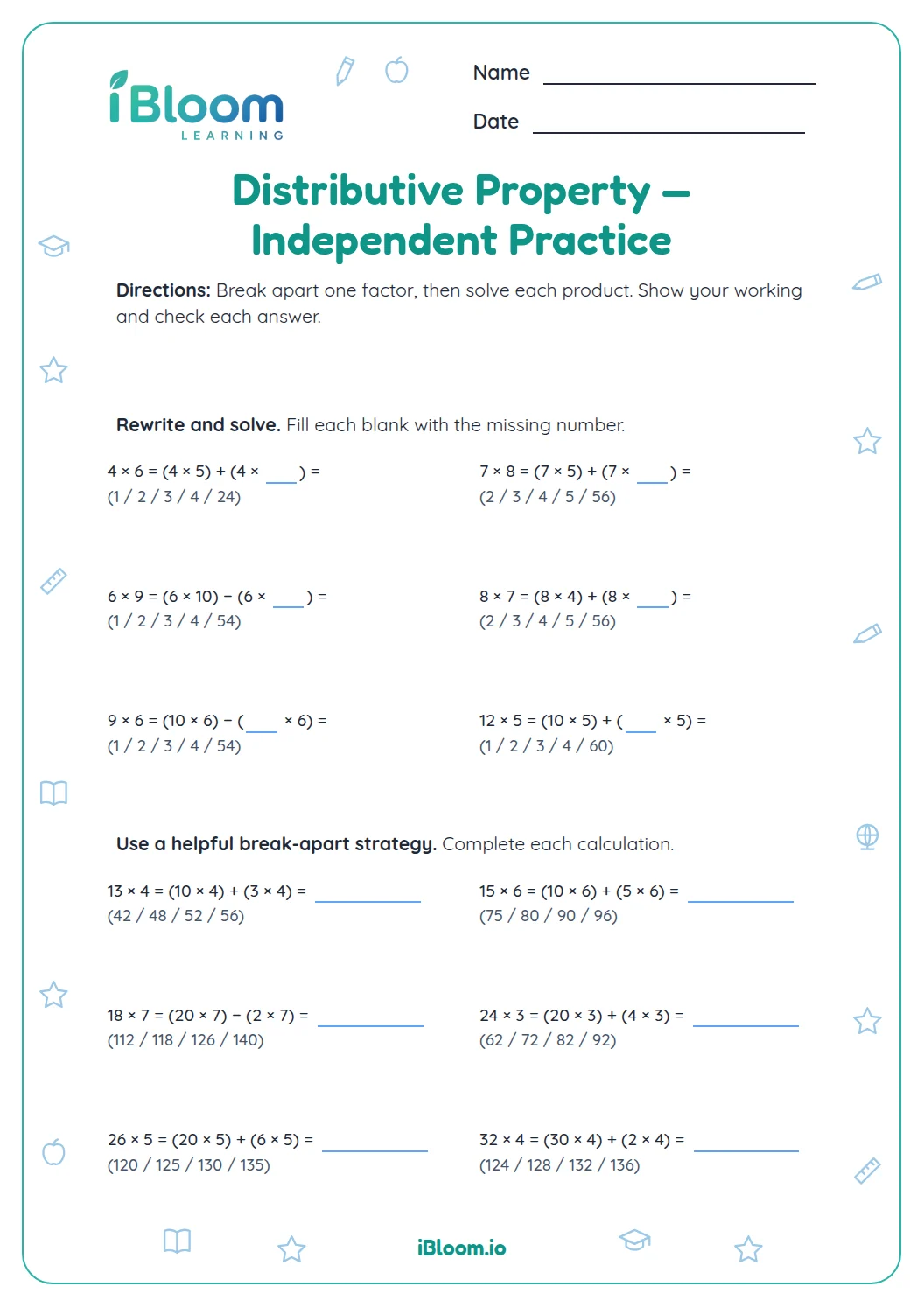
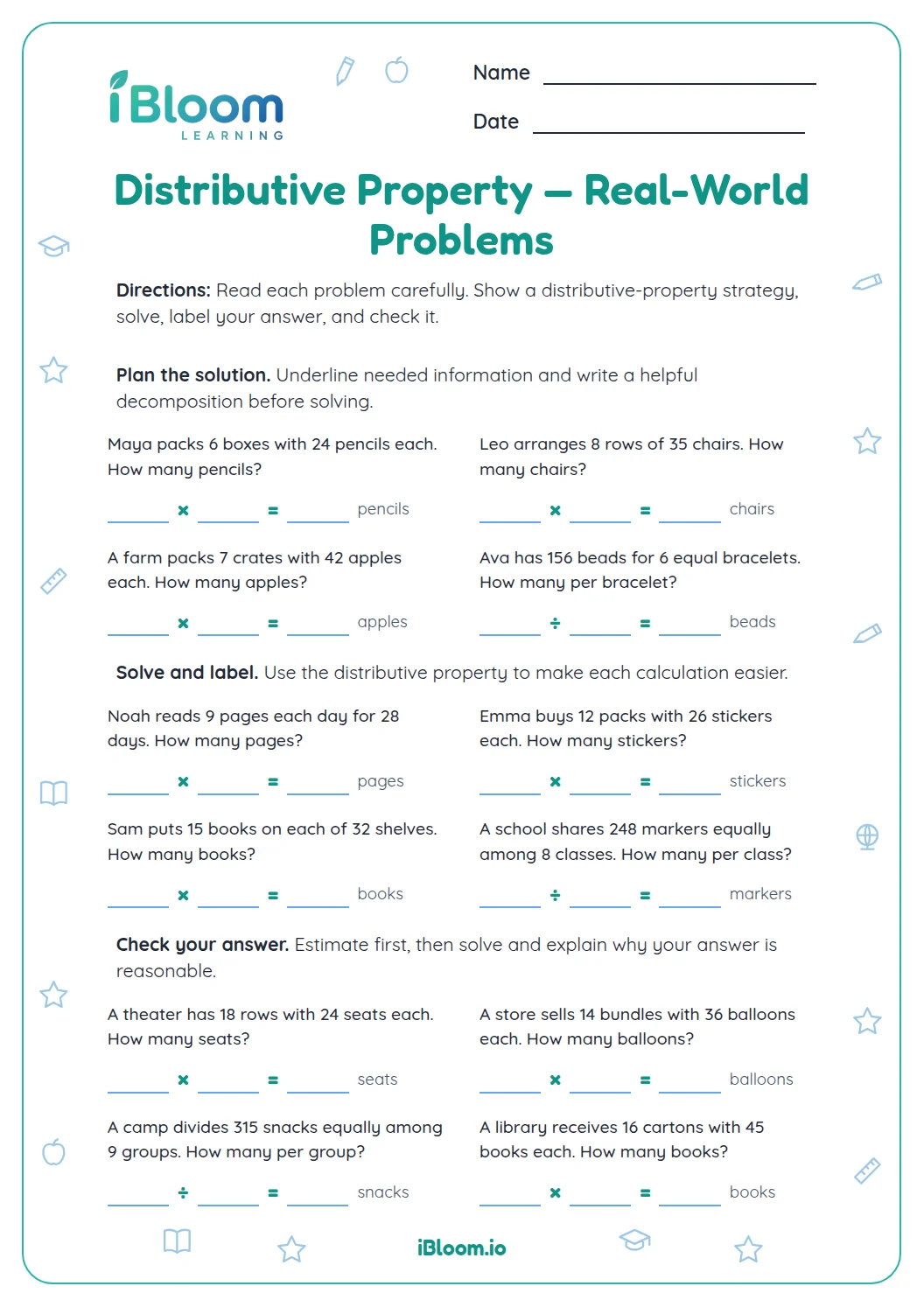
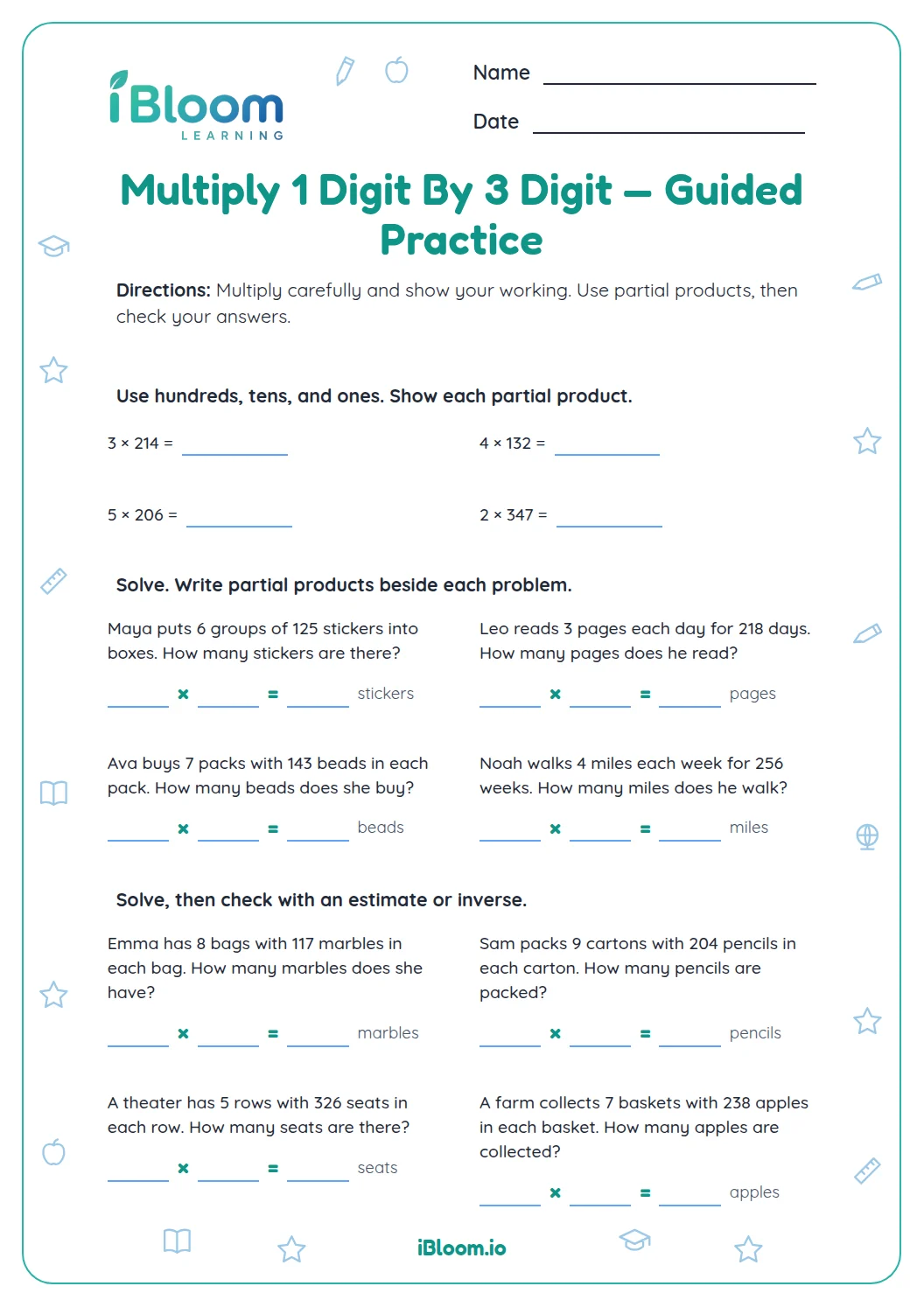
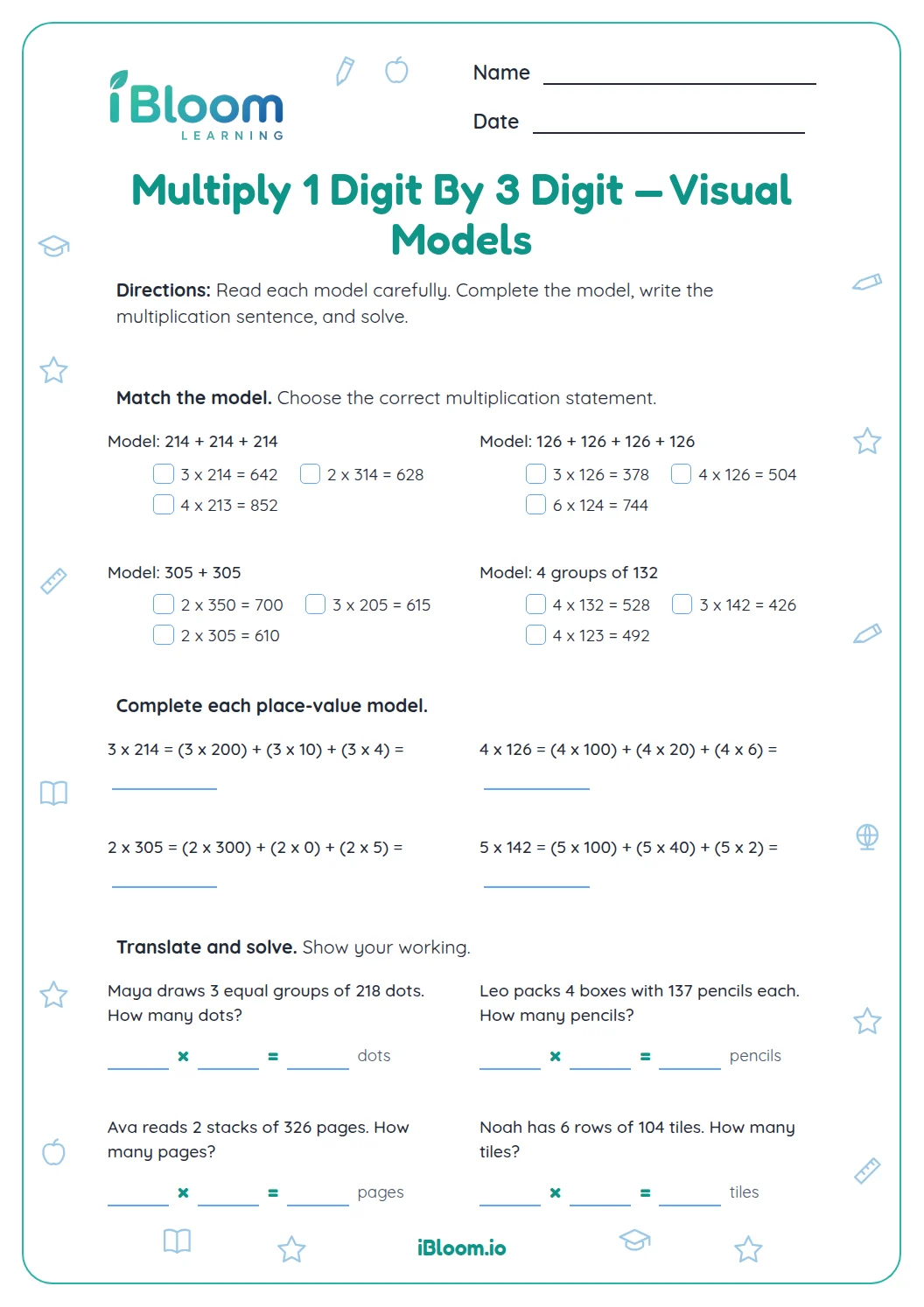
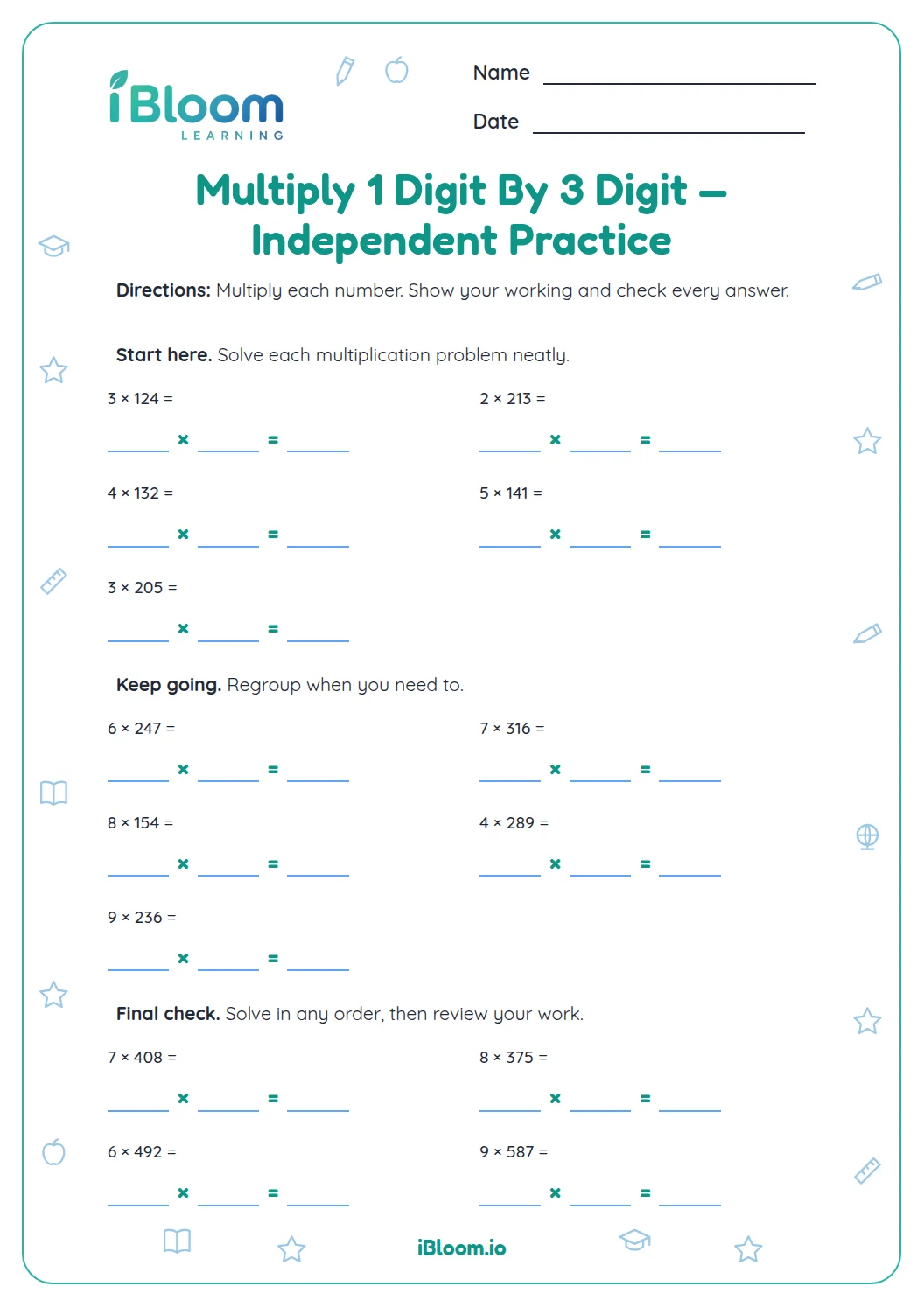
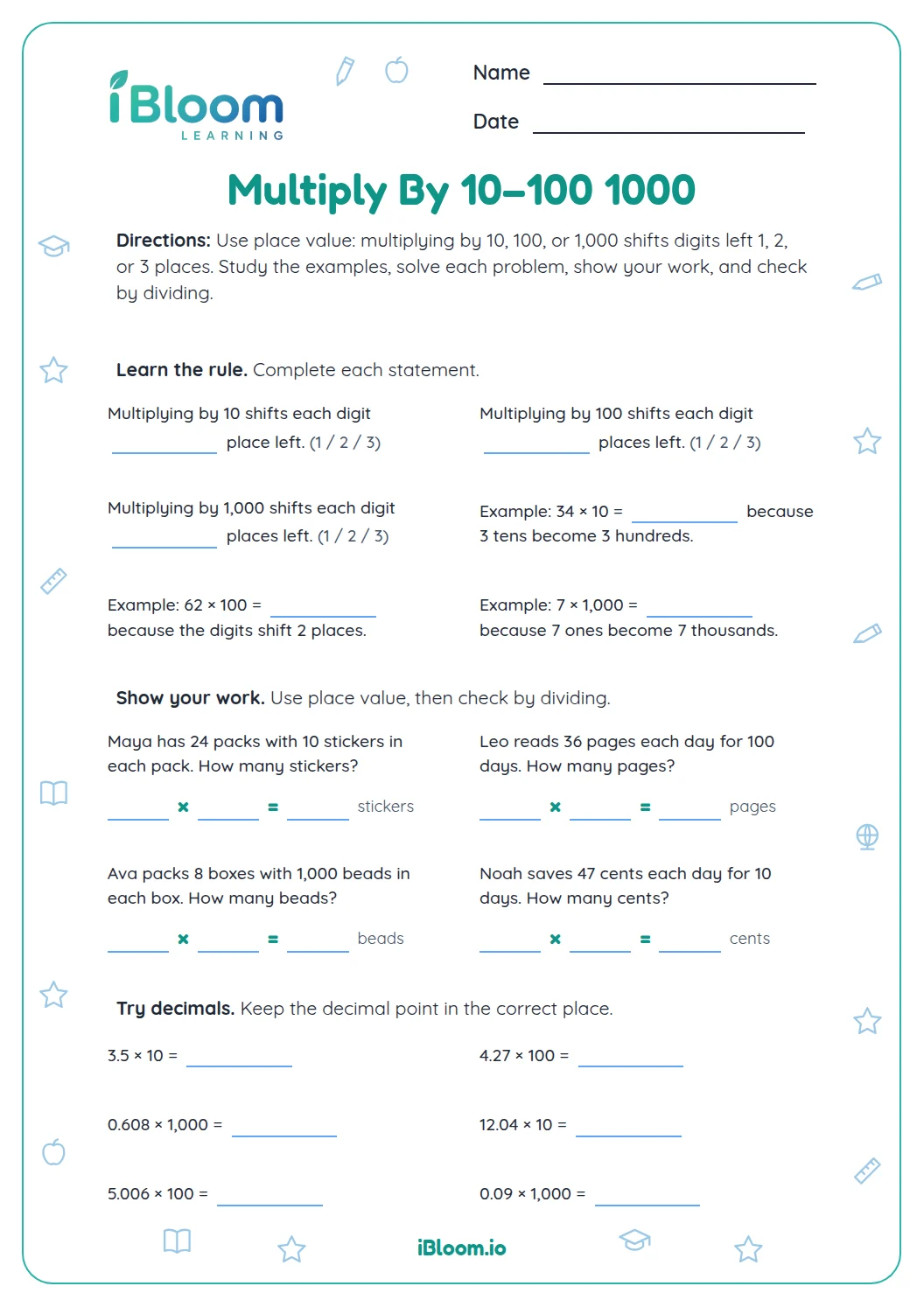
This Grade 5 worksheet connects multiplication arrays to the distributive property. Six drawn arrays show rows and columns to multiply. Seven equations ask students to break a factor into tens and ones, and four more questions use partial products to find a product. The answer key lists each product and missing part.
Aligned to 5.NBT.B.5
How does an array show a product?
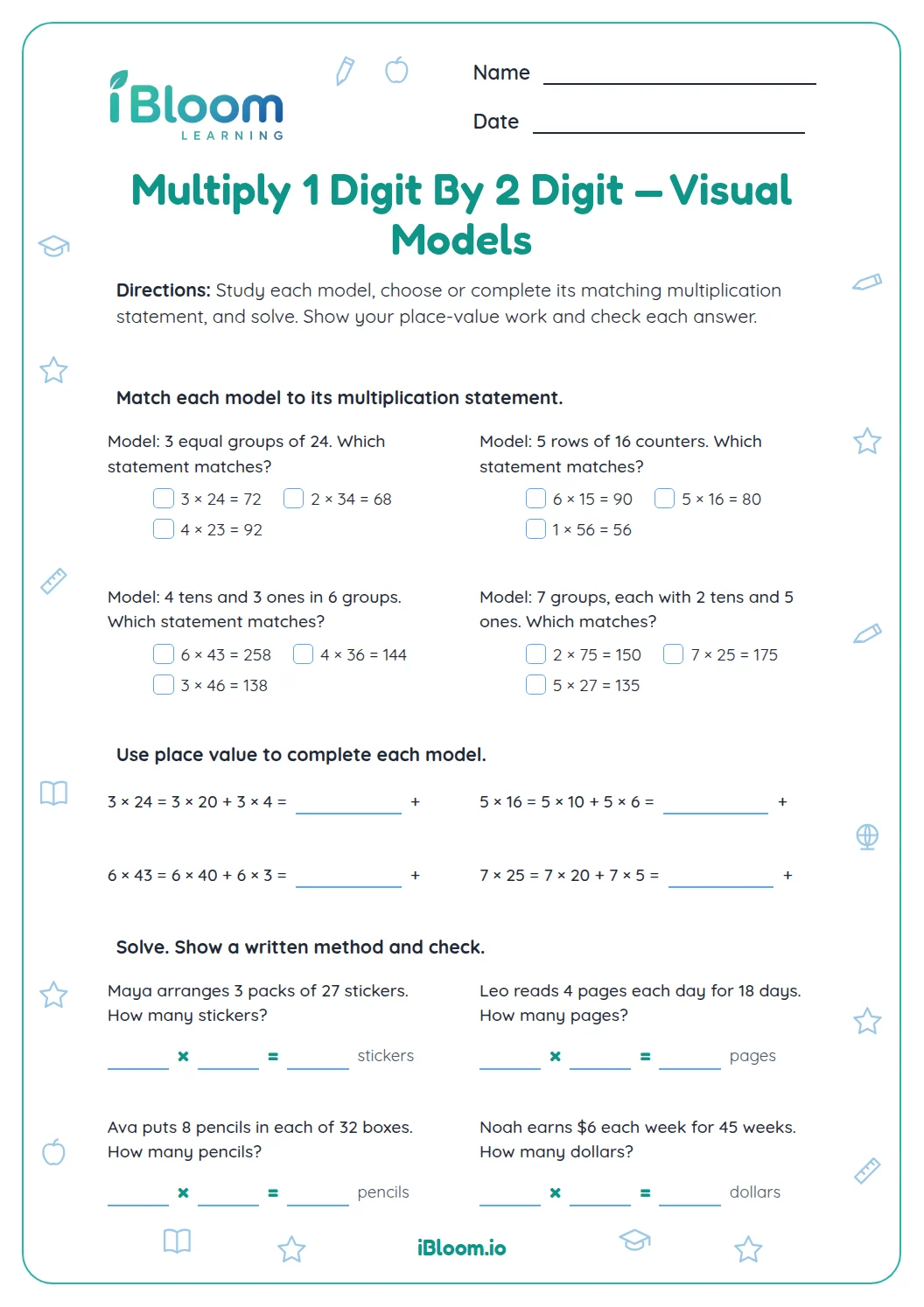
Each array has equal rows and columns. For a 3-by-7 array, multiply 3 × 7 to count 21 dots. The array gives a visual way to see equal groups and connect them to a multiplication equation.
How can a factor be split into tens and ones?
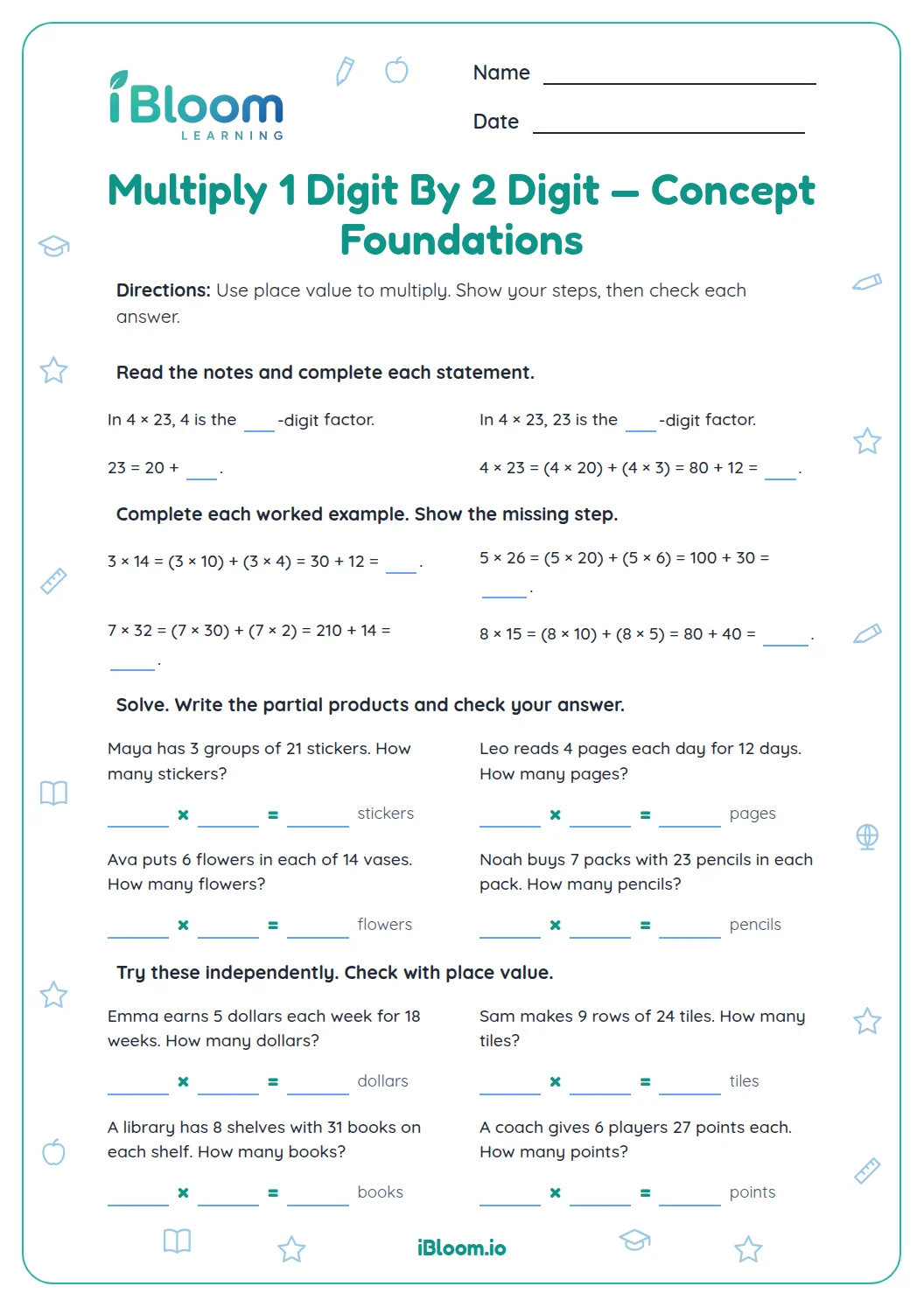
The split-factor equations show a two-digit factor as tens plus ones. For example, 6 × 14 = (6 × 10) + (6 × 4). Find each partial product, then add them to get 84.
How do partial products lead to the total?
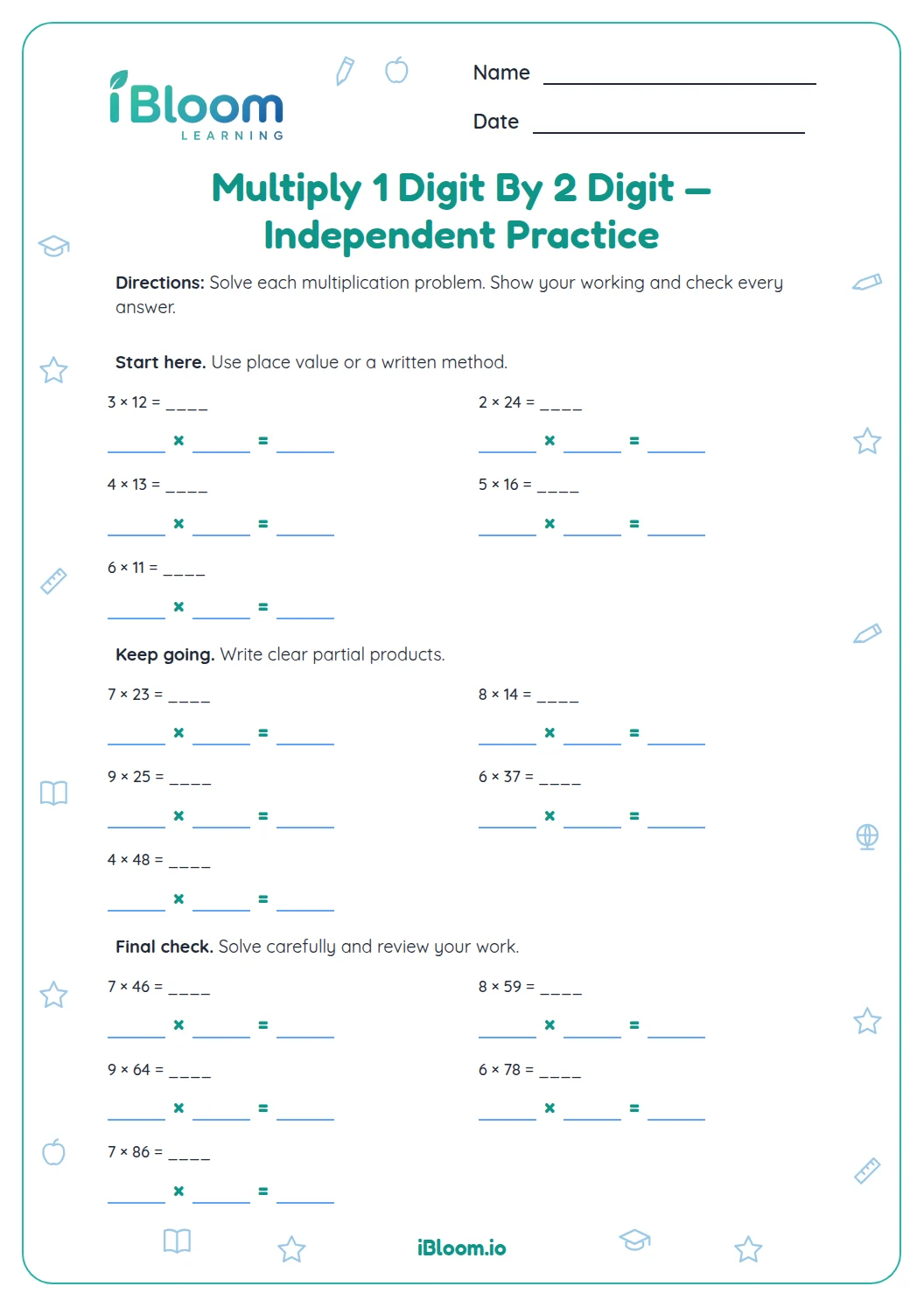
The final questions provide two parts of an array as multiplication expressions. Calculate each part and add the partial products. For 11 × 17, use 11 × 10 and 11 × 7: 110 + 77 = 187.
How to use this worksheet
- 1Count the rows and columns in each array.
- 2Multiply the two dimensions to find the total dots.
- 3Split the second factor into tens and ones.
- 4Multiply the first factor by each part of the split.
- 5Add the partial products to find the full product.
- 6Check that the result matches the full multiplication fact.
Common mistakes and quick fixes
The mistake
Splitting 14 into 1 and 4 instead of 10 and 4.
The fix
Write the tens value, 10, before multiplying.
The mistake
Multiplying by the ones part but forgetting the tens part.
The fix
Calculate both partial products and add them.
The mistake
Reading the array dimensions in reverse or skipping a row.
The fix
Count the rows and columns, then multiply those counts.
Use area arrays and partial products to multiply whole numbers.
On this sheet:
Show the official wordingHide the official wording
Fluently multiply multi-digit whole numbers using the standard algorithm.
What to practice next
Make more practice
Further reading
Questions parents and teachers ask
What is the distributive property?
The distributive property lets a factor multiply each part of a sum. For example, 6 × 14 can be written as (6 × 10) + (6 × 4). The two partial products add to the same total as multiplying 6 by 14 directly.
How many models are drawn?
The first six questions each include a dot array with its rows and columns drawn. Students use those models to find the total number of dots. Later questions use equations to split a factor into tens and ones, then combine partial products to find a product.
What does an array help students see?
An array organizes equal groups in rows and columns. A 4-by-6 array has 4 rows of 6 dots, so 4 × 6 gives 24 dots. Counting both dimensions makes the multiplication structure visible before students work with larger factors.
How do I solve a split-factor equation?
Break the two-digit factor into tens and ones, multiply each part by the other factor, and add. In 7 × 13, split 13 into 10 and 3. Then calculate 7 × 10 and 7 × 3, and combine 70 and 21.
What are partial products?
Partial products are the smaller multiplication results formed from a split factor. For 11 × 17, the parts are 11 × 10 and 11 × 7. Their products, 110 and 77, add to make the full product, 187.
What should students check in the answer key?
Students can compare each array total, missing ones value, and final product with the key. For a split equation, check that the two parts add back to the original factor. Then check that the partial products combine to the full product.