


About this worksheet
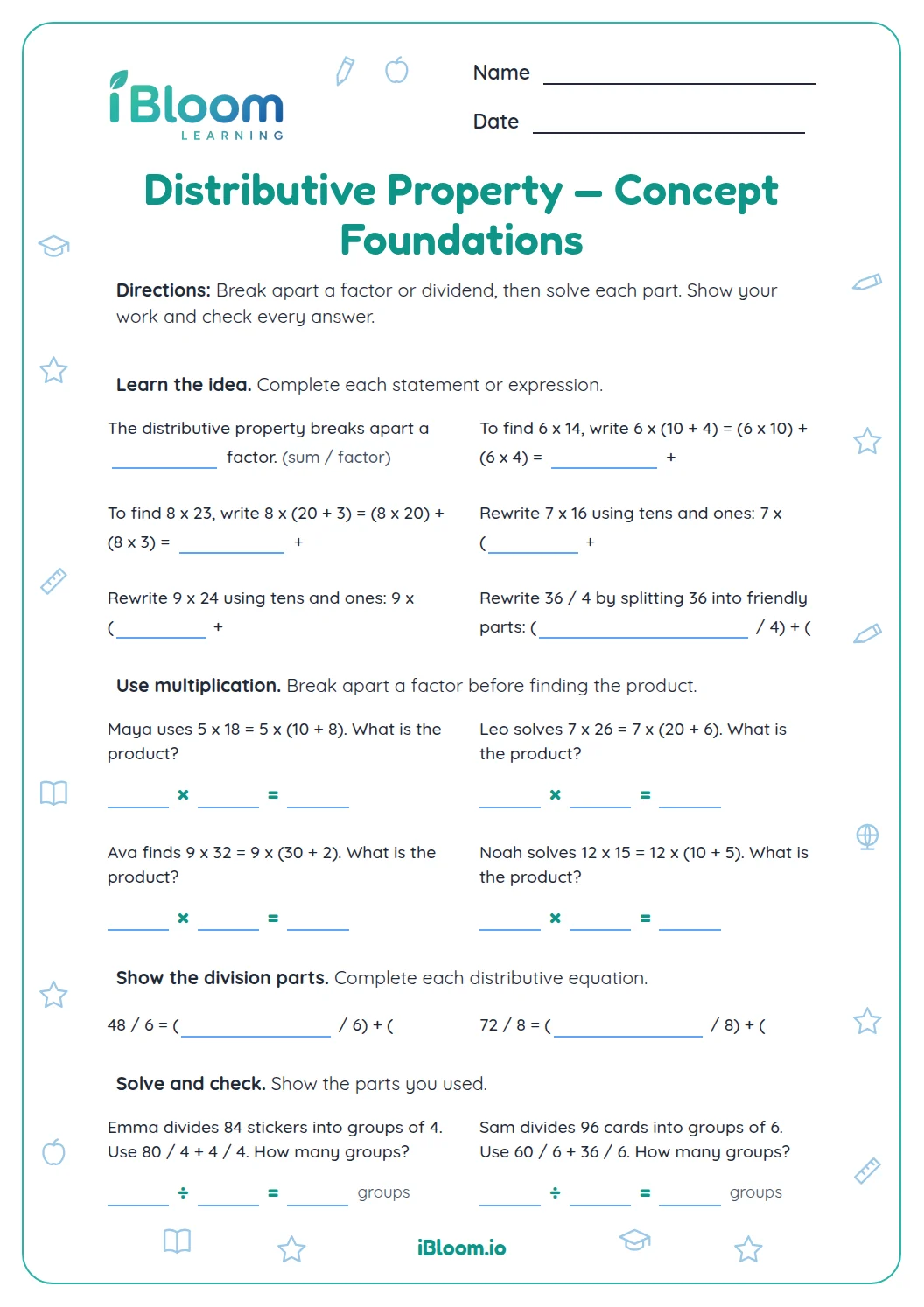
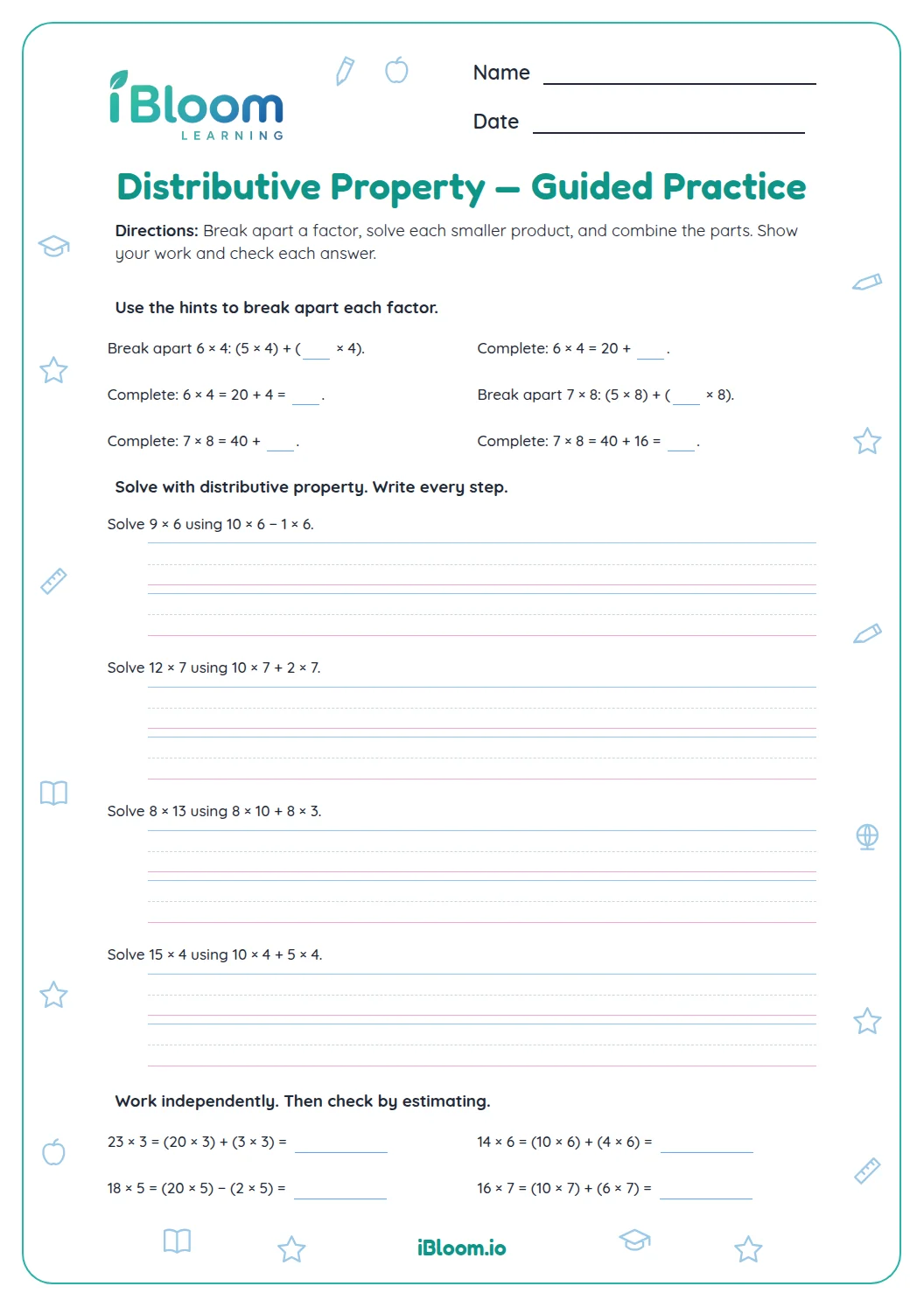
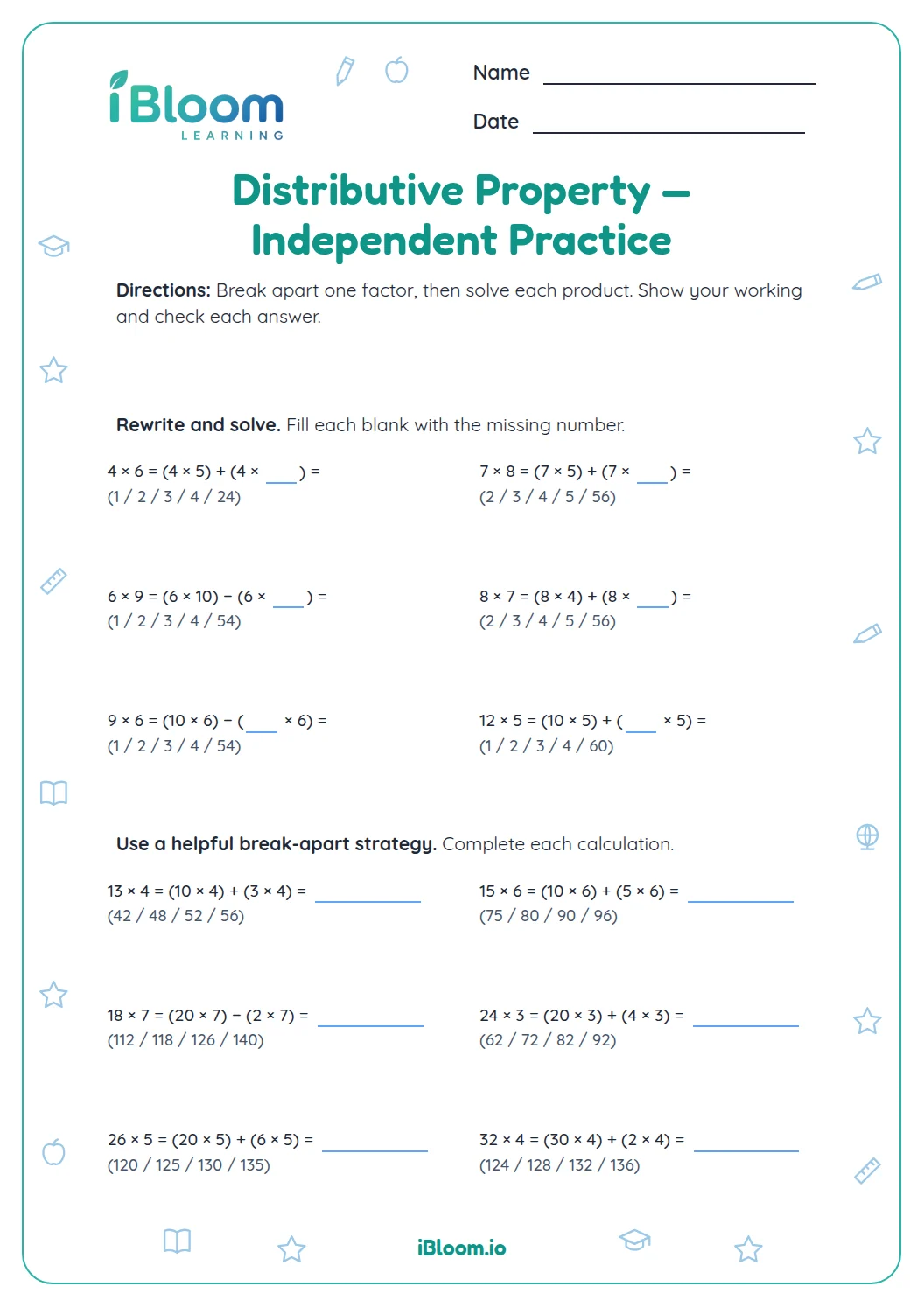
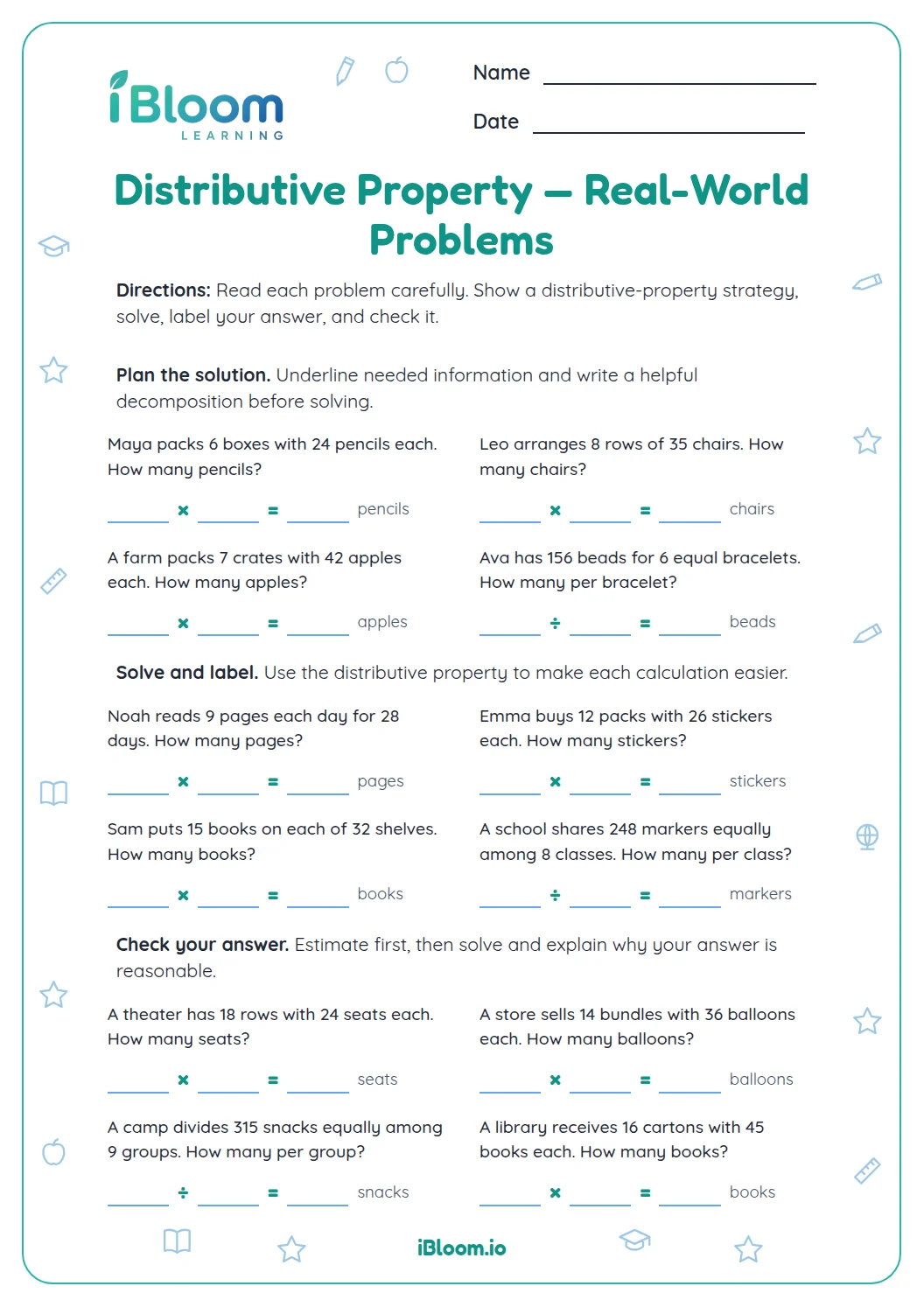
This free printable Grade 5 worksheet builds reasoning with the distributive property in multiplication. Students select equivalent expansions, complete missing factors, correct errors, and use decompositions to find products. It has 15 questions in three parts and a separate two-page answer key. The work practices multiplying a whole number by a multi-digit whole number using place-value decompositions, CCSS 5.NBT.B.5.
Aligned to 5.NBT.B.5
How does the distributive property break up a product?
Split one factor into a sum, multiply each part by the other factor, then add the partial products. This keeps the value of the expression the same.
Question 1 rewrites 7 × 36 as 7 × 30 + 7 × 6. The partial products are 210 and 42, which combine to 252.
- 17 × 36
- 236 = 30 + 6
- 37 × 30 + 7 × 6
- 4210 + 42 = 252
How can you spot an incomplete expansion?
When a factor is split, every part must still be multiplied by the other factor. Part C asks students to find incomplete expansions and compare strategies for numbers near a friendly multiple of ten.
What is in the challenge?
Fifteen questions build from equivalent expressions, to missing parts, to explaining and calculating. The key includes a model correction or calculation for each written response.
How to use this worksheet
- 1Choose a factor to split into tens and ones.
- 2Write the other factor beside every part of the split factor.
- 3Multiply each partial product carefully.
- 4Add the partial products and compare with the original product.
- 5For error questions, name the missing multiplication before correcting the total.
Common mistakes and quick fixes
The mistake
Multiplying only one part after splitting a factor.
The fix
Put the other factor in every term, such as 5 × 20 + 5 × 8.
The mistake
Adding a leftover part without multiplying it.
The fix
Keep the factor visible in each partial product; 6 × 41 becomes 6 × 40 + 6 × 1.
The mistake
Choosing a nearby multiple but moving in the wrong direction.
The fix
For 9 × 99, calculate 9 × 100 and subtract one group of 9.
Common Core alignment
This worksheet gives practice with the following Common Core standard.
Fluently multiply multi-digit whole numbers using the standard algorithm.
On this sheet: The questions repeatedly ask students to decompose factors into tens and ones, multiply each part, and combine partial products.
Show the official wordingHide the official wording
Fluently multiply multi-digit whole numbers using the standard algorithm.
What to practice next
Make more practice
Further reading
Questions parents and teachers ask
What does the distributive property do?
It lets you split a factor into parts, multiply each part by the other factor and add the partial products. For example, 7 × 36 = 7 × 30 + 7 × 6 = 252. The total stays the same because 30 and 6 still make 36.
Why must the other factor appear in every term?
Each piece still belongs to the original group of equal sets. In 5 × 28, splitting 28 into 20 + 8 gives 5 × 20 + 5 × 8, not 5 × 20 + 8. Multiplying both parts preserves the original product.
How can a nearby multiple of ten make a product easier?
Multiply by a nearby ten and adjust by one group. For 9 × 99, use 9 × 100 − 9, which is 900 − 9 = 891. This works because 99 is one less than 100, so one group of 9 must be removed.
How many questions require written reasoning?
The final five questions ask students to correct an expansion, explain an error, compare strategies, or show partial products. The first ten questions provide five equivalent-expression choices and five missing-part equations. Together they practice both calculation and the reason each decomposition preserves the product.
What is included in the answer key?
The answer key gives the equivalent expressions and missing values, then provides concise corrected equations for the reasoning questions. Equivalent explanations that show the same multiplication are acceptable, as long as every part of the decomposed factor is multiplied.