



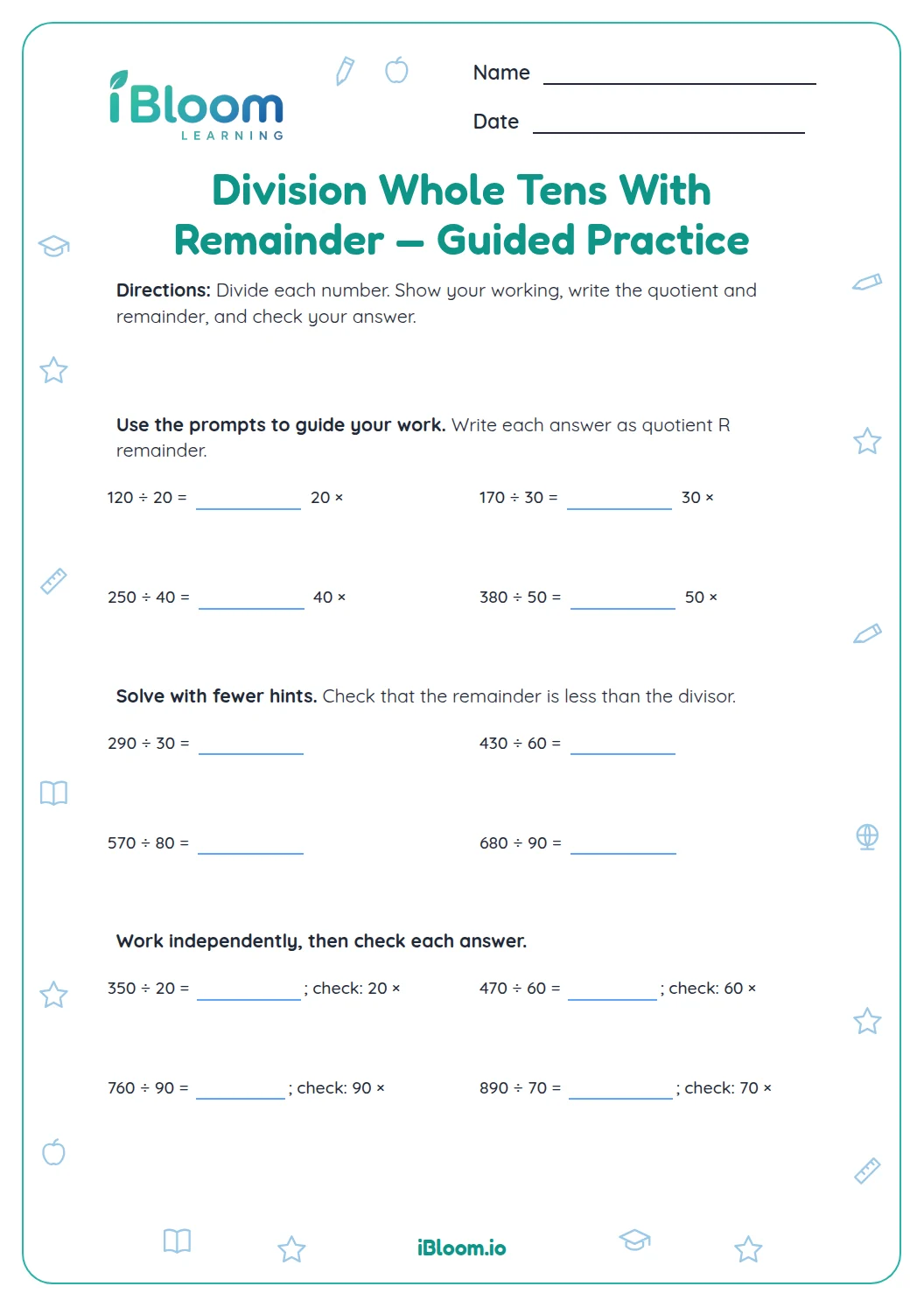

About this worksheet
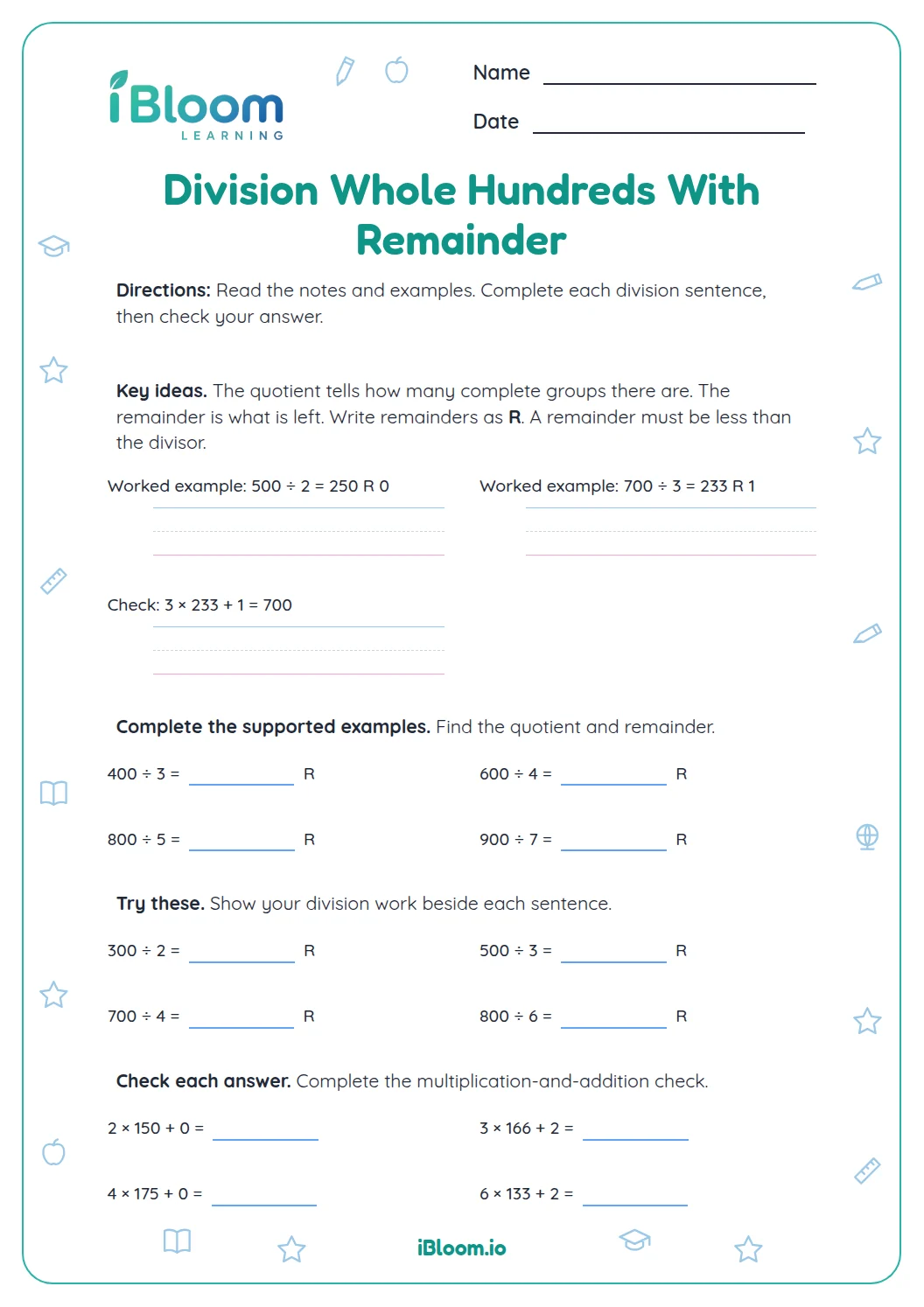
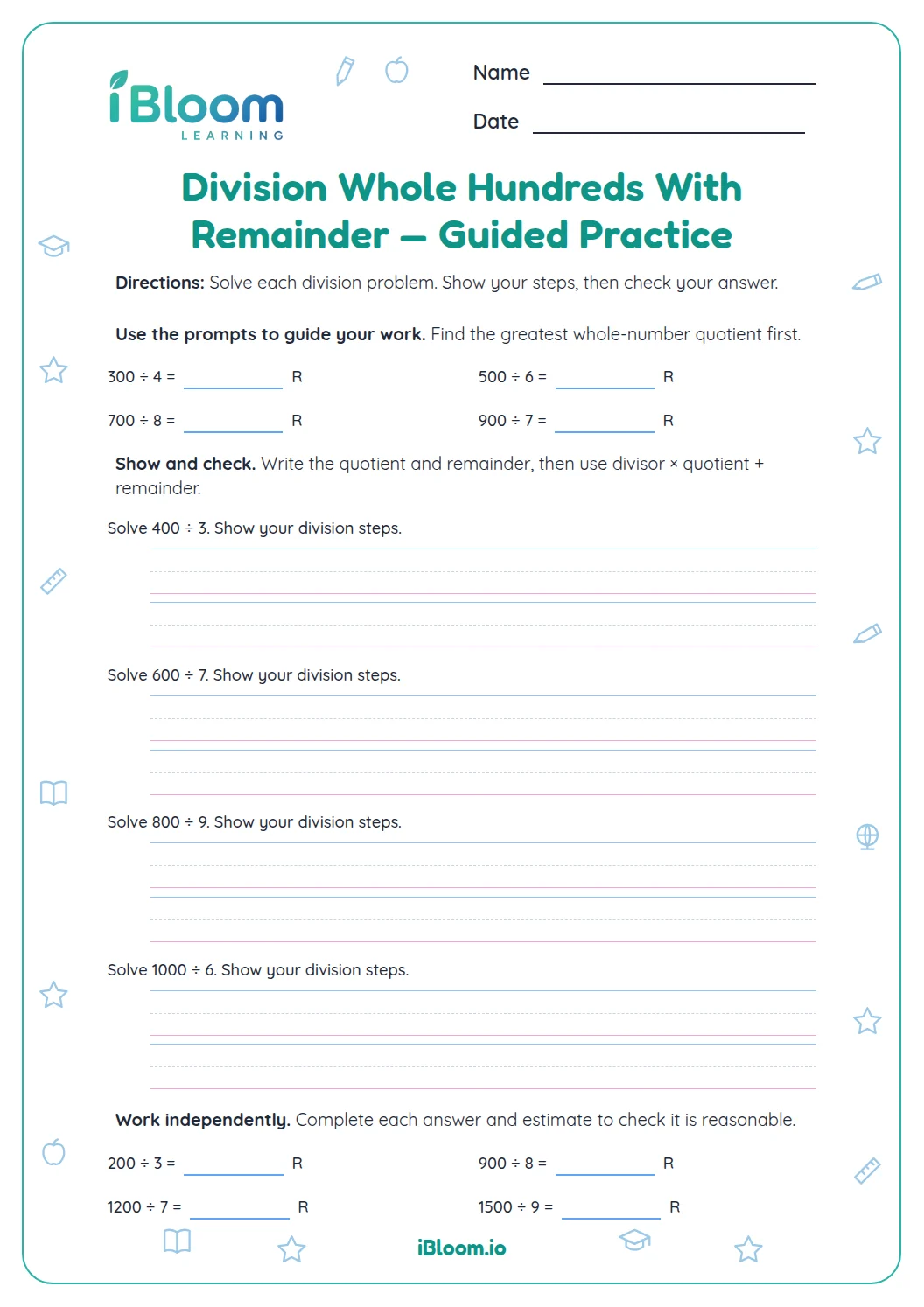
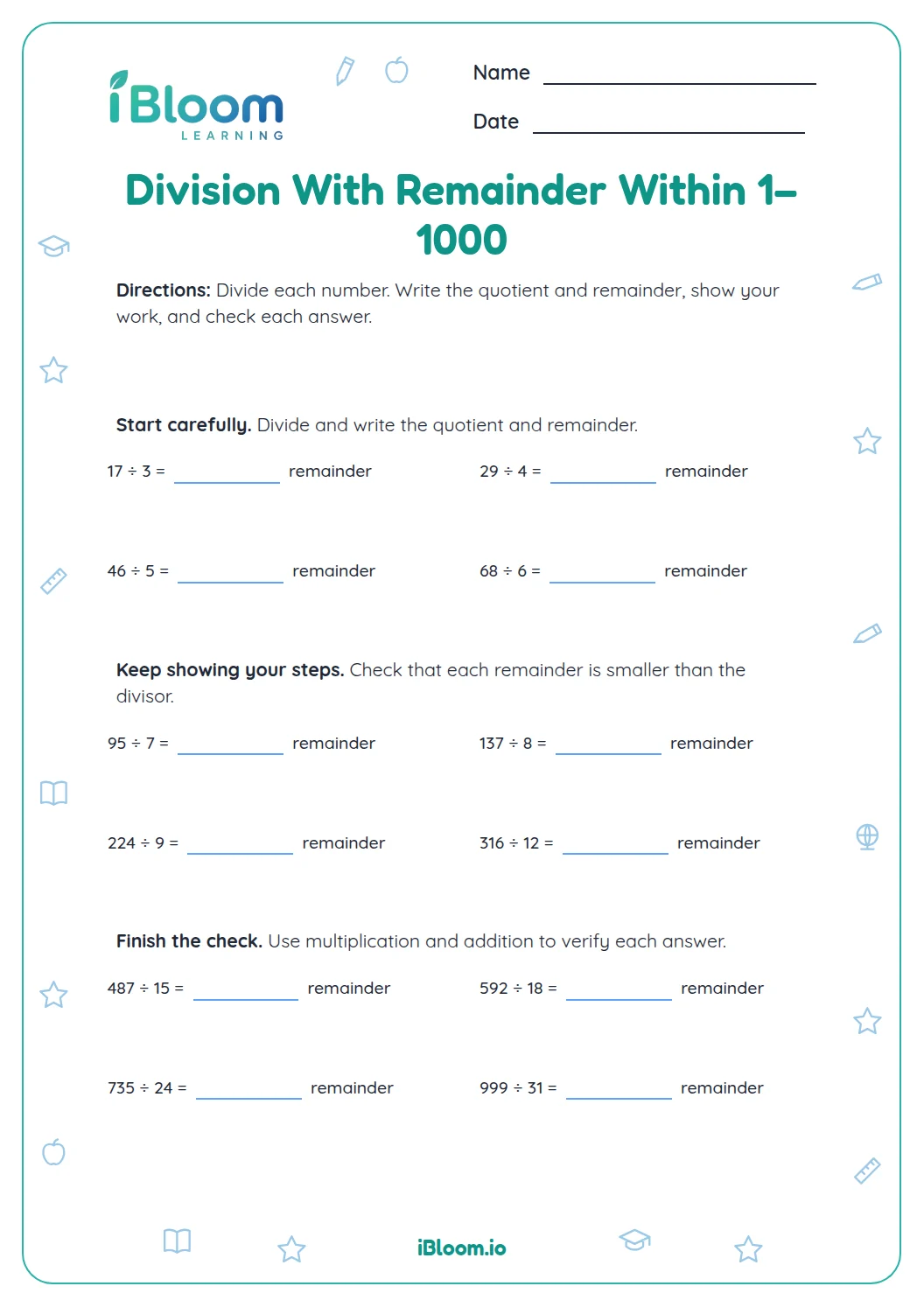
This Grade 5 worksheet builds division fluency with whole hundreds and thousands divided by two-digit numbers. Students solve 12 number sentences, then apply the same quotient-and-remainder method to four equal-grouping stories. Story problems include space for working. The separate answer key lets students check by multiplying the quotient by the divisor and adding the remainder.
Aligned to 5.NBT.B.6
What does this worksheet practice?
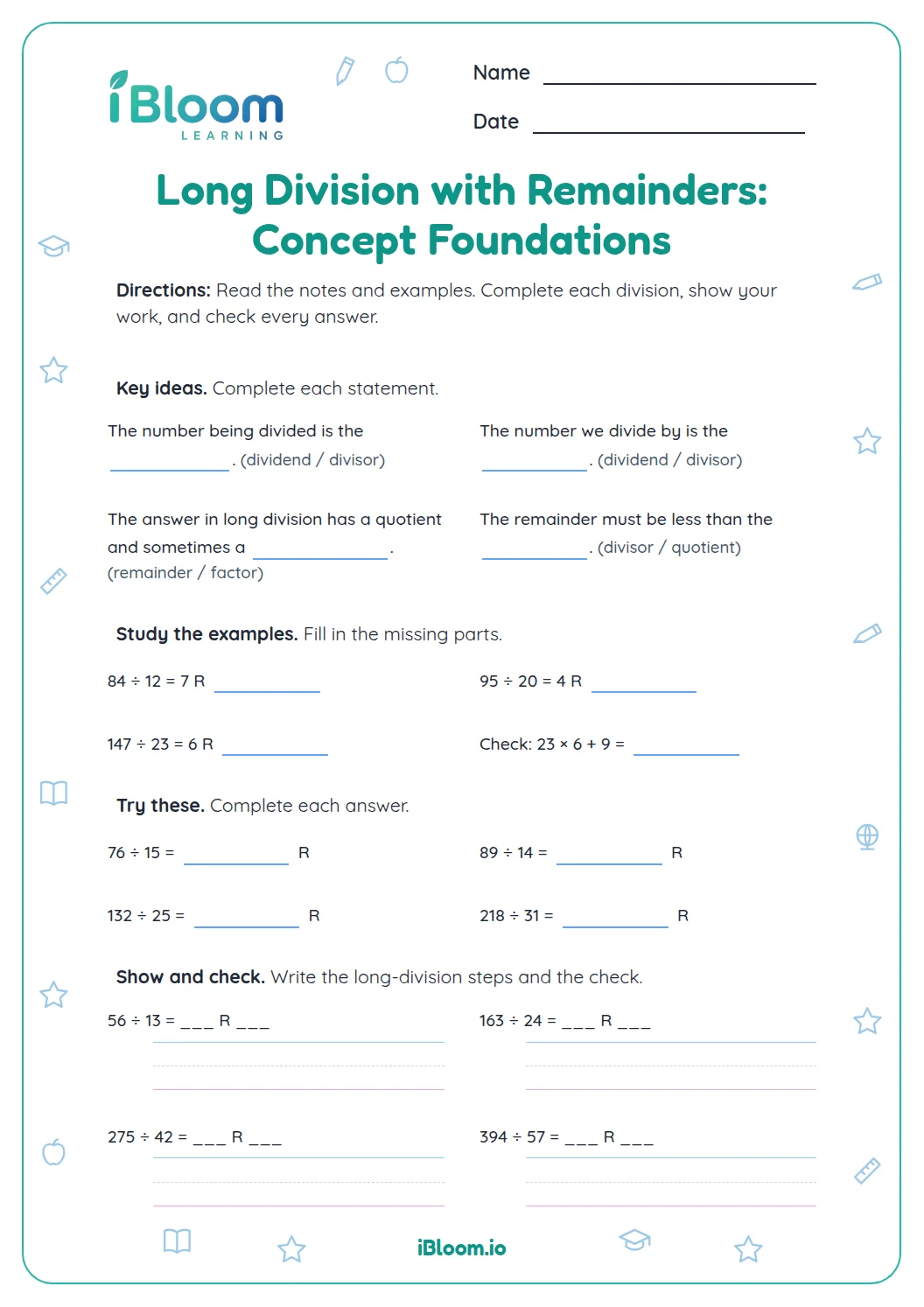
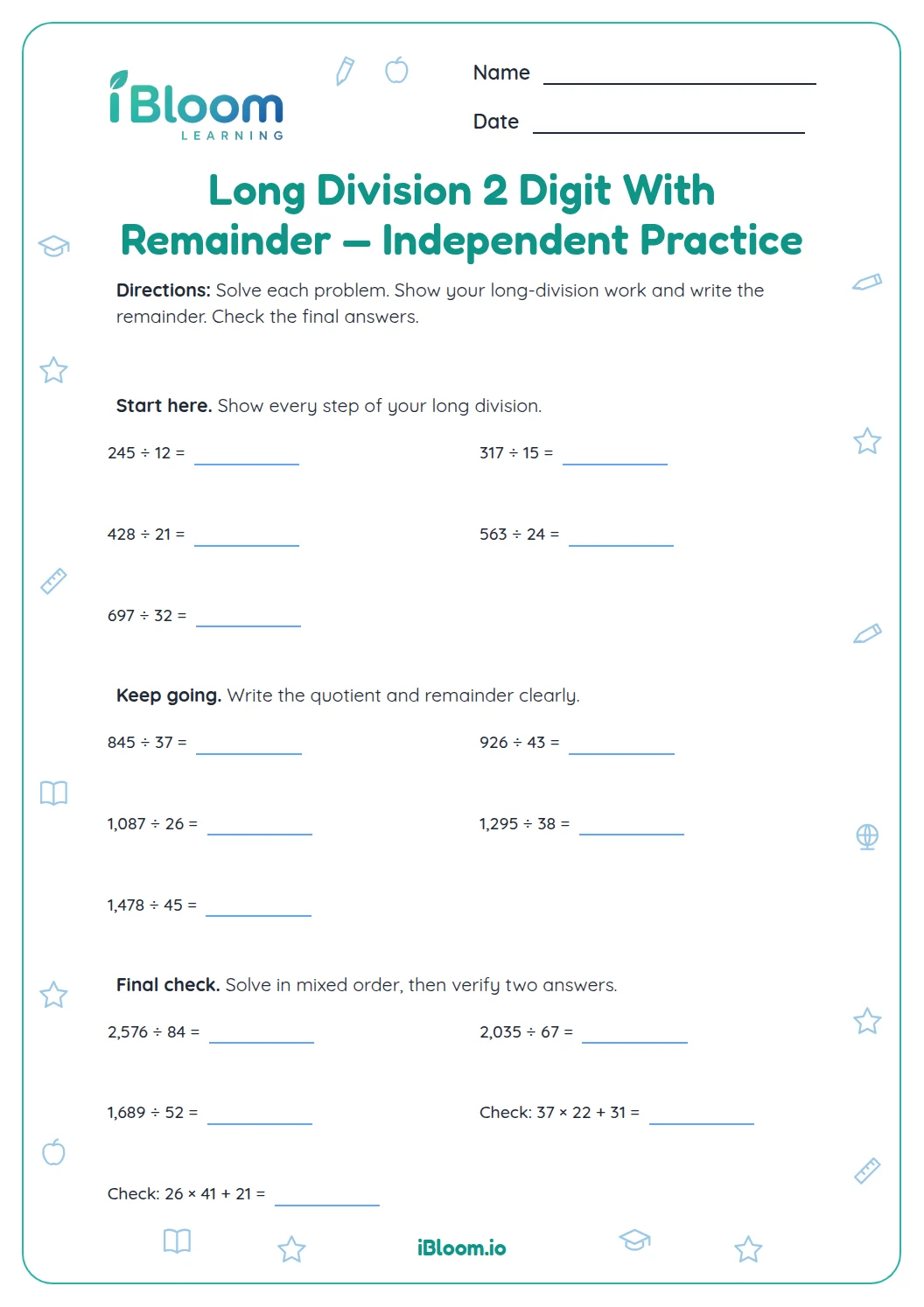
Part A and Part C contain 12 division number sentences; Part B applies the same quotient-and-remainder method to four grouping situations. Each divisor has two digits, and the numbers stay within four-digit dividends.
How do you check a quotient and remainder?
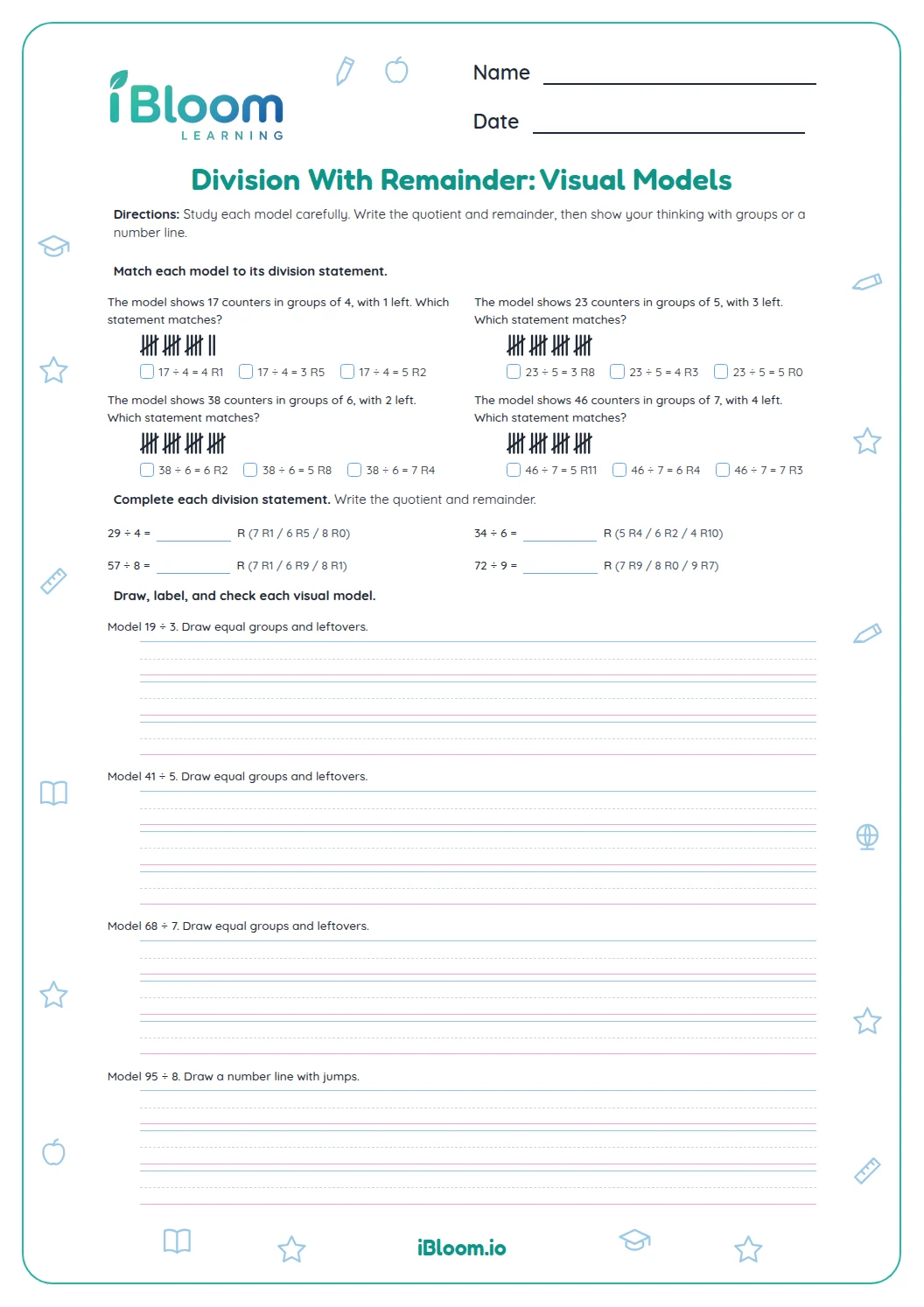
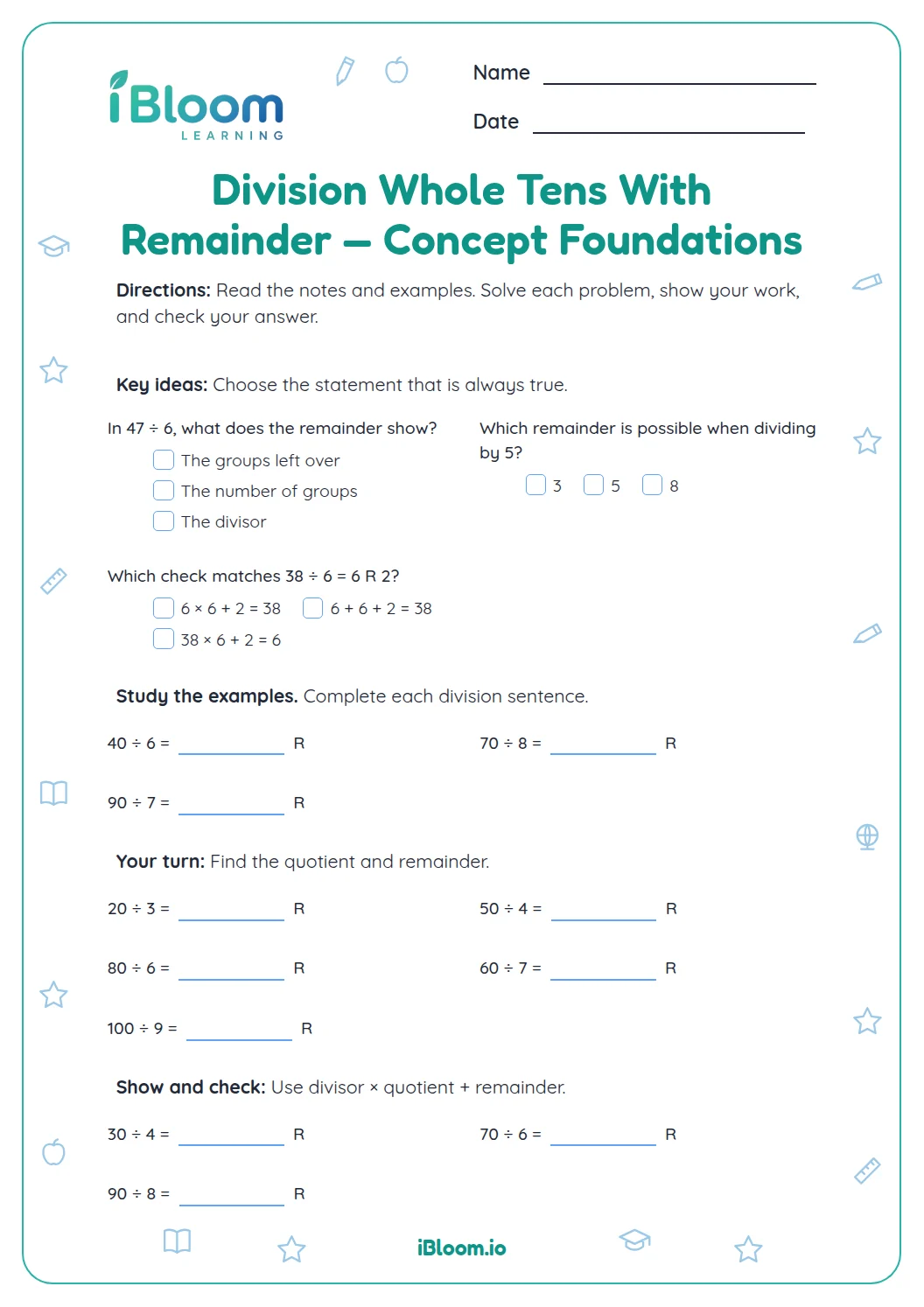
The remainder must be smaller than the divisor. Multiply the quotient by the divisor and add the remainder to see whether you get the starting number.
- 11,200 ÷ 35 = 34 R 10
- 235 × 34 = 1,190; 1,190 + 10 = 1,200
How can an adult support the practice?
Ask the learner to estimate how many groups fit before calculating. Afterward, check the remainder is less than the group size and use multiplication to verify the total.
How to use this worksheet
- 1Read the divisor and dividend carefully.
- 2Estimate how many groups will fit.
- 3Find the quotient and the amount left over.
- 4Check that the remainder is less than the divisor.
- 5Multiply the quotient by the divisor and add the remainder.
- 6For story problems, label what each number counts.
Common mistakes and quick fixes
The mistake
Writing a remainder as large as the divisor.
The fix
Make another group if the remainder is at least the divisor.
The mistake
Stopping after finding the quotient.
The fix
Subtract the groups used from the dividend to find what remains.
The mistake
Leaving the story answer unlabeled.
The fix
Name both the full groups and the leftover items.
Common Core alignment
Find whole-number quotients with up to four-digit dividends and two-digit divisors.
On this sheet: The questions divide whole hundreds and thousands by two-digit divisors and record remainders.
Show the official wordingHide the official wording
Find whole-number quotients of whole numbers with up to four-digit dividends and two-digit divisors, using strategies based on place value, the properties of operations, and/or the relationship between multiplication and division. Illustrate and explain the calculation by using equations, rectangular arrays, and/or area models.
What to practice next
Make more practice
Further reading
Questions parents and teachers ask
What does R mean in an answer?
R means remainder: the amount left after making as many full groups as possible. For example, 34 R 10 means 34 full groups and 10 left over. On the story problems, write what those groups and leftovers represent.
How do I know whether a remainder is correct?
A remainder must be less than the divisor. Multiply the quotient by the divisor and add the remainder; that result should equal the dividend. The worksheet’s answer key lists both the quotient and remainder for every question. Use the multiplication check to confirm the groups and leftovers together.
What is on the two parts?
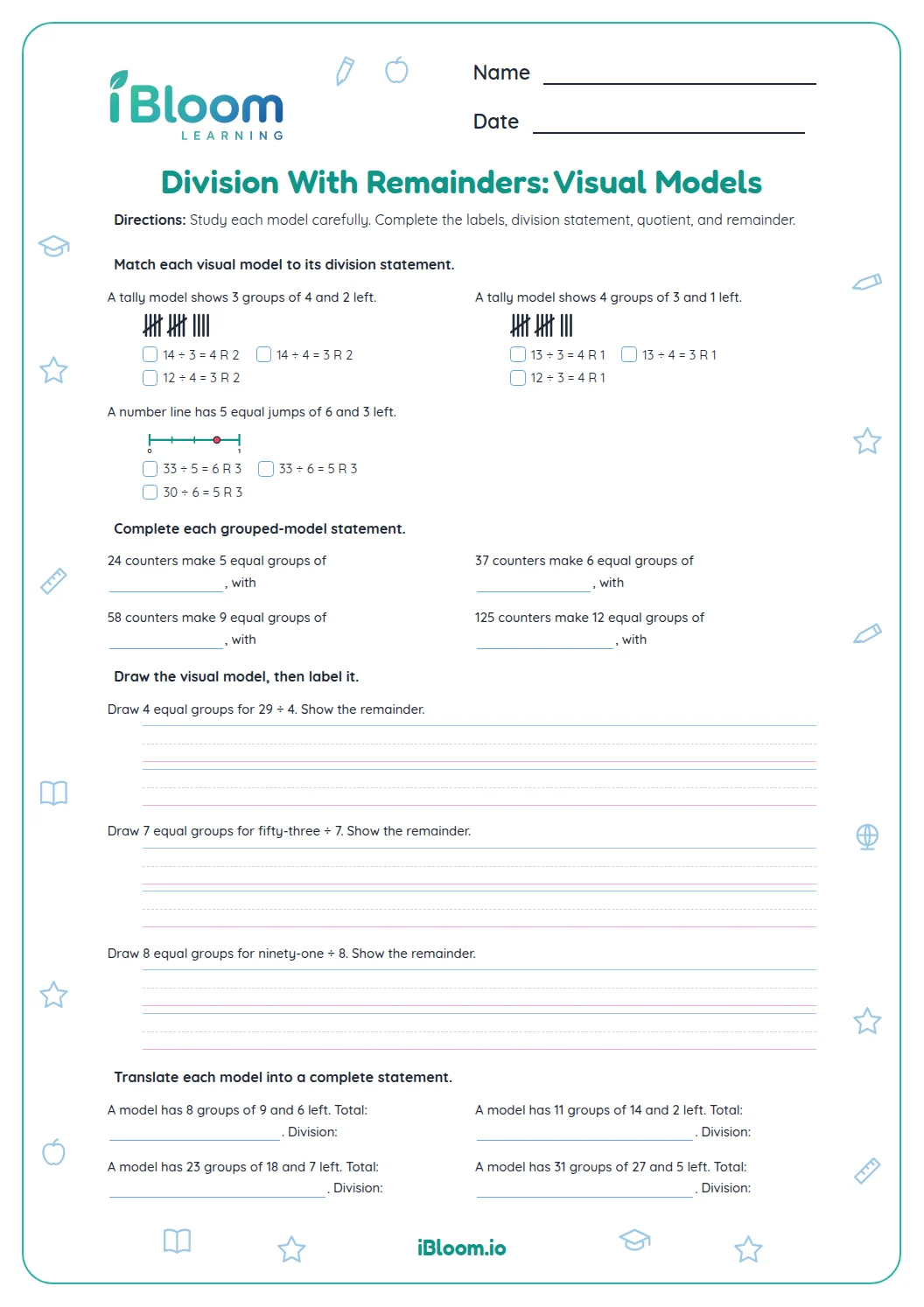
Part A and Part C have 12 number sentences with whole hundreds or thousands divided by two-digit numbers. Part B has four equal-grouping stories about items such as stickers and buttons. Story problems include room to work. Students can label the units.
Can students use this at home?
Yes. A learner can work through the number sentences and stories independently, then use the separate answer key to check. An adult can ask the learner to explain the multiplication check when an answer needs another look. Pause after each part so the learner can explain one calculation.
How long will it take?
Plan for about 20 minutes for the 16 questions, depending on how much written work the learner shows. The two number-sentence parts and story part can be completed in short sittings, with the answer key used afterward. Pause between the parts.
What should a learner try next?
After checking the quotient and remainder method, try a division worksheet with smaller dividends or a long-division page. The linked skills move from division with remainders toward recording the written division steps. The linked practice keeps the focus on dividing and checking remainders.