



About this worksheet
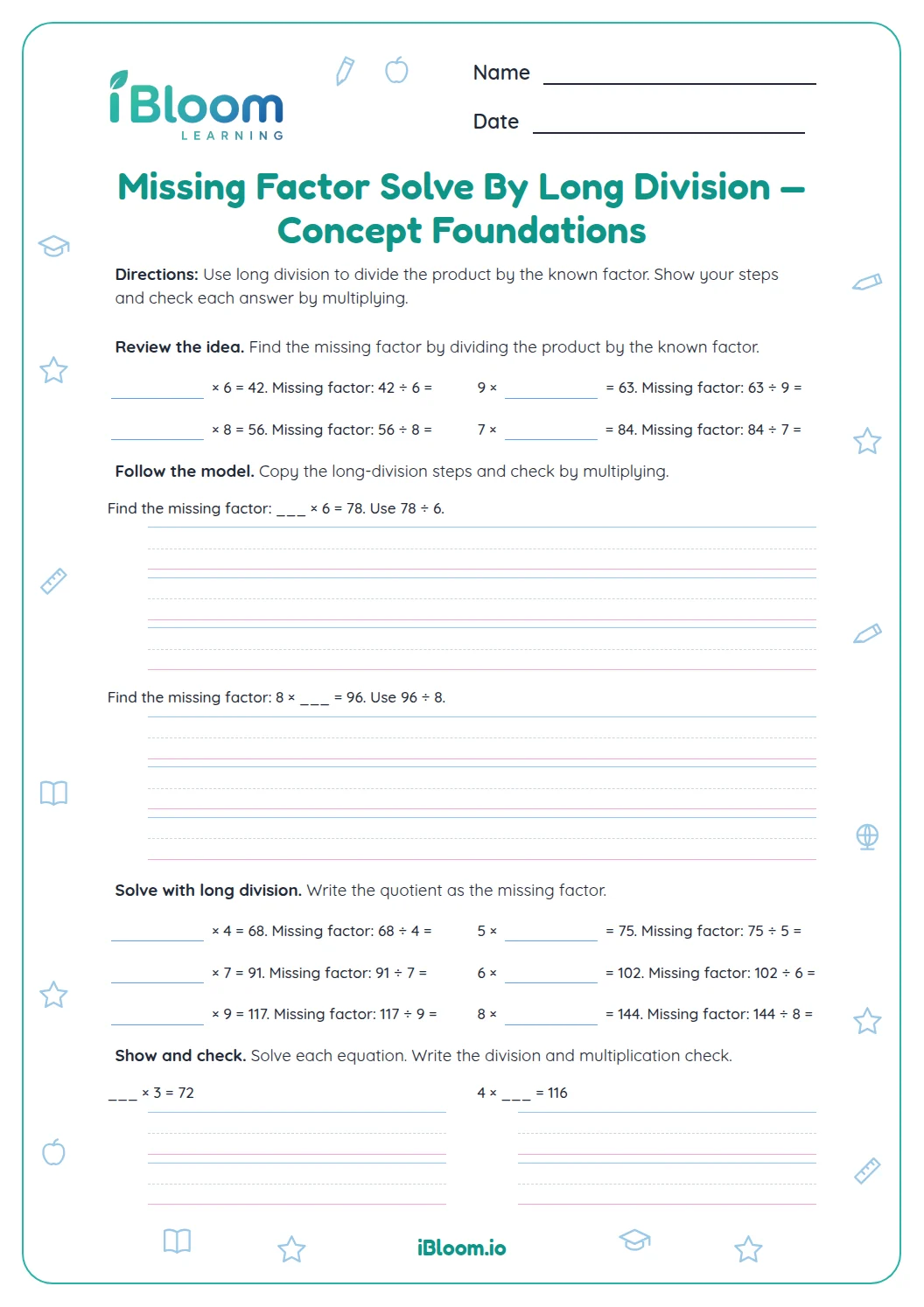
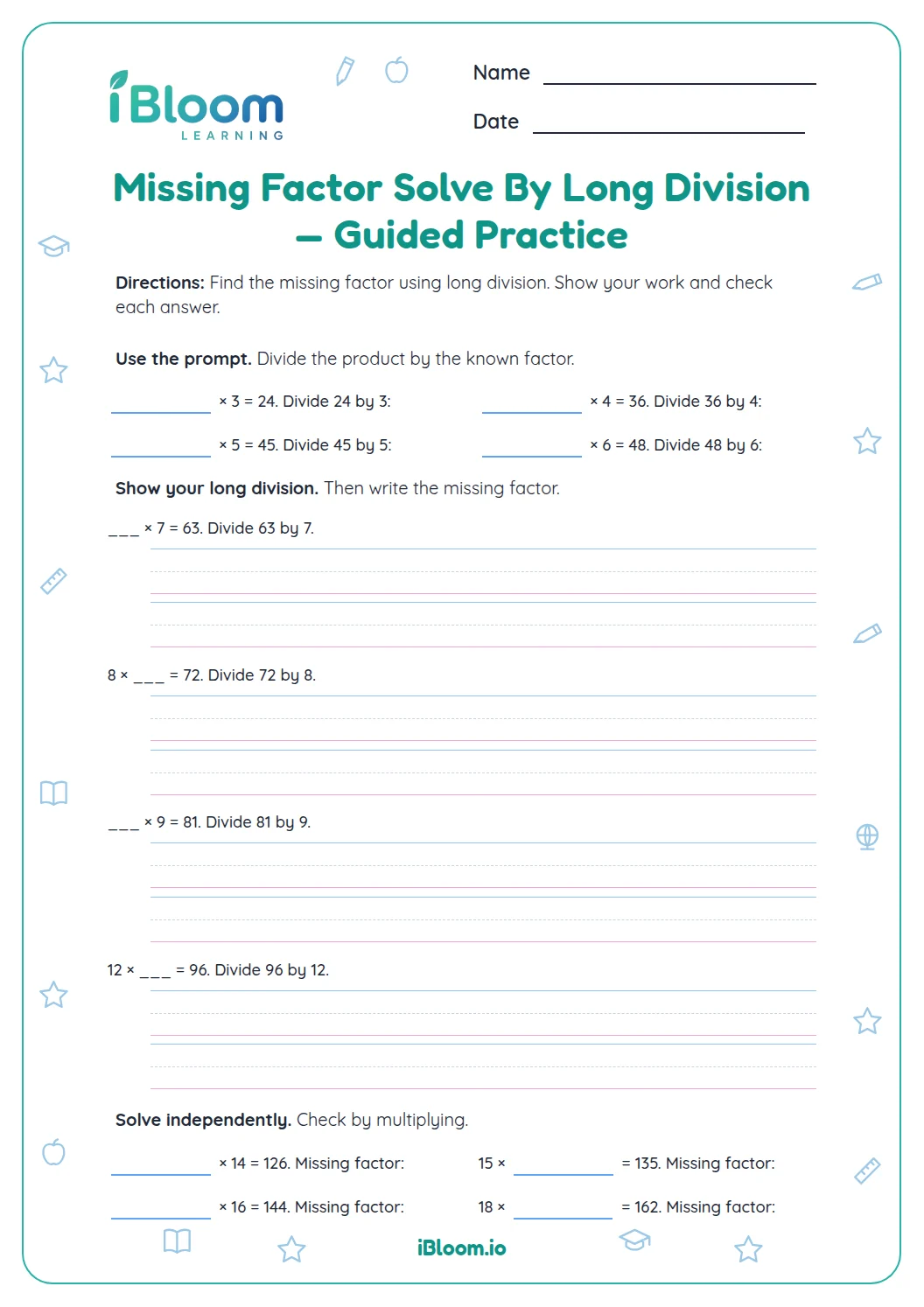
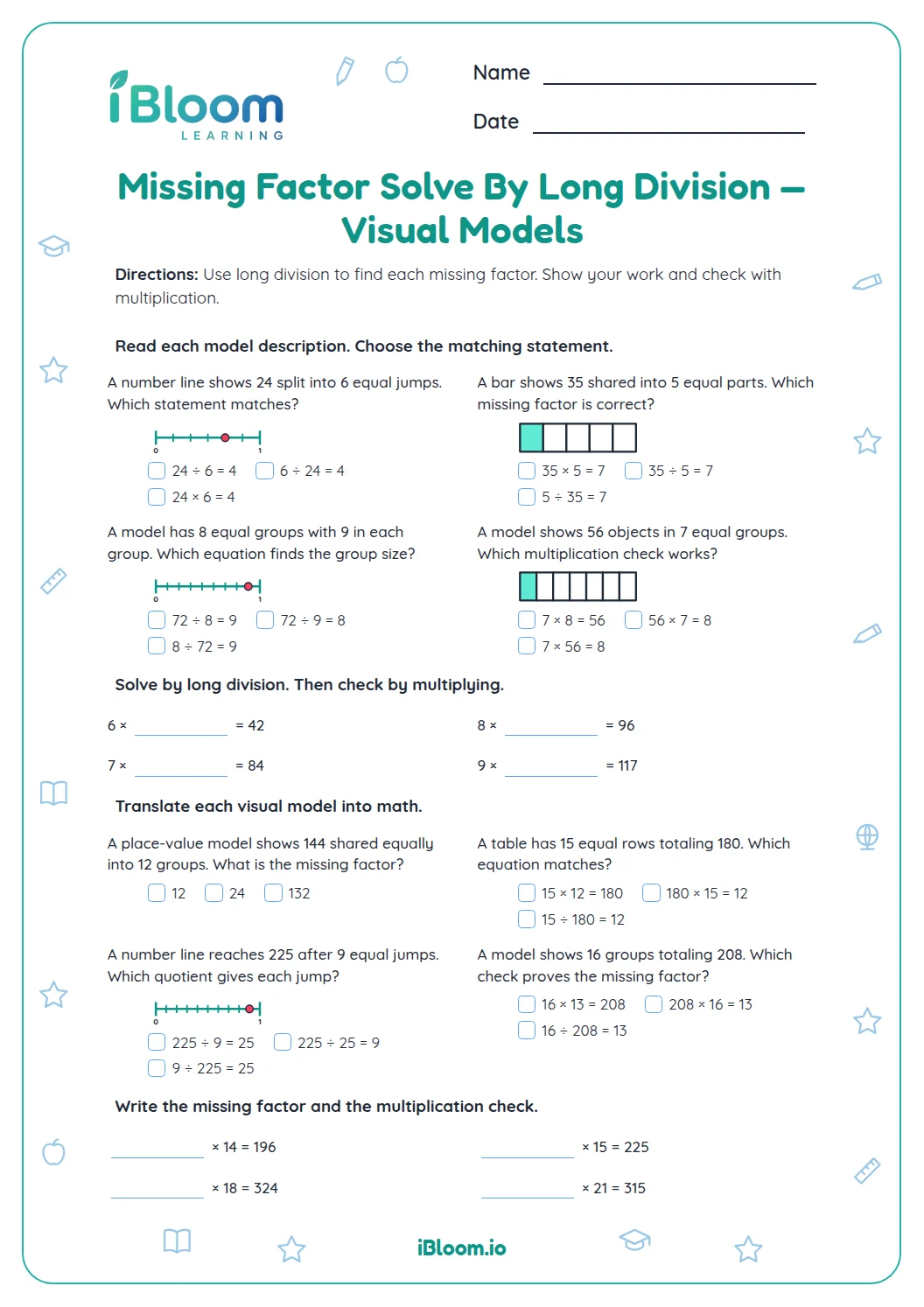
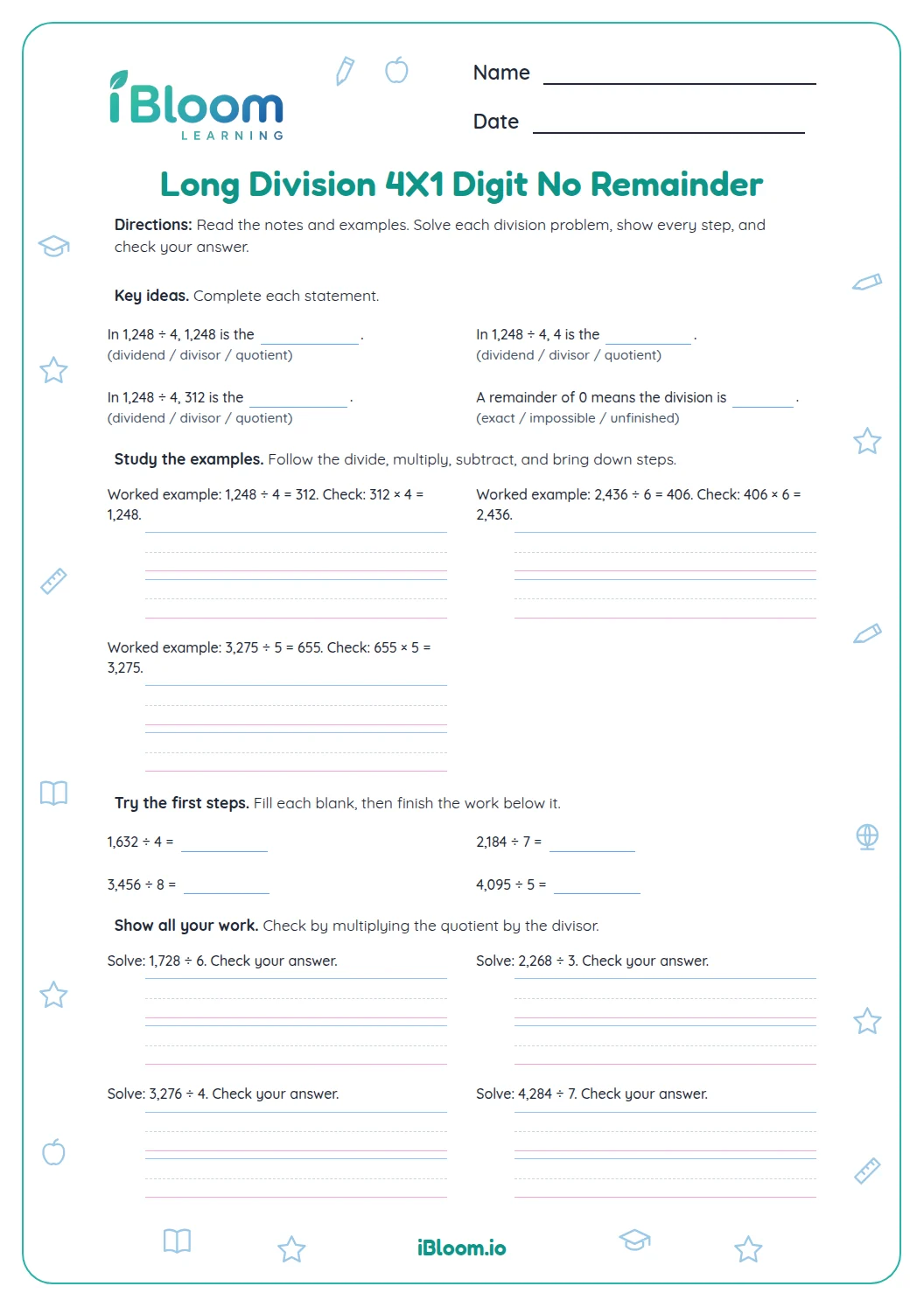
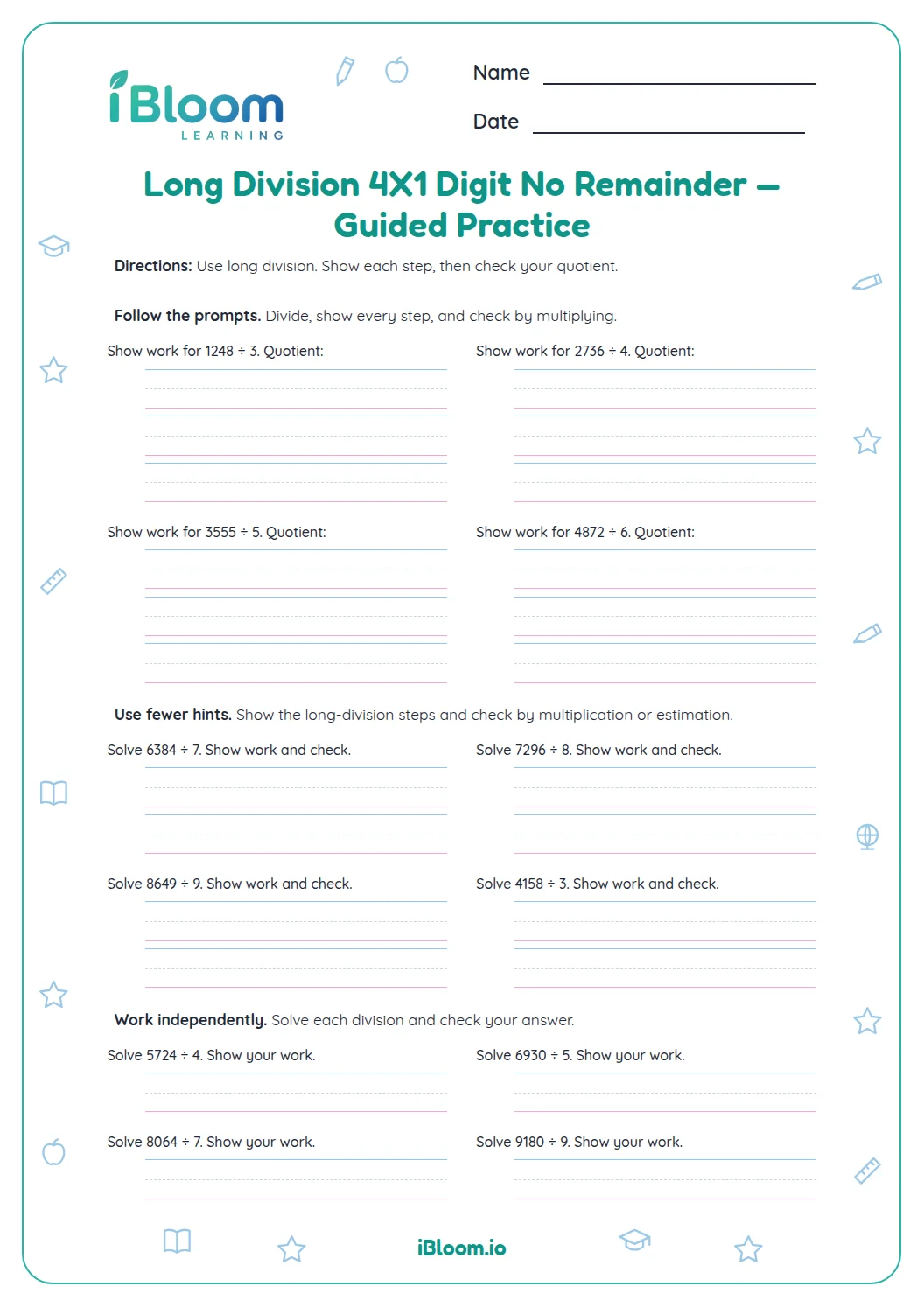
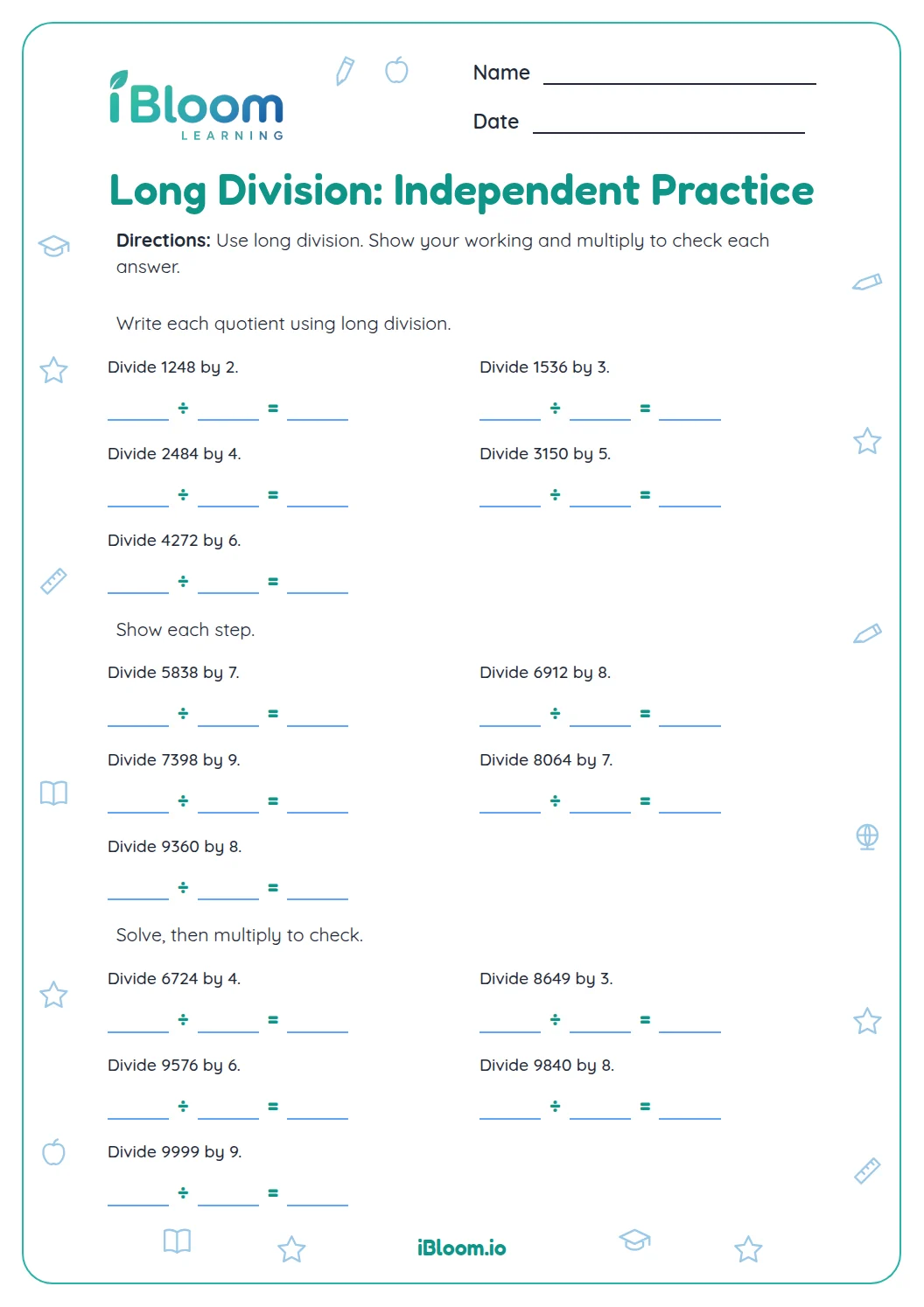
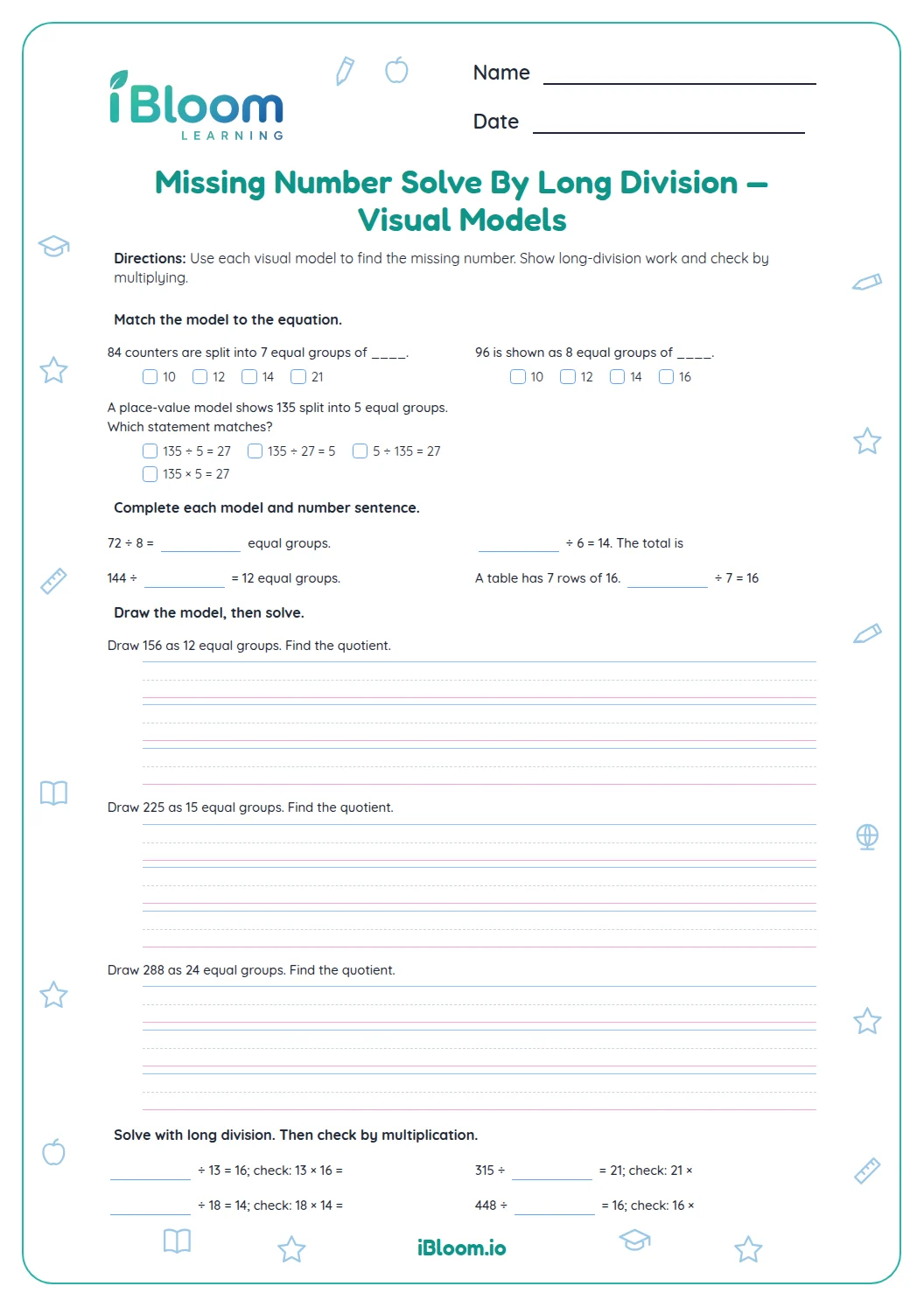
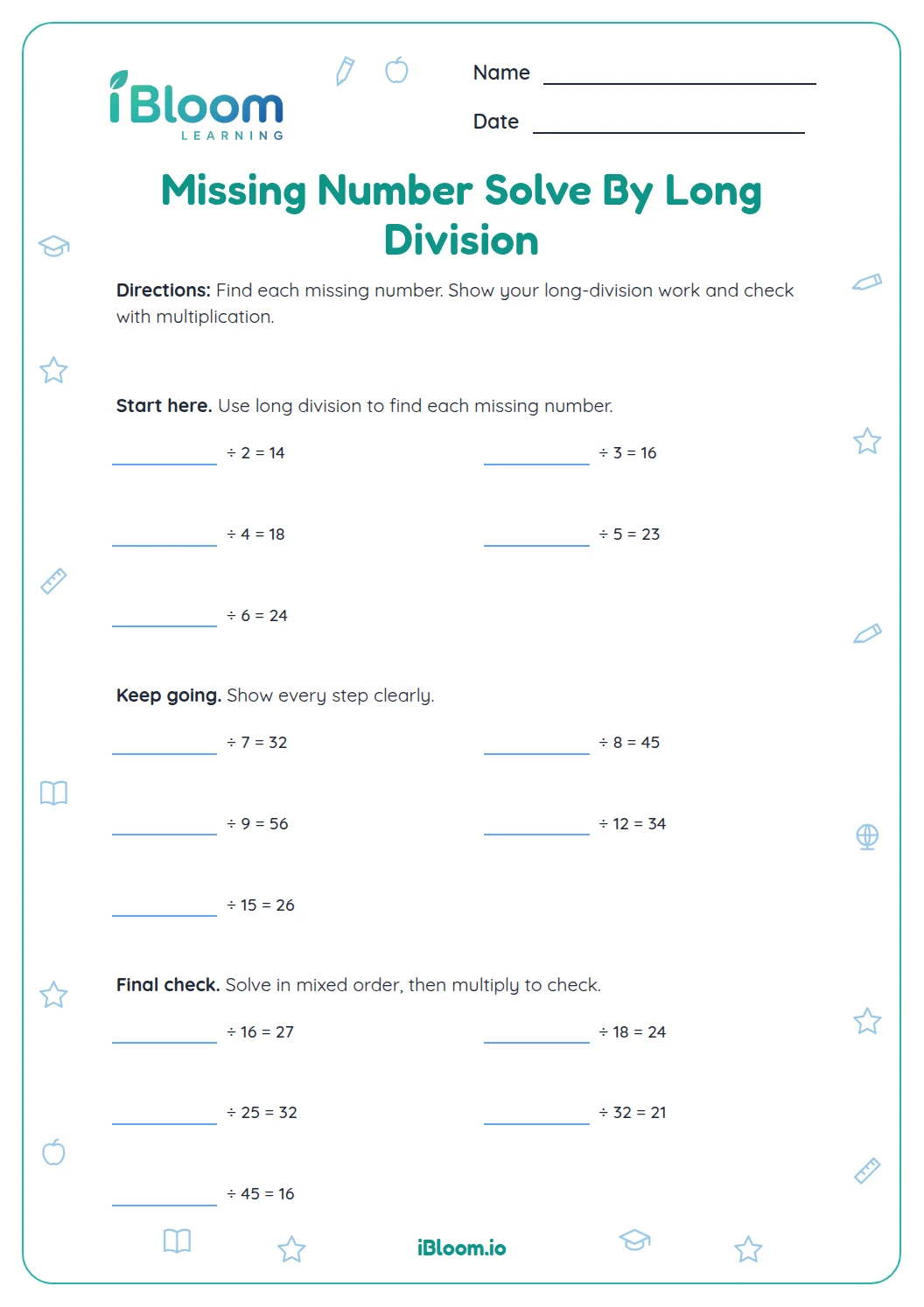
This Grade 5 printable turns missing-factor division into equal-group situations children can picture: pencils in boxes, books on shelves, and more. For each story, divide the total by the known number of groups to find the unknown factor, then multiply to check. The 14 problems use whole-number quotients without remainders. A separate answer key supports quick checking at home or in class.
Aligned to 5.NBT.B.6
How does division reveal the missing factor?
In an equal-groups story, the total is the product and one factor tells how many groups there are. Divide the total by that factor to find the other factor.
For example, 672 pencils in 8 boxes means 672 ÷ 8 = 84 pencils per box. Check: 84 × 8 = 672.
- 1672 pencils ÷ 8 boxes
- 2672 ÷ 8 = 84
- 384 pencils in each box
- 4Check: 84 × 8 = 672
What do the 14 stories ask students to find?
The contexts change, but the structure stays the same: a total is split into equal groups. Divisors range from one-digit to two-digit numbers, and each story has a whole-number answer. Write units with the quotient so the number answers the question.
How can a multiplication check catch an error?
Multiply the answer by the number of groups. The product should match the story total exactly. If it does not, revisit the division steps and place value.
How can I use this sheet?
- 1Underline the total and the number of equal groups.
- 2Decide whether the question asks for the group size or number of groups.
- 3Write total ÷ known factor = missing factor.
- 4Use long division and label the quotient with the story unit.
- 5Multiply quotient × known factor to check.
What errors should I watch for?
The mistake
Dividing the group count by the total.
The fix
The quotient should be a reasonable share of the total; write total ÷ groups.
The mistake
Dropping a place-value digit during division.
The fix
Estimate first, then check by multiplying.
The mistake
Giving a number without its meaning.
The fix
Add the unit asked for, such as books per shelf.
Curriculum alignment
Use place-value strategies and equations to divide whole numbers by one- and two-digit divisors.
On this sheet: Use place-value strategies and equations to divide whole numbers by one- and two-digit divisors.
Show the official wordingHide the official wording
Find whole-number quotients of whole numbers with up to four-digit dividends and two-digit divisors, using strategies based on place value, the properties of operations, and/or the relationship between multiplication and division. Illustrate and explain the calculation by using equations, rectangular arrays, and/or area models.
What to practice next
Make more practice
Questions parents and teachers ask
What does “missing factor” mean?
A missing factor is the number multiplied by another number to make a known product. In these stories, the total is the product and the number of equal groups is known. Division finds the factor that tells how many items belong in each group.
Should students write a division equation?
Yes. Write total ÷ known group count = items in each group. For 672 pencils packed into 8 boxes, compute 672 ÷ 8 = 84 pencils per box. The quotient is the missing factor because the group count and group size multiply to make the total.
How can children check a quotient?
Multiply the quotient by the known group count. For example, 84 pencils in each of 8 boxes gives 84 × 8 = 672 pencils, matching the total. If the product differs from the story total, check the long-division steps and place values.
Do these problems have remainders?
All 14 stories have whole-number quotients. Students can label each quotient with the unit named in the question, such as buttons per bag. This lets the answer communicate what the number represents in that particular situation, and helps a reader check the answer against the story.
How many problems are on the sheet?
There are 14 equal-group stories. Each asks for the unknown group size, and the answer key lists every quotient. Students can also multiply each quotient by its group count to verify that it rebuilds the total in the prompt.