

About this worksheet
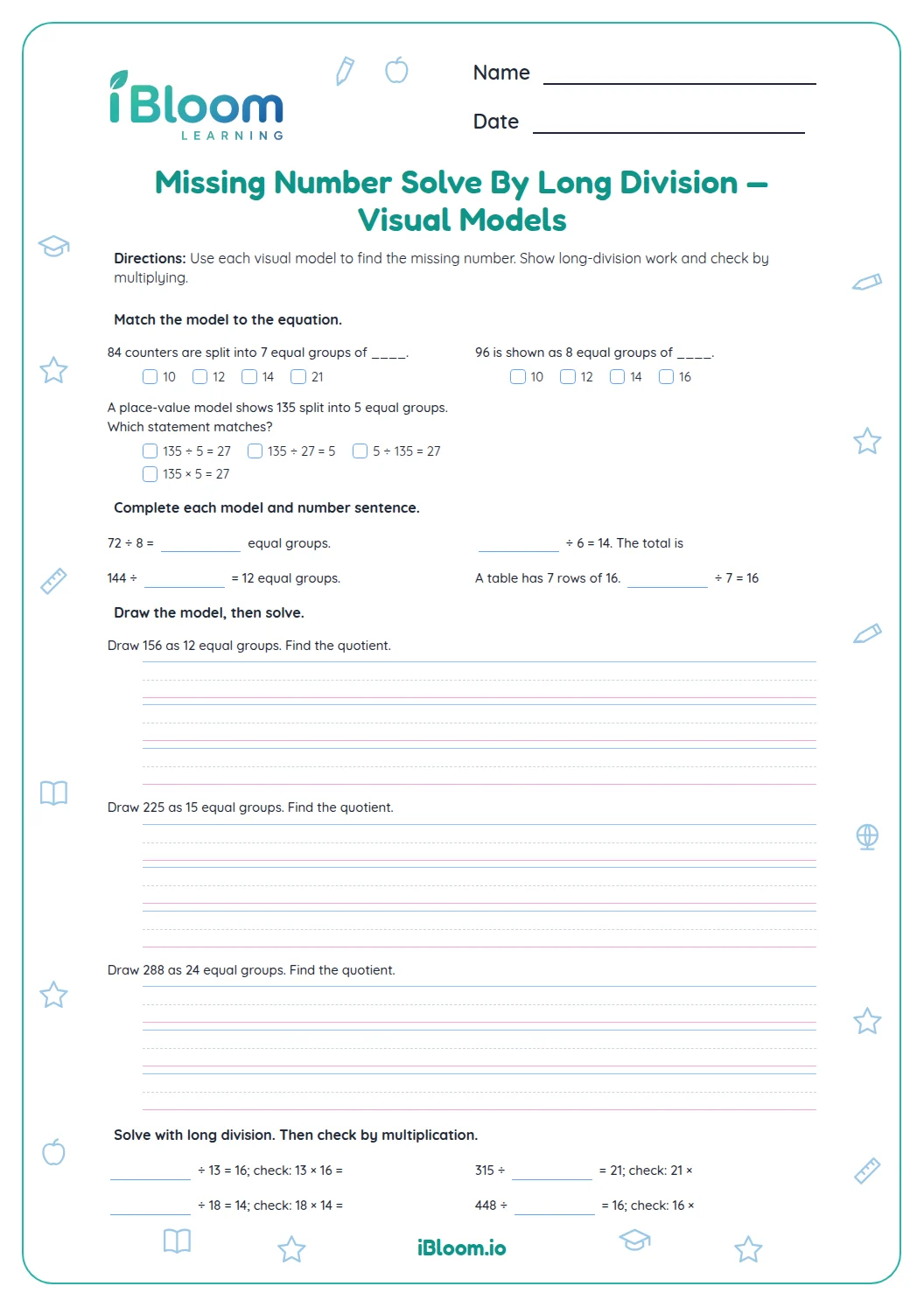
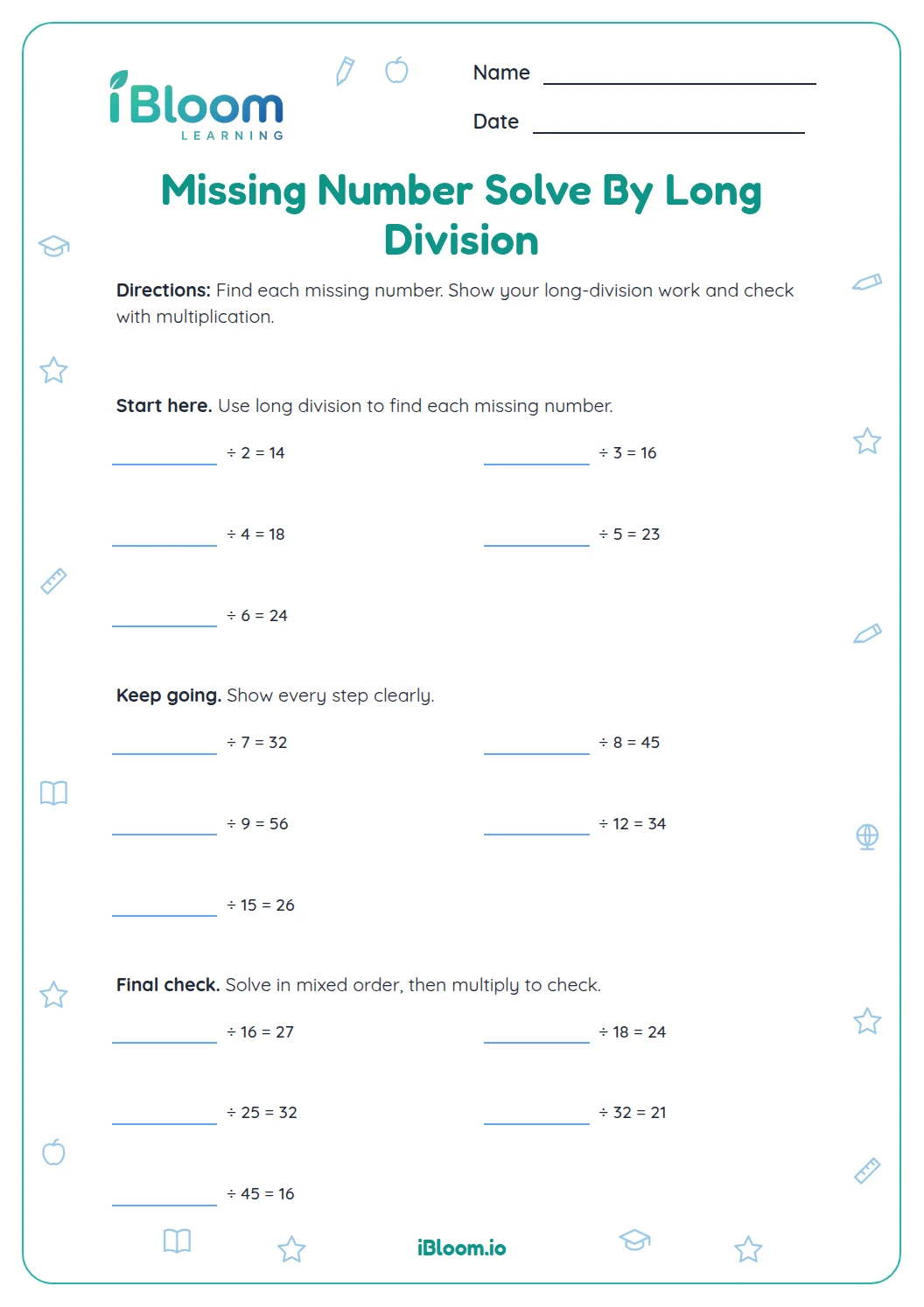
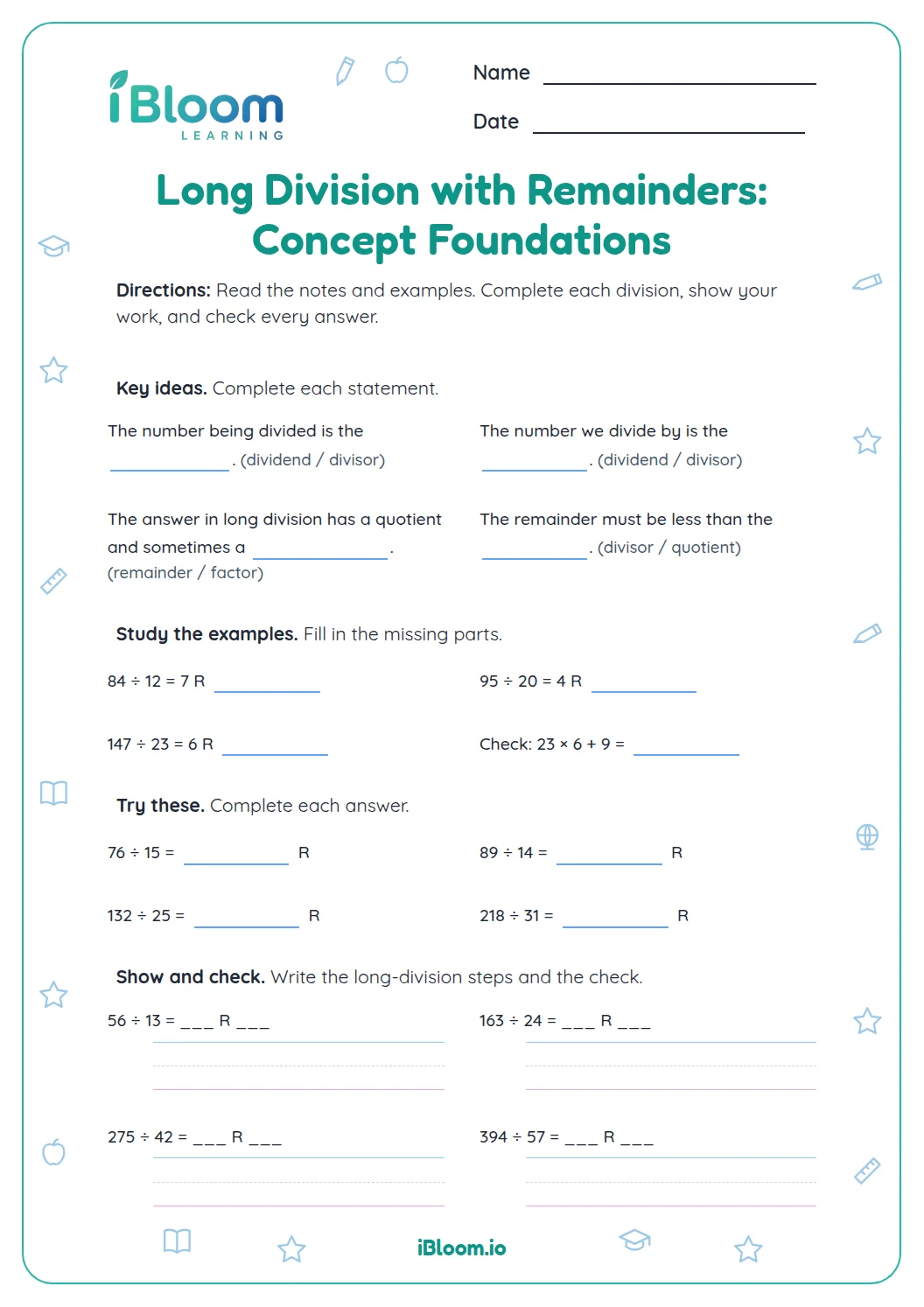
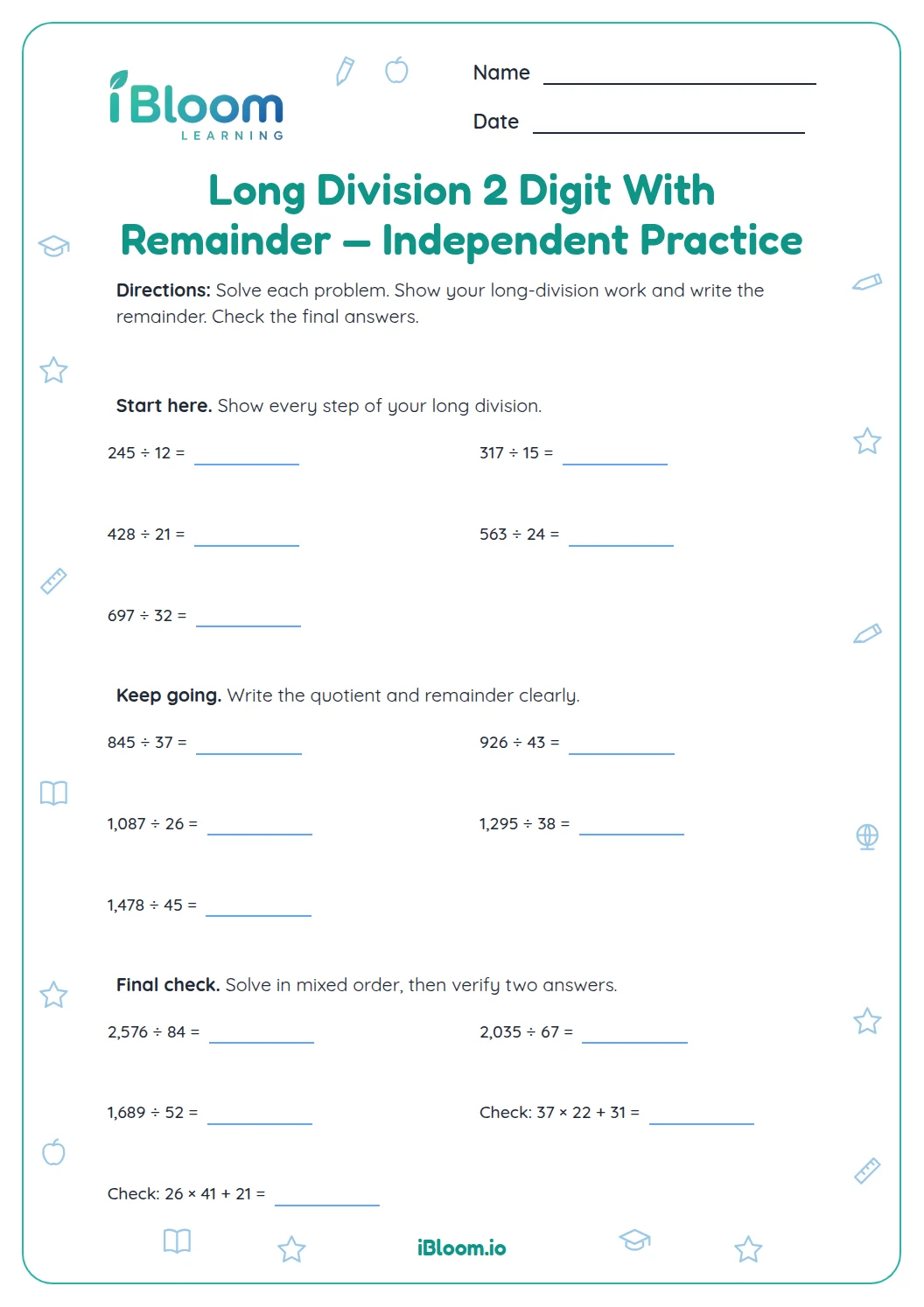
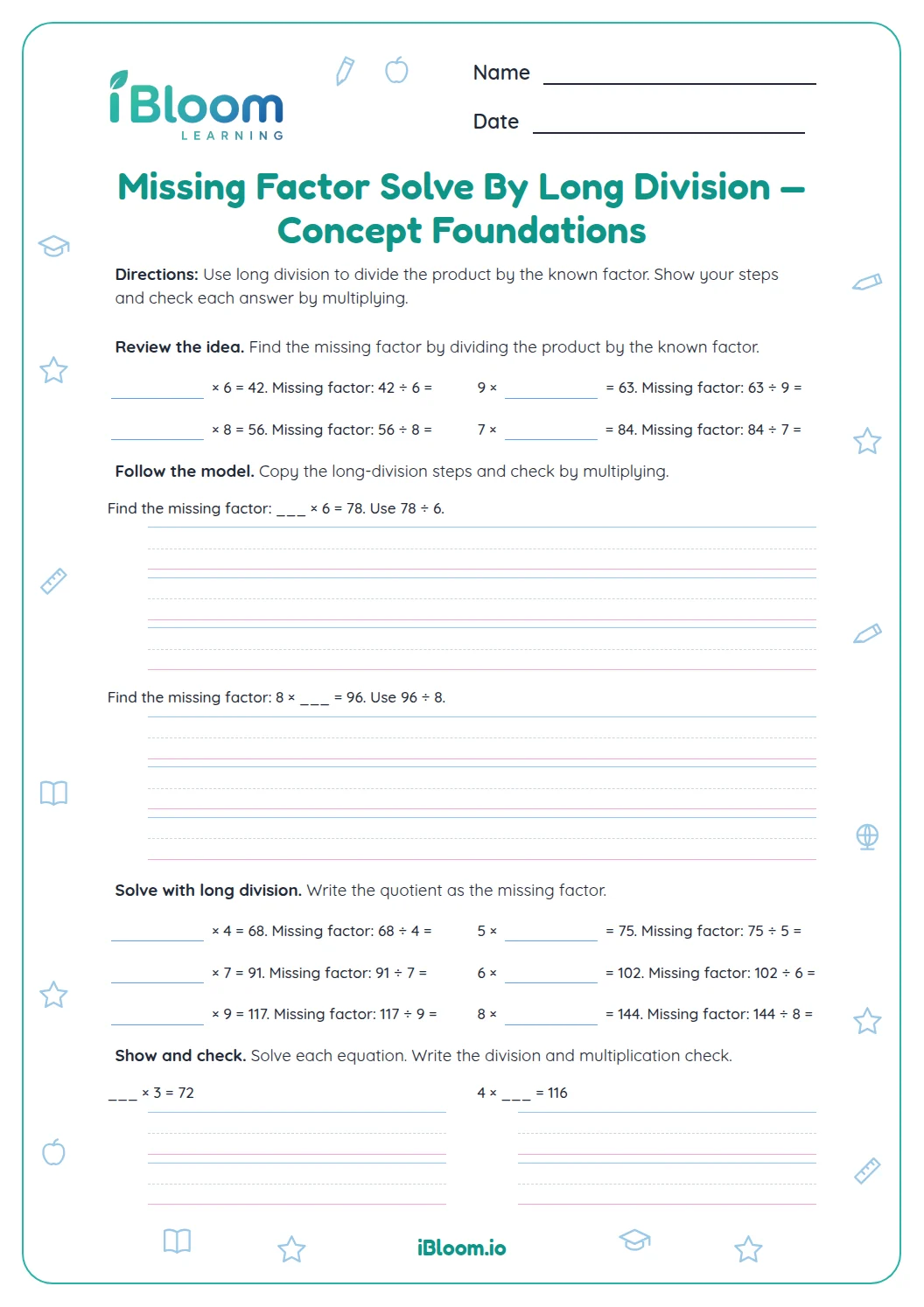
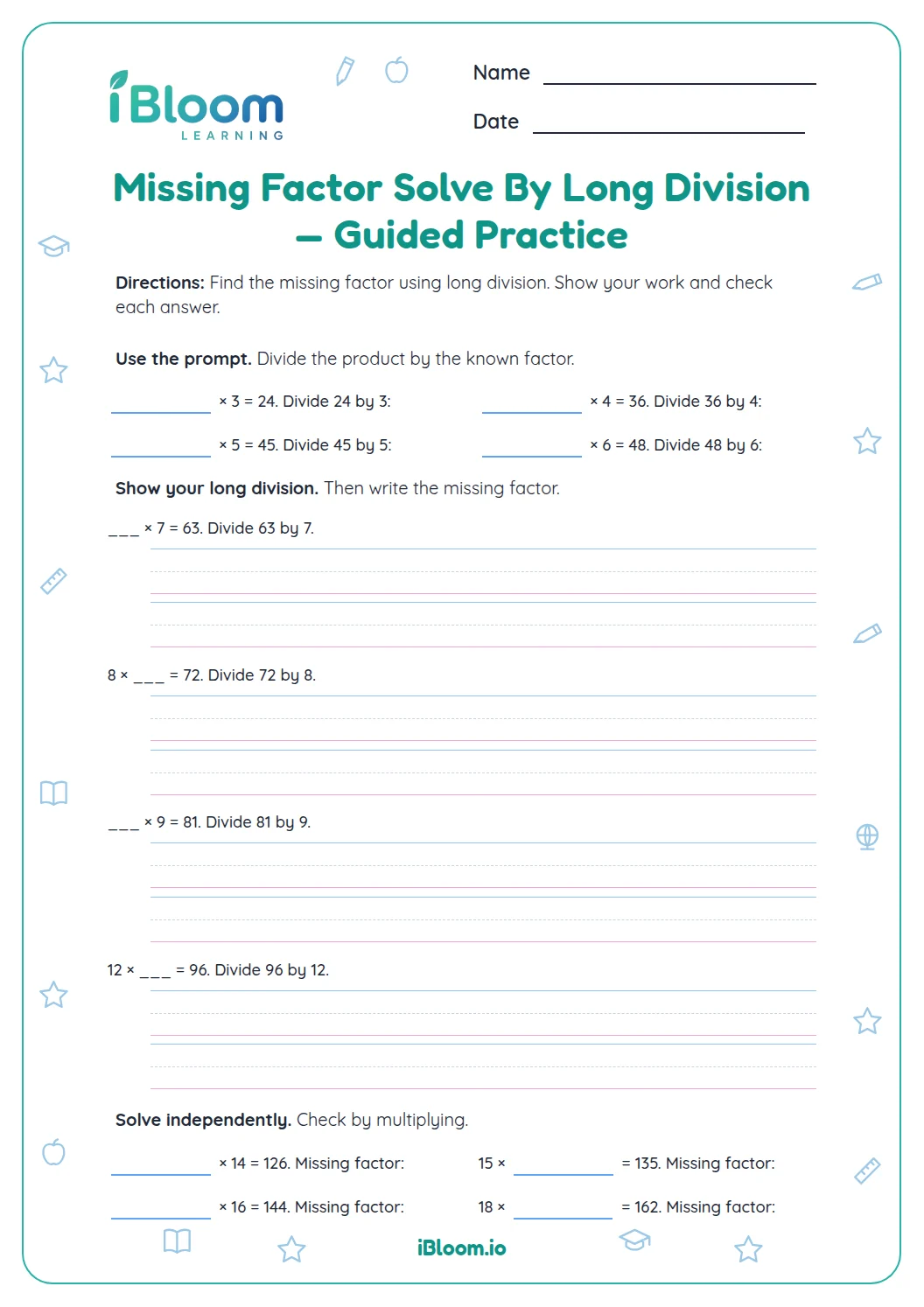
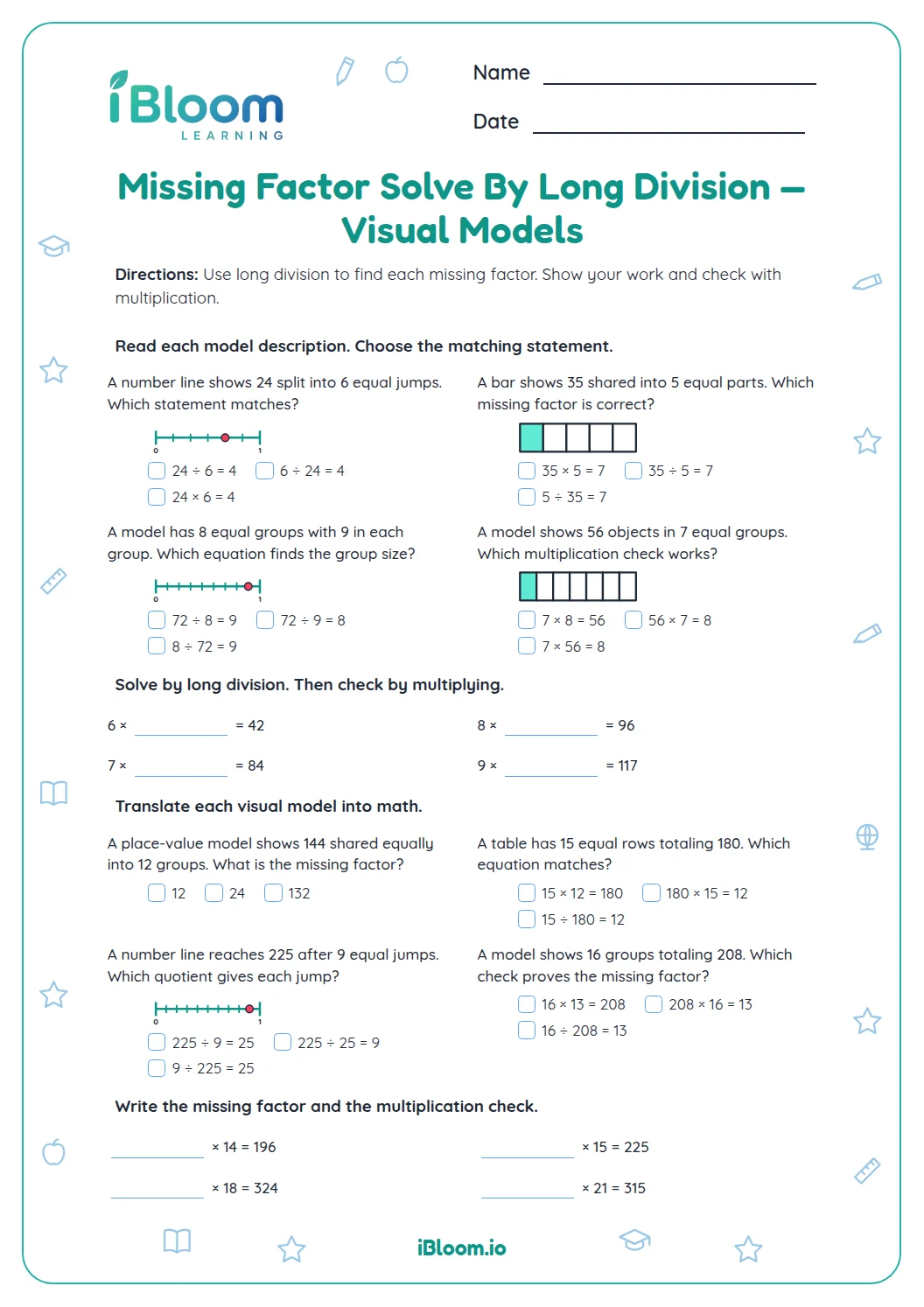
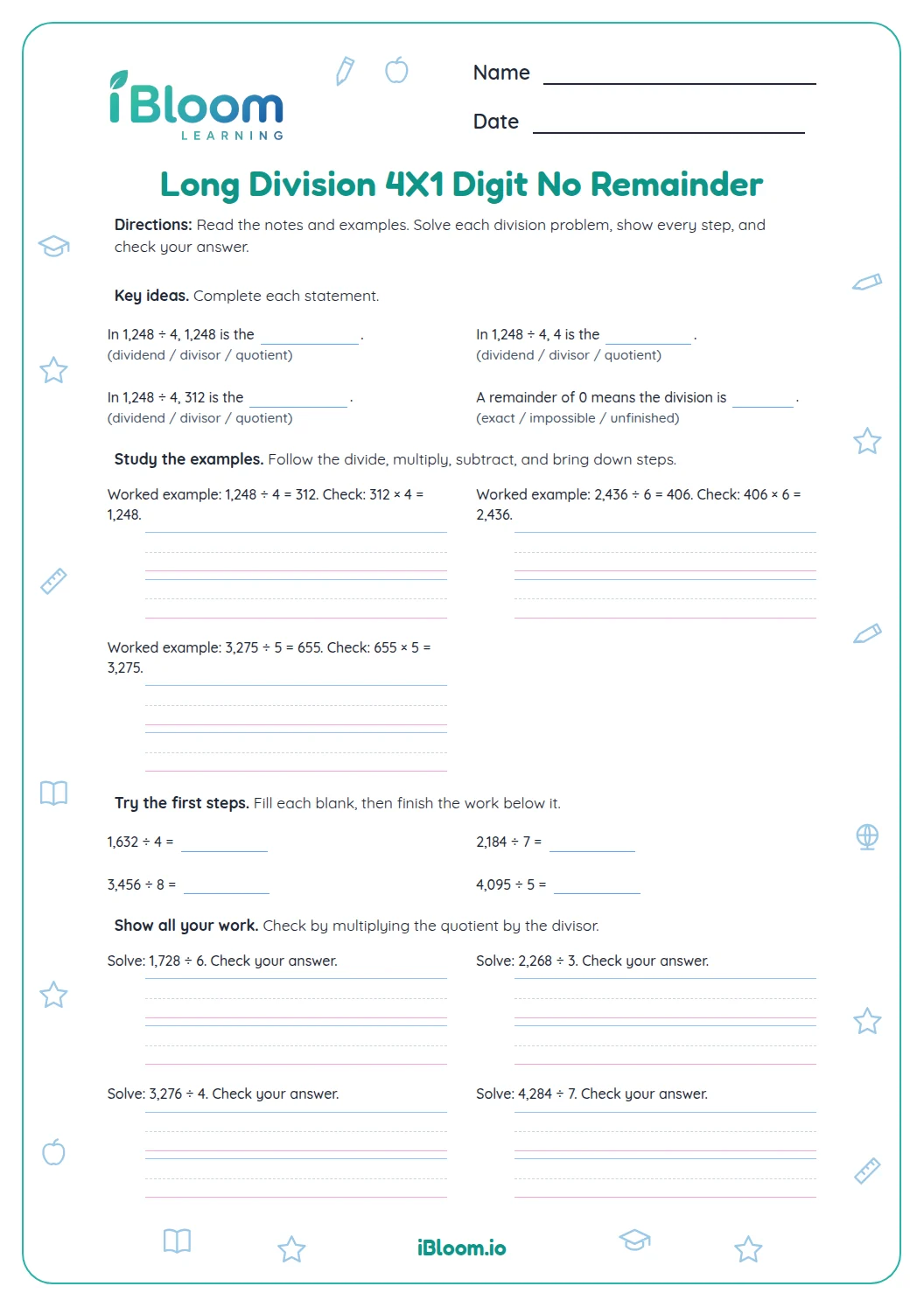
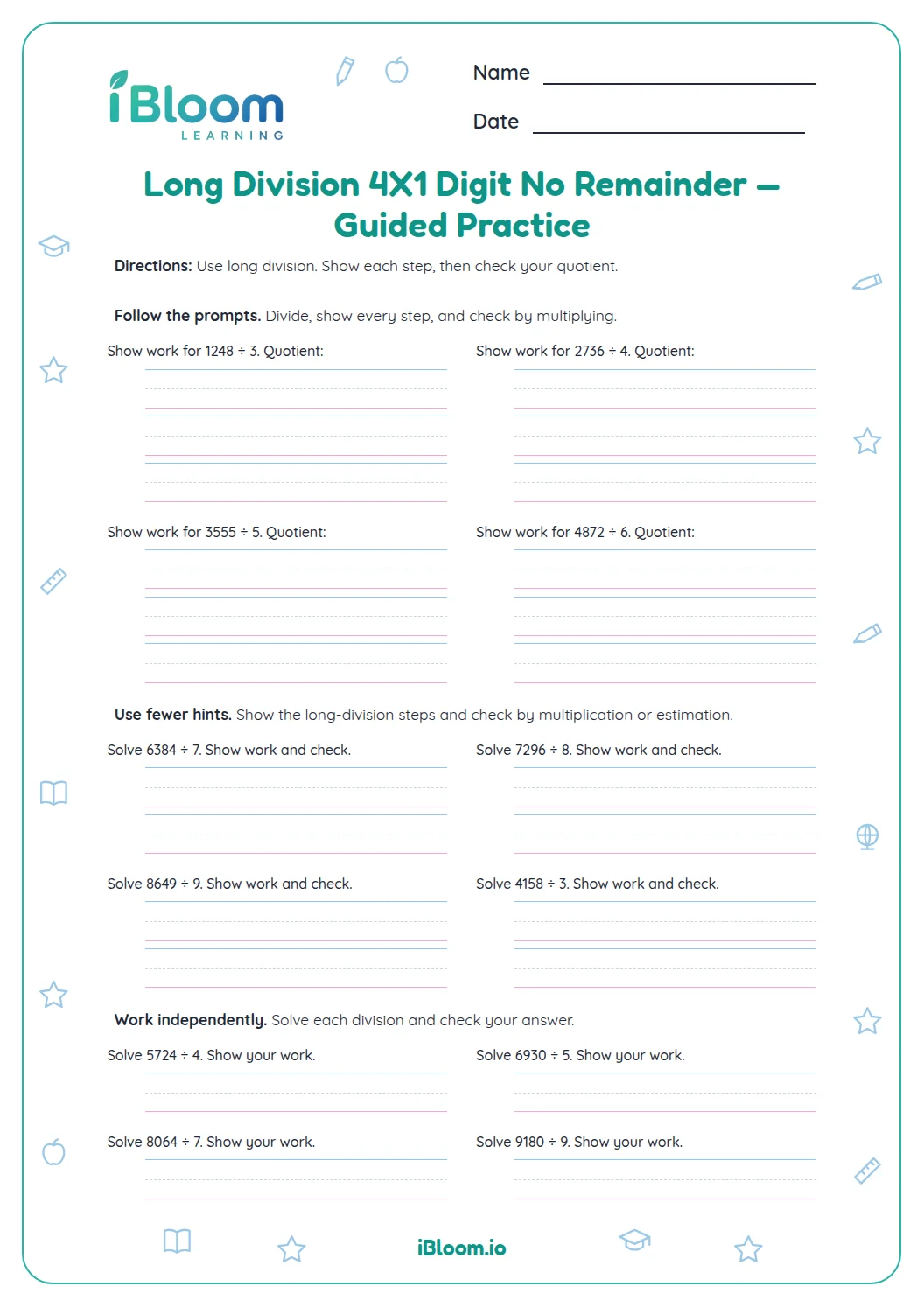
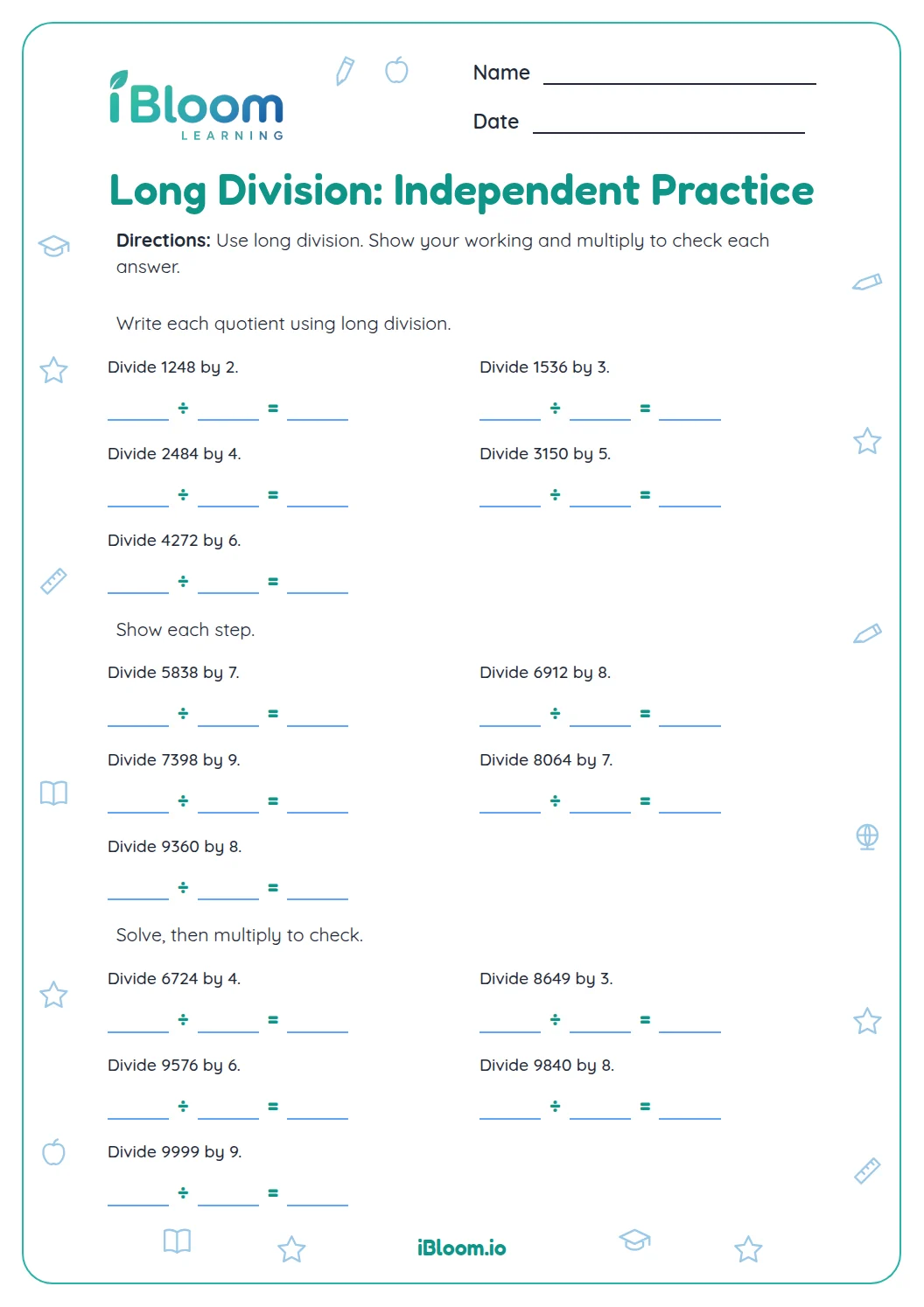
This Grade 5 worksheet builds the link between long division and multiplication through 15 missing-number equations. Students solve for a dividend, divisor, or quotient, using long division and the inverse relationship between division and multiplication. The practice aligns with CCSS 5.NBT.B.6 and has a separate answer key.
Aligned to 5.NBT.B.6
What kinds of missing numbers will I solve?
The 15 equations are grouped by the position of the unknown. Part A asks for a dividend, Part B for a divisor, and Part C for a quotient. Use multiplication to rebuild a missing dividend, and use division for a missing divisor or quotient.
- 1___ ÷ 12 = 34
- 2Multiply 34 by 12: 34 × 12 = 408.
- 3The missing dividend is 408.
How can multiplication find a missing dividend?
When the dividend is missing, multiply the divisor by the quotient. In ___ ÷ 12 = 34, the equal groups have 12 in each group and there are 34 groups, so the total is 408. Check by dividing 408 by 12.
How can I check a missing divisor or quotient?
For a missing divisor, divide the dividend by the known quotient. For a missing quotient, divide the dividend by the divisor. Multiply the two known factors afterward; their product should equal the dividend.
How to use this worksheet
- 1Read which number is missing before choosing a method.
- 2For a missing dividend, multiply the divisor by the quotient.
- 3For a missing divisor, divide the dividend by the quotient.
- 4For a missing quotient, use long division.
- 5Multiply to check each completed equation.
Common mistakes and quick fixes
The mistake
Dividing the known divisor by the quotient when the dividend is missing.
The fix
Multiply divisor × quotient to rebuild the total being divided.
The mistake
Treating the missing divisor like a missing quotient.
The fix
Use dividend ÷ quotient to find the divisor, then multiply to check.
The mistake
Stopping after a quotient digit without checking the remainder.
The fix
These equations divide evenly; confirm divisor × quotient equals the dividend.
Common Core alignment
The equations practice whole-number division through place value and the multiplication–division relationship.
Use place value and multiplication–division relationships to find whole-number quotients.
On this sheet: Each equation asks students to use division and its inverse relationship to find a missing dividend, divisor, or quotient.
Show the official wordingHide the official wording
Find whole-number quotients of whole numbers with up to four-digit dividends and two-digit divisors, using strategies based on place value, the properties of operations, and/or the relationship between multiplication and division. Illustrate and explain the calculation by using equations, rectangular arrays, and/or area models.
What to practice next
Make more practice
Further reading
Questions parents and teachers ask
How do I find the missing dividend?
Multiply the divisor by the quotient. For example, in ___ ÷ 12 = 34, 12 × 34 equals 408, so 408 is the missing dividend. Check by dividing 408 by 12; the result is 34, which matches the equation. This check is quick to write beside the long-division work.
How do I find a missing divisor?
Divide the dividend by the quotient. In 936 ÷ ___ = 78, compute 936 ÷ 78 to get 12. Then multiply 78 by 12 to make sure the product returns to 936. This confirms the divisor and checks the original division equation.
What does the answer key include?
The answer key gives each missing number for all 15 equations. It is arranged in the same three groups as the worksheet: dividends, divisors, then quotients. Students can compare a final result after completing the work in the equation space and checking by multiplication.
Are there remainders on this worksheet?
No. Each of the 15 division equations has a whole-number answer and divides evenly. That lets students focus on identifying the unknown position and using long division or the inverse operation to recover it. A multiplication check confirms each answer.
Can students use multiplication to solve the page?
Yes. Multiplication is especially useful for missing dividends and for checking every answer. For a missing quotient or divisor, students can use long division first, then multiply the two factors to verify that they return to the dividend in the original equation.