

About this worksheet
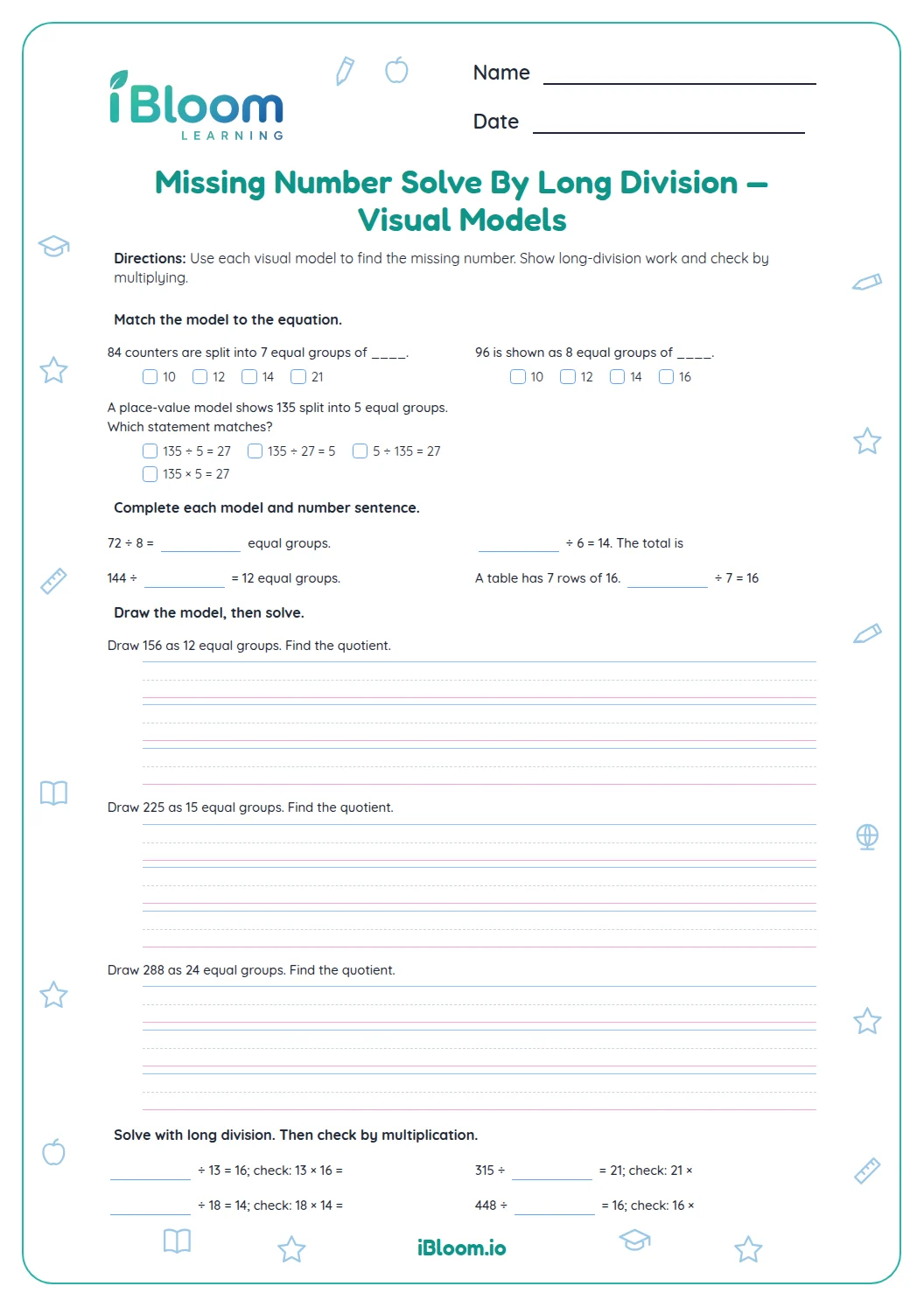
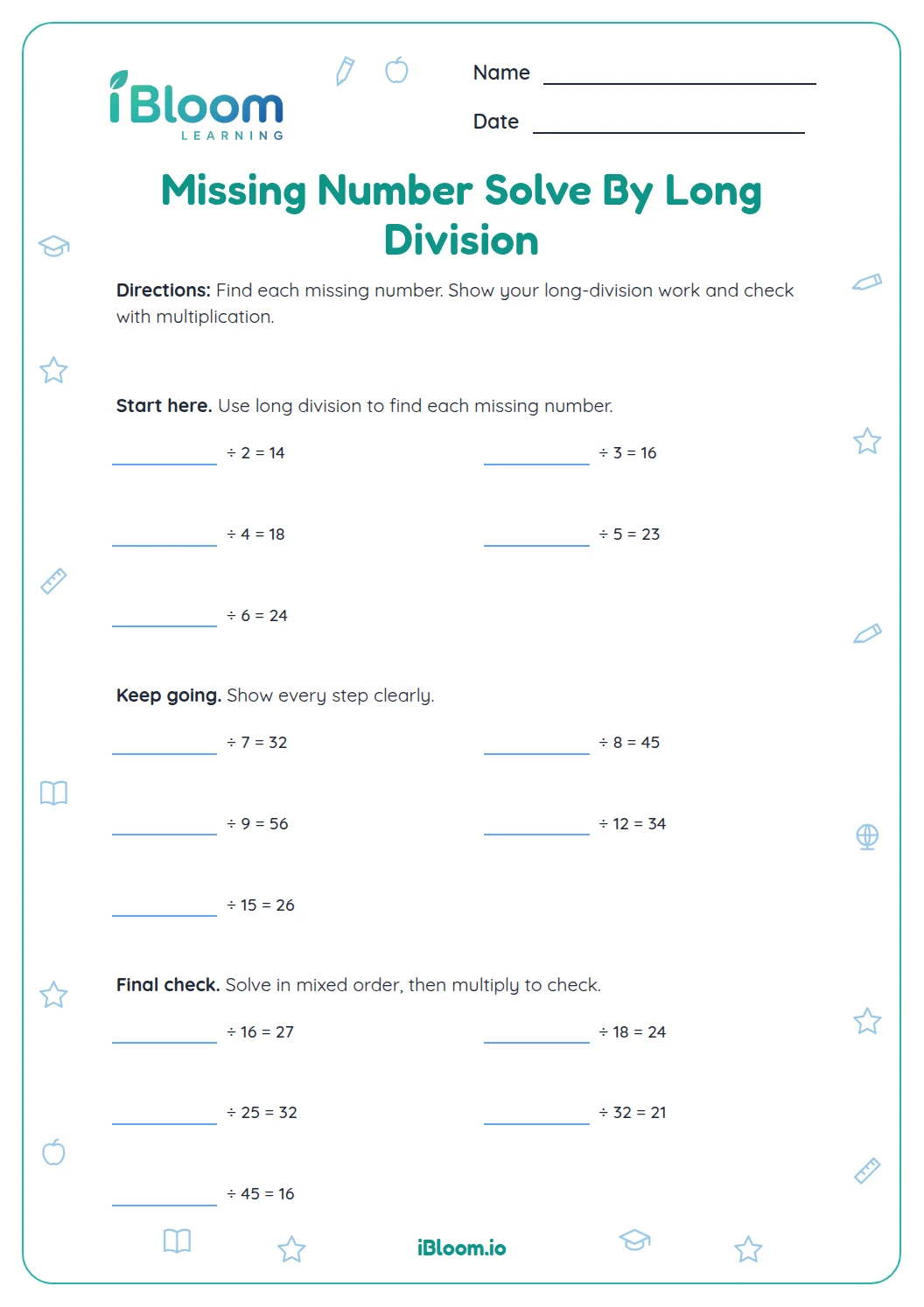
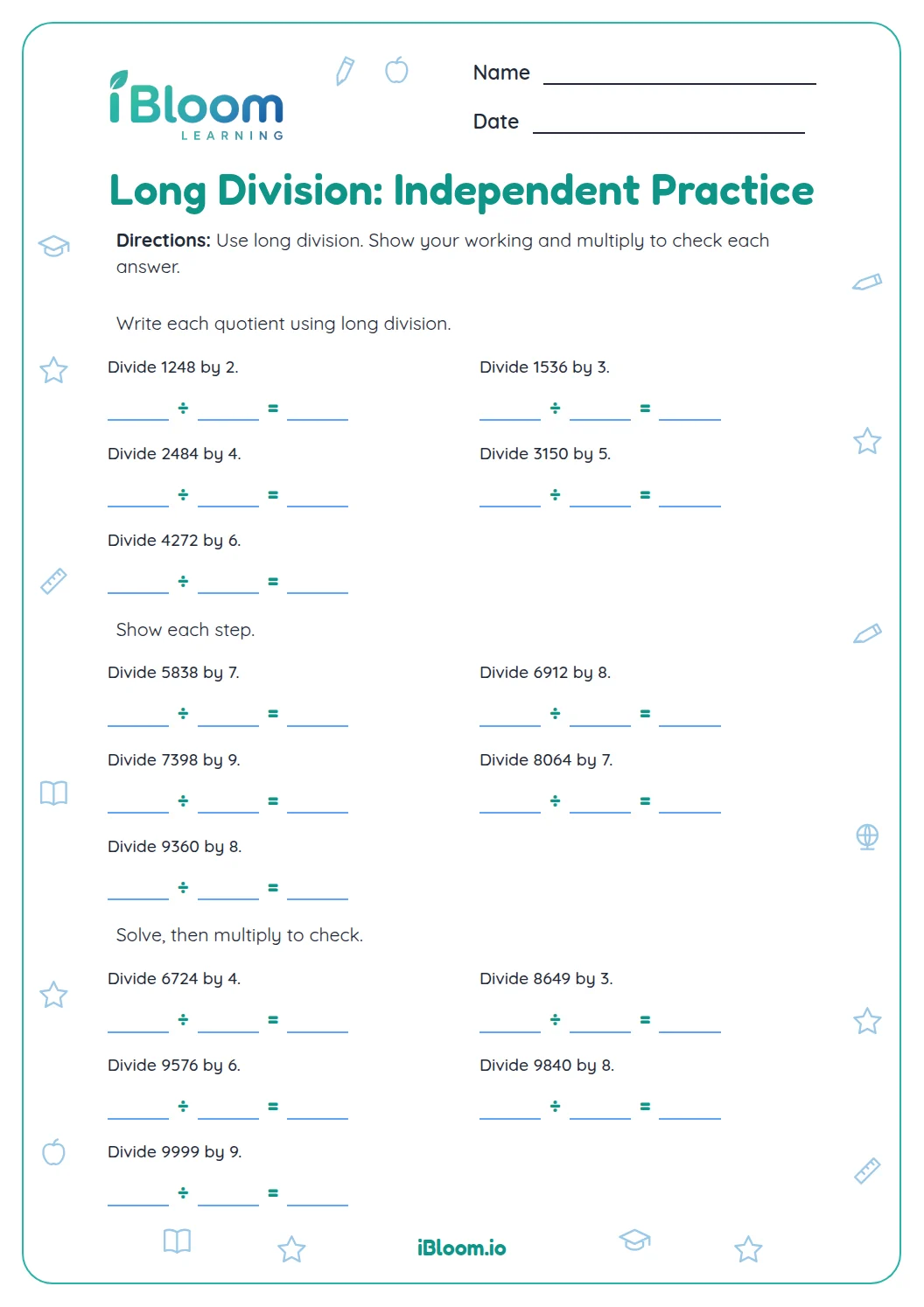
This Grade 5 worksheet gives students 15 ways to use division to find an unknown. Part A asks for missing quotients and dividends with one-digit divisors; Part B adds two-digit divisors and missing divisors; Part C applies division to pencils, books, and cans shared equally. The equations leave room for written work, and the separate key supports checking each result.
Aligned to 5.NBT.B.6
Which number is missing?
The first six equations alternate between a missing quotient and a missing dividend. For 864 ÷ 4 = ___, divide to find 216. For ___ ÷ 6 = 125, multiply 125 by 6 to find 750. Substitution checks either result.
How do two-digit divisors change the work?
Part B includes divisors such as 12, 14, 15, and 16. When the divisor is missing, use the known dividend and quotient: 1,575 ÷ ___ = 225, so the blank is 7 because 225 × 7 = 1,575.
How does division describe equal sharing?
The last three questions name a total and a number of equal groups. Write a division equation first: 1,248 pencils shared among 6 classrooms gives 1,248 ÷ 6 = 208 pencils per classroom. Include the unit in the answer.
How to use this worksheet
- 1Read the equation to identify which number is unknown.
- 2Divide when the quotient is missing.
- 3Multiply the divisor by the known quotient when the dividend is missing.
- 4Use the known dividend and quotient to find a missing divisor.
- 5Write an equation for each sharing story and include the requested unit.
- 6Multiply to check that the completed equation is true.
Common mistakes and quick fixes
The mistake
Dividing when the dividend is missing.
The fix
Multiply the divisor by the known quotient.
The mistake
Treating a missing divisor like a missing quotient.
The fix
Divide the dividend by the quotient to recover the divisor.
The mistake
Leaving off what each answer counts.
The fix
Add the unit named in the sharing question.
Solve for missing dividends, divisors, and quotients with whole-number division.
On this sheet:
Show the official wordingHide the official wording
Find whole-number quotients of whole numbers with up to four-digit dividends and two-digit divisors, using strategies based on place value, the properties of operations, and/or the relationship between multiplication and division. Illustrate and explain the calculation by using equations, rectangular arrays, and/or area models.
What to practice next
Make more practice
Further reading
Questions parents and teachers ask
How many questions are on the worksheet?
There are 15 questions in three parts. The first 12 are division equations with a missing quotient, dividend, or divisor. The final three are equal-sharing word problems about pencils, books, and cans. The answer key is separate from the two worksheet pages.
How can I check a missing dividend?
Multiply the divisor by the quotient written in the equation. For example, in ___ ÷ 6 = 125, calculate 6 × 125 to get 750. Put 750 in the blank and divide to confirm that the quotient is 125.
What is the difference between a missing divisor and quotient?
A missing quotient is the result of division, while a missing divisor is the number you divide by. In 2,184 ÷ 14 = ___, divide to find the quotient. In 1,575 ÷ ___ = 225, divide 1,575 by 225 to recover the divisor.
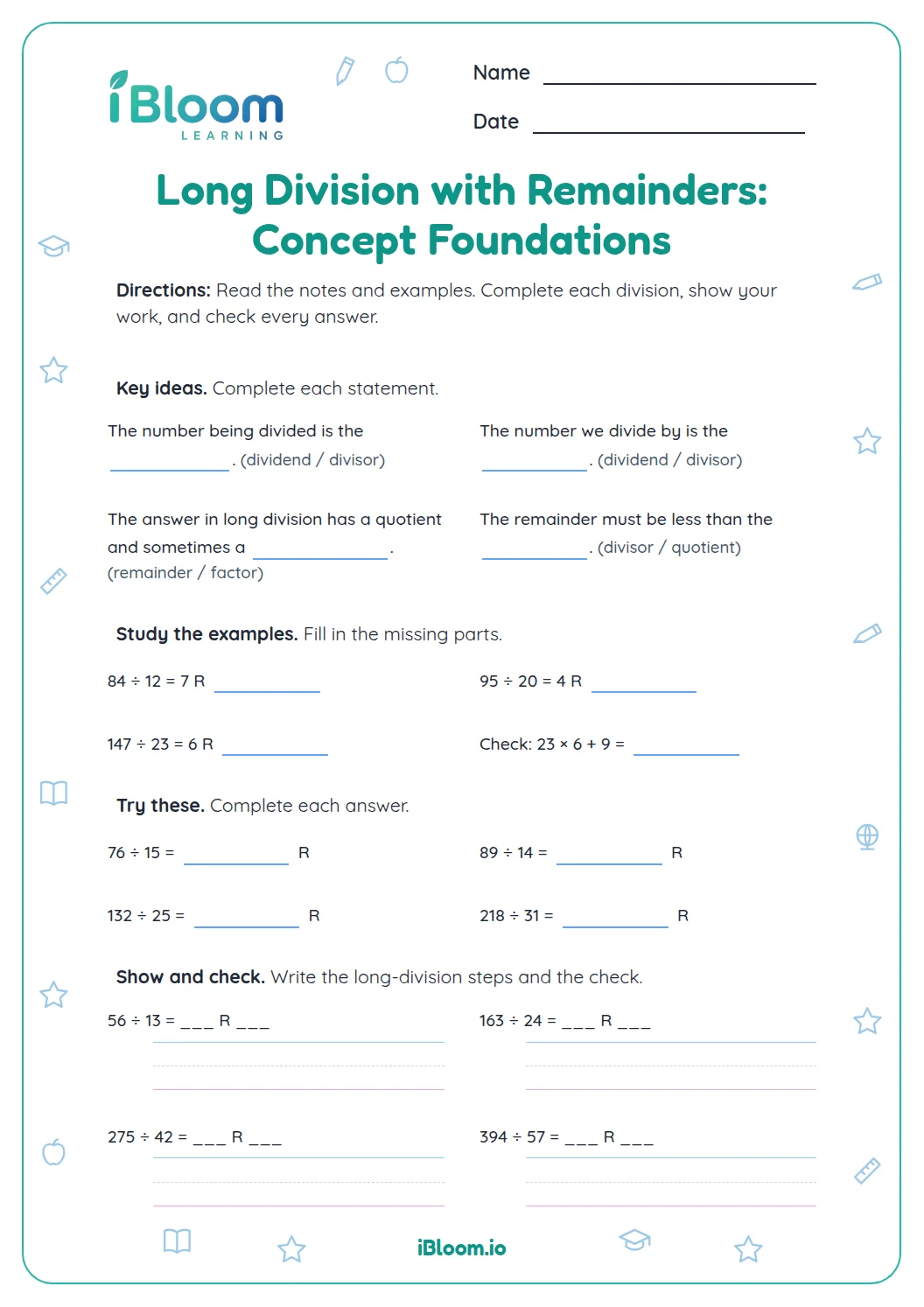
Does the worksheet include remainders?
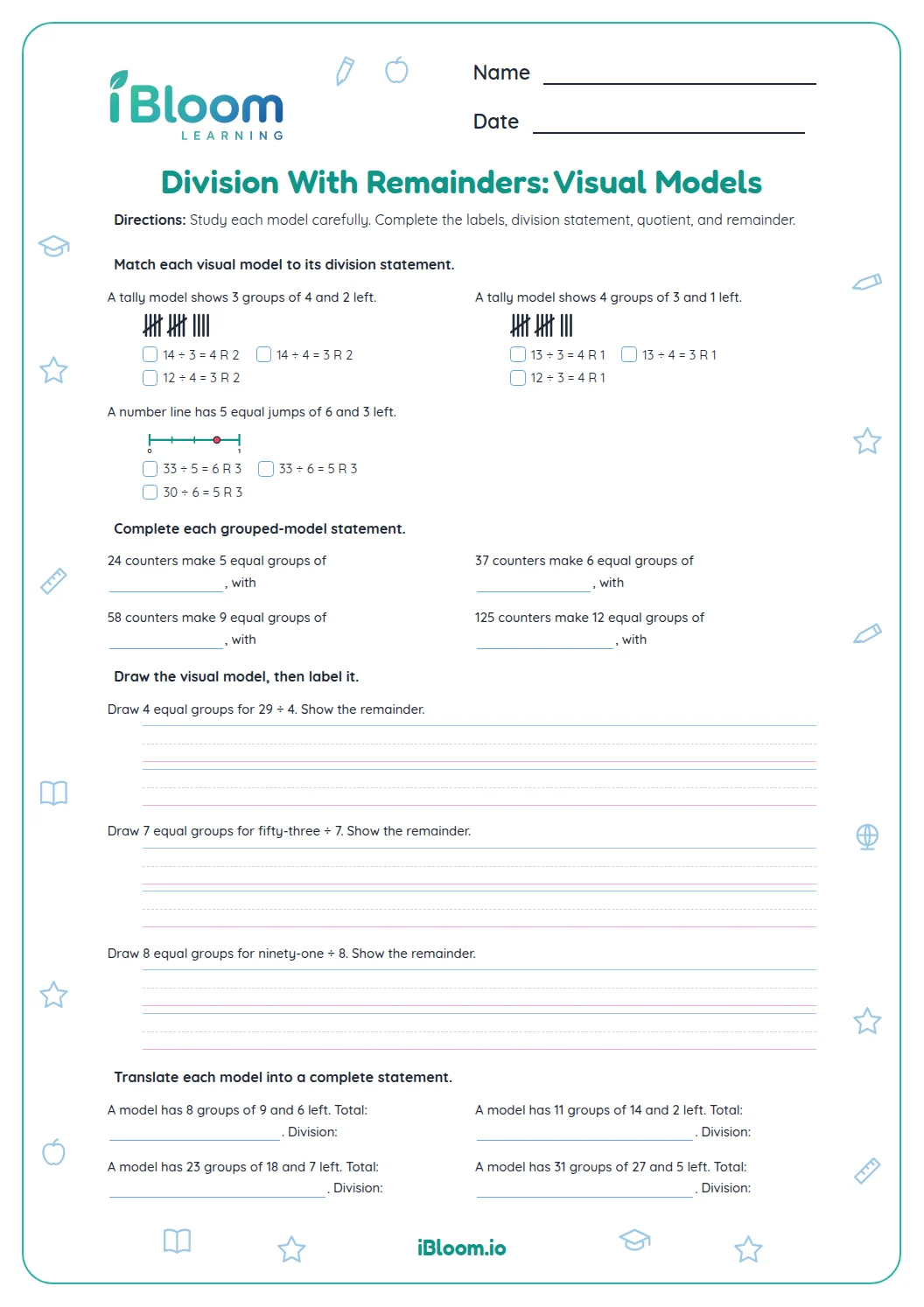
The equations and sharing situations are set up for whole-number answers without remainders. Students practice identifying the unknown and using multiplication or division to find it. The final questions also ask for equal groups, so each group has the same whole-number amount.
Should students show long-division work?
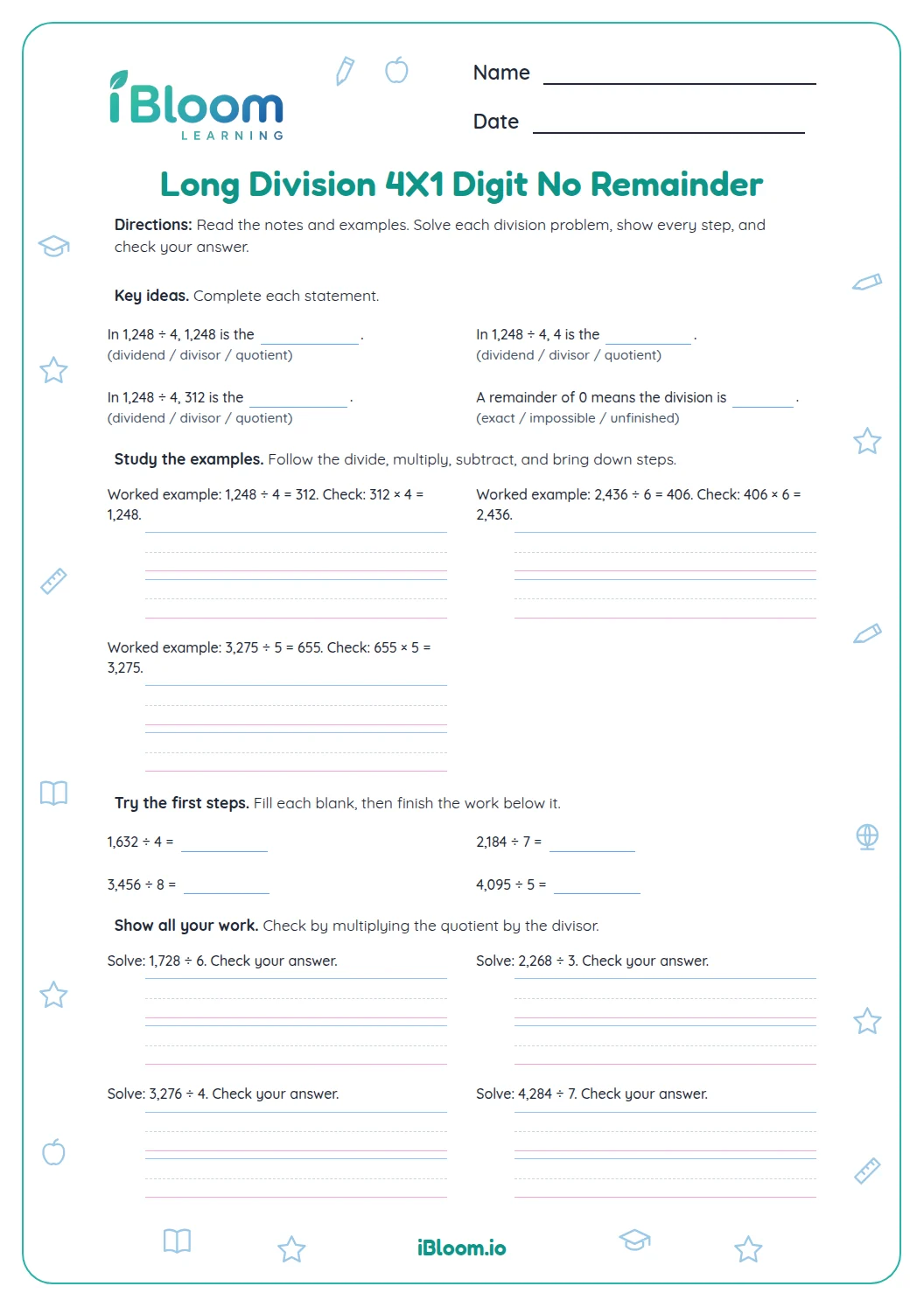
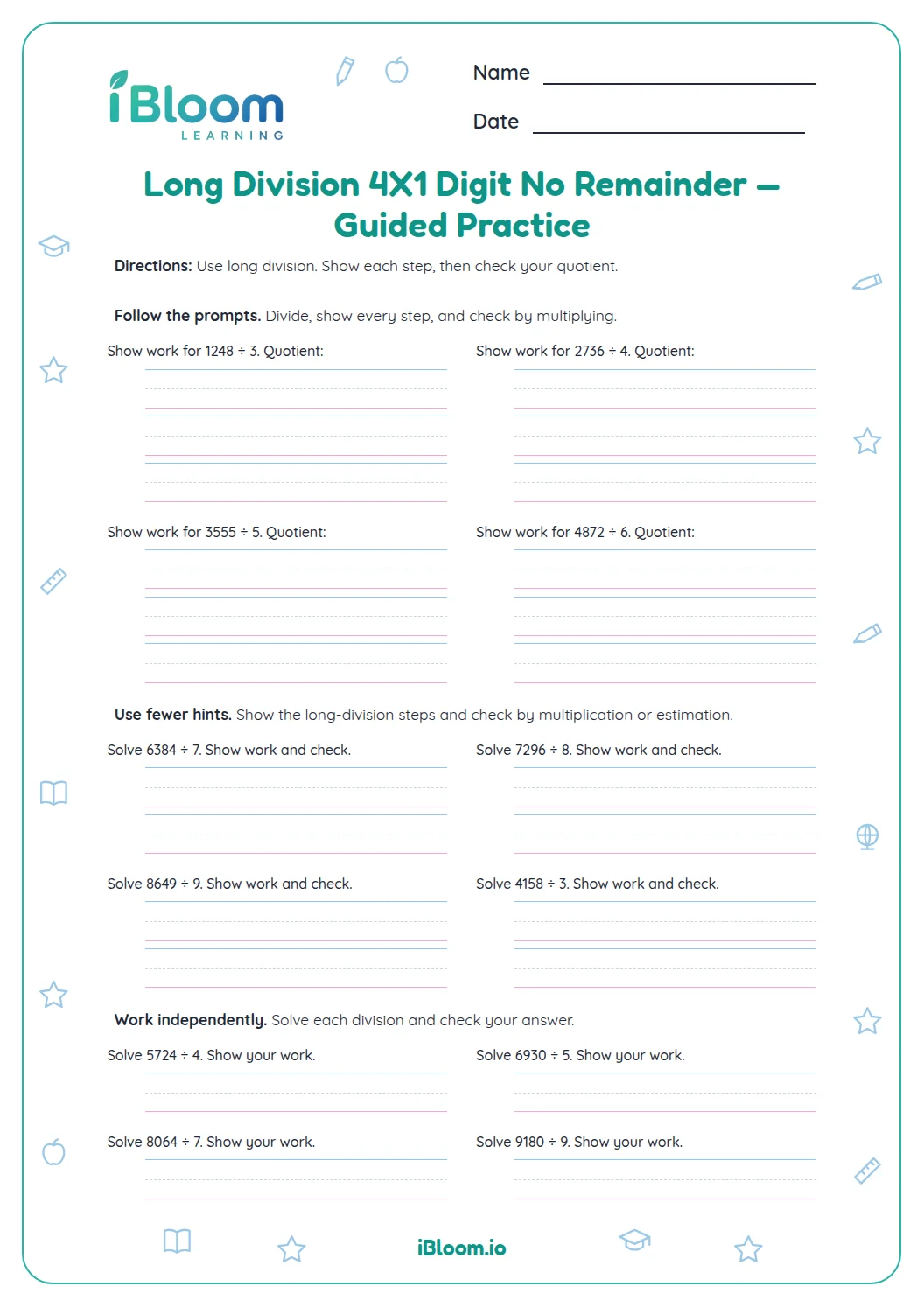
The sheet directions invite students to use long division when helpful, and the equation items leave space for working. A student can also check with multiplication. For a missing dividend, multiplying the known quotient and divisor is the most direct way to verify the answer.
What can students practice next?
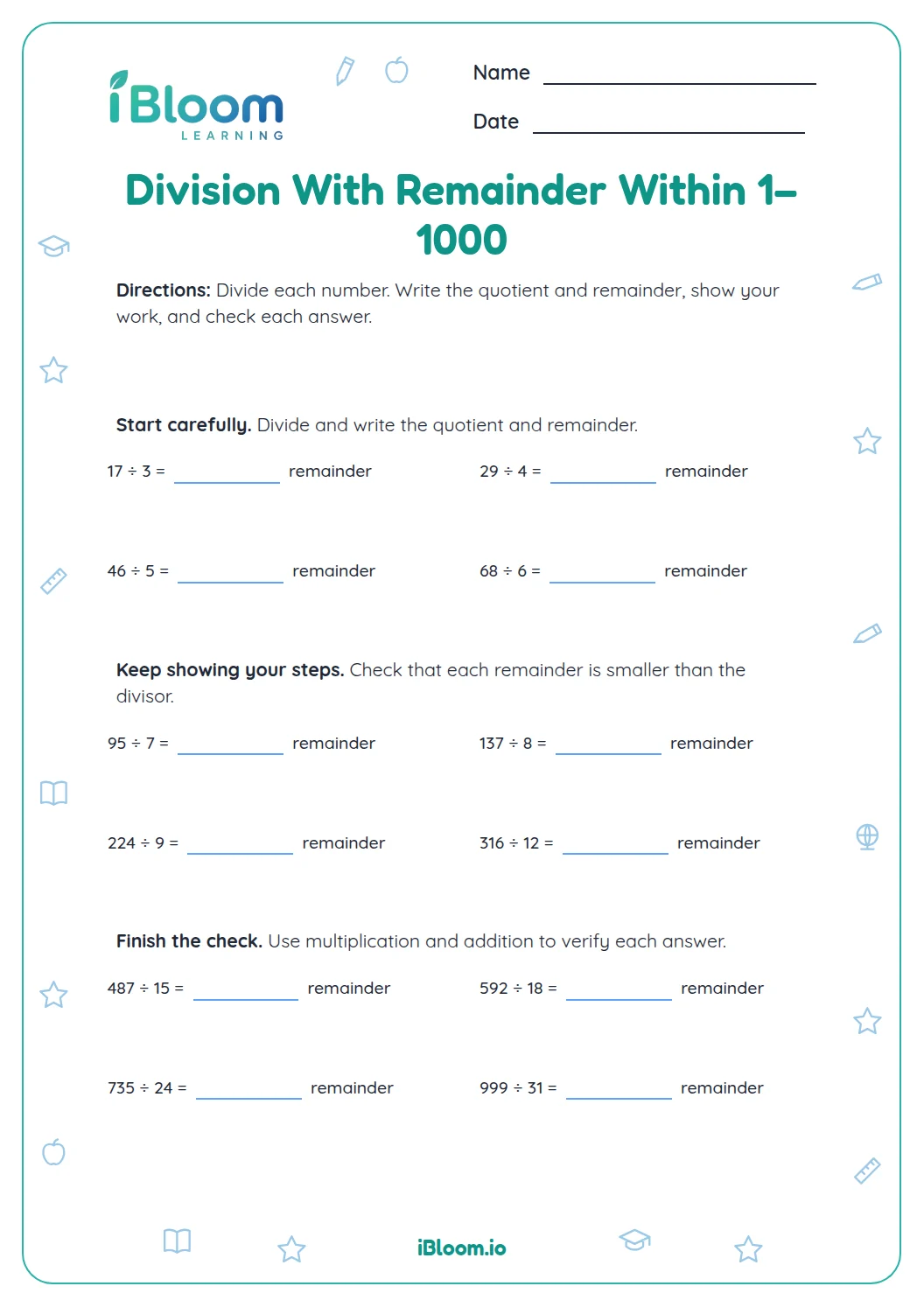
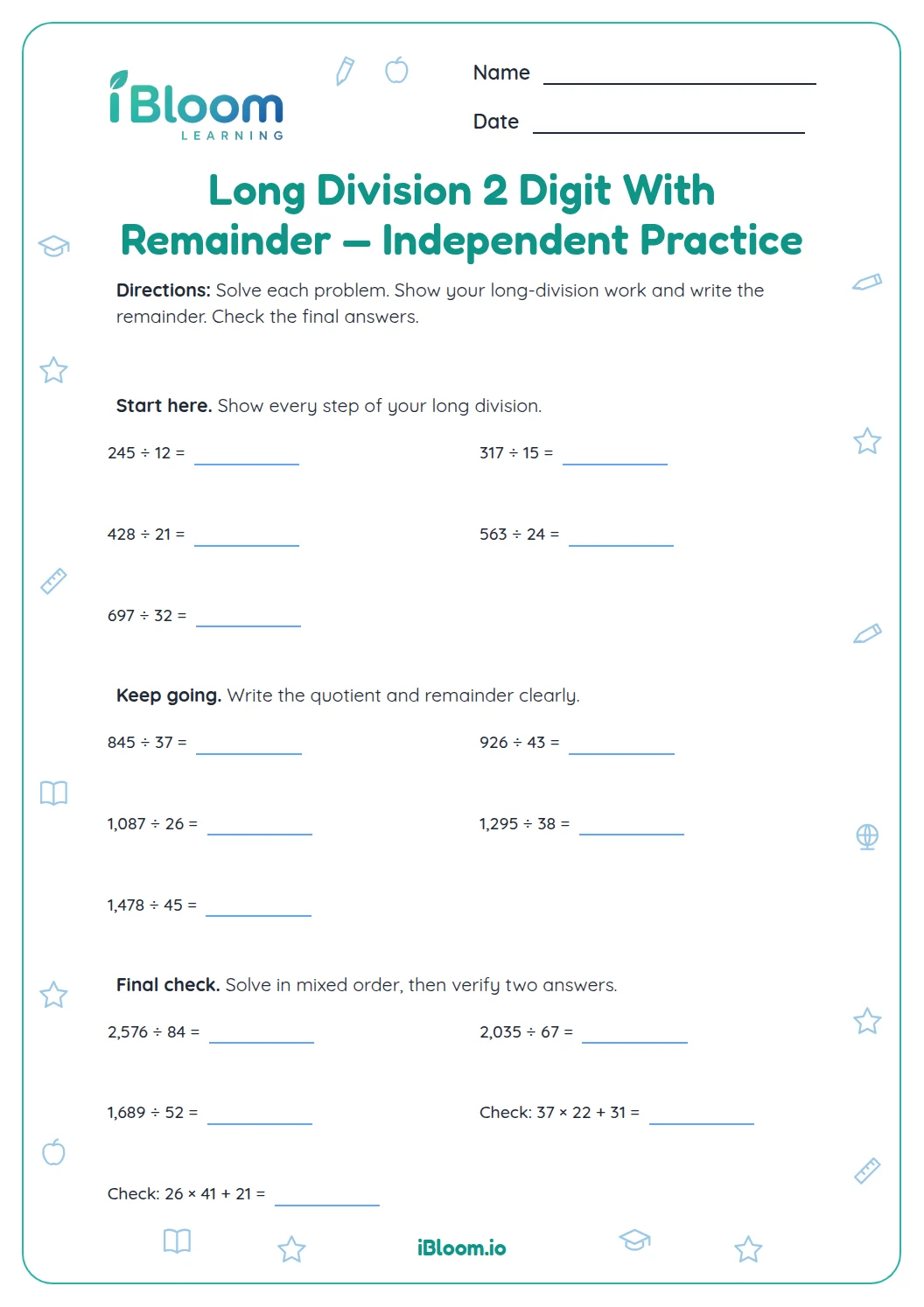
After these missing-number equations, students can try long division with a two-digit divisor or division with remainders. Those related pages extend the same division relationship to longer calculations and answers that include a remainder, with new examples to solve.