

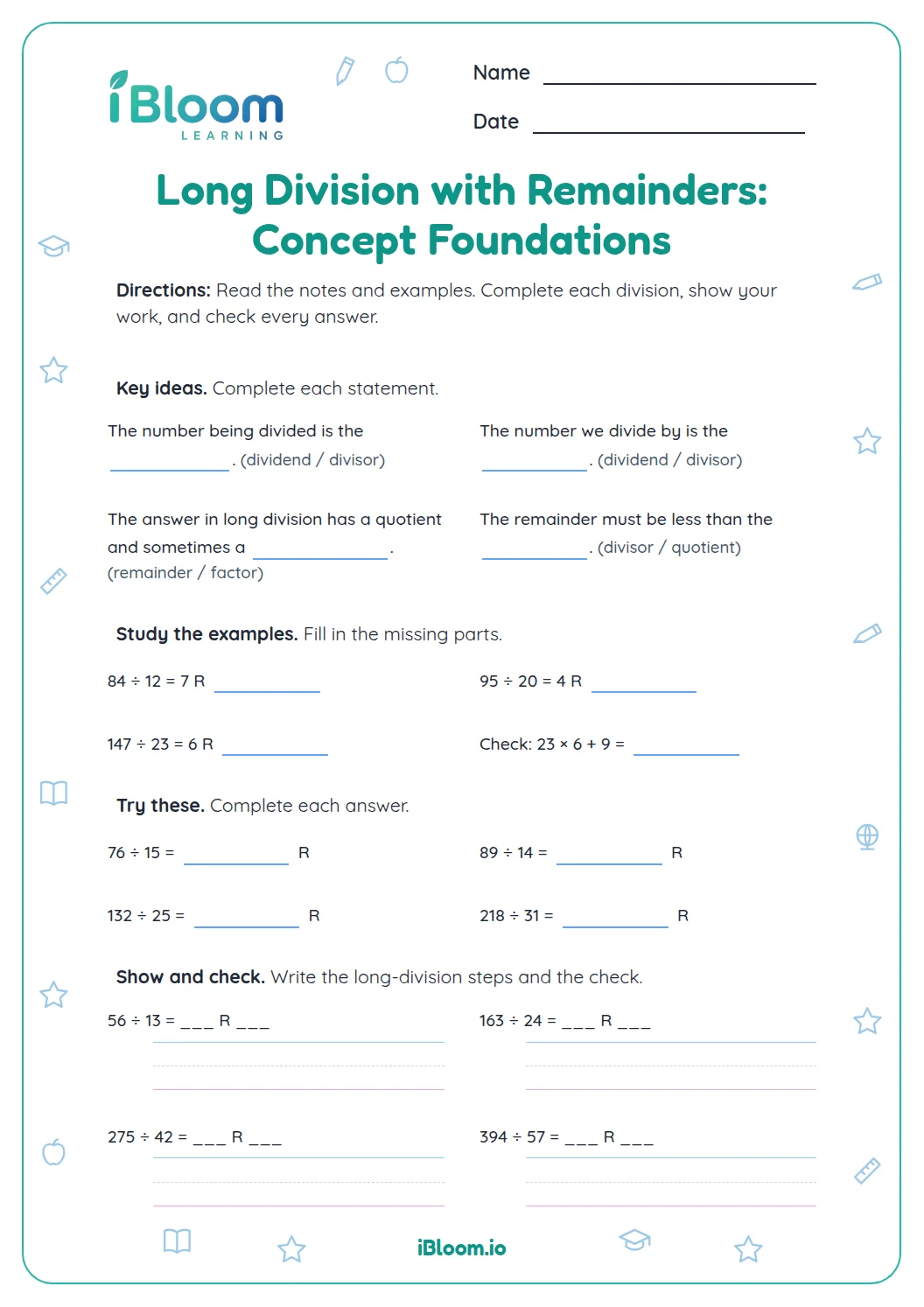
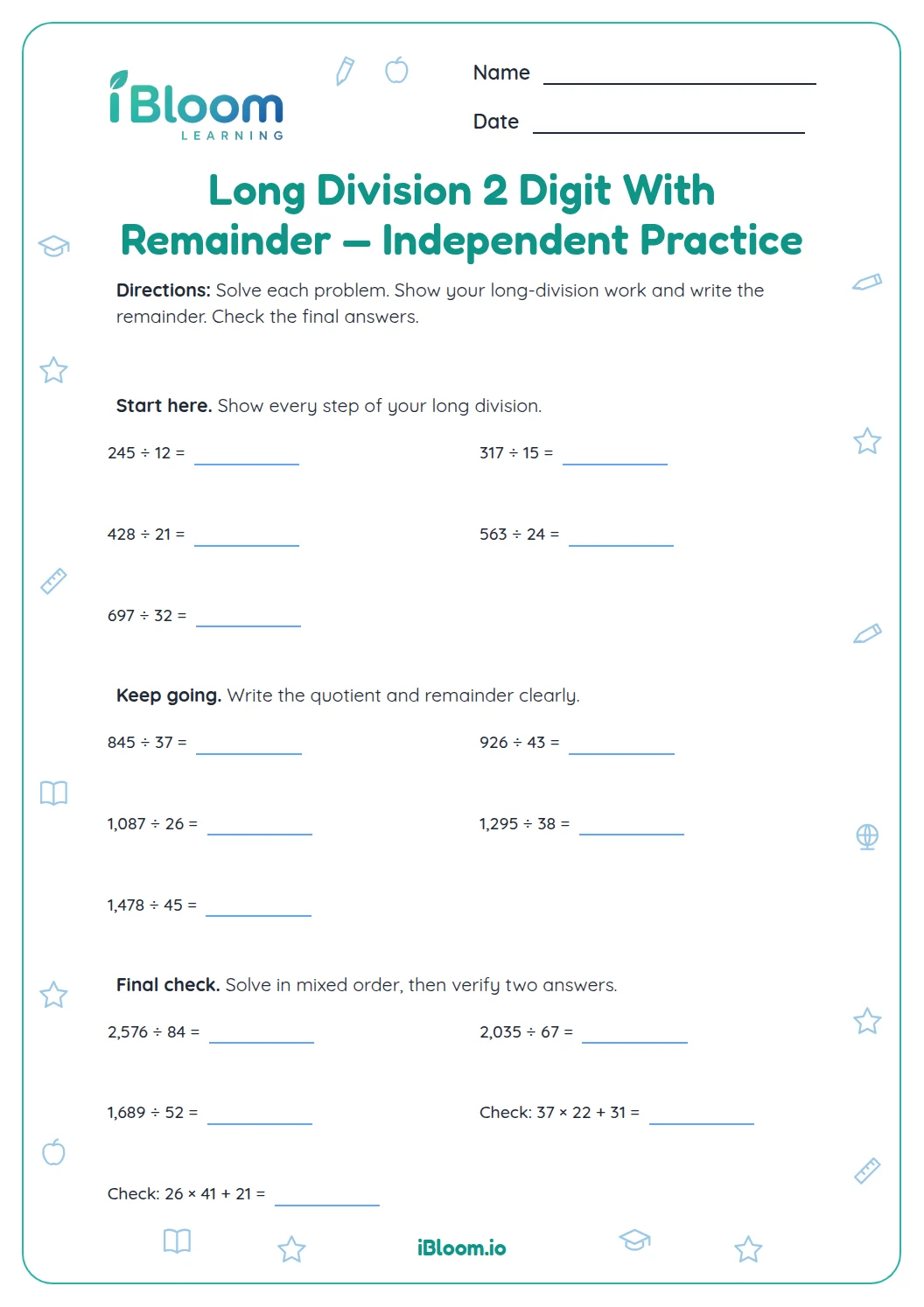
About this worksheet
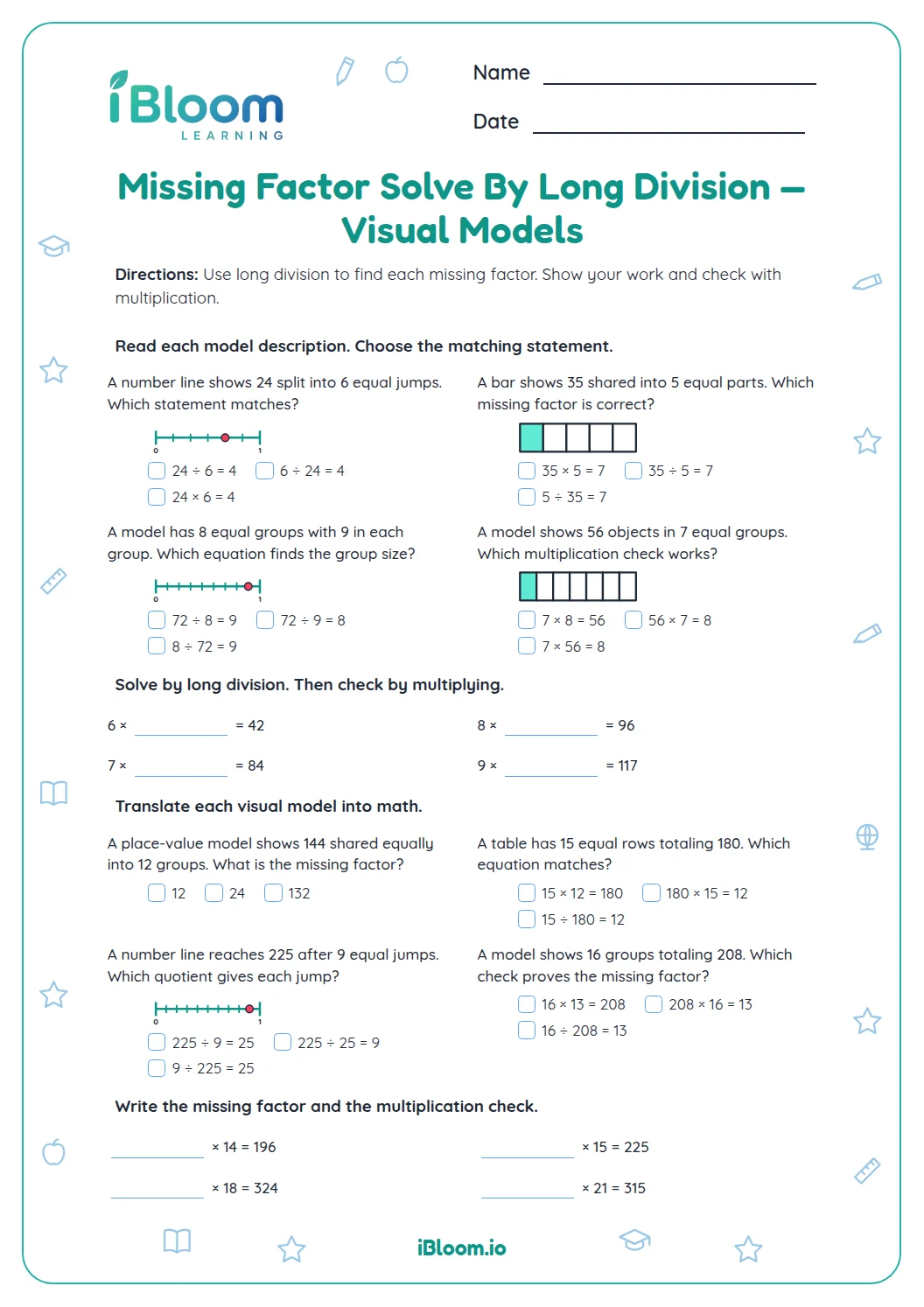
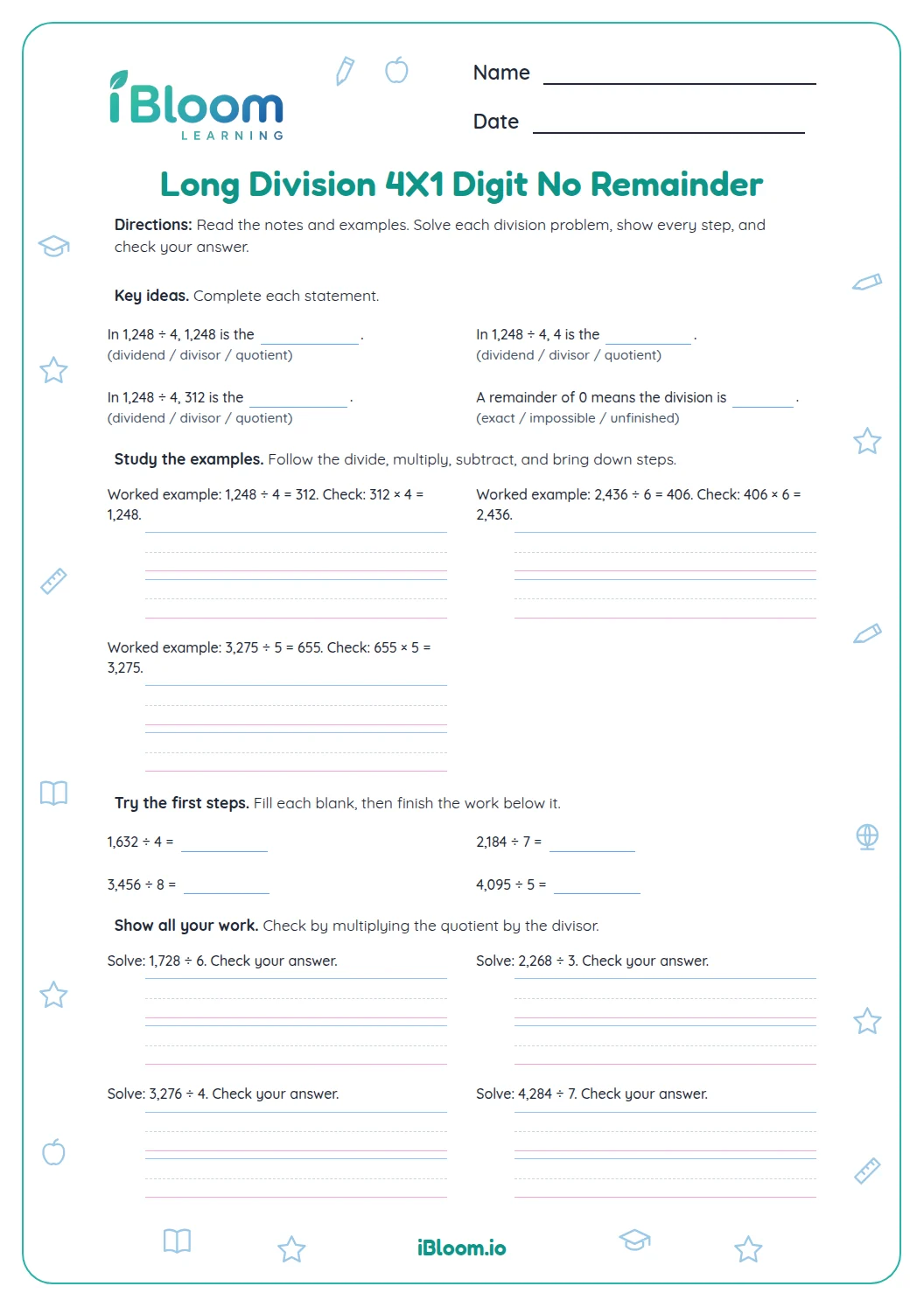
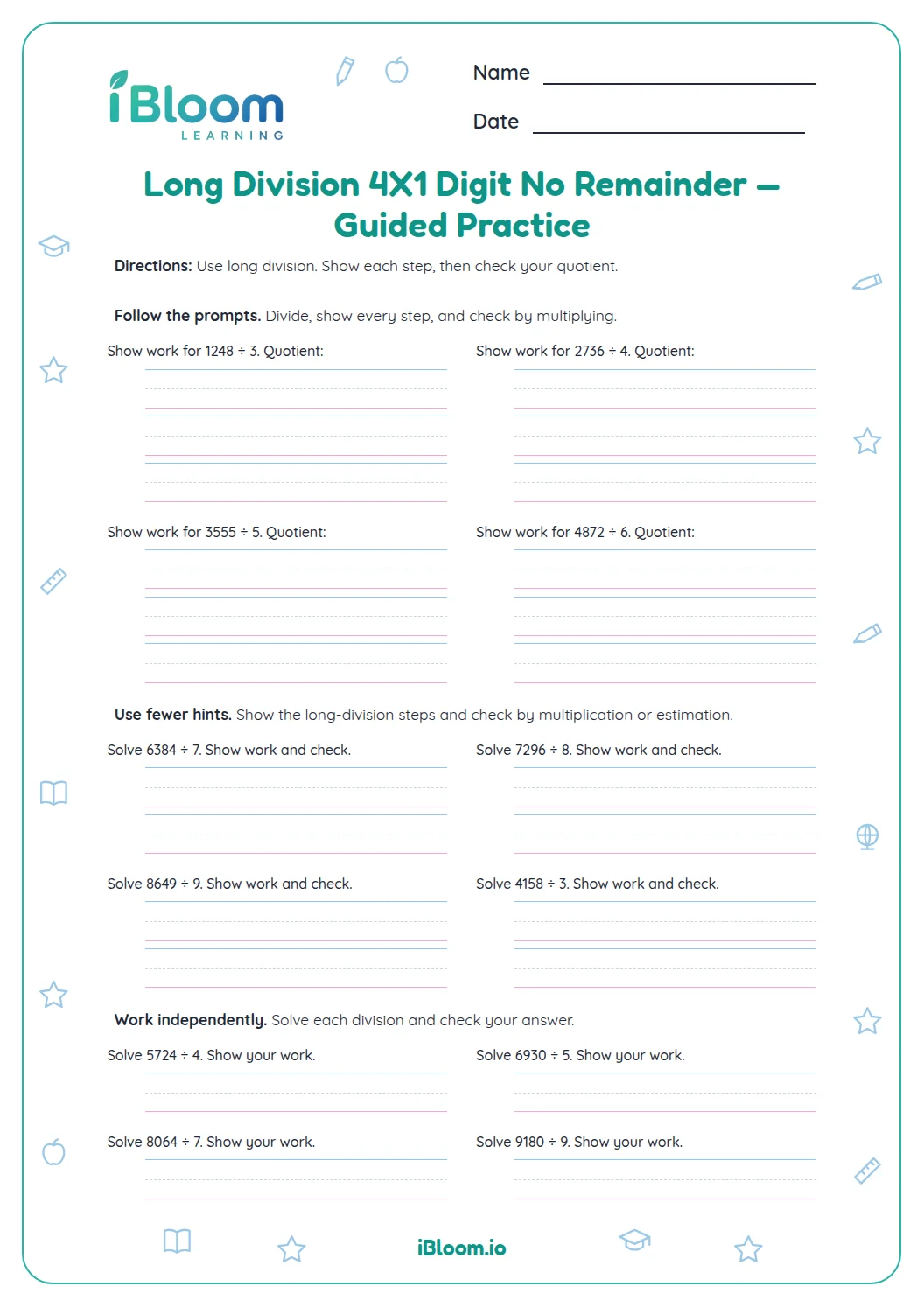
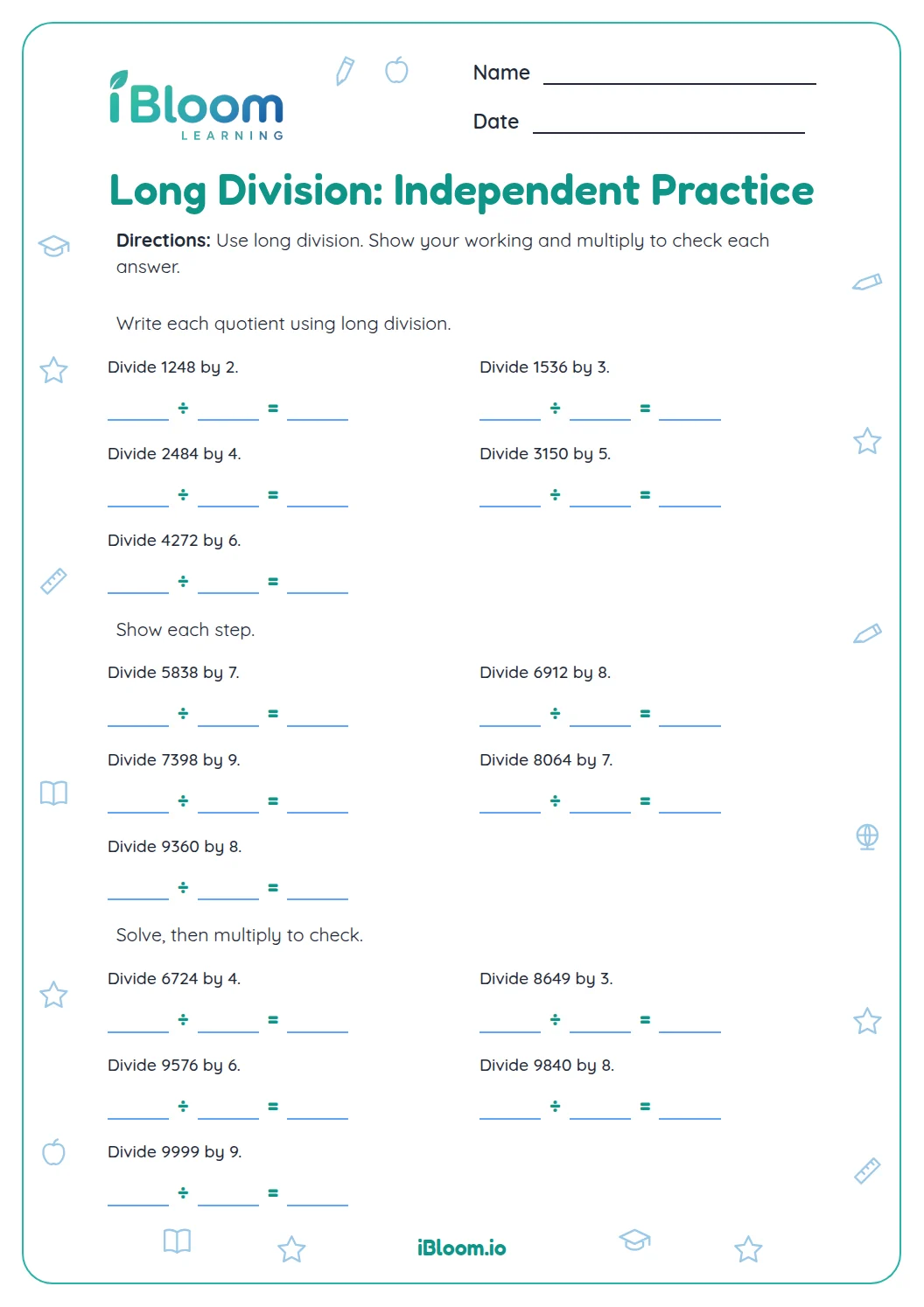
This Grade 5 worksheet gives 16 equal-group stories with the total and number of groups known. Students divide to find how many items are in each group, using long division and checking with multiplication. The stories include boxes, shelves, cartons, and rows; a separate answer key lists every quotient.
Aligned to 5.NBT.B.6
How do you find the number in each group?
Divide the total by the number of equal groups. In question 1, 144 items are shared among 12 boxes: 144 ÷ 12 = 12 items per box. Multiplication checks the quotient because 12 × 12 = 144.
- 1144 ÷ 12 = 12
- 212 × 12 = 144
How does long division help?
For a two-digit divisor, estimate how many times it fits into each part of the dividend, multiply, subtract, and bring down the next digit. Keep place value aligned and continue until no digits remain.
What kinds of stories are included?
All 16 questions describe equal groups and ask for the amount in one group. The totals and divisors vary, and each division has a whole-number quotient.
How can multiplication check the answer?
Multiply the number of groups by the proposed amount in each group. The product should equal the total from the story.
How to solve each story
- 1Identify the total and the number of equal groups.
- 2Write total ÷ number of groups.
- 3Use long division, keeping each quotient digit over its place.
- 4Label the quotient with the story unit.
- 5Multiply quotient × groups to check the total.
Common mistakes and quick fixes
The mistake
Dividing the number of groups by the total.
The fix
Start with total items ÷ number of groups.
The mistake
Dropping a place-value zero in the quotient.
The fix
Check each quotient digit by multiplying back.
The mistake
Giving the total as the amount per group.
The fix
Ask whether the quotient is one group or all groups combined.
Common Core alignment
This worksheet gives focused practice with 5.NBT.B.6.
Use missing divisors in stories to show the reasoning in each item.
On this sheet: The questions ask learners to apply missing divisors in stories throughout the sheet.
Show the official wordingHide the official wording
Find whole-number quotients of whole numbers with up to four-digit dividends and two-digit divisors, using strategies based on place value, the properties of operations, and/or the relationship between multiplication and division. Illustrate and explain the calculation by using equations, rectangular arrays, and/or area models.
What to practice next
Make more practice
Further reading
Questions parents and teachers ask
What is the unknown in these problems?
The unknown is how many items go in one equal group. Each problem gives a total and the number of groups, so students divide the total by the group count to find the missing amount. The group count is the divisor because the total is being split into that many equal groups.
Why use long division?
Several problems use two-digit divisors, so long division organizes the quotient digits and remainders at each place. Students can estimate, multiply, subtract, and bring down digits until the dividend is used. The written division steps help keep the quotient aligned with the correct place value.
How can students check a quotient?
Multiply the quotient by the number of groups. For question 1, 12 items per box × 12 boxes = 144 items, which matches the total. Every problem on the sheet has an exact whole-number quotient. For every item, the quotient multiplied by the group count returns the given total.
What is on the answer key?
The separate key gives a labeled quotient for all 16 stories. Use it after the student has identified the dividend and divisor and completed a long-division calculation. Students can use the labels in each story to explain what the quotient represents.
How long does this worksheet take?
Allow about 25 minutes for the 16 problems. The two-digit divisors may take more steps than a one-digit division fact, so students can complete one section at a time and check with multiplication. The exact quotients keep attention on long-division steps and equal-group reasoning.