

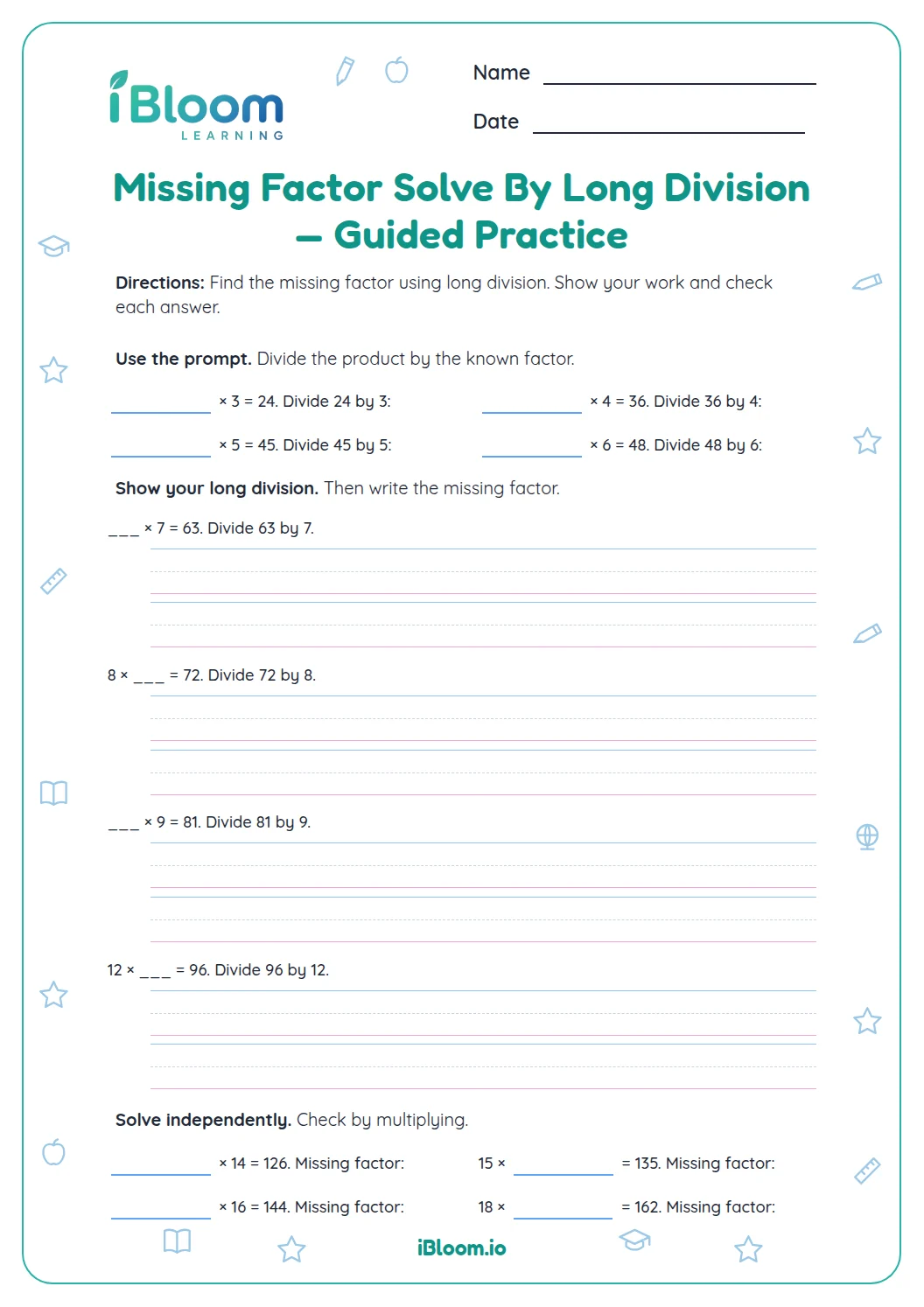
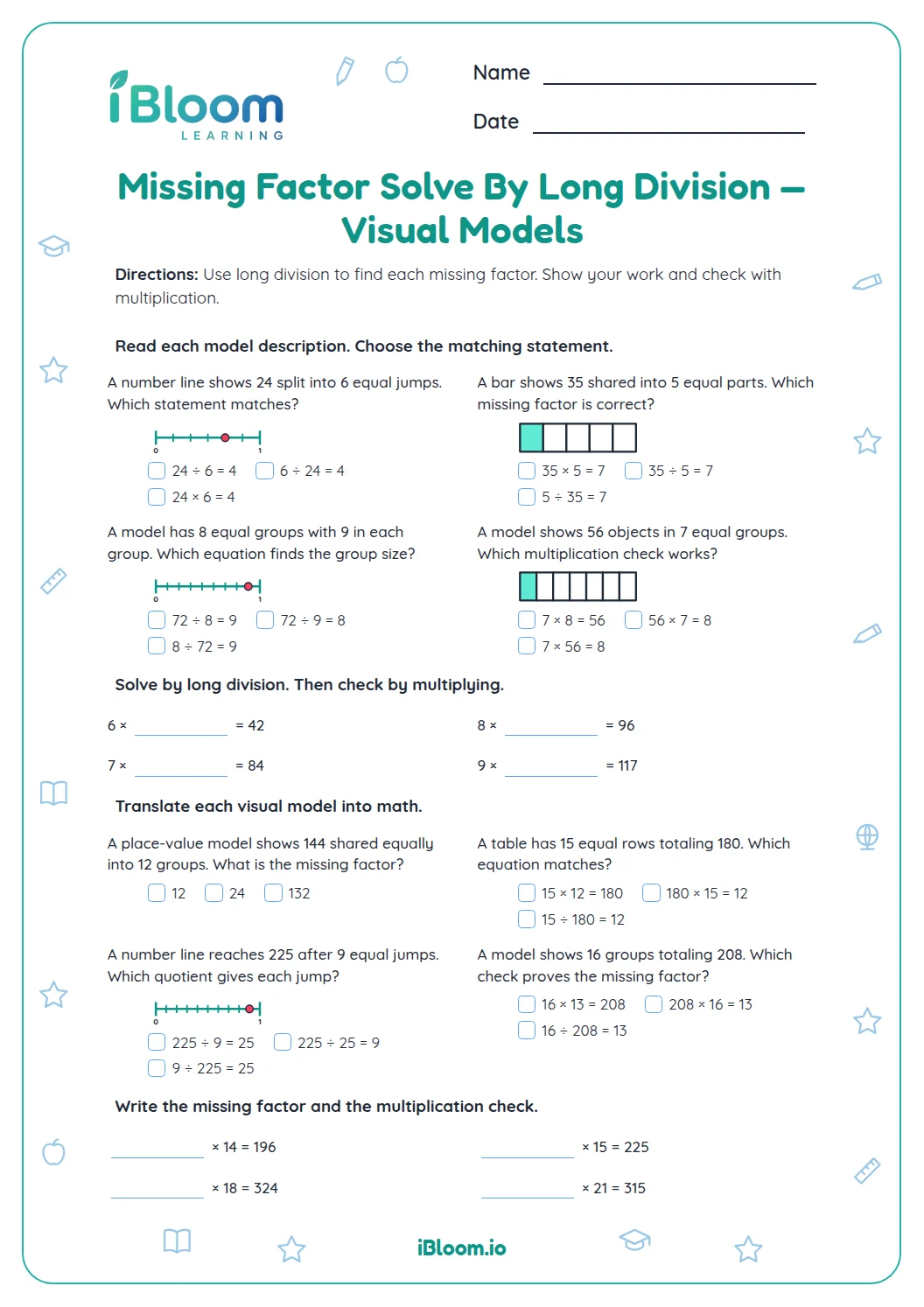
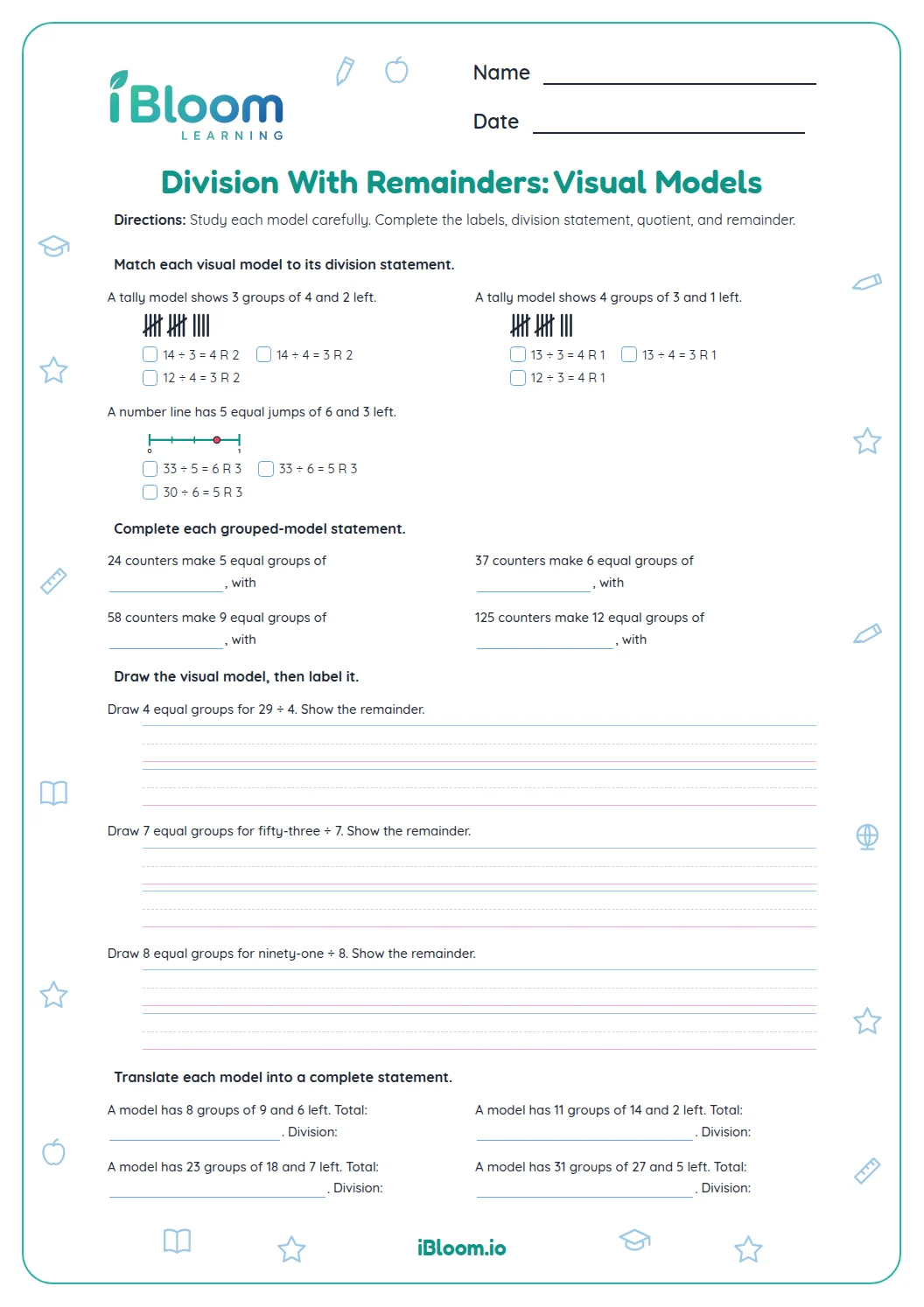
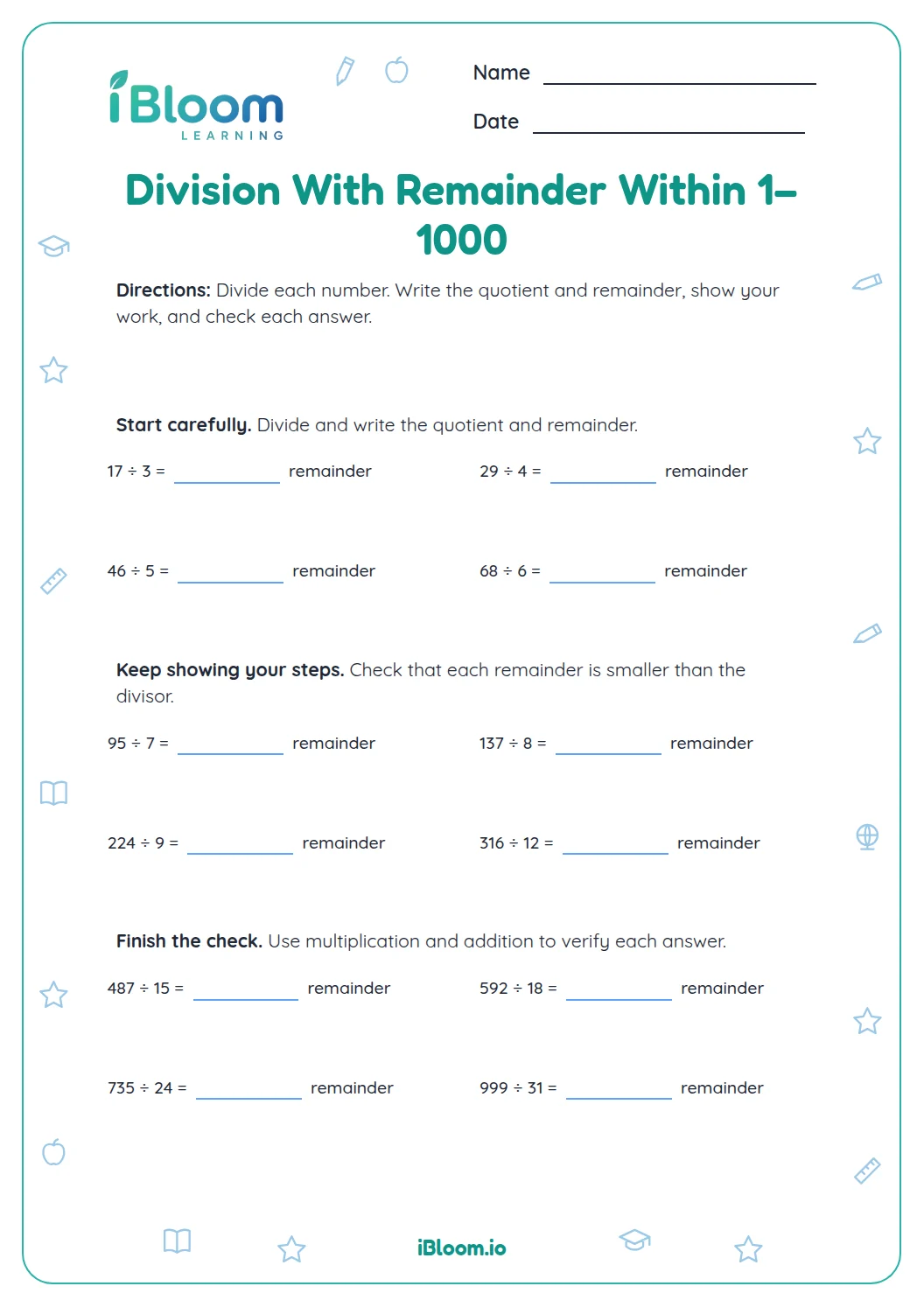
About this worksheet
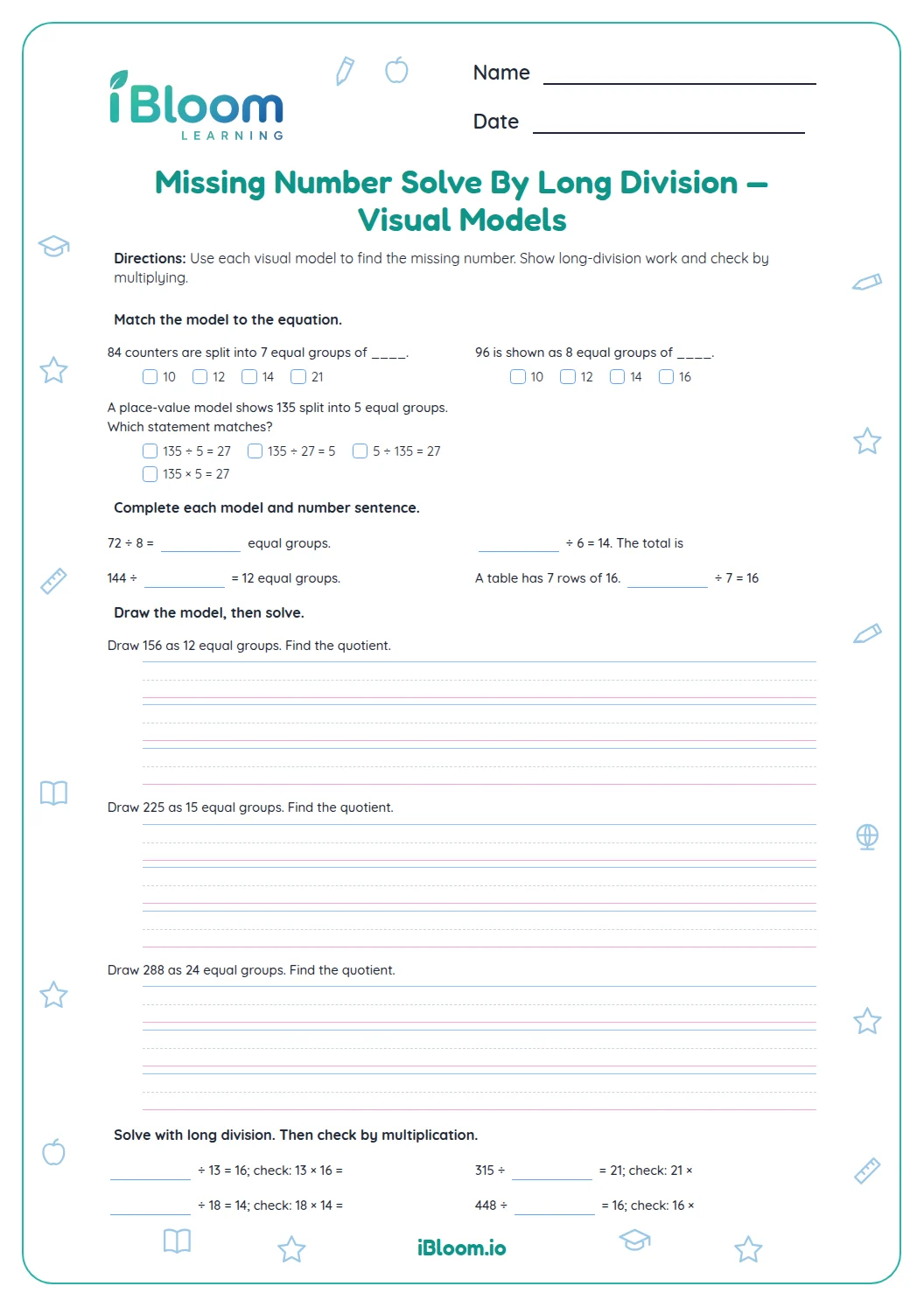
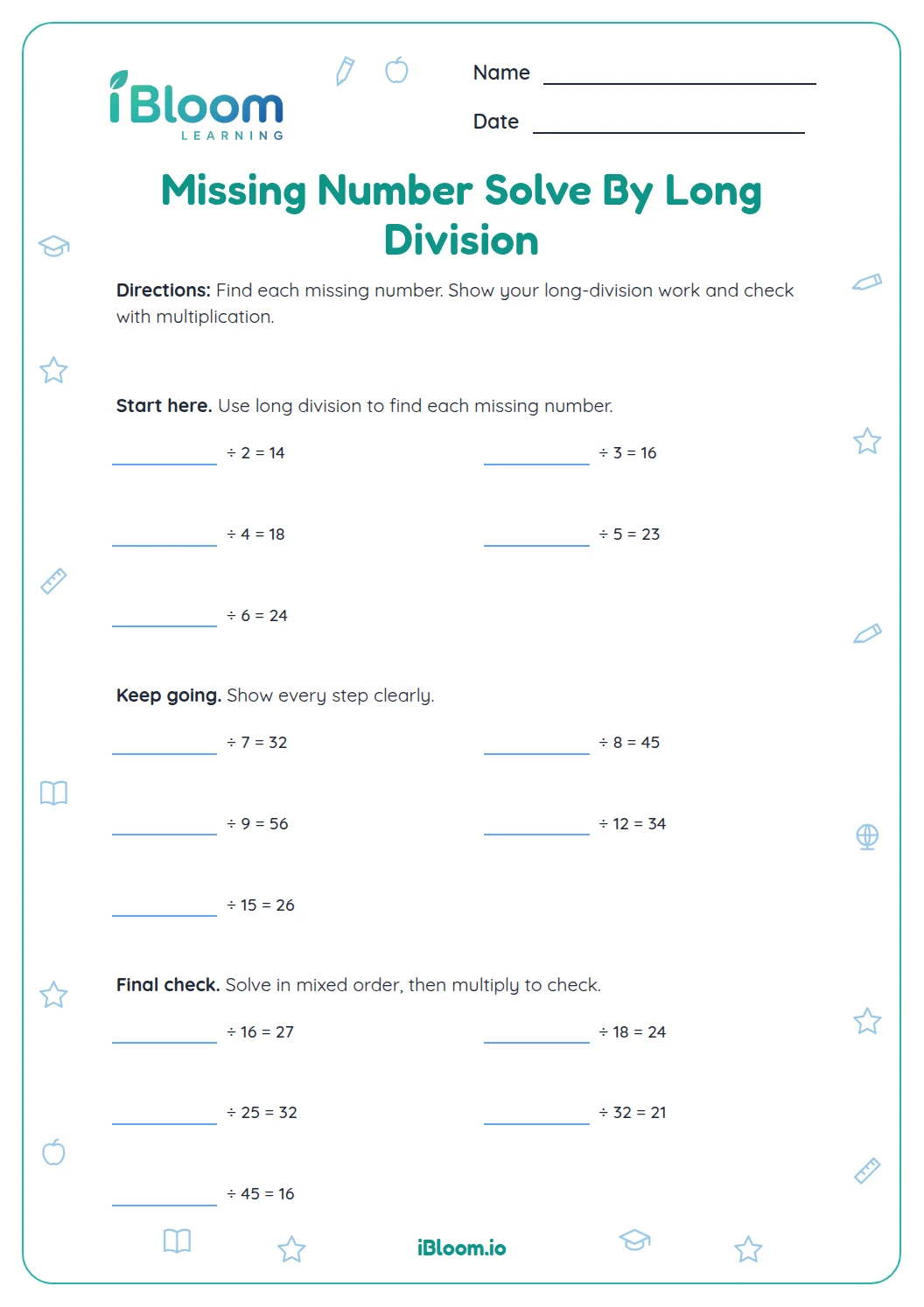
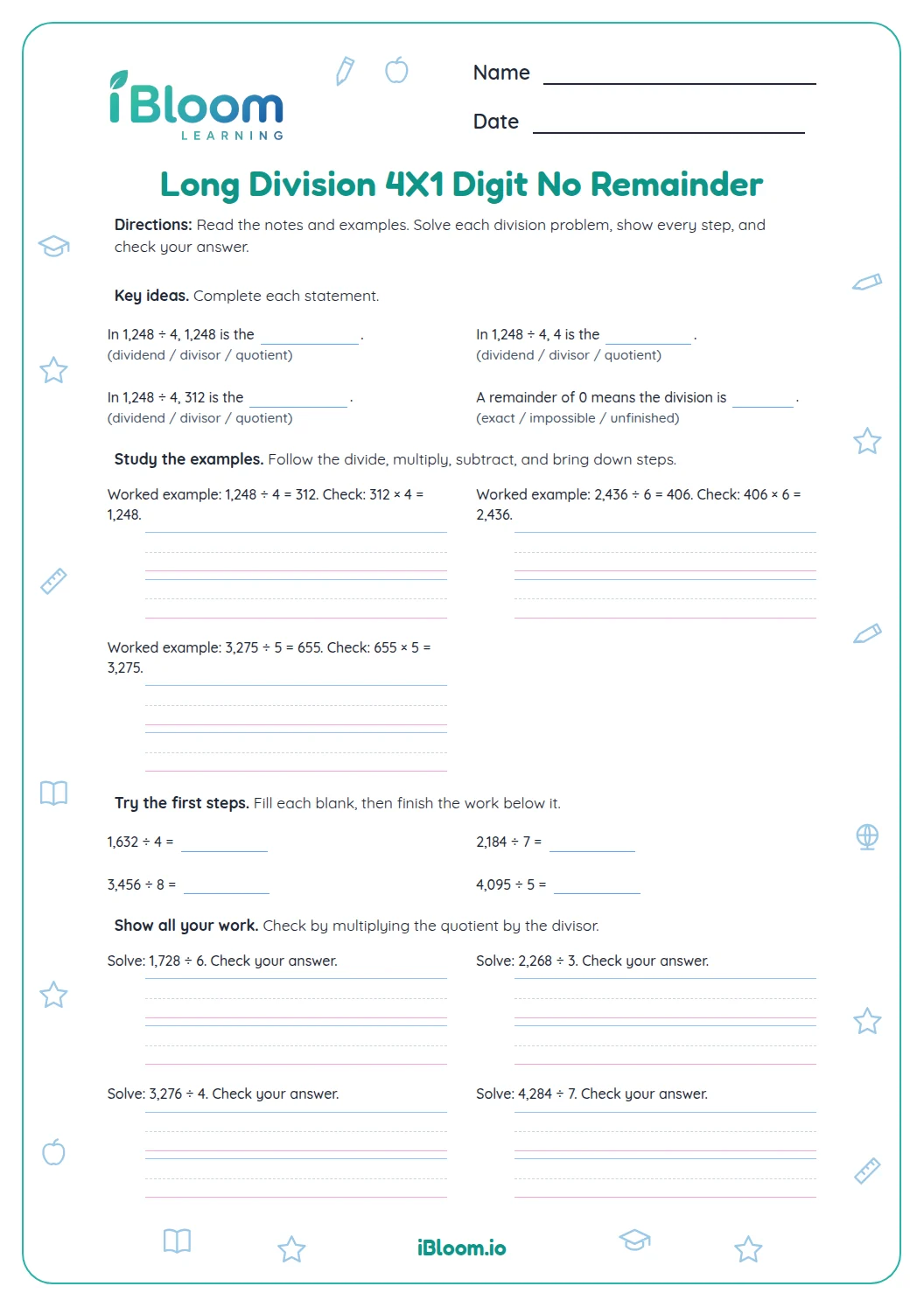
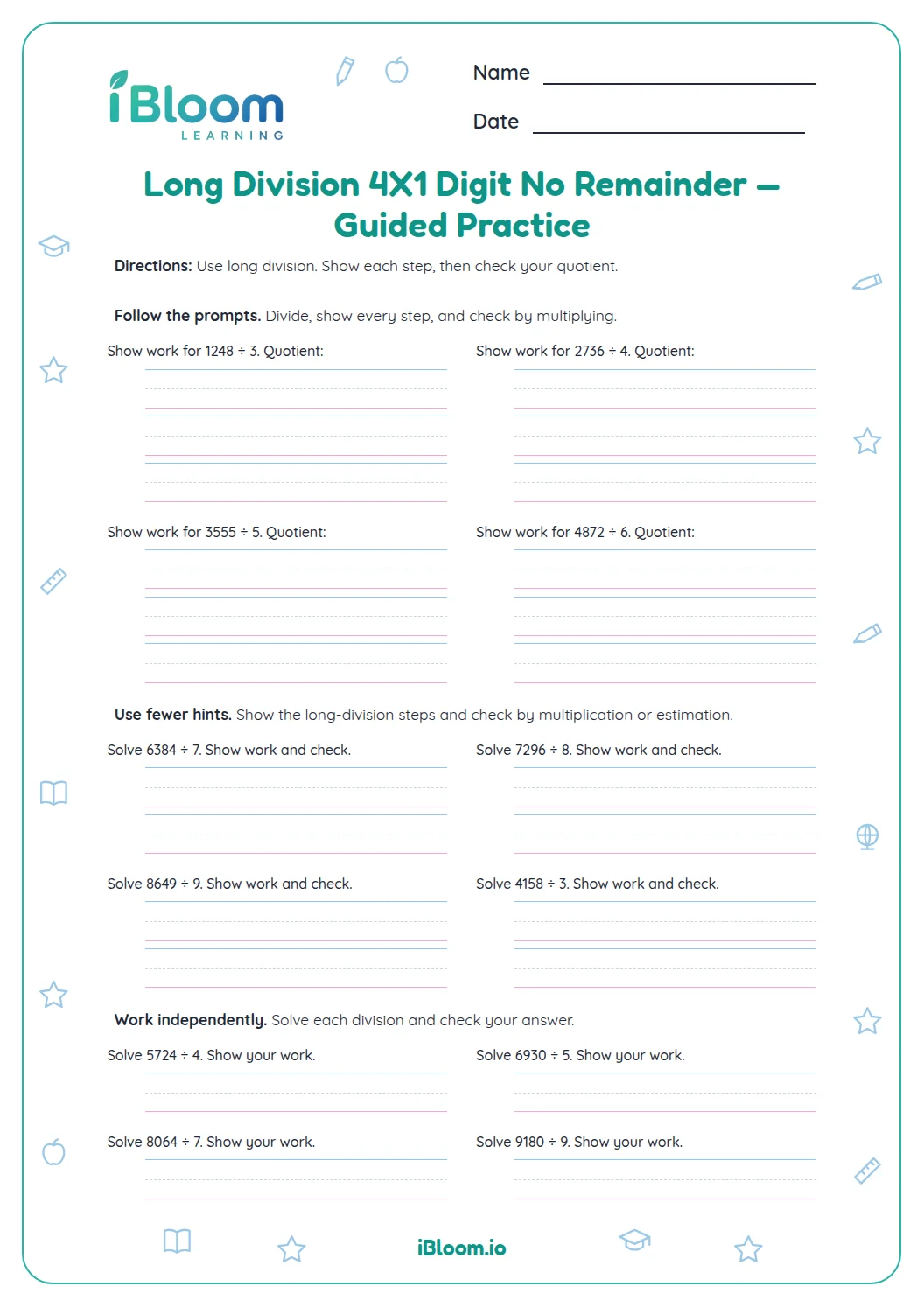
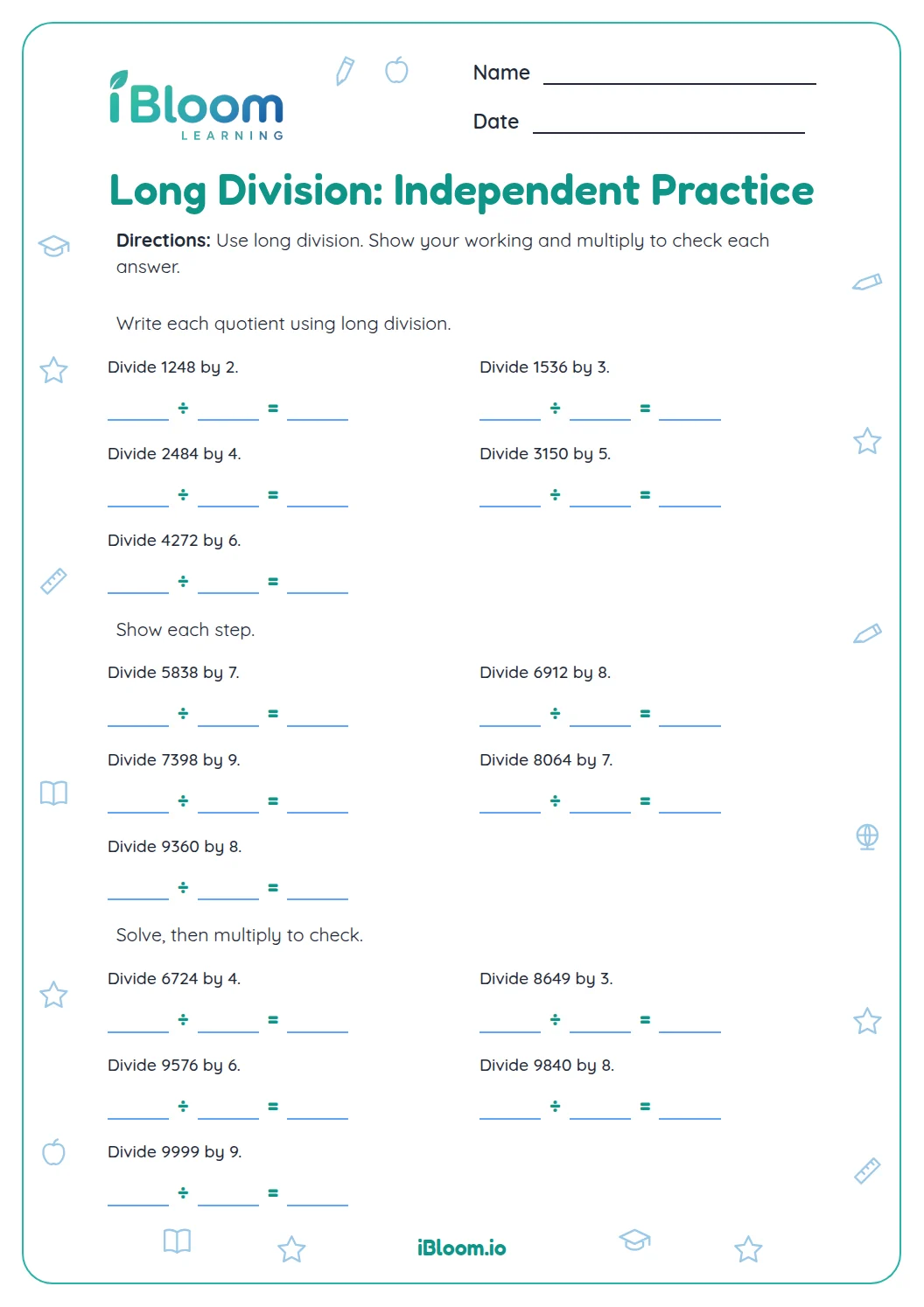
This Grade 5 long-division worksheet practices finding an unknown dividend, divisor, or quotient. Part A presents eight division equations with one blank. Part B uses equal groups, full groups with leftovers, and inverse-operation reasoning in eight word problems. Students have room to show their calculations, and the answer key gives quotients with units where the story needs them.
Aligned to 5.NBT.B.6
How do you find a missing number in division?
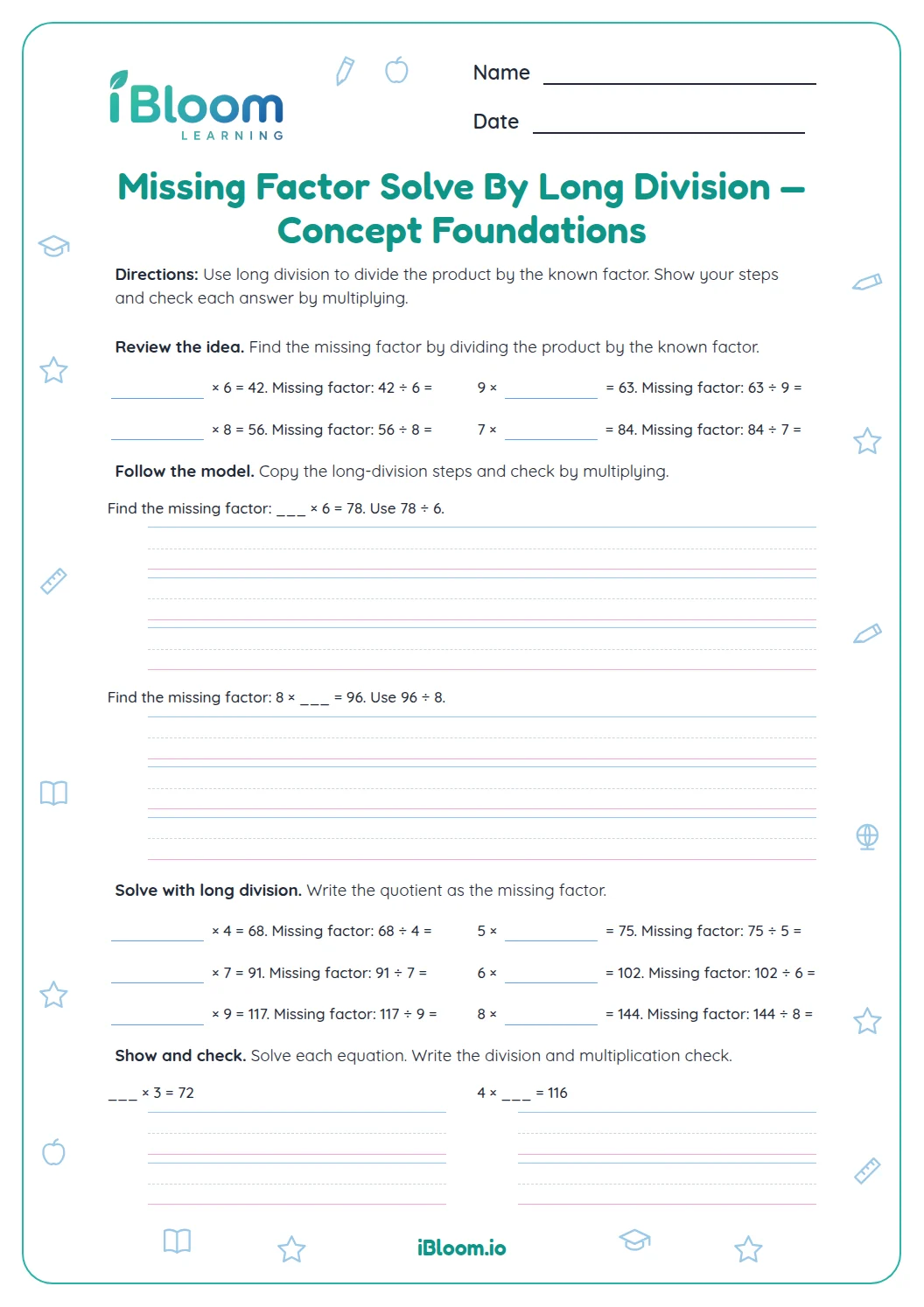
Identify which part of the division equation is unknown. Use the inverse multiplication fact when the dividend is missing, or test a divisor when the dividend and quotient are known. Check the result in the original equation.
- 1Question 1: ___ ÷ 6 = 148 → 148 × 6 = 888, so the missing dividend is 888.
How do you interpret the quotient in a story?
Write a division equation from the equal groups in the story. Then decide whether the problem asks for a quotient alone or for full groups and a remainder. Keep the answer unit matched to the story.
- 1Question 11: 1,346 ÷ 5 = 269 R 1 → 269 full boxes and 1 apple.
How can you check a quotient with a remainder?
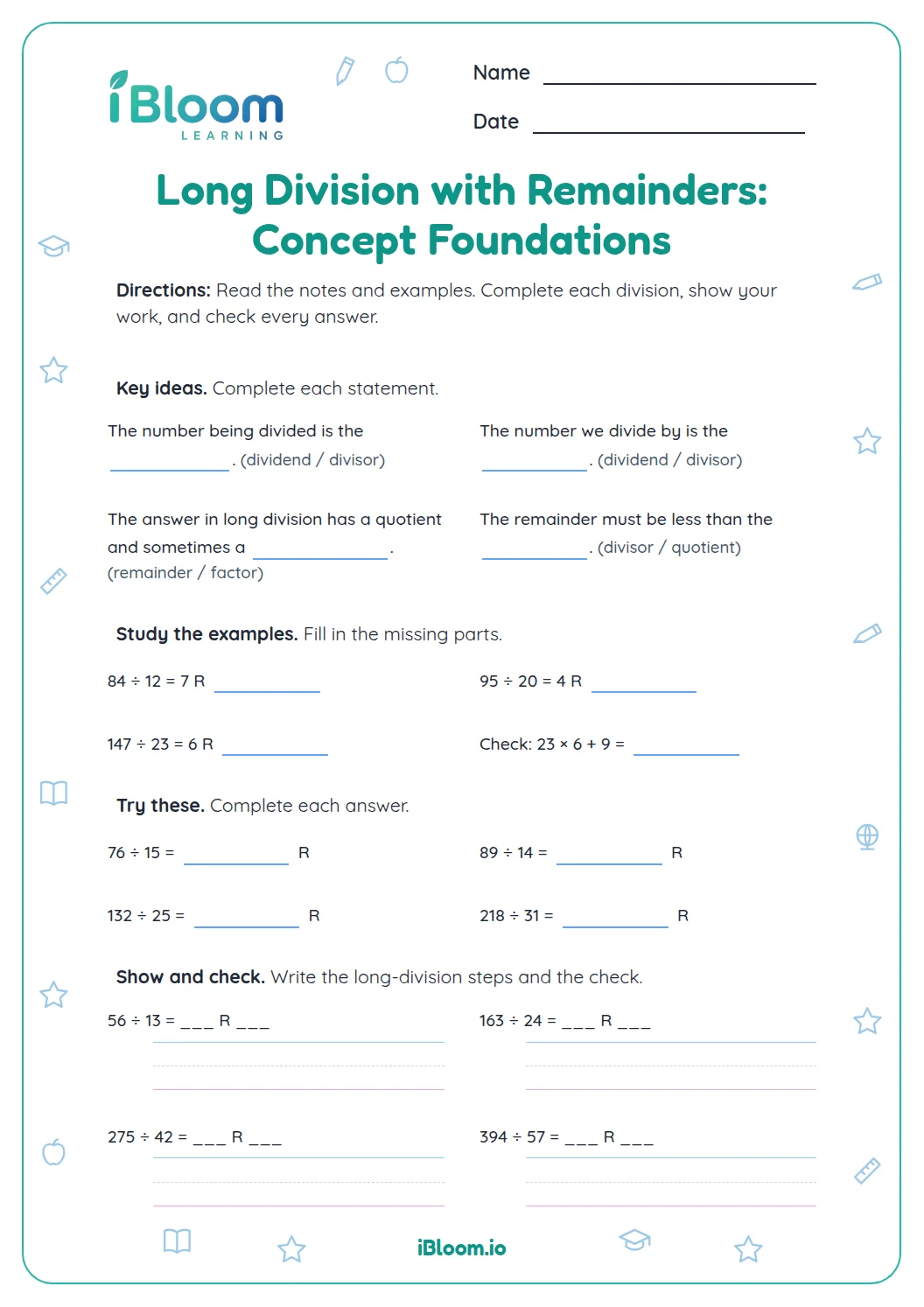
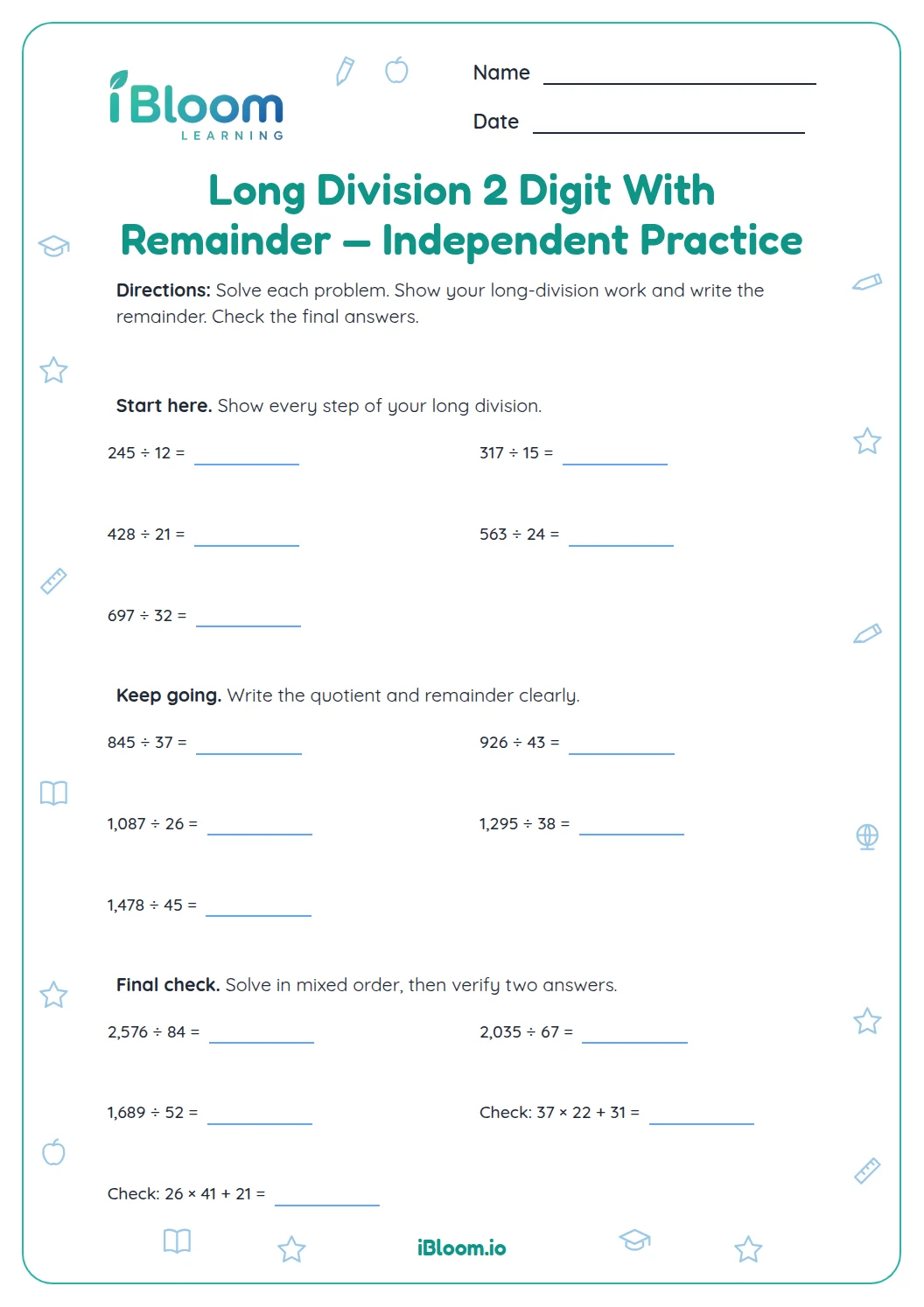
Multiply the divisor by the quotient and add the remainder. The total should equal the dividend, and the remainder must be smaller than the divisor.
How to use this worksheet
- 1Mark whether the blank is the dividend, divisor, or quotient.
- 2Use multiplication to find a missing dividend or divisor when it helps.
- 3For word problems, write a division equation before calculating.
- 4Decide whether a remainder means leftover items or a partial group.
- 5Check by multiplying divisor × quotient and adding any remainder.
Common mistakes and quick fixes
The mistake
Treating the divisor as the missing dividend.
The fix
Read the equation in order: dividend ÷ divisor = quotient.
The mistake
Dropping a remainder in a full-group context.
The fix
State how many complete groups fit and what is left.
The mistake
Accepting a remainder equal to the divisor.
The fix
Check that the remainder is less than the divisor; otherwise another group fits.
Common Core alignment
Students use place value and the relationship between multiplication and division to solve larger division problems.
Find whole-number quotients and remainders using place value and multiplication facts.
On this sheet: Students solve whole-number division equations, including dividends or divisors represented by a blank, and apply division to contexts.
Show the official wordingHide the official wording
Find whole-number quotients of whole numbers with up to four-digit dividends and two-digit divisors, using strategies based on place value, the properties of operations, and/or the relationship between multiplication and division. Illustrate and explain the calculation by using equations, rectangular arrays, and/or area models.
What to practice next
Make more practice
Further reading
Questions parents and teachers ask
What does the missing number represent?
The blank may be the dividend, divisor, or quotient. Use the relationship between division and multiplication to identify what value makes the equation true, then check by multiplying. Questions 1 through 8 include examples of each missing value.
How many problems are on the page?
There are 16 questions in two parts. Eight use division equations with a missing number; eight apply division to equal-sharing, grouping, and quotient-with-remainder situations. The answer key includes the numerical results and units where the prompt calls for them.
How can multiplication help solve a division blank?
For a missing dividend, multiply the divisor by the quotient and add any remainder. For a missing divisor or quotient, use related multiplication facts or divide, then check that the original equation is true. The key lists each result.
What should students do with a remainder?
A remainder is the amount left after making as many equal groups as possible. In Questions 11 and 14, report both the number of full boxes or bags and the leftover items; the key gives both quantities and units.
Does the key include units?
Yes. The key includes units such as books, packs, apples, seats, pencils, and rolls where the question gives a real-world context. For number sentences, it gives the missing number without adding a unit. This helps keep the answer connected to the story.