


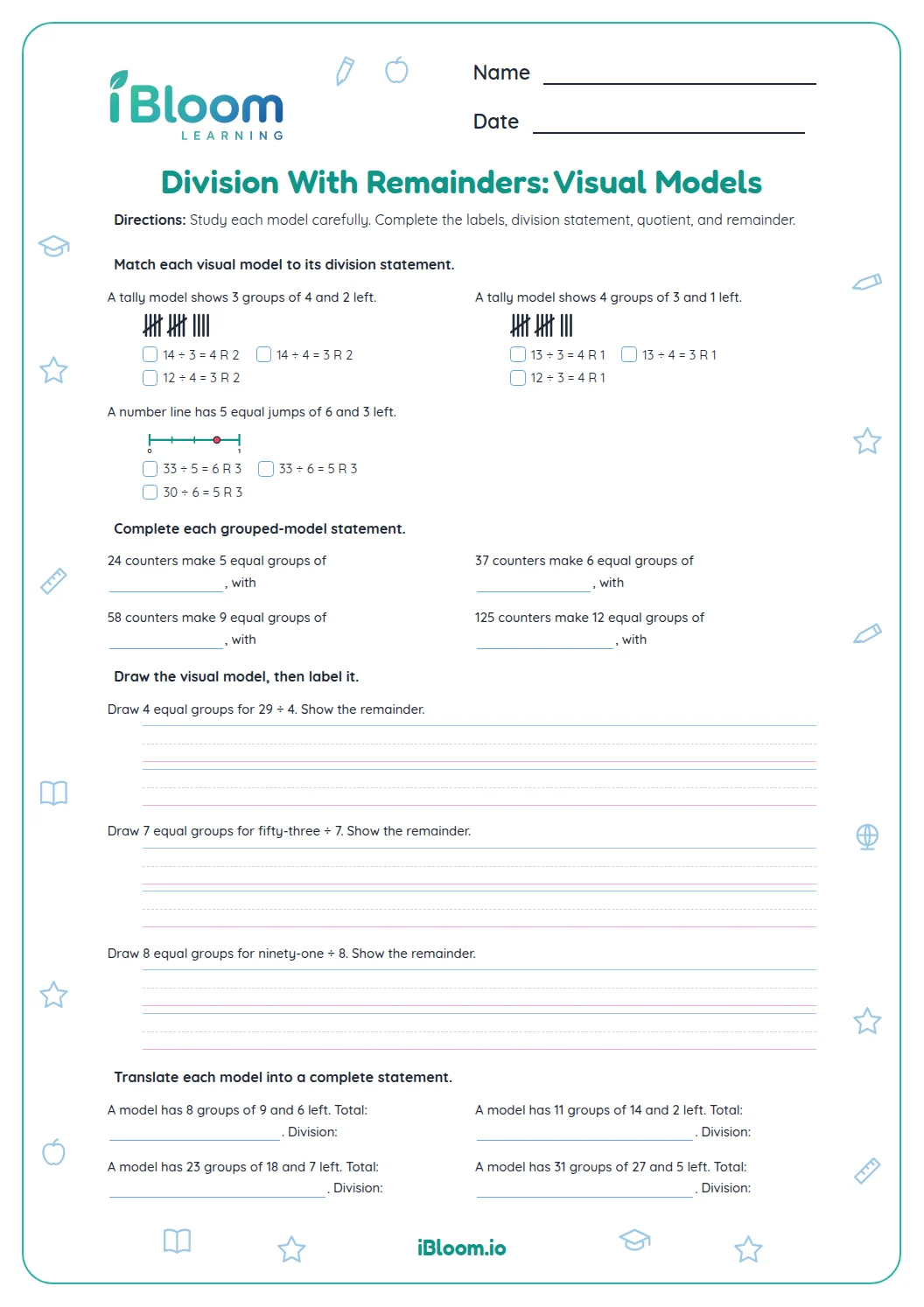
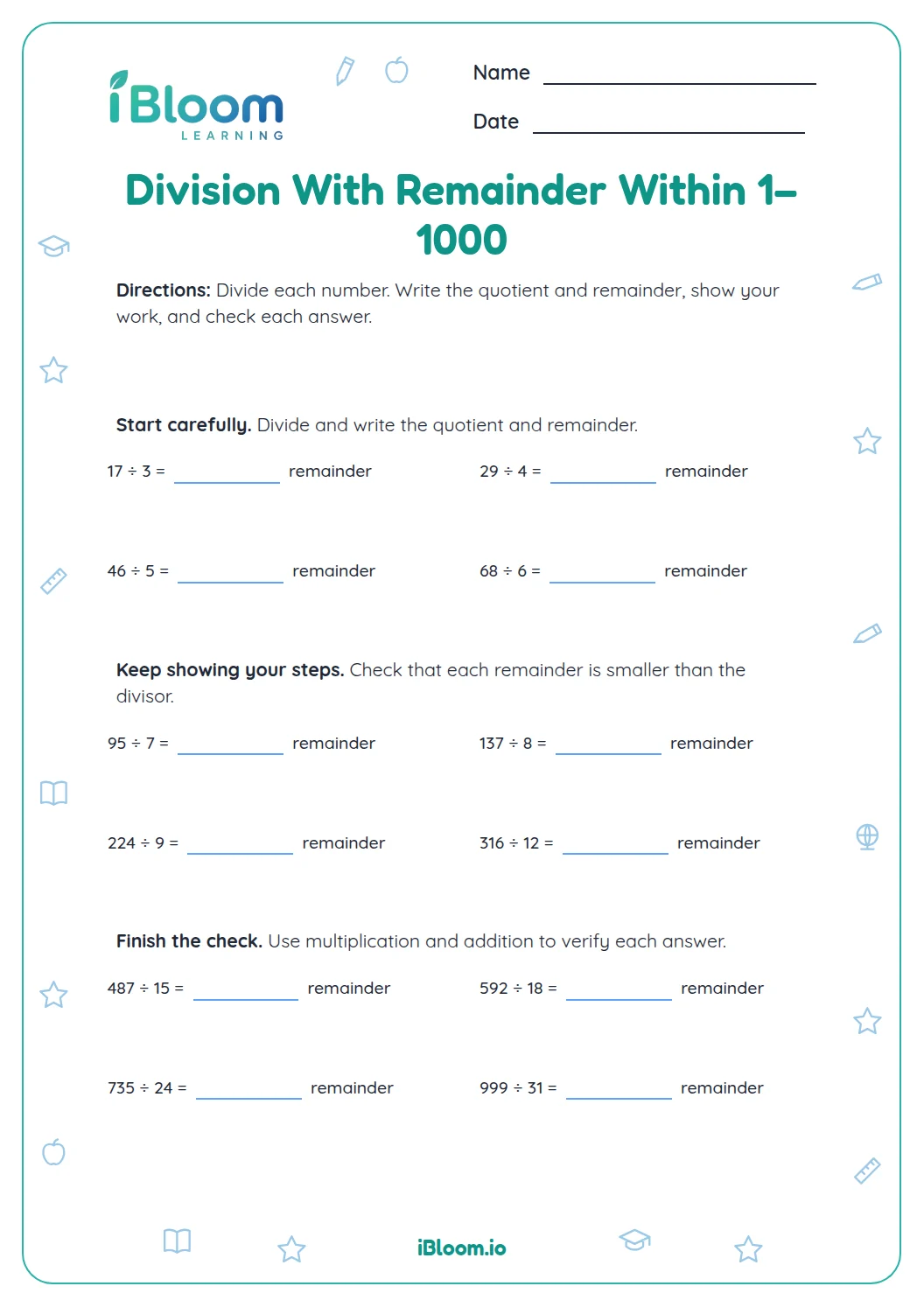
About this worksheet
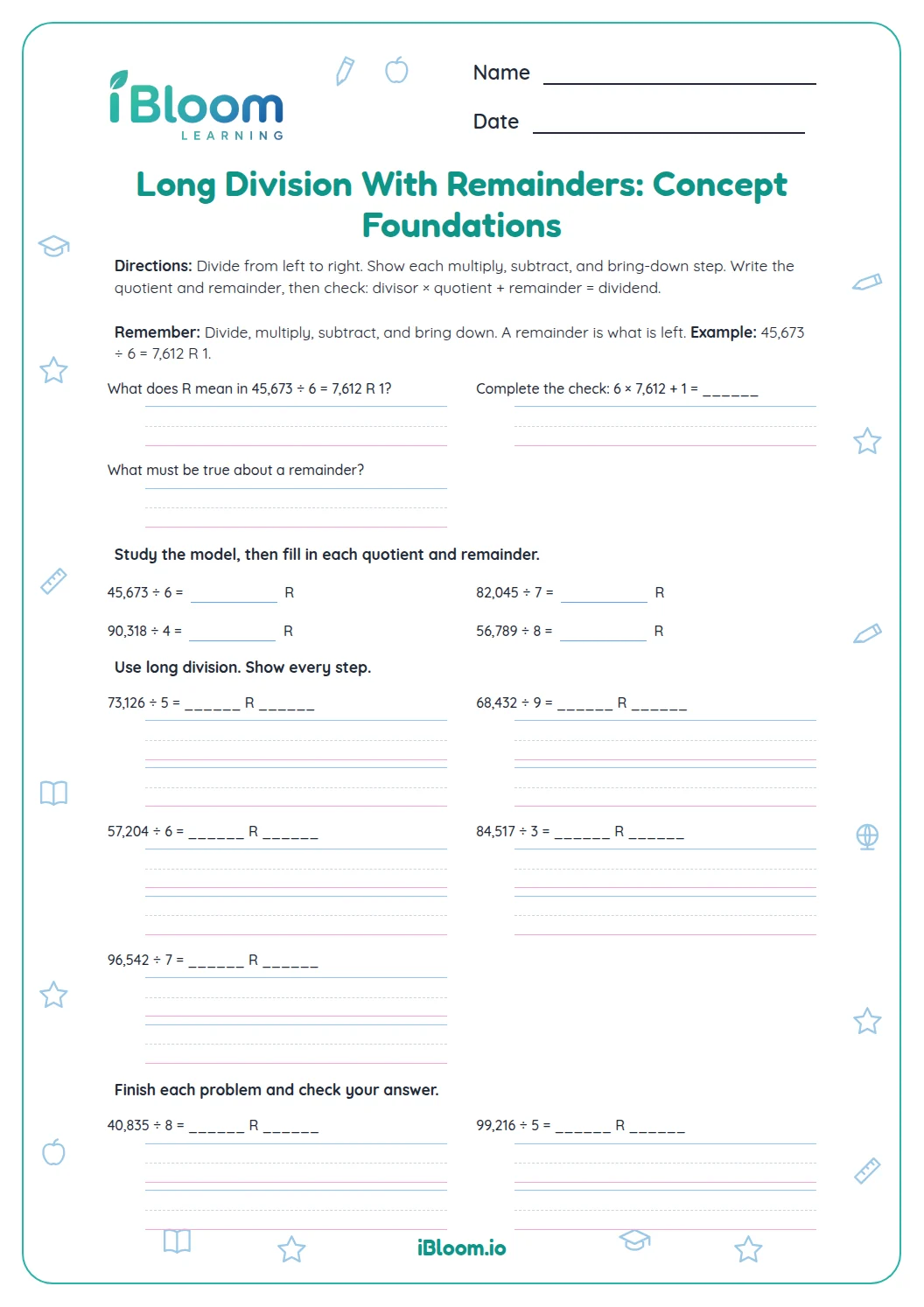
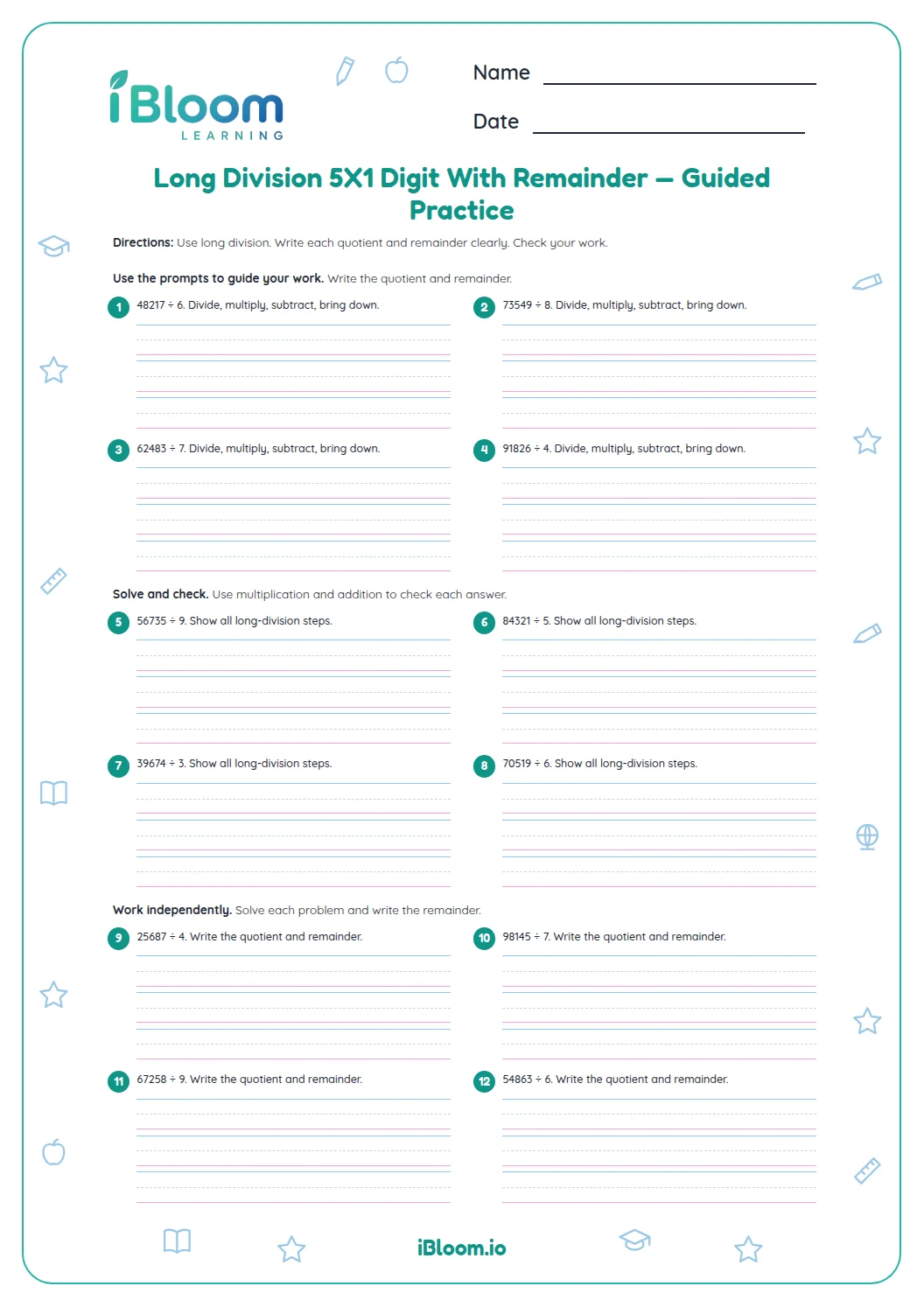
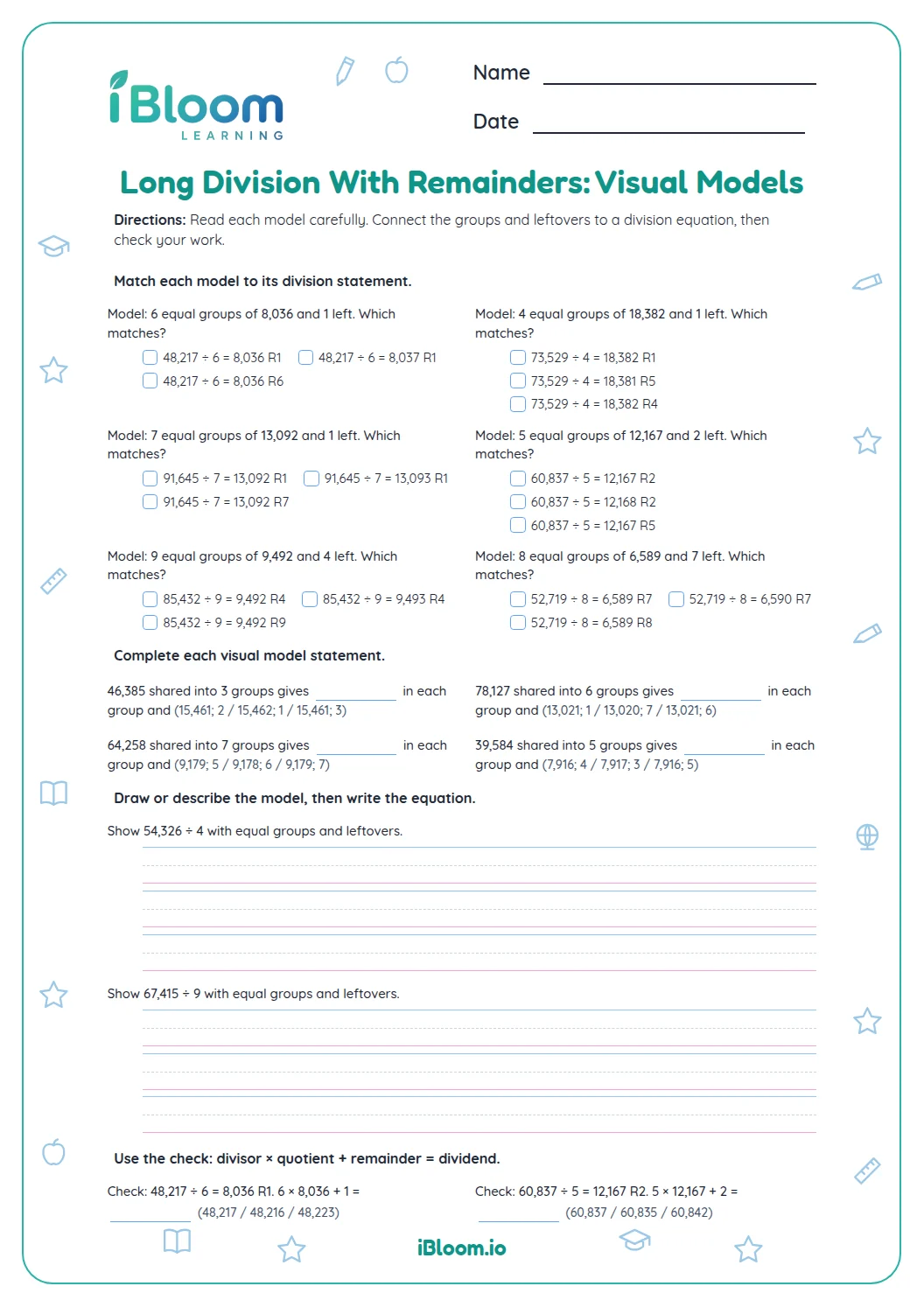
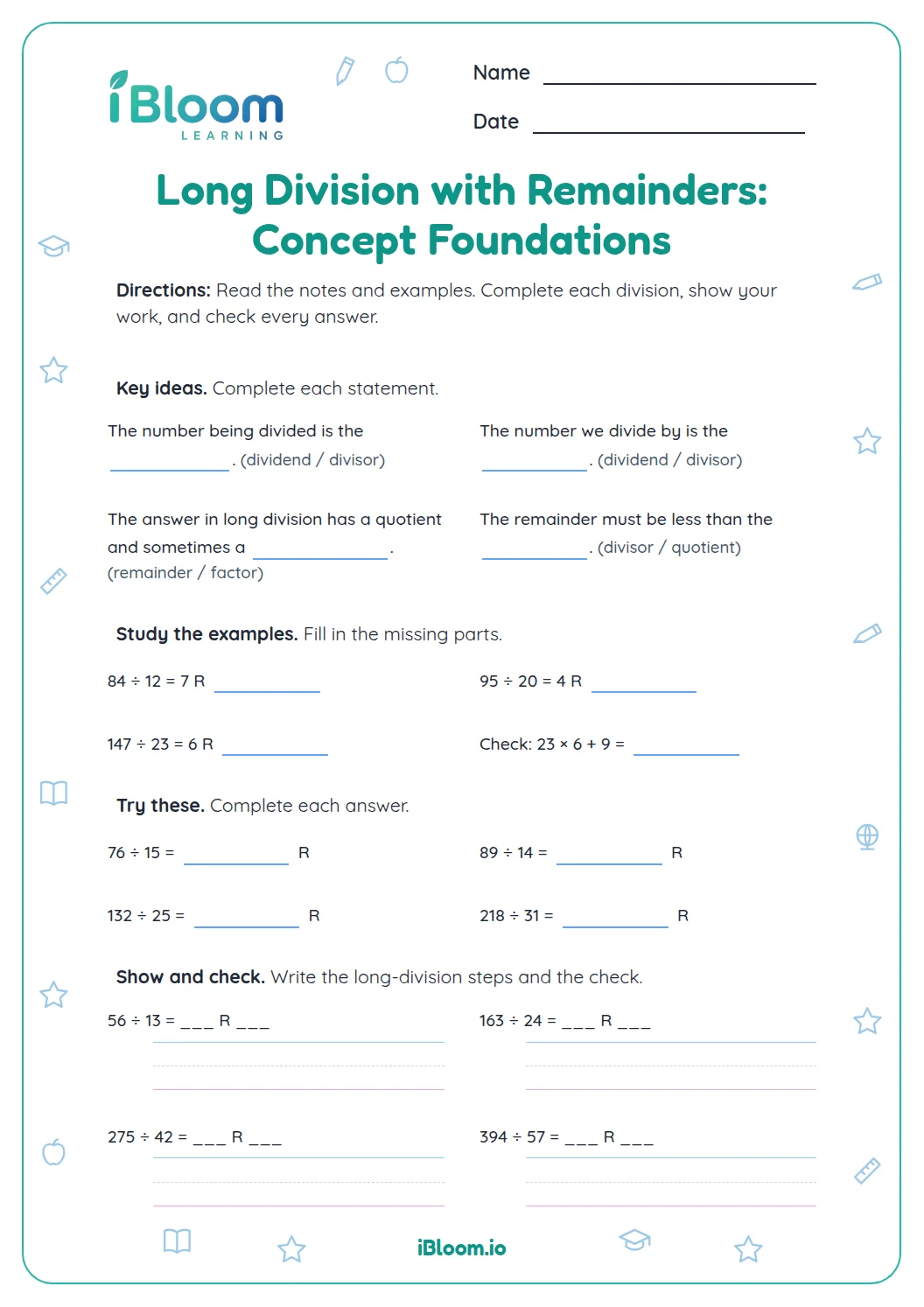
This Grade 5 long-division worksheet contains 16 real-world sharing and grouping problems. Each situation uses a five-digit total and a one-digit divisor, so students practice the long-division skill named in the worksheet title and interpret any remainder in context. The answer key gives the quotient and leftover amount, with units named in the story.
How do you turn a story into division?
Find the total amount and the number of equal groups. Divide the total by the group count, then label the quotient and remainder with the story’s unit.
What does the remainder mean?
A remainder is the amount that cannot be placed equally into the groups. Keep it smaller than the divisor and include it in the final response.
- 1Question 1: 12,543 art kits shared among 4 classrooms.
- 212,543 ÷ 4 = 3,135 R 3.
- 3Each classroom gets 3,135 kits, with 3 left over.
How can you check a quotient and remainder?
Multiply the quotient by the divisor and add the remainder. The result should equal the original total, and the remainder must be less than the divisor.
How to use this worksheet
- 1Underline the total and circle the number of equal groups.
- 2Write the division equation before calculating.
- 3Use long division to find the quotient and remainder.
- 4Check by multiplying the quotient by the divisor and adding the remainder.
- 5Answer in the units and context named in the story.
Common mistakes and quick fixes
The mistake
Writing a remainder as large as the divisor.
The fix
Divide one more time when the leftover amount is at least the divisor.
The mistake
Reporting only the quotient.
The fix
Read the question again and include leftover items when they remain.
The mistake
Mixing up the divisor and dividend.
The fix
The total being shared is the dividend; the number of groups is the divisor.
What to practice next
Make more practice
Further reading
Questions parents and teachers ask
How many division problems are included?
There are 16 story problems. Each gives a five-digit total and a one-digit group count, and students find the amount per group and any remainder. Units in the story help them interpret the result. Students should name the object or unit that the quotient represents.
How should students write the remainder?
Use the quotient with the remainder, then name the unit. For example, a sharing story might end with “3,135 kits, remainder 3.” Check that the leftover amount is smaller than the divisor before writing the final response. A remainder tells how many objects stay unshared after equal groups are made.
Are all answers whole numbers?
The quotients are whole numbers. Some totals divide evenly, while other problems leave a remainder that must be interpreted in the story. Each answer states how many are in a group and what remains after sharing. The worksheet includes both divisible totals and totals with leftovers.
Does the worksheet include an answer key?
Yes. The answer key lists each quotient and any leftover amount with the matching unit, so a student can check both the calculation and its meaning in the sharing situation described in the prompt. The unit comes from the story, such as books, bottles, or seeds.
What calculation check can students use?
Multiply the quotient by the divisor and add the remainder. The check should equal the original total, and the remainder must be less than the divisor. This confirms the division result and catches a misplaced remainder. This check works for every division item on the printable.