



About this worksheet
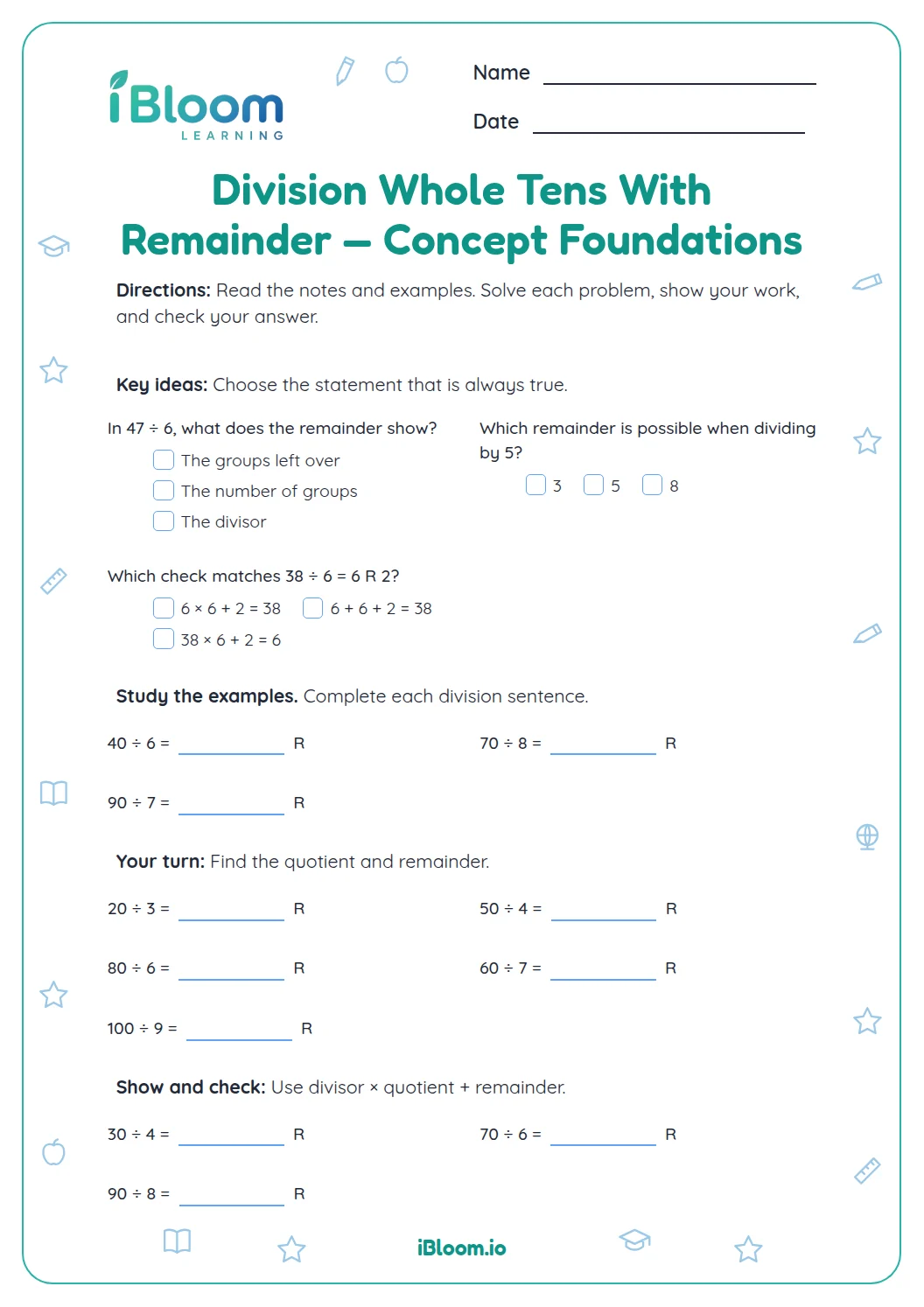
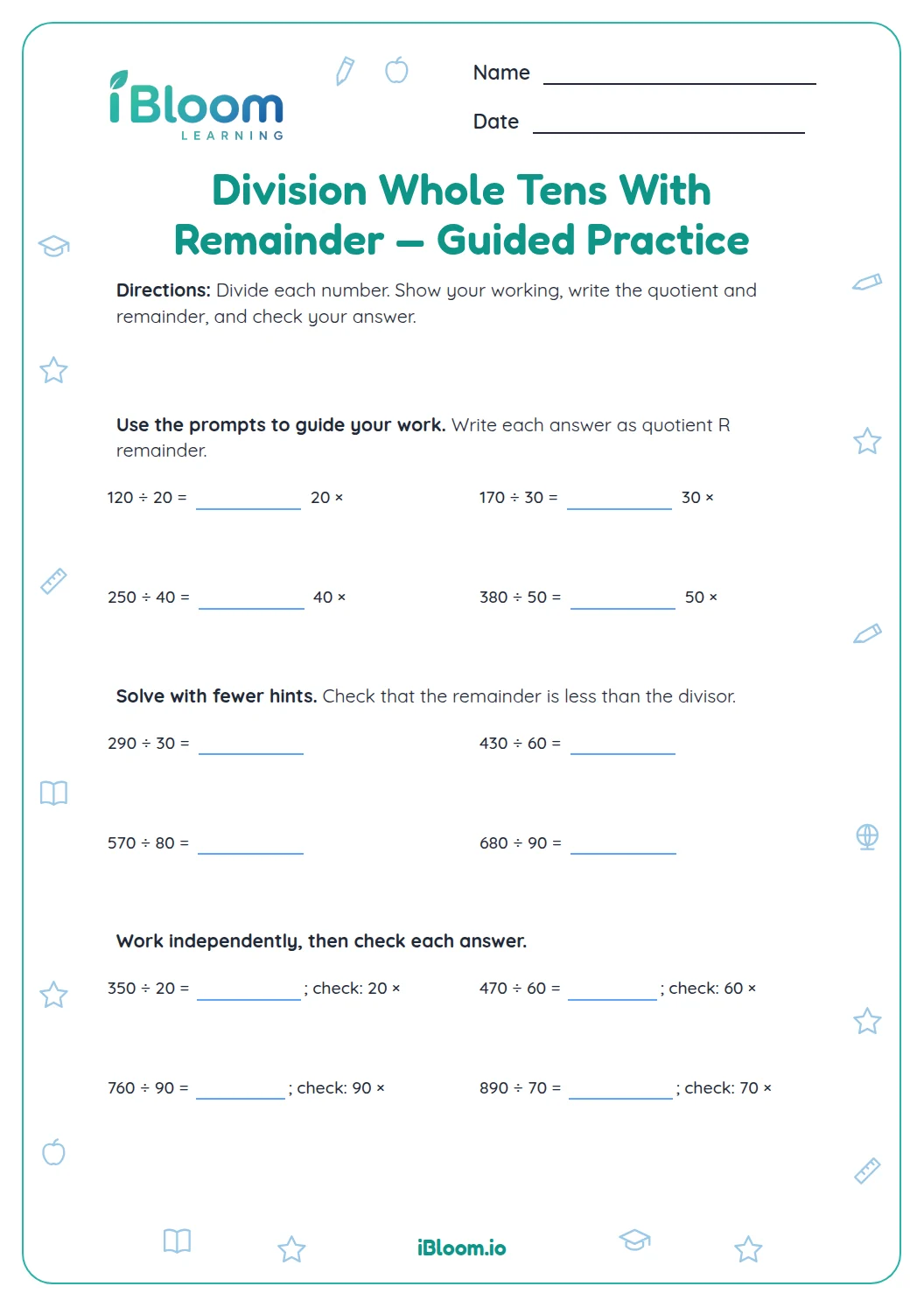
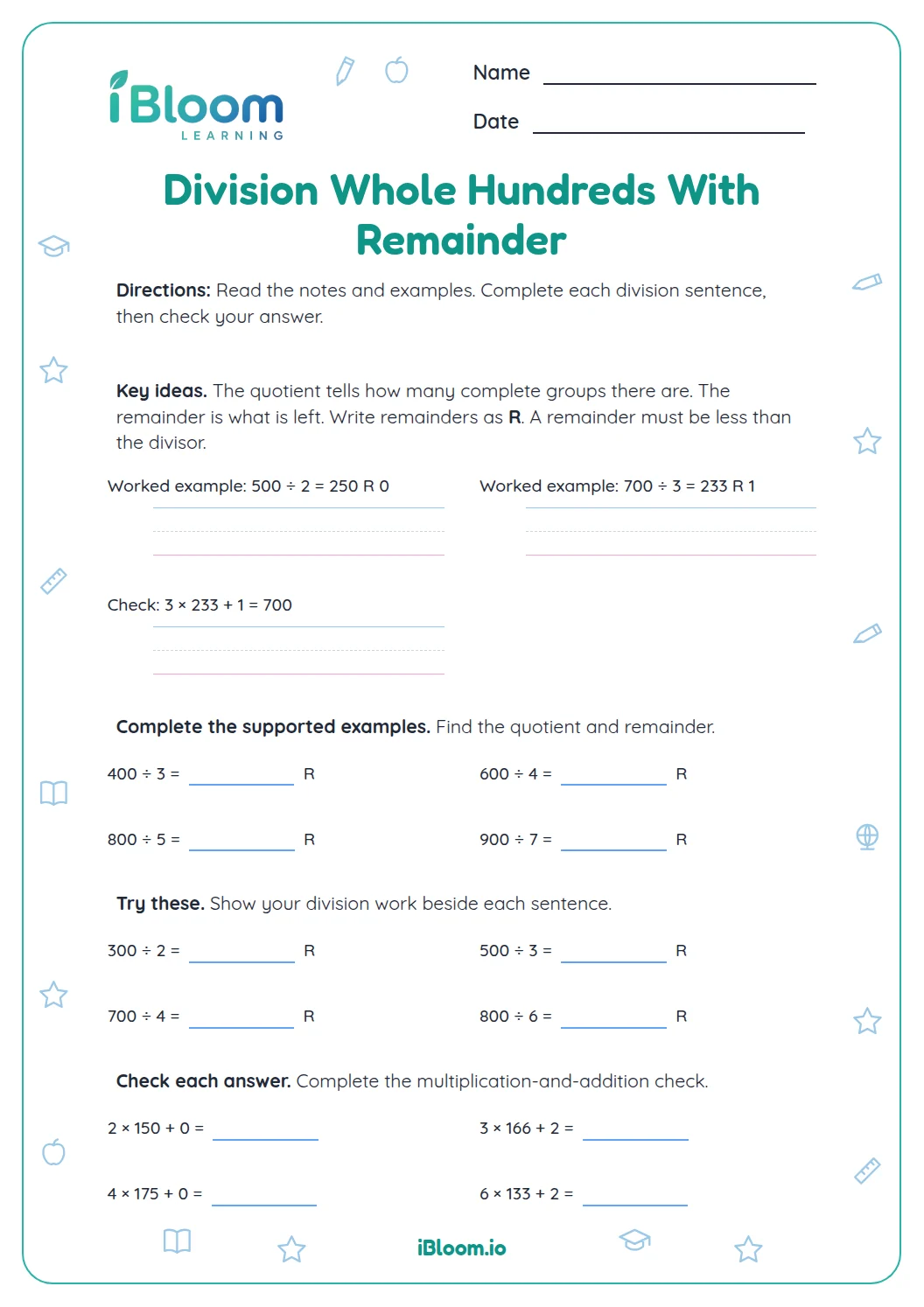
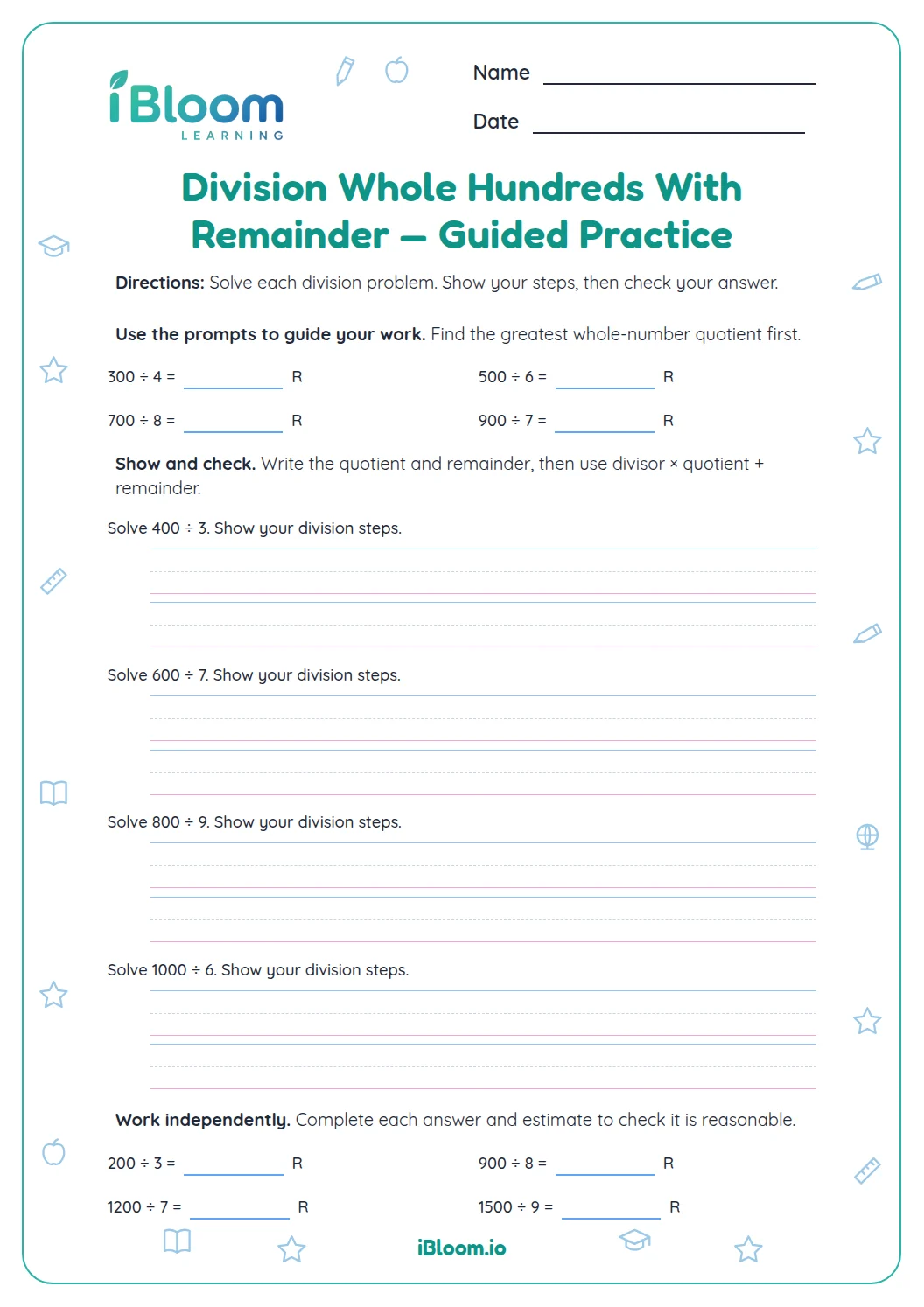
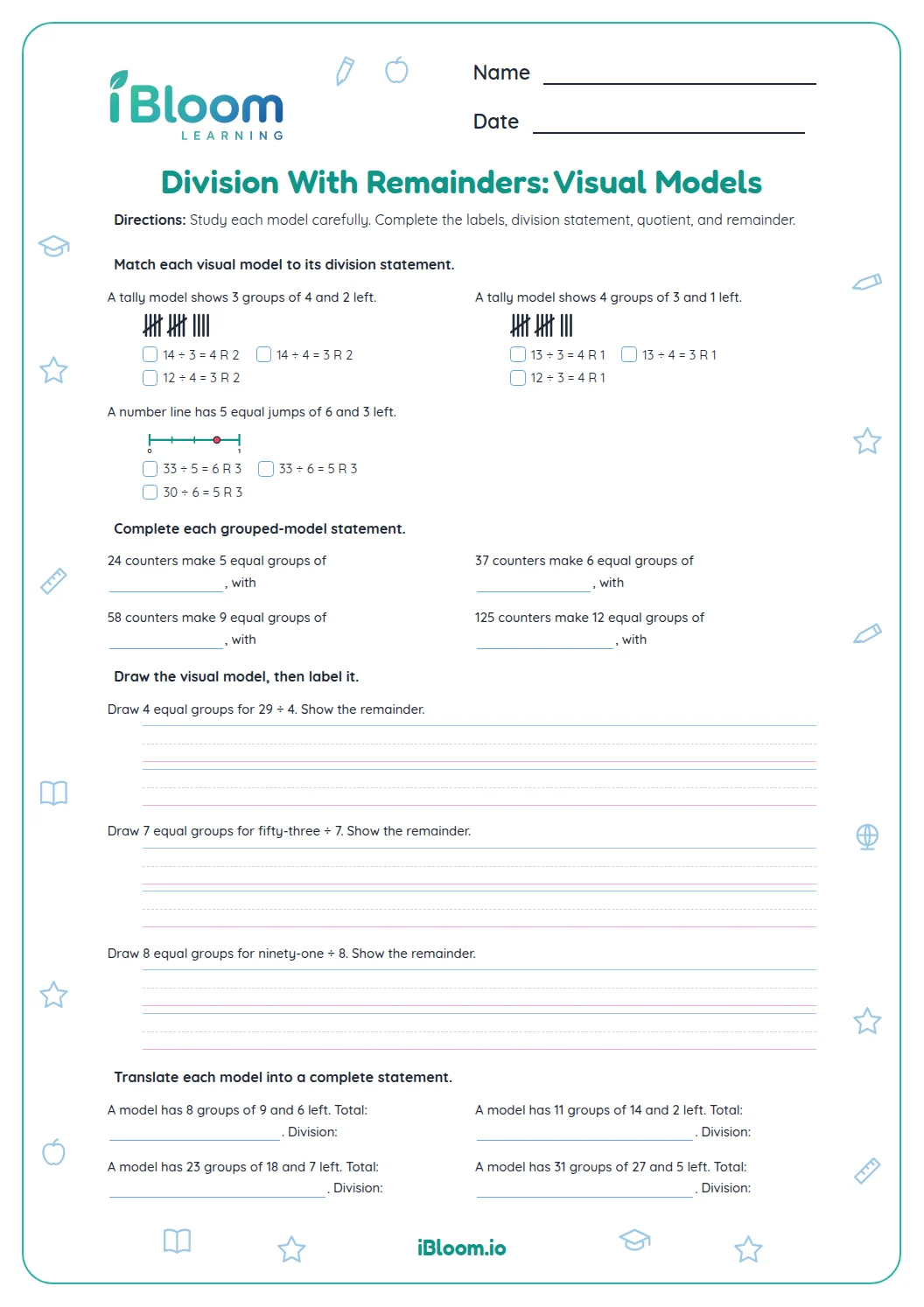
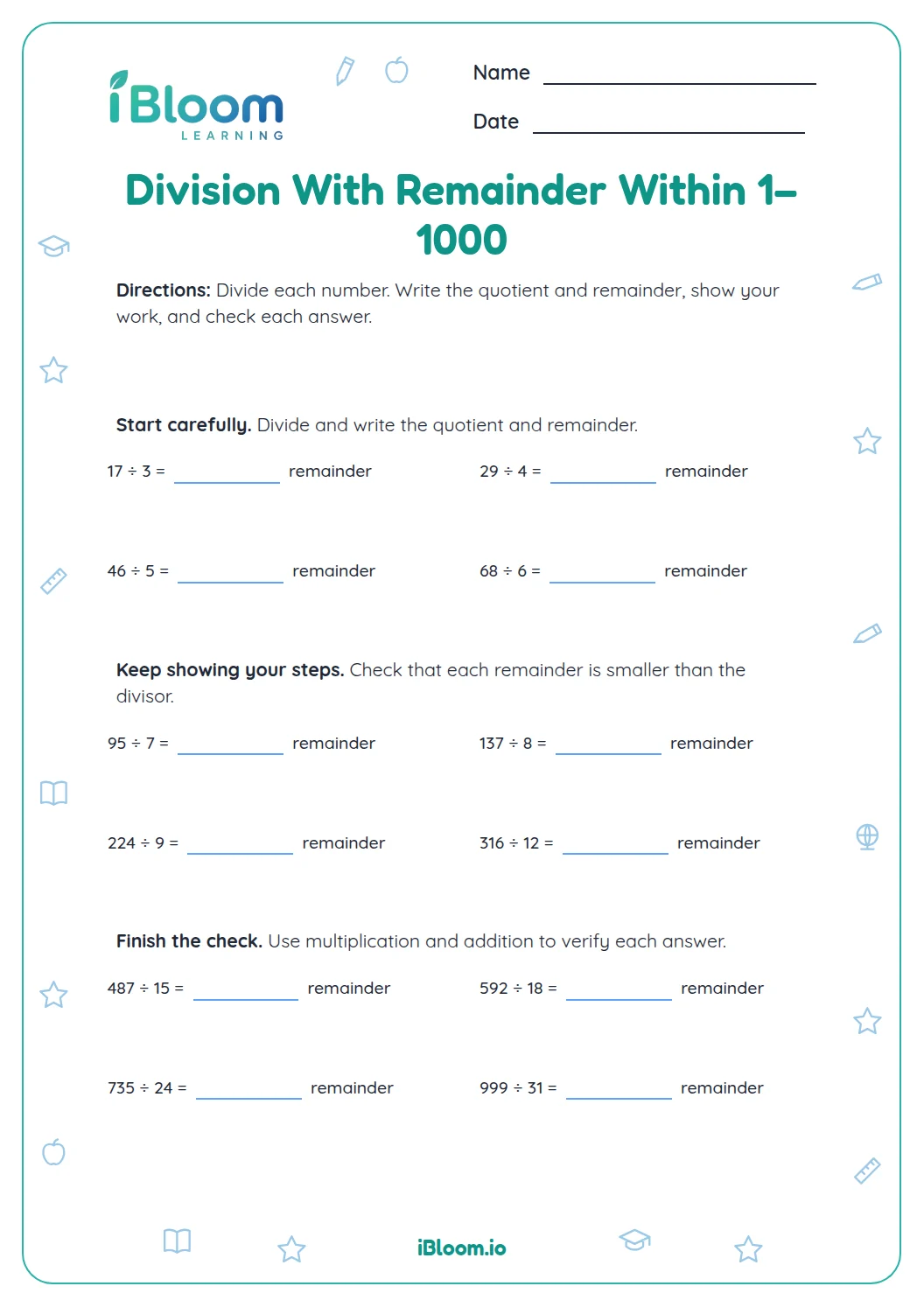
This Grade 5 worksheet gives practice dividing whole tens by one-digit divisors when a remainder is left. Fourteen short sharing situations use objects such as tickets, pencils, and tiles. Learners find the quotient and state the leftovers, then check that each remainder is smaller than the divisor. The page practices CCSS 5.NBT.B.6 and includes a separate answer key.
Aligned to 5.NBT.B.6
What do quotient and remainder mean here?
The quotient tells how many items each group receives. The remainder tells how many items are left after every group gets the same whole-number amount.
- 1150 stickers are shared among 7 boxes.
- 2Answer: 21 R 3
- 3Each box gets 21 stickers, with 3 left over.
How can the answer be checked?
Multiply the number in each group by the number of groups, then add the leftovers. For question 1, 21 × 7 + 3 = 150, and 3 is less than 7.
How should the story guide the answer?
Keep the object and groups in mind. A remainder describes items that cannot make another complete equal group; the prompt asks for those items separately from the quotient.
How to use this worksheet
- 1Identify the total number of objects and the number of groups.
- 2Divide the total by the group count.
- 3Record the whole-number quotient.
- 4Find the leftover amount and write it as the remainder.
- 5Multiply back and add the remainder to check the total.
Common mistakes and quick fixes
The mistake
Writing a remainder as large as the divisor.
The fix
If the remainder equals or exceeds the group count, make another group.
The mistake
Reporting only the quotient.
The fix
Read the question’s second part and include the leftovers.
The mistake
Changing the total while checking.
The fix
Multiply quotient by divisor, then add the remainder to recover the original total.
Common Core alignment
This worksheet practices whole-number division and interpreting remainders in equal-sharing situations.
Find whole-number quotients and interpret the remainder in each sharing problem.
On this sheet: The worksheet directly practices this skill.
Show the official wordingHide the official wording
Find whole-number quotients of whole numbers with up to four-digit dividends and two-digit divisors, using strategies based on place value, the properties of operations, and/or the relationship between multiplication and division.
What to practice next
Make more practice
Further reading
Questions parents and teachers ask
What is a remainder in these stories?
It is the number of objects left after the same whole-number amount has been placed in each group. The worksheet asks learners to state that leftover count alongside the quotient for every sharing situation. Ask the learner to explain how the text or numbers support that answer.
Are all the problems about whole tens?
Yes. Each total is a whole-number multiple of ten, and each is divided by a one-digit group count. The quotients may be larger than ten, so learners also practice keeping track of place value while dividing. Ask the learner to explain how the text or numbers support that answer.
How do learners check their quotient and remainder?
Multiply the quotient by the number of groups, then add the remainder. The result should equal the original total, and the remainder should be smaller than the number of groups. Ask the learner to explain how the text or numbers support that answer.
Is an answer key included?
Yes. The separate key gives a quotient and remainder for all 14 problems. It can be used to check the arithmetic and talk through what the remainder means for the objects in each story. Ask the learner to explain how the text or numbers support that answer.
How long should the page take?
About 20 minutes is a reasonable estimate. Some learners may want to write a multiplication check for each story, while others may work mentally and use the key to review afterward. Ask the learner to explain how the text or numbers support that answer.