

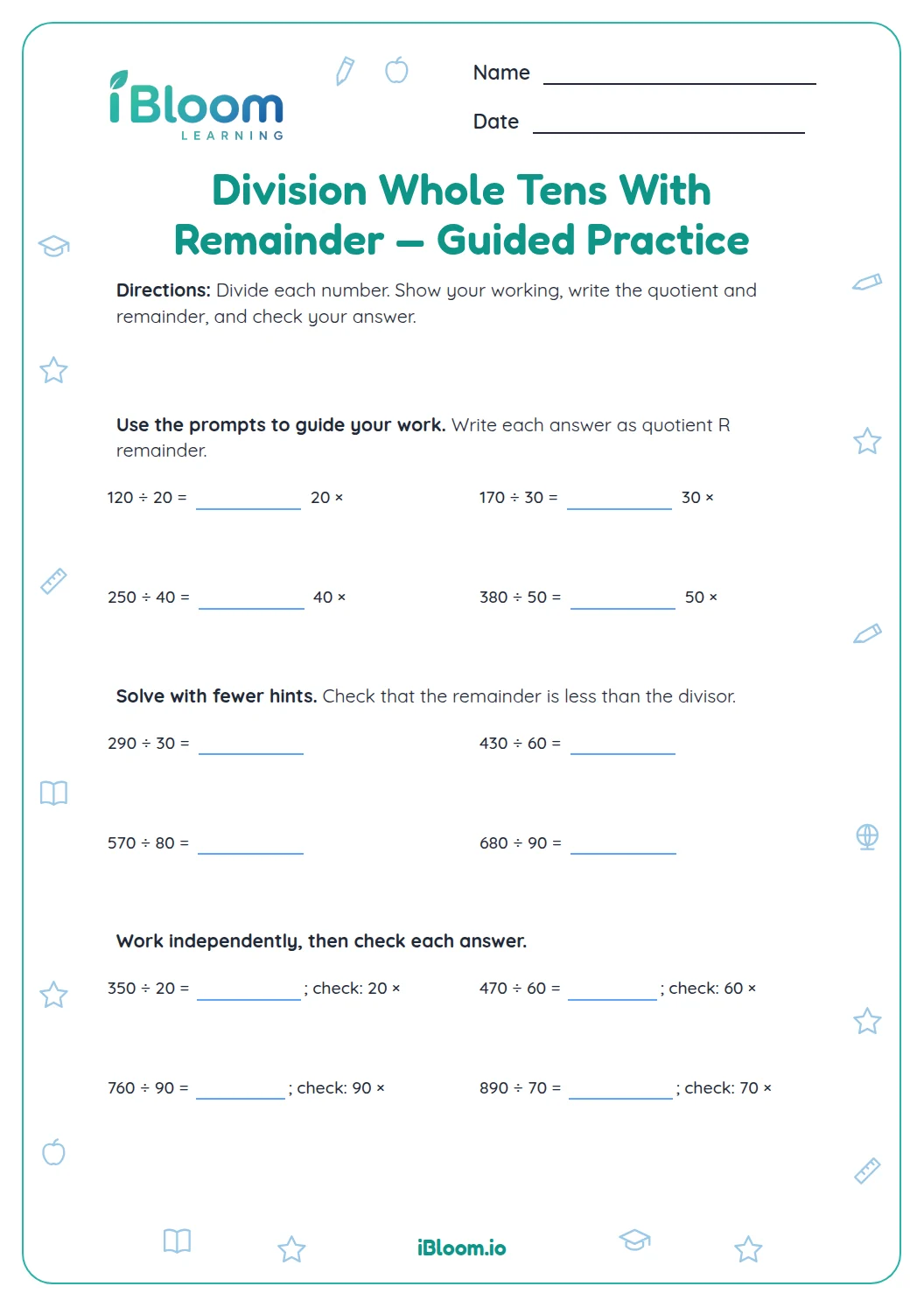

About this worksheet
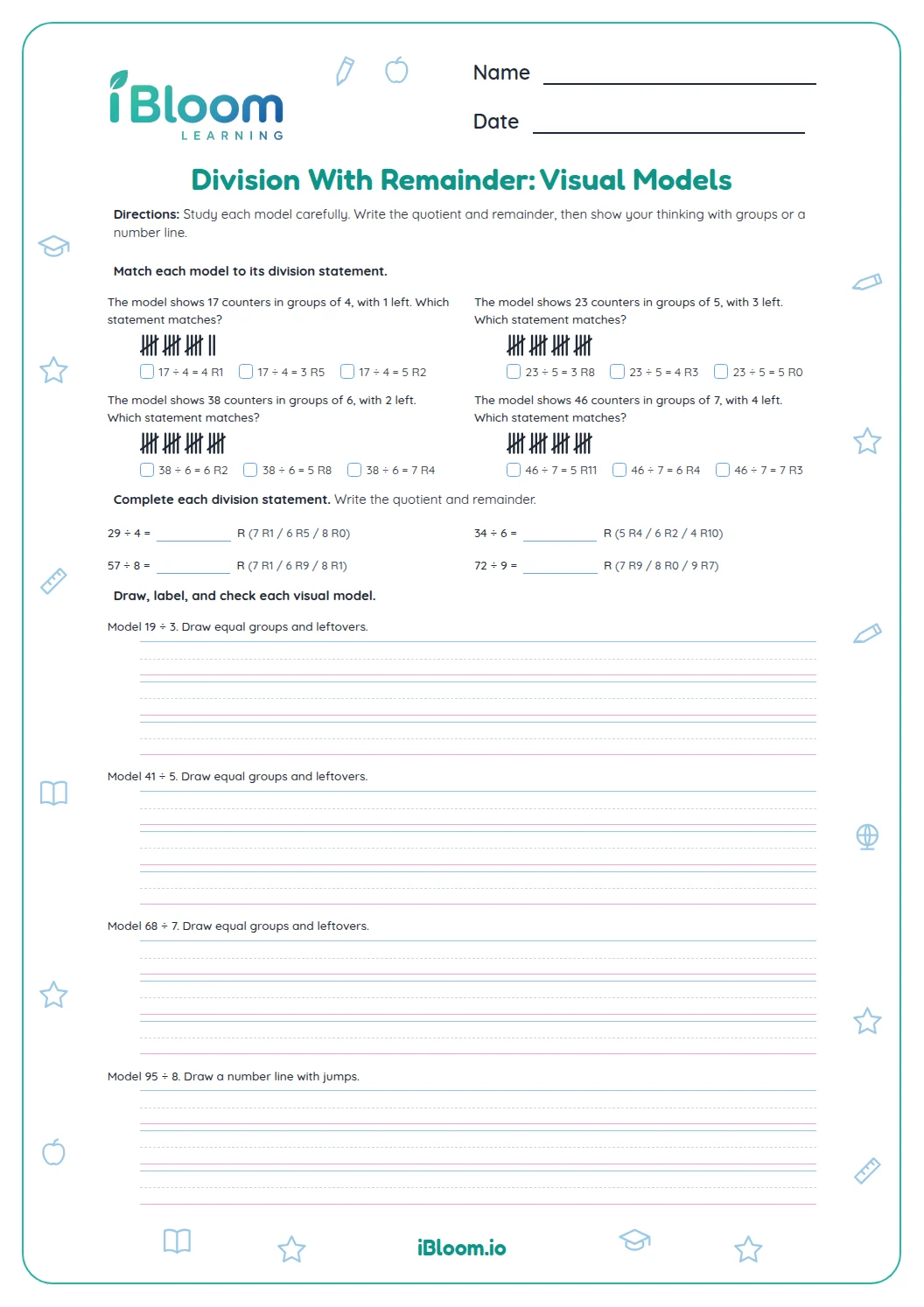
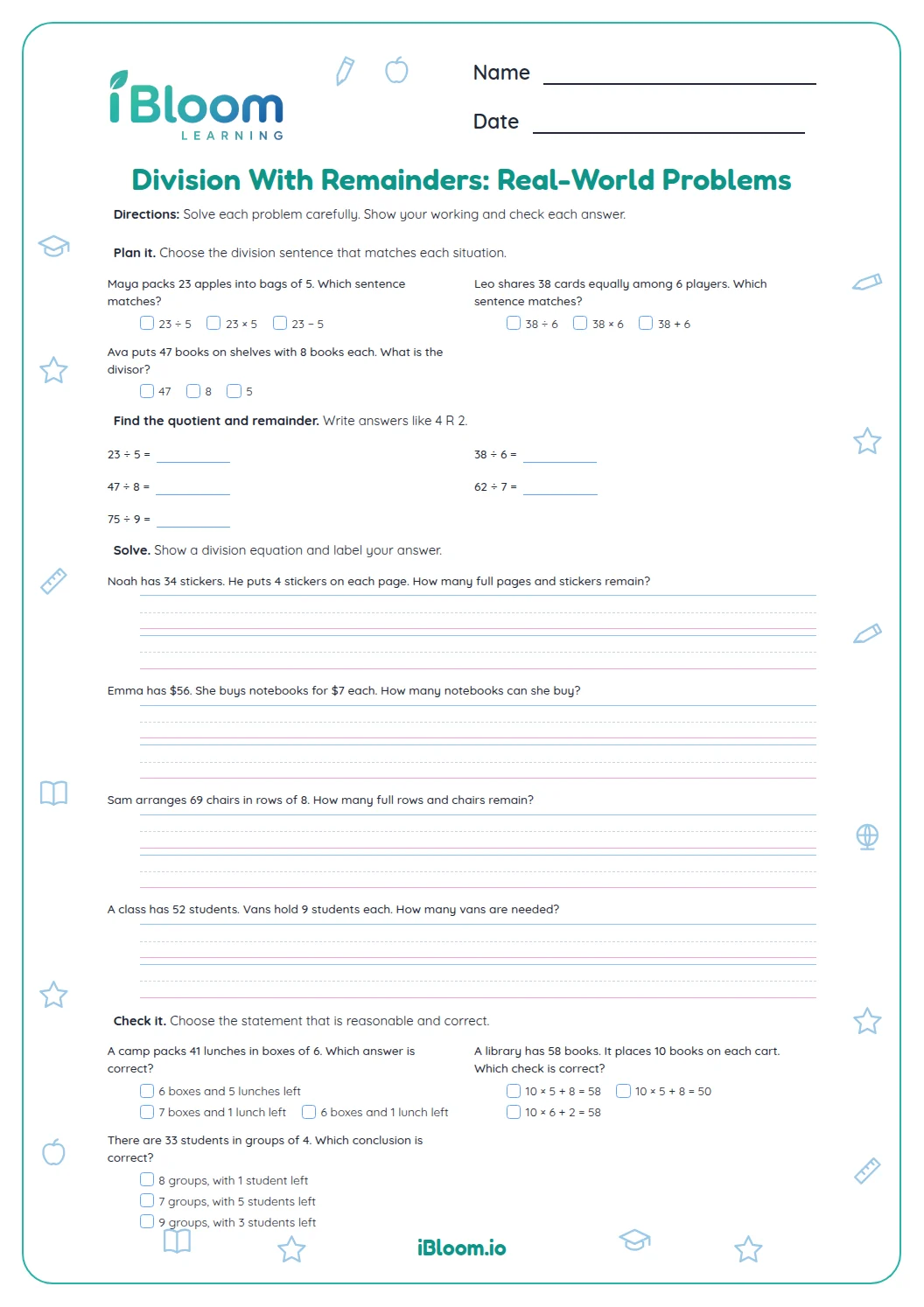
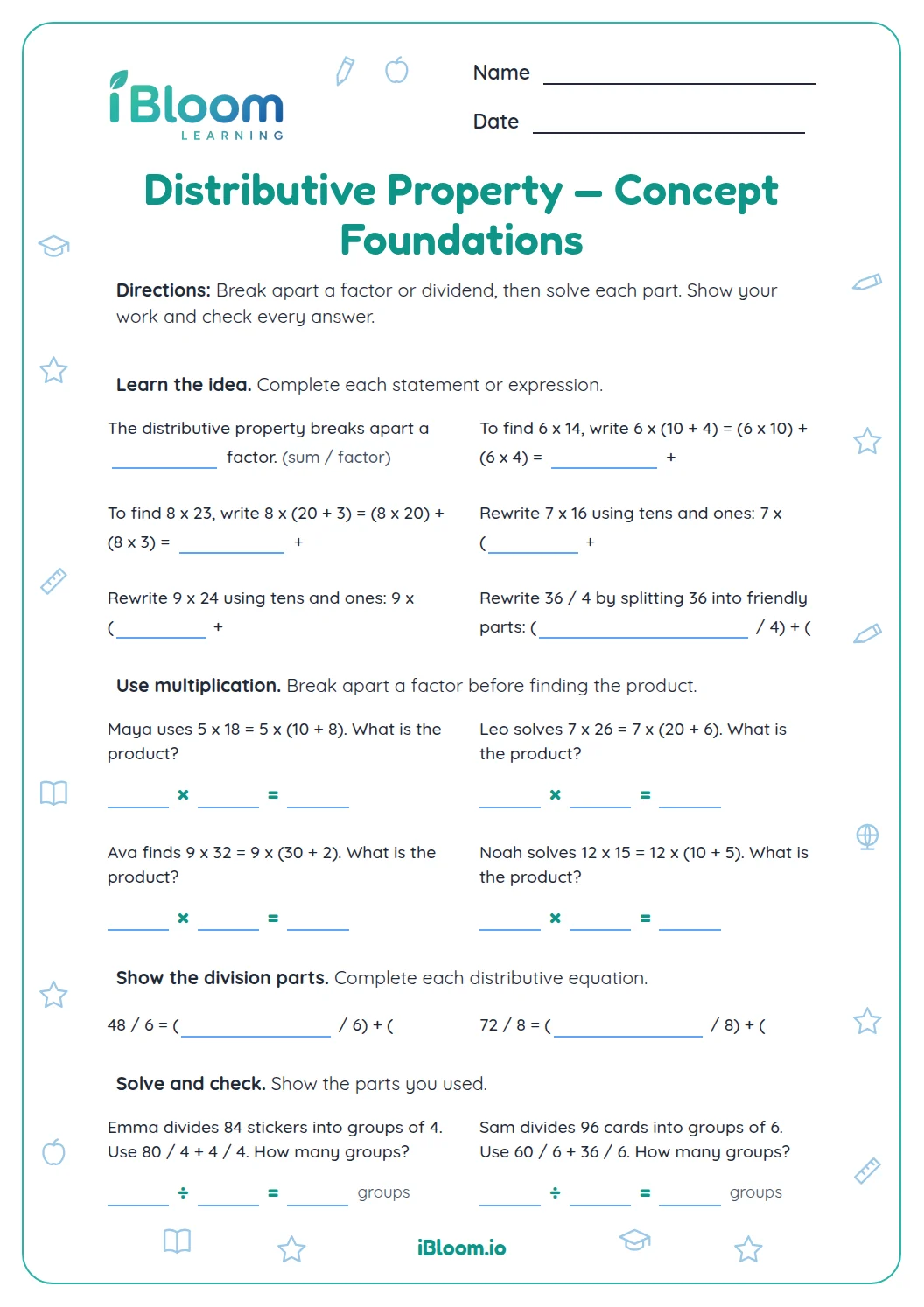
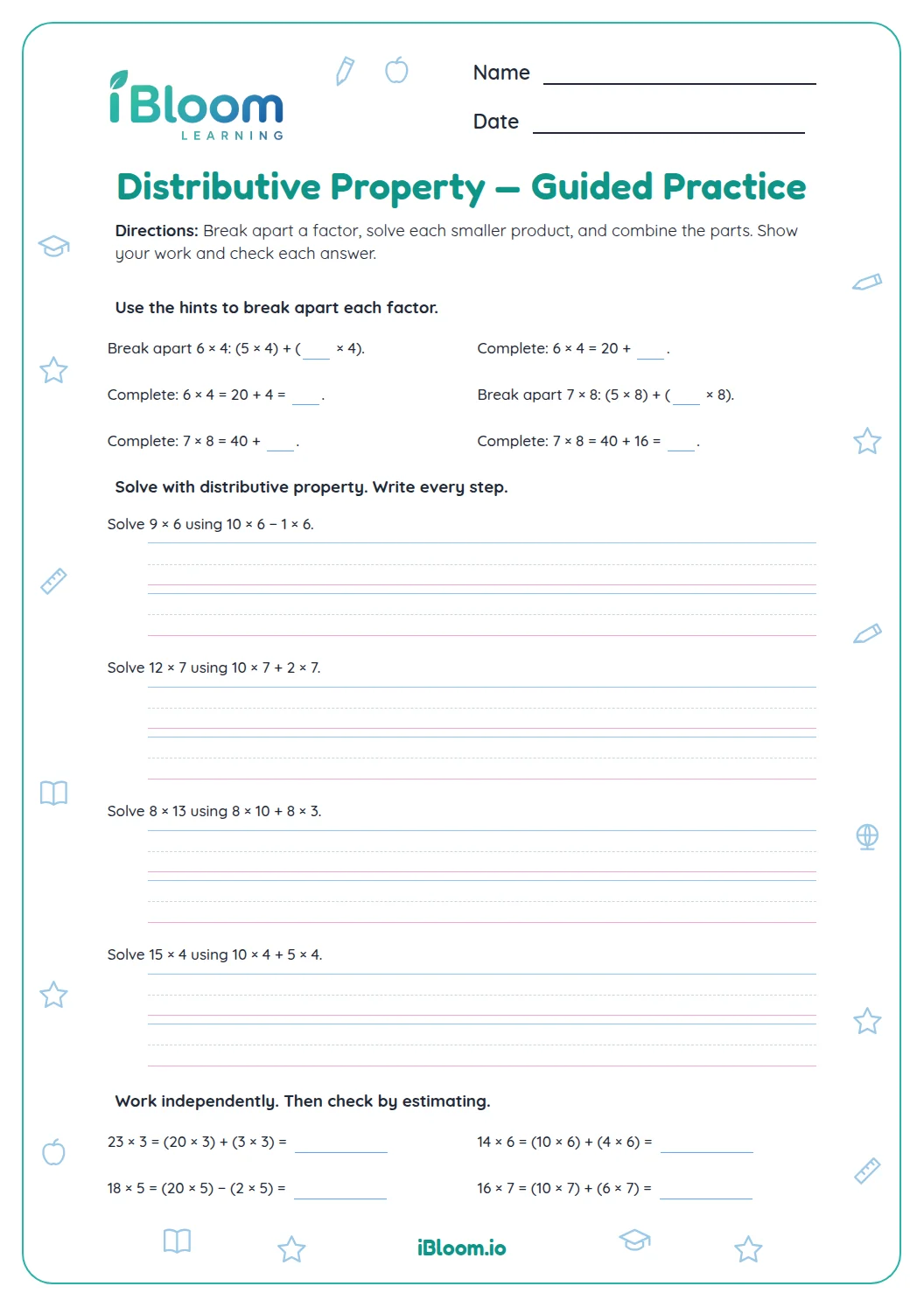
This Grade 5 worksheet practices division with one-digit divisors and dividends below 100. Four items ask learners to inspect quotient and remainder claims, four give compact quotient-remainder practice, three compare strategies, and three ask learners to explain or solve. Each remainder must be smaller than its divisor. The answer key supports independent review.
Aligned to 4.NBT.B.6
How do you find a quotient and remainder?
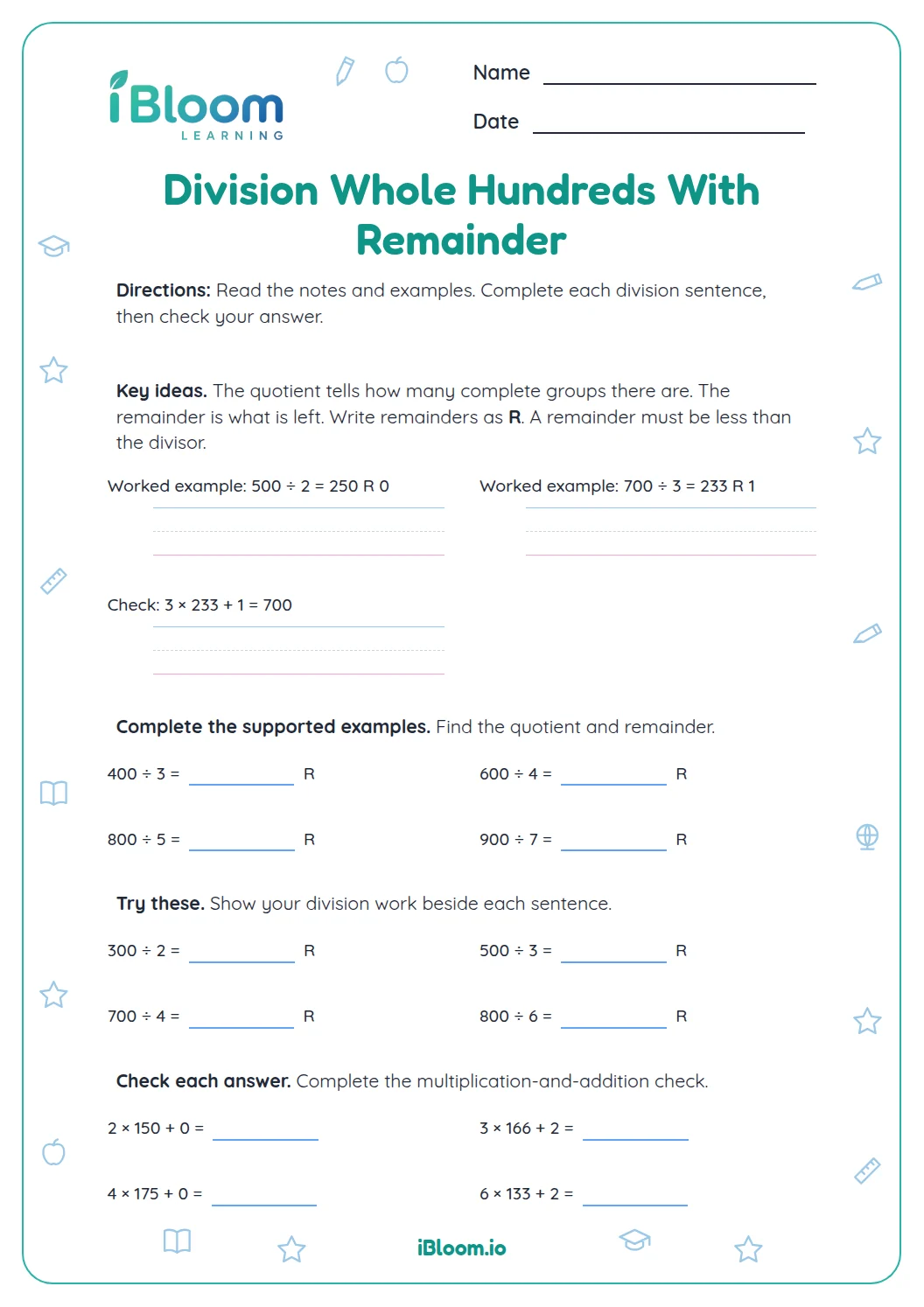
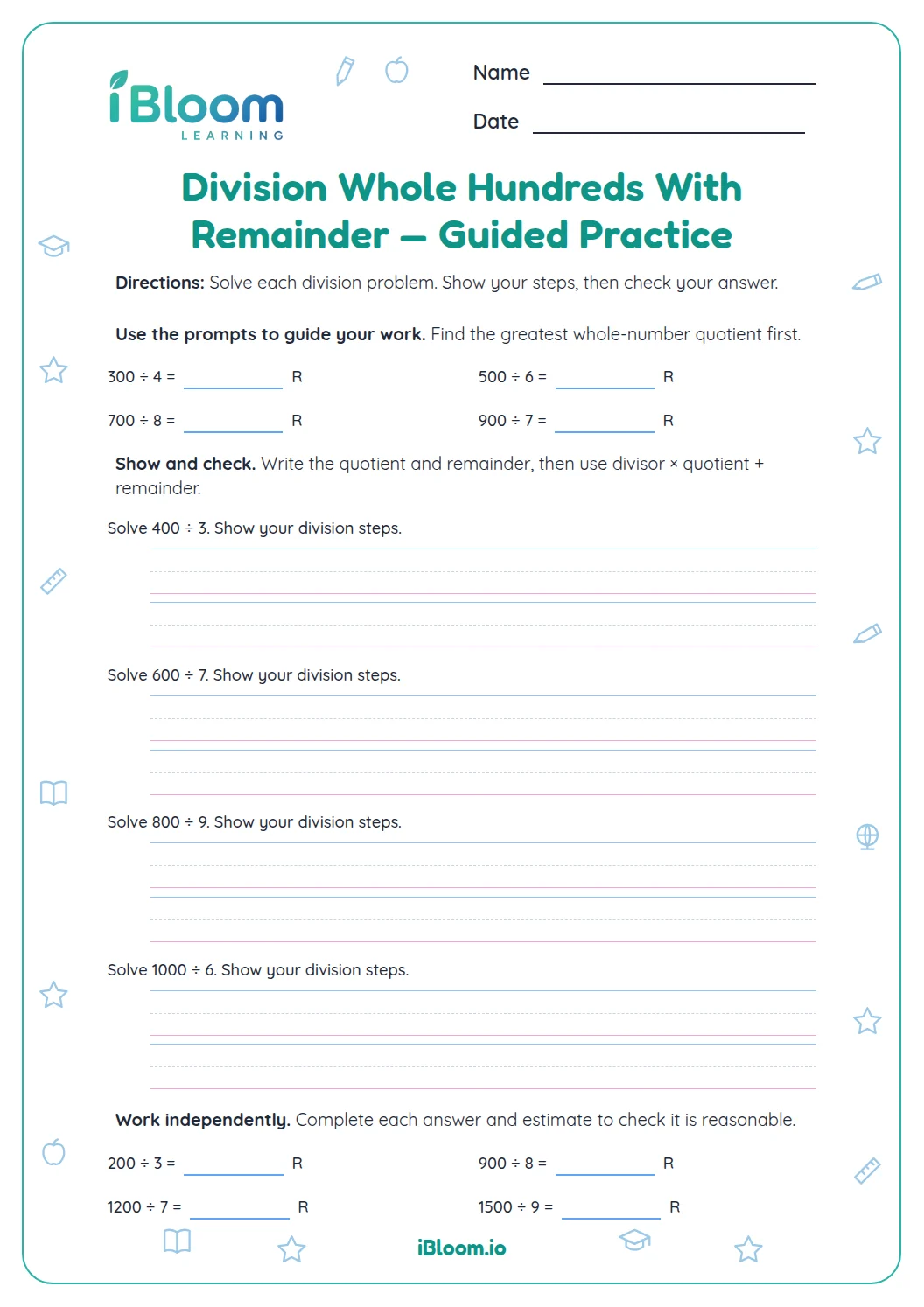
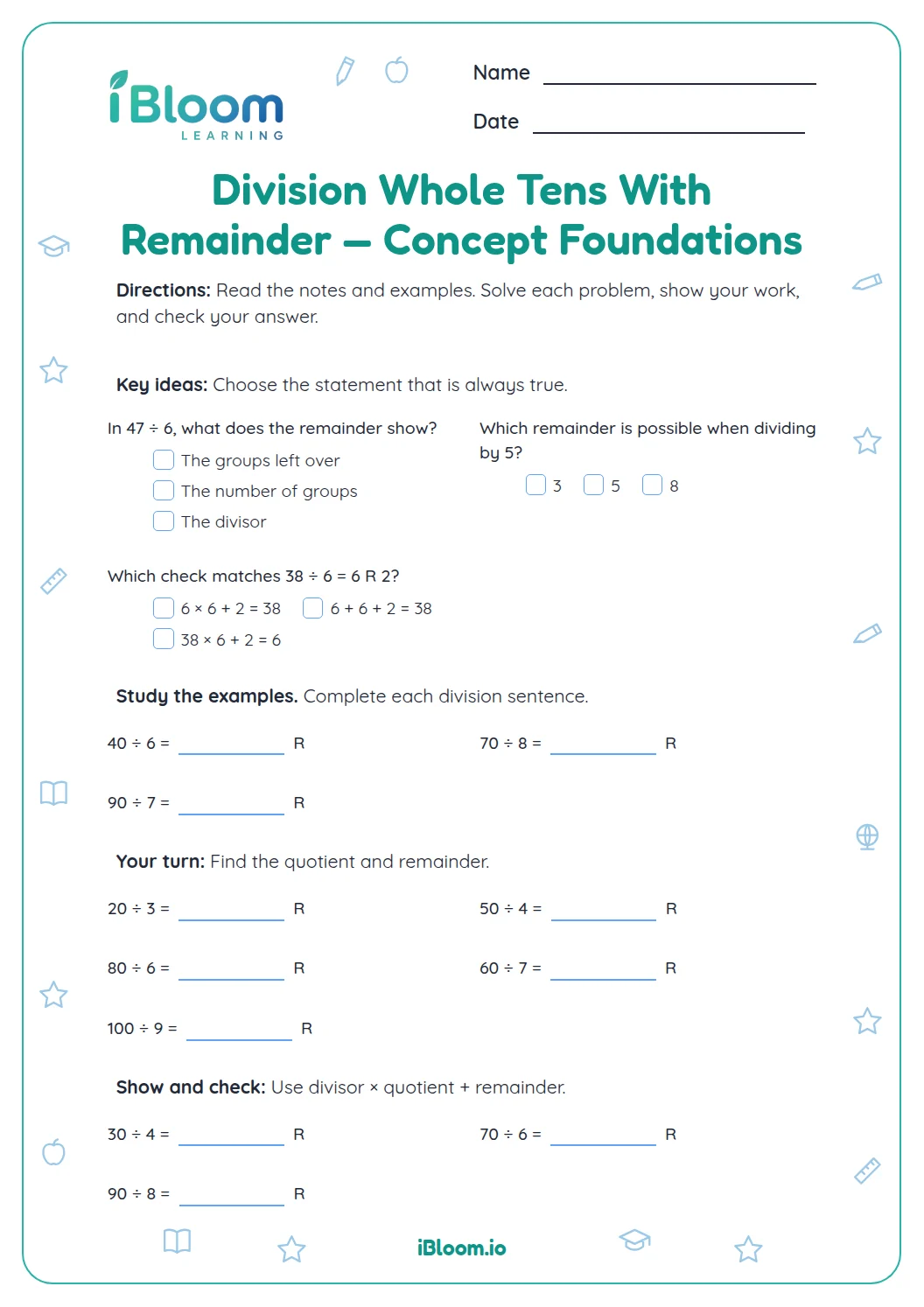
Find the largest multiple of the divisor that does not pass the dividend. The number of groups is the quotient; the amount left is the remainder. In 38 ÷ 4, four groups of nine use 36, leaving 2: 9 R 2.
- 138 ÷ 4 = 9 R 2
- 24 × 9 + 2 = 38
How can you spot a remainder error?
A remainder cannot equal or exceed the divisor, because another full group could still be made. In 43 ÷ 5, 7 R 8 is invalid; 8 more than fits another group, so the correct result is 8 R 3.
What does the remainder mean in a sharing problem?
Share as many items as possible equally among groups. The quotient tells how many full groups can be made, and the remainder tells what is left. For 58 cards in groups of 7, there are 8 full groups and 2 cards left.
How to use this worksheet
- 1For each division, find a nearby multiple of the divisor.
- 2Subtract that multiple from the dividend to find what remains.
- 3Check quotient × divisor + remainder = dividend.
- 4Confirm that the remainder is smaller than the divisor.
- 5In sharing problems, say what the quotient and leftover represent.
- 6Use the key to check each calculation after trying it.
Common mistakes and quick fixes
The mistake
Leaving a remainder equal to the divisor.
The fix
Make one more group and reduce the remainder.
The mistake
Checking only the quotient.
The fix
Multiply the quotient by the divisor and add the remainder to recover the dividend.
The mistake
Giving the remainder as the amount in each group.
The fix
Use the quotient for each group and the remainder for items left over.
Curriculum alignment
This worksheet gives practice with the Common Core skill below.
Divide up to four-digit whole numbers by one-digit divisors using place-value strategies.
On this sheet: The questions use one-digit divisors and ask learners to calculate and interpret whole-number quotients and remainders.
Show the official wordingHide the official wording
Find whole-number quotients and remainders with up to four-digit dividends and one-digit divisors, using strategies based on place value, the properties of operations, and/or the relationship between multiplication and division. Illustrate and explain the calculation by using equations, rectangular arrays, and/or area models.
What to practice next
Make more practice
Further reading
Questions parents and teachers ask
What does “R” mean in an answer?
“R” marks the remainder, the number left after making as many equal groups as possible. In 37 ÷ 5, seven groups use 35 items and two remain, so the answer is 7 R 2. The remainder must be smaller than five.
How many questions are on the worksheet?
There are 14 questions in four parts: four claim checks, five quotient-remainder calculations, and five strategy or application choices. Learners work from checking claims to applying division. The key shows each quotient and remainder in the printed order.
How can I check a quotient and remainder?
Multiply the quotient by the divisor, then add the remainder. For 57 ÷ 6 = 9 R 3, calculate 9 × 6 + 3 = 57. Also check that 3 is less than 6; a remainder as large as the divisor means another group can be made.
What should the remainder mean in a sharing problem?
The quotient is the number of items each group receives, and the remainder is the number of items left after sharing equally. For example, 29 items shared among four groups gives seven per group with one left over. The key records both numbers.
Is an answer key included?
Yes. The separate key gives quotient-remainder pairs, corrected choices, and results for each sharing question. Ask the learner to explain what a remainder represents before checking. This helps distinguish a calculation result from the leftover items in the story.