Free printable practice
Expanded Notation Practice Activities
Grade 5 students practise writing numbers as sums of place-value parts so each digit’s value is clear before rounding or comparing.
Free printable worksheet PDFs
Preview every available page, then download the free worksheet PDF for home, homeschool, tutoring, or classroom practice.
Preview the exact activity before downloading it.
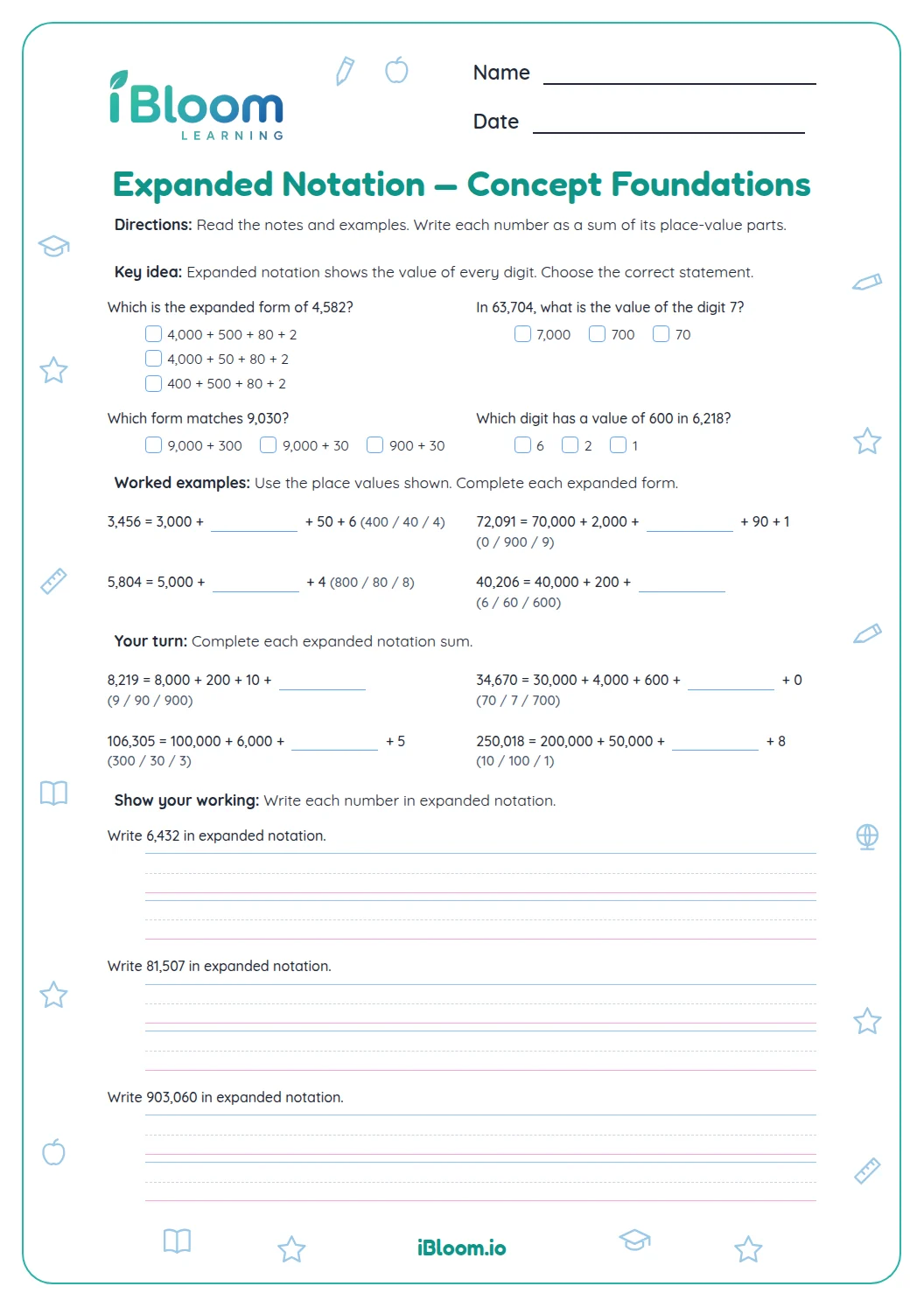 Expanded Notation — Concept FoundationsGrade 5 students practise writing numbers as sums of place-value parts so each digit’s value is clear before rounding or comparing. This Grade 5 foundations worksheet adds concise teaching notes, worked examples, and supported first attempts.Grade 5Free PDF preview
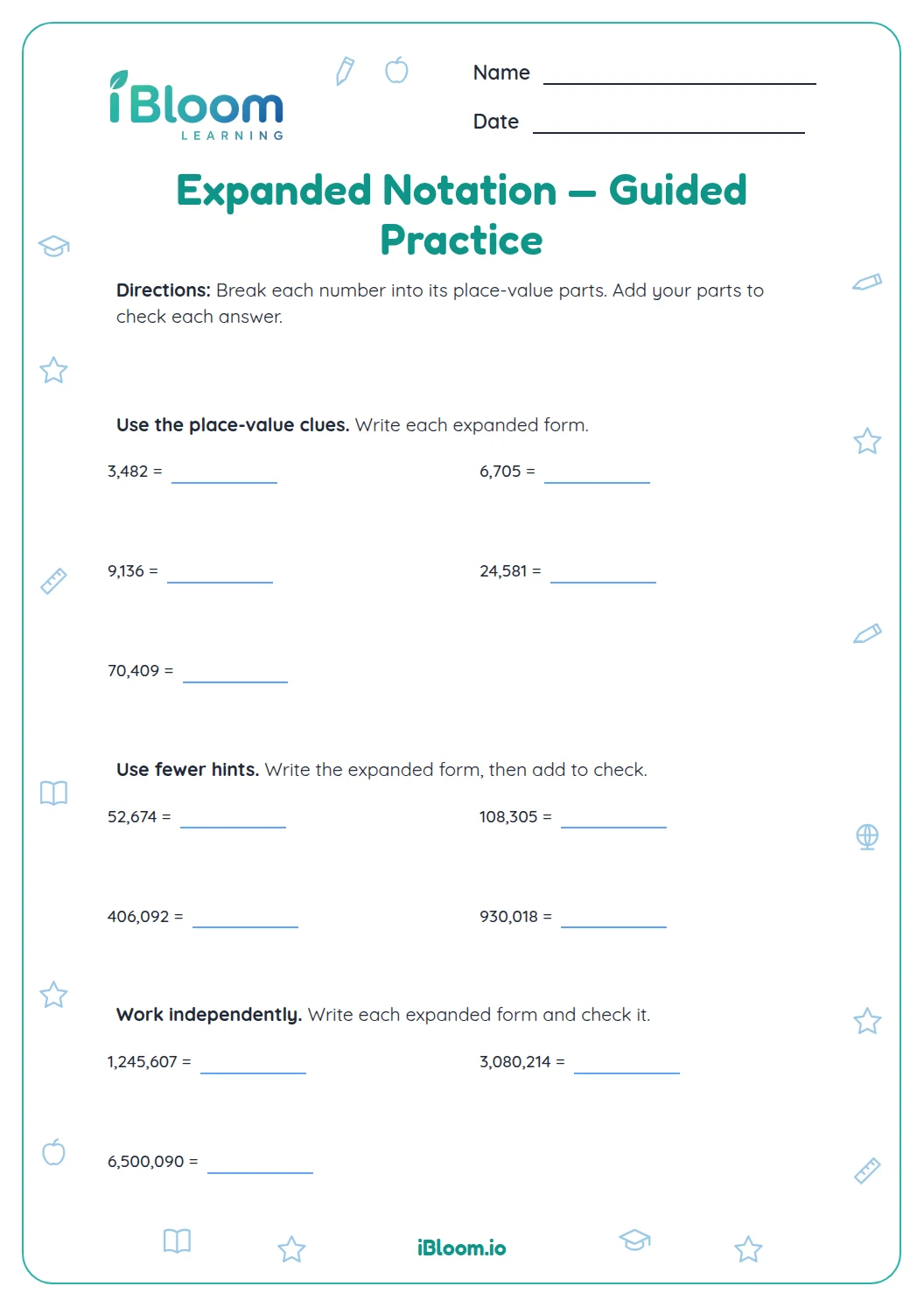 Expanded Notation — Guided PracticeGrade 5 students practise writing numbers as sums of place-value parts so each digit’s value is clear before rounding or comparing. This Grade 5 guided-practice worksheet progresses from prompts and checkpoints to independent questions.Grade 5Free PDF preview4 pages
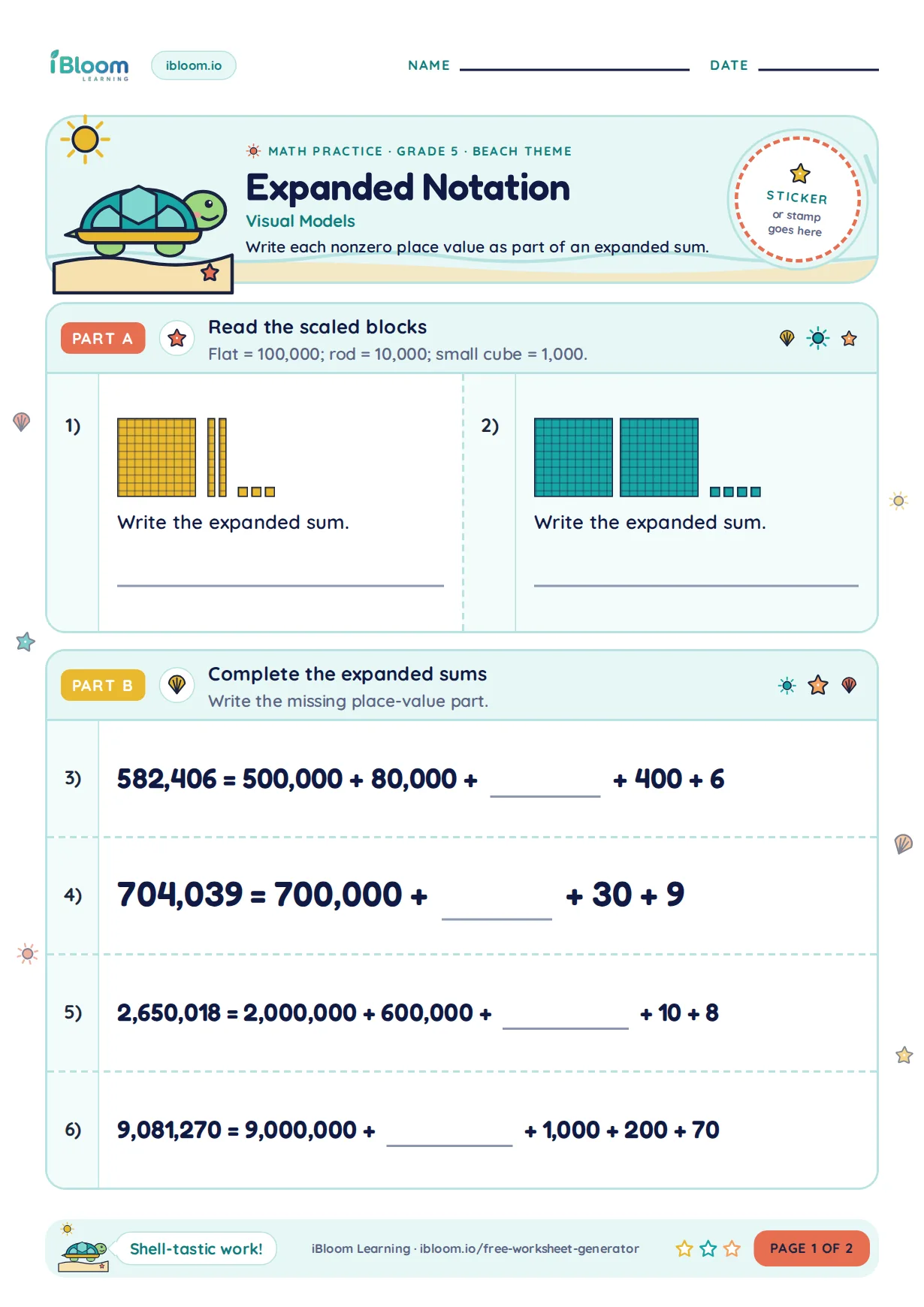 Expanded Notation — Visual ModelsGrade 5 students practise writing numbers as sums of place-value parts so each digit’s value is clear before rounding or comparing. This Grade 5 visual-model worksheet connects suitable diagrams, tables, number lines, or place-value models to mathematical notation.Grade 5Free PDF preview
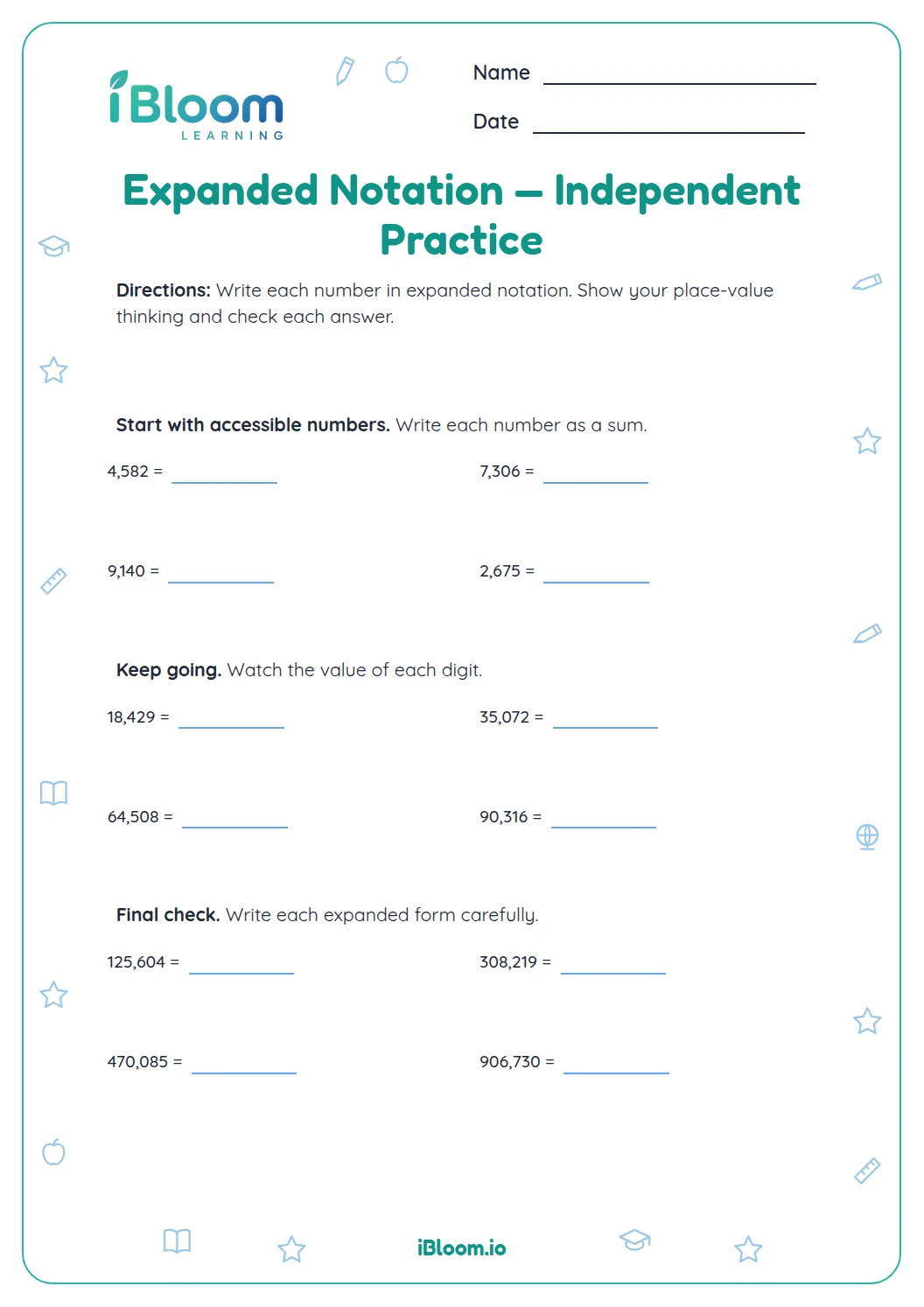 Expanded Notation — Independent PracticeGrade 5 students practise writing numbers as sums of place-value parts so each digit’s value is clear before rounding or comparing. This Grade 5 independent-practice worksheet provides a balanced sequence of accurate, grade-level exercises.Grade 5Free PDF preview4 pages
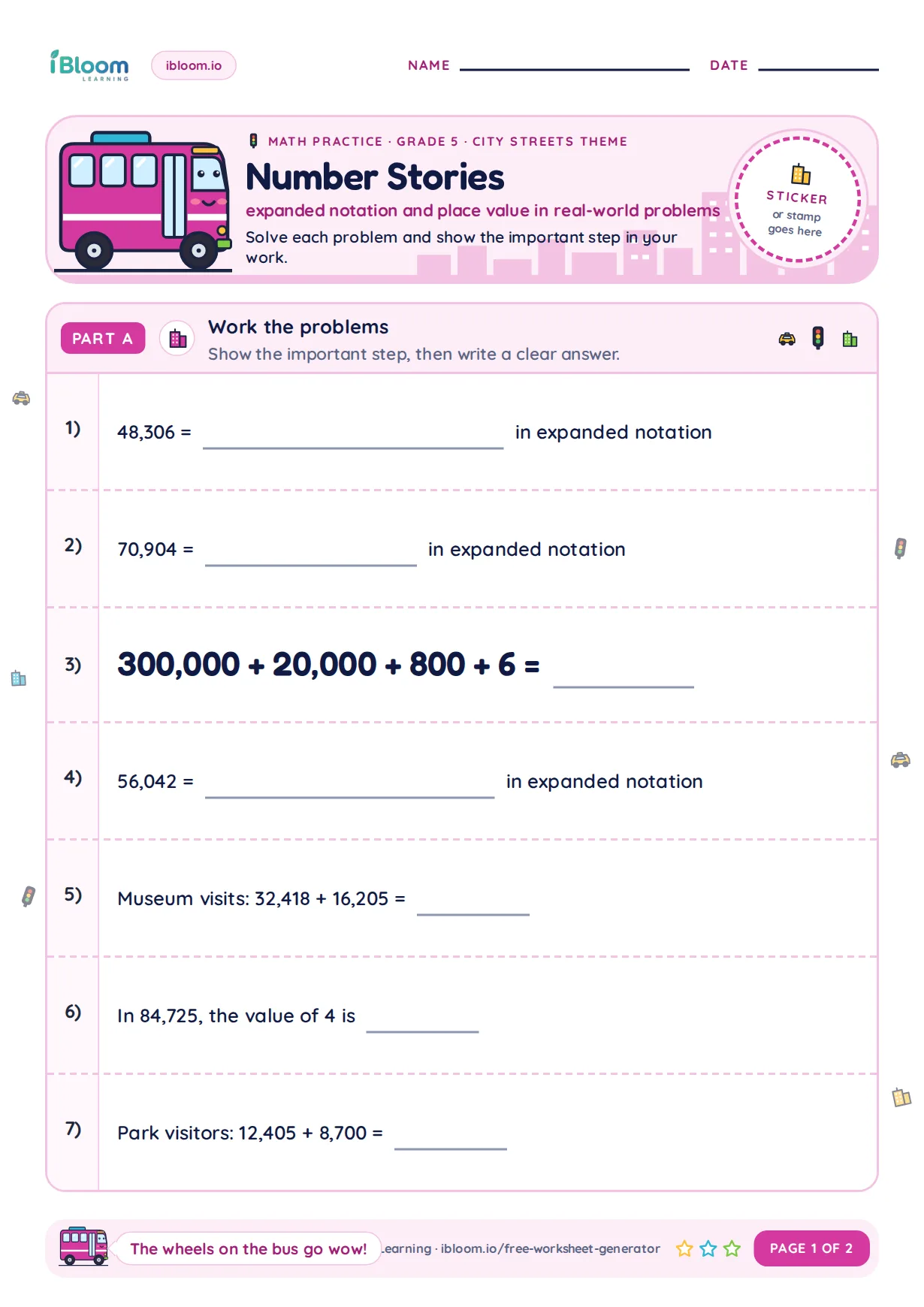 Expanded Notation — Real-World ProblemsGrade 5 students practise writing numbers as sums of place-value parts so each digit’s value is clear before rounding or comparing. This Grade 5 application worksheet uses realistic one-step and multi-step situations with room to model and solve.Grade 5Free PDF preview
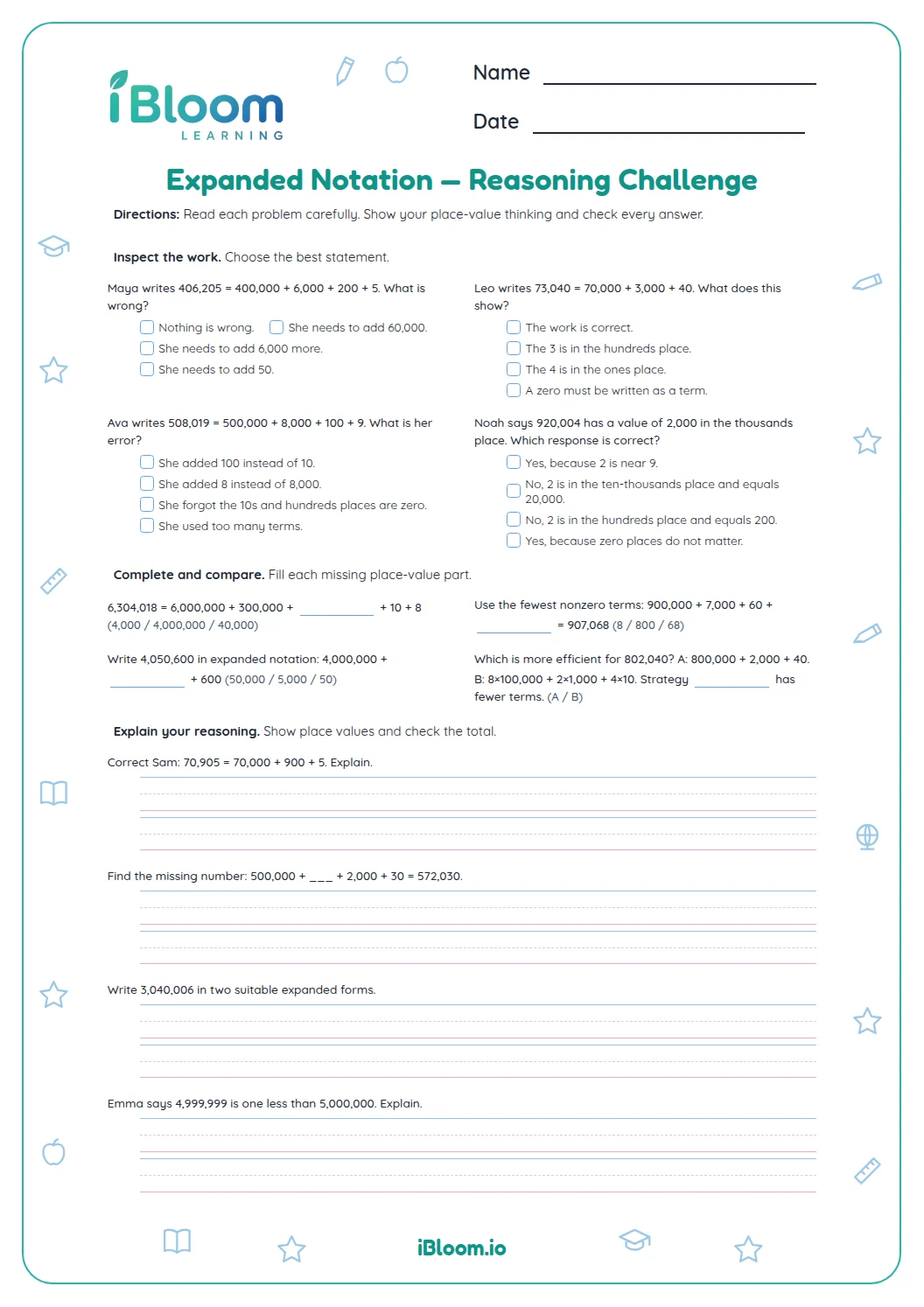 Expanded Notation — Reasoning ChallengeGrade 5 students practise writing numbers as sums of place-value parts so each digit’s value is clear before rounding or comparing. This Grade 5 reasoning worksheet combines error analysis, strategy comparison, missing information, and a gentle extension.Grade 5Free PDF preview
Practice that builds confidence
Building from place value to notation
These Grade 5 expanded notation worksheets help students show what each digit in a number is worth. Children practise breaking multi-digit numbers into place-value parts, such as thousands, hundreds, tens, ones, and decimal places when included.
The printable activities include clear number-writing practice, matching tasks, and conversion between standard form and expanded notation. They fit naturally within place value and rounding work because students must understand a digit’s value before deciding how a number changes.
Expanded notation makes the hidden value of each digit visible. Instead of seeing a number as one long string of digits, students write it as a sum of parts, such as 40,000 + 3,000 + 200 + 10 + 6, or as digit-times-place-value expressions when that format is used. This supports Grade 5 place value reasoning because students connect each digit to its position, not just its name.

Progression in the worksheets
Students begin by identifying place-value parts and writing numbers in expanded notation. They then move between standard form and expanded notation, read expressions carefully, and combine the parts back into one number. The practice can include numbers with zeros, which is important because zeros hold places even when they do not add a visible amount.
A simple parent routine
Choose one number from the worksheet and ask your child to read it aloud. Have them underline one digit and say its value: “The 7 is worth 7,000,” not just “seven.” Then ask them to write the full expanded notation and check it by adding the parts mentally or with written work. End with one rounding question, such as, “Which place would matter if we rounded to the nearest thousand?”

Classroom uses for teachers
Teachers can use these printables for warm-ups, small-group reteaching, math centers, or independent review before rounding lessons. They also work well as quick checks: if a student can write a number in expanded notation, the teacher can see whether the student understands the value of each digit rather than relying on memorized reading patterns.

Common errors to watch for
Some students drop zeros too early, write digits in the wrong place, or confuse the digit with its value. For example, they may write 5 instead of 5,000. Others may reverse places when a number contains a zero, such as skipping the hundreds place and shifting the tens into it. Encourage students to label places or use a place-value chart when numbers become longer.
Free printable PDF download
Use this grade 5 expanded notation worksheet page to preview the activity, print it, or download it as a PDF for quick practice. It works well for homework, homeschool lessons, tutoring, morning work, revision, and classroom centers.
Answers and answer key support
After the child completes the worksheet independently, parents and teachers can use the answer support or answer key information to check the work, review mistakes, and choose the next practice step.
Why iBloom worksheets help
The iBloom activities give repeated, focused practice without crowding the page. Students see the same idea in several forms, which helps them build accuracy and confidence. A child-friendly strategy is: “Name the place, say the value, then write the part.” This short routine keeps attention on meaning and prepares students for stronger rounding and number comparison.
Helpful answers
Frequently asked questions
What is expanded notation in Grade 5 math?
Expanded notation shows a number as the sum of the values of its digits. For example, 43,216 can be written as 40,000 + 3,000 + 200 + 10 + 6.
How is expanded notation different from just reading the number?
Reading a number names it, but expanded notation shows the value of each digit. This helps students see that a 4 in the ten-thousands place is worth 40,000, not just 4.
Why do zeros cause mistakes in expanded notation?
Zeros hold places in a number. Students sometimes skip a zero and shift the other digits into the wrong places, so using a place-value chart can help them keep each digit in its correct position.
How does expanded notation help with rounding?
Rounding depends on place value. When students know the value of each digit, they can identify the rounding place and the digit that tells them whether to round up or keep the number the same.
Can these worksheets be used for math centers?
Yes. They work well for centers because students can practise converting between standard form and expanded notation independently while teachers observe place-value understanding.
Is this grade 5 expanded notation worksheet free?
Yes. You can preview it for free and use the printable worksheet for home or classroom practice.
Can I download this grade 5 expanded notation worksheet as a PDF?
Yes. Use the worksheet download option to save a printable PDF, or print the worksheet directly from the page.
Does this grade 5 expanded notation worksheet include answers or an answer key?
When the activity has fixed answers, iBloom includes answer support so parents and teachers can check the completed worksheet.