
About this worksheet
This free Grade 5 worksheet practices expanded notation as a sum of place values. Students read two scaled block models, fill eight missing place-value parts, and write six complete expansions of six- and seven-digit whole numbers. A flat represents 100,000, a rod represents 10,000, and a small cube represents 1,000 in Part A. Later questions include millions and zeros between nonzero digits. The work practices Common Core 4.NBT.A.2, reading and writing whole numbers in expanded form. A separate answer key gives every missing value and complete sum.
Aligned to 4.NBT.A.2
What does expanded notation show?
This sheet uses expanded notation to mean a sum of place values. In 582,406, the 2 represents 2,000, so it belongs between 80,000 and 400 in the expanded sum. A digit keeps the value of its original place even when nearby digits are zero.
Write the nonzero values from greatest to least. For 903,070, that gives 900,000 + 3,000 + 70. The zeros hold places in the numeral but contribute nothing to the sum.
How do the blocks represent large numbers?
Part A assigns values to the block sizes: a small cube is 1,000, a rod is 10,000, and a flat is 100,000. Use that scale for both drawings.
Question 2 has two flats, no rods, and four small cubes. Its sum is 200,000 + 4,000. The absent rods explain the zero in the ten-thousands place of 204,000.
- 11 flat represents 100,000.
- 22 rods represent 20,000.
- 33 small cubes represent 3,000.
- 4100,000 + 20,000 + 3,000 = 123,000.
What practice follows the visual models?
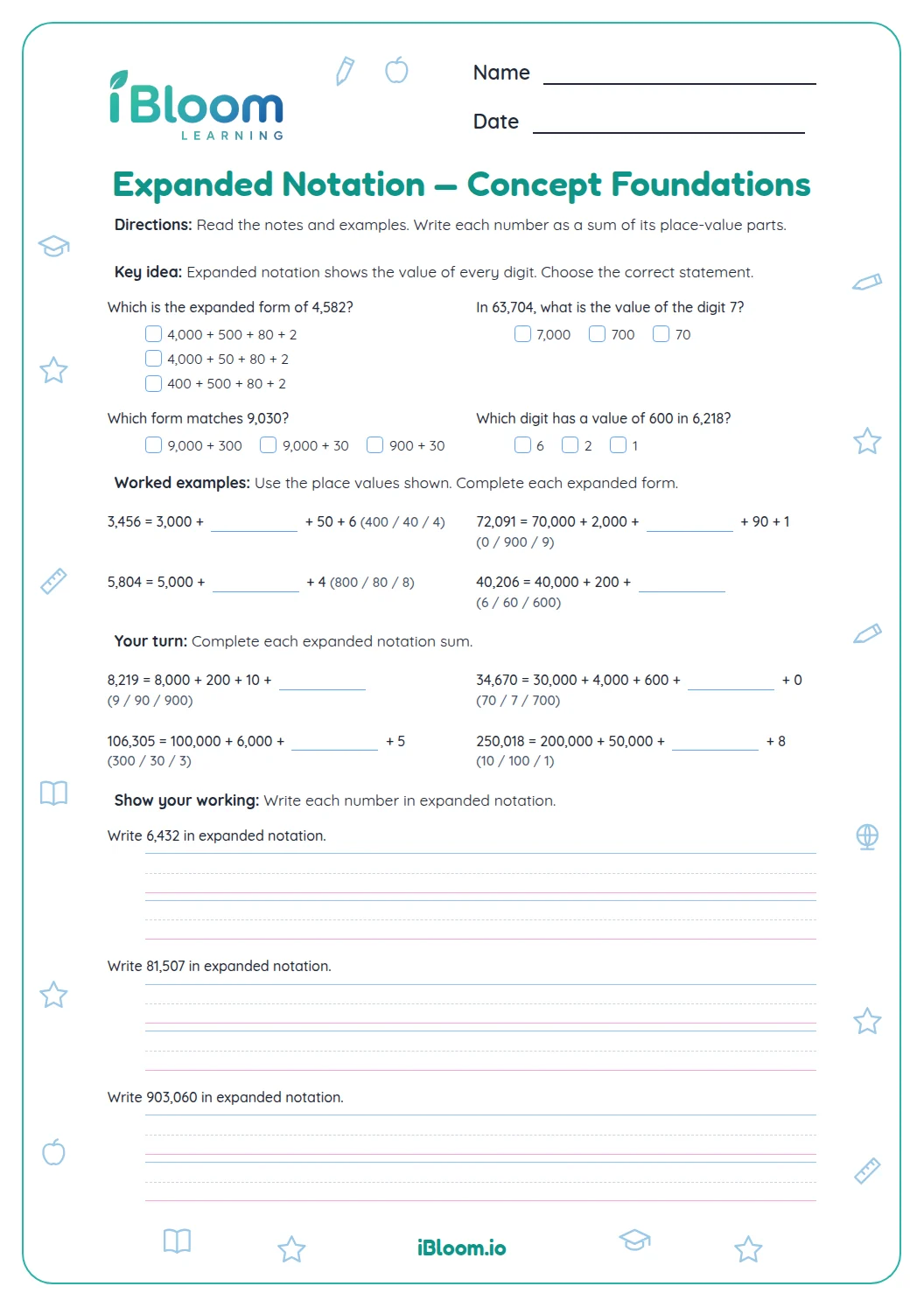
Part B gives eight incomplete sums. Students identify the missing place-value part, including values as small as 2 and as large as 80,000. Four of these numerals reach the millions place.
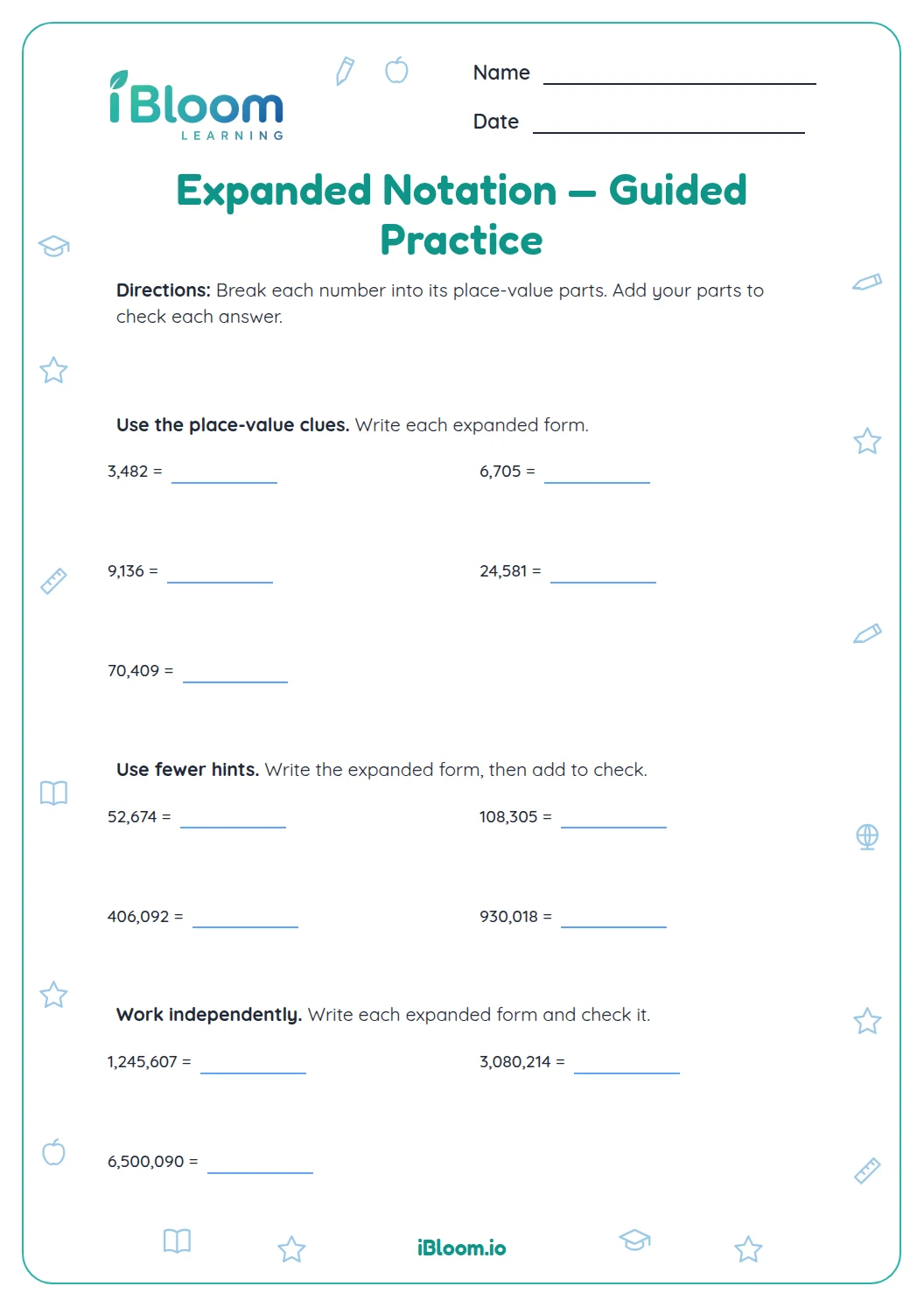
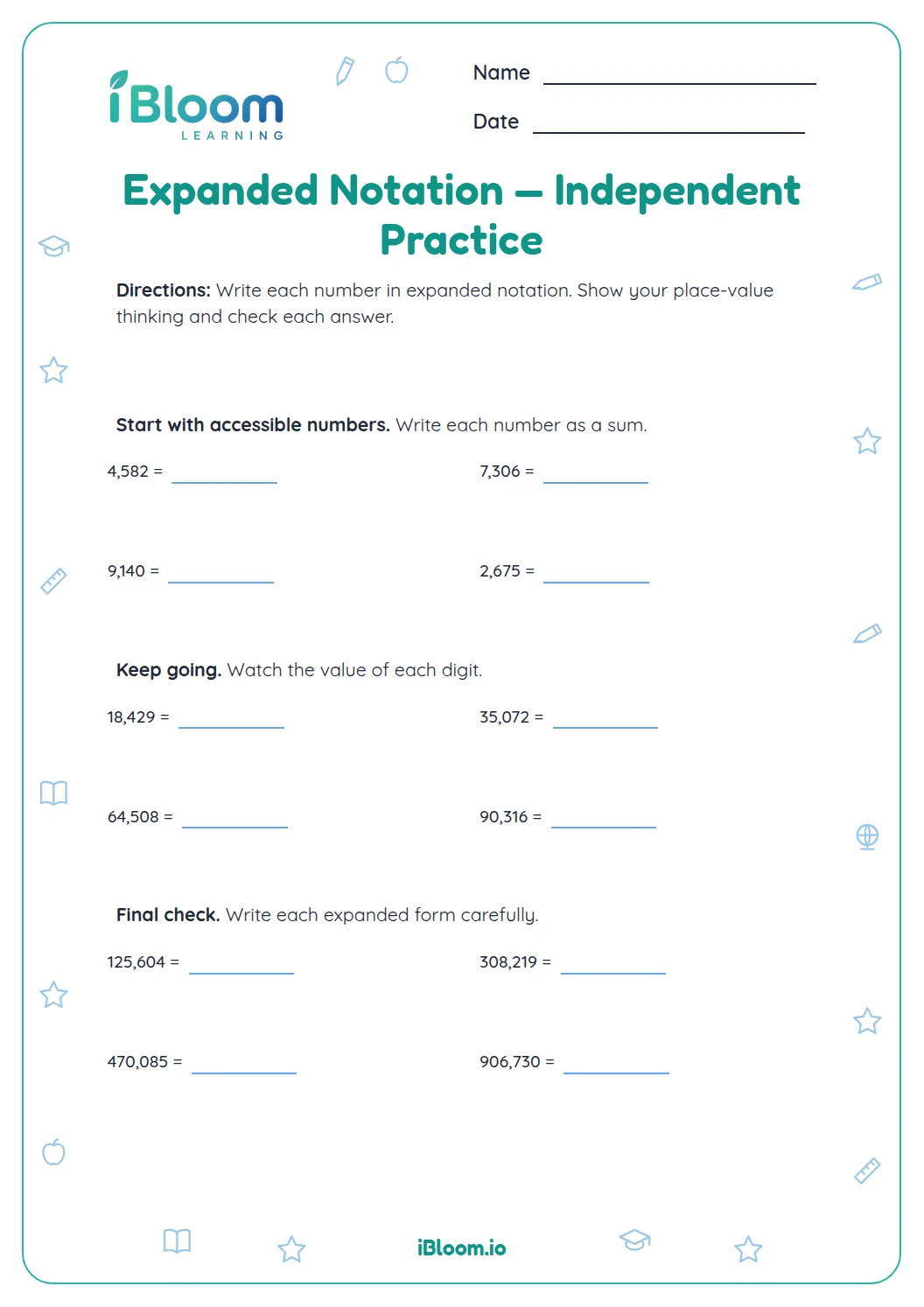
Part C asks for six complete expansions without supplied terms. Students must account for every nonzero digit, including the internal zeros in 8,006,419 and 6,103,904. Add each completed sum to check that it equals the original numeral.
How to use this worksheet
- 1Read the scale above Part A and identify a flat, a rod, and a small cube.
- 2Work question 1 together, counting each block type and writing its total value.
- 3Complete question 2, leaving out the absent ten-thousands term.
- 4For each Part B blank, find the digit whose value is missing from the sum.
- 5In Part C, read each numeral from left to right and write one term for every nonzero digit.
- 6Add the terms to check the original number, then compare with the key.
Mistakes to discuss
The mistake
Treating a small cube as 1 in Part A.
The fix
Read the printed scale: each small cube represents 1,000 on this sheet.
The mistake
Writing 2 instead of 2,000 for the missing part of 582,406.
The fix
Name the digit’s place first. The 2 is in the thousands place, so it represents 2,000.
The mistake
Moving the 6 in 8,006,419 into the ten-thousands place.
The fix
Count from the right: ones, tens, hundreds, thousands. Write 6,000 and keep the zero places in the original numeral.
Common Core alignment
Read large whole numbers and express their place values in expanded notation.
On this sheet: Students read scaled block models and write expanded sums for whole numbers through millions.
Show the official wordingHide the official wording
Read and write multi-digit whole numbers using base-ten numerals, number names, and expanded form. Compare two multi-digit numbers based on meanings of the digits in each place, using >, =, and < symbols to record the results of comparisons.
What to practice next
Make more practice
Further reading
Questions parents and teachers ask
Why is a small cube worth 1,000 here?
The model uses a stated scale to represent large whole numbers with a small drawing. Ten small cubes make a rod worth 10,000, and ten rods make a flat worth 100,000. Read the printed key before both models so every block is counted at its assigned value.
What should students write for question 2?
They should write 200,000 + 4,000. The drawing has two flats, no rods, and four small cubes, so it represents 204,000. The missing rods contribute no term to the sum. The zero in the numeral still holds the ten-thousands place between the 2 and the 4.
Does this sheet use sums or multiplication products?
This sheet asks for sums of place values, such as 100,000 + 20,000 + 3,000 for 123,000. Multiplication products can represent the same number, but the requested format here makes each digit’s total value visible. Students use that format for both the block models and the six complete expansions.
How do students handle zeros in an expansion?
Leave out terms worth zero while keeping every other digit in its correct place. For 903,070, write 900,000 + 3,000 + 70. Reading the original numeral from right to left can help name the places before writing the sum from greatest value to least.
What does the answer key include?
The key gives two model expansions, eight missing values, and six complete sums. Check each term against the corresponding digit in the original number. Then add the terms to verify the total. This catches both a misplaced value and an accidentally omitted nonzero digit.