
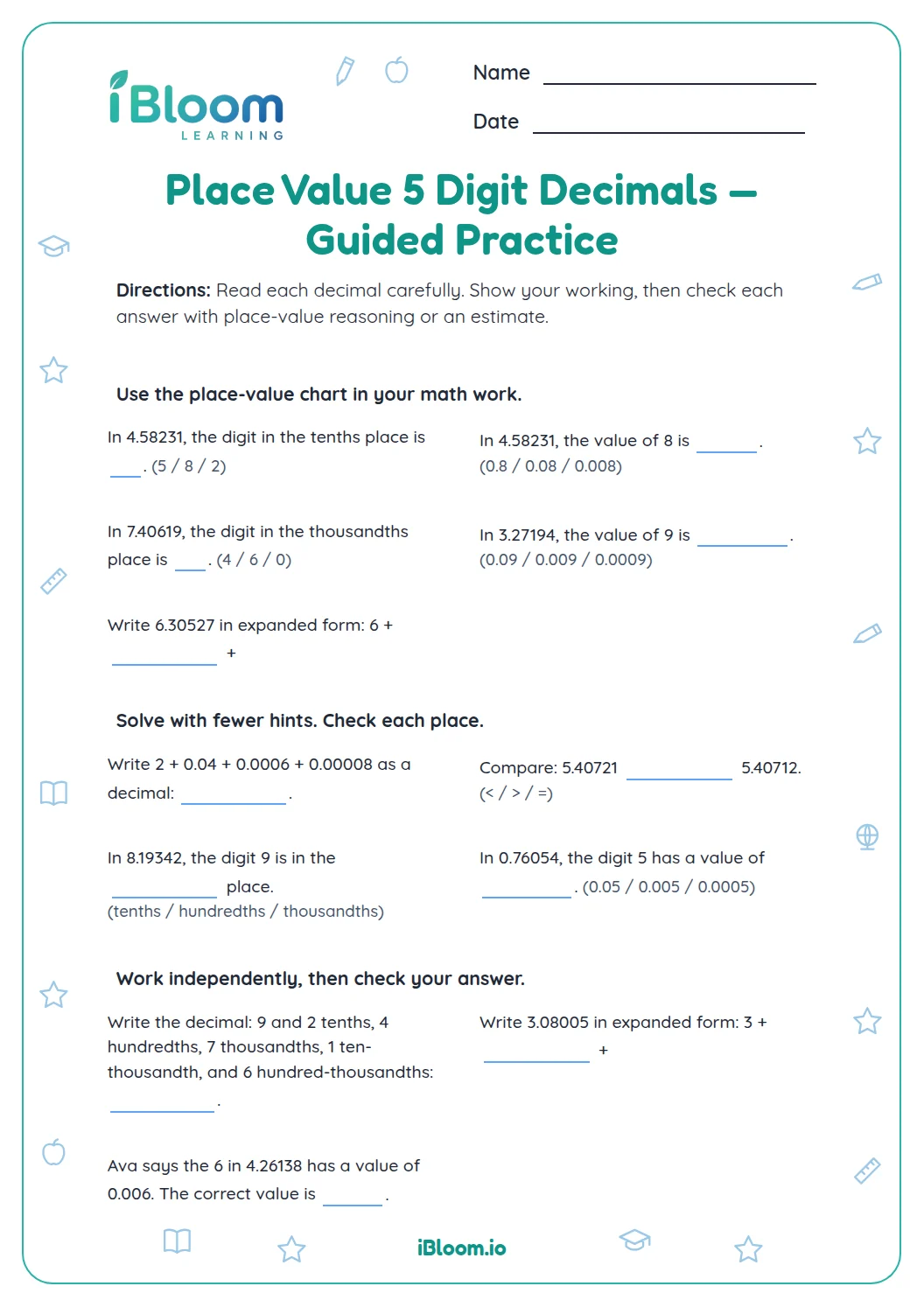
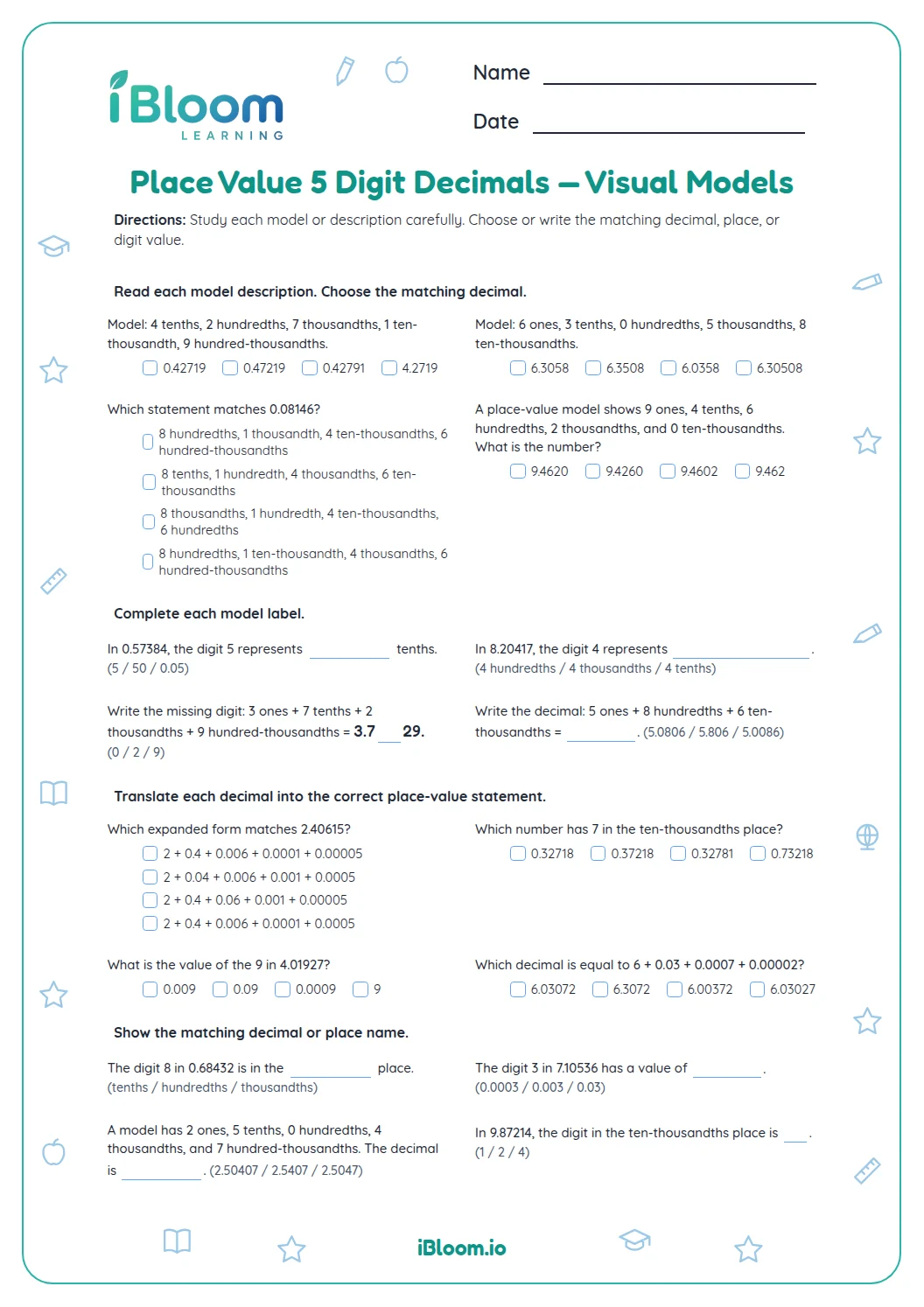
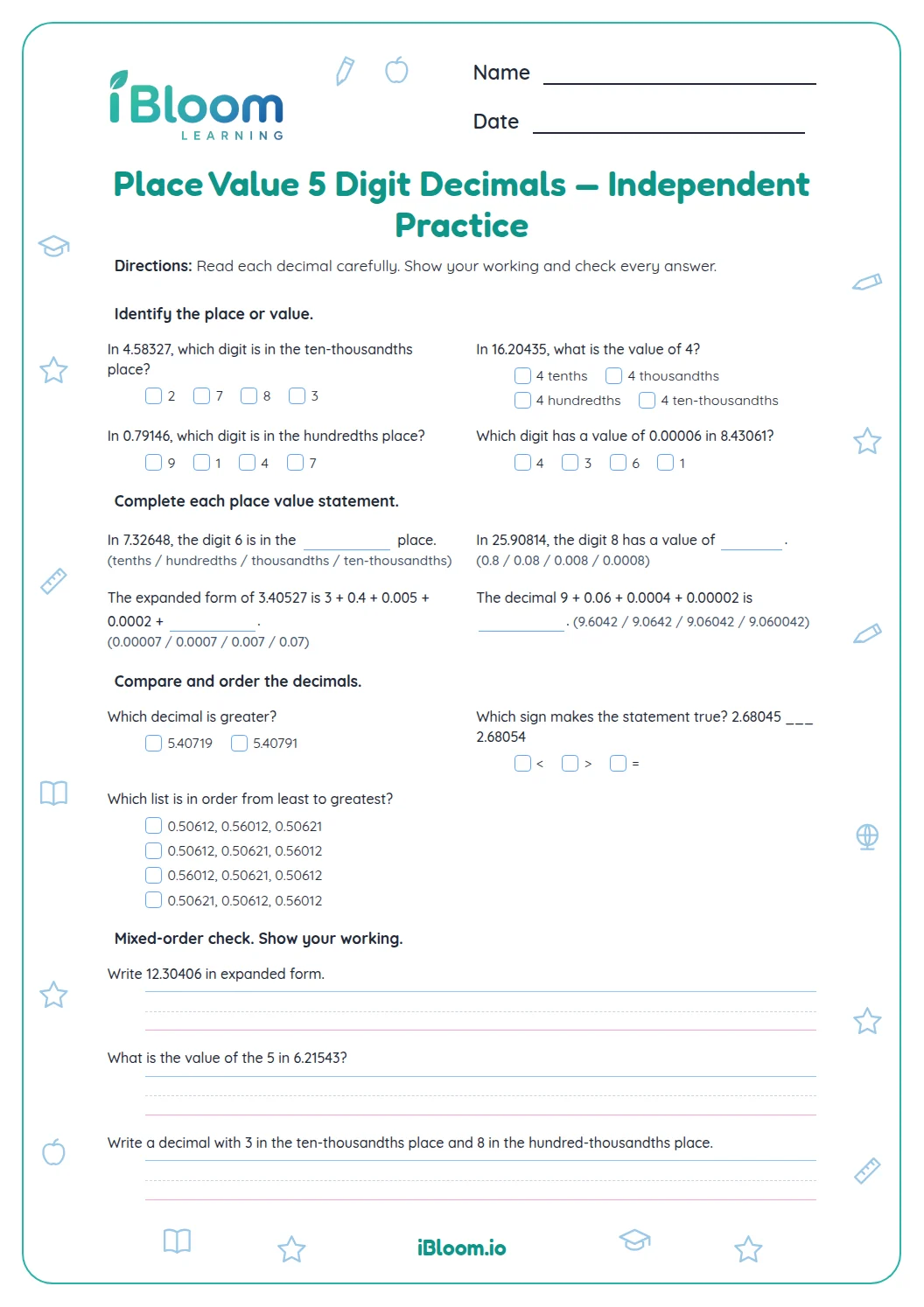
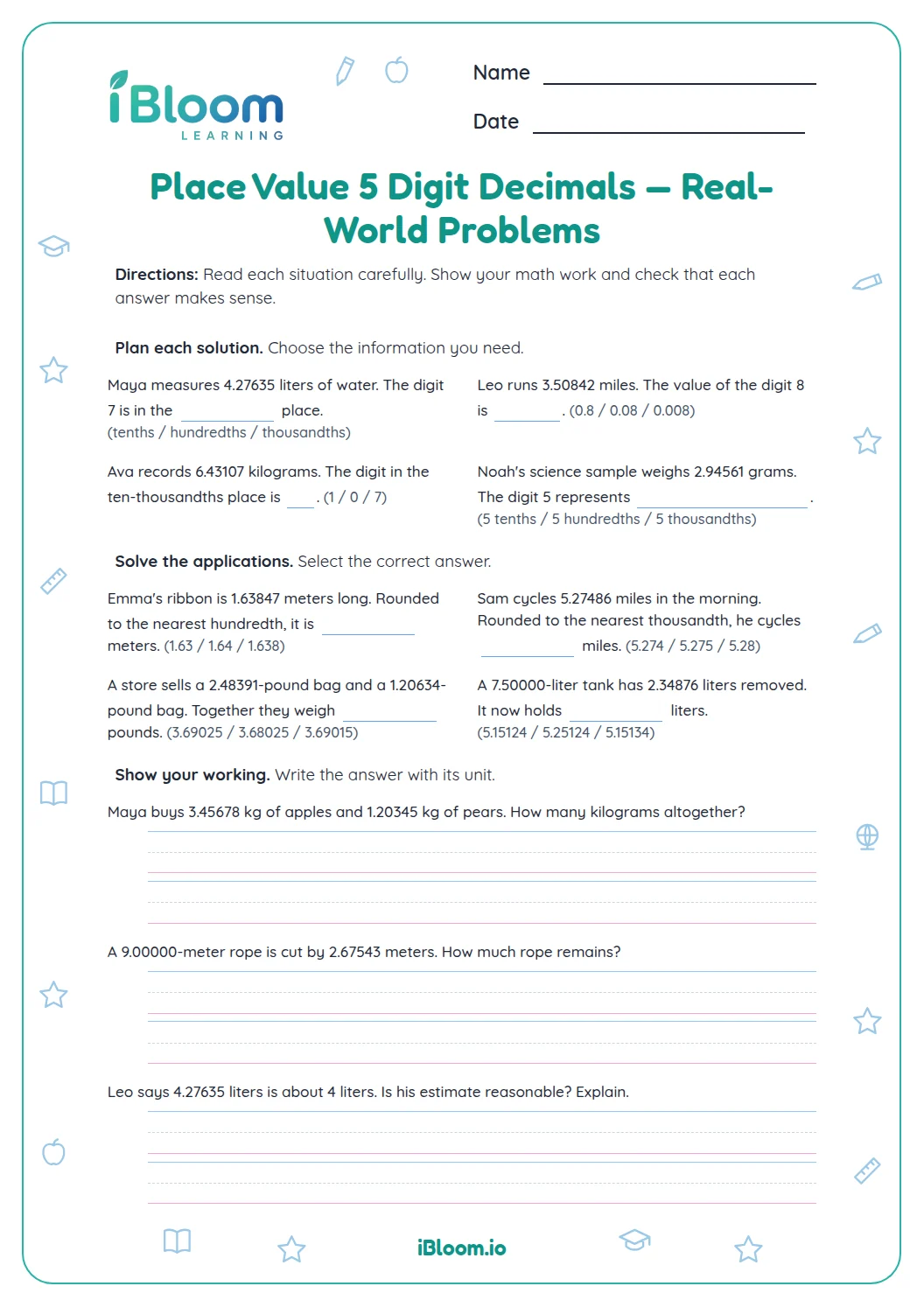

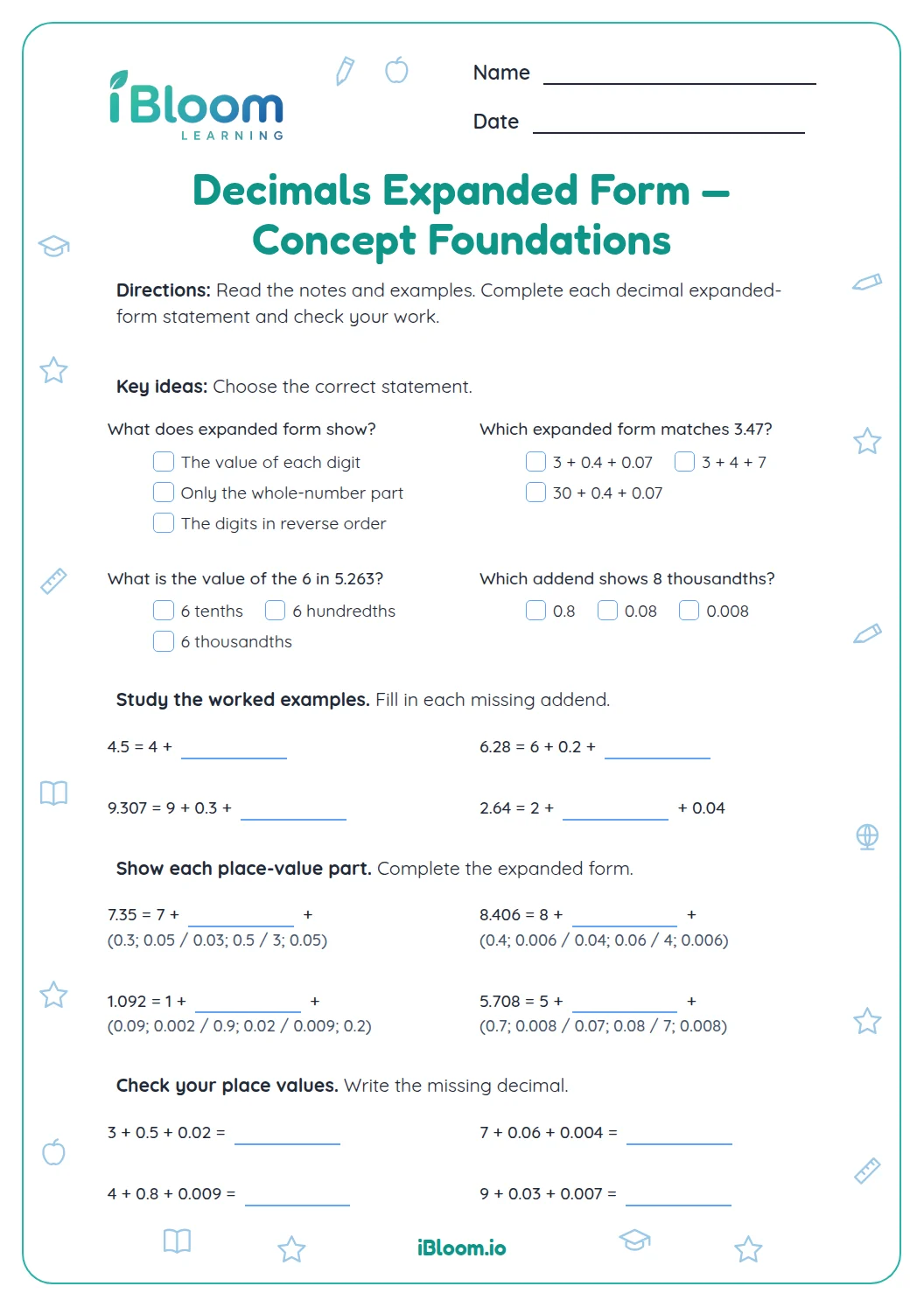

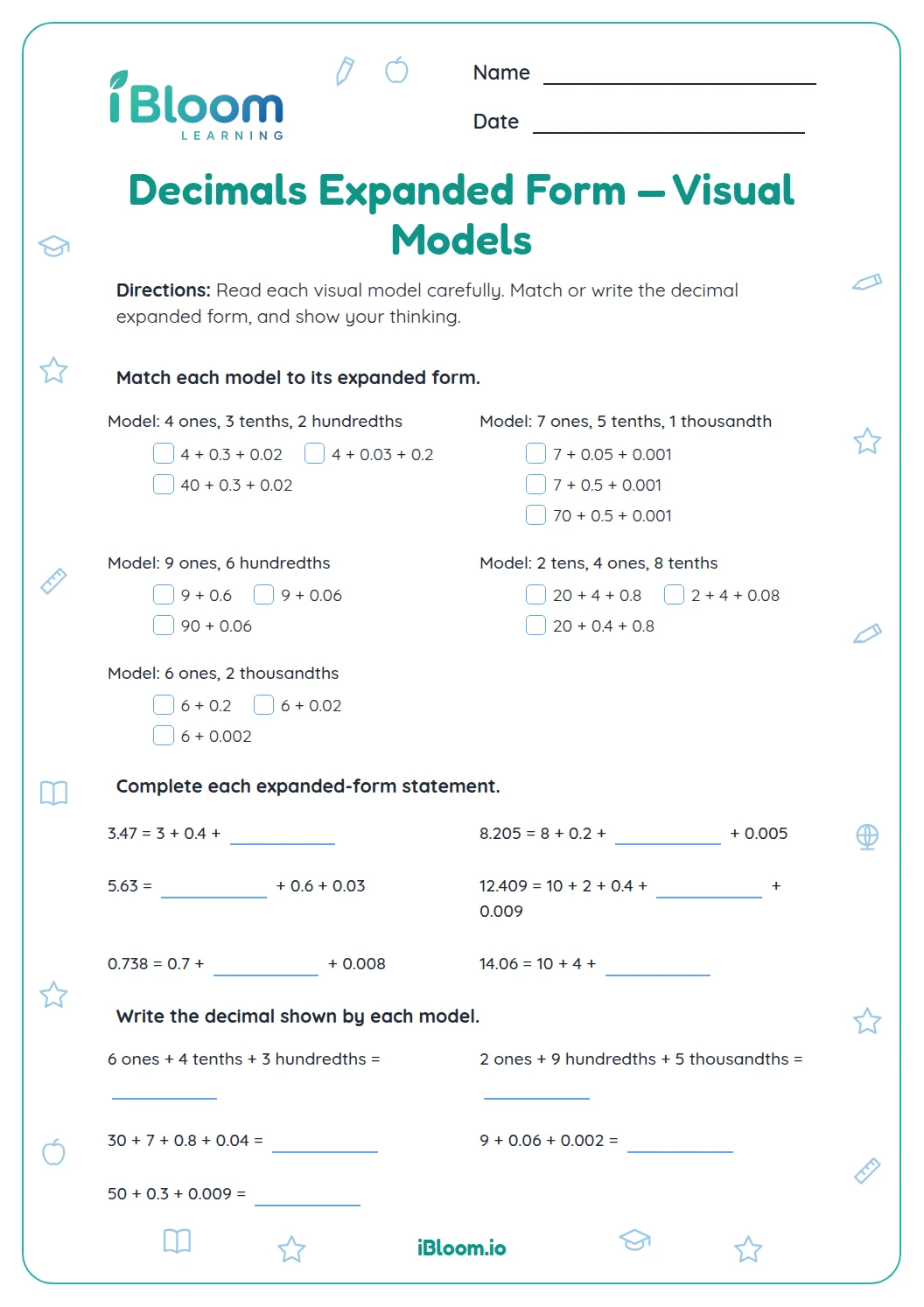
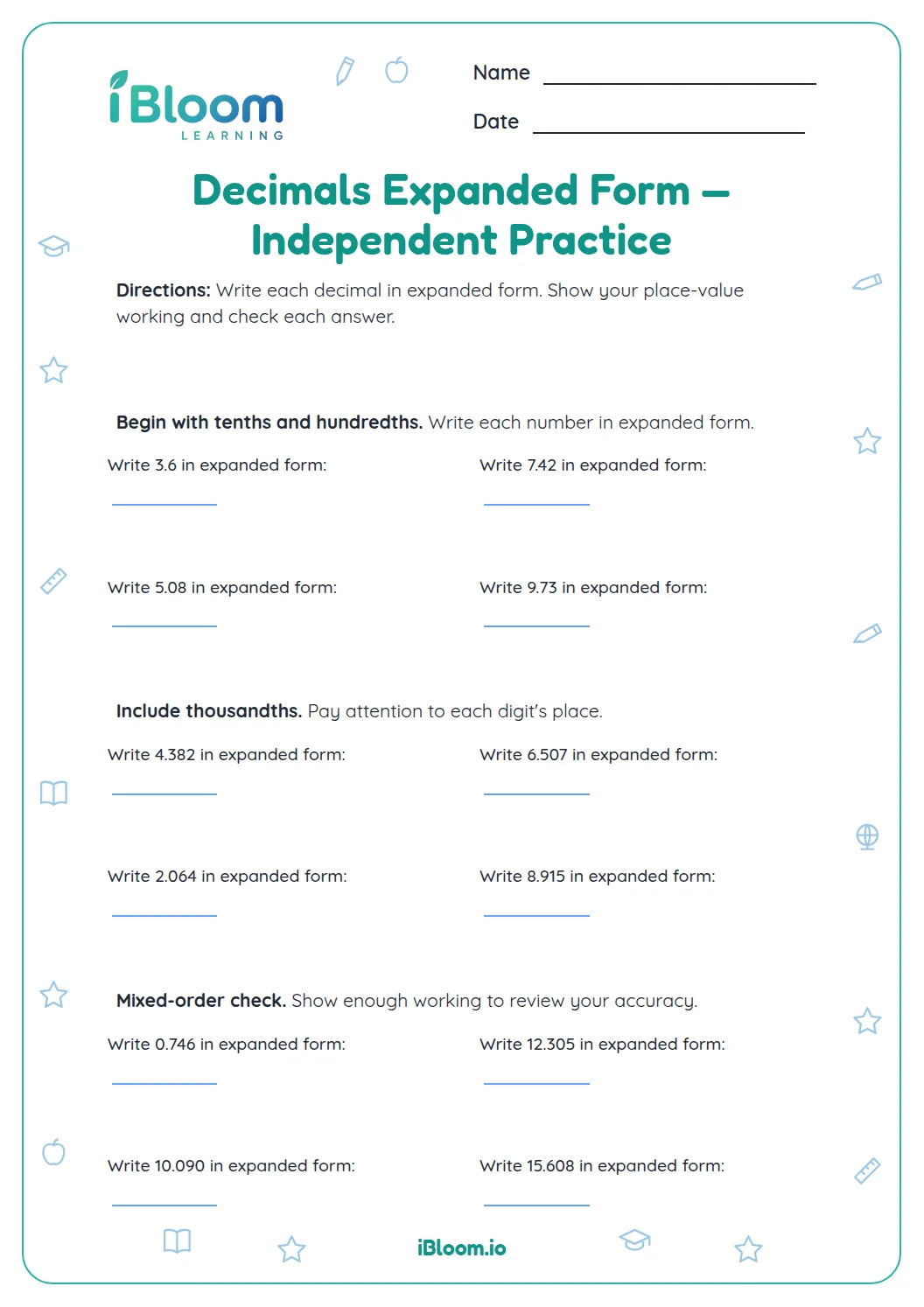
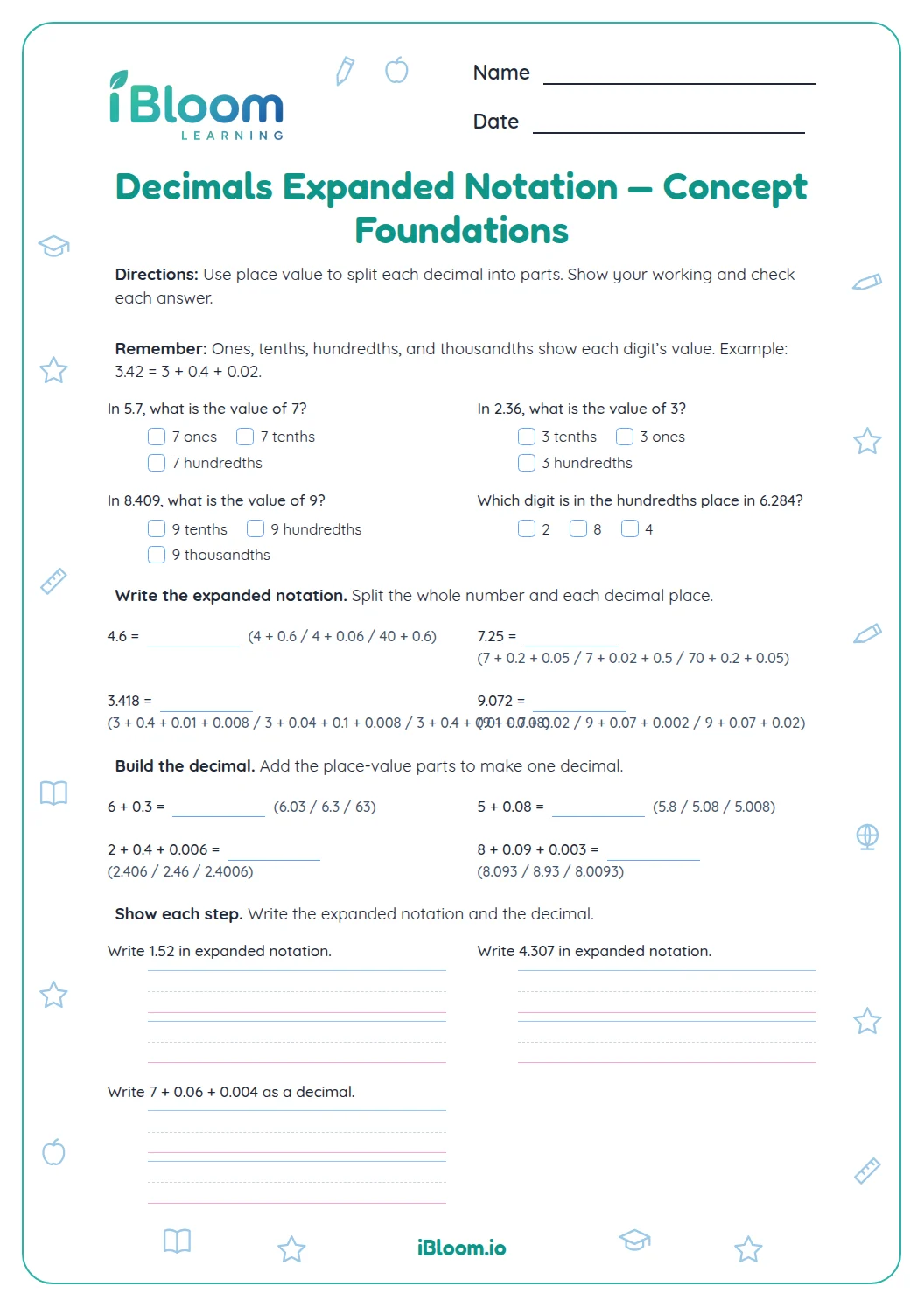


About this worksheet
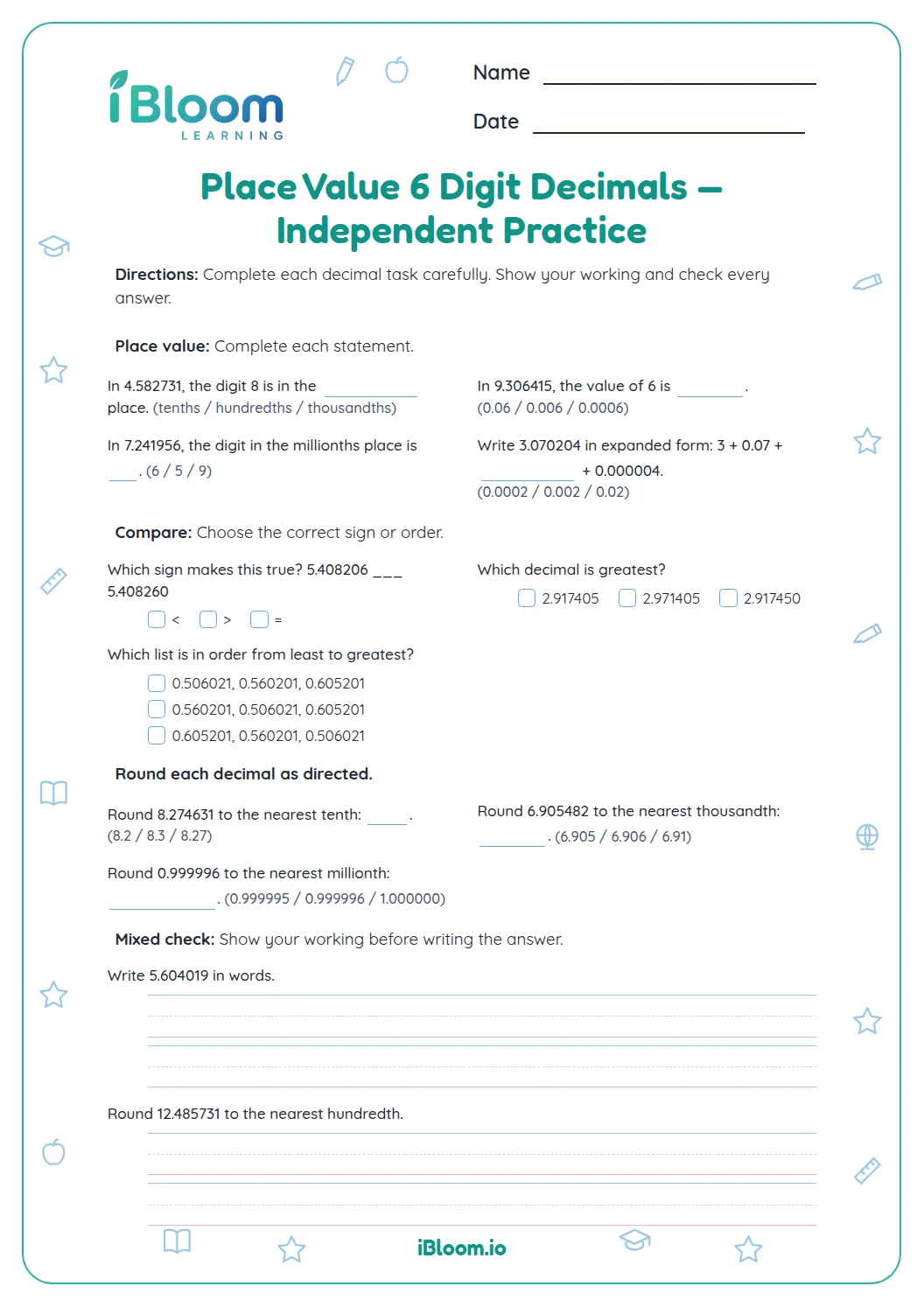
This free Grade 5 math worksheet practices decimal place value through hundred-thousandths. Students identify a digit’s place and value, connect decimal names with notation, write expanded forms, compare and order decimals, and explain one comparison. The 14 questions span four parts and include a separate answer key. The place-value relationships practice CCSS.Math.Content.5.NBT.A.1.
Aligned to CCSS.Math.Content.5.NBT.A.1
Which digit fits the place clue?
Count right from the decimal point to identify the named place.
- 1In 6.35214, the 5 is two places to the right of the decimal point.
- 2That is the hundredths place, so 6.35214 fits the clue.
How does place value help you compare?
Compare equal places in order. If the tenths match, move to hundredths; continue until one digit is greater or all digits match.
What is each digit worth?
A digit’s value is the digit multiplied by its place value. In 83.20514, the 2 is in the tenths place and is worth 0.2.
How can you explain a decimal comparison?
Name the first place where the digits differ. Question 14 asks students to compare 8.30519 with 8.35000 and explain the result.
How to use this worksheet
- 1Count decimal places from the decimal point: tenths, hundredths, thousandths, ten-thousandths, hundred-thousandths.
- 2Name the place first, then state the value of its digit.
- 3Keep every digit in its place when writing expanded form.
- 4Line up decimal points and compare matching places from left to right.
- 5Use the key to check each value and explain any missed comparison.
Common mistakes and quick fixes
The mistake
Calling the third decimal digit the hundredths digit.
The fix
Count from the decimal point: tenths, hundredths, then thousandths.
The mistake
Dropping a zero while writing an expanded decimal.
The fix
Keep each digit aligned with its place, including zero placeholders.
The mistake
Comparing decimals by counting how many digits follow the point.
The fix
Compare matching place values from left to right.
Students read digit values and use place-value relationships to write and compare decimals.
Use the factor-of-10 relationship to interpret digit values across decimal places.
On this sheet:
Show the official wordingHide the official wording
Recognize that in a multi-digit number, a digit in one place represents 10 times as much as it represents in the place to its right and 1/10 of what it represents in the place to its left.
What to practice next
Make more practice
Further reading
Questions parents and teachers ask
How many decimal places are practiced?
The worksheet uses decimals with as many as five digits after the decimal point, through hundred-thousandths. Students name places, find digit values, write expanded forms, and compare decimals. The questions also include a word name to connect decimal notation with place-value language.
Why do some answers include zeros?
A zero can hold a place even when it contributes no value, as in 12.09000 and 12.09. The comparison question asks students to notice that these names represent the same decimal. Keeping place columns aligned helps prevent a zero from shifting a digit.
How should students compare two decimals?
Line up the decimal points, then compare digits from left to right in matching places. In 8.30519 and 8.35000, the tenths digits match, but the hundredths digits are 0 and 5. That difference shows which decimal is smaller.
What is the expanded-form question asking?
It asks students to show the value contributed by each digit. For 28.46715, the parts include 20, 8, 0.4, 0.06, 0.007, 0.0001, and 0.00005. The missing term represents the digit in the hundredths place. Write each expanded term in its own place column before adding.
How can I check the answer key?
Use the key after the student completes the worksheet. Check the selected answers and missing values, then ask the student to explain one comparison or expanded form. The key displays two pages, matching the two-page worksheet, and shows a sample explanation for the last item.