



About this worksheet
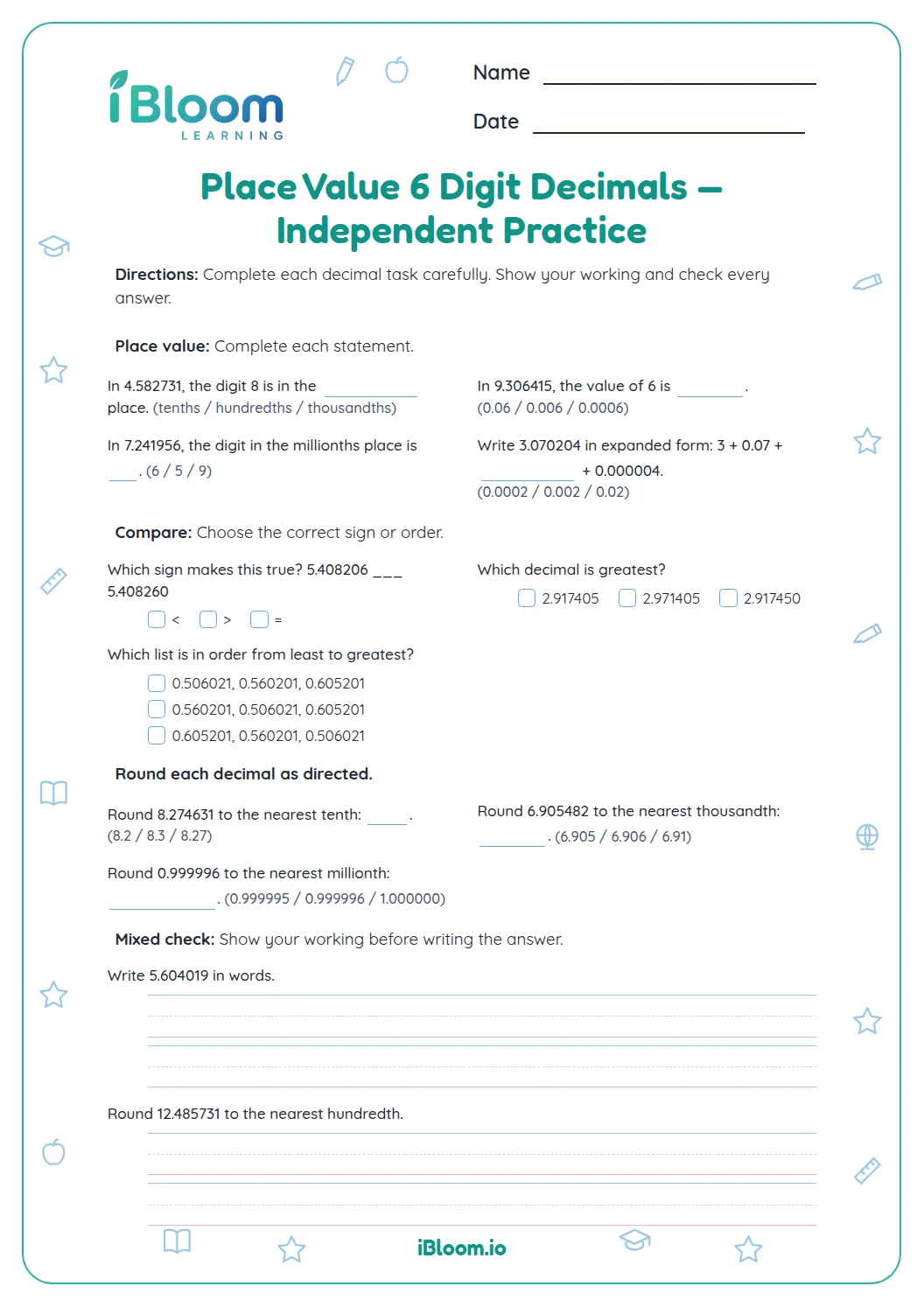
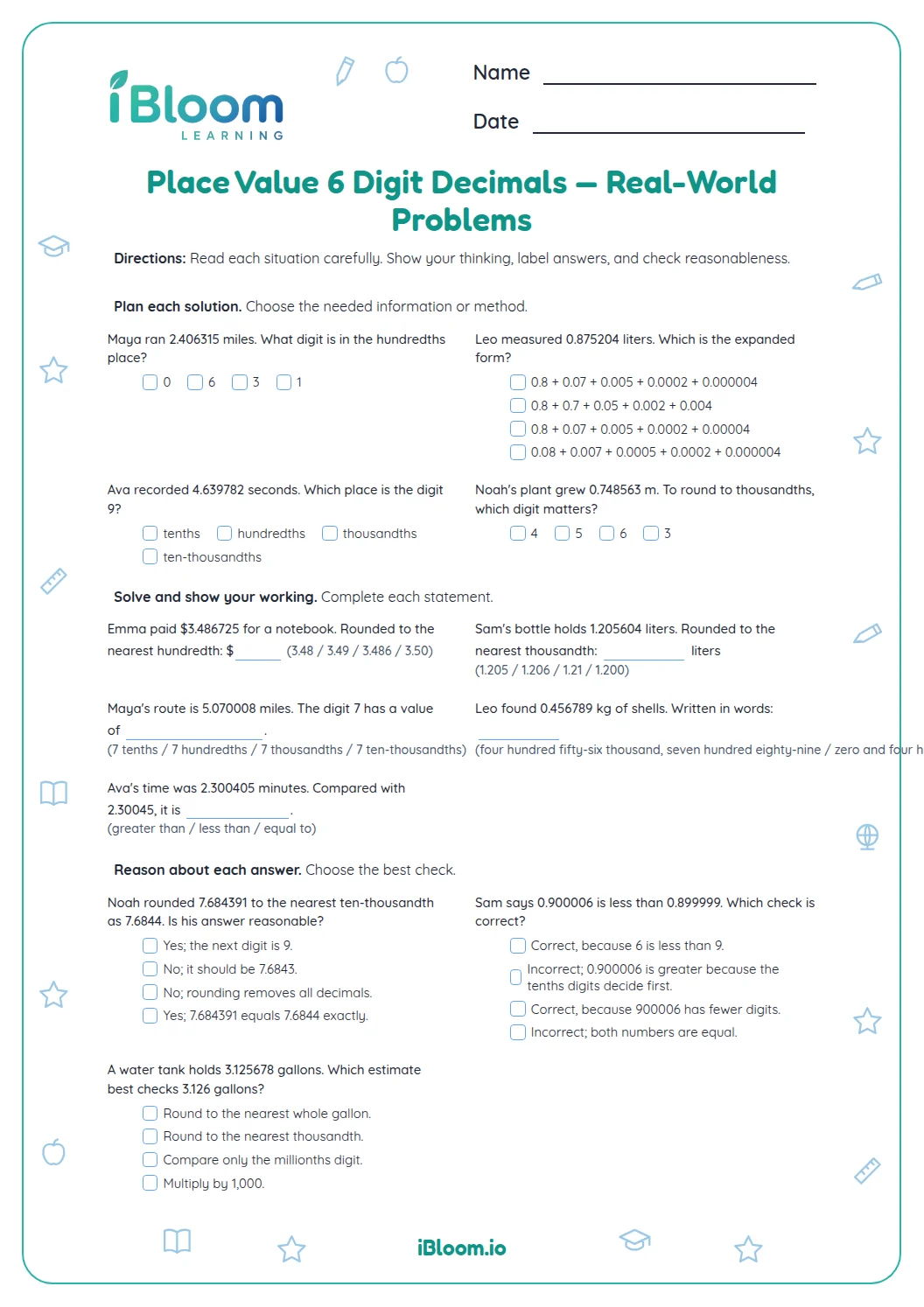
This free printable Grade 5 worksheet practices decimal place value and rounding. Across 15 questions, students name the value of digits, write decimals in expanded form and words, compare decimals, and round to the nearest thousandth, hundredth, or millionth. The thousandths work aligns with CCSS 5.NBT.A.3, and the rounding questions practice 5.NBT.A.4. A separate answer key follows the two worksheet pages.
Aligned to 5.NBT.A.3.a and 5.NBT.A.4
What skills appear on the worksheet?
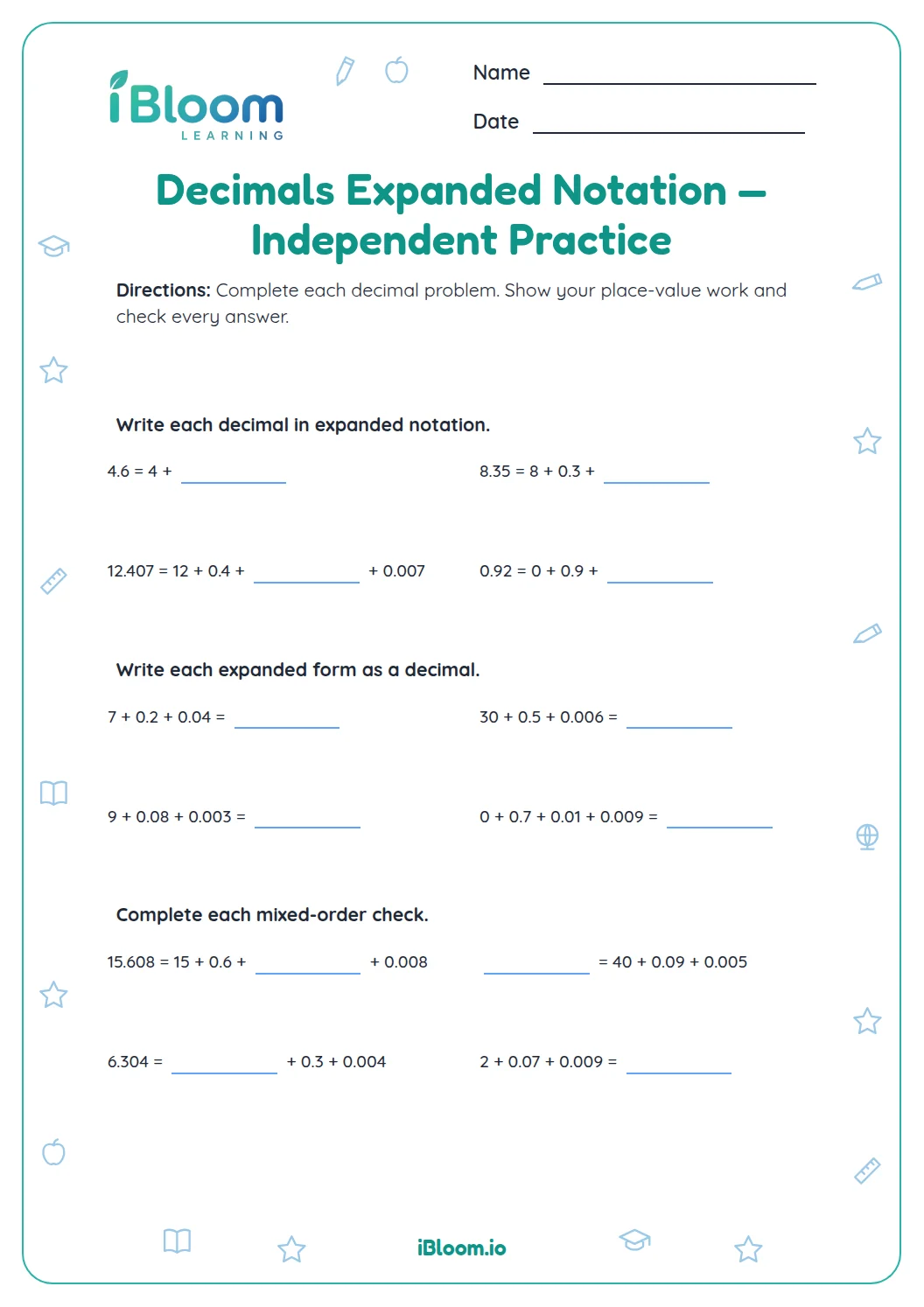
Part A asks students to name digit values and write decimals in expanded form or words. Part B moves to comparing decimals, expressing tenths as hundredths, and rounding to named places. The final two questions include digits beyond thousandths, following the old sheet’s millionths focus.
- 8 place-value and decimal-form questions
- 7 comparison, equivalence, and rounding questions
- A separate key with answers for all 15 items
How do you compare decimals with different lengths?
Line up the decimal points and compare from left to right. Add a zero at the end when it helps you see matching places; a trailing zero does not change the value.
- 13.408 ___ 3.48
- 2Write 3.48 as 3.480.
- 3Compare thousandths: 408 thousandths is less than 480 thousandths.
- 4So, 3.408 < 3.48.
How do you round to a named place?
Keep the digit in the named place, then inspect the digit immediately to its right. Leave the rounding digit alone when that next digit is 0–4; increase it by one when the next digit is 5–9. Carry into the whole-number part when needed, as in 12.9995048 rounded to the nearest millionth.
Why does a zero matter in a decimal?
A zero can hold a place in the middle of a decimal, as in 4.02, where 2 means two hundredths. A zero at the end can show precision but does not change the value: 4.2 and 4.20 are equal.
How to use this worksheet
- 1Read the place name in the question before identifying a digit’s value.
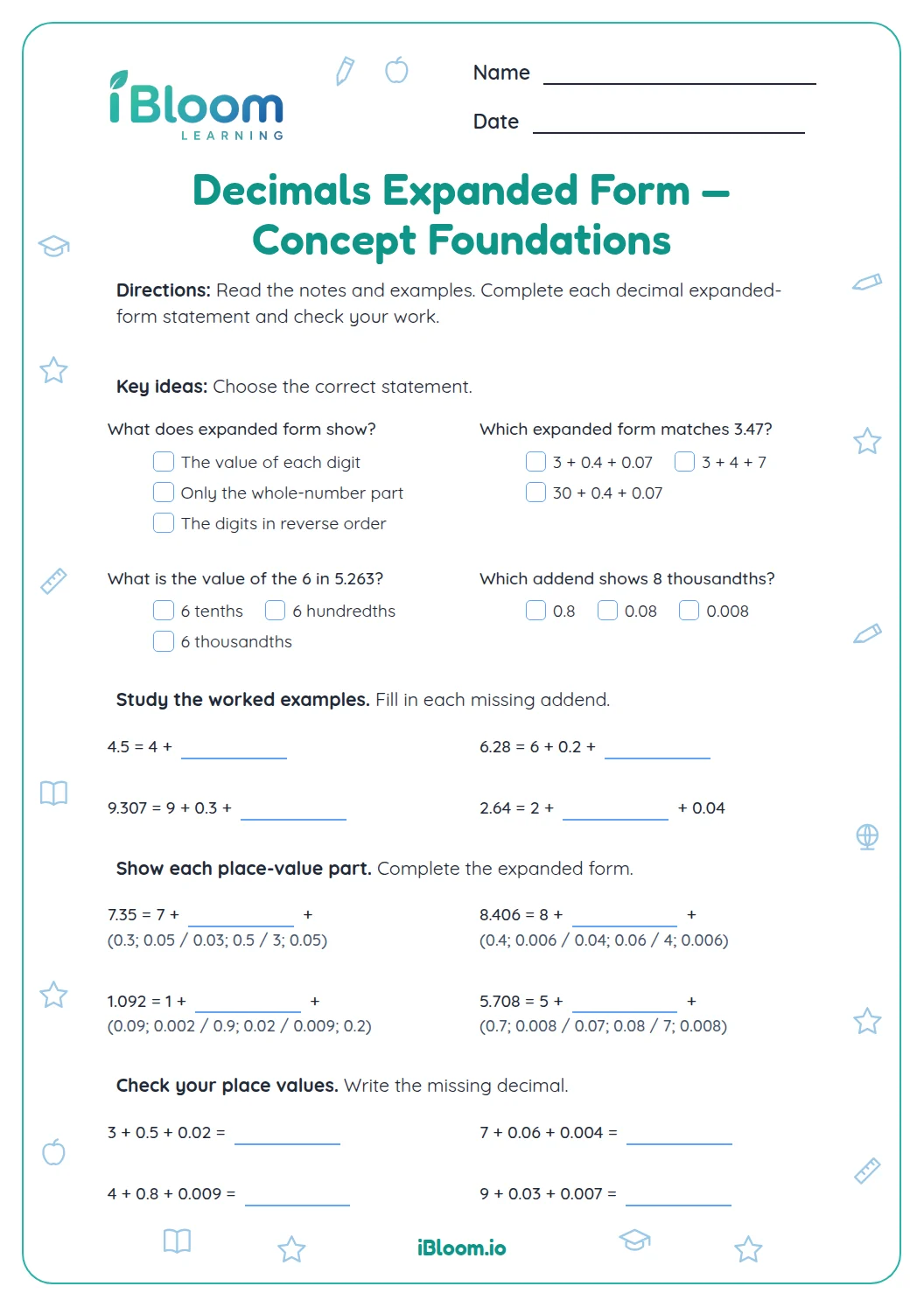
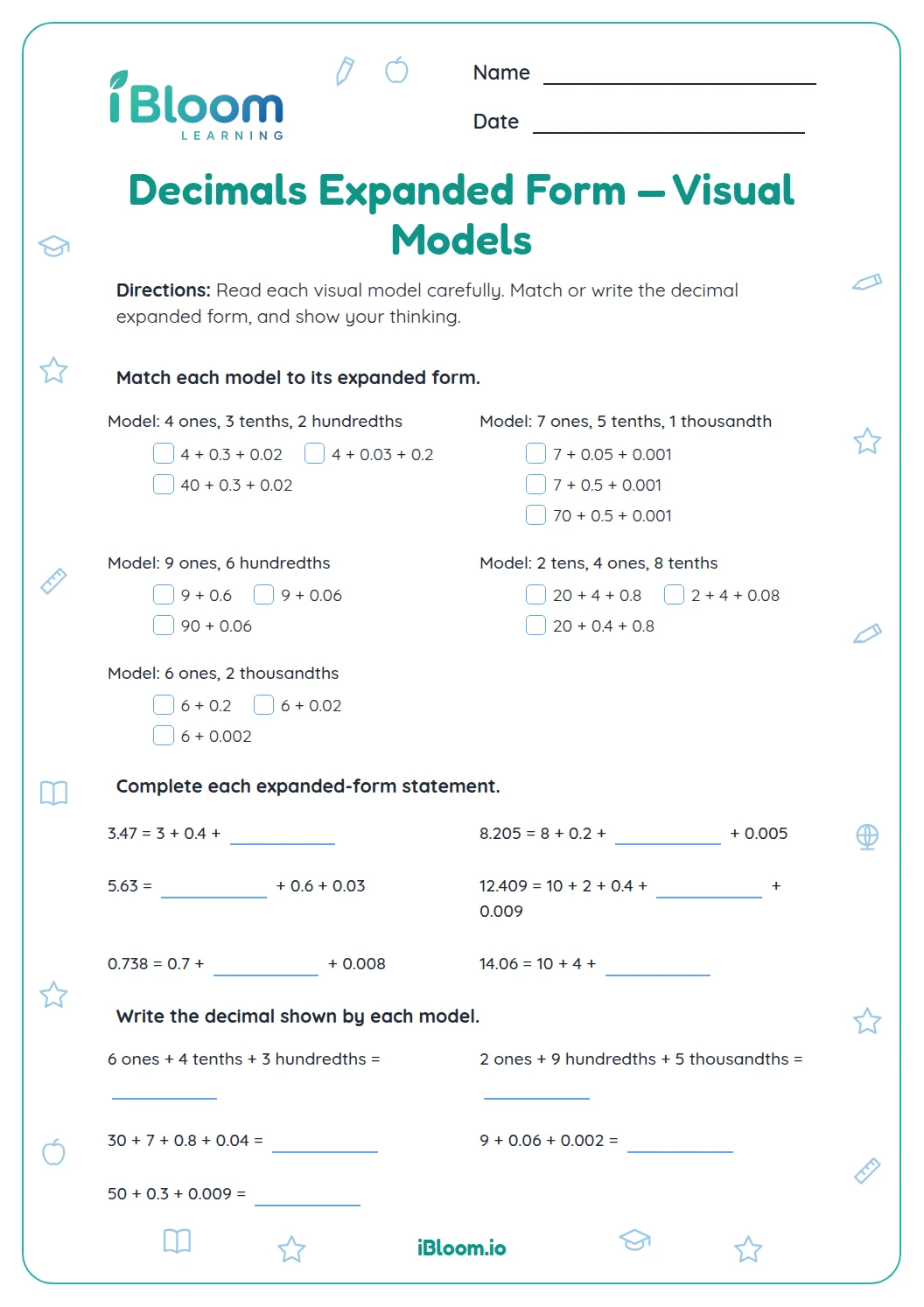
- 2For expanded form, include each nonzero digit’s value as a separate addend.
- 3Compare from the whole-number place, moving right one place at a time.
- 4For rounding, mark the named place and look one digit to its right.
- 5Use the answer key to check equivalent forms and correct any place-value slips.
Common decimal place-value slips
The mistake
Reading the 8 in 905.184 as 0.8.
The fix
The 8 is in the hundredths place, so its value is 0.08.
The mistake
Thinking 4.20 is greater than 4.2 because it has more digits.
The fix
Compare matching places: 4.2 is 4.20, so the values are equal.
The mistake
Stopping at the digit being rounded.
The fix
Check the digit one place to the right; it tells whether the rounding digit stays or increases.
Common Core alignment
The worksheet practices Grade 5 decimal reading, writing, comparison, and rounding.
Read and write decimals to thousandths in numeral, number-name, and expanded forms.
On this sheet: Questions 1–7 and 11 practice digit value, expanded form, and number names; comparison questions work with decimal place value.
Show the official wordingHide the official wording
Read and write decimals to thousandths using base-ten numerals, number names, and expanded form.
Use place-value understanding to round decimals to named places.
On this sheet: Questions 13–15 round decimals to a named place.
Show the official wordingHide the official wording
Use place value understanding to round decimals to any place.
What to practice next
Make more practice
Further reading
Questions parents and teachers ask
Which places does this worksheet include?
The problems identify digit values through millionths, write decimals in several forms, compare decimals, and round to named places. The final rounding question uses hundredths, while others use thousandths and millionths. The sheet gives 15 questions across two worksheet pages, followed by a separate answer key.
How do I find the value of a decimal digit?
Name the place where the digit sits, then write the amount that place represents. In 905.184, the 8 is in the hundredths place, so its value is 0.08. The digit itself is 8, but its value depends on its position in the number.
Are 4.2 and 4.20 different amounts?
No. The zero at the end of 4.20 adds no value, so 4.2 and 4.20 are equal. Writing the extra zero can make it easier to compare decimals by lining up the same number of places, as the comparison questions on this page ask students to do.
What is the first step when rounding a decimal?
Locate the place named in the question, then look at the digit immediately to its right. Keep the named digit if the next digit is less than 5; increase it if the next digit is 5 or more. Remember to carry when the rounding digit is 9.
Does the worksheet include an answer key?
Yes. The key is printed separately from the two worksheet pages and gives an answer for every question. It also shows the decimal forms and comparison symbols, so a student can review which place-value step led to a missed answer.