


About this worksheet
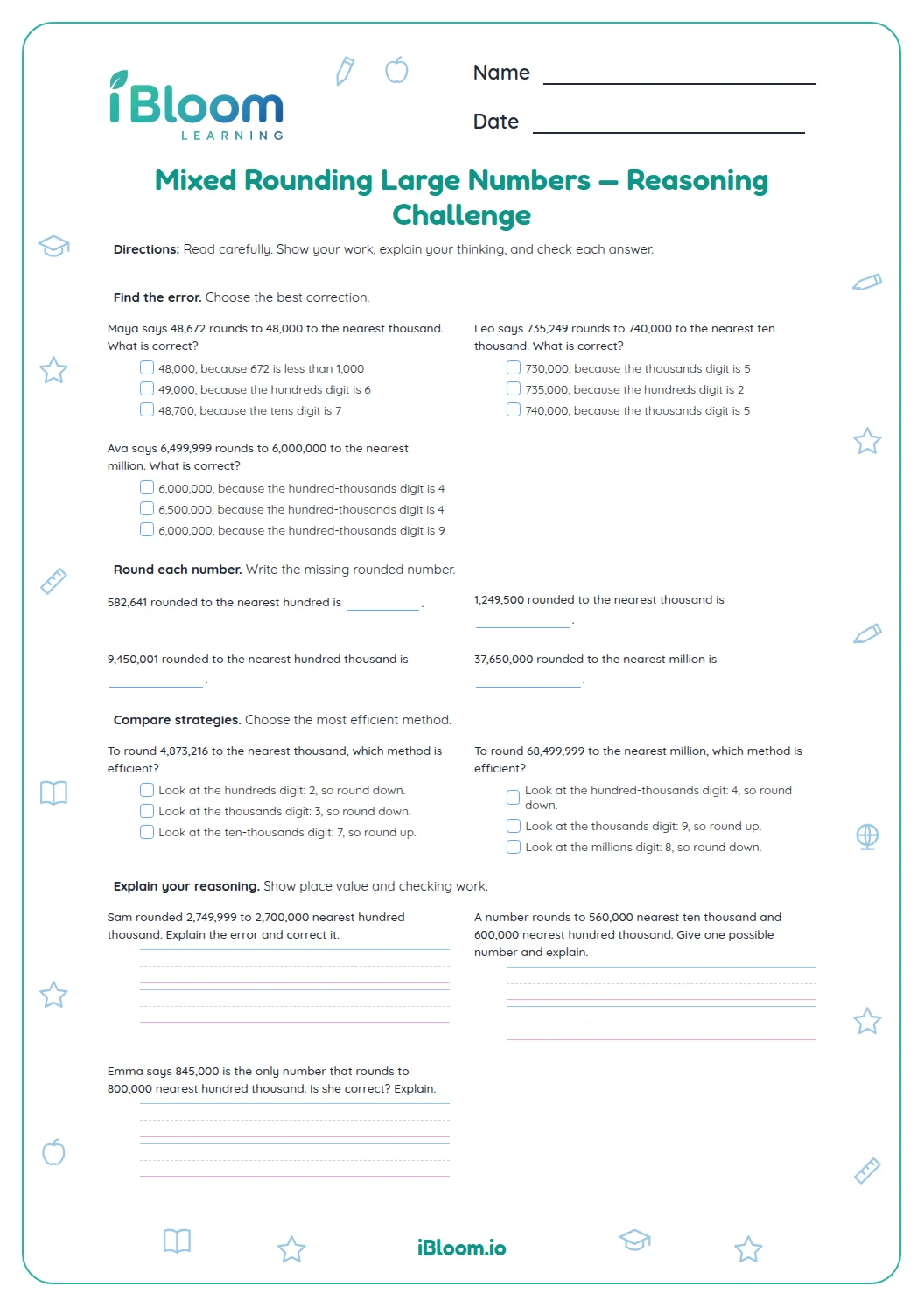
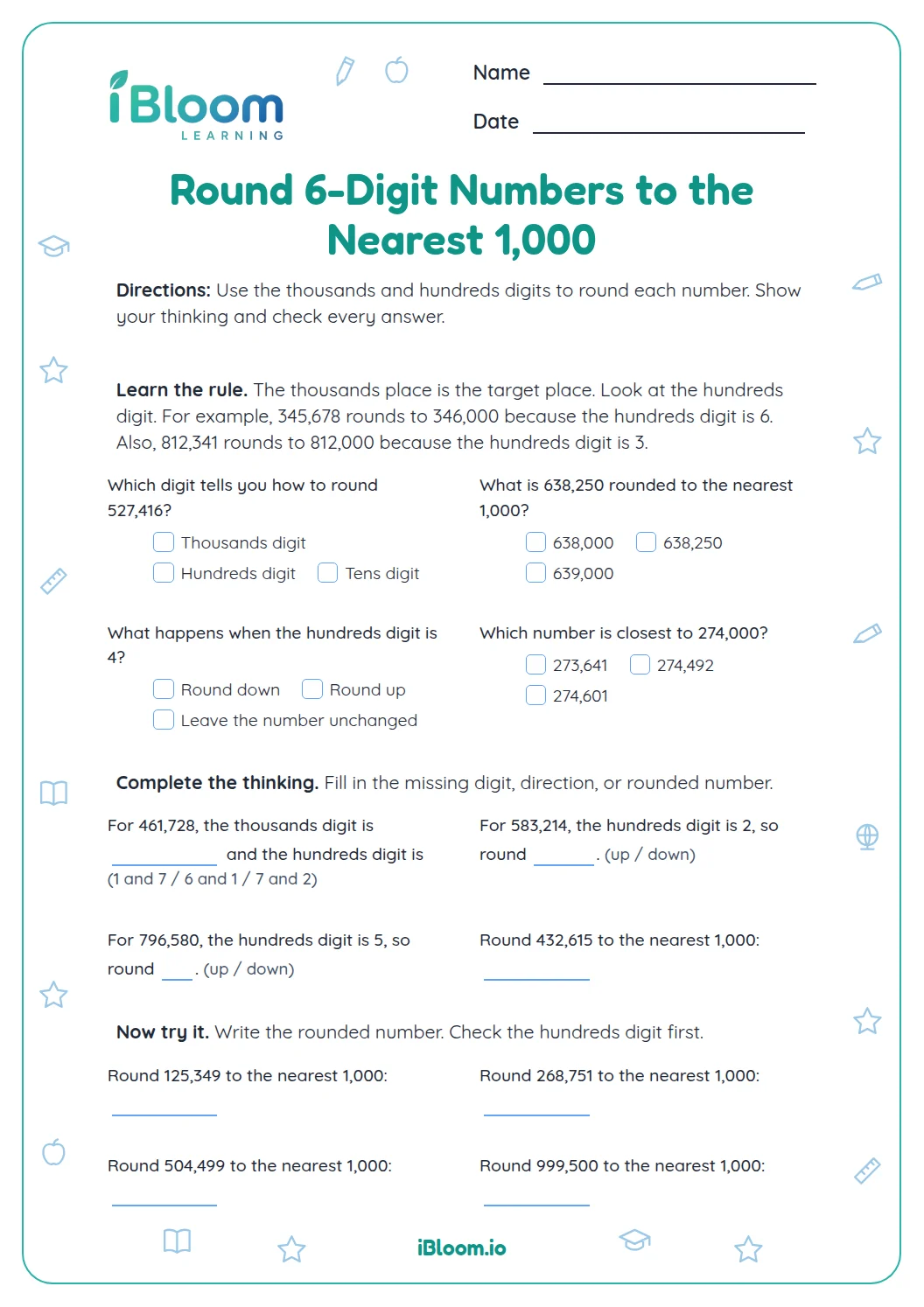
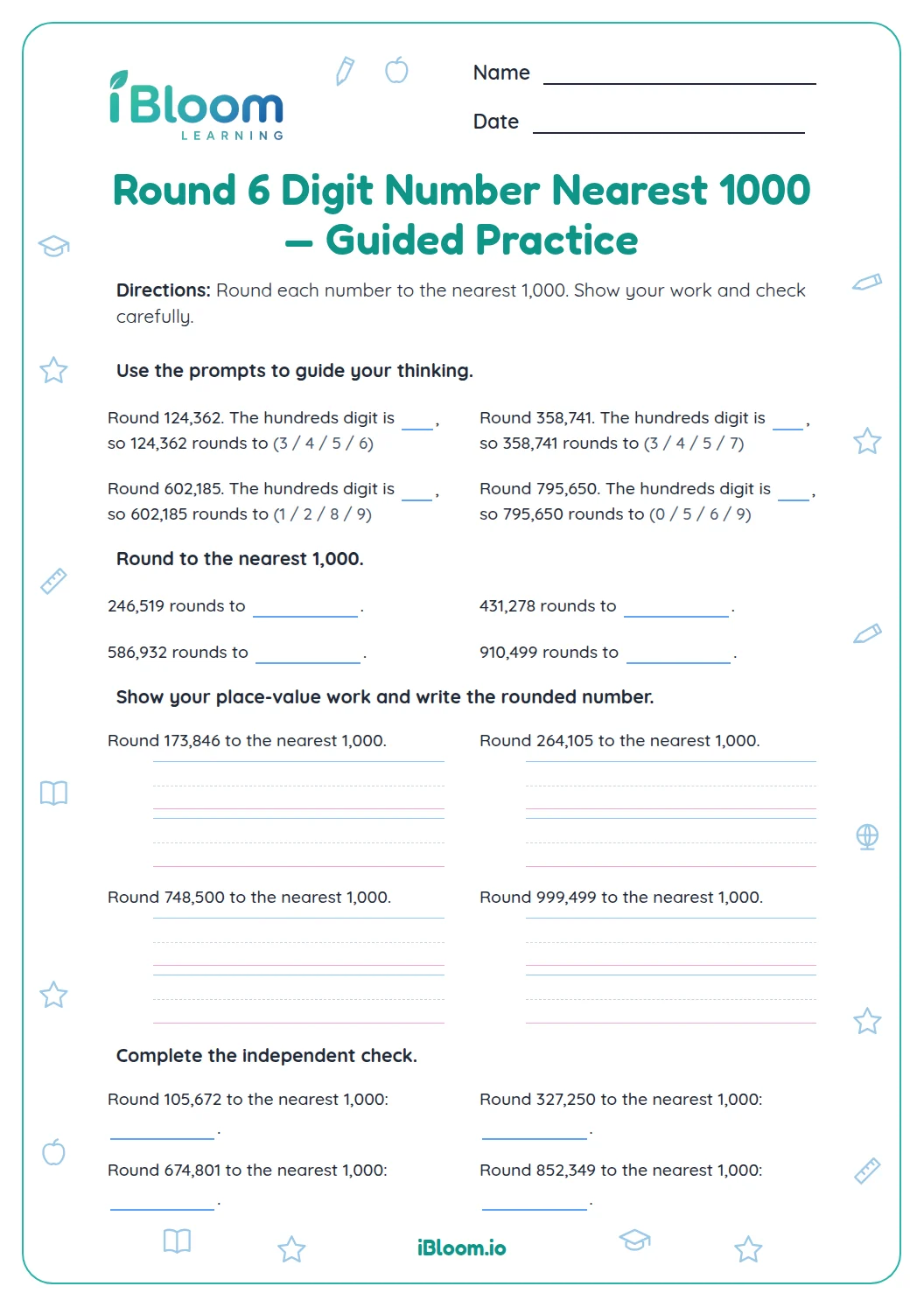
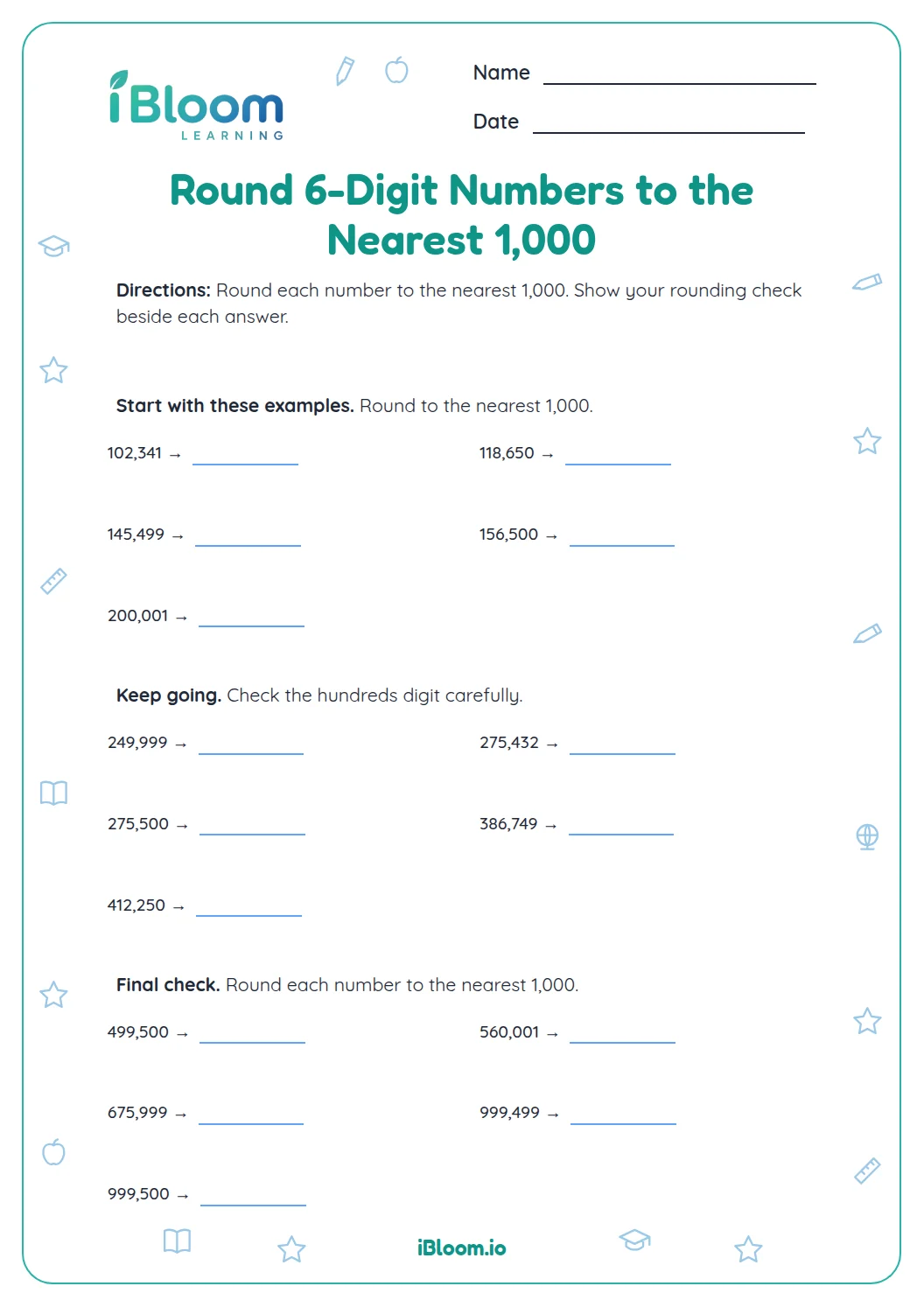
This free printable worksheet gives Grade 5 students independent practice rounding large whole numbers. The 14 questions mix nearest tens, hundreds, thousands, ten thousands, hundred thousands and millions. Part A establishes the routine with eight shorter prompts. Part B changes the target place and includes a carry into a new million. Part C applies rounding to library and stadium counts. The work practices Common Core 4.NBT.A.3, using place value to round multi-digit whole numbers to any place. A separate answer key gives all 14 rounded values.
Aligned to 4.NBT.A.3
Which digit decides whether to round up?
The digit immediately to the right of the requested place decides. If it is 0 through 4, keep the target digit; if it is 5 through 9, increase it by one. Replace all digits to the right of the target place with zeros.
In 482,650 rounded to the nearest hundred, the tens digit is 5. The answer is 482,700. The thousands digit does not decide this question because the target is hundreds.
What happens when the target digit is 9?
Increasing a 9 requires regrouping, just as in addition. Question 10 asks for 3,950,000 to the nearest hundred thousand. Increasing the 9 in the hundred-thousands place carries into the millions place.
- 1Target place: hundred thousands
- 2Deciding digit: 5 in the ten-thousands place
- 3Round 3,950,000 up to 4,000,000.
- 4Check: it is halfway between 3,900,000 and 4,000,000.
How can students check each rounded answer?
Check that the answer is a multiple of the requested place value. An answer rounded to the nearest thousand must end in at least three zeros. Then identify the two neighboring multiples and check which is closer, choosing the higher one at the midpoint.
The two Part C situations ask for the same rounding decisions in words. Keep the unit with the final answer: books for the library and seats for the stadium.
How to use this worksheet
- 1Read the target place in each prompt before touching the number.
- 2Underline the target digit and circle the digit immediately to its right.
- 3Keep or increase the target digit, then write zeros to its right.
- 4For a carry across 9s, rewrite the whole result and check its commas.
- 5Check the two situation answers with their units, then compare all answers with the key.
Mistakes to notice and fix
The mistake
Looking at the final digit for every problem.
The fix
Use the digit next to the target place: for nearest thousand, check hundreds.
The mistake
Writing 3,1000,000 after rounding 3,950,000.
The fix
Regroup ten hundred thousands as one million; the rounded number is 4,000,000.
The mistake
Rounding a number in stages through several places.
The fix
Start from the original number each time. For 765,499 to the nearest thousand, use the 4 in the hundreds place and write 765,000.
Common Core alignment
Round four- to eight-digit whole numbers to the requested place.
On this sheet: All three parts ask students to use a named place value when rounding whole numbers.
Show the official wordingHide the official wording
Use place value understanding to round multi-digit whole numbers to any place.
What to practice next
Make more practice
Further reading
Questions parents and teachers ask
Which place values does this worksheet use?
Students round to the nearest ten, hundred, thousand, ten thousand, hundred thousand and million. The given numbers have four to eight digits. Each prompt names its target place, so students need to read it again for every question instead of applying one rounding rule to the entire page.
How should students handle halfway values?
Use the higher neighboring multiple when the number is exactly halfway. For example, 358,500 lies halfway between 358,000 and 359,000, so question 5 rounds to 359,000. The deciding digit is 5. Question 12 applies the same idea to millions: 38,500,000 rounds to 39,000,000.
Why does 3,950,000 round to 4,000,000?
The target in question 10 is the nearest hundred thousand, and the deciding digit is 5. Increasing the 9 in the hundred-thousands place makes ten hundred thousands, or one million. Regrouping changes 3,900,000 to 4,000,000, which is the higher of the two equally close choices.
Should my child round to hundreds before rounding to thousands?
Start with the original number for every requested place. Rounding in stages can change an answer: 765,499 rounds directly to 765,000 at the nearest thousand. If it were rounded to hundreds first, it would become 765,500, which would then incorrectly lead to 766,000 for the original question.
What is included in the answer key?
The key gives the rounded value for each of the 14 questions, with books and seats included for the two situations. Check the named place as well as the digits. Ask students to identify their deciding digit when a response differs from the key before they revise it.