

About this worksheet
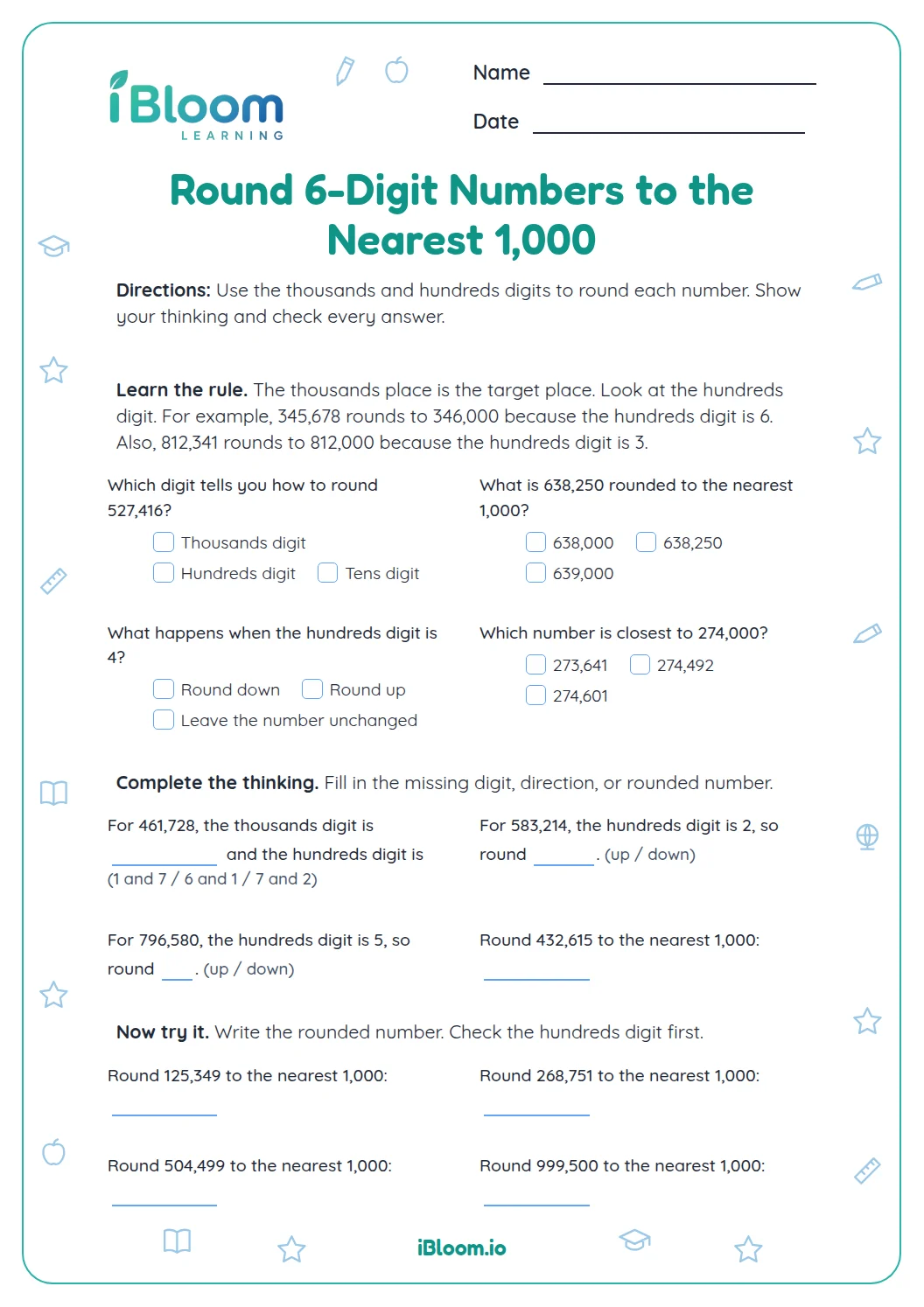
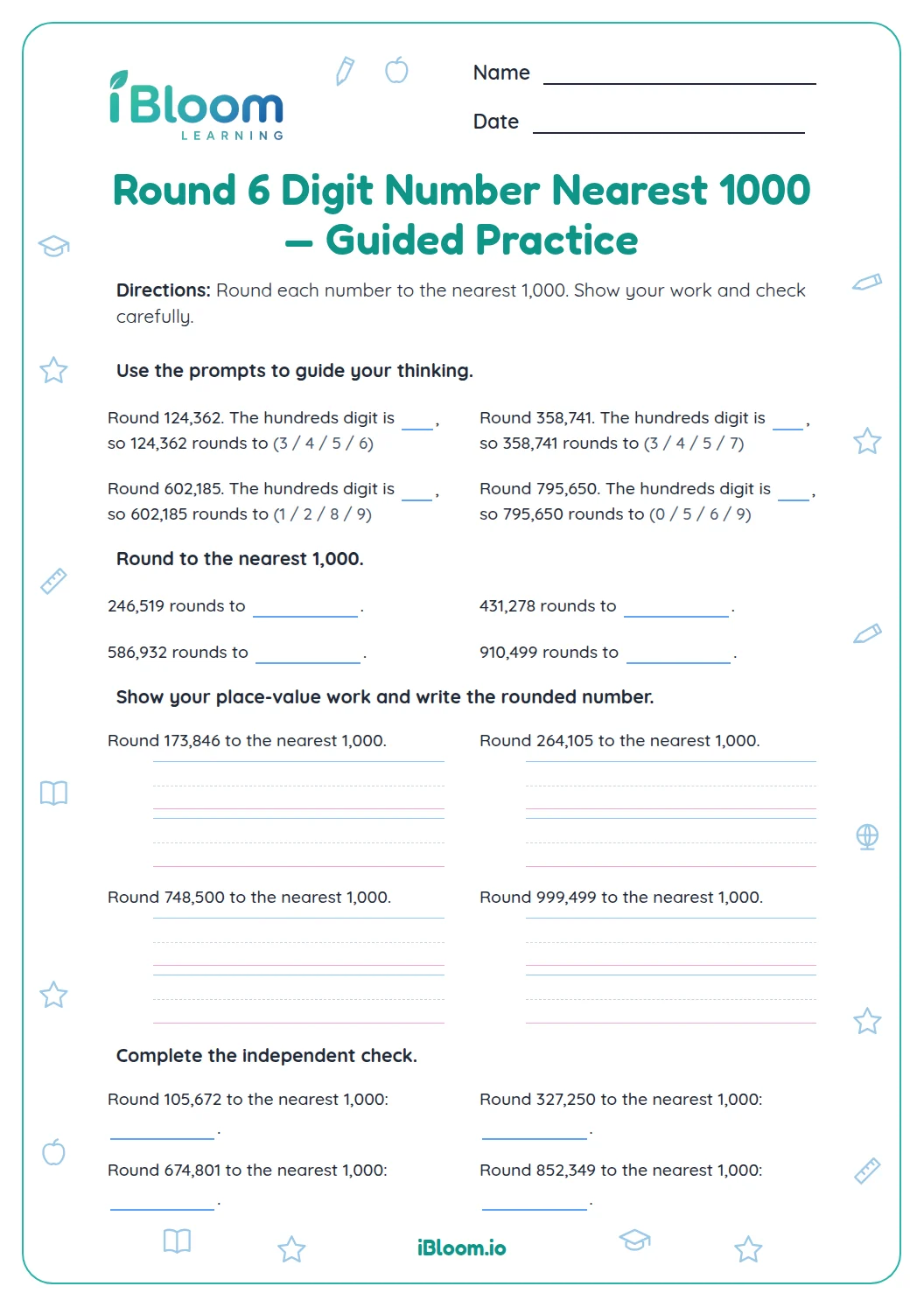
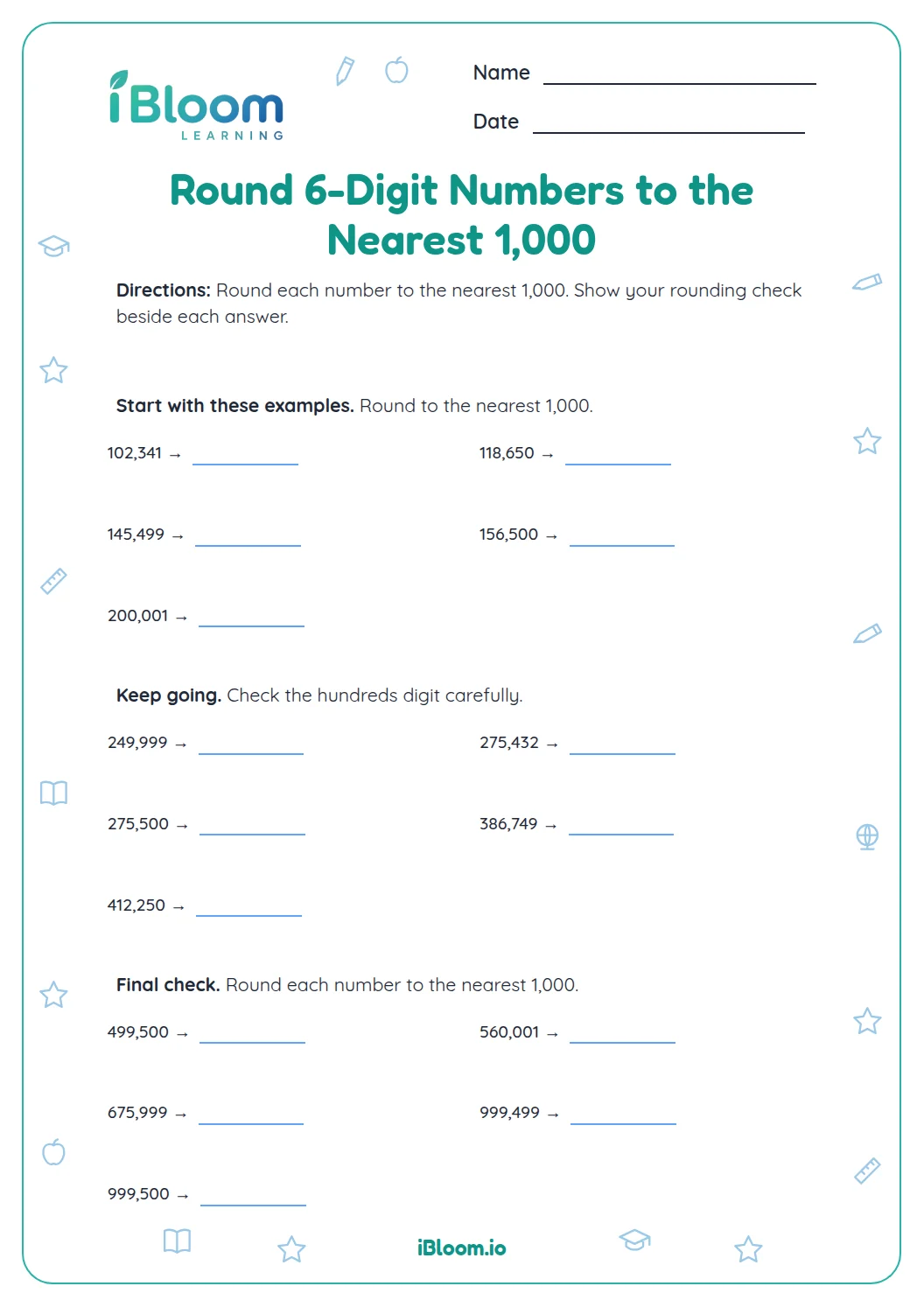
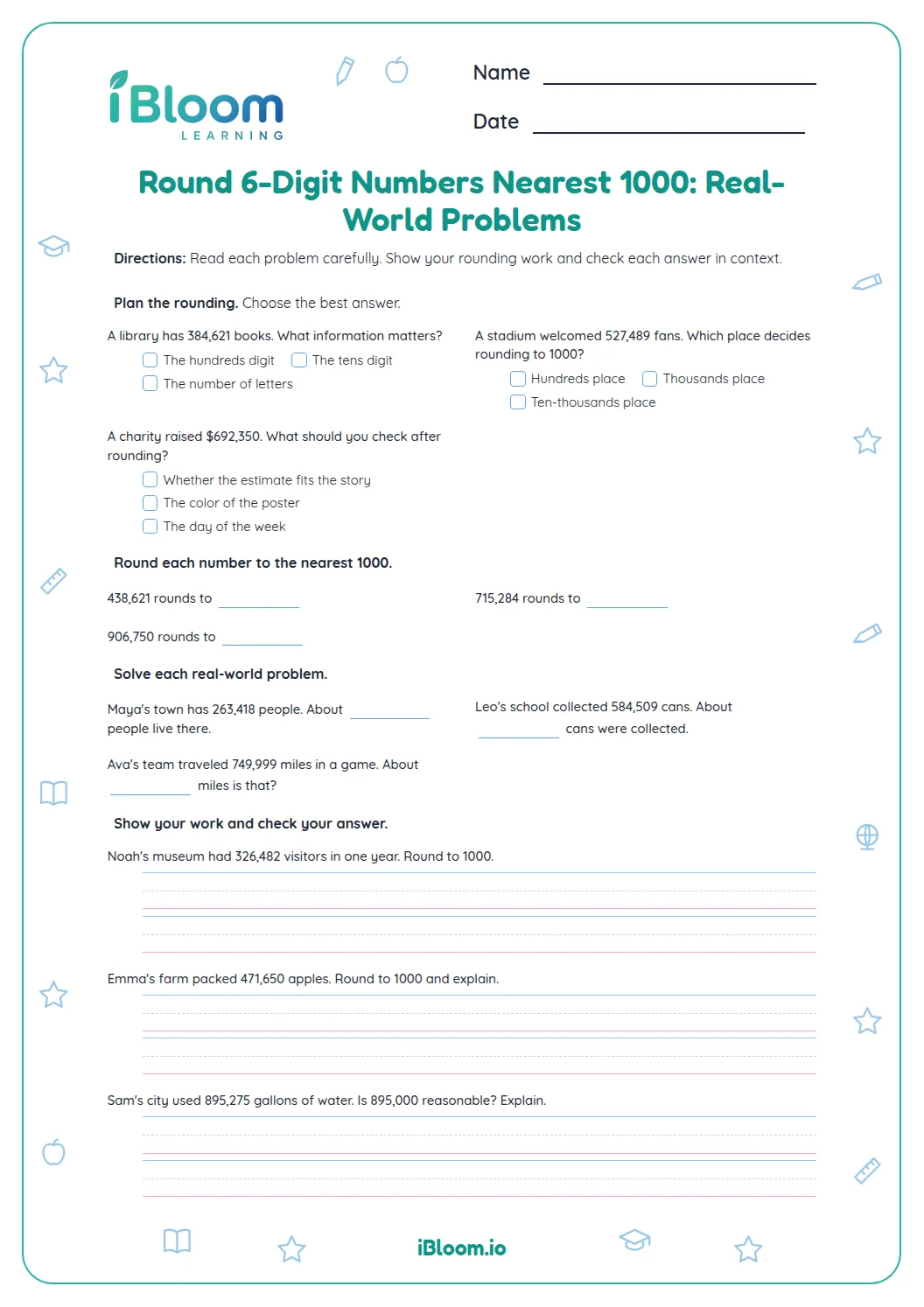
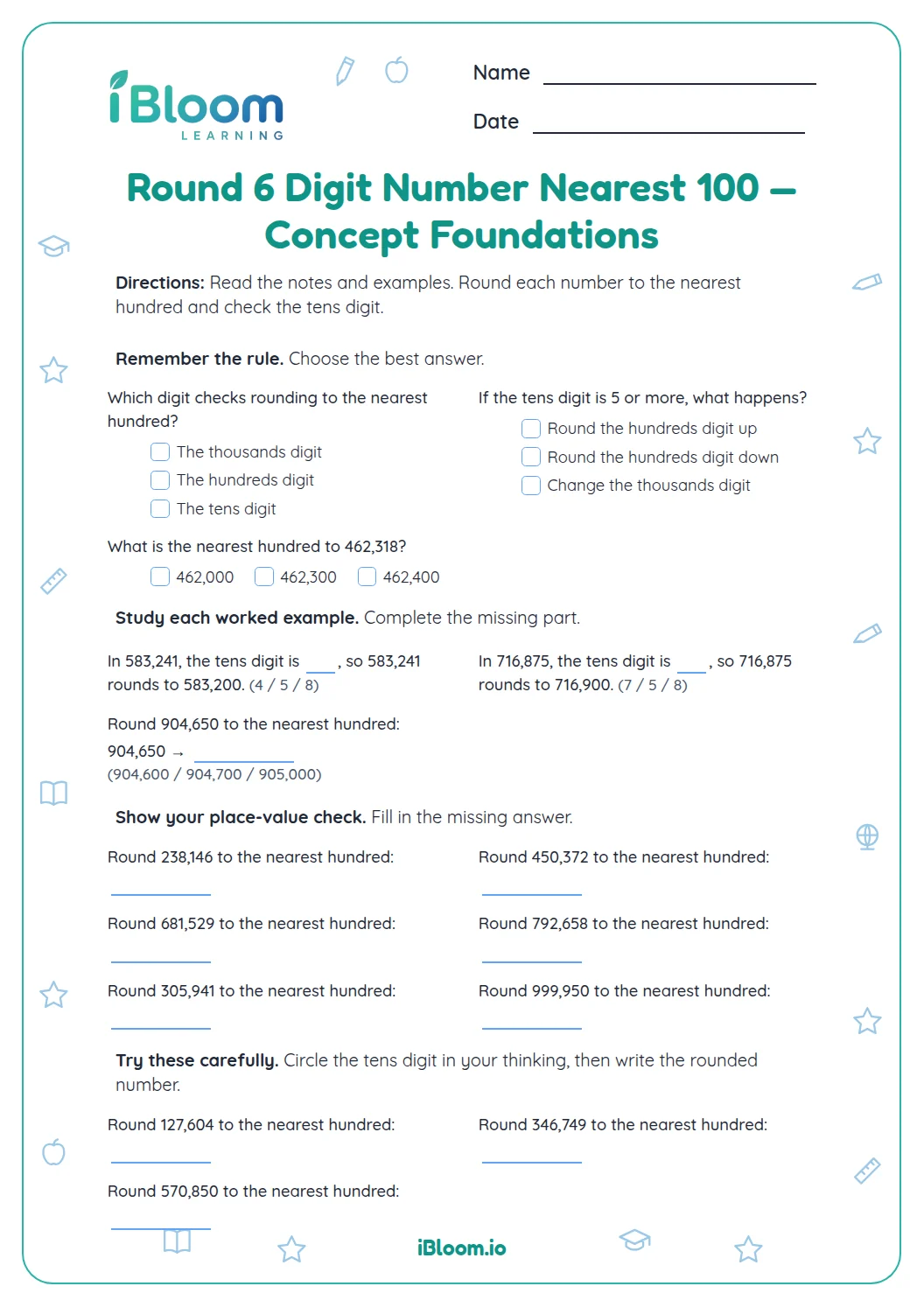
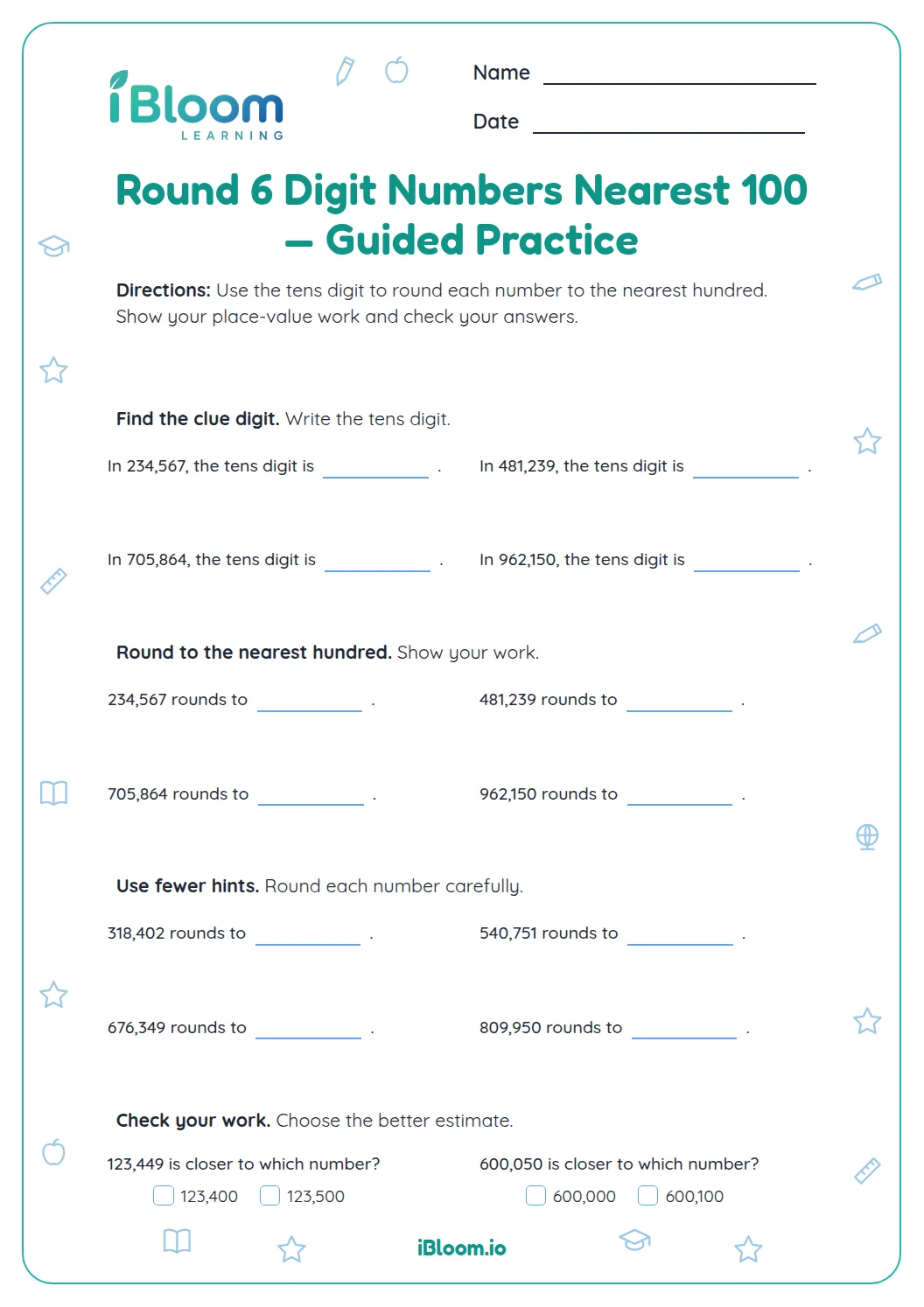
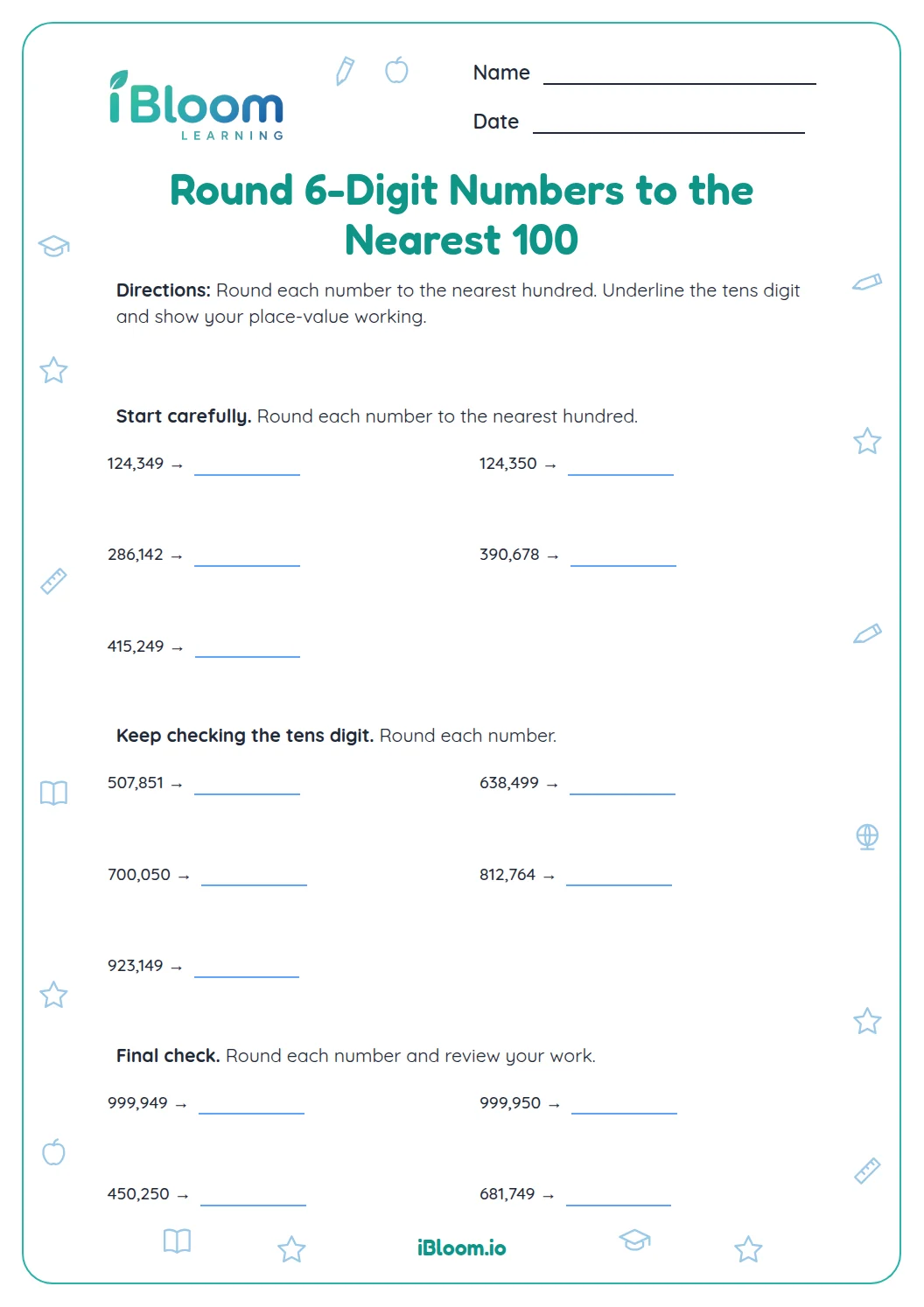
This Grade 5 worksheet gives students 14 chances to round six-digit whole numbers to the nearest 1,000. In Part A, number lines run between consecutive thousands and place a point for students to compare with the halfway mark. Part B asks for direct rounding, including an exact halfway case. The answer key lists all rounded values. The practice aligns with CCSS 4.NBT.A.3, which calls for using place-value understanding to round multi-digit whole numbers.
Aligned to 4.NBT.A.3
How do the number lines model rounding?
Each line shows consecutive thousands, divided into hundreds, with point A marking a six-digit number. The halfway point is 500 above the lower thousand. A point to the left rounds down; a point at or to the right rounds up.
- 1For 123,421, point A is between 123,000 and 124,000.
- 2The halfway value is 123,500. Point A is below it.
- 3So 123,421 rounds to 123,000.
Which digit controls rounding to a thousand?
The hundreds digit tells whether the number is below, at, or above the halfway point. A hundreds digit from 0 through 4 keeps the thousands digit; 5 through 9 increases it by one. Digits to the right of the thousands place become zeros.
What happens at the halfway point?
When the hundreds digit is 5, the number is halfway or above, so round to the next thousand. For 329,500, the hundreds digit is 5 and the answer is 330,000.
How to use this worksheet
- 1Locate the thousands and hundreds digits.
- 2On a number line, find the midpoint between the labeled thousands.
- 3Compare point A with that midpoint.
- 4If rounding directly, use the hundreds digit: 0–4 down, 5–9 up.
- 5Write the nearest thousand with zeros in the lower places, then check the key.
Common mistakes and quick fixes
The mistake
Rounding down when the hundreds digit is 5.
The fix
Treat 5 as halfway and round up to the next thousand.
The mistake
Changing only the hundreds digit and leaving nonzero tens or ones.
The fix
After choosing the thousand, write zeros in the hundreds, tens, and ones places.
The mistake
Reading point A as the answer instead of the nearest thousand.
The fix
Use point A to compare with the midpoint, then select one of the line’s endpoint thousands.
Common Core alignment
Use place value to round six-digit whole numbers to the nearest thousand.
On this sheet: Every item rounds a six-digit whole number to the nearest thousand; the lines mark consecutive thousands and show a number between them.
Show the official wordingHide the official wording
Use place value understanding to round multi-digit whole numbers to any place.
What to practice next
Make more practice
Further reading
Questions parents and teachers ask
How do I round a six-digit number to the nearest thousand?
Find the thousands digit and look at the hundreds digit. If the hundreds digit is 5 or greater, increase the thousands digit by one; if it is 4 or less, keep it. Replace the digits to the right with zeros.
What does the number line show?
Each number line runs from one thousand to the next in steps of 100, with point A marking the number to round. The midpoint is 500 above the lower thousand. Compare the point with that halfway location to choose the closer thousand.
What happens when a number is exactly halfway?
A number exactly 500 above the lower thousand rounds up to the next thousand under the usual classroom rule. For example, 329,500 rounds to 330,000. Question 6 gives this exact halfway case. The midpoint is halfway between the two thousand endpoints on a number line.
Why do some answers end in three zeros?
Rounding to the nearest thousand gives a multiple of 1,000. The hundreds, tens, and ones become zeros, such as 184,276 rounding to 184,000. Those zeros show that the answer is an exact multiple of one thousand. They also make the rounded place value easy to read.
How is the answer key organized?
The separate answer key lists the closer thousand for each of the four number-line questions and the rounded value for all ten direct questions. For a line question, compare point A with the halfway mark first, then check whether the lower or upper thousand is nearer.
What should my child practice next?
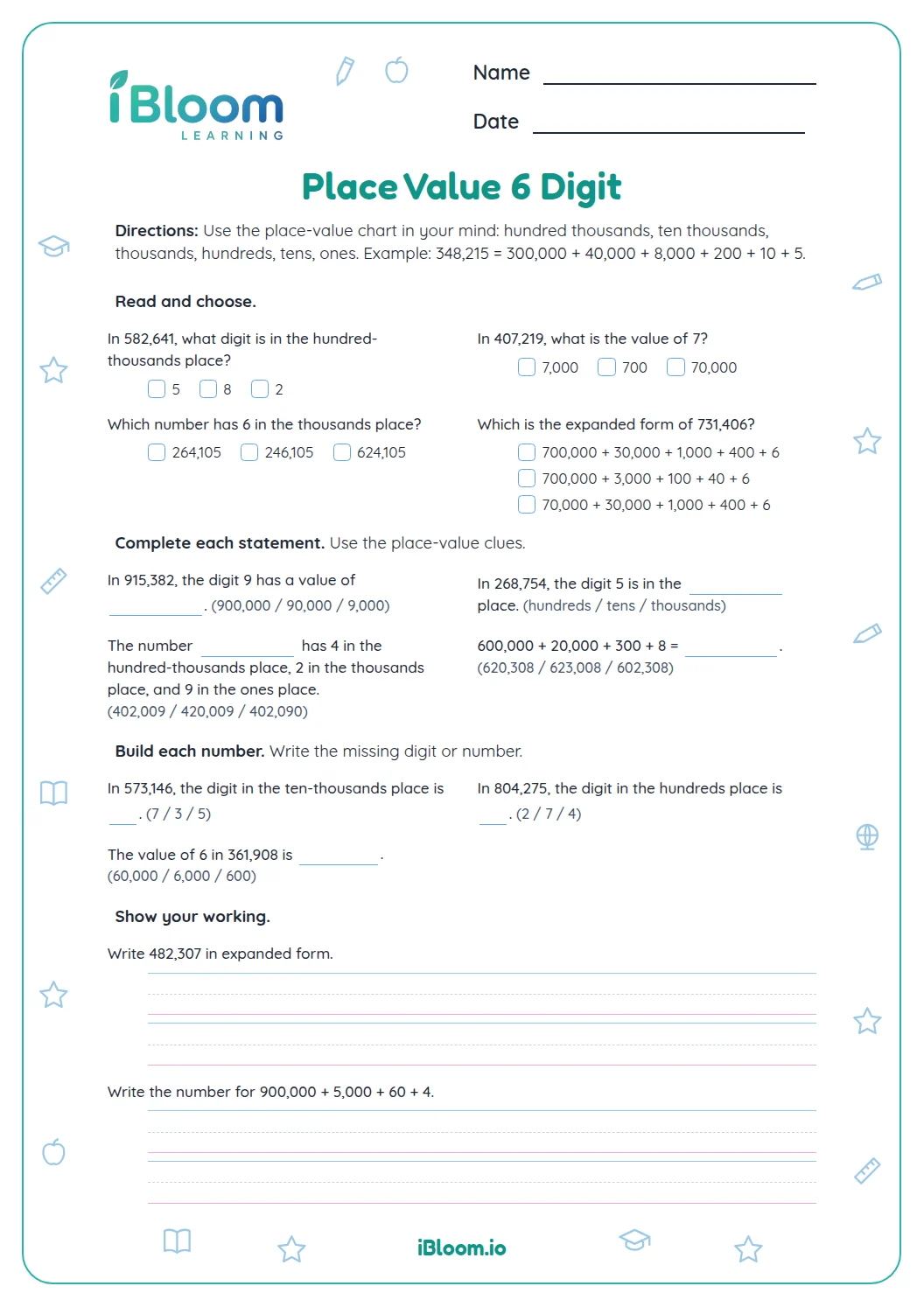
The linked nearest-100 worksheet keeps the six-digit numbers and changes the target place value. Mixed rounding asks learners to choose among target places, while six-digit place-value practice reviews the value of each digit. These pages extend the same place-value reasoning in a clear next step.