

About this worksheet
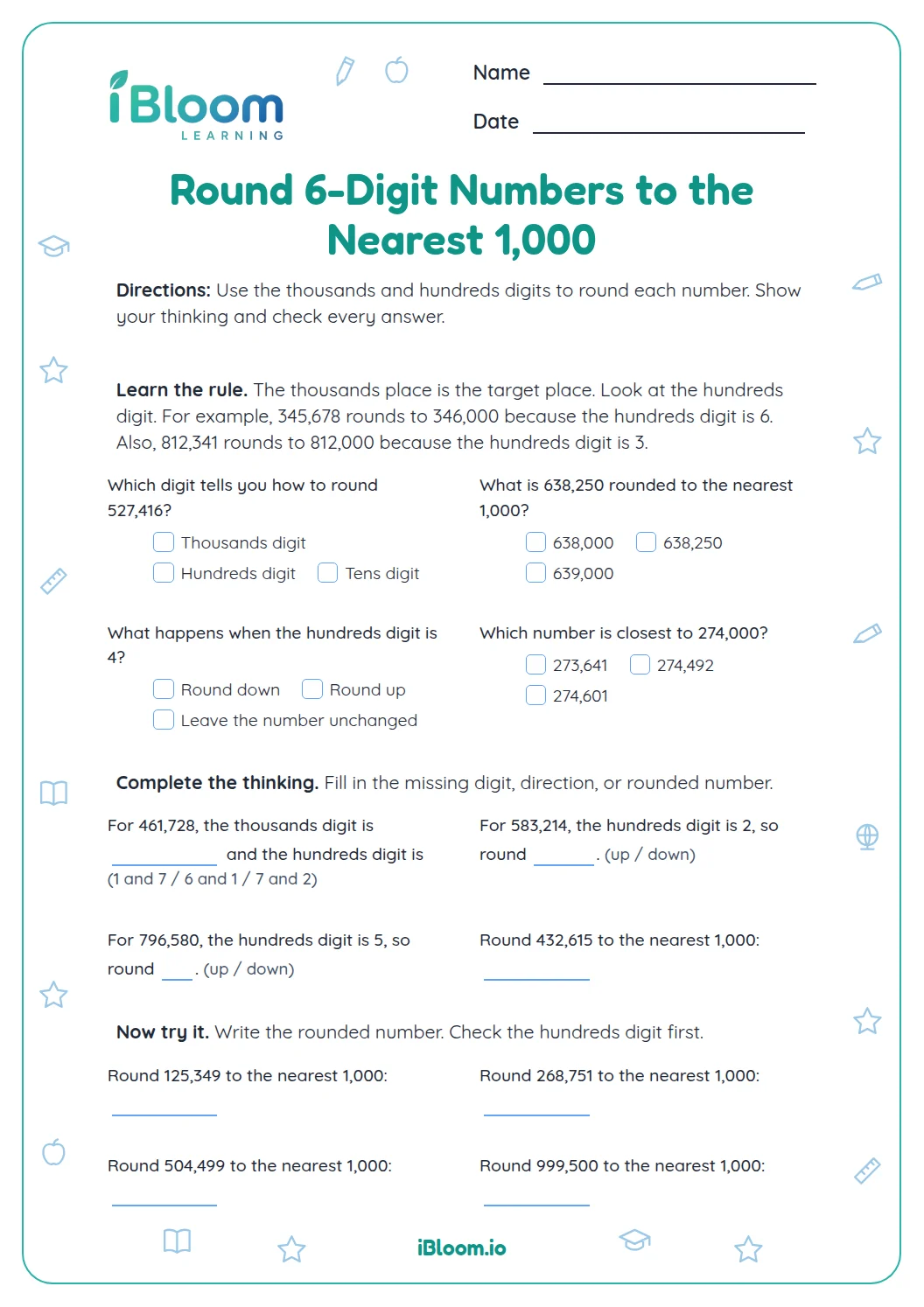
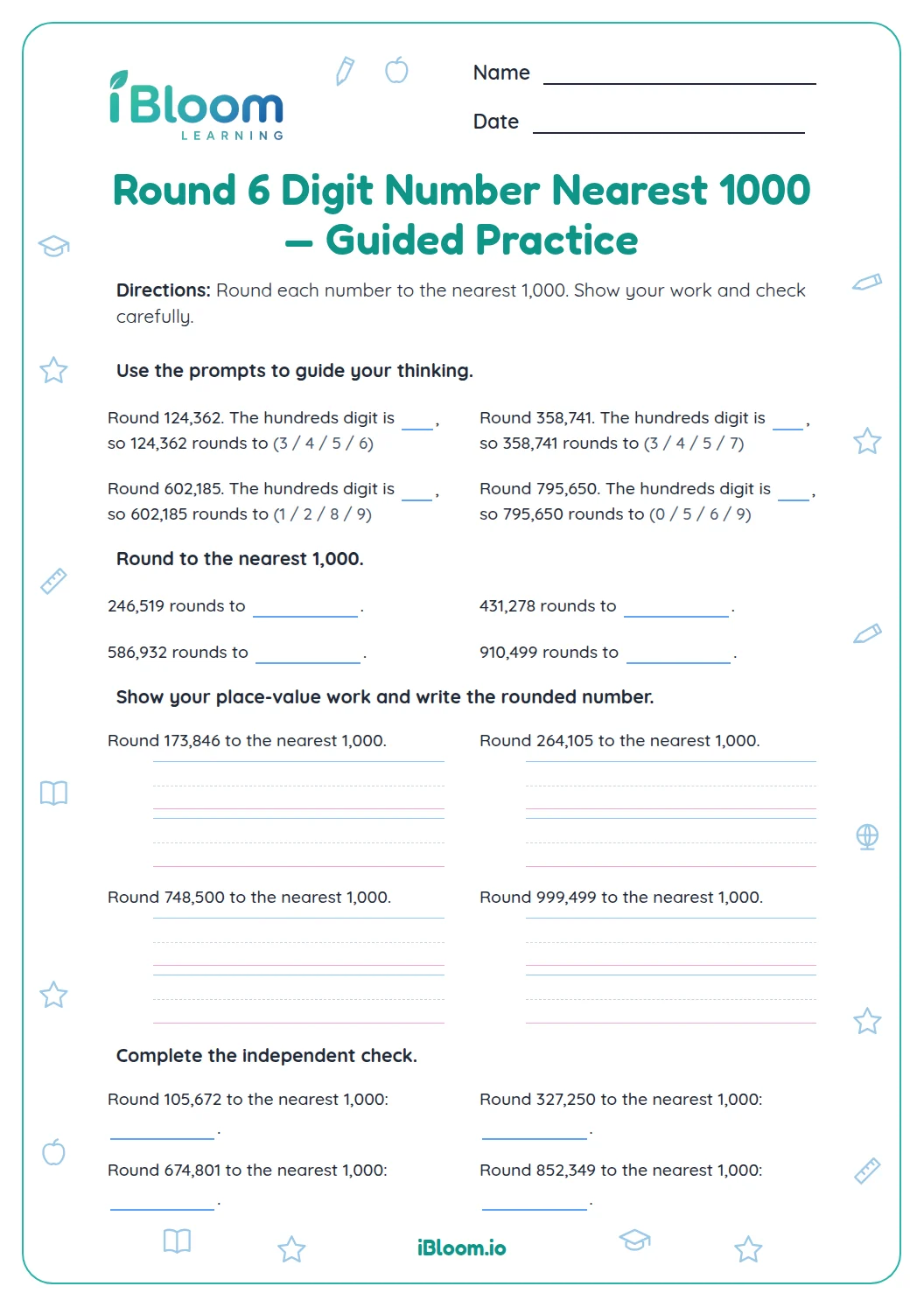
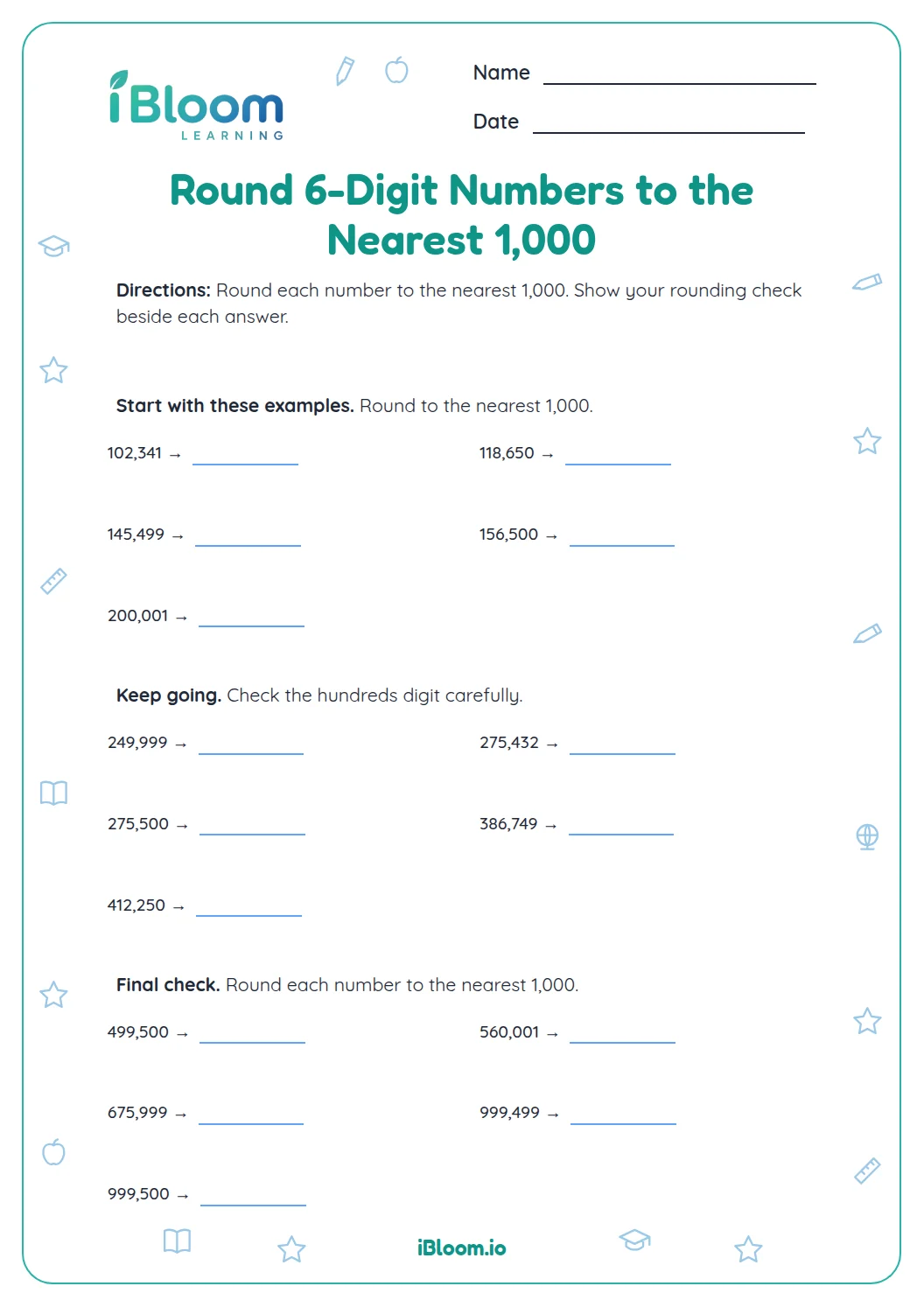
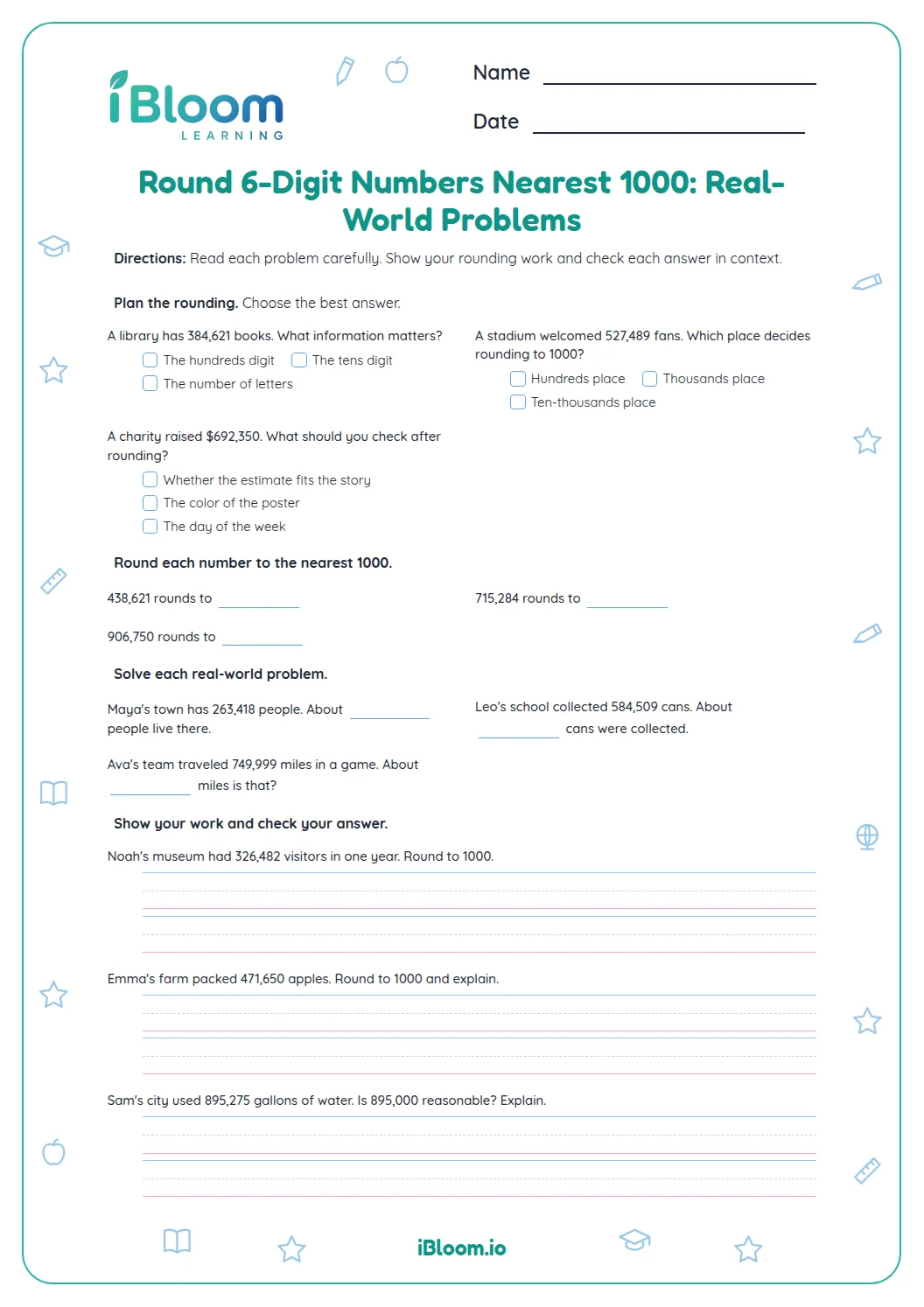
This free printable Grade 5 worksheet helps students round six-digit whole numbers to the nearest thousand. Across 16 questions, students choose estimates, complete rounding statements, explain a classmate’s error, identify boundary numbers, and apply rounding to visitor and population totals. The work aligns with CCSS 5.NBT.A.4: use place value understanding to round multi-digit whole numbers to any place. A separate answer key is included.
Aligned to 4.NBT.A.3
How do you round to the nearest thousand?
Look at the hundreds digit. If it is 0, 1, 2, 3, or 4, keep the thousands digit and change the digits to its right to zero. If it is 5, 6, 7, 8, or 9, increase the thousands digit by one.
For question 1, 348,621 has 6 in the hundreds place, so 348,000 increases to 349,000. The ten-thousands digit stays 4.
- 1348,621
- 2Hundreds digit: 6
- 3348,621 = 3 hundred-thousands, 4 ten-thousands, 8 thousands, 6 hundreds, 2 tens, 1 one
- 48 is at least 5, so round 348,000 up to 349,000.
What happens when a number is halfway?
A number ending in 500 is exactly halfway between two thousands. The usual whole-number rounding rule sends it to the greater thousand. For example, 231,500 rounds to 232,000, while 231,499 is one less and rounds to 231,000.
Questions 11 and 12 ask for the ends of the group that rounds to 420,000. The smallest is 419,500; the largest is 420,499.
How does rounding help with estimates?
Rounded totals are easier to compare and communicate when an exact count is not needed. In question 13, 286,735 is closer to 287,000 than to 286,000, so 287,000 is a sensible estimate.
Question 16 lets students create a number in the rounding interval for 368,000. Any whole number from 367,500 through 368,499 works.
How can students work through the sheet?
- 1Underline the thousands digit and circle the hundreds digit.
- 2Name the two neighboring thousands before deciding which is closer.
- 3Use the hundreds digit to choose down or up, then change the lower digits to zero.
- 4For midpoint questions, apply the rule that 500 rounds up.
- 5When asked to explain, include the key digit and the rounded result.
- 6Check each estimate against both neighboring thousands.
Rounding errors to watch for
The mistake
Looking at the tens digit instead of the hundreds digit.
The fix
Point to the digit three places to the right of the thousands place.
The mistake
Changing the ten-thousands digit when rounding to a thousand.
The fix
Keep places left of the thousands place unless the thousands digit rolls over 9; set lower digits to zero.
The mistake
Treating 500 as rounding down because it is exactly halfway.
The fix
Use the stated whole-number rule: halfway and above rounds to the greater thousand.
Common Core alignment
This worksheet practices rounding whole numbers using place value.
Students use place value to round six-digit whole numbers to the nearest thousand.
On this sheet:
Show the official wordingHide the official wording
Use place value understanding to round multi-digit whole numbers to any place.
What to practice next
Make more practice
Further reading
Questions parents and teachers ask
What does “nearest thousand” mean?
The nearest thousand is the multiple of 1,000 closest to the number. For example, 348,621 lies between 348,000 and 349,000 and is closer to 349,000. Students can write both choices first, then mark which thousand is nearer by comparing the distance on each side.
Which digit decides rounding to the nearest thousand?
The hundreds digit decides whether to round down or up. The worksheet asks students to identify it in six-digit numbers, then explain why the result follows from that digit. A useful check is to name the thousands immediately below and above the original number before applying the rule.
Does 231,500 round up or down?
It rounds up to 232,000 under the usual whole-number rule. The hundreds digit is 5, so the number reaches the midpoint and rounds to the greater thousand. The answer key uses this same rule, so students can compare their place-value explanation with the worked result afterward.
What numbers round to 420,000?
Whole numbers from 419,500 through 420,499 round to 420,000. The smallest is 419,500, and the greatest is 420,499; both endpoints are included. Students can confirm the endpoints by checking that 419,499 rounds to 419,000 and 420,500 rounds to 421,000.
How can I check a rounded answer?
Find the two neighboring thousands and compare the original number with their midpoint. Your answer should be the closer thousand, with exact halfway values rounding up. For instance, 286,735 is above the midpoint of 286,000 and 287,000, so 287,000 is the better estimate.
What is included in the answer key?
The key gives rounded results and sample explanations for open-ended items. For the create-a-number prompt, any whole number from 367,500 through 368,499 is correct. Students may choose any valid number in that interval, then check the hundreds digit to explain why it rounds as requested.