



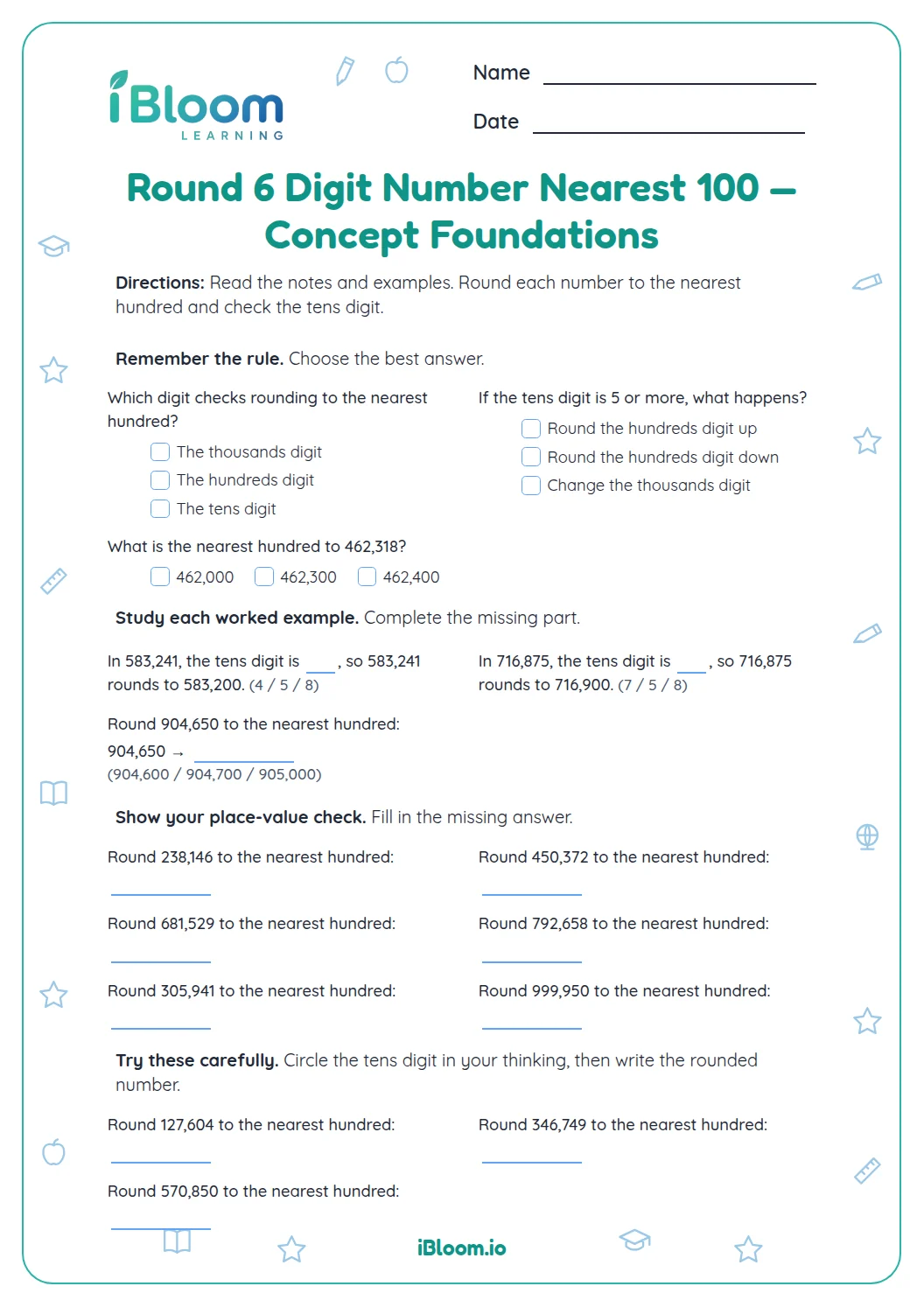
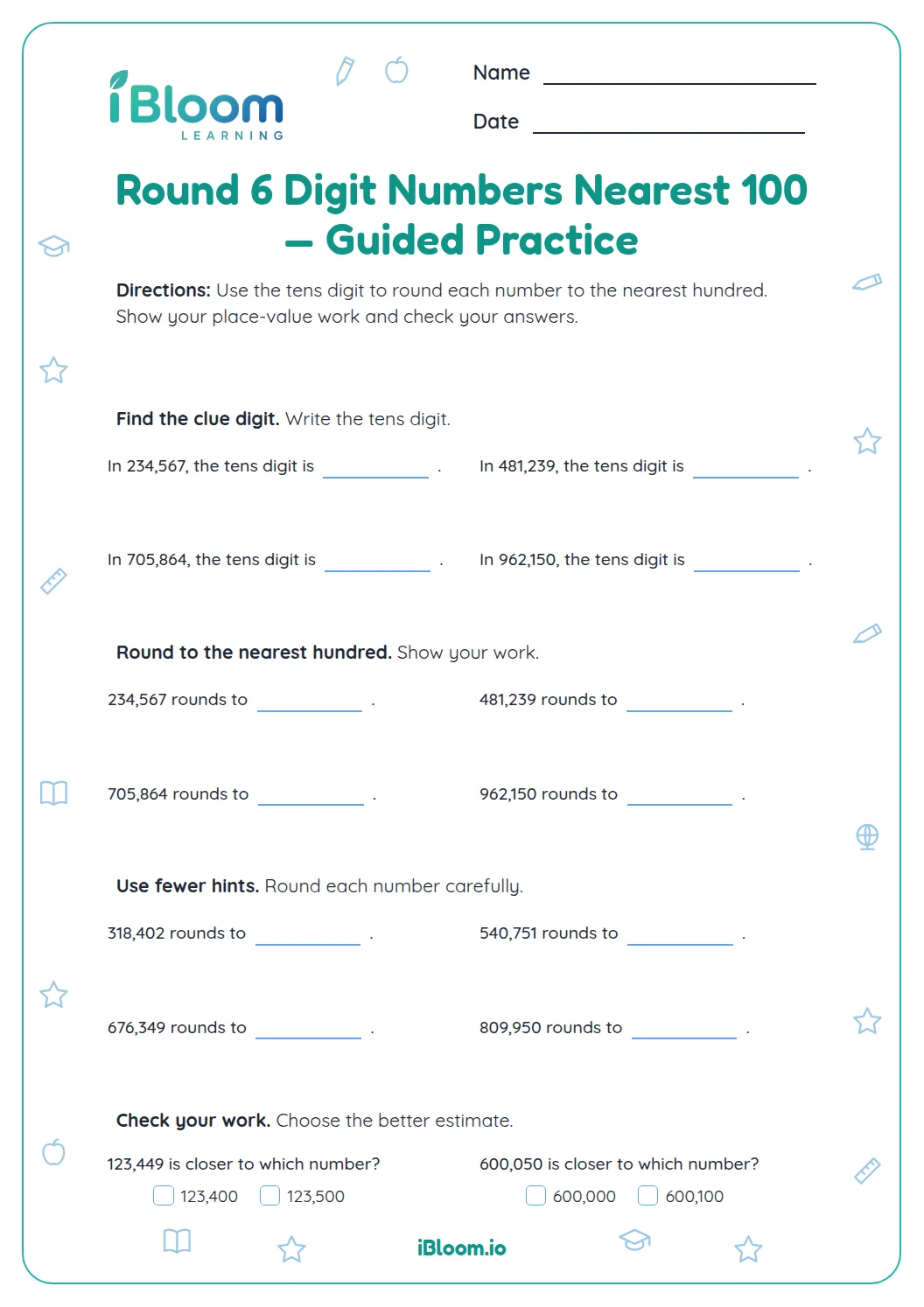

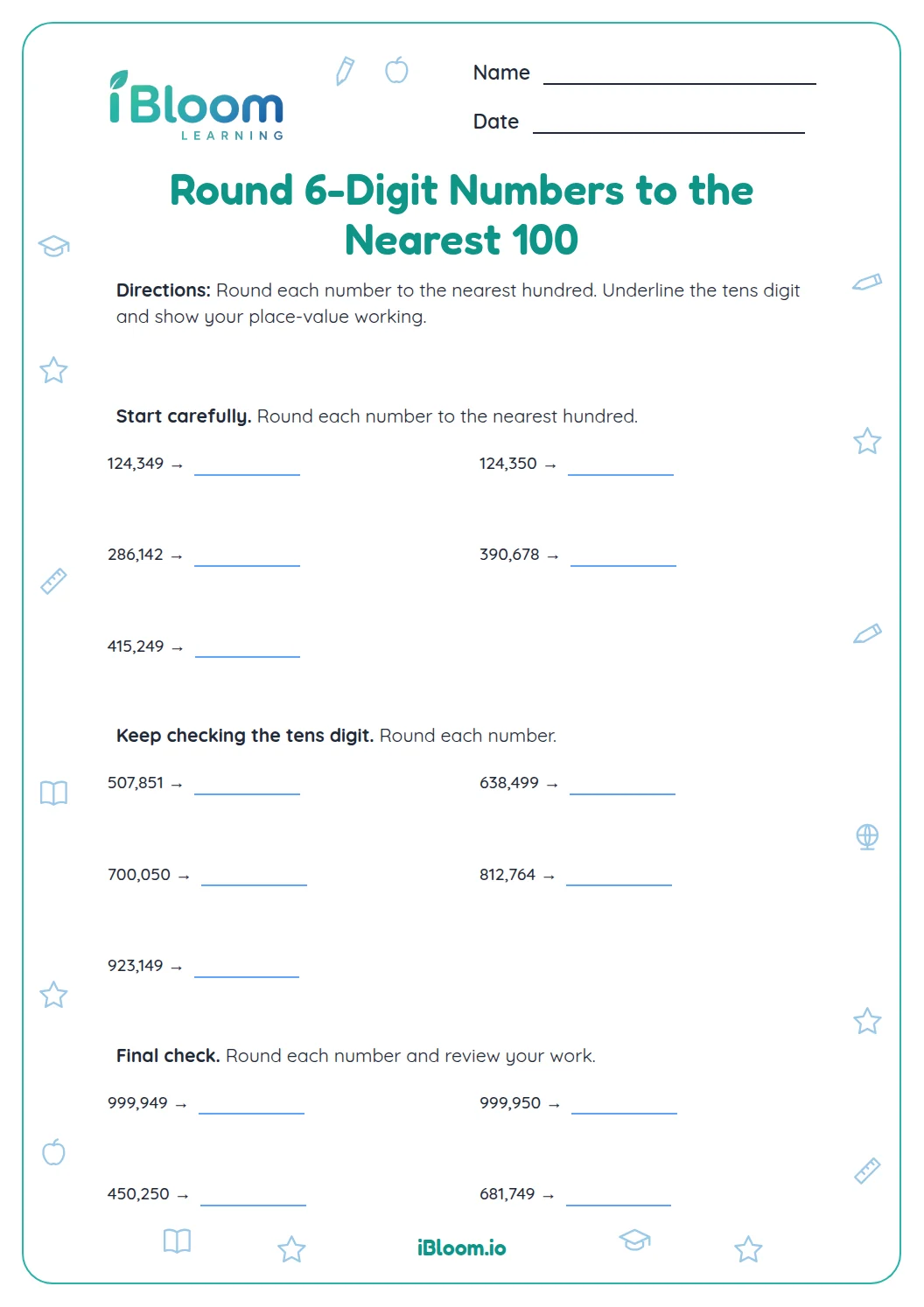
About this worksheet
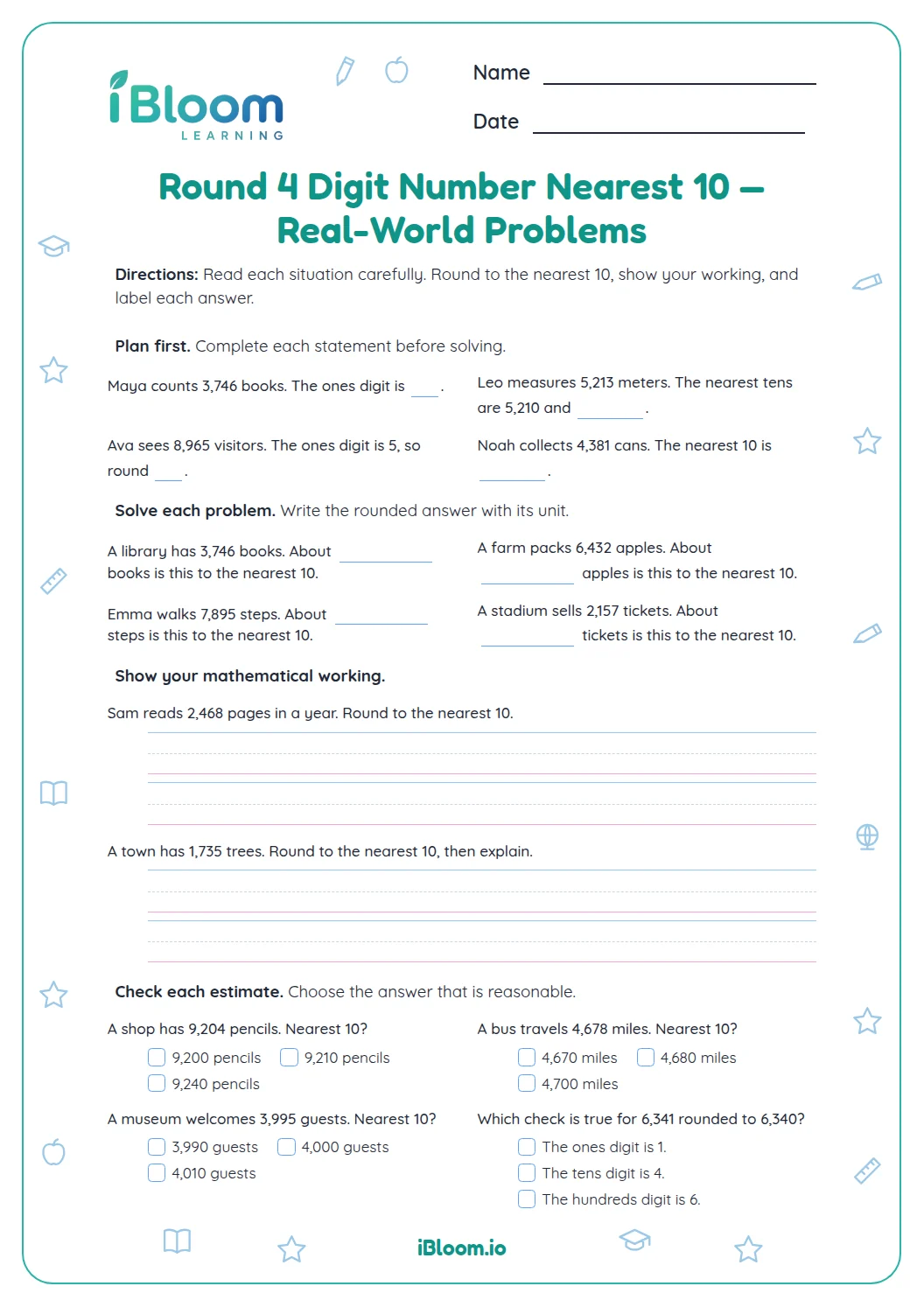
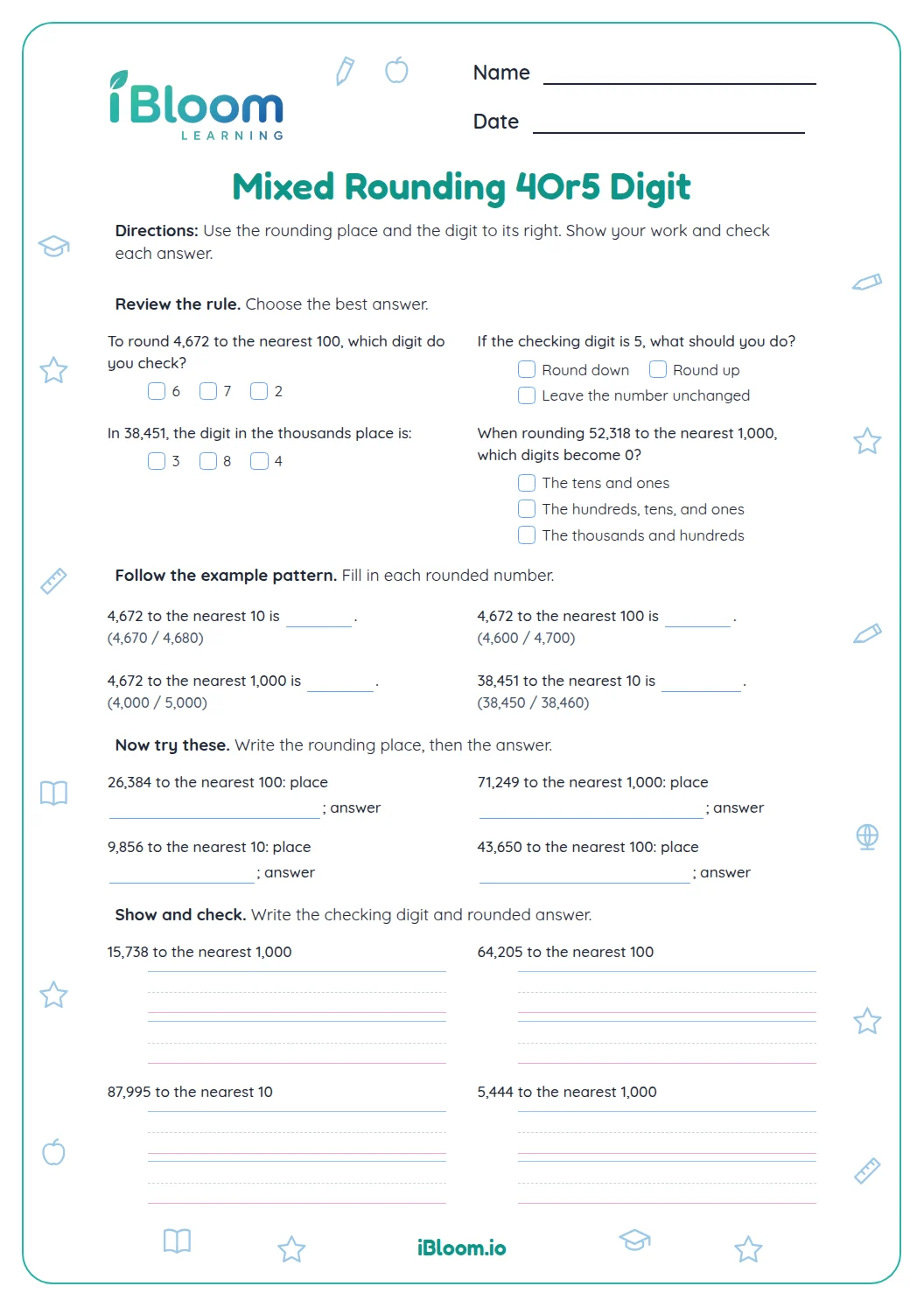
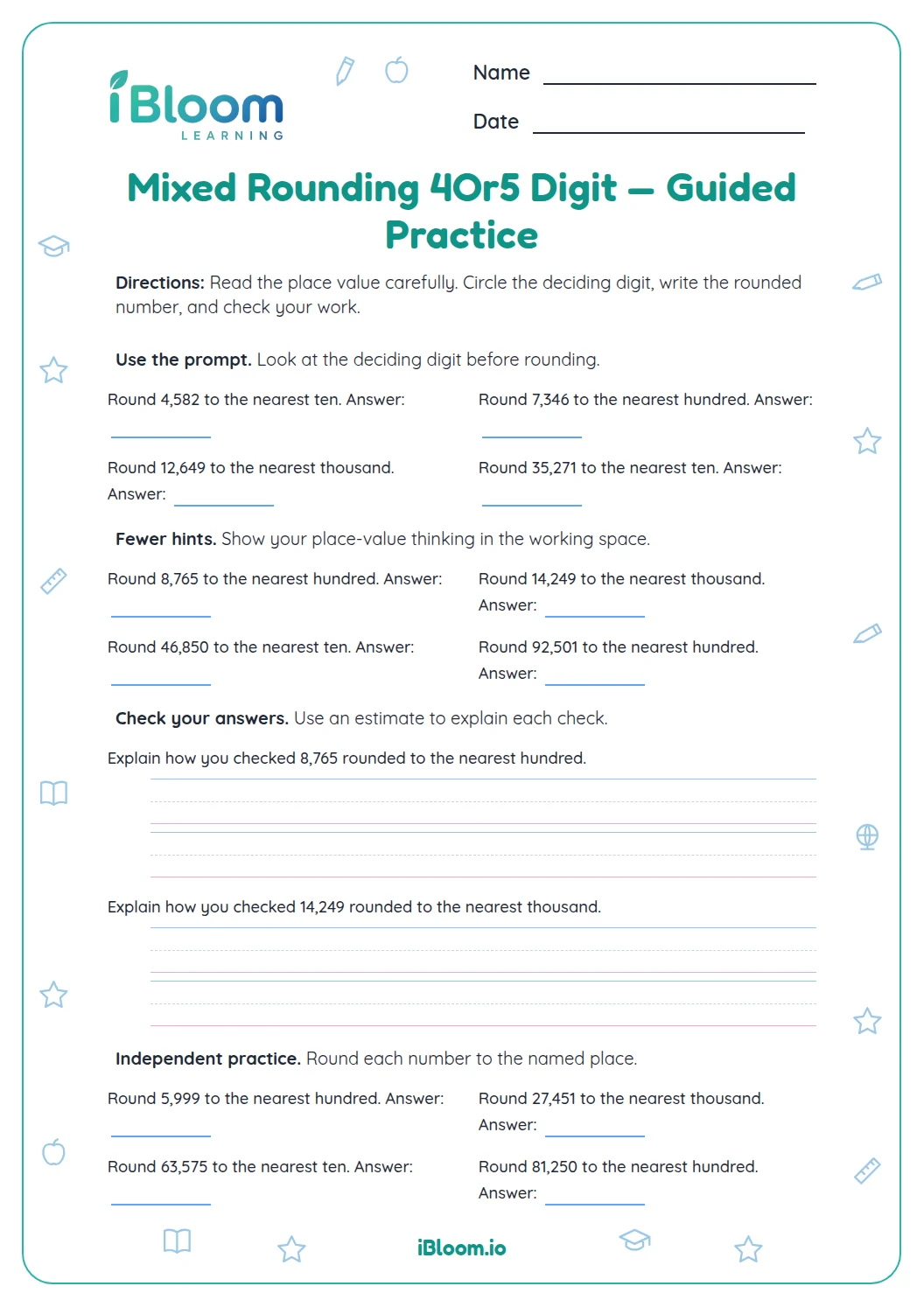
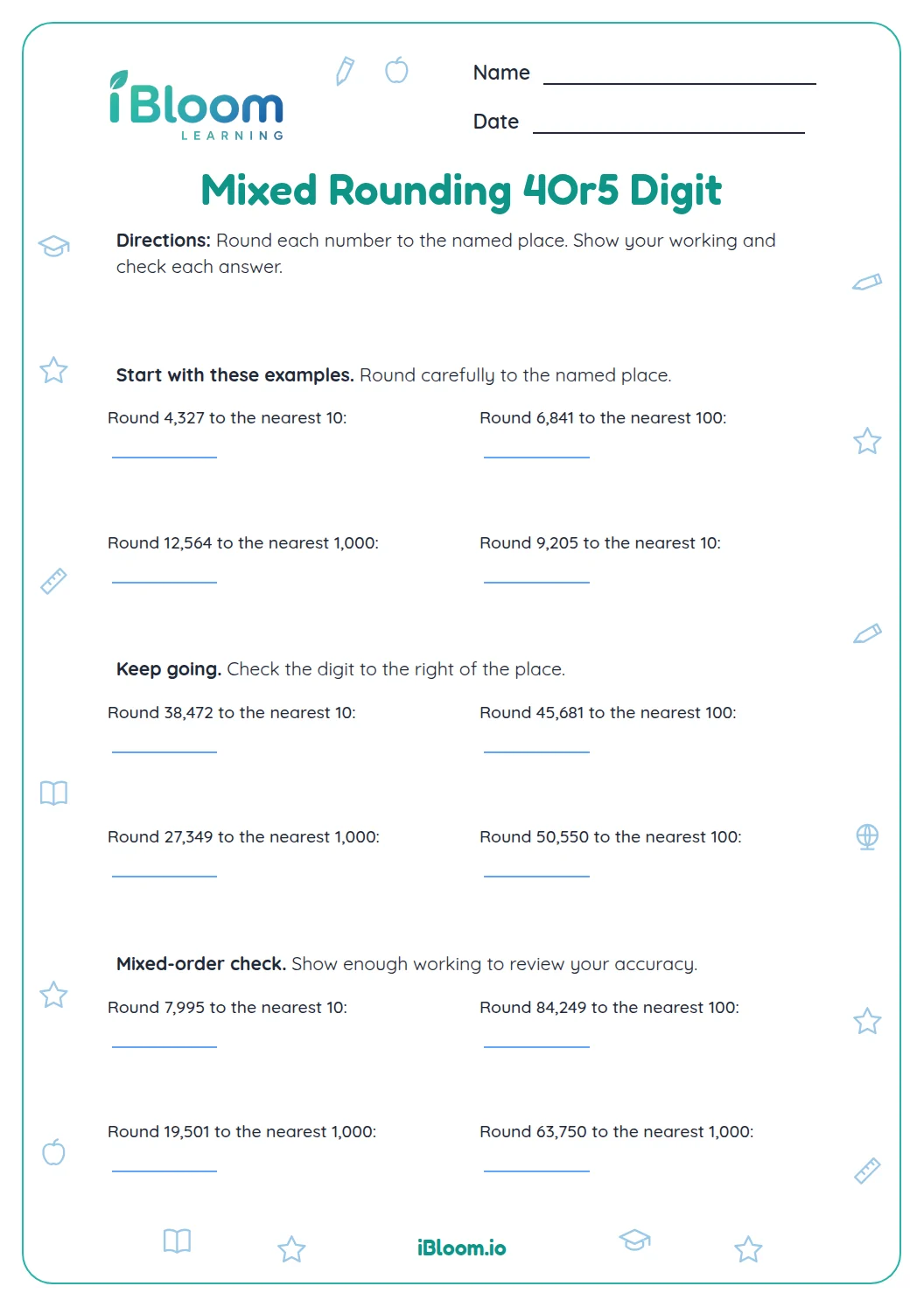
This free printable gives Grade 5 learners 16 questions on rounding four-digit whole numbers to the nearest ten. It starts with direct problems, then adds midpoint and regrouping cases, followed by multiple-choice error checks. The skill aligns with CCSS 4.NBT.A.3: use place-value understanding to round multi-digit whole numbers to any place. The worksheet and its separate answer key each have two pages.
Aligned to 4.NBT.A.3
Which digit tells you how to round to the nearest ten?
The ones digit decides whether to stay at the current ten or move to the next one. A ones digit from 0 through 4 rounds down; 5 through 9 rounds up. The rounded number ends in zero.
For question 3, 7,045 has a ones digit of 5. Round up to the next ten: 7,050.
- 17,045
- 2Ones digit: 5
- 3Round up to the next ten
- 47,045 rounds to 7,050
What happens when rounding crosses a group of tens?
If the target digit is 9 and the ones digit is 5 or more, the next ten may require regrouping. In 6,995, the nearest ten above is 7,000. Check the estimate by placing the original number between 6,990 and 7,000.
What kinds of problems appear on the sheet?
The 16 items include direct practice, midpoint and regrouping cases, and reasoning checks. Children write a rounded number for twelve items and choose a result in four checks.
- Part A: round six four-digit numbers
- Part B: round six more numbers, including ties and regrouping
- Part C: choose the correct rounding in four reasoning checks
- Separate answer key included.
How to use this worksheet
- 1Underline the ones digit in each number.
- 2If it is 0–4, keep the tens digit; if it is 5–9, add one ten.
- 3Replace the ones digit with 0.
- 4Check midpoint items and regrouping across 9s.
- 5Use the answer key to explain any corrected mistake.
Common mistakes and quick fixes
The mistake
Looking at the tens digit instead of the ones digit
The fix
Circle the ones digit first; it decides the rounding direction.
The mistake
Leaving the original ones digit in the answer
The fix
A number rounded to the nearest ten ends in 0.
The mistake
Forgetting to regroup when the tens digit is 9
The fix
Add one ten, then carry through the hundreds or thousands as needed.
Common Core alignment
Use place value to round multi-digit whole numbers to a requested place.
On this sheet: Each problem rounds a four-digit whole number to the nearest ten.
Show the official wordingHide the official wording
Use place value understanding to round multi-digit whole numbers to any place.
What to practice next
Make more practice
Further reading
Questions parents and teachers ask
What is the rounding rule for the nearest ten?
Look at the ones digit. If it is 0, 1, 2, 3, or 4, keep the tens digit and change the ones digit to zero. If it is 5, 6, 7, 8, or 9, add one ten and change the ones digit to zero.
How does the sheet handle a ones digit of 5?
A ones digit of 5 rounds up to the next ten. For example, 7,045 is halfway between 7,040 and 7,050, so it rounds to 7,050. The rule on this sheet sends a midpoint upward, as in the standard place-value practice.
What is the answer to the 6,995 question?
6,995 rounds to 7,000. The ones digit is 5, so increase the tens place by one. The carry passes through the 9s, which makes this a useful check that rounding can change more than the ones digit. The carry moves through the neighboring place values.
Why does 3,478 round to 3,480?
The ones digit is 8, so increase the tens digit from 7 to 8 and replace the ones digit with 0. The nearest tens around 3,478 are 3,470 and 3,480; 3,478 is only 2 away from 3,480. Compare the distance to the ten just below and above.
How many questions are on the printable?
There are 16 questions in three parts: twelve direct rounding items and four multiple-choice reasoning checks. The printable and its separate answer key each have two pages. The set includes midpoint cases and regrouping, including 6,995 rounding to 7,000.
What can learners practice after this sheet?
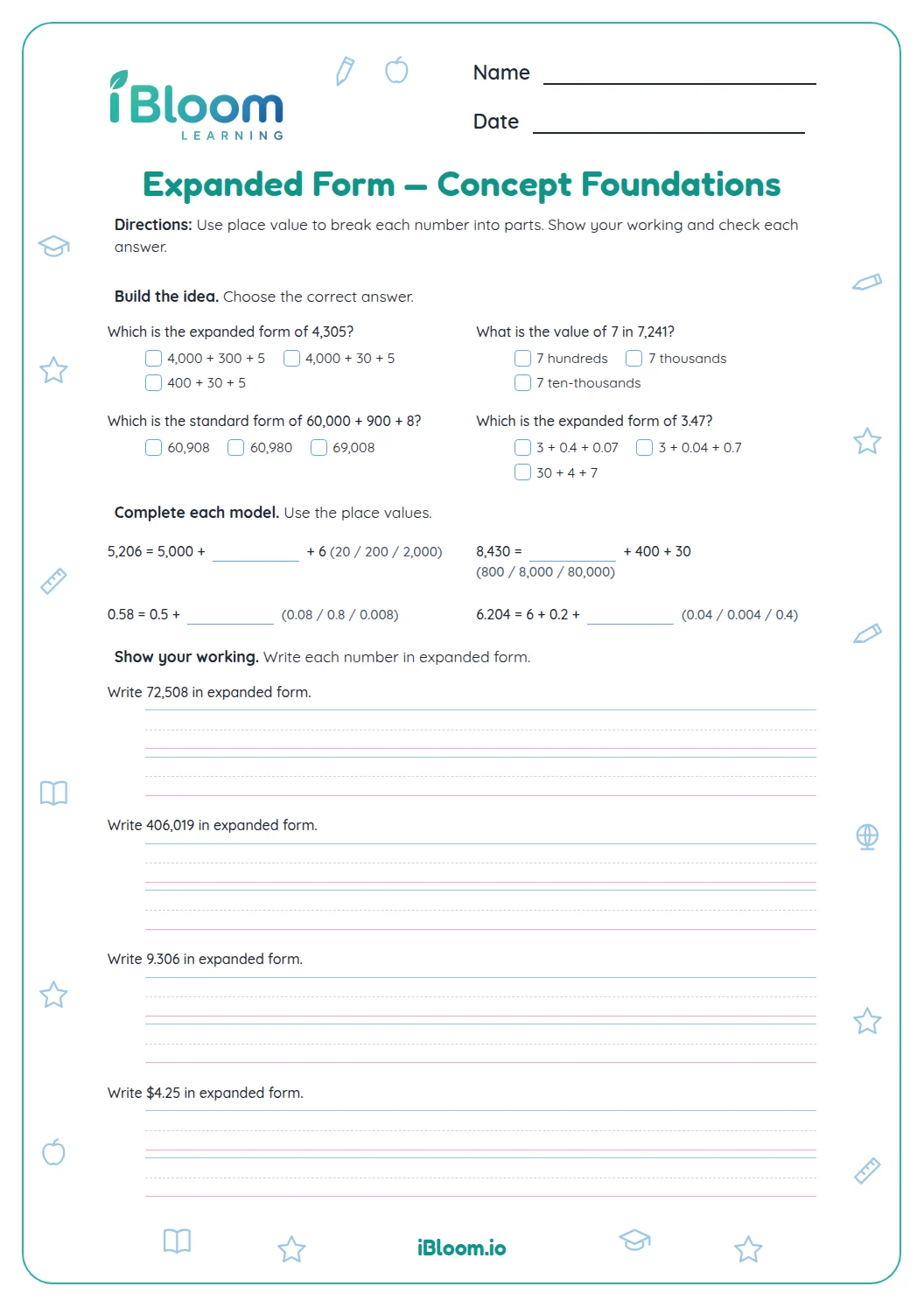
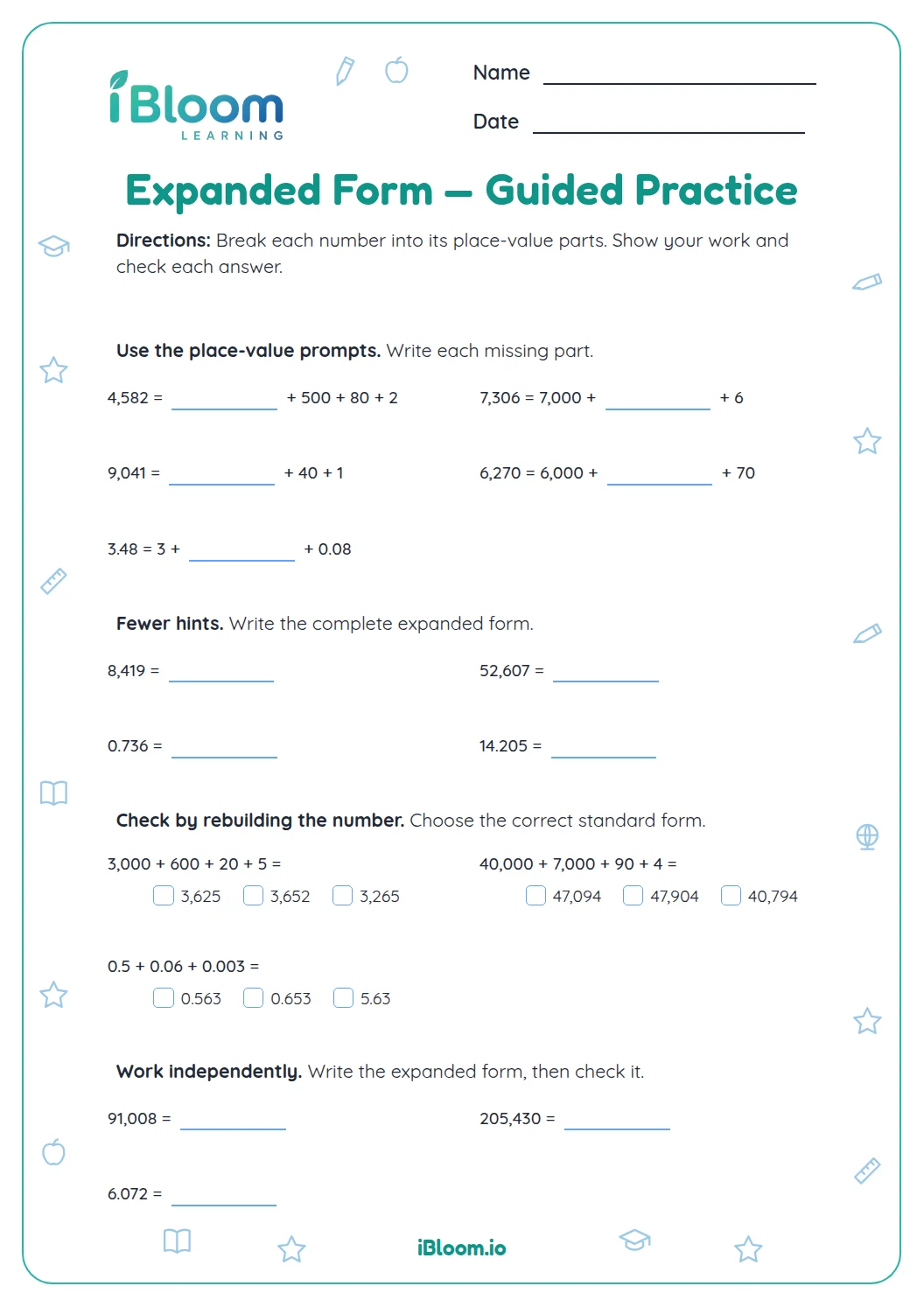
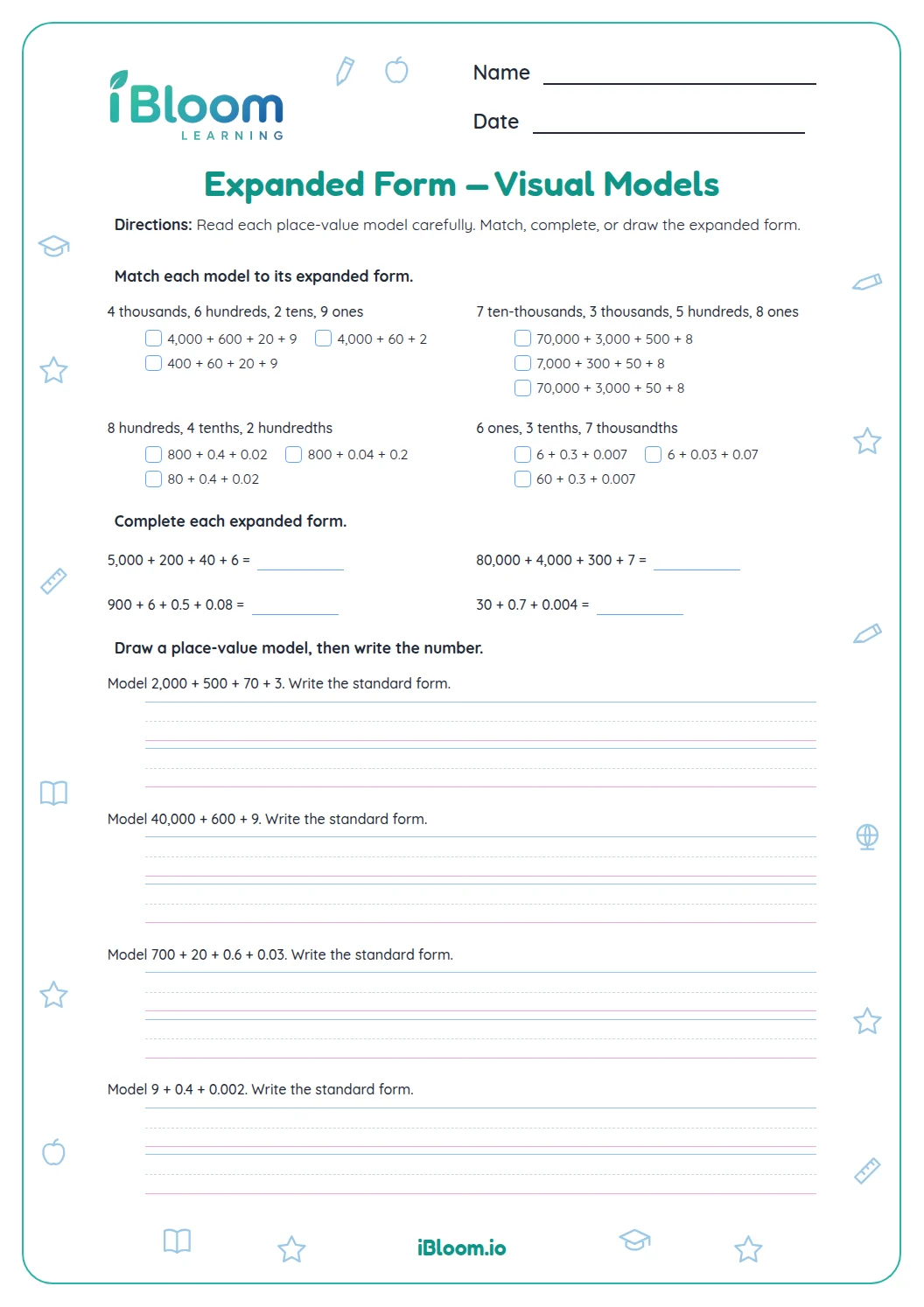
They can review expanded form and digit values, then apply rounding to larger numbers or other place values. Those next steps keep the same idea—use the digit to the right of the target place—while changing the number or place being rounded.