



About this worksheet
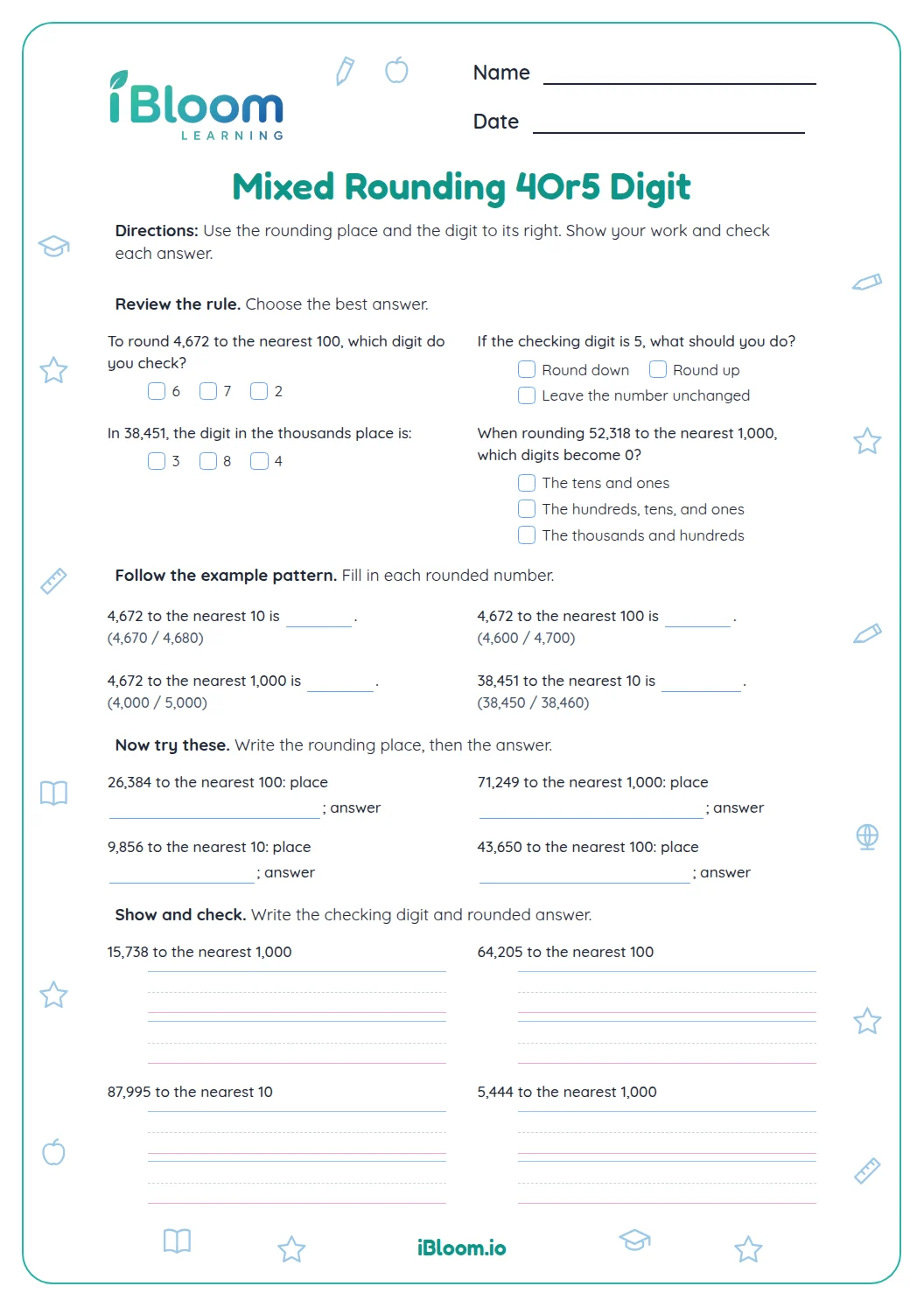
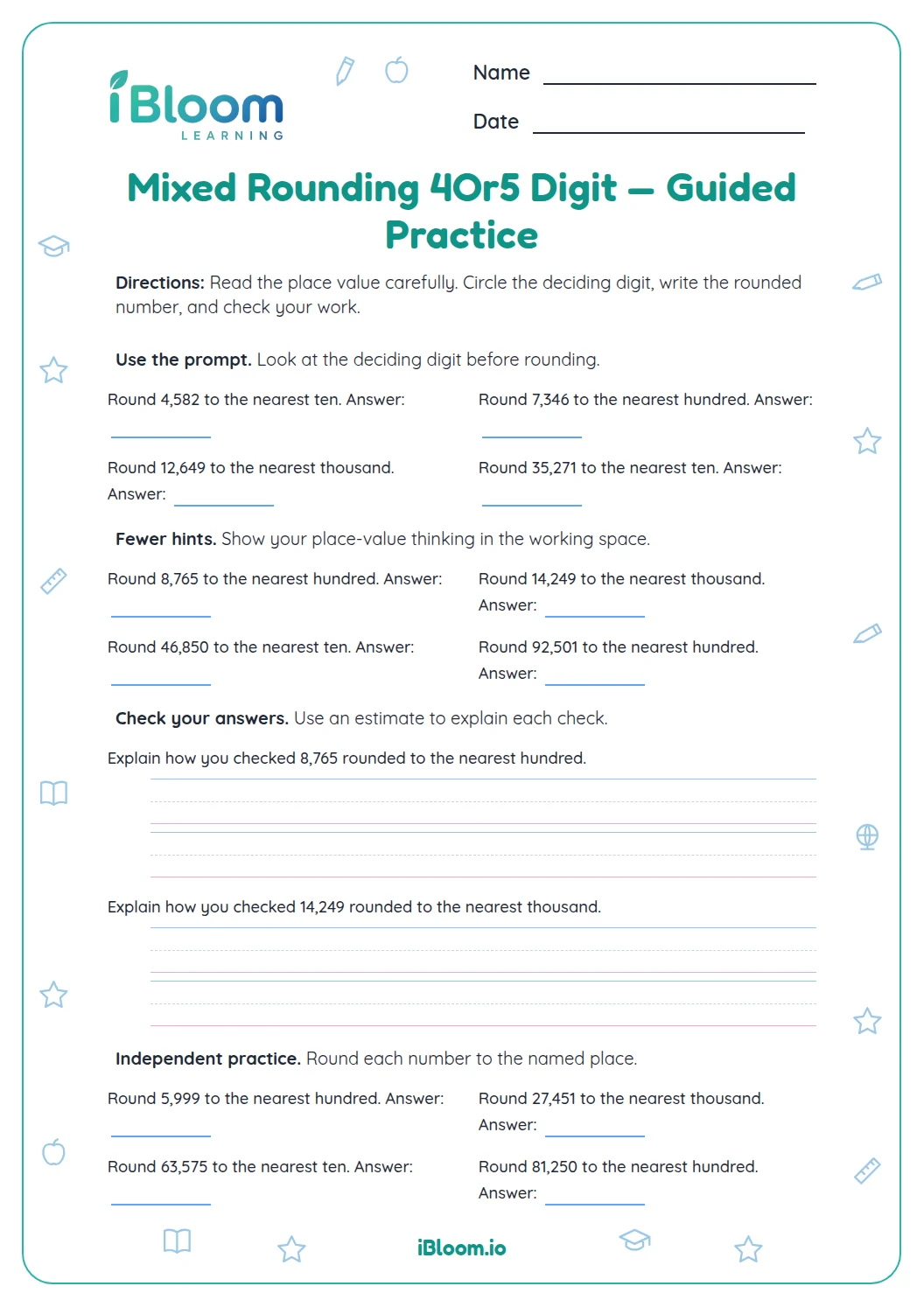
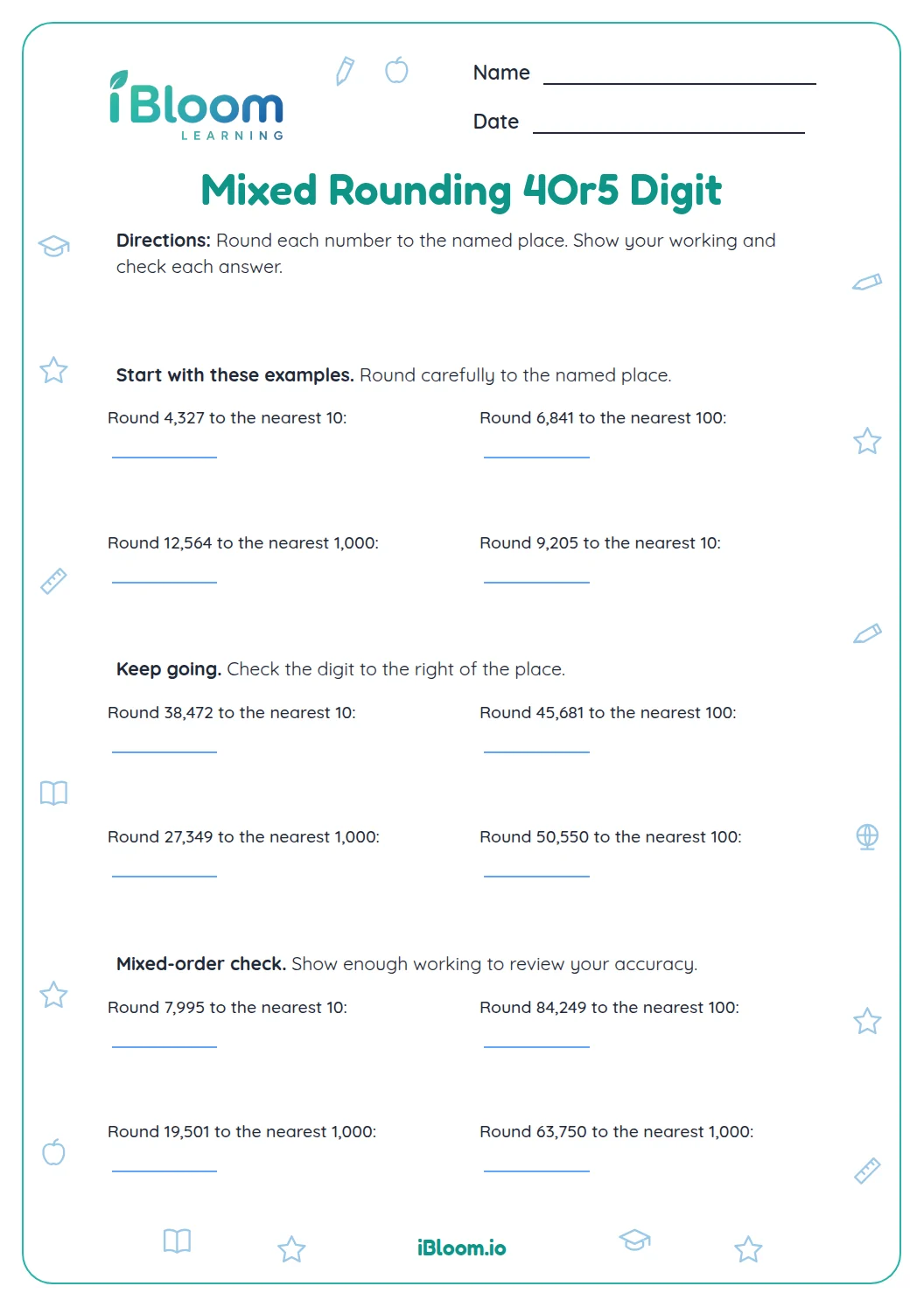
This Grade 5 printable gives 16 mixed practice questions on rounding four- and five-digit whole numbers to the nearest ten, hundred, or thousand. Learners read number lines and use place value to choose the nearest benchmark. The separate answer key shows a response for each question. The practice connects to Common Core 4.NBT.A.3, which asks students to round multi-digit whole numbers to any place.
Aligned to 4.NBT.A.3
How do you decide which way to round?
First identify the place named in the question. Then inspect the digit immediately to its right: 0–4 keeps the target digit, and 5–9 increases it by one. The number lines make the two neighboring multiples visible.
- 1Round 43,826 to the nearest thousand.
- 243,826 is between 43,000 and 44,000. It is closer to 44,000, so the answer is 44,000.
What do the number lines help you see?
A number line places the original number between two possible rounded values. For 91,535 to the nearest hundred, compare 91,500 and 91,600; the number is 35 above the lower hundred and 65 below the upper hundred, so it rounds to 91,500.
What is on the worksheet?
Part A practices rounding four- and five-digit numbers to tens, hundreds, and thousands. Part B uses number-line comparisons for the same three place values. There are 16 questions total, and the key has one answer for each.
How to use this worksheet
- 1Read the target place before looking at the digits.
- 2Name the two neighboring multiples of that place.
- 3Check the digit right of the target place.
- 4Use the number line to compare distances when one is shown.
- 5Write the rounded value with zeros in the places to its right.
- 6Check all 16 responses with the answer key.
Common slips and quick fixes
The mistake
Rounding a number to the place of the last digit instead of the named place.
The fix
Underline the place named in the prompt before rounding.
The mistake
Looking at the target digit instead of the digit immediately to its right.
The fix
Use the next digit to decide whether the target digit stays or increases.
The mistake
Leaving nonzero digits to the right of the target place.
The fix
Replace every digit to the right of the rounded place with zero.
Common Core alignment
Round multi-digit whole numbers by using the value of the digit in the target place.
On this sheet: Each item rounds a four- or five-digit whole number to a named place.
Show the official wordingHide the official wording
Use place value understanding to round multi-digit whole numbers to any place.
What to practice next
Make more practice
Further reading
Questions parents and teachers ask
What does “nearest thousand” mean?
It means choosing the multiple of 1,000 closest to the number. For example, 43,826 lies between 43,000 and 44,000 and is closer to 44,000. The worksheet also practices rounding to tens and hundreds, so read the named place carefully each time.
How many questions are on the rounding worksheet?
There are 16 questions in two parts. Part A mixes rounding to tens, hundreds, and thousands; Part B continues with number-line comparisons. The separate answer key lists all 16 rounded values, so an adult can check the work after the learner finishes.
Why are some numbers shown on number lines?
A number line shows the two multiples that can be the rounded answer and where the original number falls between them. Compare the distances to decide which multiple is nearer. At a midpoint, the standard rounding rule sends the value to the greater multiple.
Does this page practice four- and five-digit numbers?
Yes. Every value has four or five digits, and the questions name tens, hundreds, or thousands as the target place. Learners use place value in each case; the number line is an extra visual aid for selected items.
What standard does this worksheet practice?
The questions practice Common Core 4.NBT.A.3: using place value understanding to round multi-digit whole numbers to any place. Students identify a target place and round a multi-digit value to the nearest ten, hundred, or thousand. The key also demonstrates the place-value rule used throughout the set.