

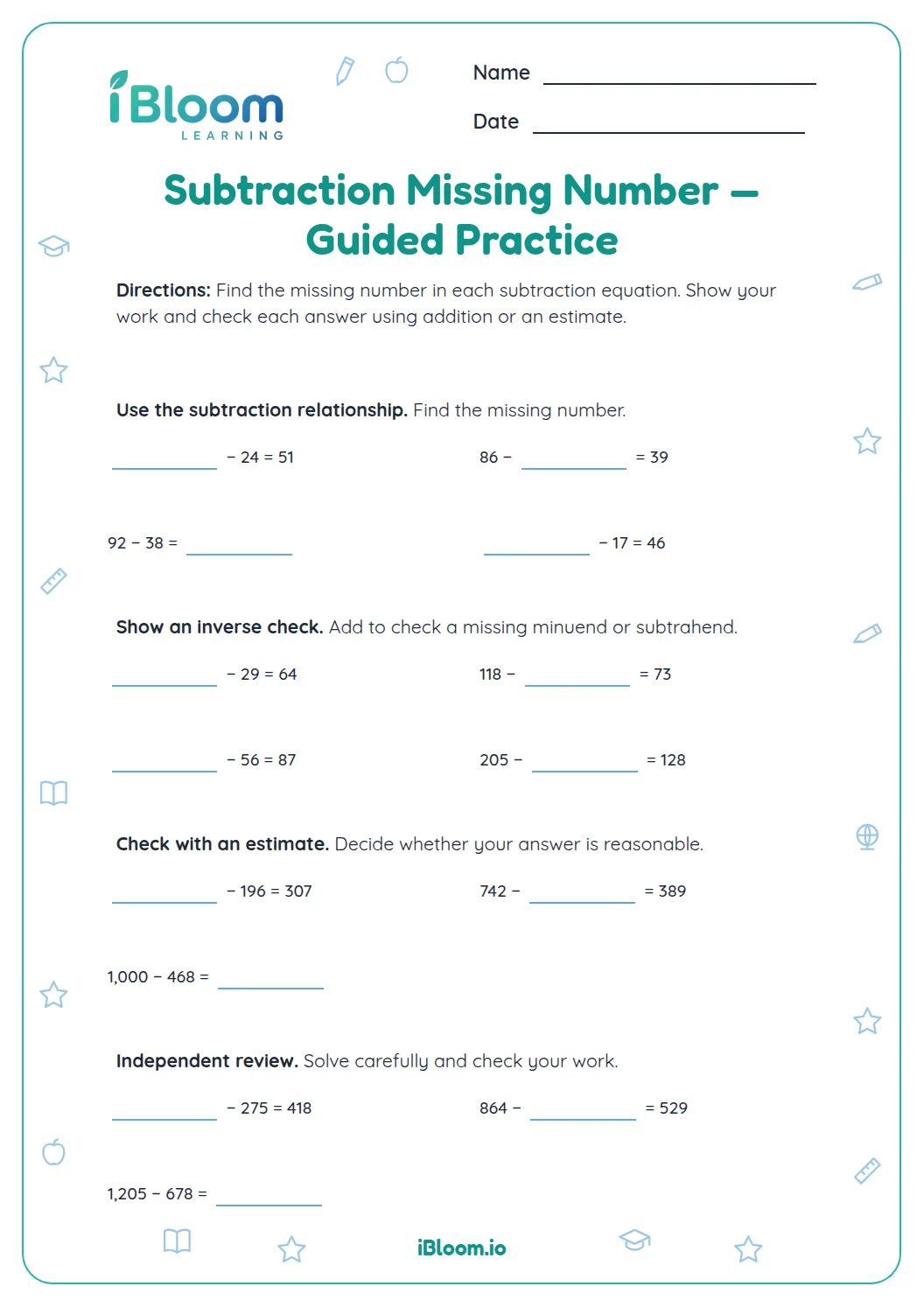
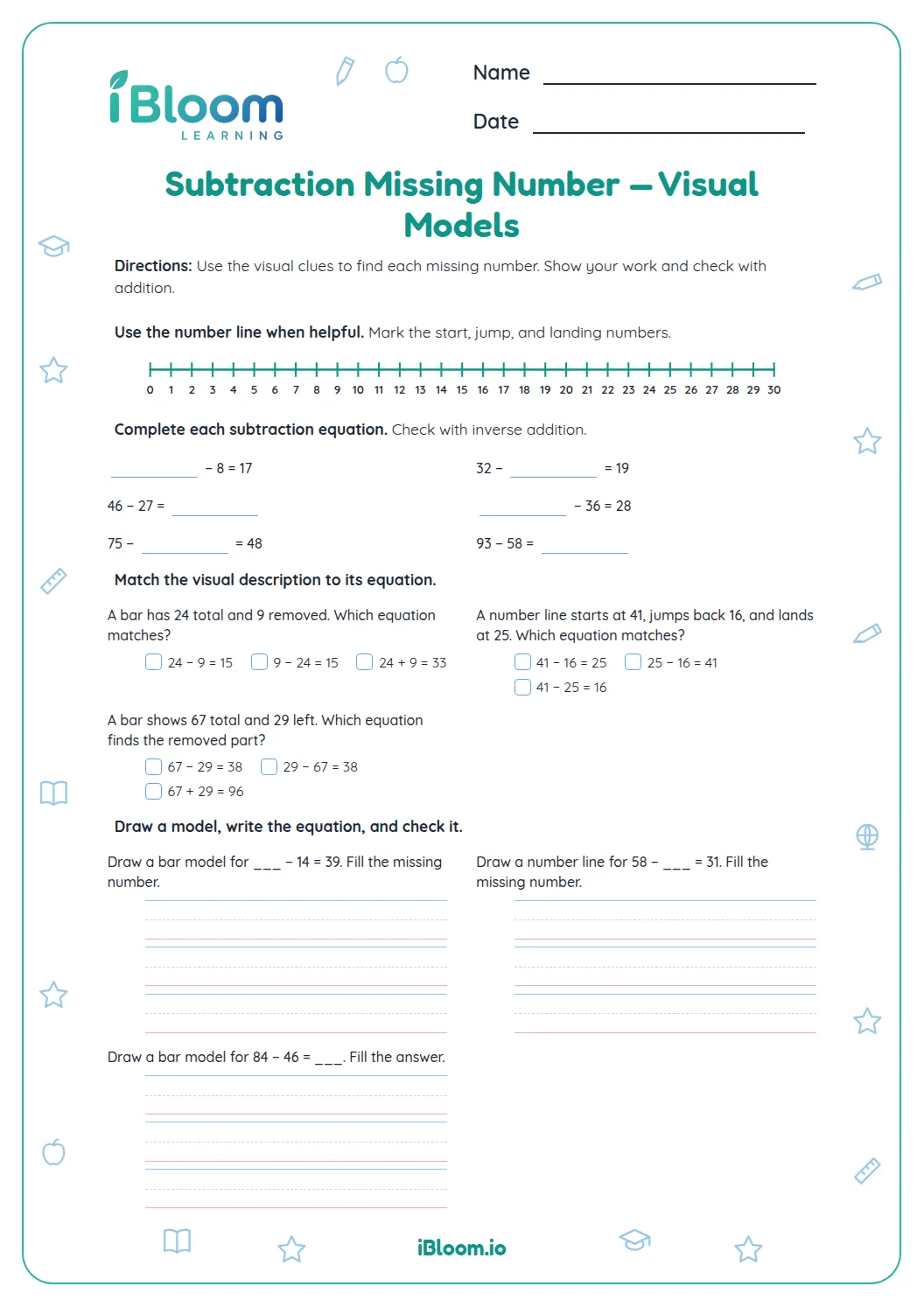
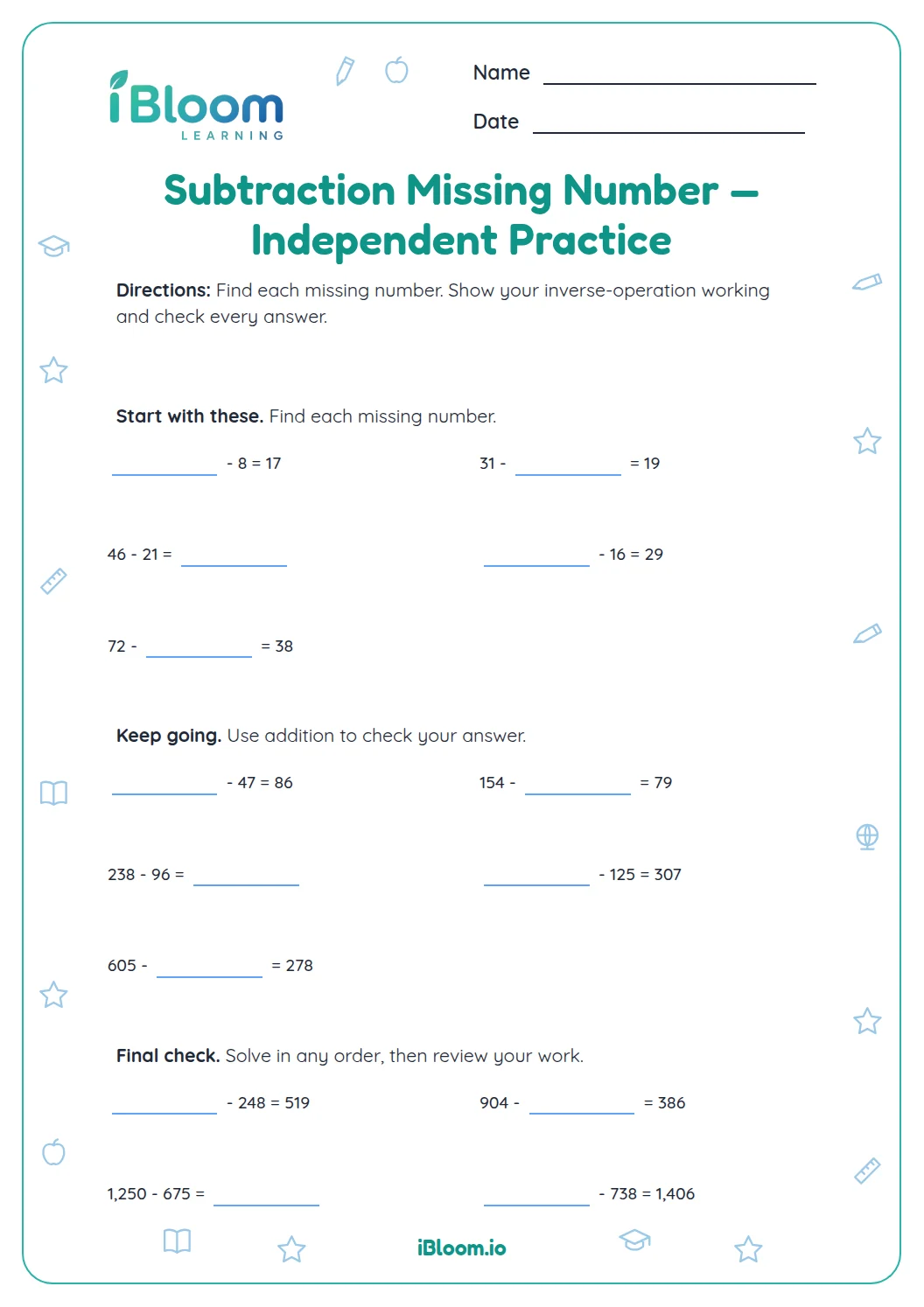
About this worksheet
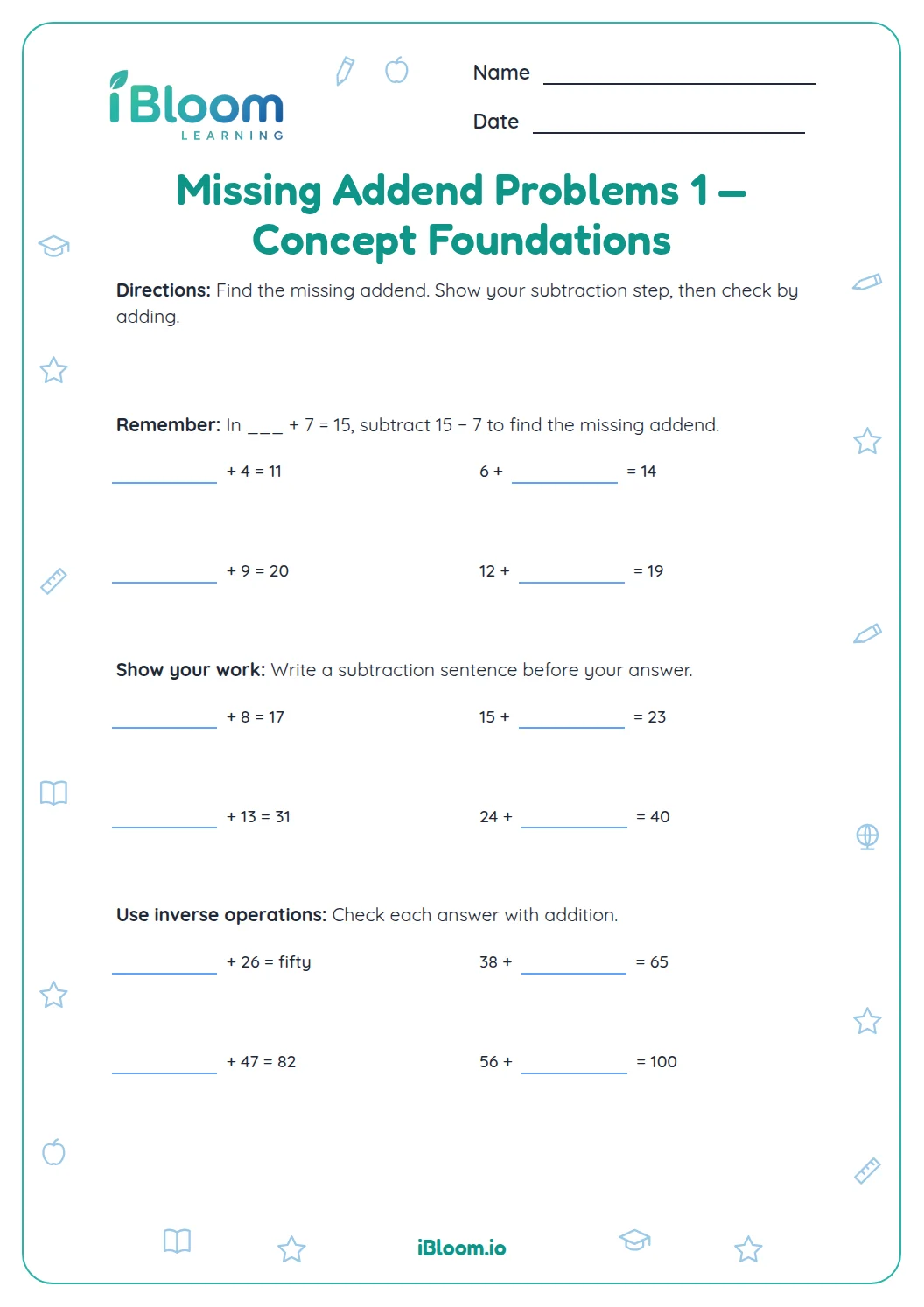
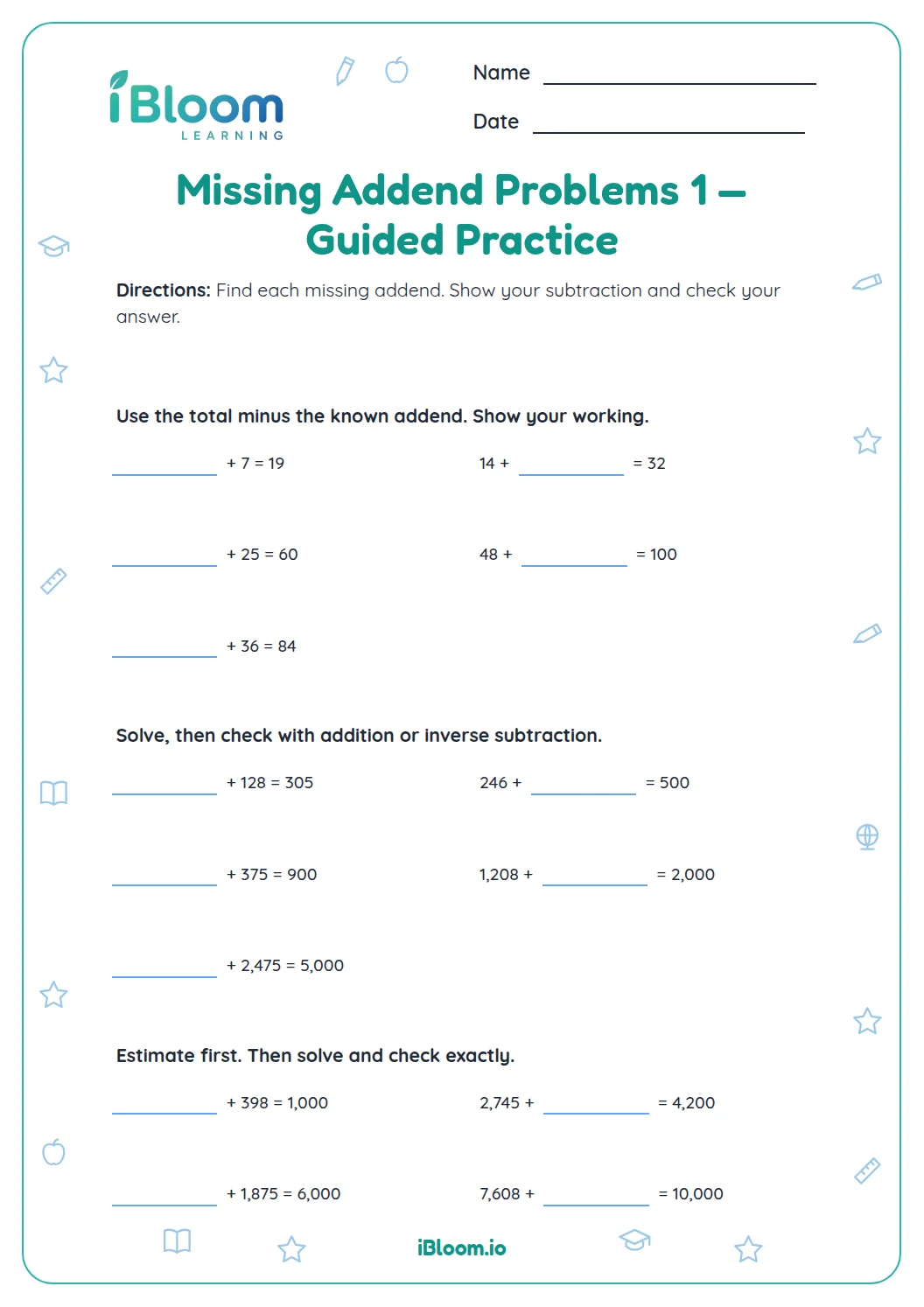
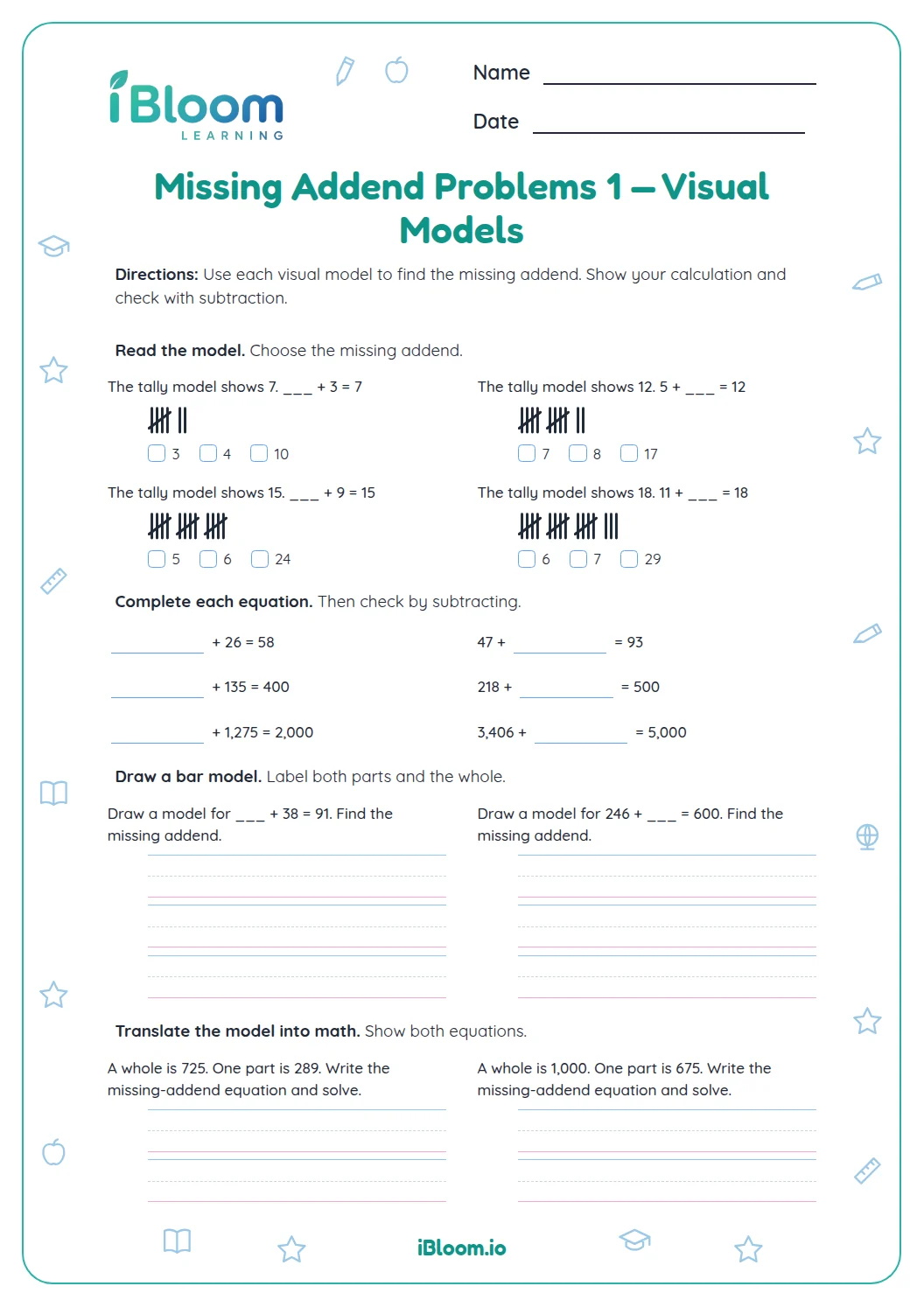
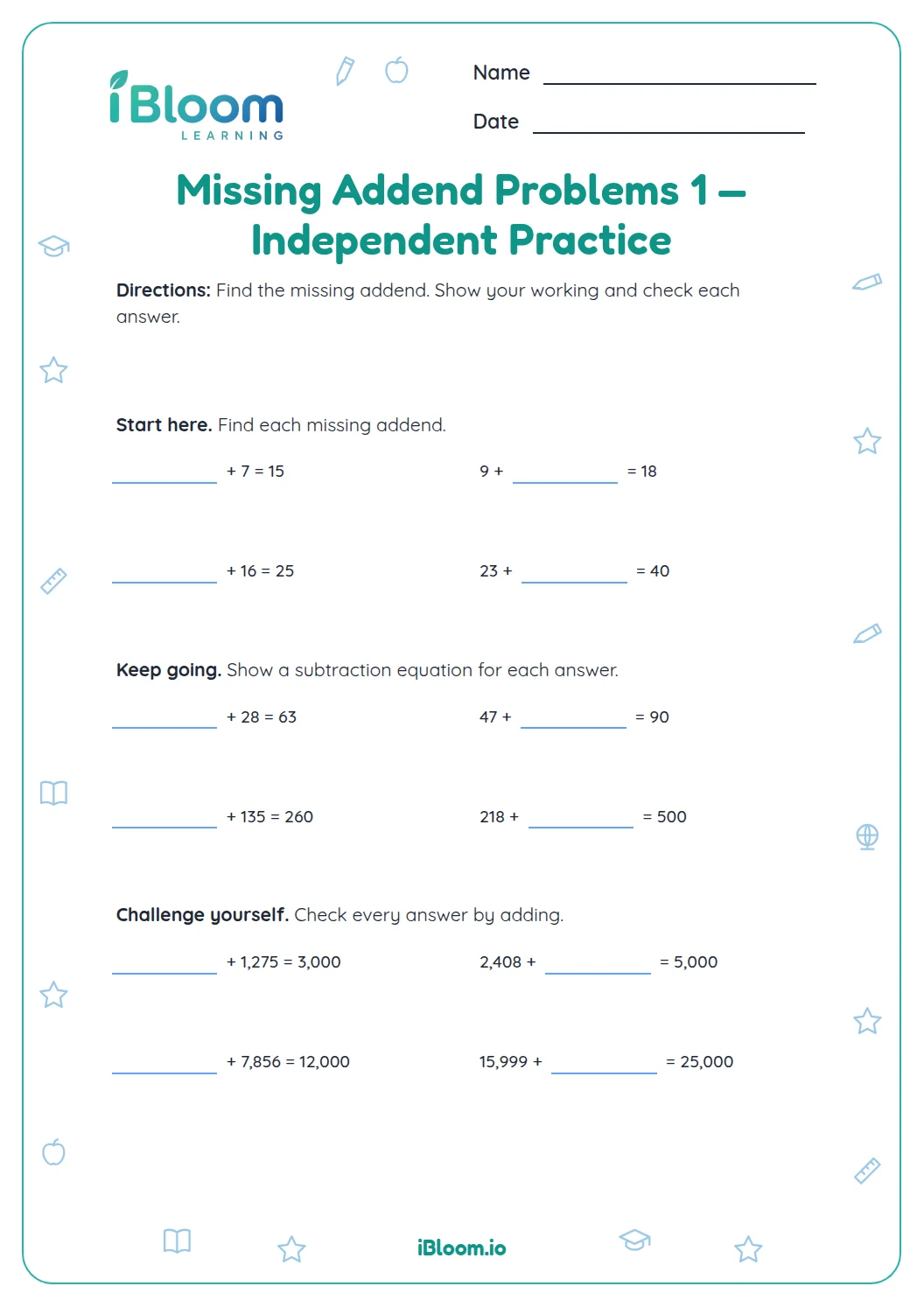
This Grade 6 worksheet asks students to reason backward from a sum to find an unknown addend. Part A mixes whole numbers, decimals, and fractions in equations. Part B uses stories and checking prompts to connect the equation to the situation. Students can subtract the known addend from the total, then substitute their result to check. The answer key is a separate page. The work connects to Common Core 6.EE.B.7, solving problems by writing and solving equations.
Aligned to 6.EE.B.7
How can subtraction uncover a missing addend?
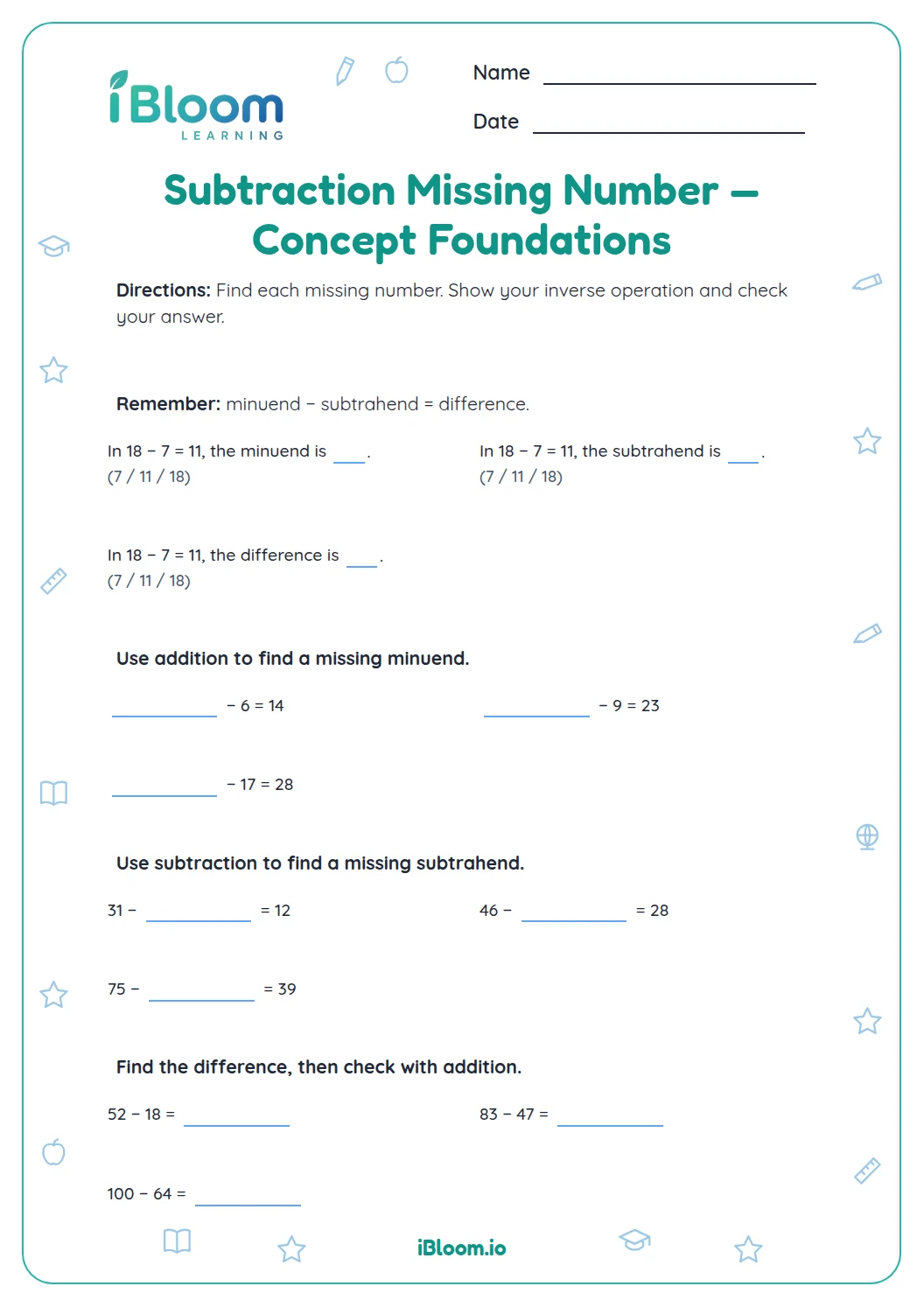
Addition combines parts to make a total. If one part is unknown, subtract the part you know from the total. Then use addition to confirm the result.
For decimal and fraction equations, keep the units and place values aligned while using the same inverse relationship.
- 1___ + 2.75 = 6.4
- 26.40 − 2.75 = 3.65
- 3Check: 3.65 + 2.75 = 6.40
- 4The missing addend is 3.65.
What kinds of reasoning appear on the page?
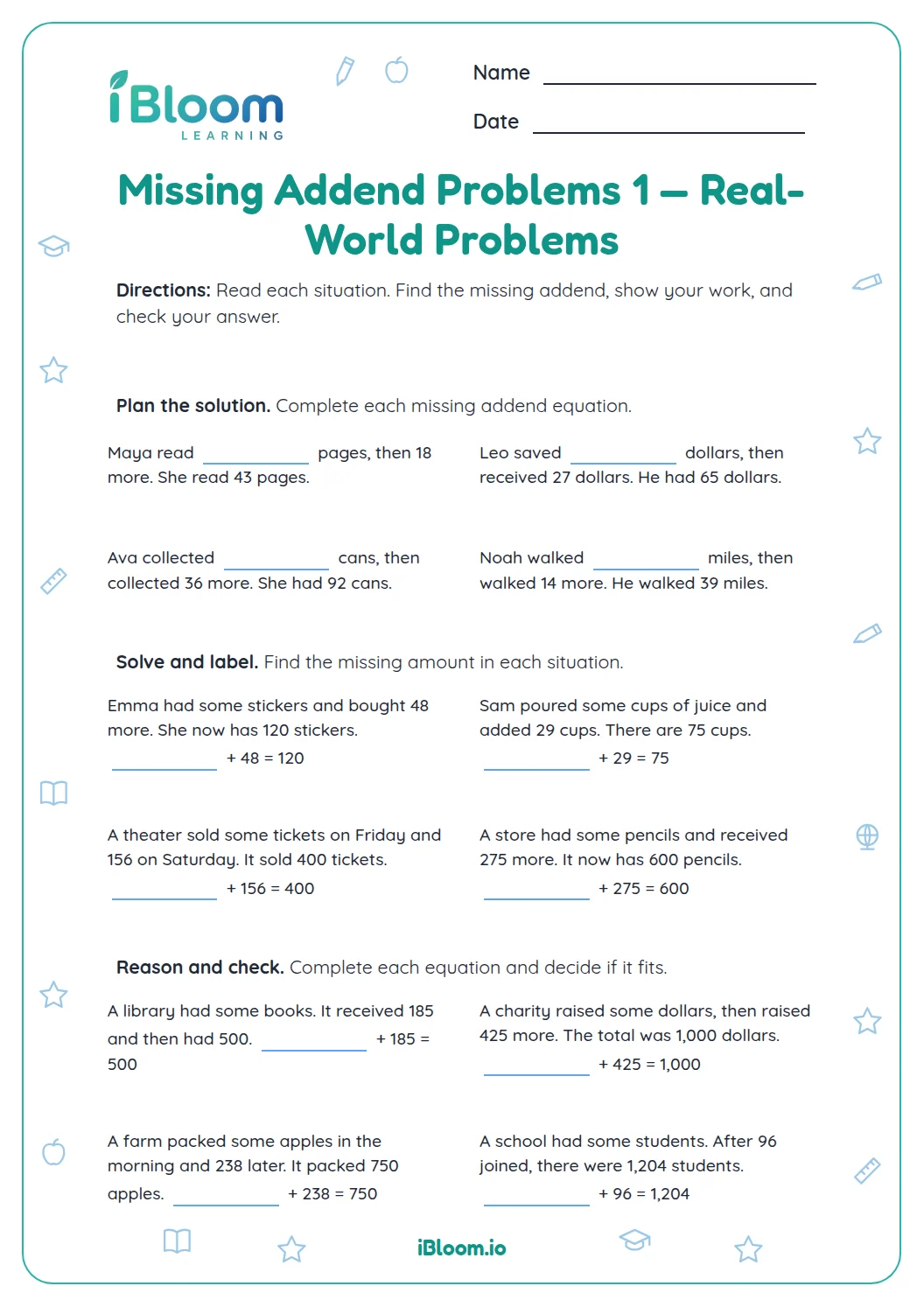
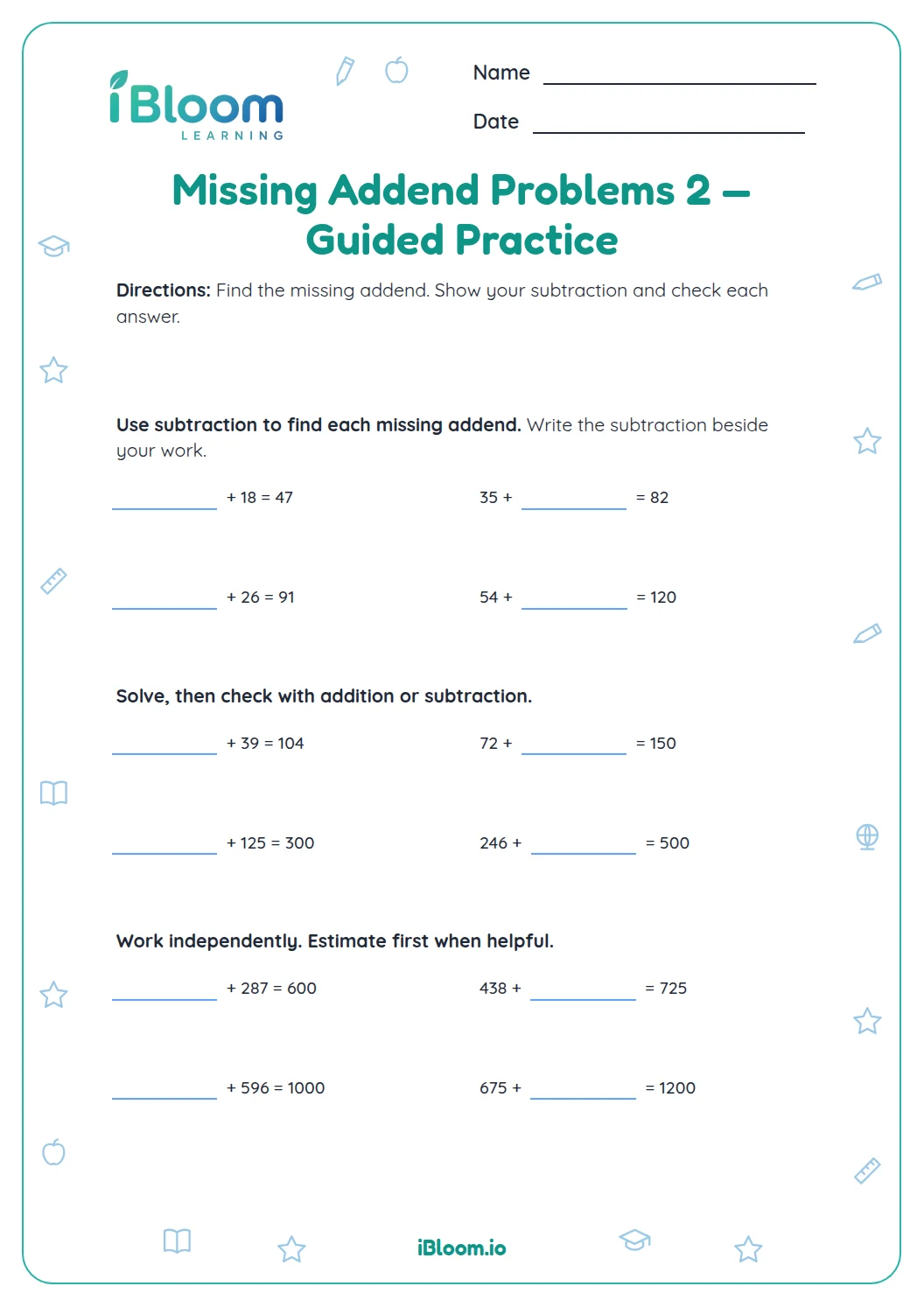
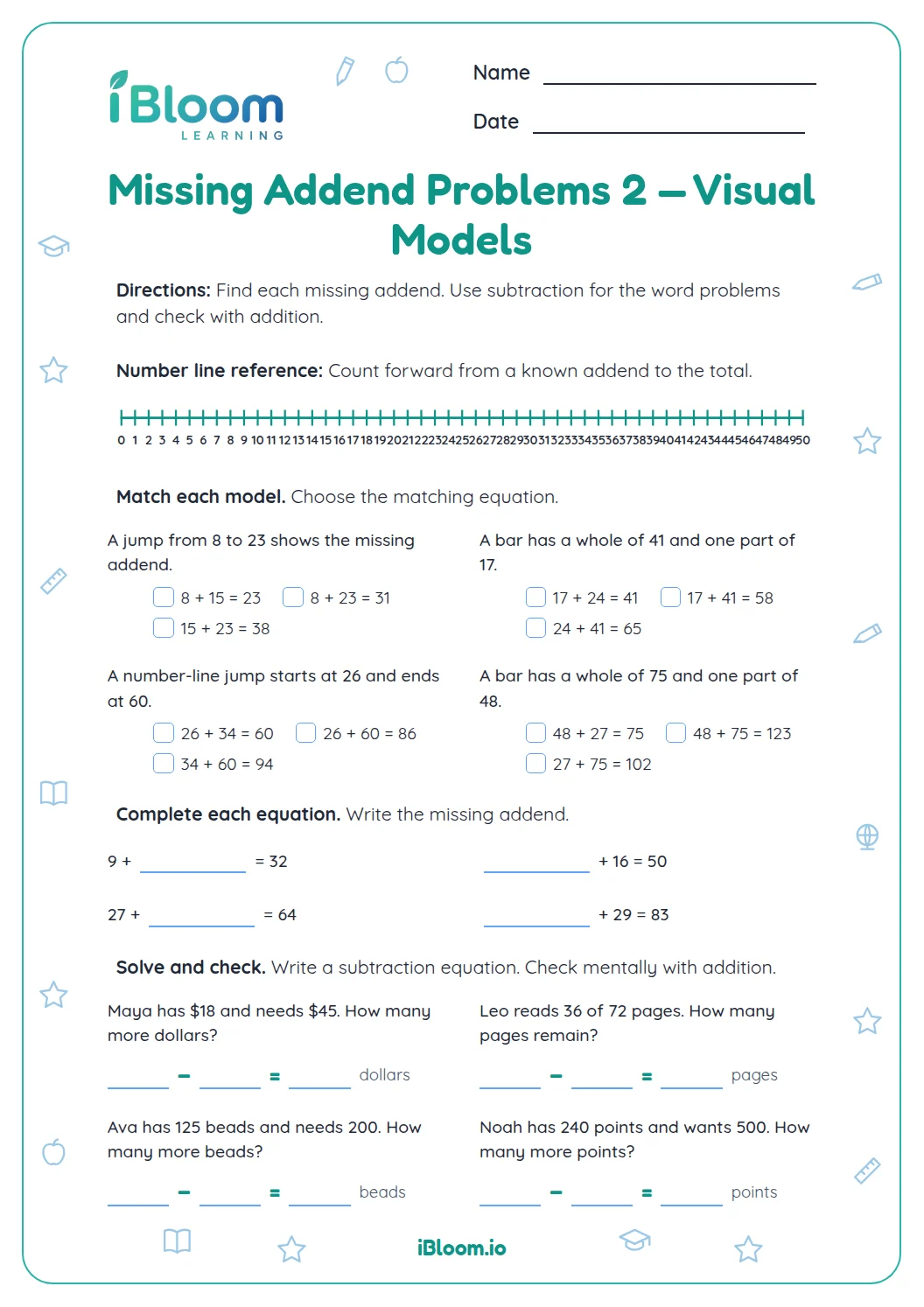
Part A includes eight missing-addend equations with whole numbers, decimals, and fractions. Part B asks students to model short situations, judge a proposed answer, and write or complete a check equation.
How to use this worksheet
- 1Circle the total in each equation or story.
- 2Identify the addend that is already known.
- 3Subtract the known addend from the total.
- 4For decimal and fraction values, line up like units.
- 5Put the missing value into the original equation.
- 6Check that both sides have the same total.
Common mistakes and quick fixes
The mistake
Subtracting the total from the known addend.
The fix
Use total minus known addend to find the missing part.
The mistake
Using a decimal value with misaligned place values.
The fix
Write matching decimal places before subtracting.
The mistake
Finding a plausible number but not checking it.
The fix
Substitute the value into the original addition equation.
Common Core alignment
Students use equations to represent unknown quantities and solve for a missing value.
Solve for an unknown quantity by writing and checking an equation.
On this sheet: The page uses unknown addends in equations and short real-world problems, then checks solutions by substitution.
Show the official wordingHide the official wording
Solve real-world and mathematical problems by writing and solving equations of the form x + p = q and px = q for cases in which p, q and x are all nonnegative rational numbers.
What to practice next
Make more practice
Further reading
Questions parents and teachers ask
How do you solve a missing-addend equation?
Subtract the addend you know from the total. In ___ + 2.75 = 6.4, calculate 6.40 − 2.75 to get 3.65. Add 3.65 and 2.75 to check that the sum is 6.40. The unknown addend is the number that completes the stated total.
Why does subtraction help find an addend?
Addition combines parts to make a total. When the total and one part are known, subtracting the known part reveals the other part. Students can check by putting that value back into the original addition equation. This relationship works with whole numbers, decimals, and fractions on the page.
What number types appear on the page?
Part A practices missing addends with whole numbers, decimals, and fractions. Part B has six short application or checking items, including quantities in books, meters, miles, and cups. They then substitute the missing value into the equation to verify the total.
How many questions and pages are included?
The worksheet has 14 questions across two parts: eight equations and six application or reasoning items. It prints on two worksheet pages, followed by a separate two-page answer key. The answer key provides a value for every equation and application item.
How can students check a word-problem answer?
Write an addition equation that includes the known amount and the unknown amount. Add the two parts and compare the result with the stated total. Keep units such as books, meters, or cups attached to the answer. This check confirms both the arithmetic and the meaning of the situation.