

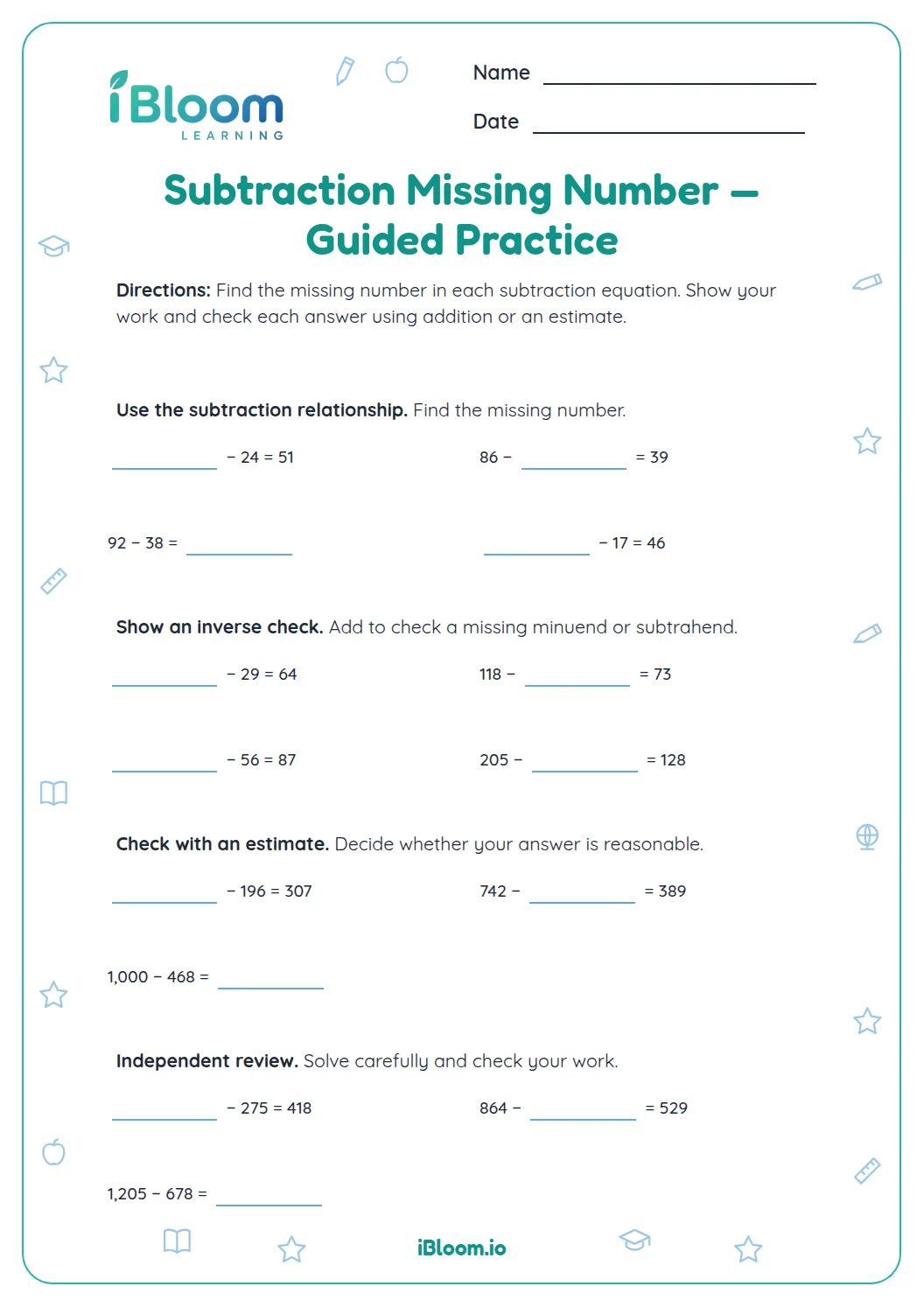
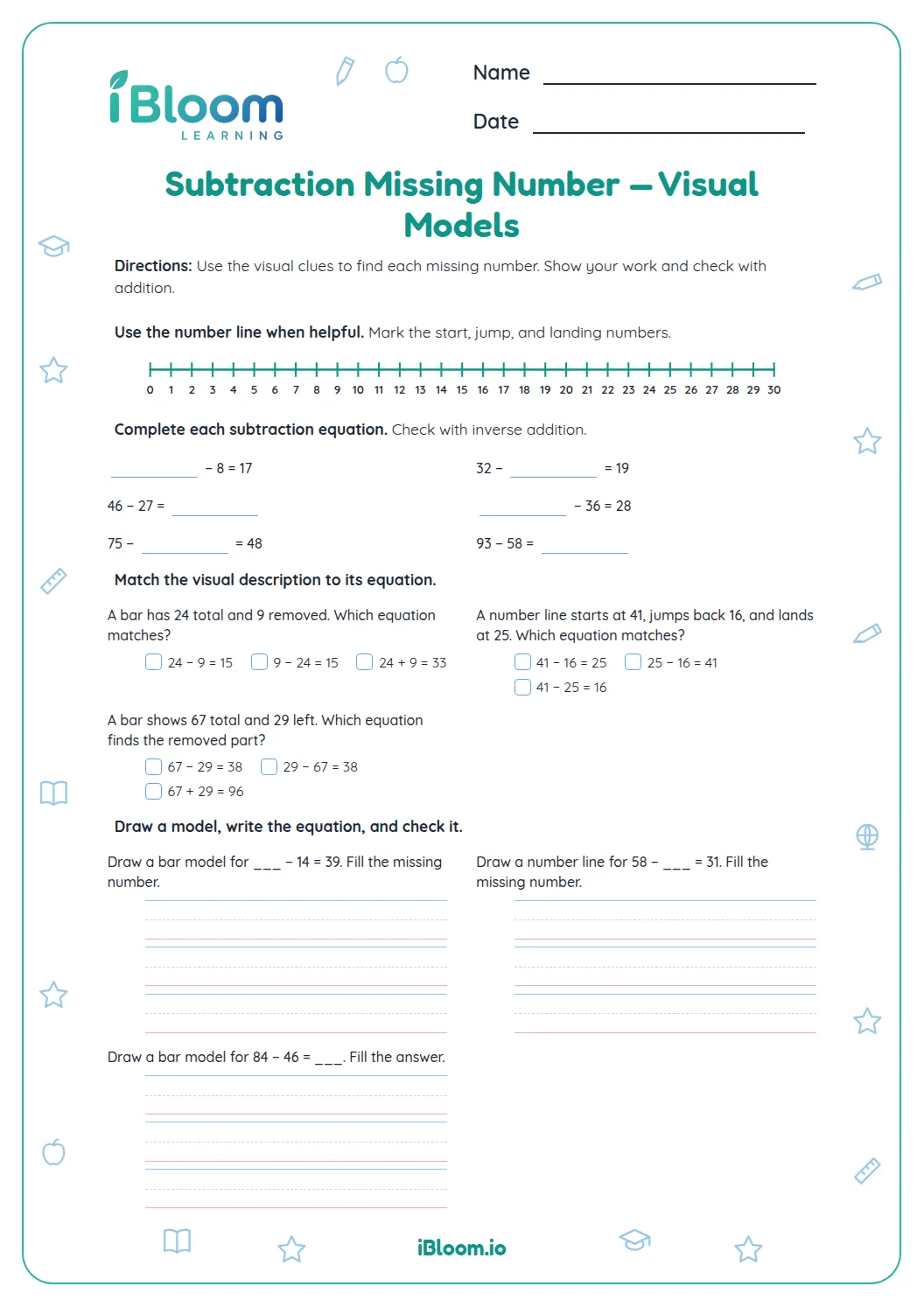
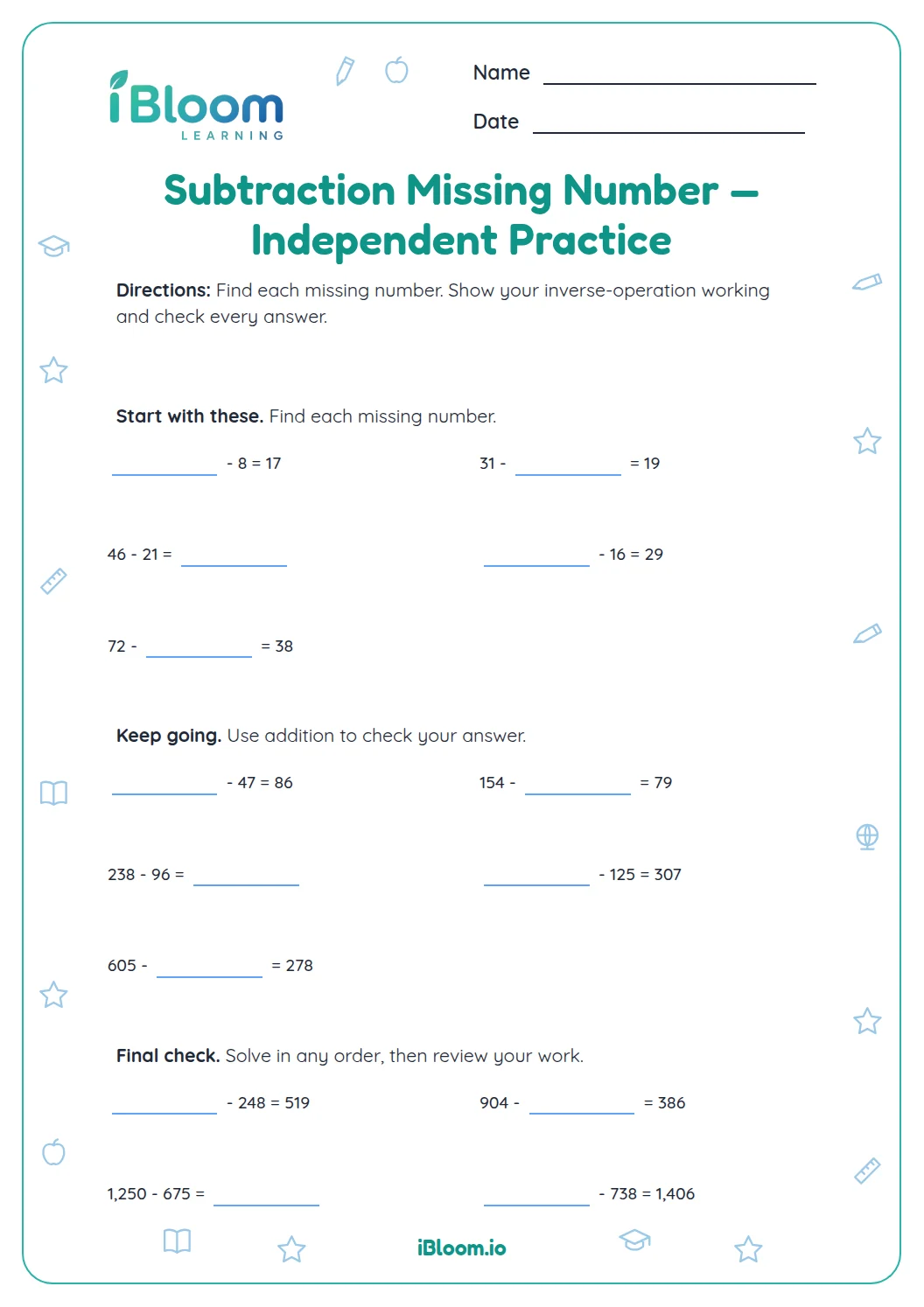
About this worksheet
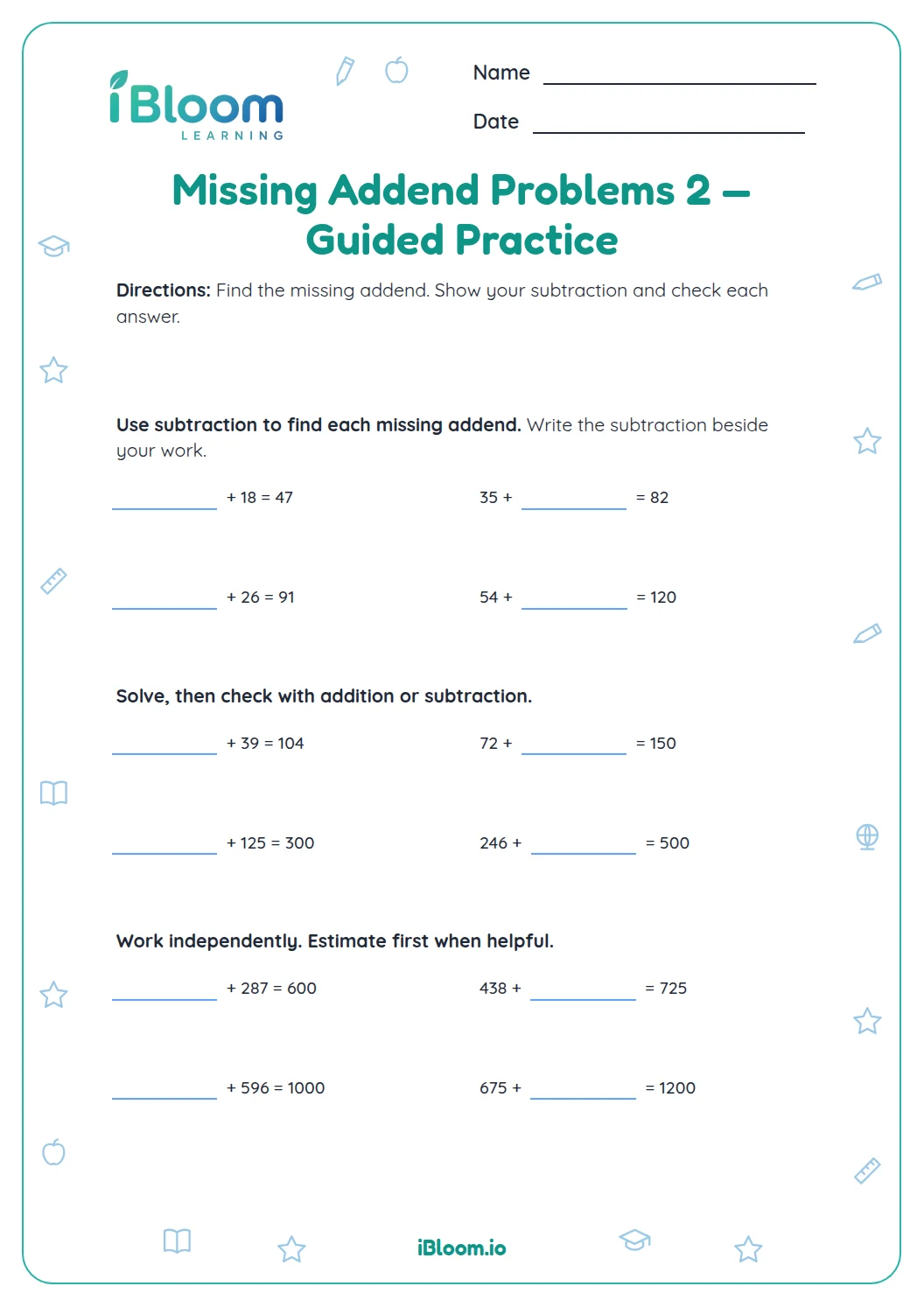
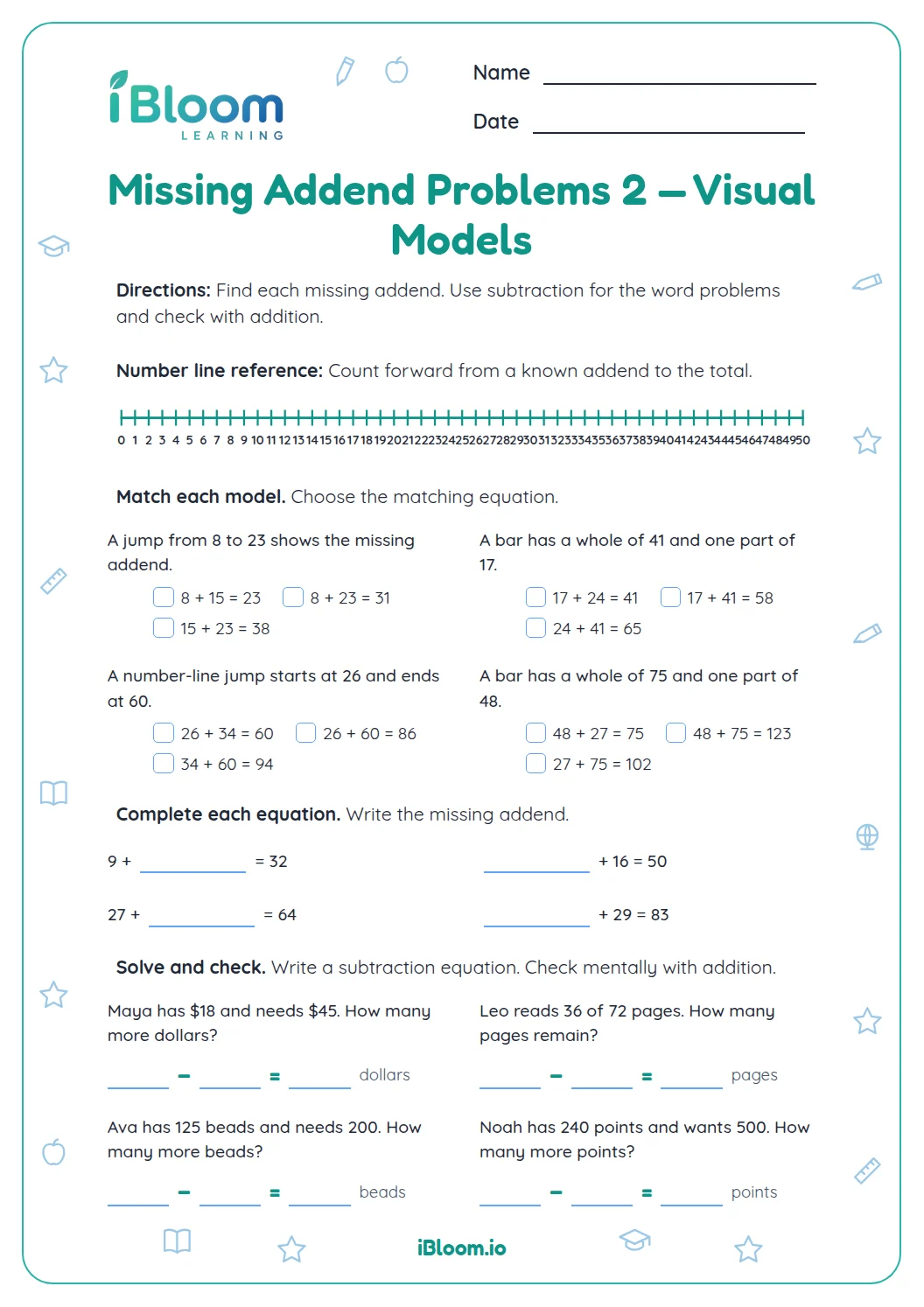
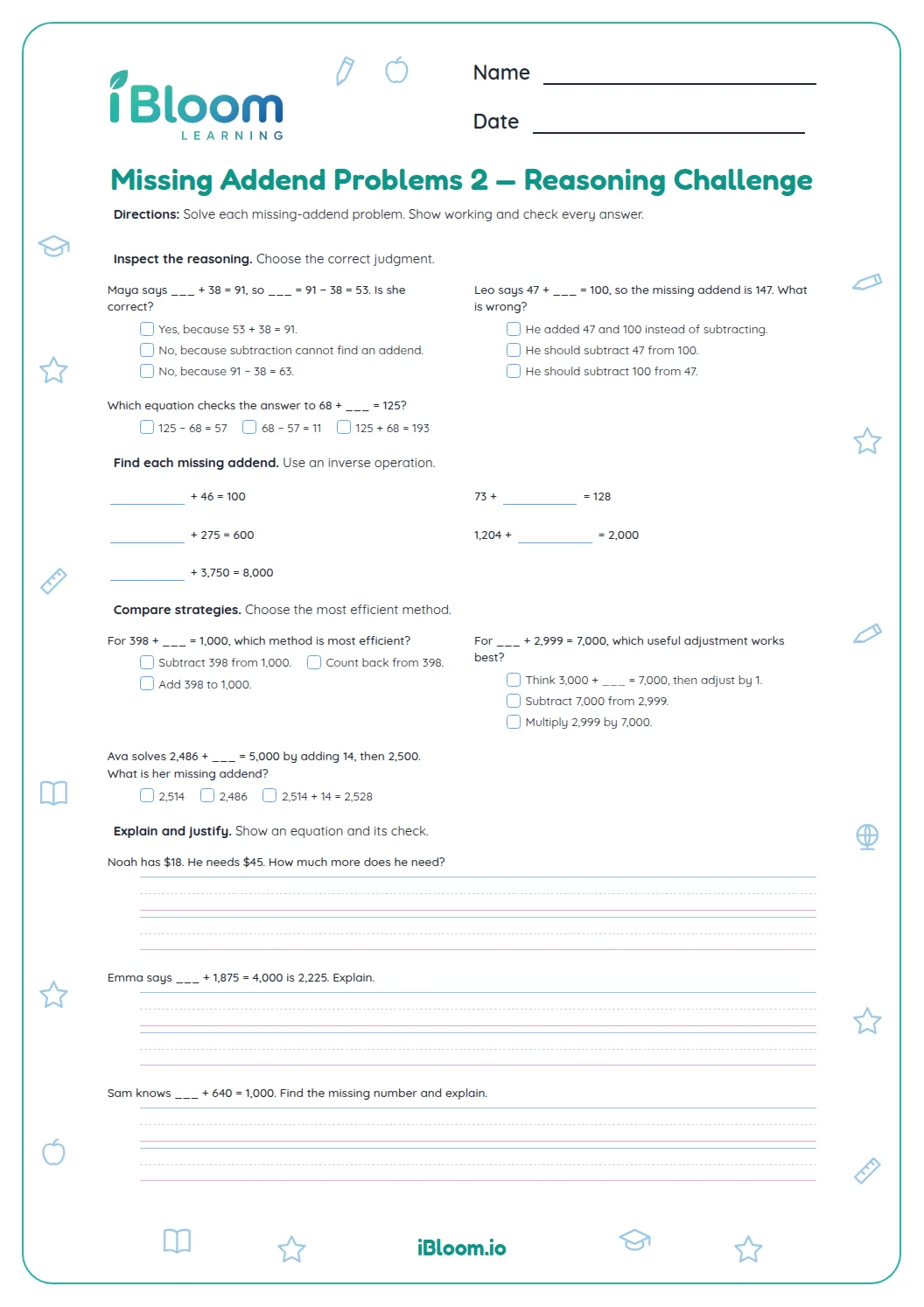
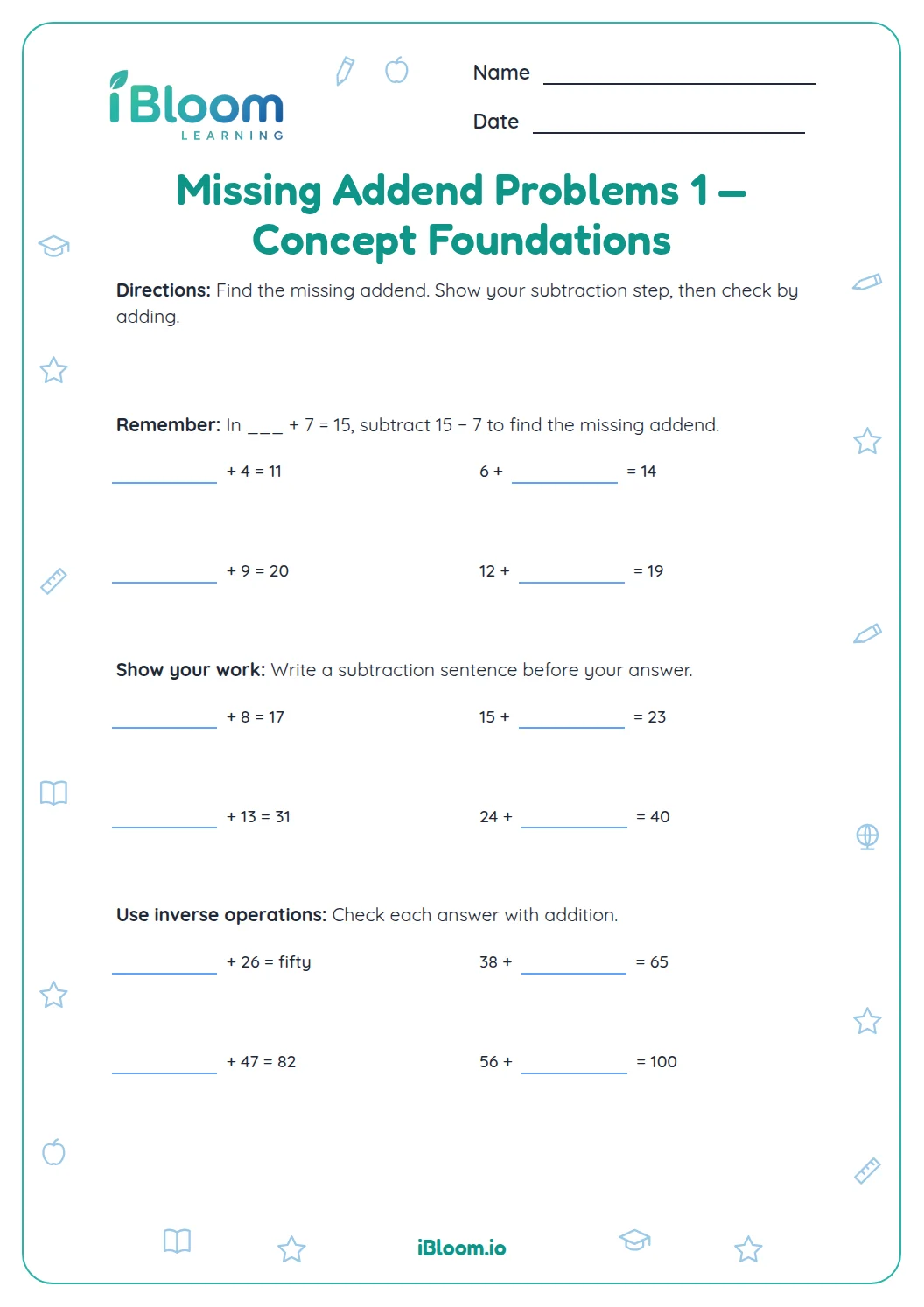
This free printable Grade 6 worksheet practices finding the value that makes an addition equation true. The 16 questions move from whole-number equations to decimals and fractions, then use an equation in a short situation and ask learners to explain a correction. A separate answer key provides the missing values and sample explanations.
Aligned to 6.EE.B.7
How can subtraction find a missing addend?
To find an unknown addend, subtract the known addend from the sum. For question 1, 38 − 21 = 17, so 21 + 17 = 38. Addition and subtraction undo one another.
Check by substituting the value back into the original equation.
Can the missing value be a fraction or decimal?
Yes. The last set includes decimals and fractions alongside whole numbers. For 5/8 + ___ = 1, write 1 as 8/8, then find 8/8 − 5/8 = 3/8.
What is on this two-page worksheet?
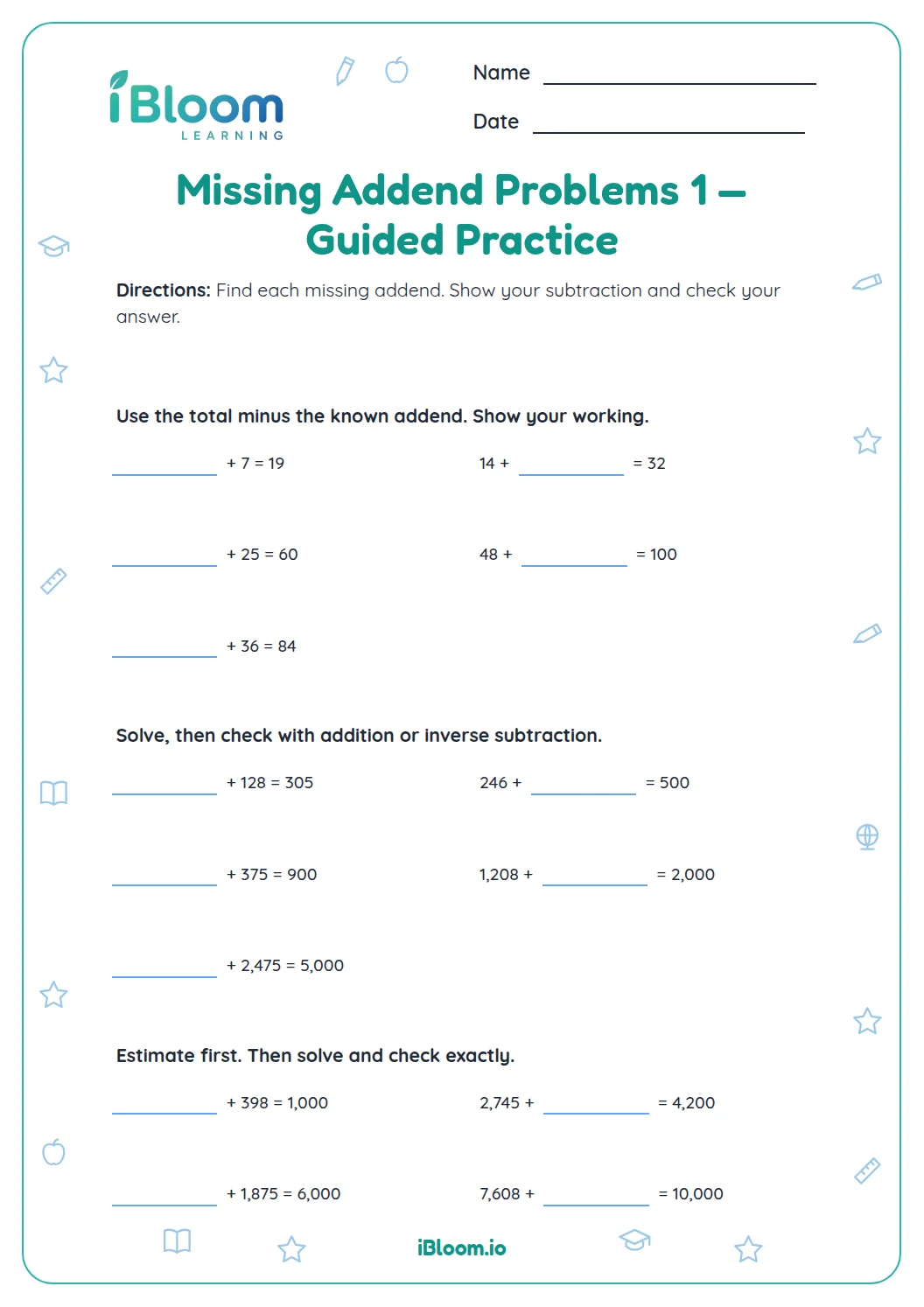
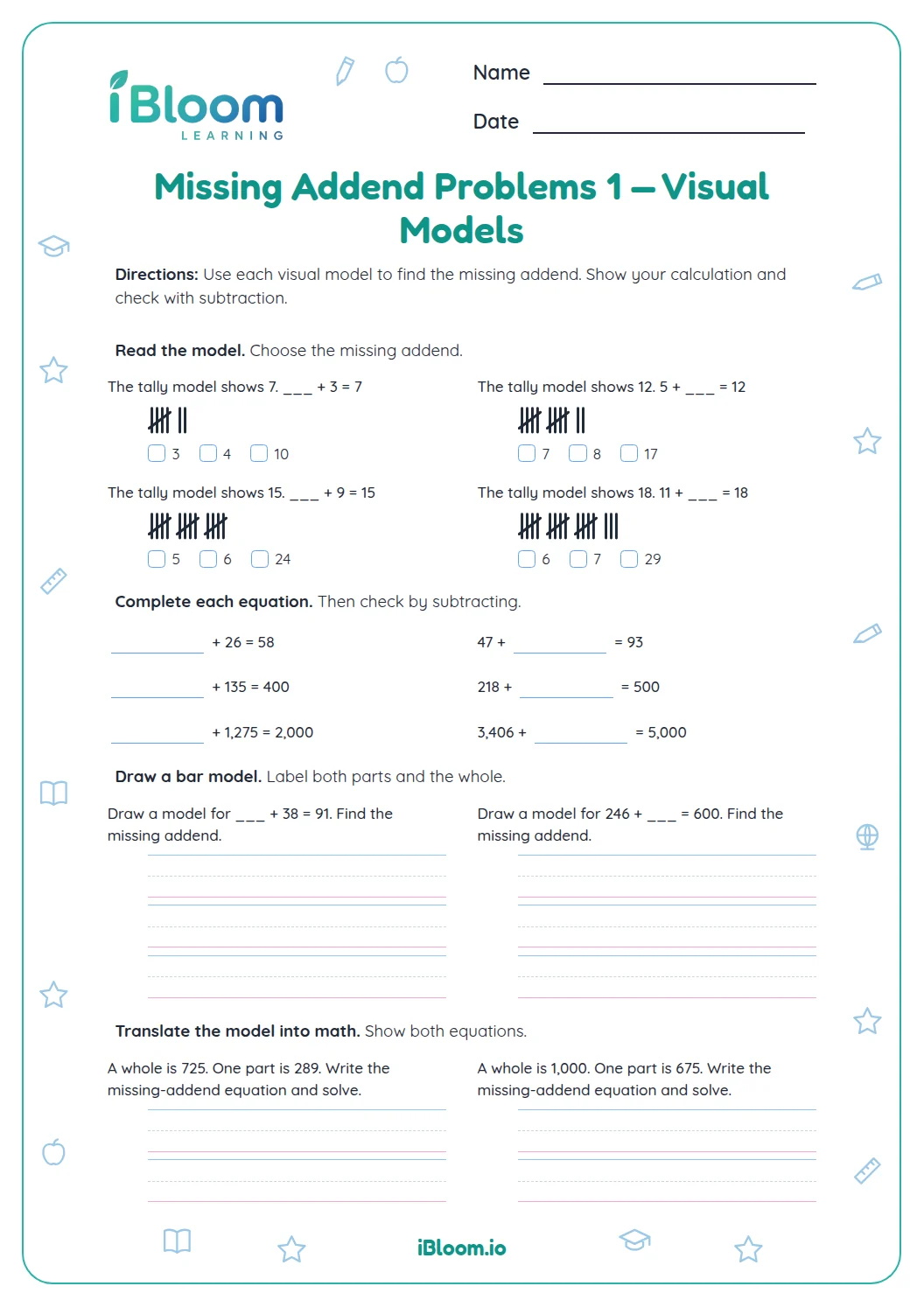
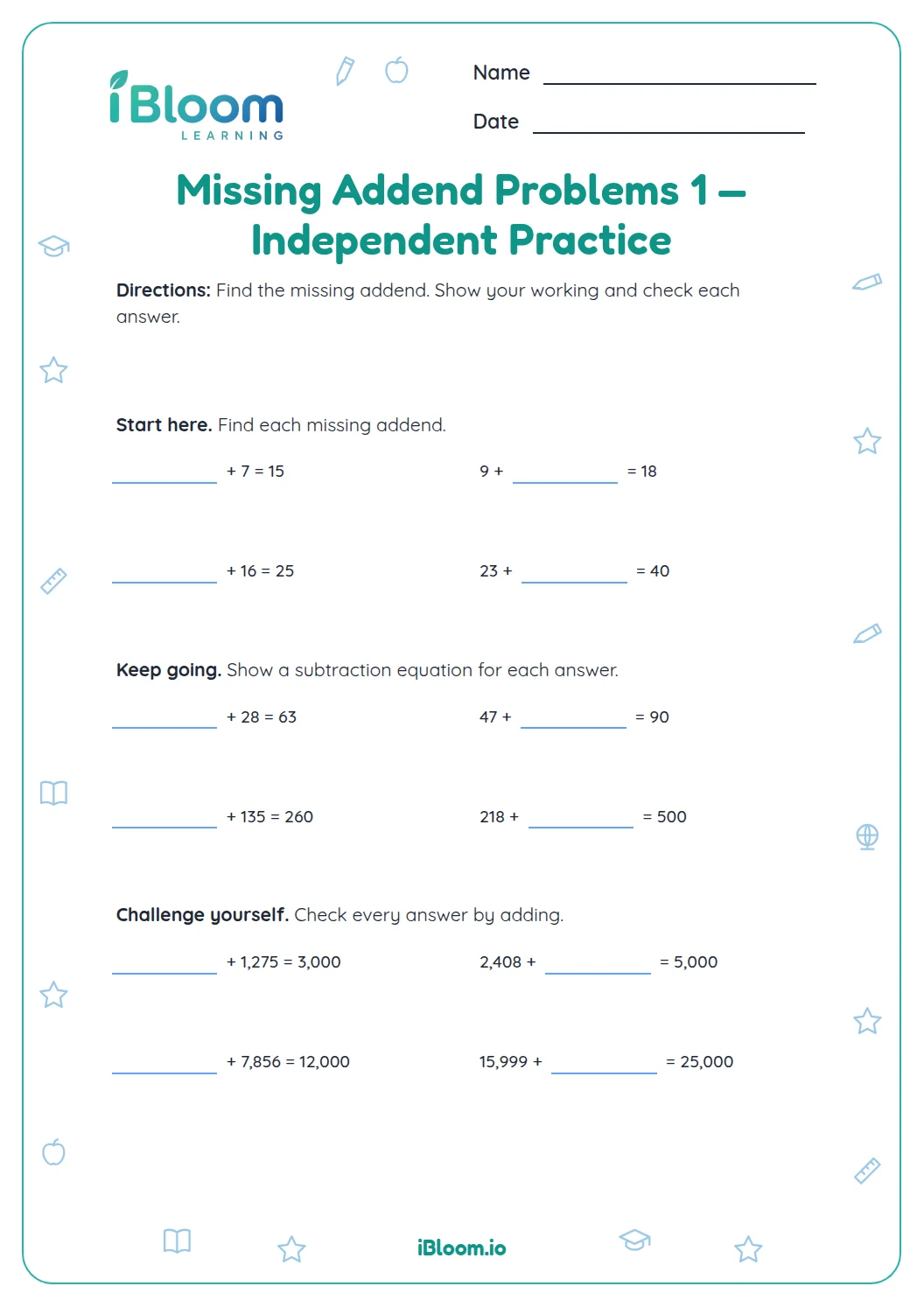
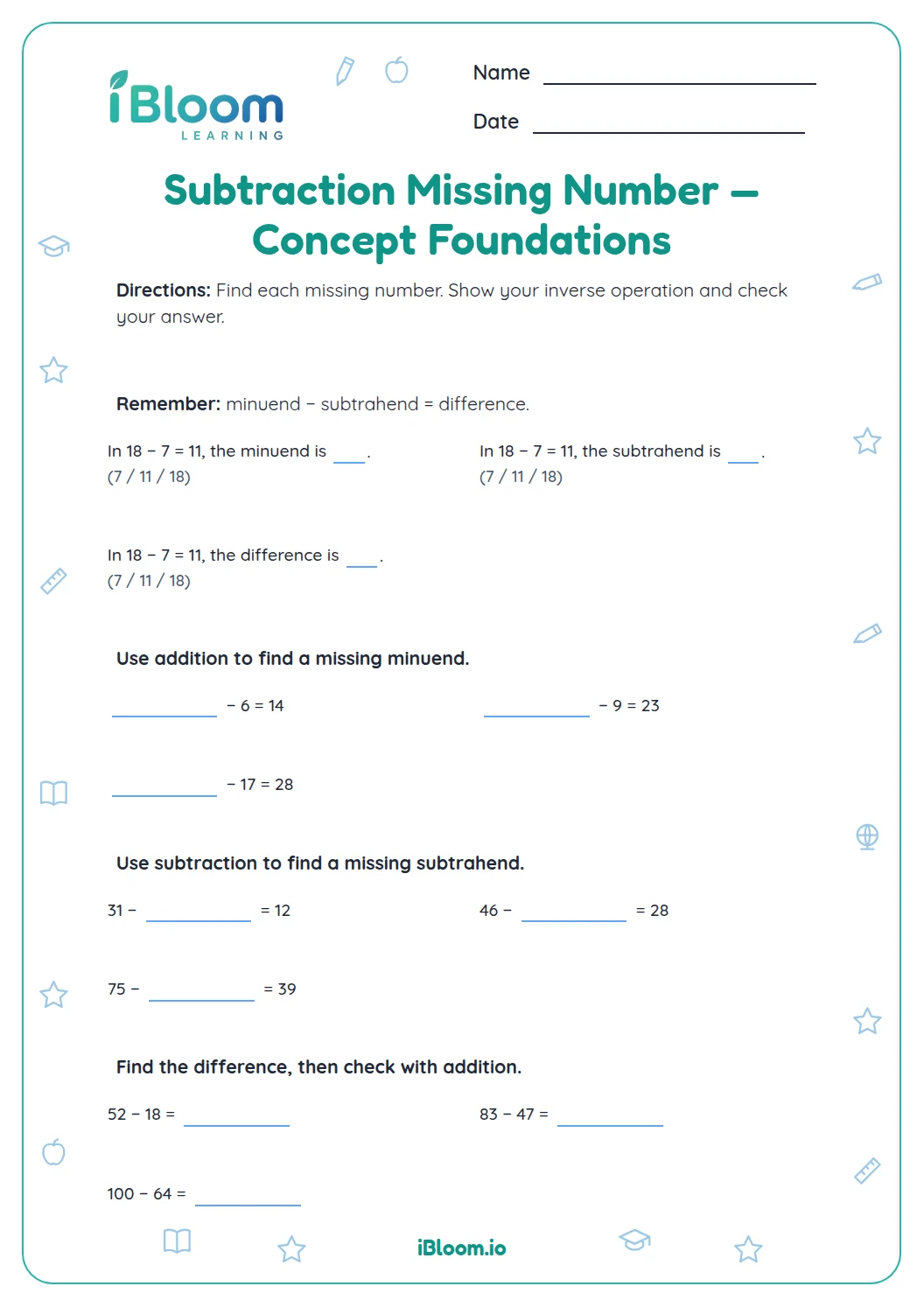
There are 16 questions in four parts: six whole-number equations, six decimal or fraction equations, three applications or corrections, and one explanation. Each asks for a value or reasoning that makes the equation true.
How to use this worksheet
- 1Read the total and identify the addend already provided.
- 2Subtract the known addend from the total.
- 3Write the missing value in the blank.
- 4Substitute it back into the original equation to check.
Common mistakes and quick fixes
The mistake
Adding the known addend to the total.
The fix
Use subtraction: total minus known addend.
The mistake
Changing only one side while checking.
The fix
Substitute the value and compare both sides.
The mistake
Subtracting fraction numerators without renaming the whole.
The fix
Rewrite 1 as 8/8 before subtracting 5/8.
Common Core alignment
This worksheet practices the skill described in the standards below.
Solve equations by finding the value that makes each side equal.
On this sheet: Solve equations by finding the value that makes each side equal.
Show the official wordingHide the official wording
Solve real-world and mathematical problems by writing and solving equations of the form x + p = q and px = q for cases in which p, q and x are all nonnegative rational numbers.
What to practice next
Make more practice
Further reading
Questions parents and teachers ask
What operation finds a missing addend?
Subtract the addend you know from the total. If the equation is 38 + 17 = 55, then the unknown addend is 55 − 17. Check by adding the result and 17 to see whether they make 55. This gives the learner another chance to explain the idea clearly.
How do I check a missing addend?
Put the answer back into the original equation. For 38 + ___ = 55, replace the blank with 17 and confirm that 38 + 17 equals 55. Both sides should have the same value. This gives the learner another chance to explain the idea clearly.
Can the missing addend be a decimal?
Yes. The second part includes decimal values. Keep the decimal places lined up when subtracting the known addend from the total, then add your answer back to check. This gives the learner another chance to explain the idea clearly. This gives the learner another chance to explain the idea clearly.
How do I solve 5/8 + ___ = 1?
Think of 1 as 8/8. Then subtract 5/8 from 8/8, leaving 3/8. Check: 5/8 + 3/8 = 8/8, or 1. This gives the learner another chance to explain the idea clearly. This gives the learner another chance to explain the idea clearly.
What does equality mean in these equations?
The equal sign means the expressions on both sides have the same value. Finding the missing addend means choosing a number that makes that statement true. This gives the learner another chance to explain the idea clearly. This gives the learner another chance to explain the idea clearly.
Is there an answer key?
Yes. The separate key lists each missing value and gives an explanation for the reasoning check. Use it after attempting a problem so the learner can compare the substitution check as well as the answer. This gives the learner another chance to explain the idea clearly.