

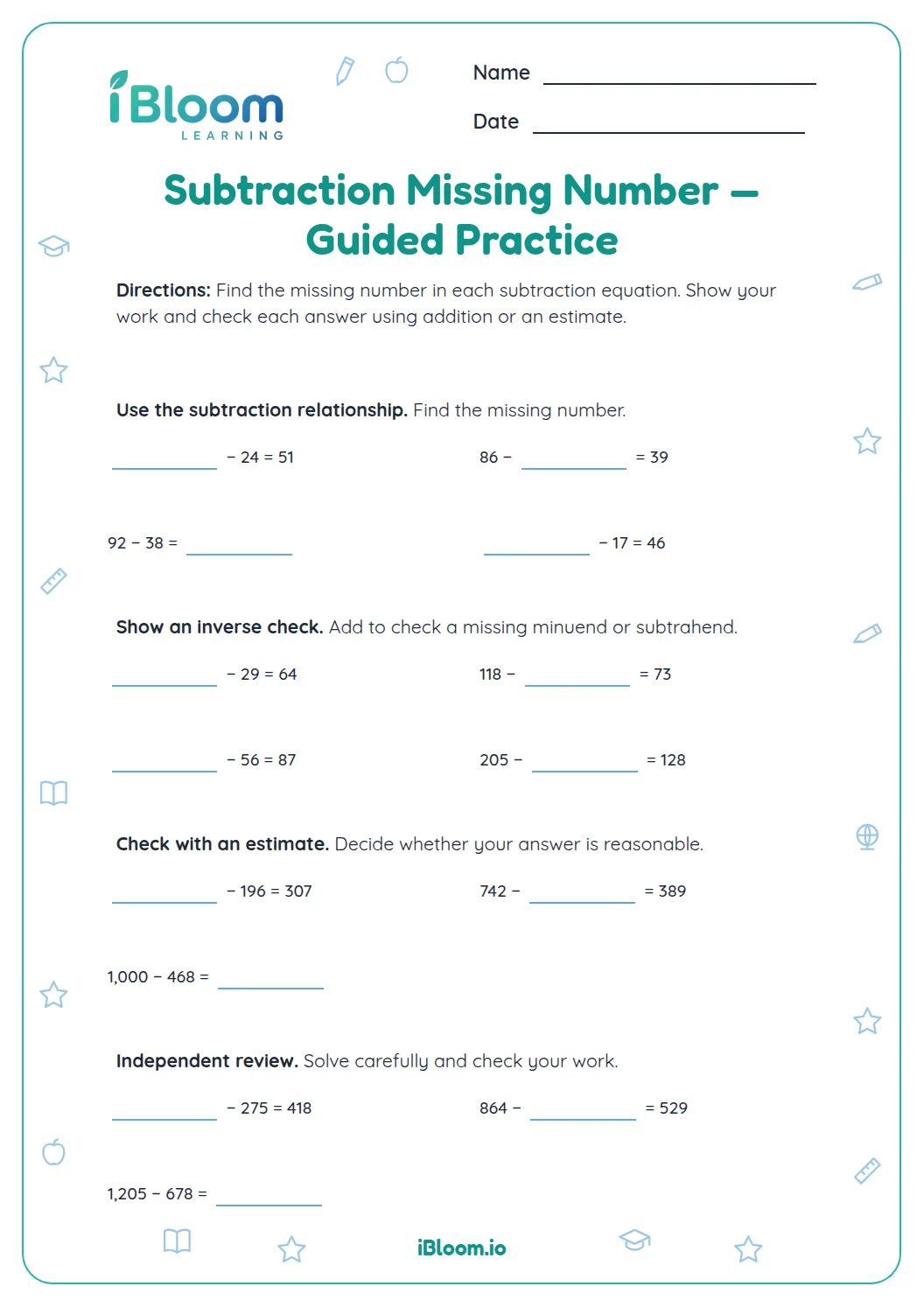
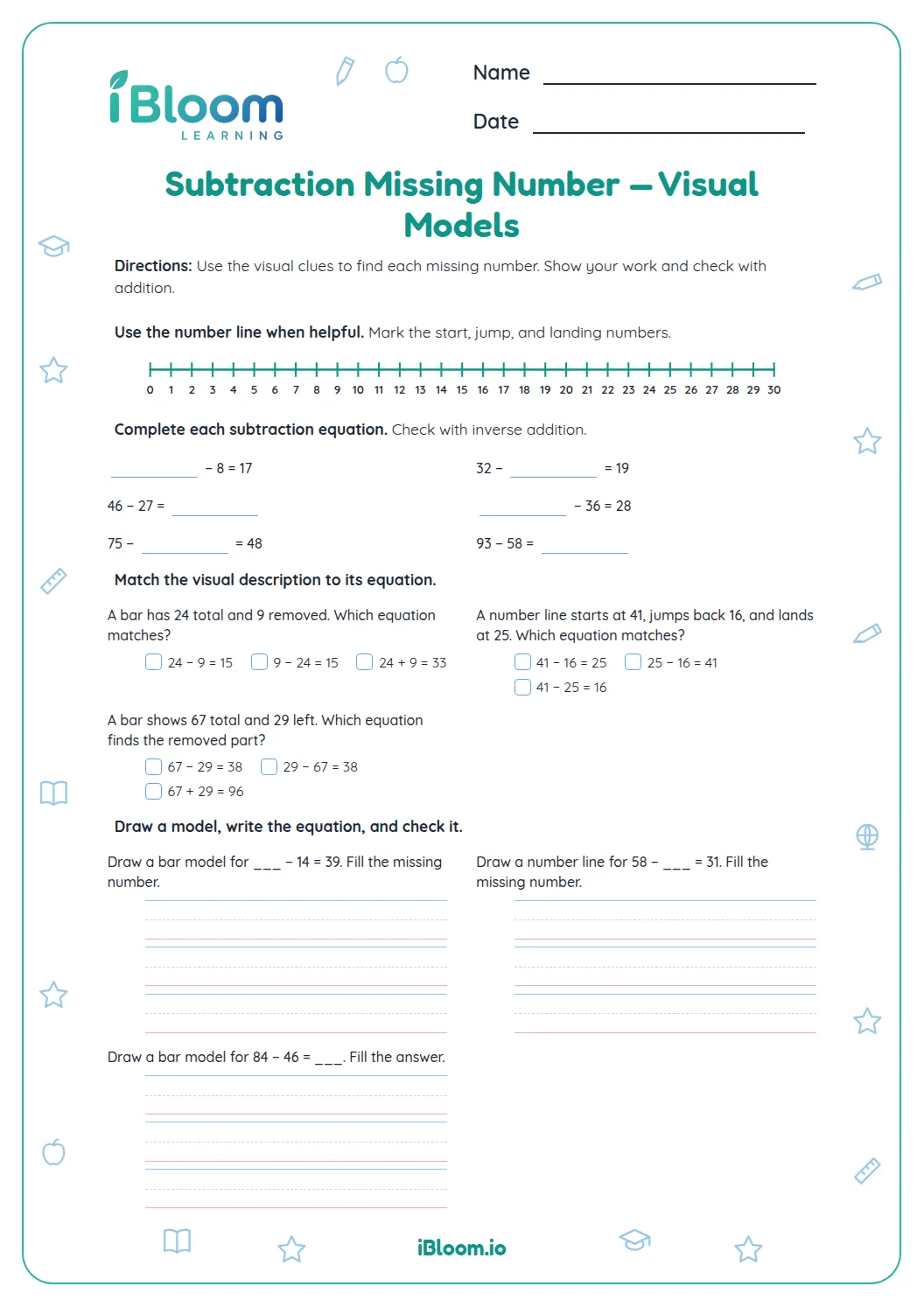
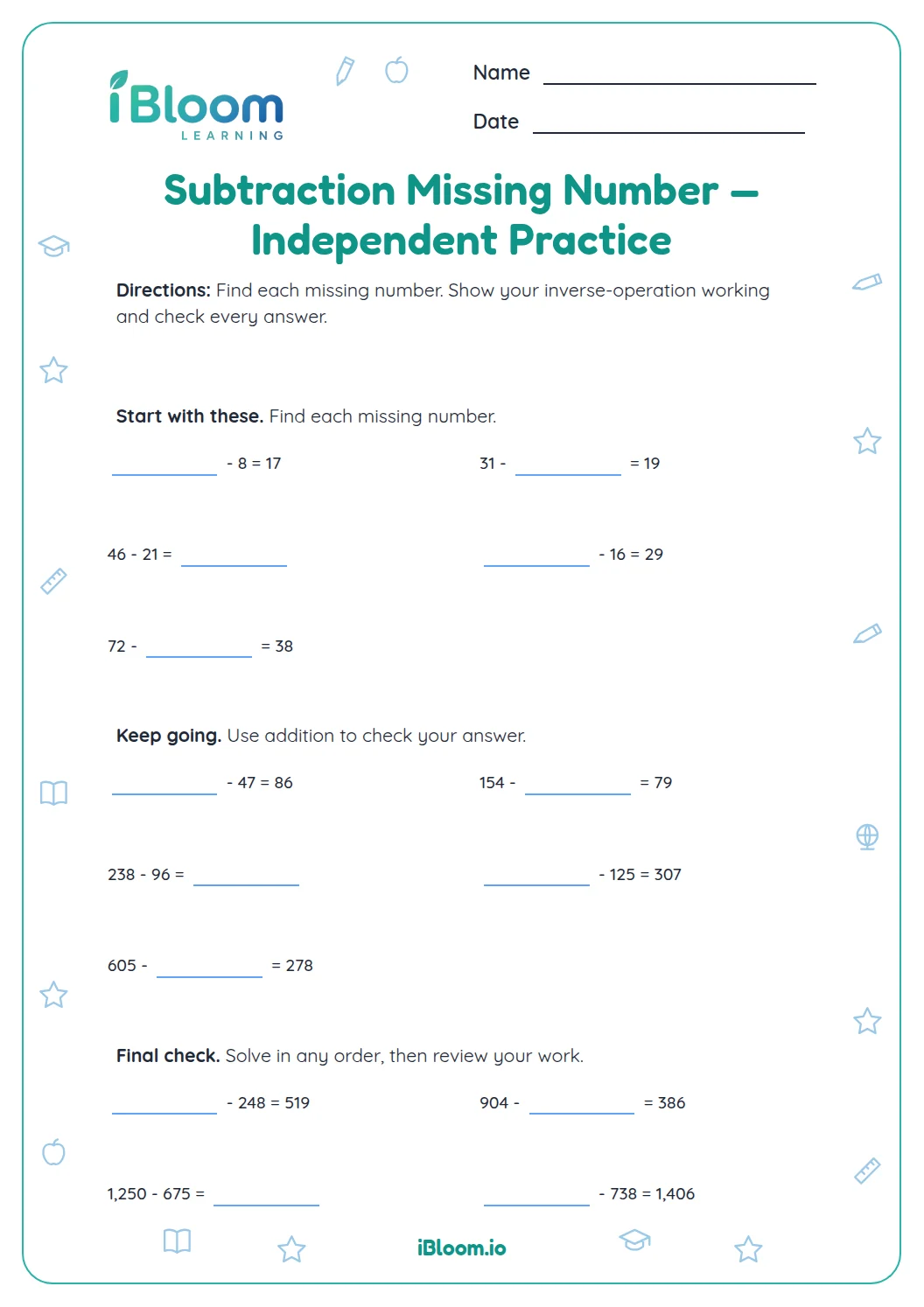
About this worksheet
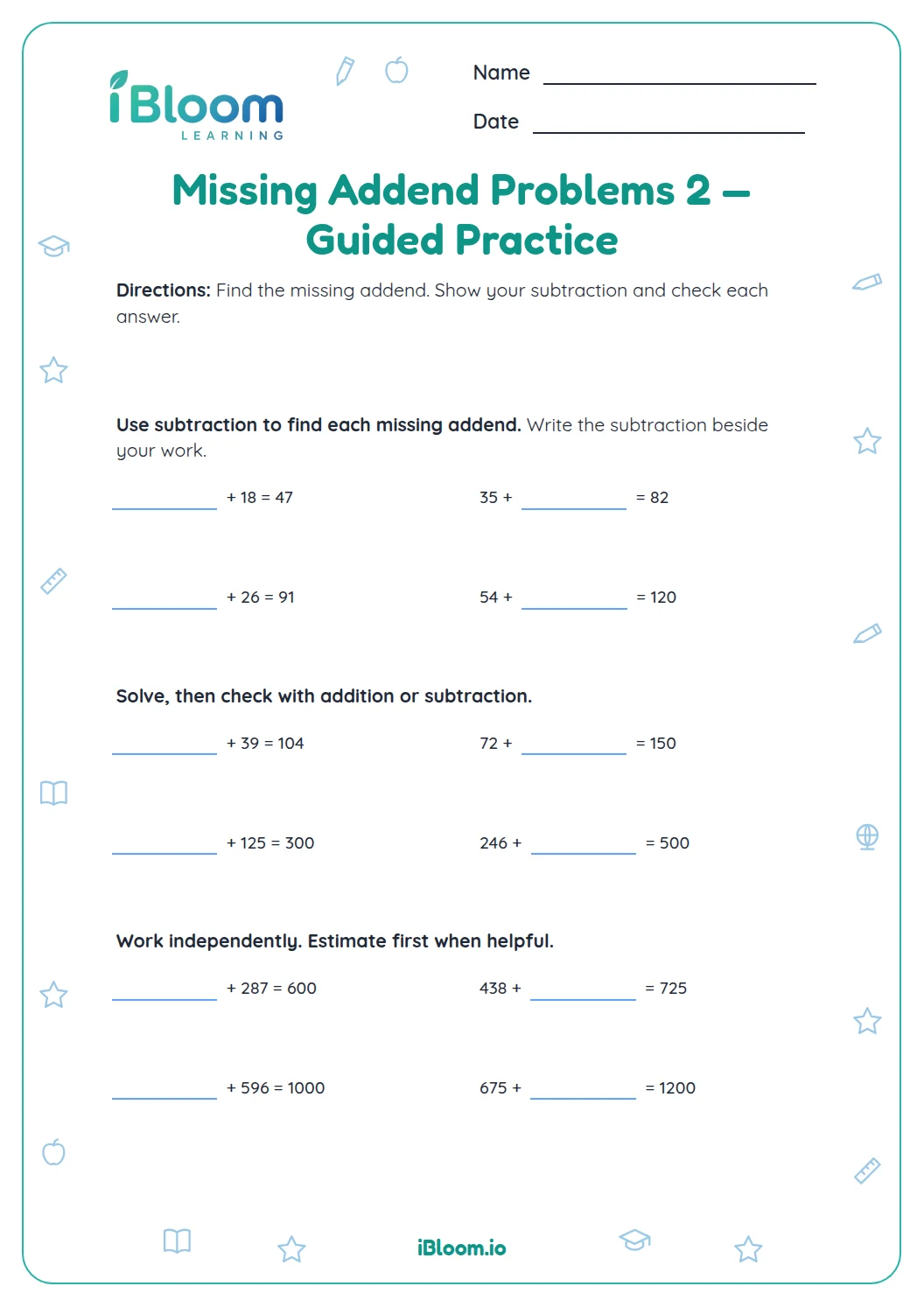
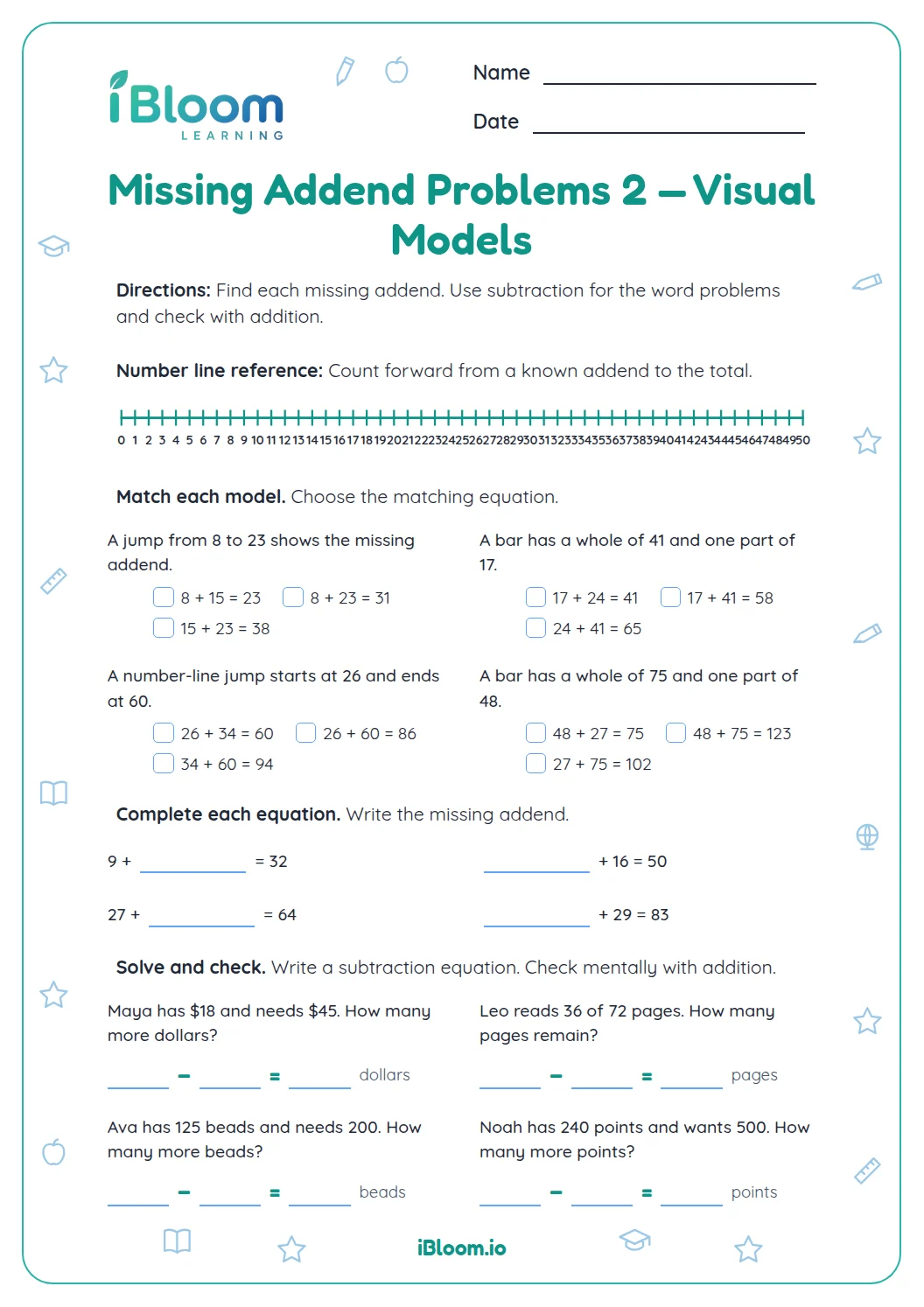
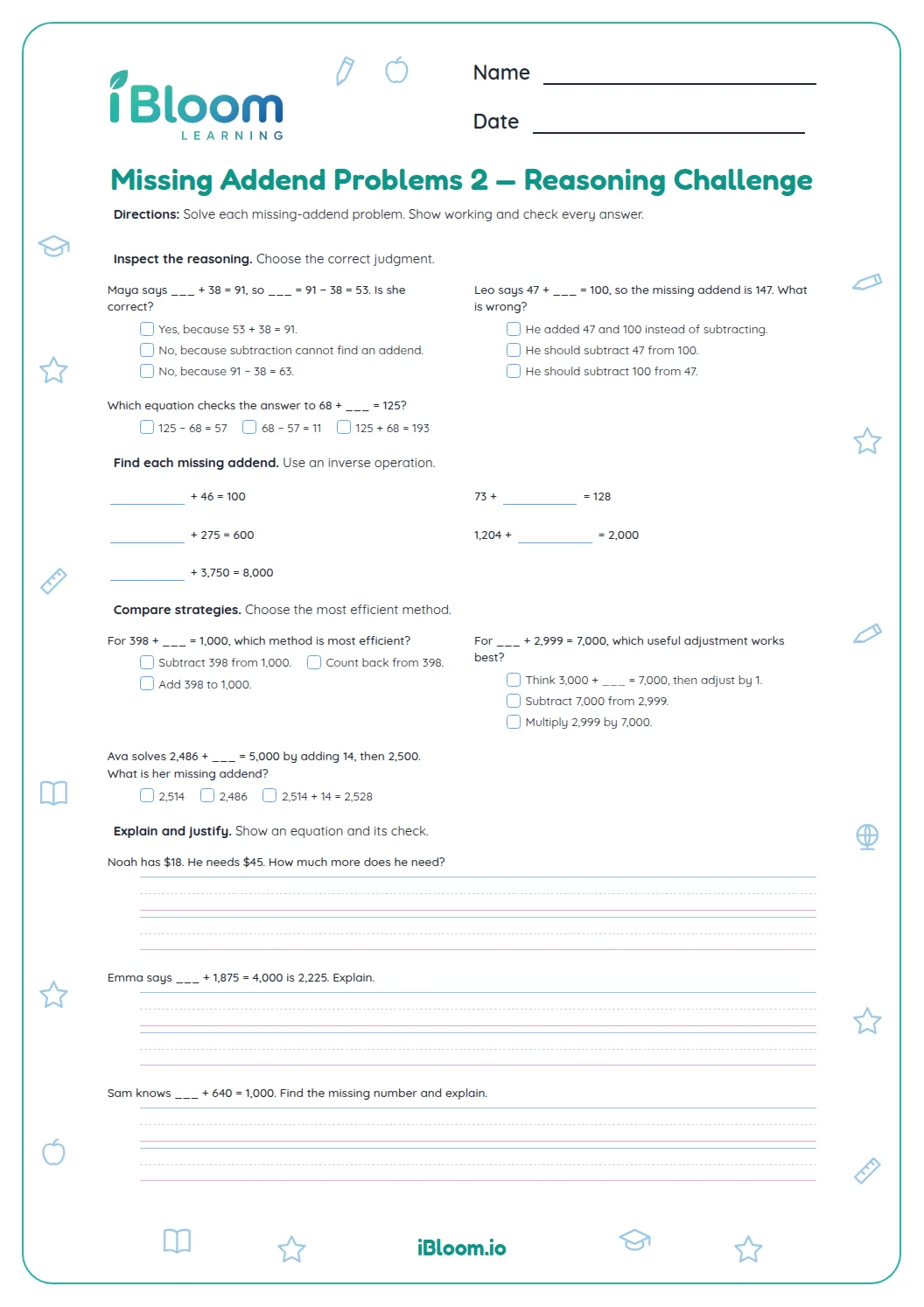
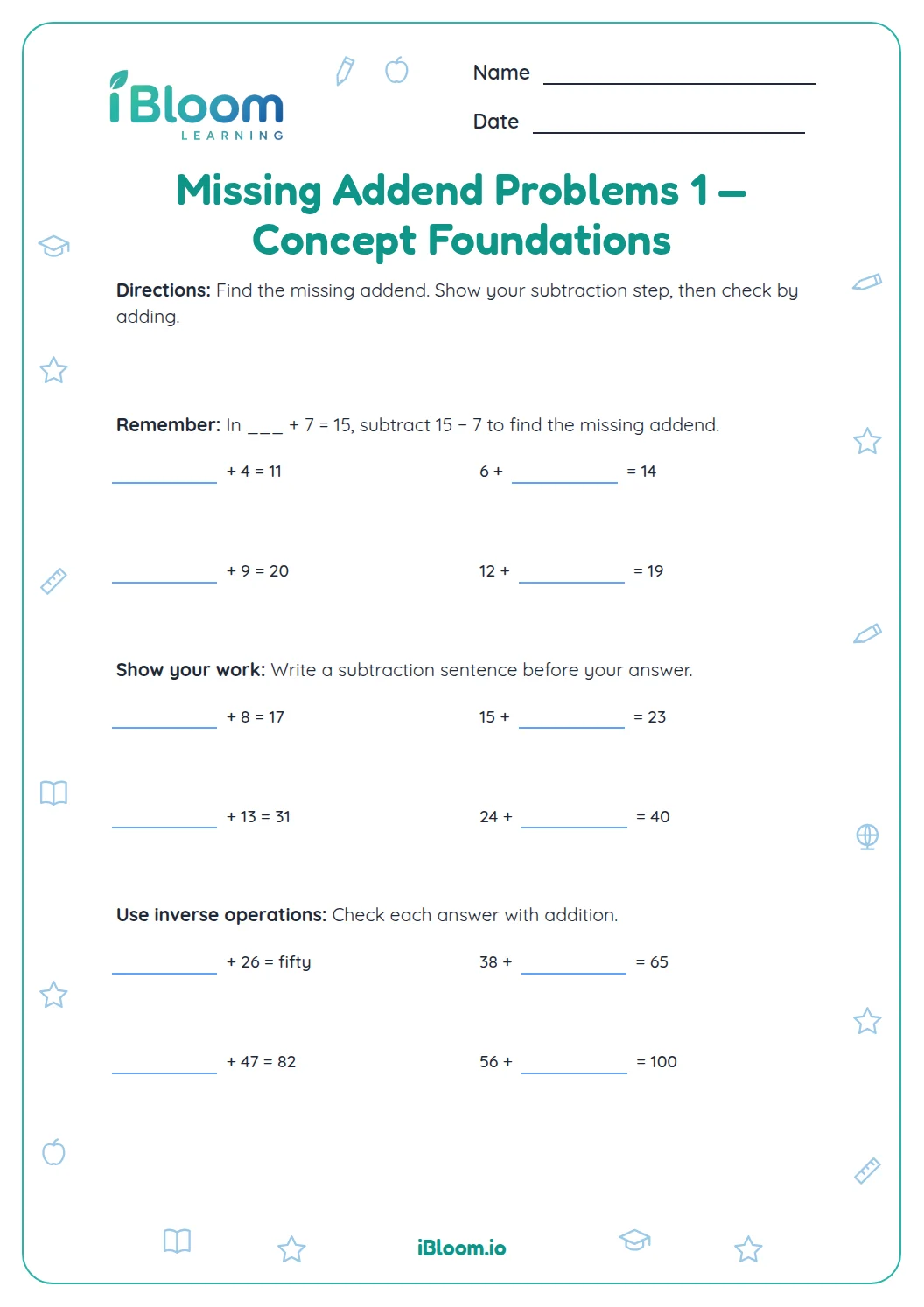
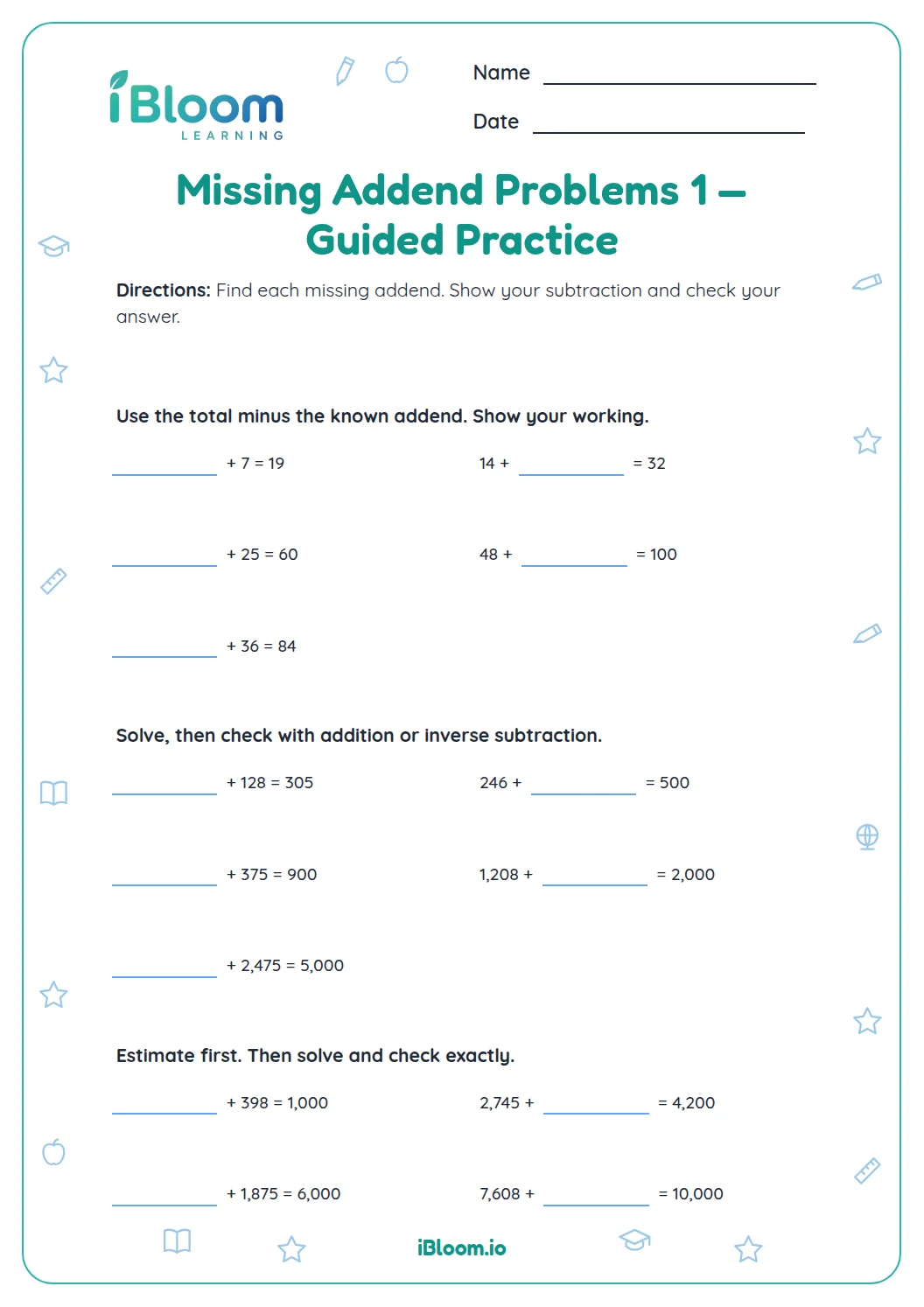
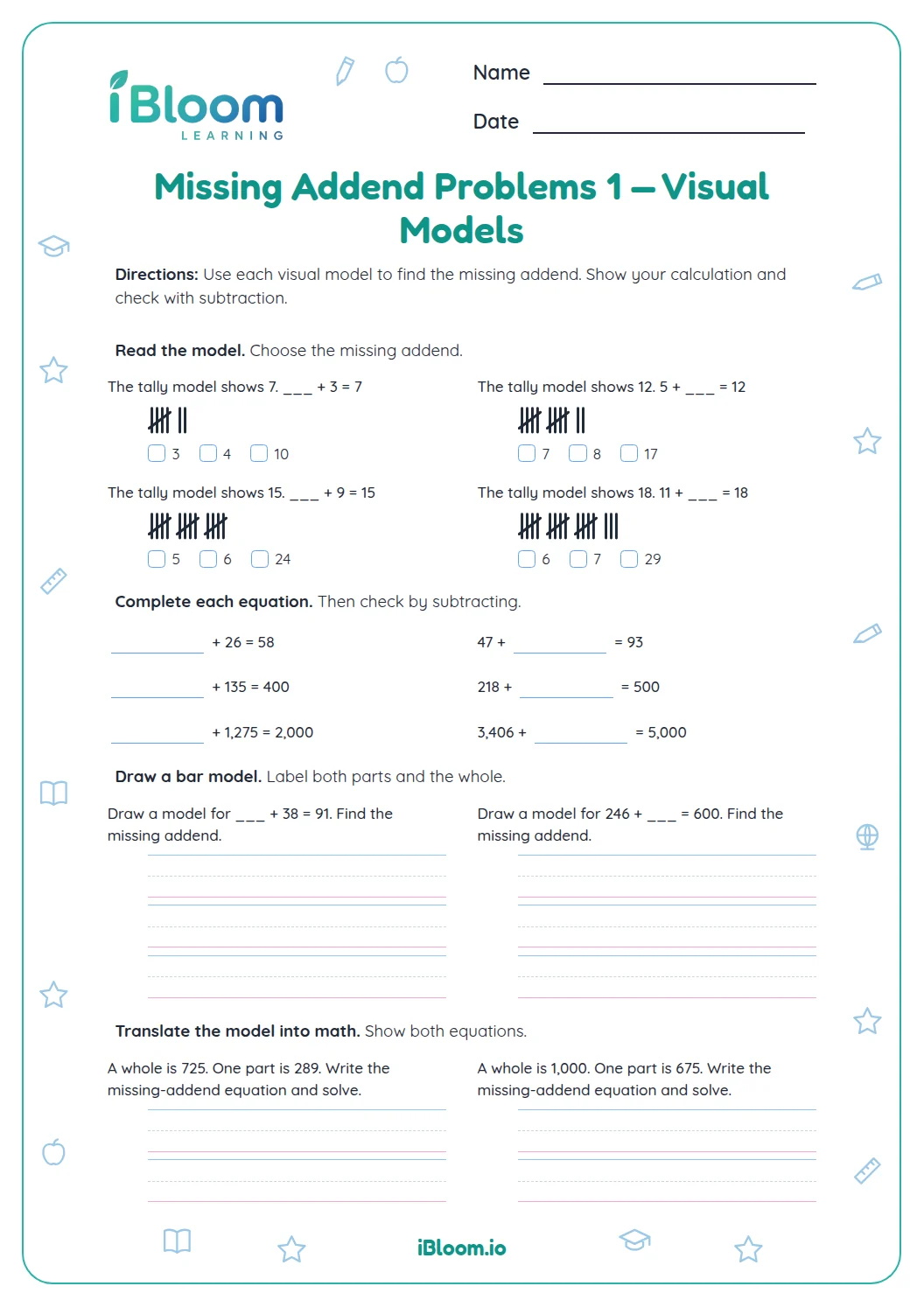
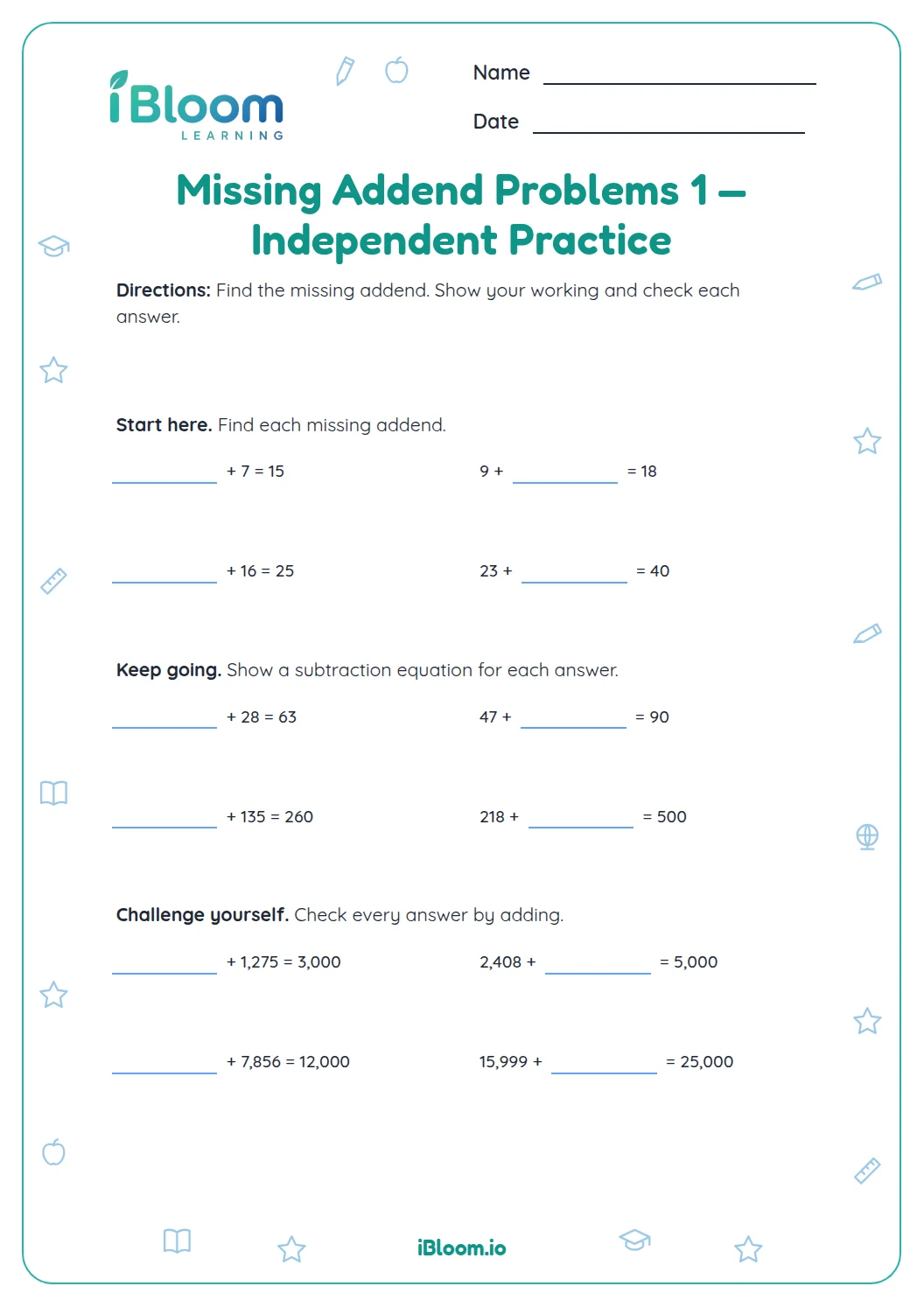
This free Grade 6 worksheet gives students 14 real-world missing-addend problems with whole numbers and decimals. Each question asks for an unknown amount, such as how many miles remain or how much money is still needed. Students write an equation, solve it, and include a unit where it helps clarify the answer. The practice aligns with CCSS 6.EE.B.7, which includes solving real-world problems by writing and solving equations with rational numbers. A separate answer key supports quick checking.
Aligned to 6.EE.B.7
What does the unknown represent?
Each problem describes a total, a change, or an amount left. First identify what the question asks you to find. In question 1, the club needs 125 chairs and already has 48, so the missing amount is 125 − 48 = 77 chairs.
- 1Total needed: 125 chairs
- 2Already available: 48 chairs
- 3125 − 48 = 77 chairs
How do you choose addition or subtraction?
Subtract when the total and one part are known. Add known parts before subtracting when a story has more than one contribution. Check by putting the found amount back into the story.
How do you handle decimal amounts?
Line up decimal points before adding or subtracting. In the hike problem, 12.5 − 7.8 = 4.7 miles remain. Keep the unit from the question in the final answer.
How can a student work through the page?
- 1Read the final question and name the unknown.
- 2Mark the amounts the story gives.
- 3Write an equation that matches the story.
- 4Calculate carefully, lining up decimal points when needed.
- 5Check by substituting the answer and include the unit.
What should students check?
The mistake
Subtracting the smaller number from the larger without considering the story.
The fix
Ask whether the unknown is a remaining amount or an added part.
The mistake
Combining quantities with different units.
The fix
Keep the unit label with each amount and check that the story uses the same unit.
The mistake
Dropping a decimal place during subtraction.
The fix
Align decimal points and add placeholder zeros if useful.
Each story becomes an equation with an unknown amount, then a solution.
On this sheet:
Show the official wordingHide the official wording
Solve real-world and mathematical problems by writing and solving equations of the form x + p = q and px = q for cases in which p, q and x are all nonnegative rational numbers.
What to practice next
Make more practice
Further reading
Questions parents and teachers ask
What is a missing addend?
A missing addend is an unknown part in an addition equation. In a story, it may be the amount still needed, the amount that arrived, or another part of a total. Students can use subtraction to find the unknown and then check that the parts combine to make the stated total.
How many problems are on the worksheet?
There are 14 story problems across two worksheet pages, followed by a separate answer key. The situations use chairs, books, distances, tickets, and money so students practice identifying an unknown amount in different settings. Each problem asks them to connect the quantities with an equation.
Should students write an equation for each story?
Yes. Writing an equation shows how the known amounts and unknown connect. Students can use a letter or blank for the unknown, solve, and then write the answer with its unit, such as “77 chairs.” A quick inverse check can confirm that the answer restores the stated total.
How can students check a subtraction answer?
Add the part that was taken away or missing back to the remaining part. For example, 48 chairs already available plus 77 more equals the goal of 125. If the check returns the stated total, the subtraction is consistent with the story.
Why do some questions use decimals?
Several questions use decimal measurements, including miles, gallons, and liters. Students line up decimal points, calculate the missing amount, and retain the unit in the answer. The whole-number and decimal situations both ask students to represent an unknown with an addition or subtraction equation.
What comes next after this practice?
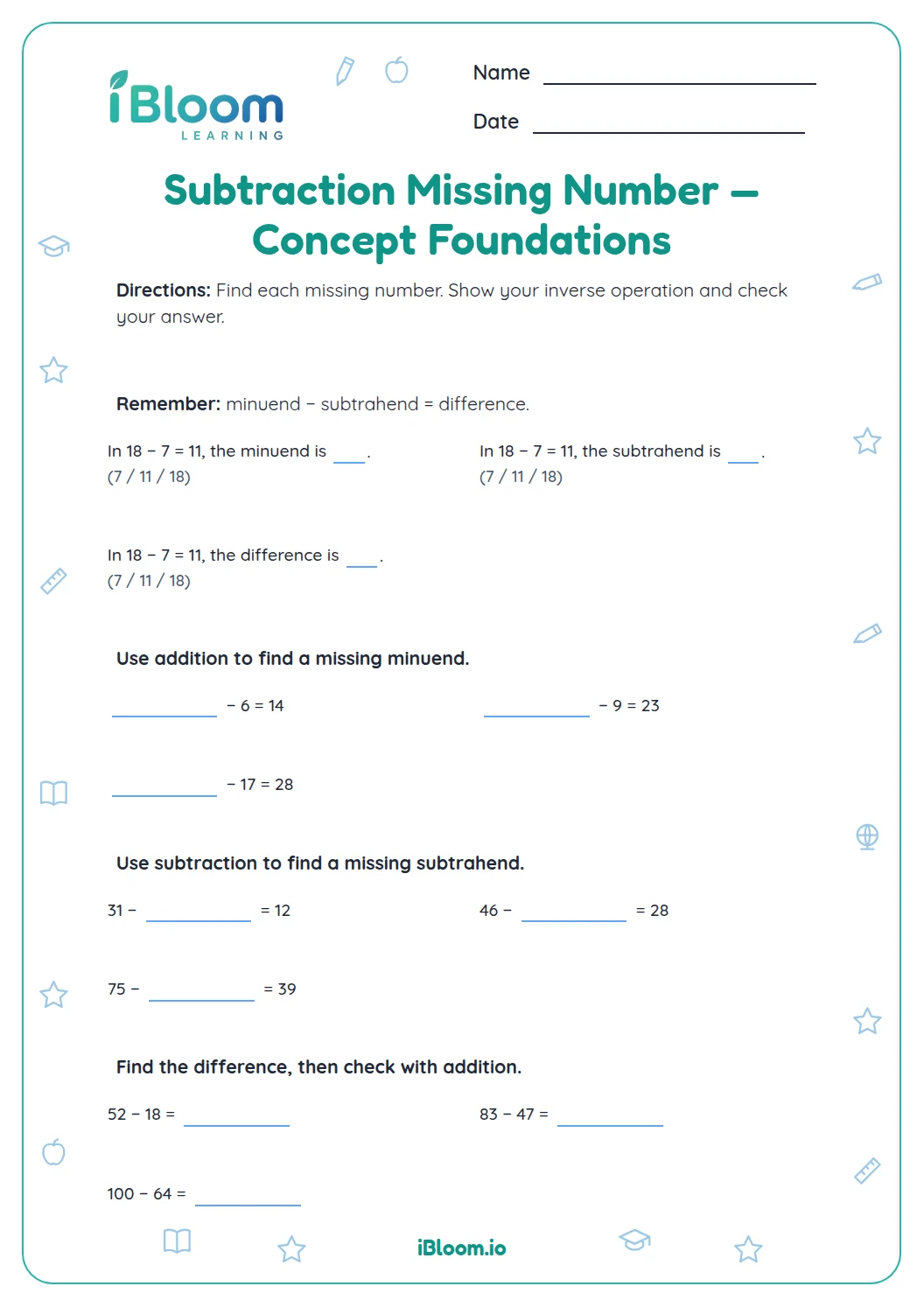
Students can continue with missing values in subtraction equations, then try mixed addition and subtraction problems. Asking them to explain what the unknown represents helps connect a calculation to the situation. Explaining the unknown helps students choose the operation with purpose.