


About this worksheet
This Grade 6 worksheet gives students 14 real-world decimal addition problems, from tenths through six decimal places. Students add lengths, distances, amounts of money, masses, and other quantities, then report totals with units where needed. The answer key includes worked totals for checking. The problems practice CCSS 6.NS.B.3, which includes fluently adding multi-digit decimals with the standard algorithm.
Aligned to 6.NS.B.3
How do you add decimals with different place lengths?
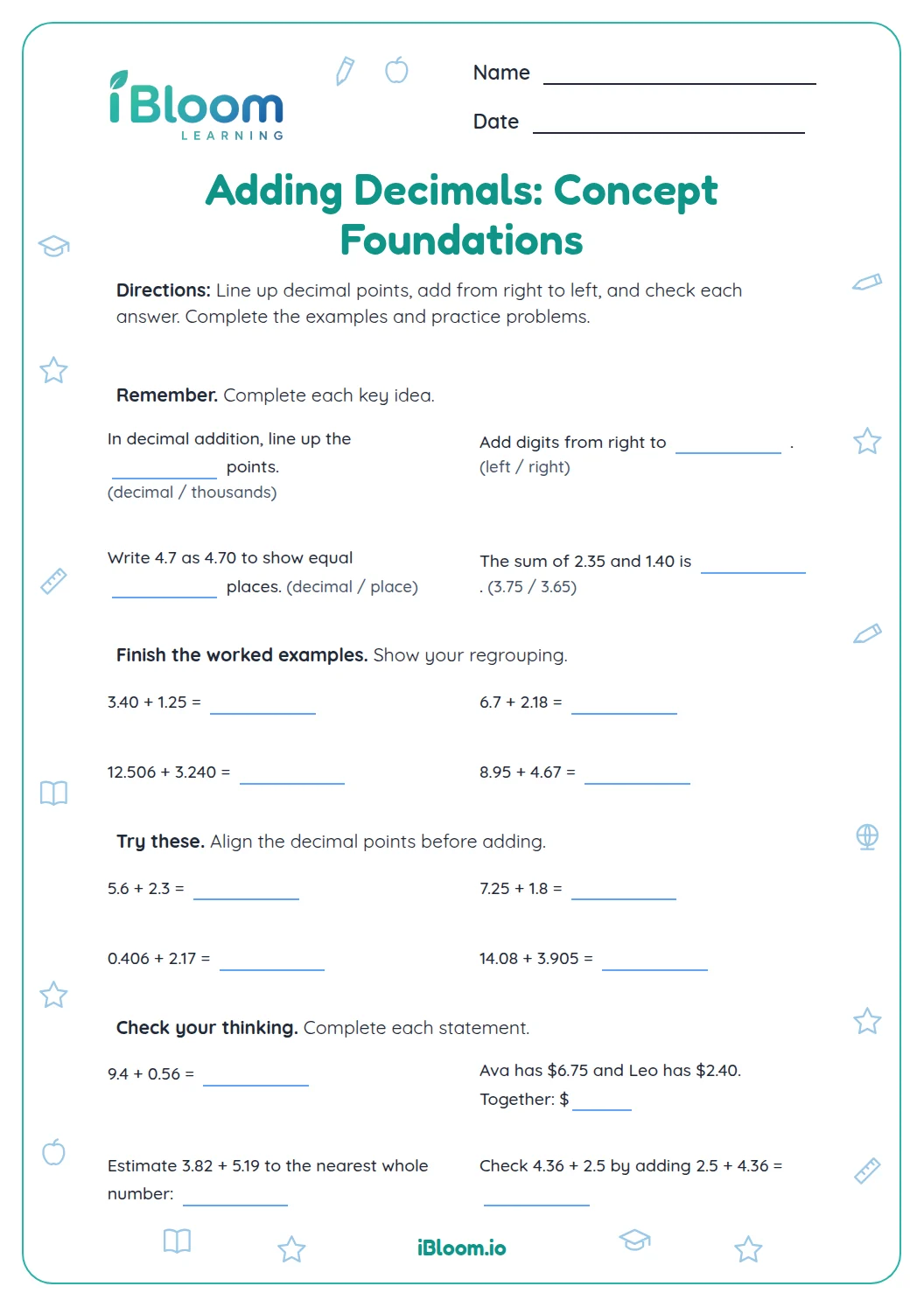
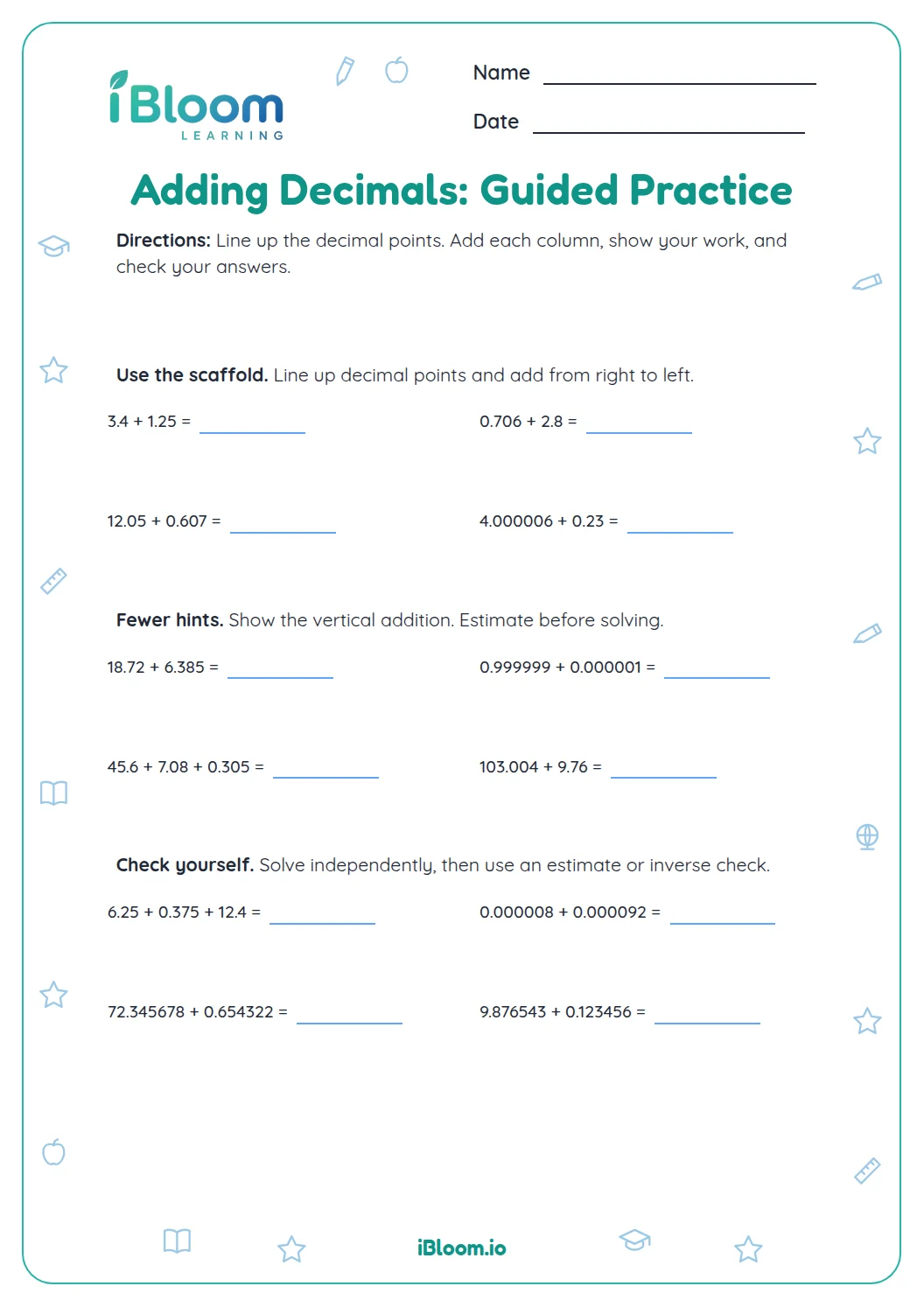
Line up the decimal points so matching place values are in the same column. Add zeros to the right of a number when helpful; for example, 2.75 can be written as 2.750 without changing its value.
How does the worksheet use decimal addition?
The first ten items are multiple choice, including totals with unequal decimal lengths. In question 2, add 18.406 L and 2.75 L by writing 2.75 as 2.750; the total is 21.156 L.
How can you check a decimal total?
Estimate the amounts before adding, then compare the estimate with the exact sum. Keep the unit from the story, and use zeros as placeholders so digits remain in their correct place-value columns.
How to use this worksheet
- 1Underline the amounts that need to be added.
- 2Write the numbers with decimal points aligned.
- 3Add placeholder zeros to make place values easier to compare.
- 4Add from right to left, regrouping when a column totals ten or more.
- 5Estimate and include the unit requested in the story.
Common mistakes and quick fixes
The mistake
Shifting digits to make decimal strings the same length.
The fix
Align decimal points, then add zeros only at the right end.
The mistake
Dropping a zero in a small decimal.
The fix
Use placeholders to keep hundredths, thousandths, and smaller places aligned.
The mistake
Writing a total without its unit.
The fix
Check the question and include miles, liters, dollars, or another stated unit.
Curriculum alignment
This worksheet practices the skills named in the standard below.
Fluently add, subtract, multiply and divide multi-digit decimals.
On this sheet: All problems require adding multi-digit decimals in real-world contexts.
Show the official wordingHide the official wording
Fluently add, subtract, multiply, and divide multi-digit decimals using the standard algorithm for each operation.
What to practice next
Questions parents and teachers ask
How should decimal points be lined up?
Place decimal points directly under one another so ones, tenths, hundredths, and smaller places match. If one amount has fewer decimal places, add zeros to its right before adding. These settings give practice keeping place values aligned while adding quantities that share a unit.
Can a decimal have more places than the other addend?
Yes. A number such as 2.75 can be written as 2.750, so it can be added to 18.406 by matching place values. The added zero does not change the amount. Writing 2.75 as 2.750 keeps the same value and lines up the thousandths place correctly.
What kinds of contexts appear in the problems?
The worksheet uses contexts such as distance, length, money, volume, mass, and quantities. The unit in each story helps students label the result correctly. Students should carry the unit from the question into the answer so the total stays meaningful.
How many decimal problems are included?
There are 14 addition problems. Ten are multiple choice, and four ask students to calculate a total and write it with the appropriate unit. The last four prompts provide room to calculate and record a total with its unit. Students can check each answer by estimating the total and matching its unit.
How can students check whether an answer is reasonable?
Round each amount to a nearby whole number or simple decimal and estimate the total. Then compare the exact sum with that estimate and check that its unit matches the problem. An estimate provides a quick check that the exact answer is close to the expected size.