





About this worksheet
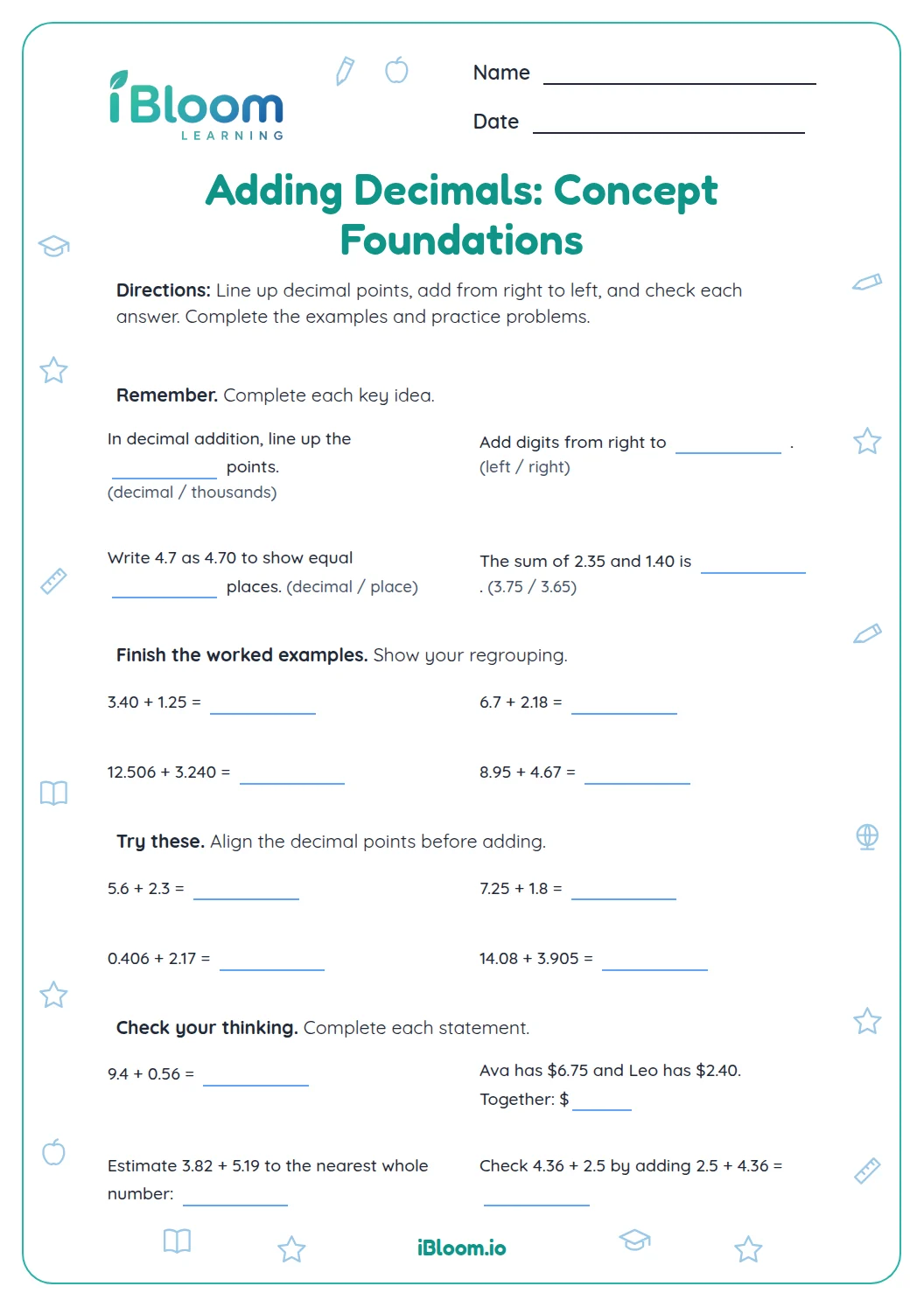
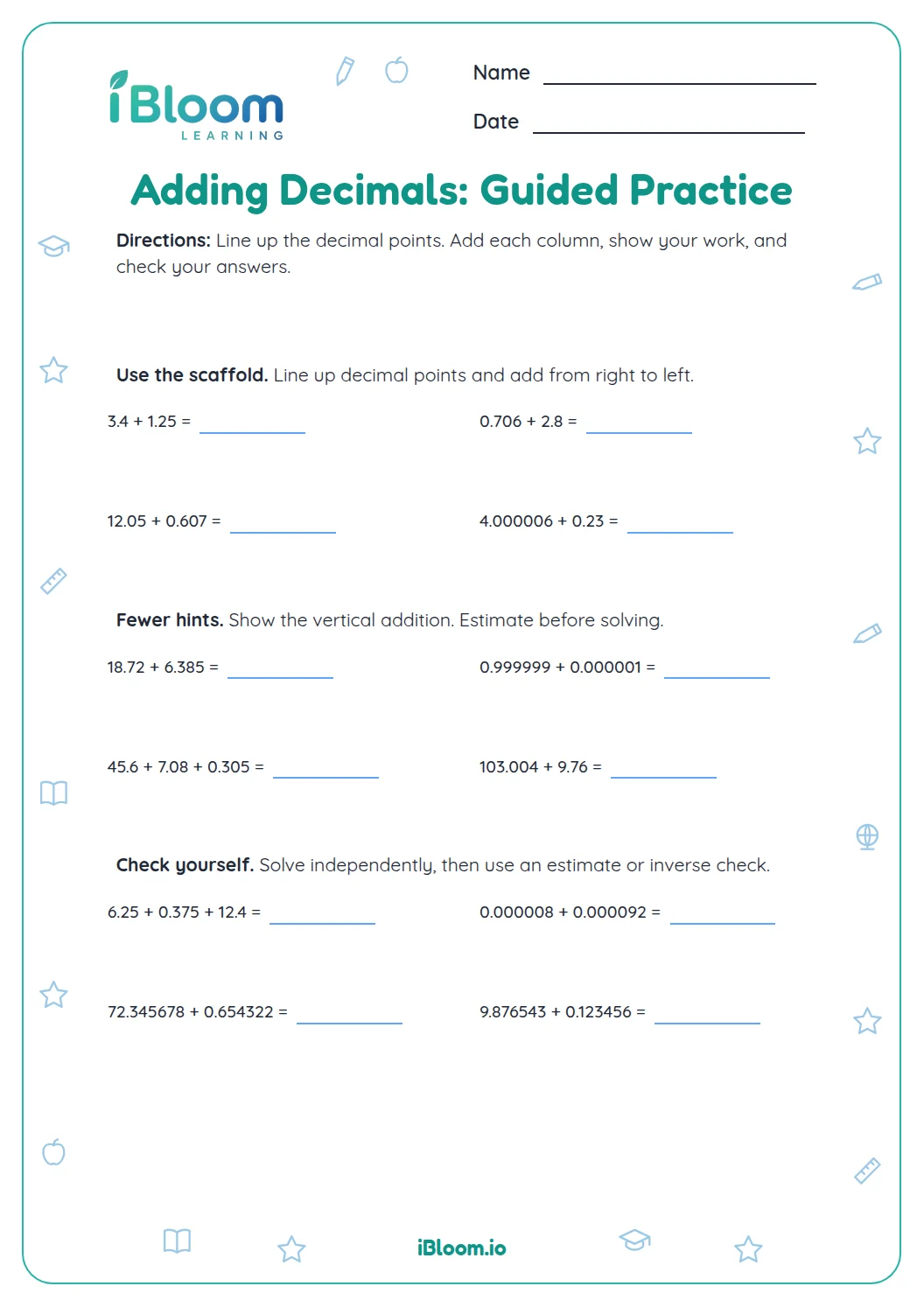
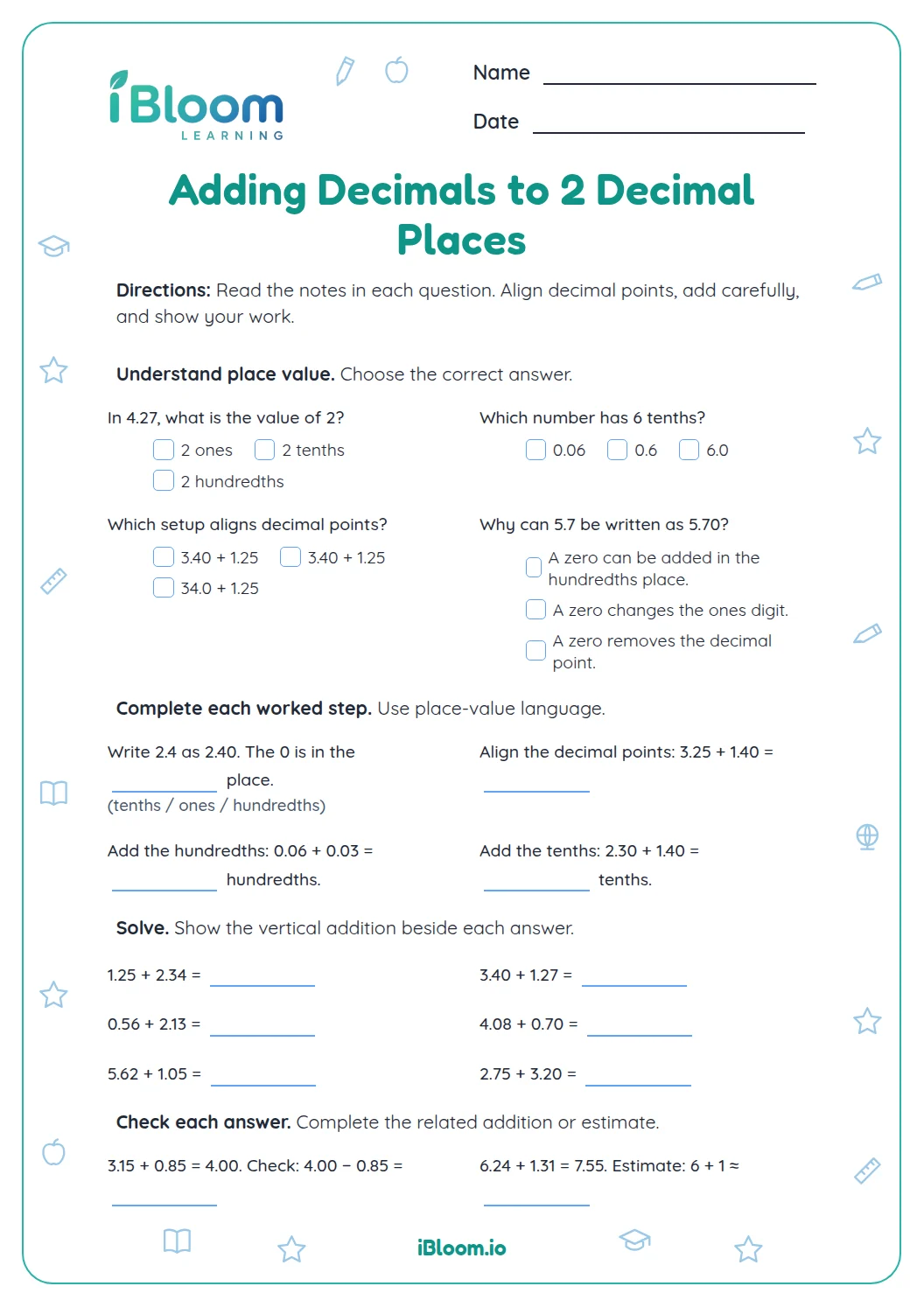
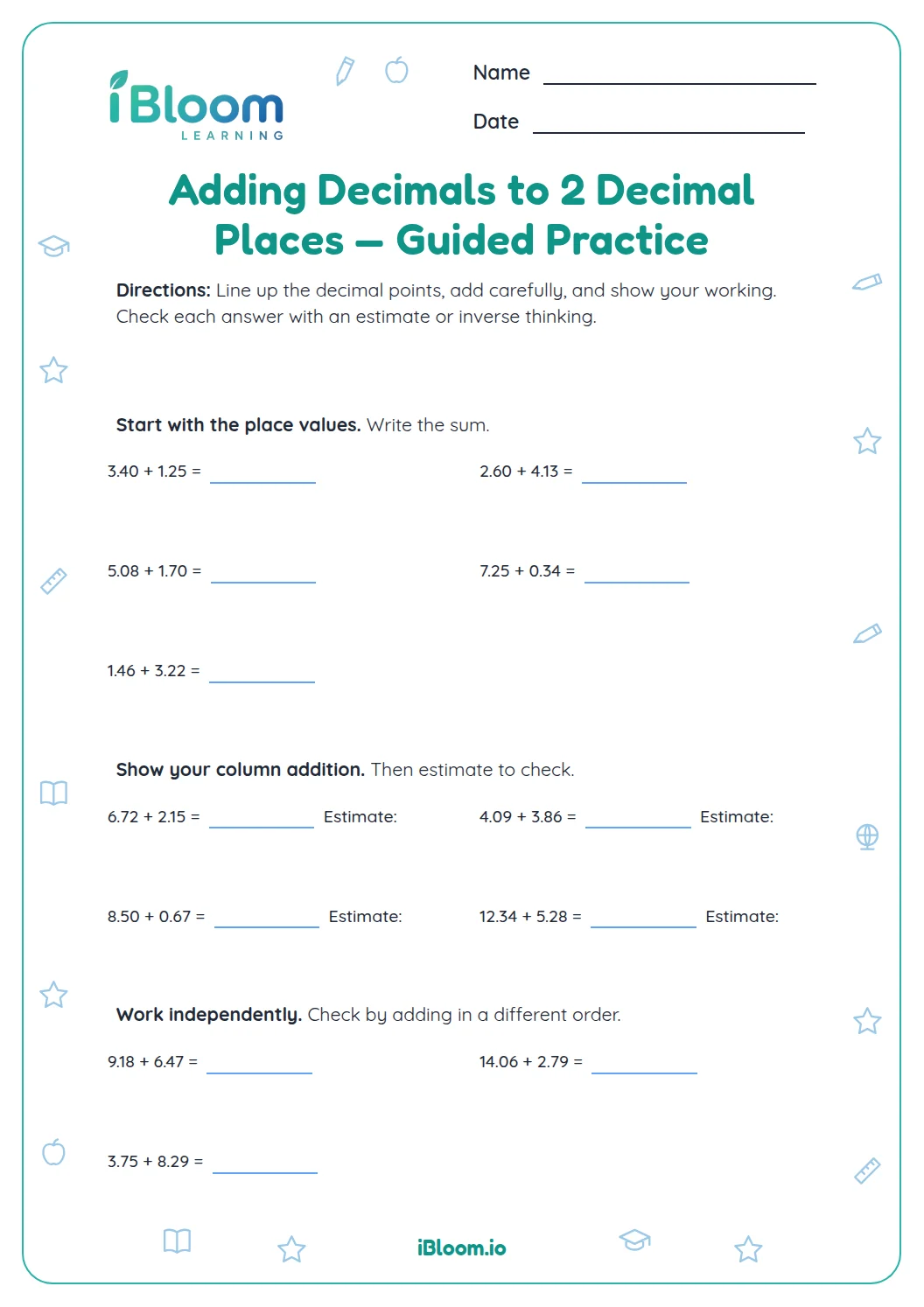
This Grade 6 worksheet gives 16 decimal addition problems, from whole-number sums to addends with six decimal places. Learners align decimal points and add, using placeholder zeros where needed. For example, 0.08 + 7.2 can be written as 0.08 + 7.20 = 7.28. The separate answer key shows each sum. This practices decimal addition with the standard algorithm described in Common Core 6.NS.B.3.
Aligned to 6.NS.B.3
Why should decimal points line up?
Each column must represent the same place value. Lining up decimal points puts tenths under tenths, hundredths under hundredths, and so on. You can add zeros to the end of a shorter decimal without changing its value.
How do placeholder zeros help?
They make the place-value columns easier to see without changing the number. In q3, write 7.2 as 7.20, then add 0.08 to get 7.28. The zero holds the hundredths place so the digits line up.
- 10.08 + 7.2 = ___
- 2Answer: 7.28
What range of decimal addition is included?
The 16 equations range from whole numbers to addends with six decimal places. Early items include tenths and thousandths; later items include four-, five-, and six-place decimals. Some sums make a whole number, while others retain decimal digits.
How to solve these decimal sums
- 1Line up the decimal points before adding.
- 2Add trailing zeros to make the columns easy to read.
- 3Add from the rightmost place, regrouping when a column totals ten or more.
- 4Place the decimal point directly below the aligned points.
- 5Check the sum by estimating or adding the parts again.
Decimal addition mistakes and quick fixes
The mistake
Aligning the last digits instead of the decimal points.
The fix
Place decimal points in one vertical line before adding.
The mistake
Treating a missing decimal place as a zero value in the wrong column.
The fix
Add trailing zeros, as in 7.2 = 7.20, to show aligned columns.
The mistake
Placing the decimal point by counting digits in the answer.
The fix
Bring it straight down from the aligned addends.
Common Core alignment
This worksheet gives focused practice connected to the following Common Core standard.
This sheet practices grade 6 decimal addition through its questions.
On this sheet: Each question gives practice connected to grade 6 decimal addition.
Show the official wordingHide the official wording
Fluently add, subtract, multiply, and divide multi-digit decimals using the standard algorithm for each operation.
What to practice next
Further reading
Questions parents and teachers ask
Can I add zeros to a decimal before adding?
Yes. Zeros at the end of a decimal do not change its value, so 7.2 equals 7.20. Writing the extra zero makes the tenths and hundredths columns easier to align with 0.08. Name the matching place values before calculating each sum.
How many decimal places does the worksheet include?
The 16 addition problems range from whole numbers with no decimal places to numbers with six decimal places. Several sums also require careful alignment when one addend has fewer digits after the decimal point than the other. Name the matching place values before calculating each sum.
What is the answer to 0.08 + 7.2?
Write 7.2 as 7.20 so the decimal points and place-value columns line up. Then add 0.08 + 7.20 to get 7.28. This is the method shown by the worked example and the key confirms each worksheet answer. Ask the learner to describe why the decimal points need to match.
Why do some answers end in zeros?
A zero at the end of a decimal does not change its value: 7.000 equals 7, and 0.500 equals 0.5. The answer key may keep trailing zeros to show the place-value alignment used in the calculation. Name the matching place values before calculating each sum.
What standard does this worksheet practice?
It practices the decimal addition part of Common Core 6.NS.B.3, which calls for fluently adding, subtracting, multiplying, and dividing multi-digit decimals with the standard algorithm. These questions focus on addition and lining up decimal places. Name the matching place values before calculating each sum.