





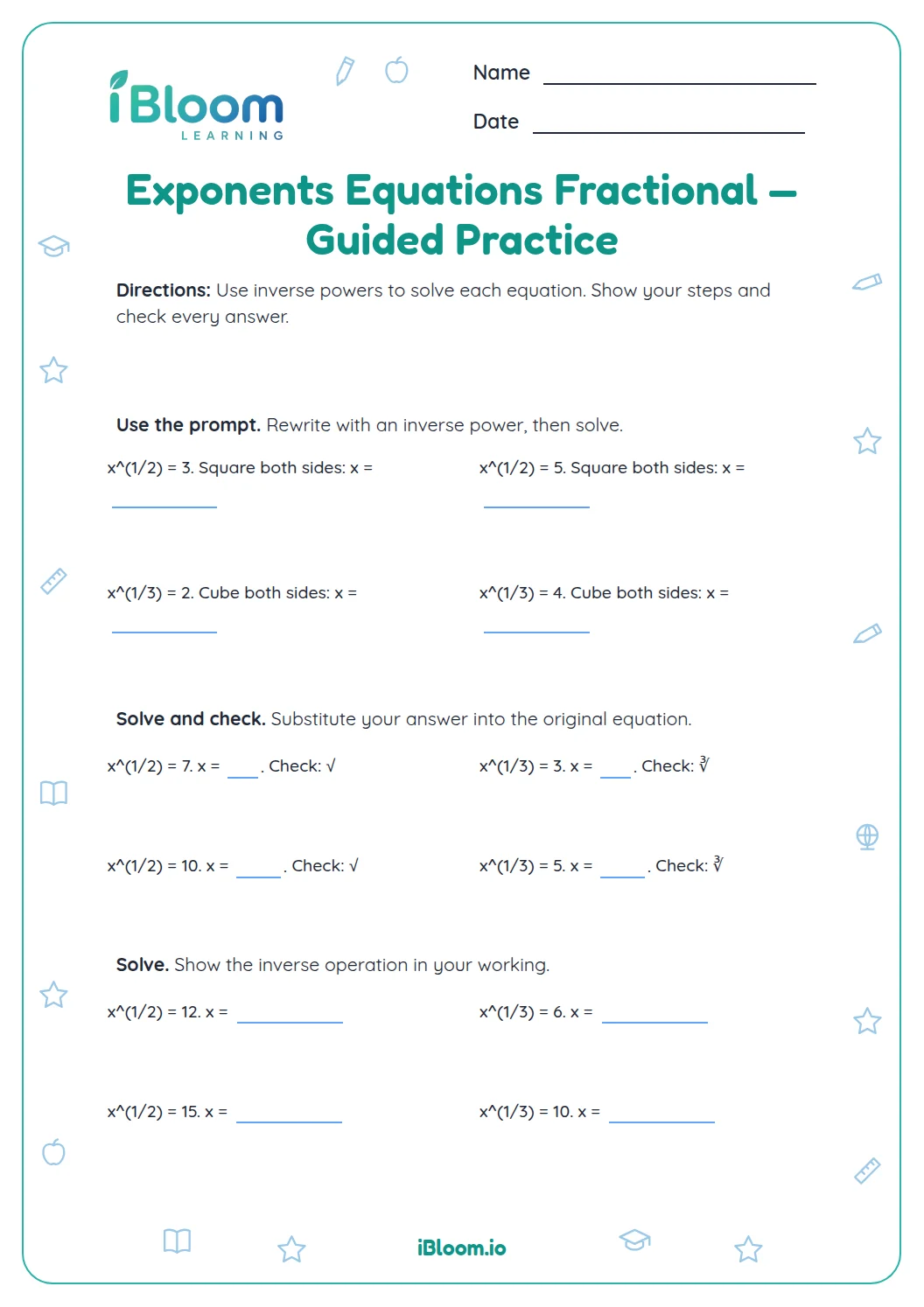
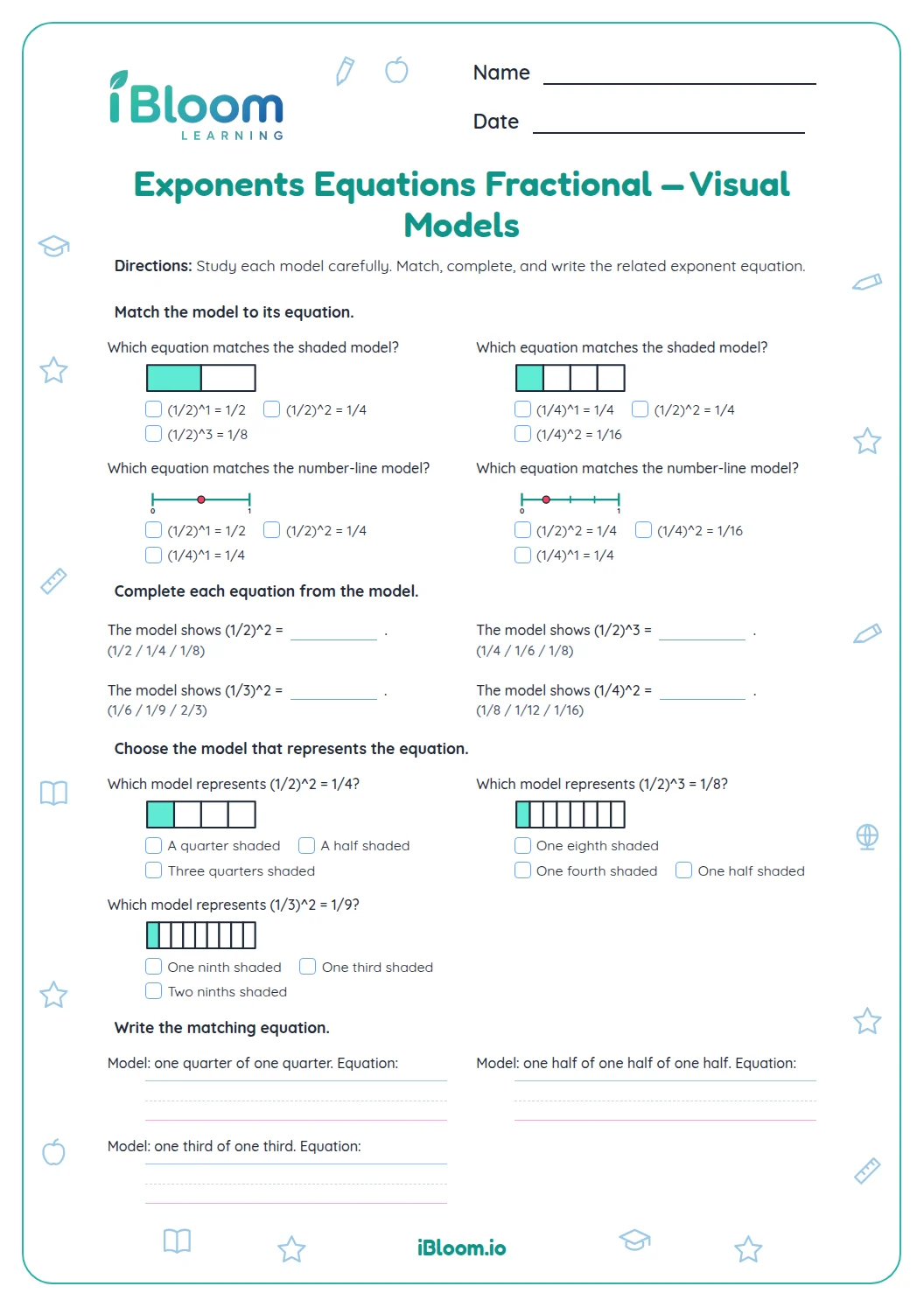
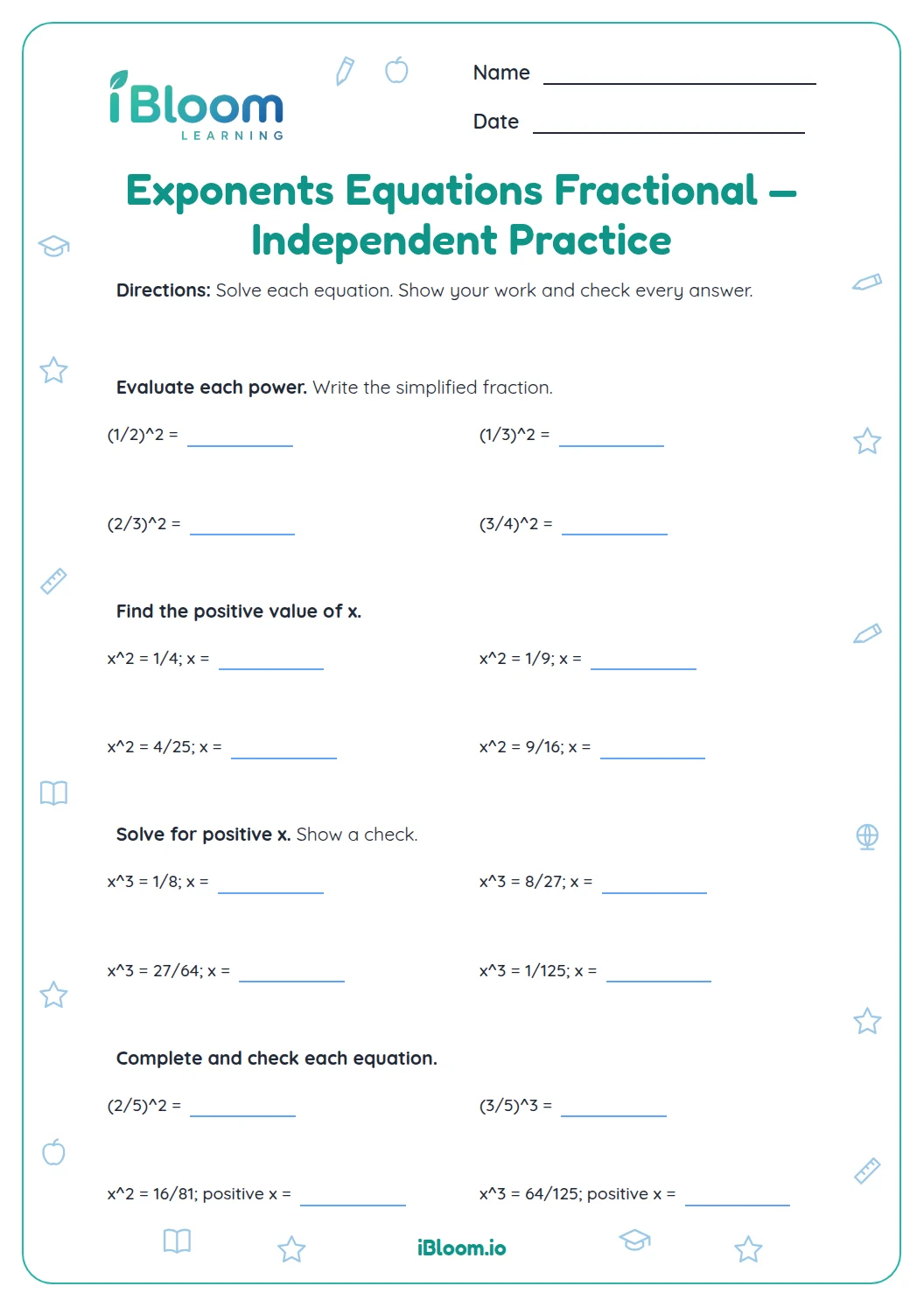
About this worksheet
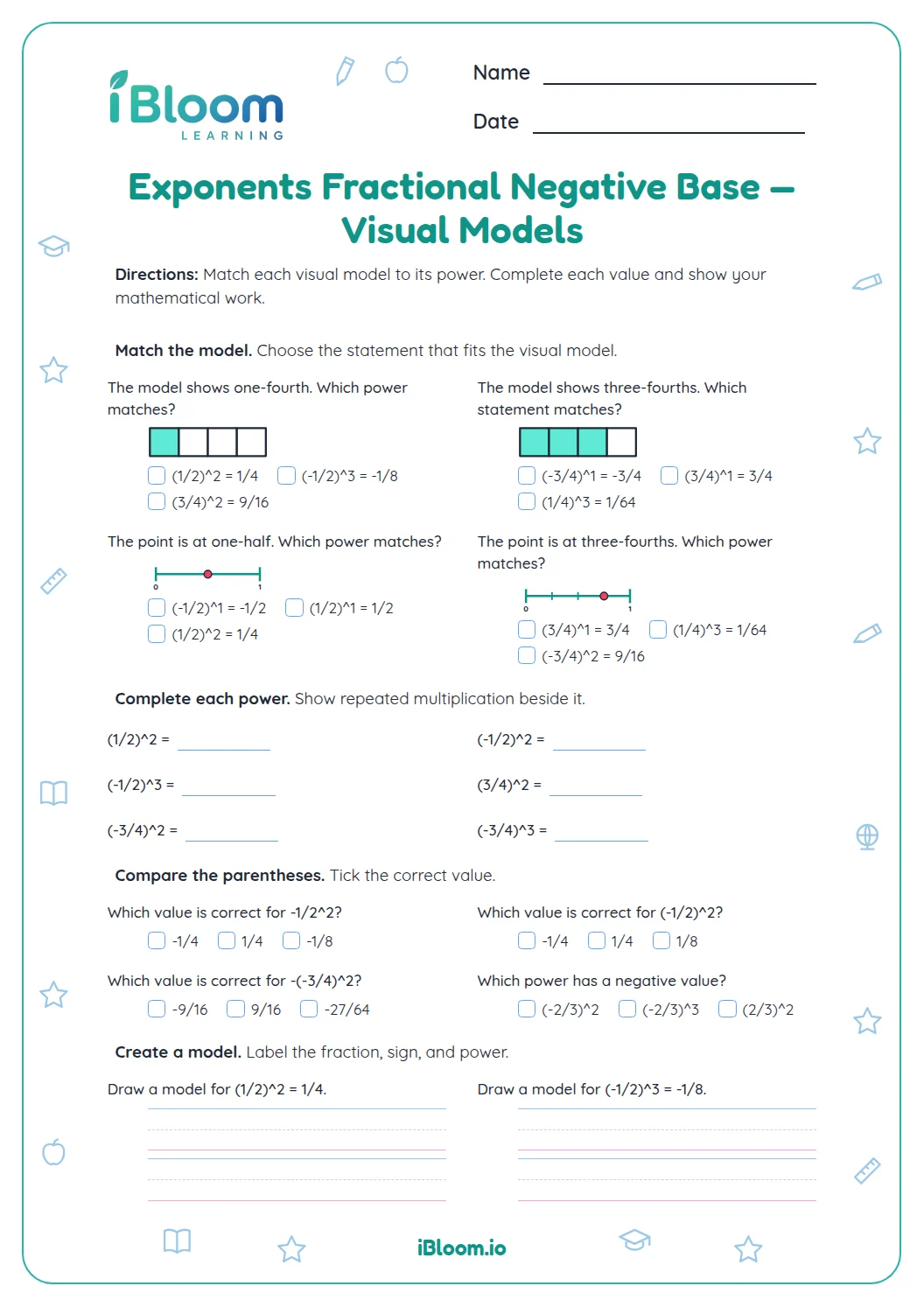
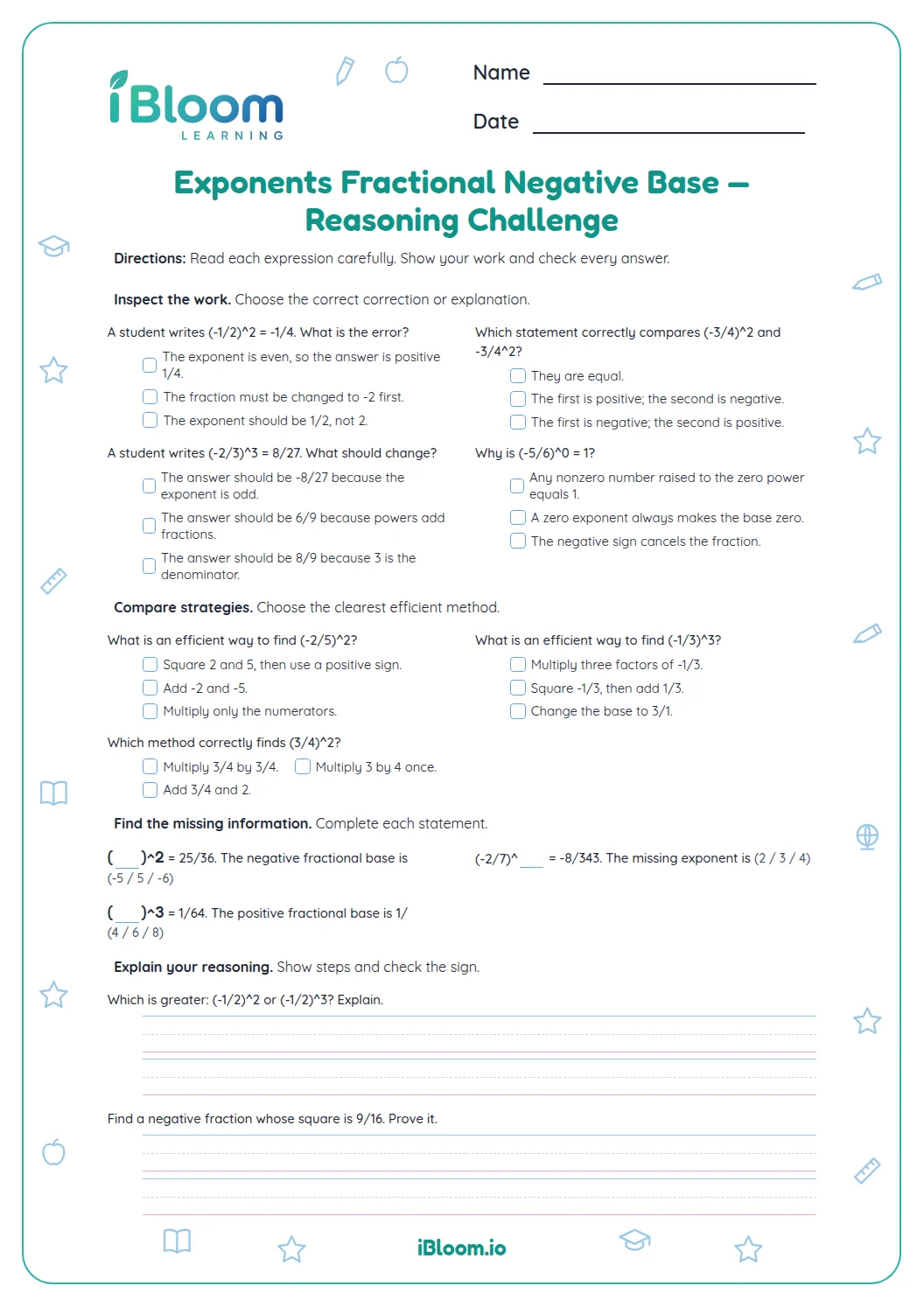
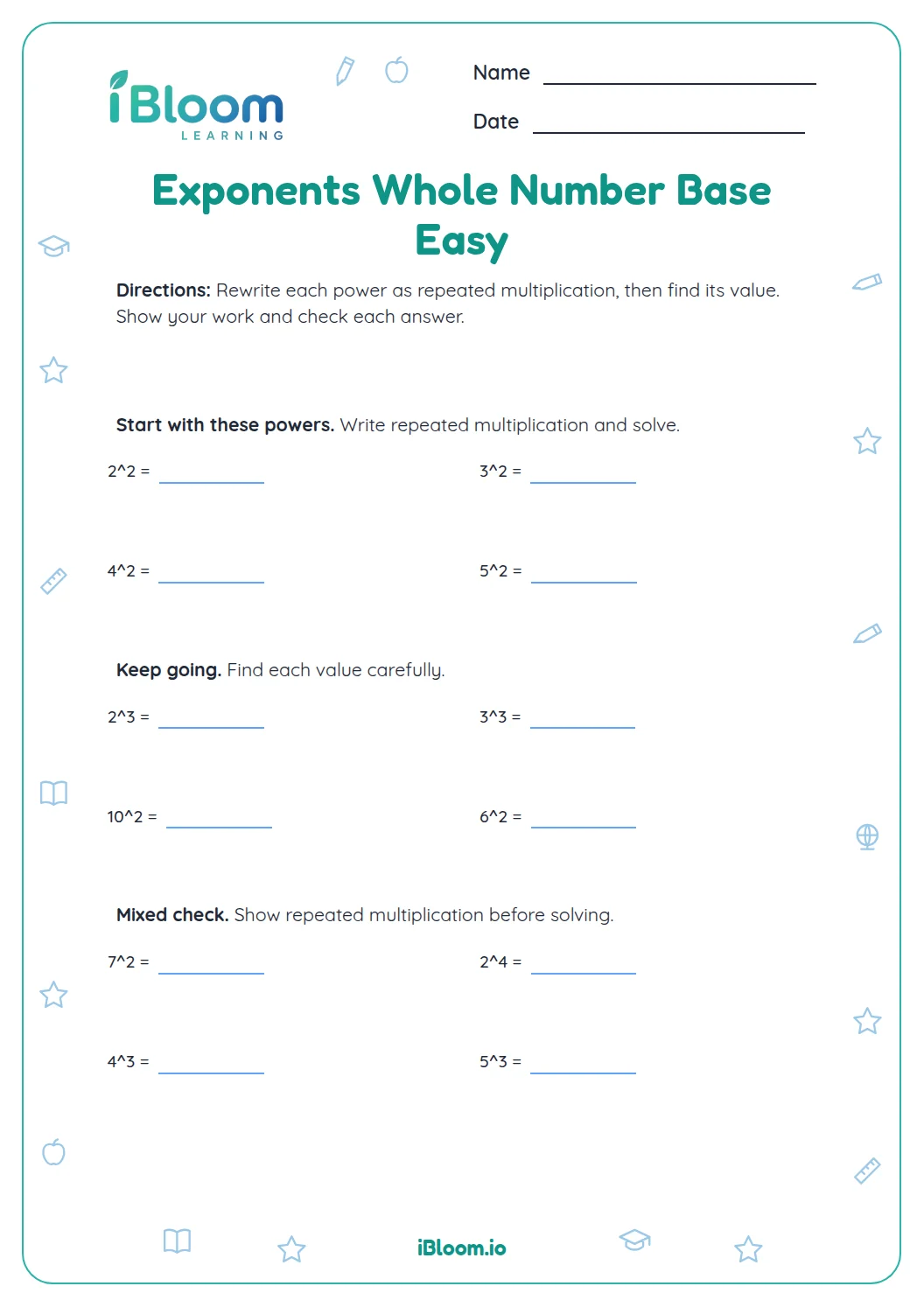
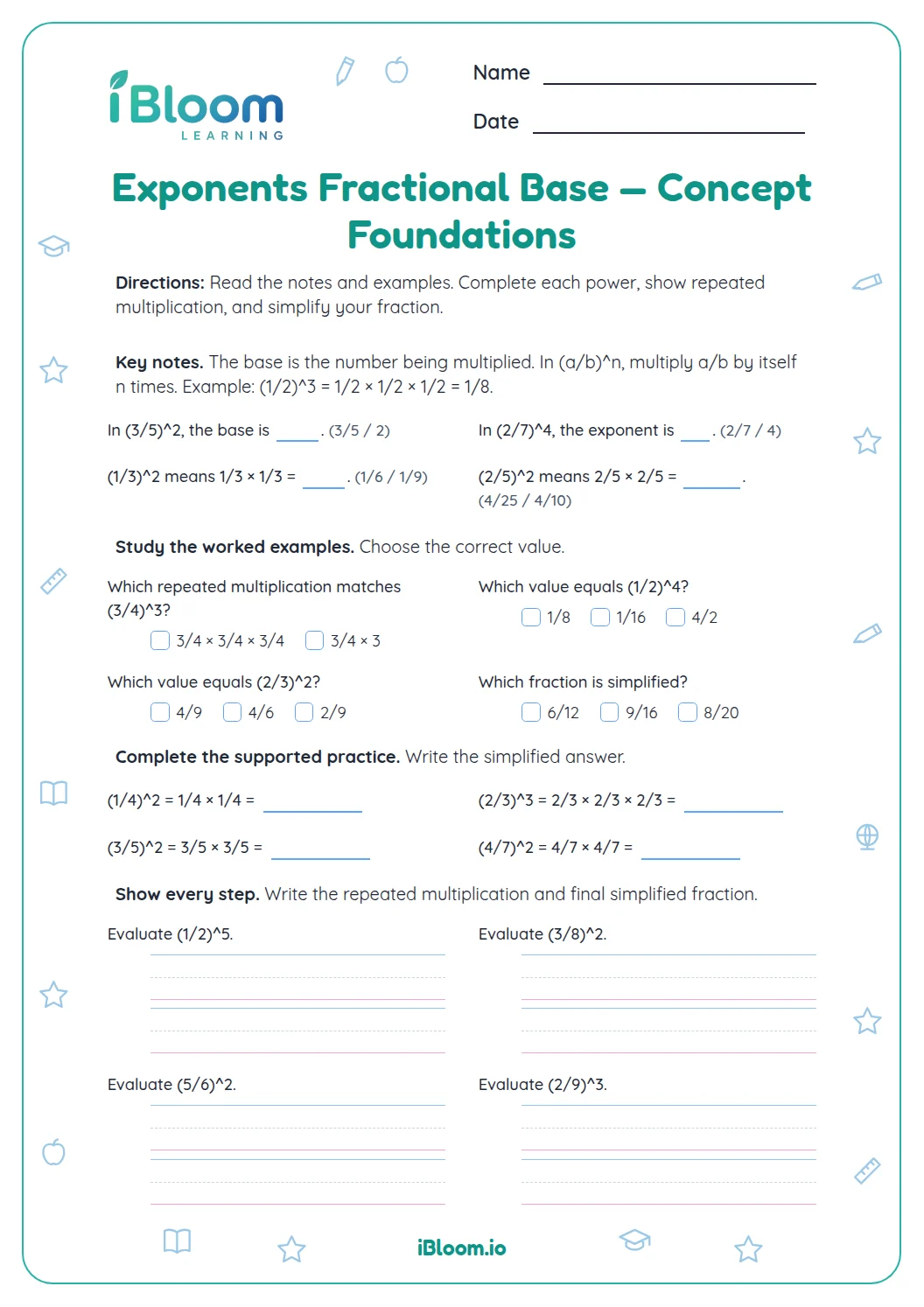
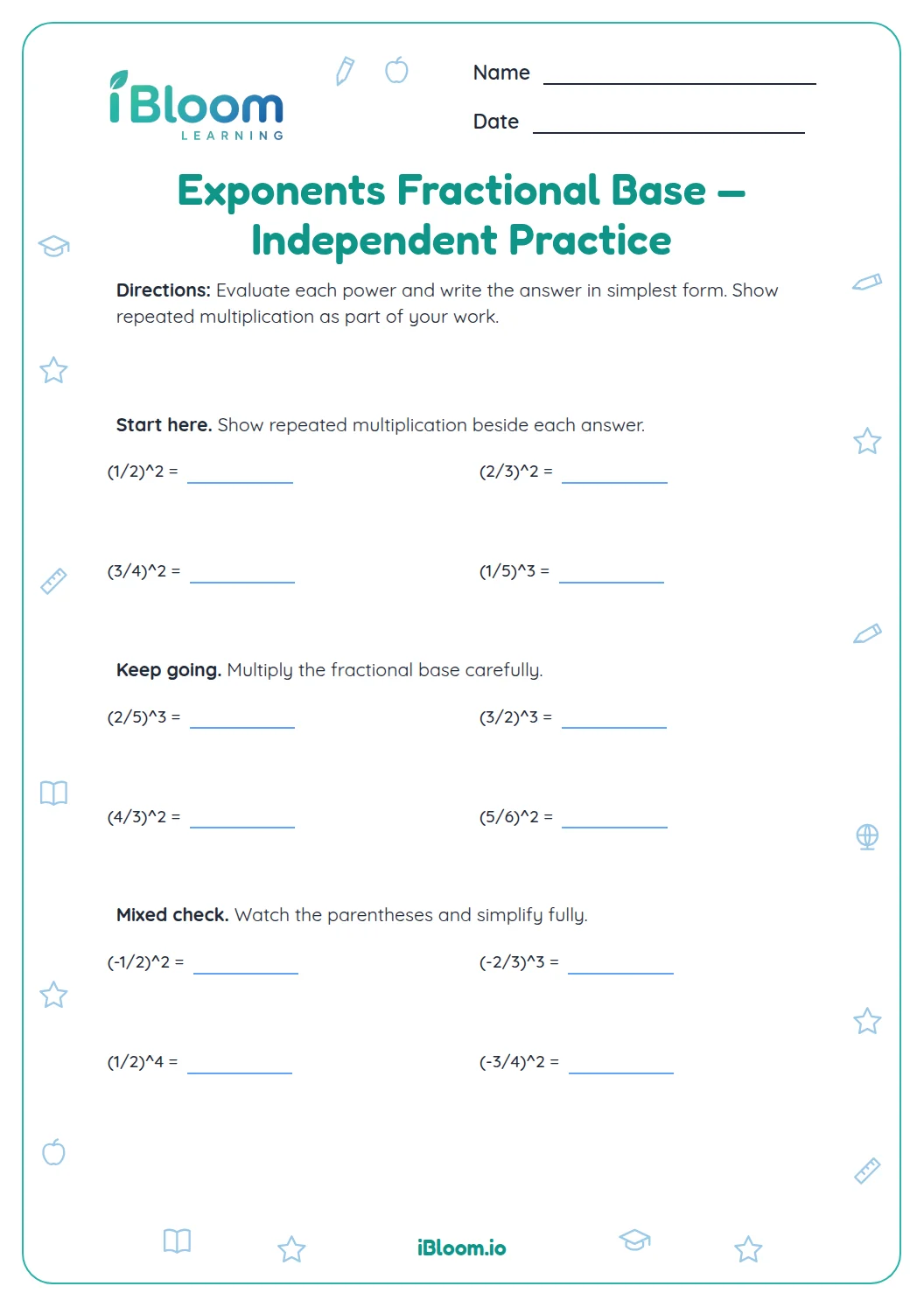
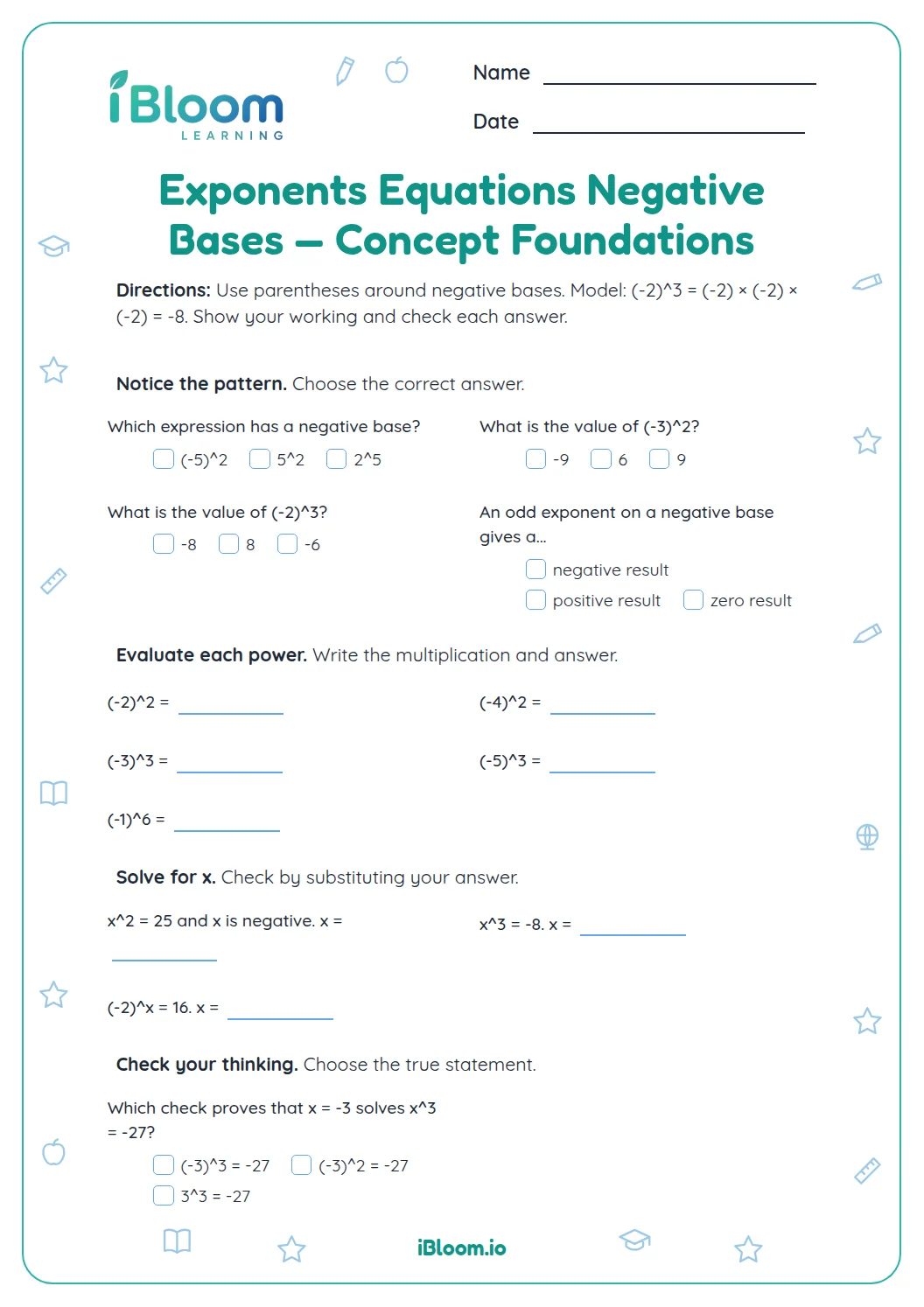
This Grade 6 worksheet focuses on powers with fractional and negative bases. Students write powers from repeated-scaling situations, evaluate the expressions, choose statements that match their values, and compare a parenthesized negative base with a negative sign outside the power. For example, (−1/2)^2 equals 1/4, while −1/2^2 equals −1/4. A separate answer key gives the values and comparison.
How do repeated changes become powers?
A repeated factor can be written as a power: a factor applied twice has exponent 2, and a factor applied three times has exponent 3. Part A asks students to write the power for each repeated change.
How do parentheses affect a negative base?
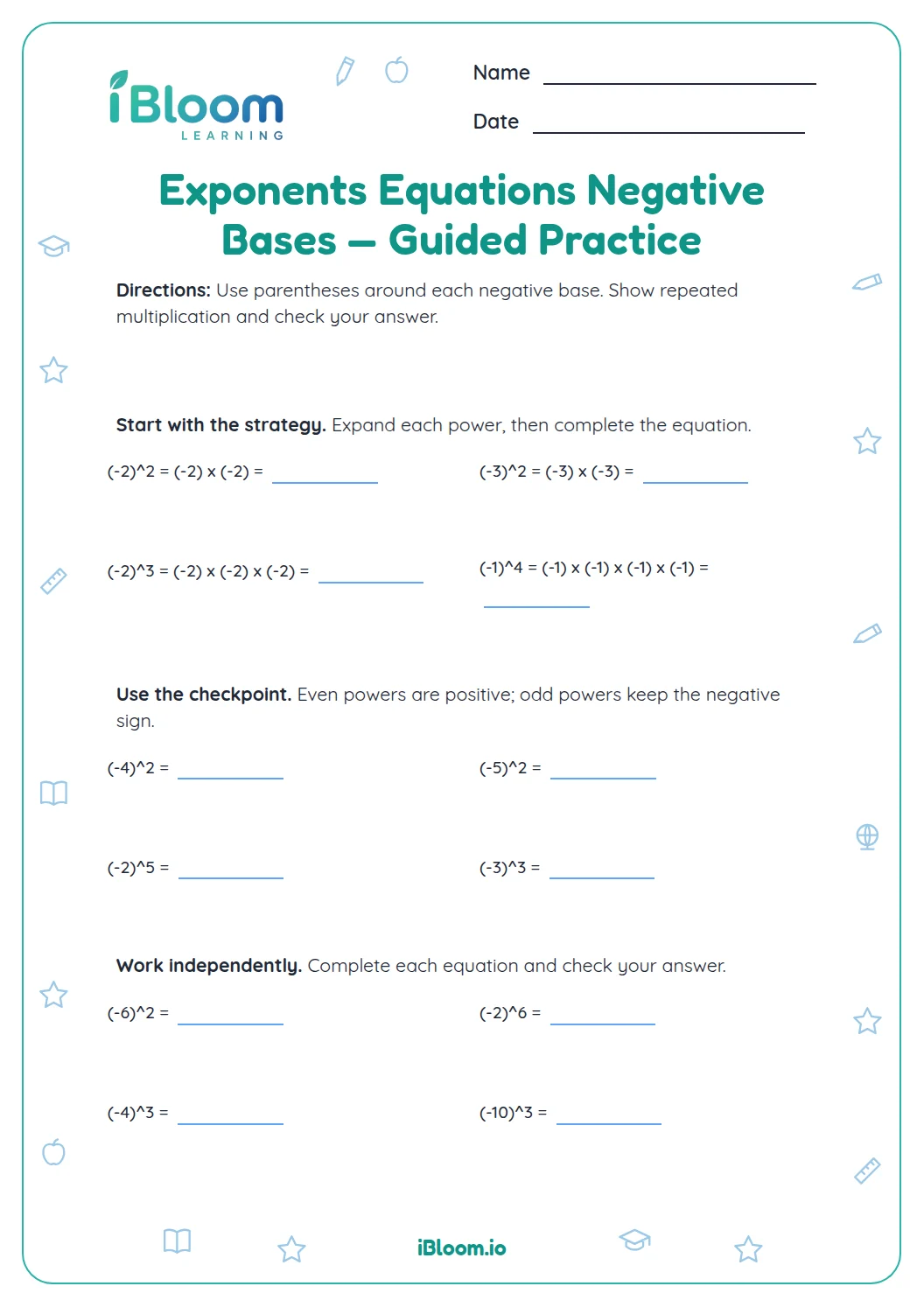
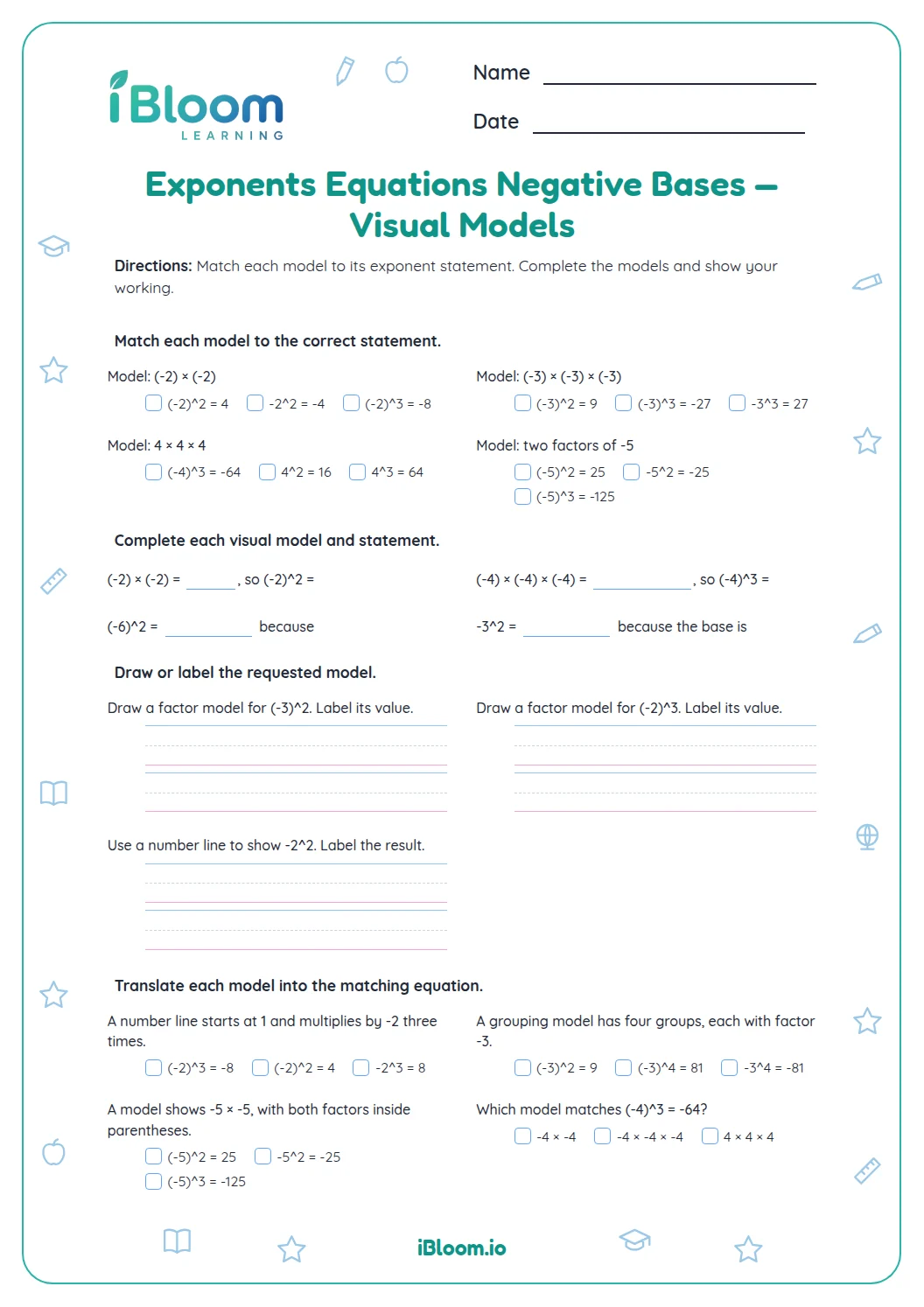
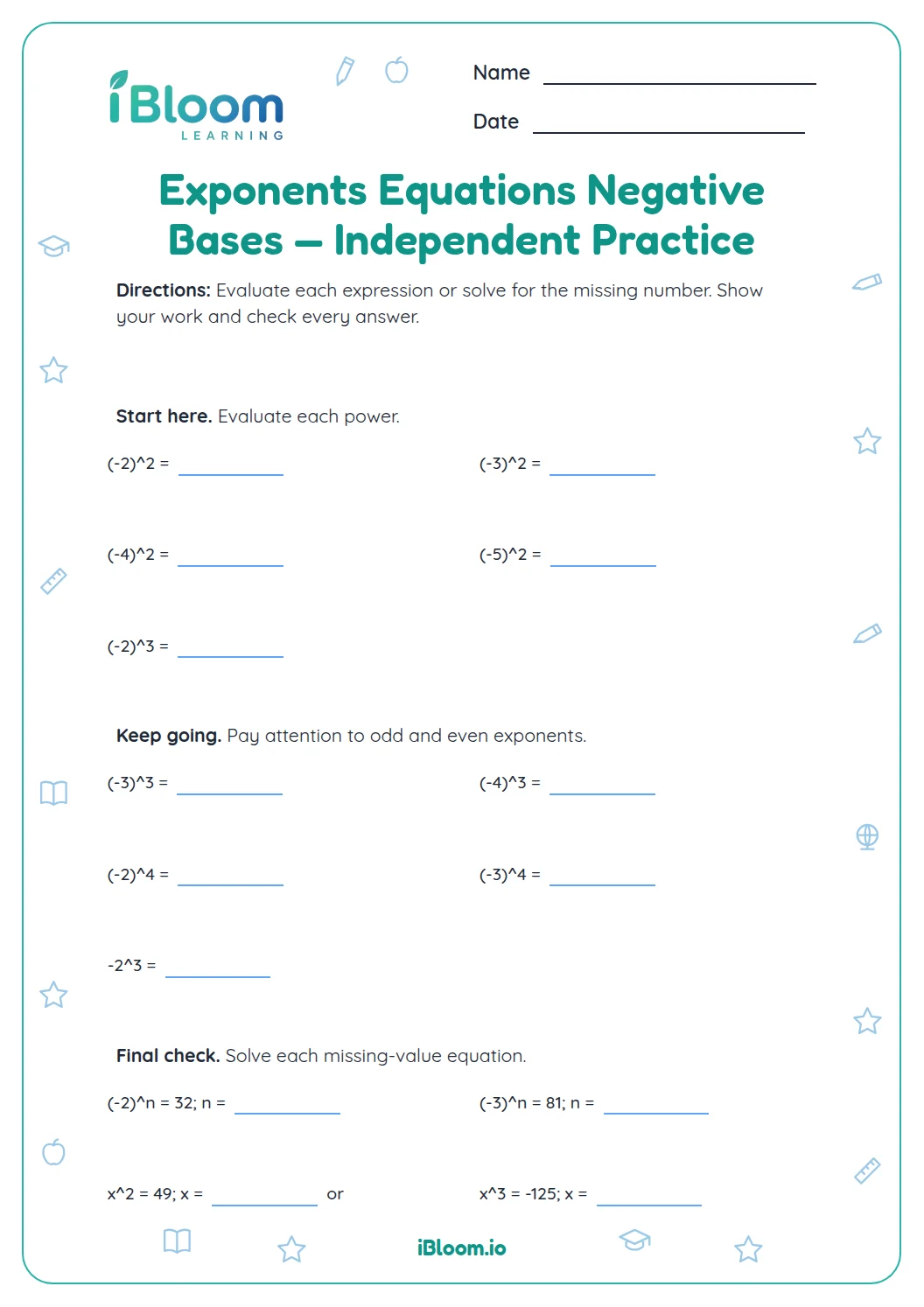
When the negative sign is inside parentheses, it is part of the base and is raised to the exponent. An even exponent makes the result positive; an odd exponent keeps it negative. Without parentheses, an exponent applies to the number before the negative sign.
What does the answer key show?
The key gives the powers, evaluated values, selected statements, and a comparison of expressions with and without parentheses. Check the sign as well as the magnitude of each result.
How to use this worksheet
- 1Write repeated factors as a power when the situation gives a repeated change.
- 2Evaluate the power by multiplying its base the stated number of times.
- 3Check whether the negative sign is inside the parentheses.
- 4Compare the value and sign of each expression.
- 5Use the written items to explain how the parentheses affect the result.
Common mistakes and quick fixes
The mistake
Reading −2^3 as if the negative sign were part of the base.
The fix
Use parentheses when the base is negative: (−2)^3.
The mistake
Assuming every power with a negative base is negative.
The fix
Pair the negative factors; even powers are positive and odd powers are negative.
The mistake
Treating (1/5)^3 as 3/5.
The fix
Multiply the base three times: 1/5 × 1/5 × 1/5 = 1/125.
What to practice next
Make more practice
Questions parents and teachers ask
What powers does this worksheet cover?
Students write and evaluate powers with fractional and negative bases, including positive and negative results. The final items compare expressions to show how parentheses determine whether the negative sign belongs to the base. Use the printed examples and answer key to review the same skill after completing the page.
Why does (−1/2)^2 have a positive value?
The parentheses make −1/2 the base, so the expression multiplies two negative halves. A pair of negative factors has a positive product: (−1/2) × (−1/2) = 1/4. Use the printed examples and answer key to review the same skill after completing the page.
What changes when the negative sign is outside the parentheses?
In −1/2^2, the exponent applies to 1/2 first, and the negative sign stays outside. That gives −1/4, while (−1/2)^2 gives 1/4. The last questions ask students to explain this sign difference. Use the printed examples and answer key to review the same skill after completing the page.
Does the answer key include the explanations?
The key lists each power and value, gives the selected context statements, and shows sample reasoning for the written comparisons. Students may use different wording if their explanation correctly identifies the base and the sign. Use the printed examples and answer key to review the same skill after completing the page.
How can students check a power with a negative base?
Write the repeated multiplication. For an even exponent, pair the negative factors; each pair has a positive product. For an odd exponent, one negative factor remains. Then multiply the fractional magnitudes and keep the sign. Use the printed examples and answer key to review the same skill after completing the page.