





About this worksheet
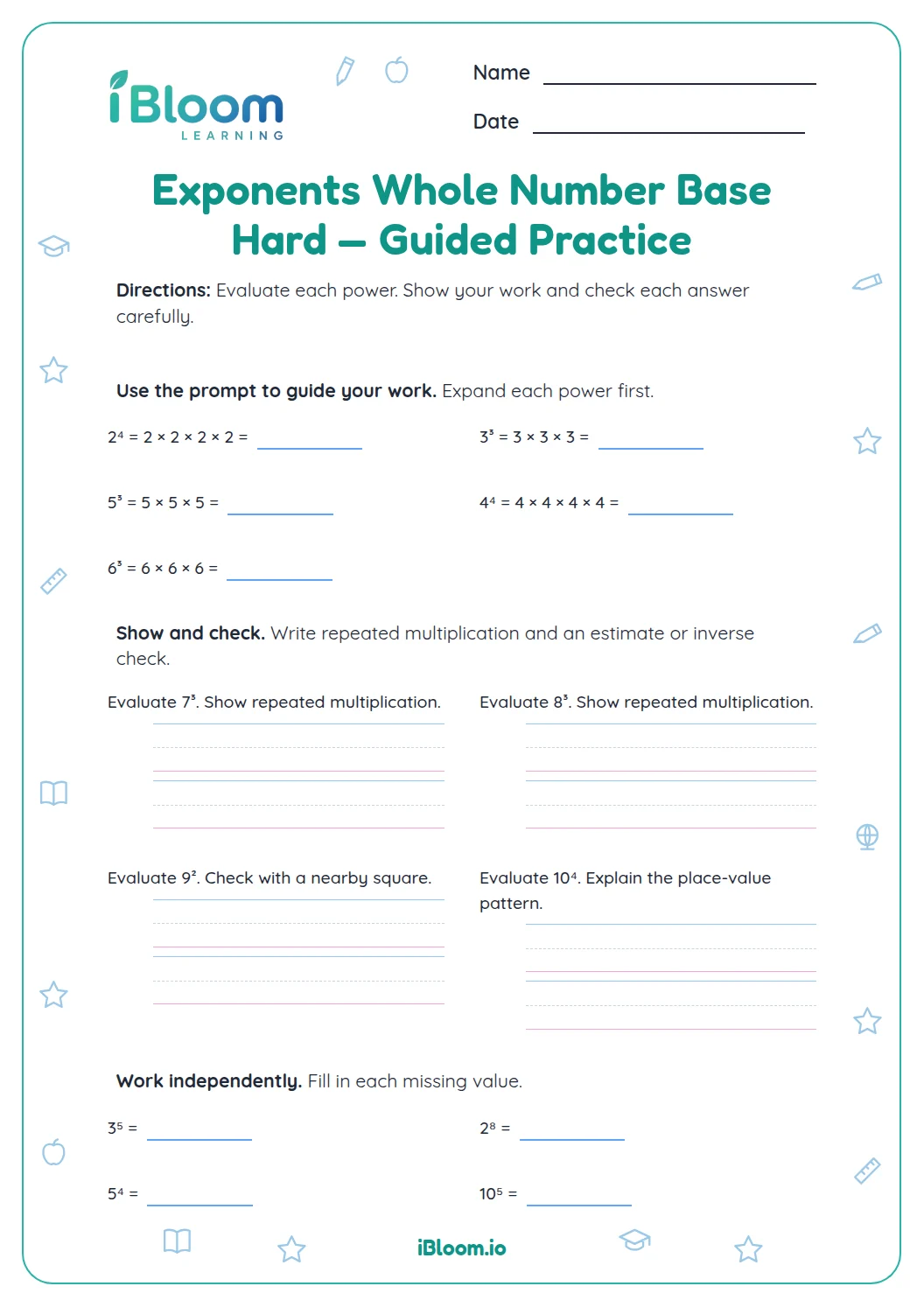
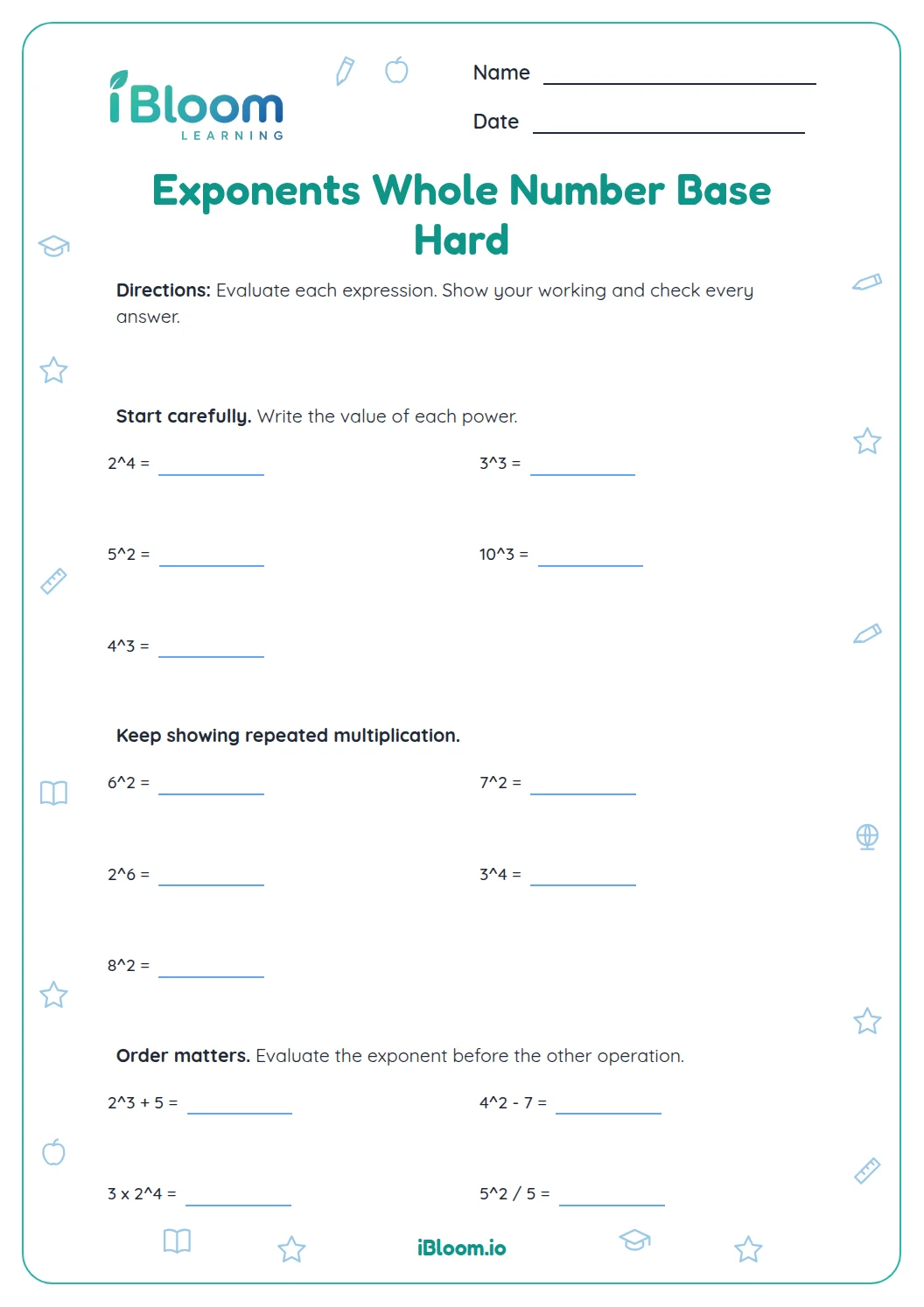
This free printable Grade 6 worksheet guides students from writing a power such as 3^4 as repeated multiplication to finding its value with fewer hints. The sheet starts with four write-it-out questions, then four with the factors already shown, four with no hints, and six that ask for more thinking: two missing numbers, two multiple choice questions comparing and matching powers, and two short problems. Bases are whole numbers from 2 to 12 and exponents run from 2 to 6. It practices Common Core 6.EE.A.1, and a separate answer key is included.
Aligned to 6.EE.A.1
What does an exponent tell you?
In 5^3, the 5 is the base and the 3 is the exponent. The exponent says how many copies of the base to multiply together, so 5^3 means 5 × 5 × 5, which is 125. It is a short way to write a long product.
A common slip is reading 5^3 as 5 times 3, because the two numbers sit next to each other. That is why Part A asks only for the factors, before any multiplying, and Part B keeps the factors on the page while students find the values.
- 12^6 = ___
- 2The base is 2 and the exponent is 6, so write six 2s
- 32 × 2 × 2 × 2 × 2 × 2
- 42 × 2 = 4, × 2 = 8, × 2 = 16, × 2 = 32, × 2 = 64
- 52^6 = 64
What is on this worksheet?
Hints fade over the first three parts, so students do the same thinking with less and less on the page. The last three parts use powers in new ways.
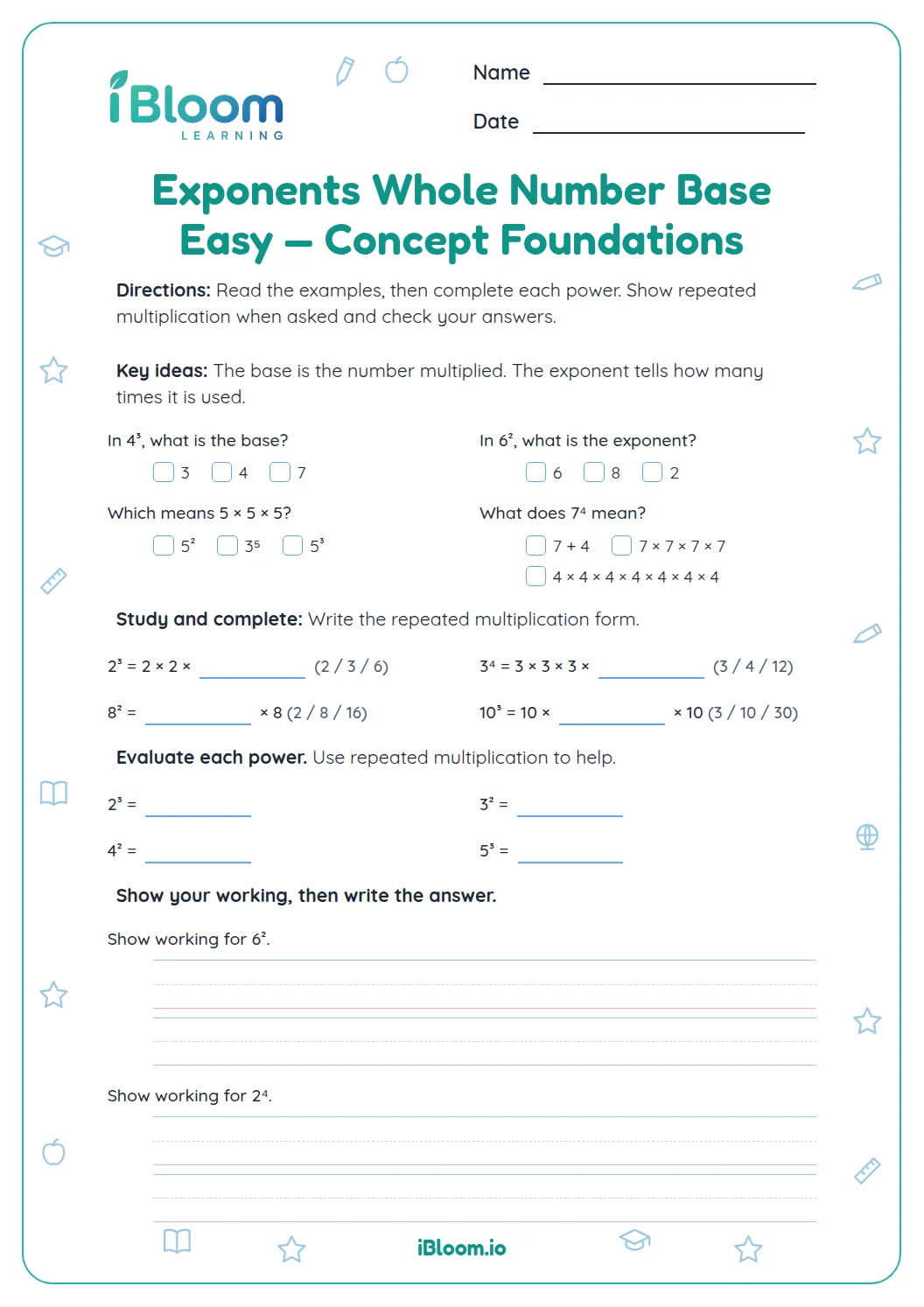
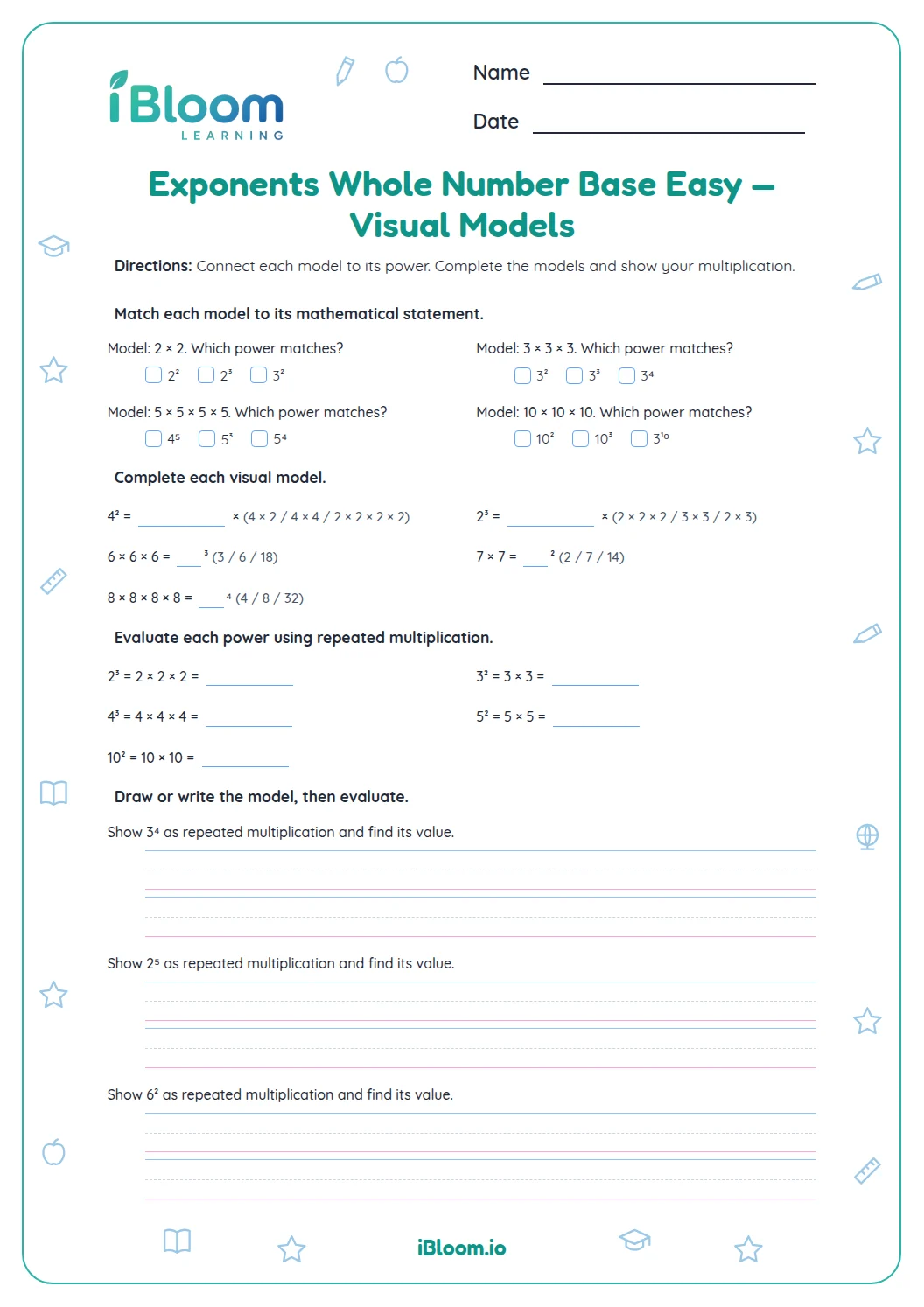
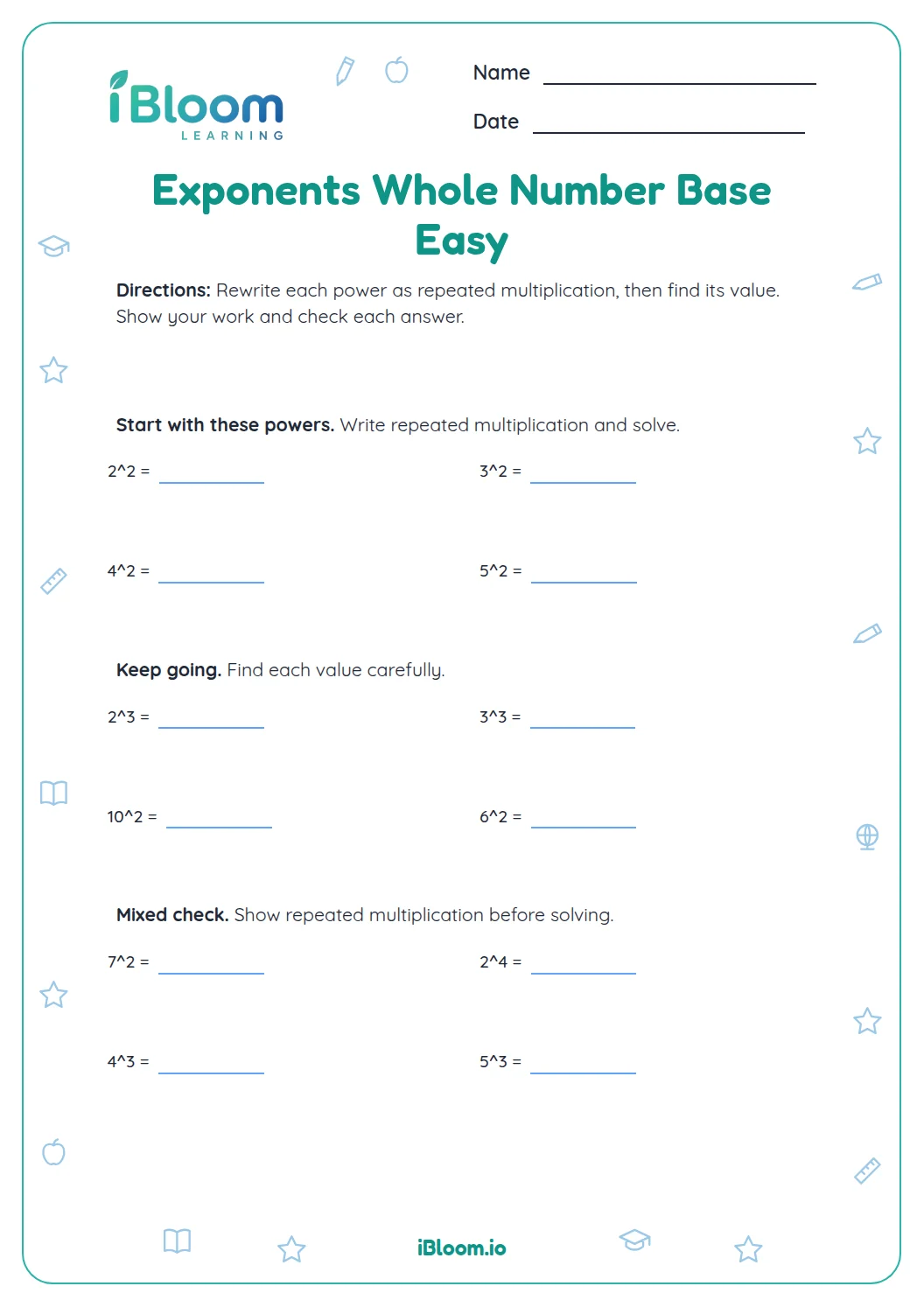
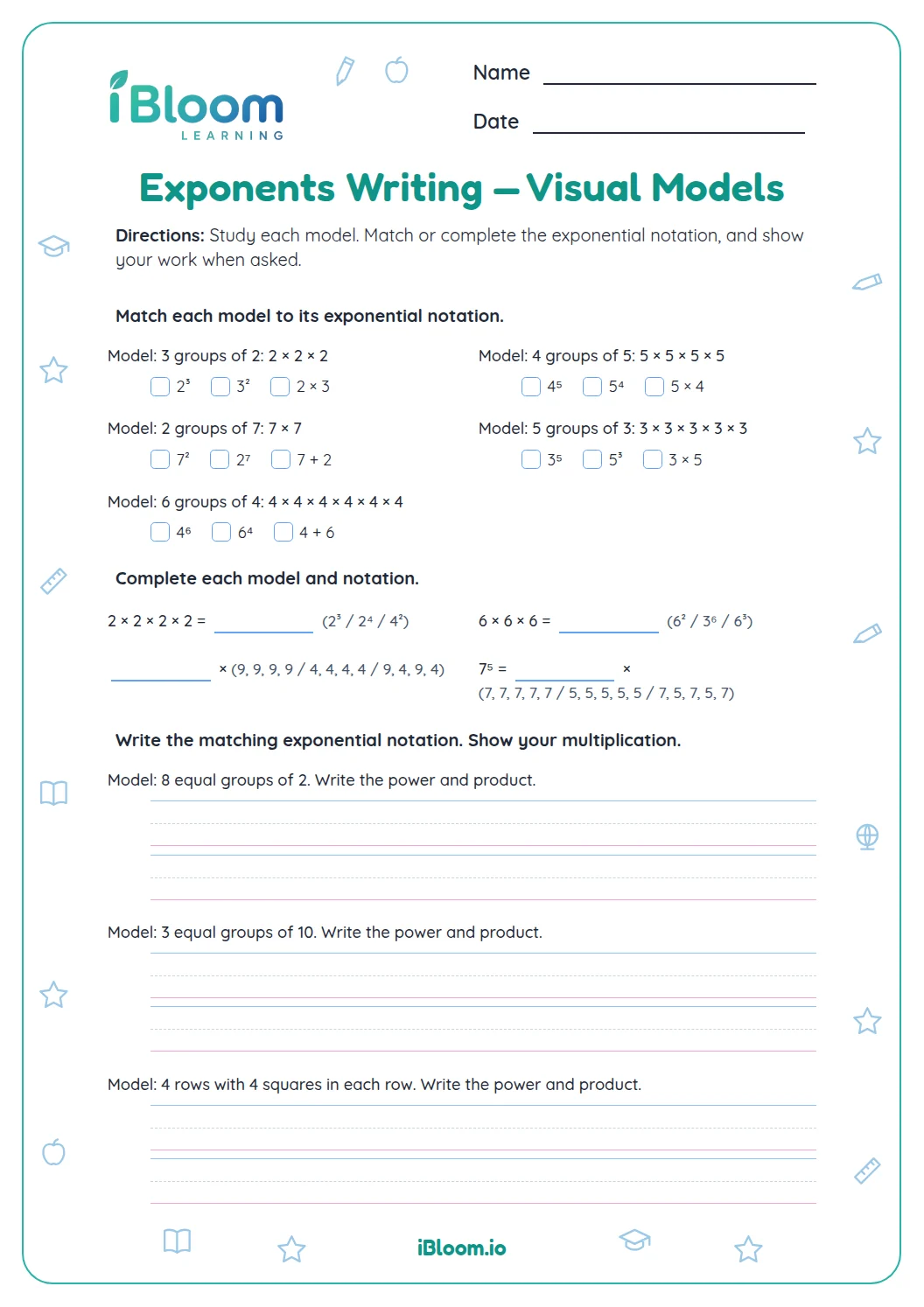
- Part A, Write it out: 2^3, 5^2, 3^4 and 10^3 as repeated multiplication
- Part B, Find the value: the factors are shown, so students multiply and write the value, from 4^3 to 9^2
- Part C, Fewer hints: 7^2, 5^3, 2^6 and 10^4 with only the power given
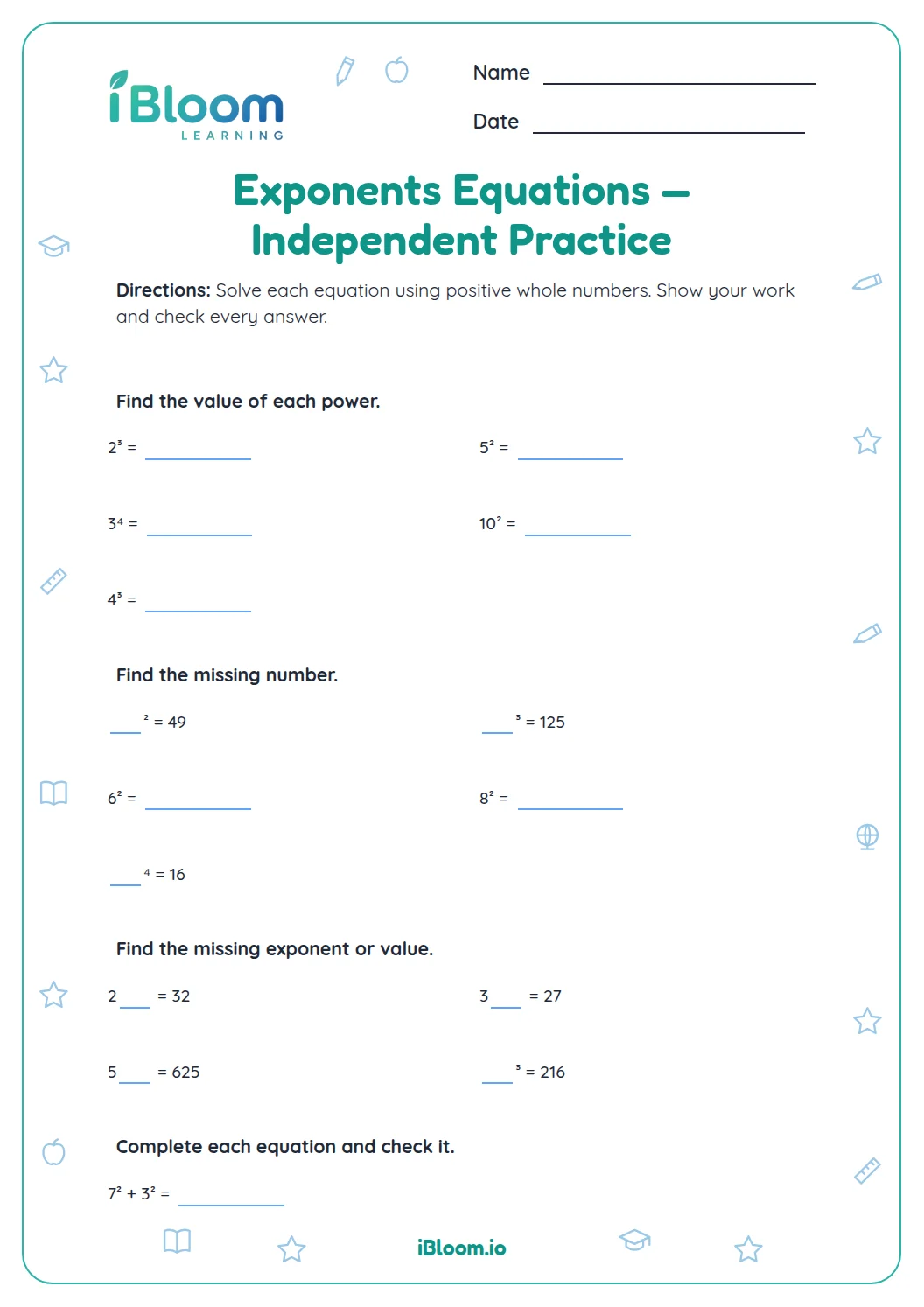
- Part D, Work backward: two missing-number sentences, 2^___ = 32 and ___³ = 27
- Part E, Compare powers: which of 2^5 and 5^2 is greater, and which power matches 7 × 7 × 7
- Part F, Use powers: two problems with space to show work
- Answer key on a separate page
Why does 10^4 have four zeros?
Ten times ten is 100, times ten again is 1,000, and one more ten gives 10,000. Each extra factor of ten adds one more zero, so the exponent equals the number of zeros after the 1. That is why 10^4 is 10,000, not 40.
Question 12 asks for this power on its own. If students write the factors first, they can see four tens and count the zeros as a check.
What do Parts D, E and F ask students to think about?
In 2^___ = 32, students multiply 2s until they reach 32 and count the factors. In ___³ = 27, they look for a number that makes 27 when it is used as a factor three times. In the comparison, 2^5 is 32 and 5^2 is 25, so swapping the base and exponent changes the value. The last two problems find the area of a 12-inch square tile and correct Mia, who says 3^4 = 12; the true value is 81.
How to use this worksheet at home or in class
- 1Warm up with 2^3 on a whiteboard. Ask: "How many 2s do we write?" Then multiply together, one step at a time: 2 × 2 = 4, 4 × 2 = 8.
- 2Do question 1 together, writing the factors before any multiplying.
- 3Let the student finish Part A and Part B alone, using the repeated multiplication as scratch work.
- 4In Part C, encourage writing the factors on scrap paper. After that, check by estimating: is 5^3 closer to 100 or 1,000?
- 5For Parts D to F, say each question out loud. For 2^___ = 32, ask: "How many 2s do you multiply to reach 32?"
- 6Mark the sheet with the answer key. For a miss, ask the student to write the factors for that power and count them.
Common mistakes and quick fixes
The mistake
Multiplying the base by the exponent, so 3^4 = 12 or 10^3 = 30.
The fix
Write the factors out. 3^4 has four 3s: 3 × 3 × 3 × 3 = 81. Ask: "Is this the number of times we multiply, or the number we multiply by?"
The mistake
Writing the wrong number of factors, such as 2 × 2 × 2 for 2^4.
The fix
Count the factors against the exponent. Put a small tally mark over each factor as you write it, and stop when the tally matches the exponent.
The mistake
Putting the wrong number of zeros in a power of 10, such as 1,000 for 10^4.
The fix
The exponent is the number of zeros after the 1. For 10^4, write 1 and then four zeros: 10,000.
Common Core alignment
Most US states use the Common Core standards or a close state version. This sheet practices the Grade 6 exponents standard below.
Write and evaluate powers with whole-number exponents.
On this sheet: Every question writes, evaluates or compares powers with a whole-number base and exponent.
Show the official wordingHide the official wording
Write and evaluate numerical expressions involving whole-number exponents.
What to practice next
Make more practice
Further reading
Questions parents and teachers ask
What should my child know before this worksheet?
Your child should know the multiplication facts through 10 × 10 and be comfortable multiplying a few numbers in a row, such as 2 × 2 × 2 × 2. Knowing the word factor helps too. No earlier exponent work is needed, because Part A shows how to write a power as repeated multiplication.
What is the answer to question 11?
The answer is 64. The question is 2^6, so write six 2s: 2 × 2 × 2 × 2 × 2 × 2. Multiply one pair at a time: 4, 8, 16, 32, and then 64. It is a good question to check, because students who multiply 2 × 6 get 12 instead.
How do students solve a sentence like 2^___ = 32?
They count how many 2s multiply to make 32. Start at 2 and keep multiplying by 2: 2, 4, 8, 16, 32. That is five 2s, so the missing exponent in question 13 is 5. Students can check by writing 2 × 2 × 2 × 2 × 2 and multiplying.
Is 2^5 greater than 5^2?
Yes. 2^5 is 2 × 2 × 2 × 2 × 2 = 32, and 5^2 is 5 × 5 = 25. Swapping the base and the exponent changes the value, so the order matters. Question 15 asks students to find both values before they decide which one is greater.
Why are the Part B questions already filled in with factors?
Those questions show the repeated multiplication, so students can focus on the multiplying. Part A asks them to write the factors, and Part C takes the hint away. This gradual removal of support is why the sheet is called guided practice: students do the same thinking each time with less on the page.
Is there an answer key for this worksheet?
Yes. A separate answer key shows the repeated multiplication for Part A, the value of every power in Parts B and C, both missing numbers, the two multiple choice answers and the answers to both problems. Print the worksheet pages on their own and keep the key for checking afterward.