




About this worksheet
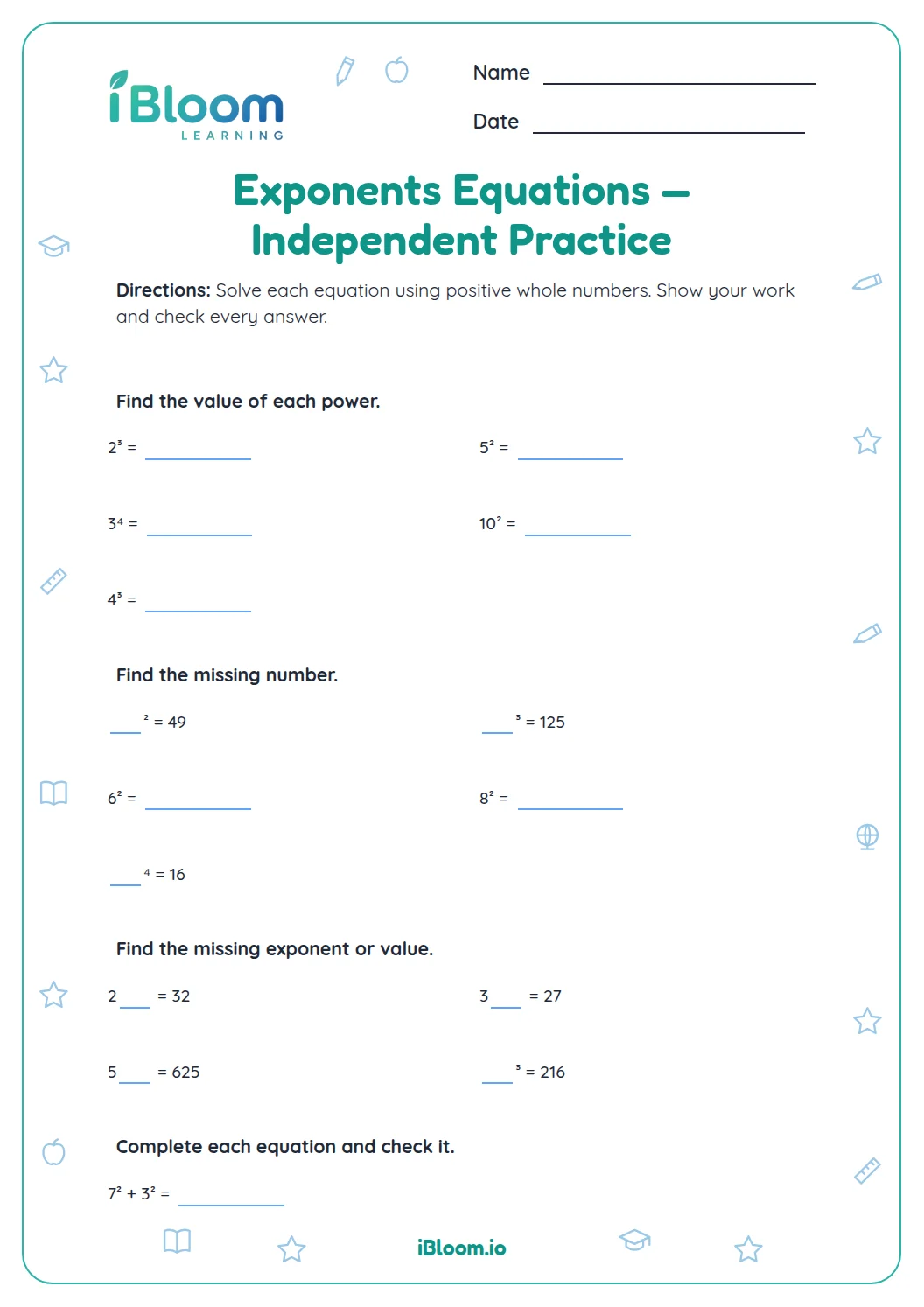
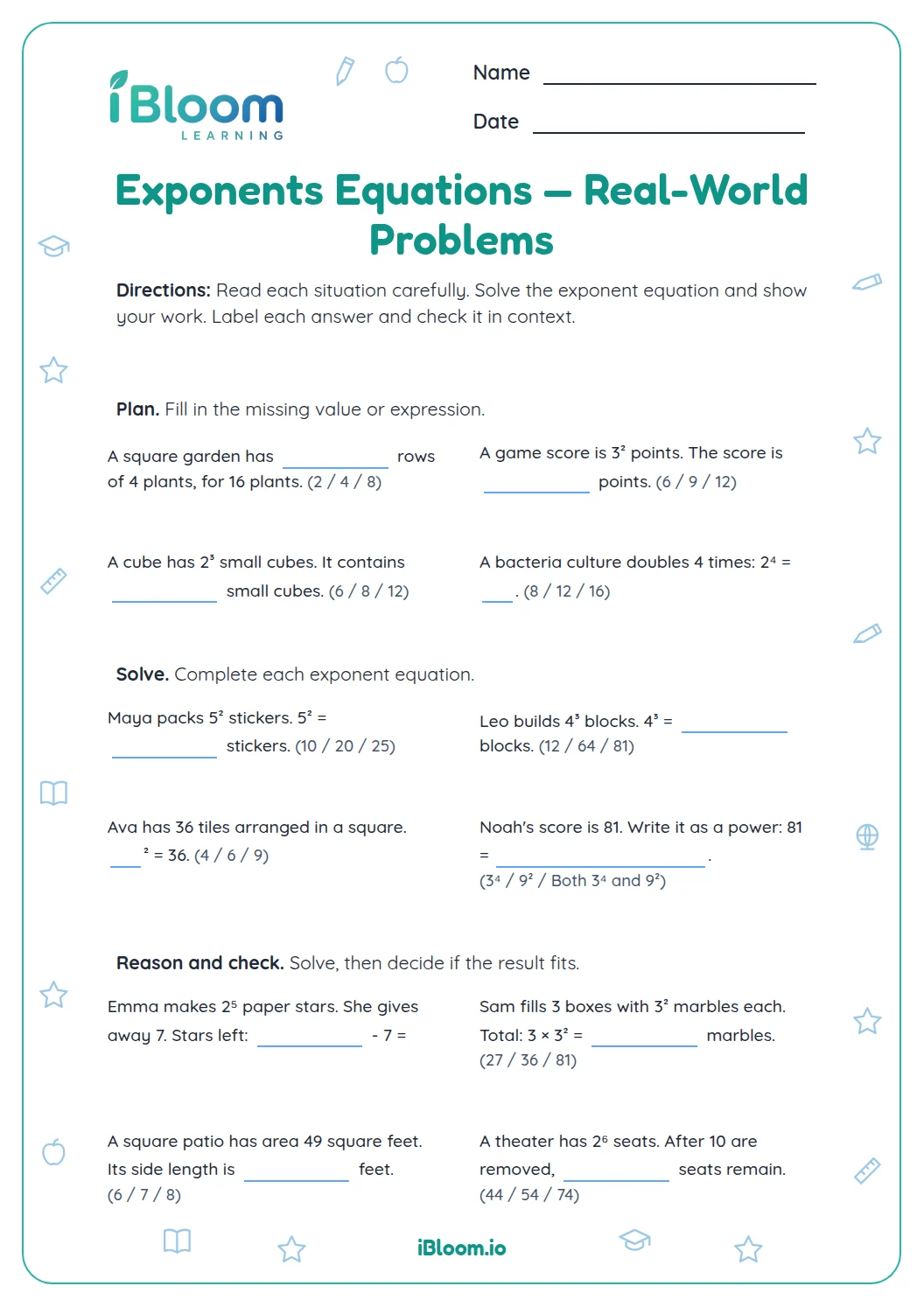
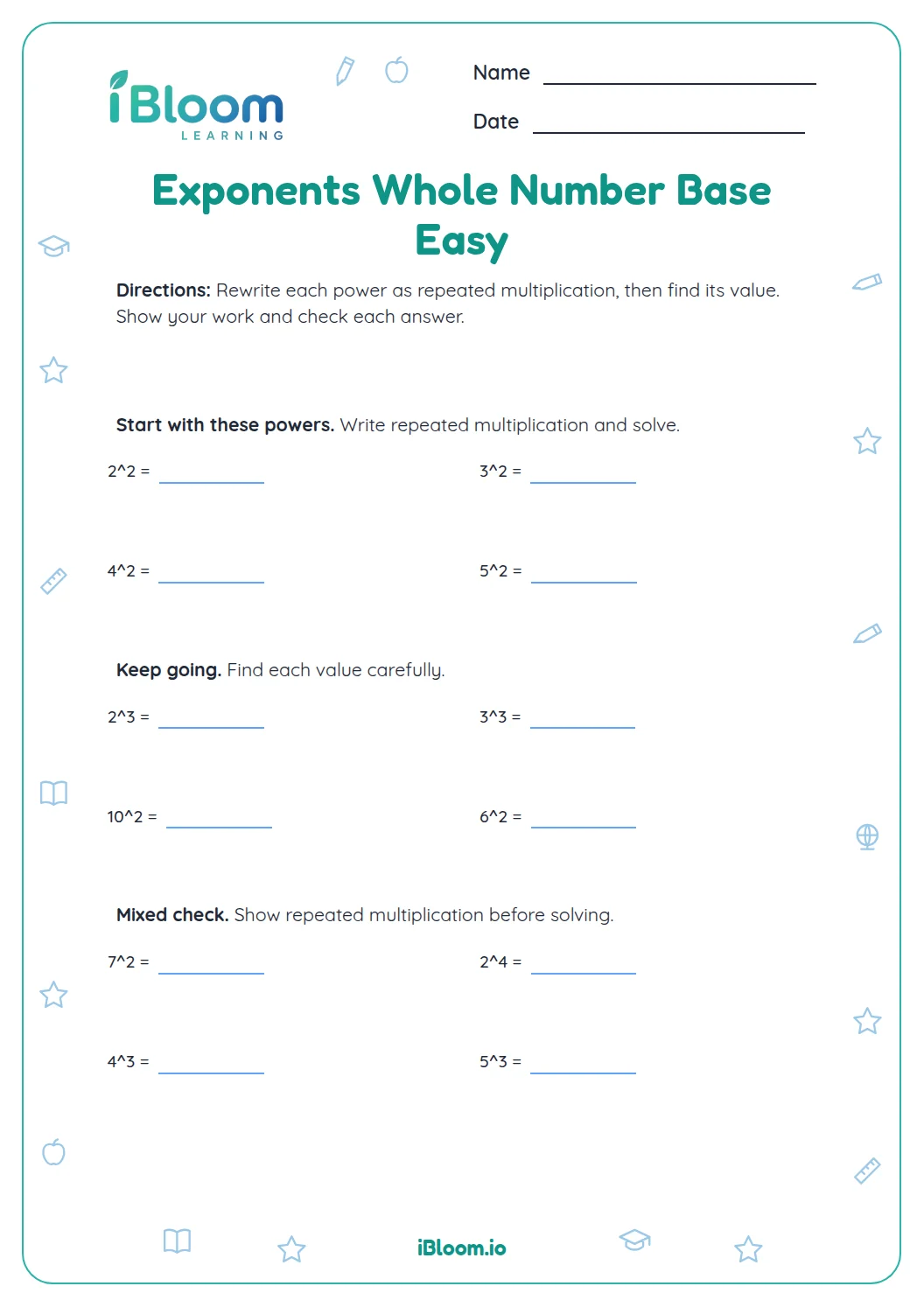
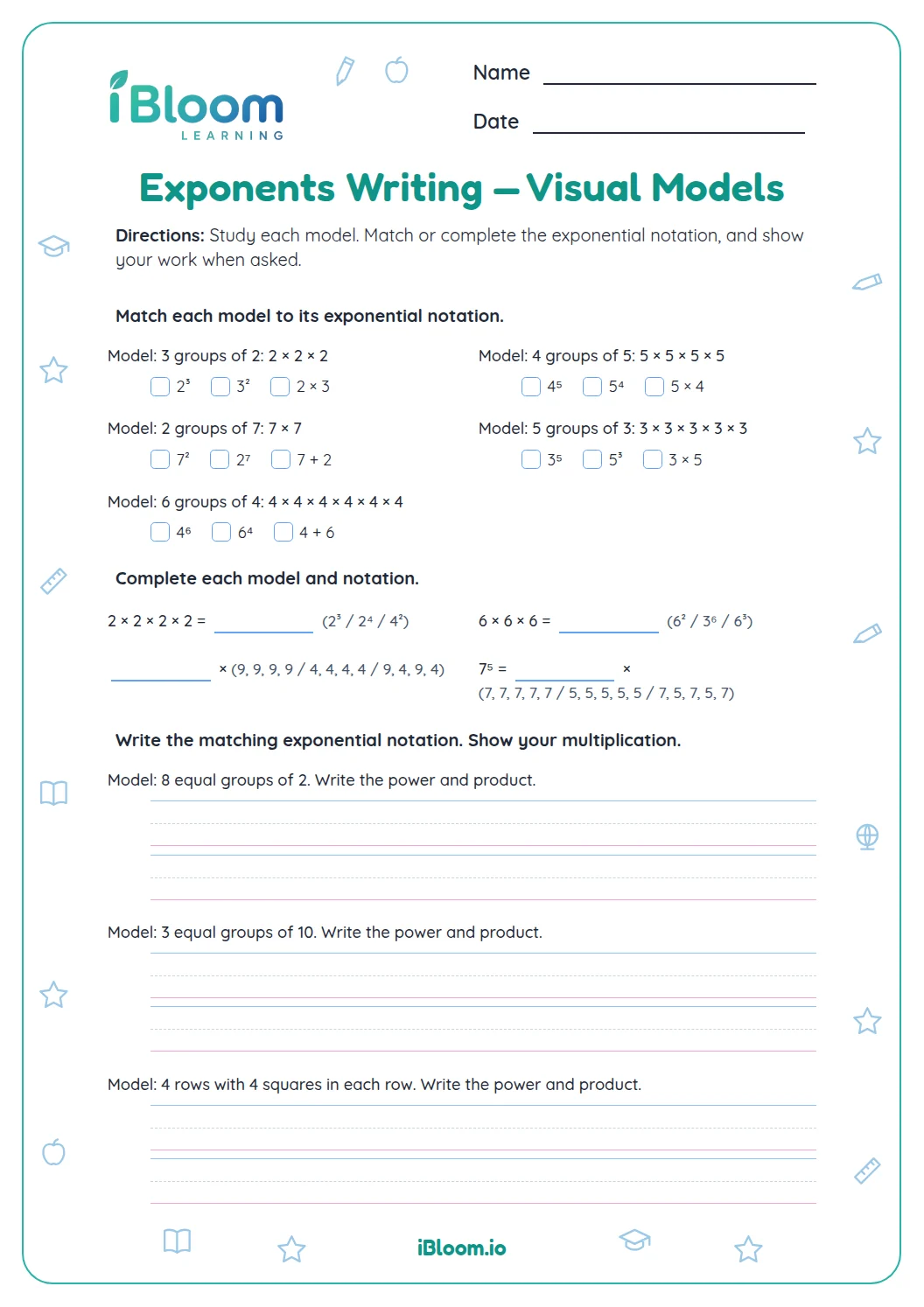
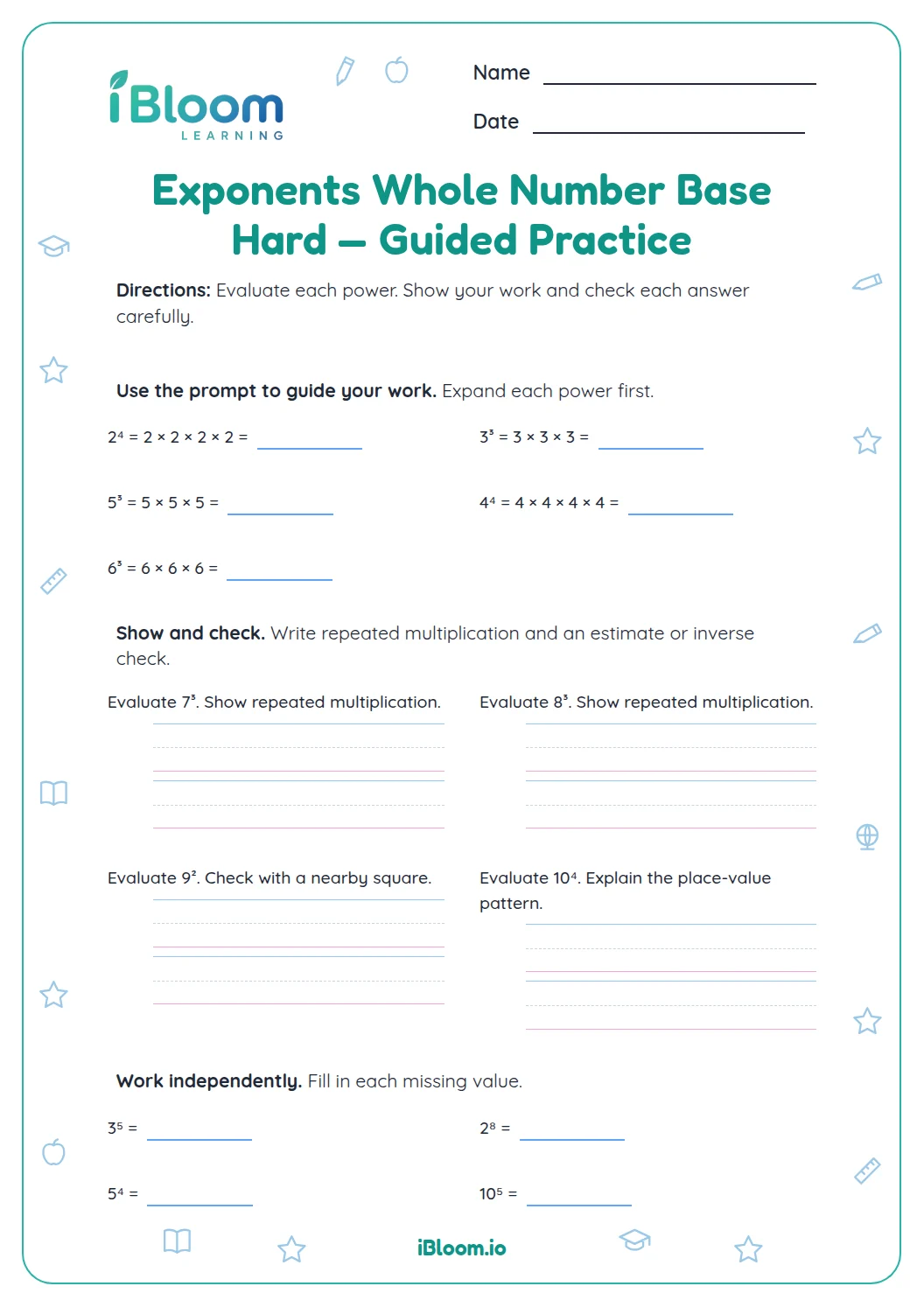
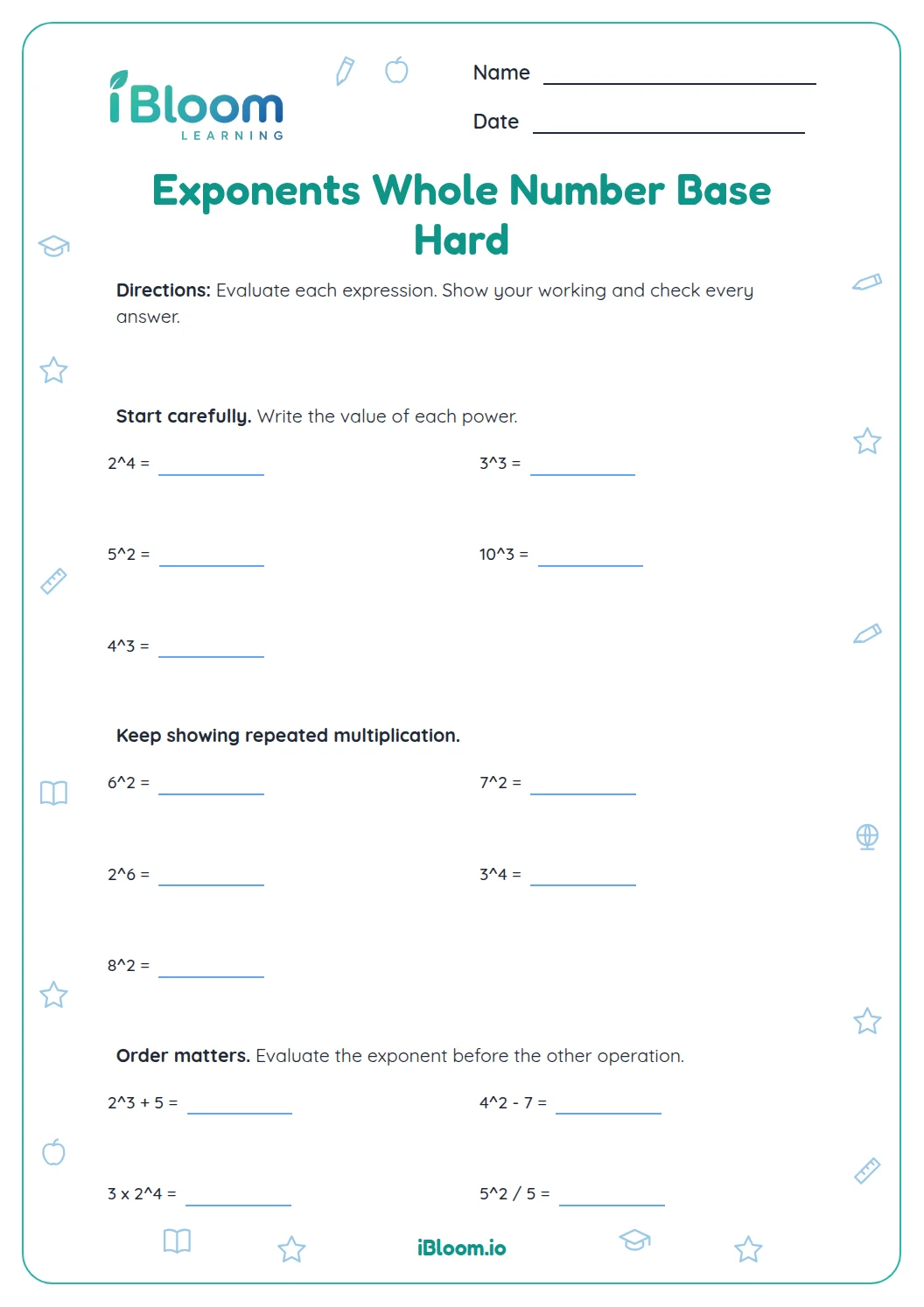
This Grade 6 printable moves from evaluating whole-number powers to solving equations with a missing base or exponent. Sixteen questions build one step at a time, followed by a separate answer key. The expressions practice CCSS 6.EE.A.1 by writing and evaluating whole-number powers.
Aligned to 6.EE.A.1
What does a power mean?
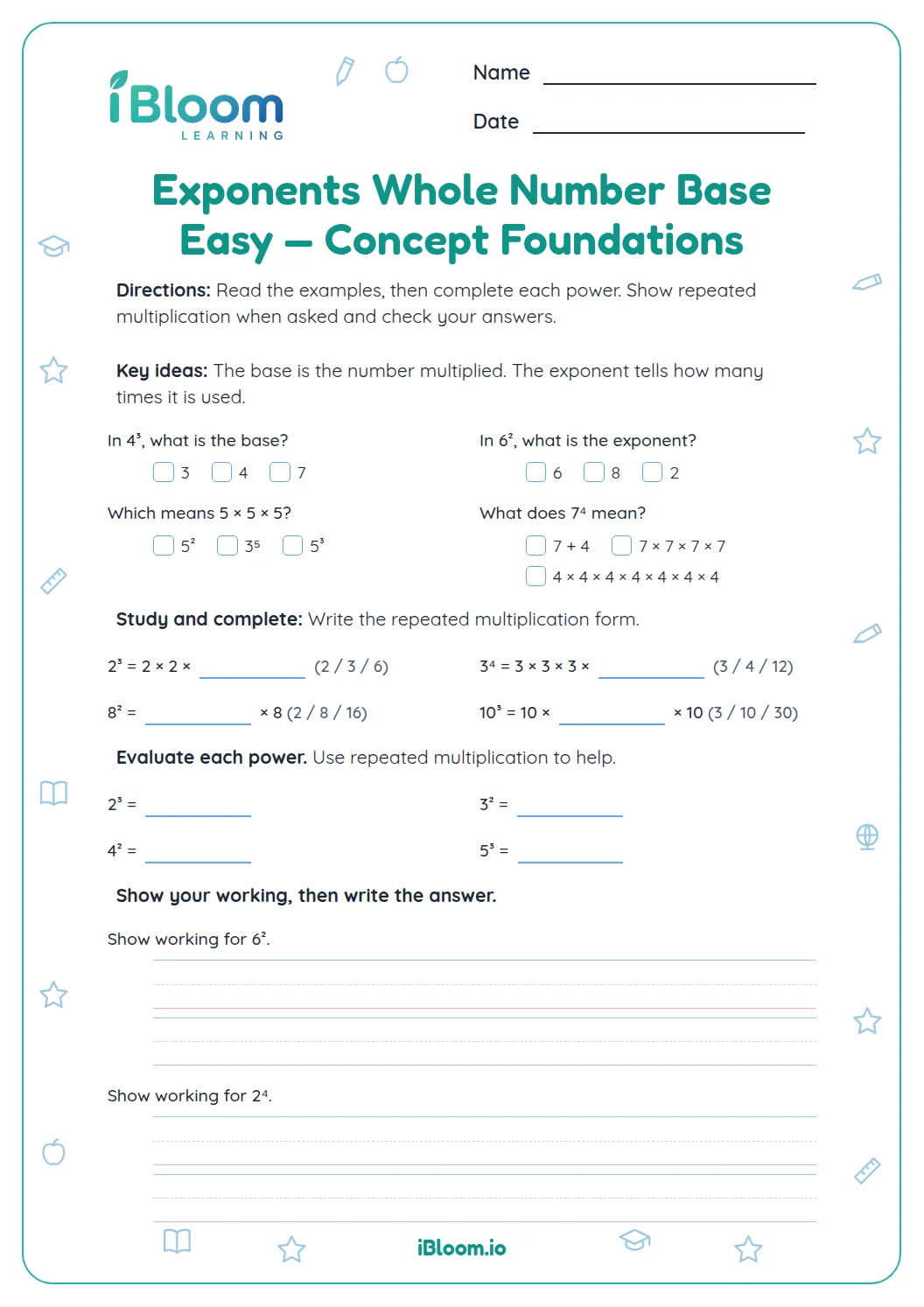
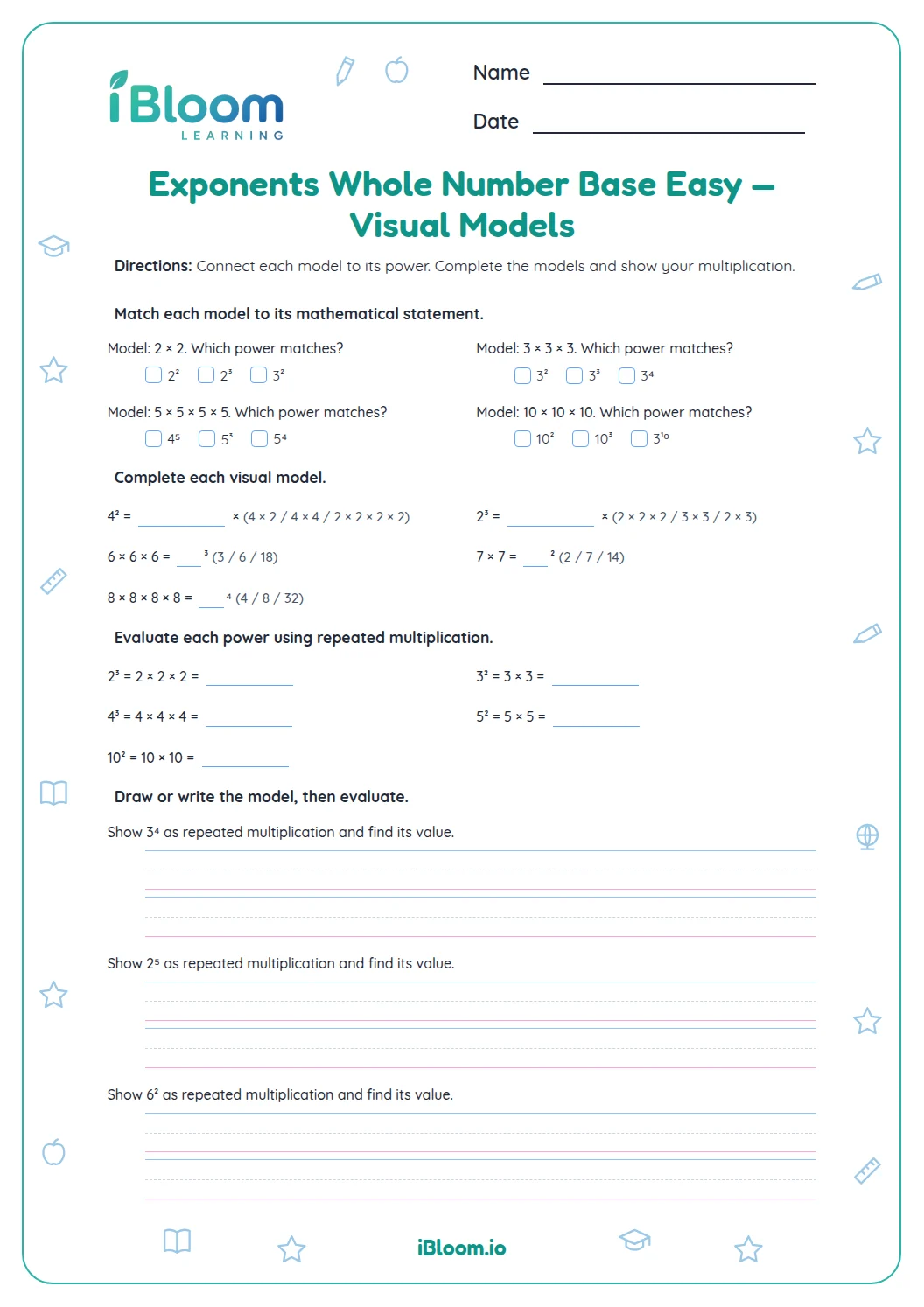
A power is a compact way to show repeated multiplication. In 3^4, the base 3 appears as a factor four times: 3 × 3 × 3 × 3 = 81.
Question 4 asks for the missing exponent in 3^___ = 27. Since 3 × 3 × 3 = 27, the missing exponent is 3.
- 13^___ = 27
- 23 × 3 × 3 = 27
- 3The exponent is 3
How do the equations get harder?
Part A reviews powers and missing bases or exponents. Part B combines a power with a short equation, so learners undo an addition or subtraction before identifying the power.
How can substitution check a solution?
Replace the variable with the proposed value and evaluate. For question 13, x = 4 gives 2^4 + 5 = 16 + 5 = 21, which matches the equation.
How to use this worksheet
- 1Read the base and exponent carefully.
- 2Write repeated multiplication for an unfamiliar power.
- 3Evaluate the power before combining it with another number.
- 4Undo addition or subtraction to isolate the power.
- 5Find the missing base or exponent.
- 6Substitute the value back to check.
Common mistakes and quick fixes
The mistake
Treating 3^4 as 3 × 4
The fix
Write four 3s as factors: 3 × 3 × 3 × 3.
The mistake
Reading the exponent as the answer
The fix
Use the exponent to count factors, then multiply them.
The mistake
Skipping the equation check
The fix
Substitute the proposed value and evaluate both sides.
Common Core alignment
This worksheet gives focused practice with the standard below.
The exponent counts equal factors.
On this sheet: The questions directly practice this skill.
Show the official wordingHide the official wording
Write and evaluate numerical expressions involving whole-number exponents.
What to practice next
Make more practice
Further reading
Questions parents and teachers ask
What does an exponent tell you?
The exponent tells how many times to use the base as a factor. For example, 2^3 means 2 × 2 × 2, which equals 8. The first part of the worksheet evaluates powers and then asks learners to identify missing bases or exponents.
How do I solve 2^x = 32?
Find the exponent that makes a power of 2 equal 32. Since 2 × 2 × 2 × 2 × 2 = 32, x = 5. Substitute 5 into the original equation to check that the left side equals the right side.
How many questions are included?
There are 16 questions in two parts across two worksheet pages. Part A evaluates powers and finds missing bases or exponents; Part B solves equations that combine a power with addition or subtraction. A two-page answer key is included for checking each solution.
What does “positive whole-number value” mean?
It asks for a counting number greater than zero. For x^2 = 36, the positive whole-number value is 6. The wording makes the requested answer unambiguous even though both 6 and −6 square to 36. Learners should follow the prompt’s wording and give the positive value.
Can learners check their answers?
Yes. Substitute the answer back into its equation and evaluate the power. For instance, if x = 4 in 2^x + 5 = 21, then 16 + 5 = 21. The separate answer key lists every solution. The key also shows answers in question order for quick review.