






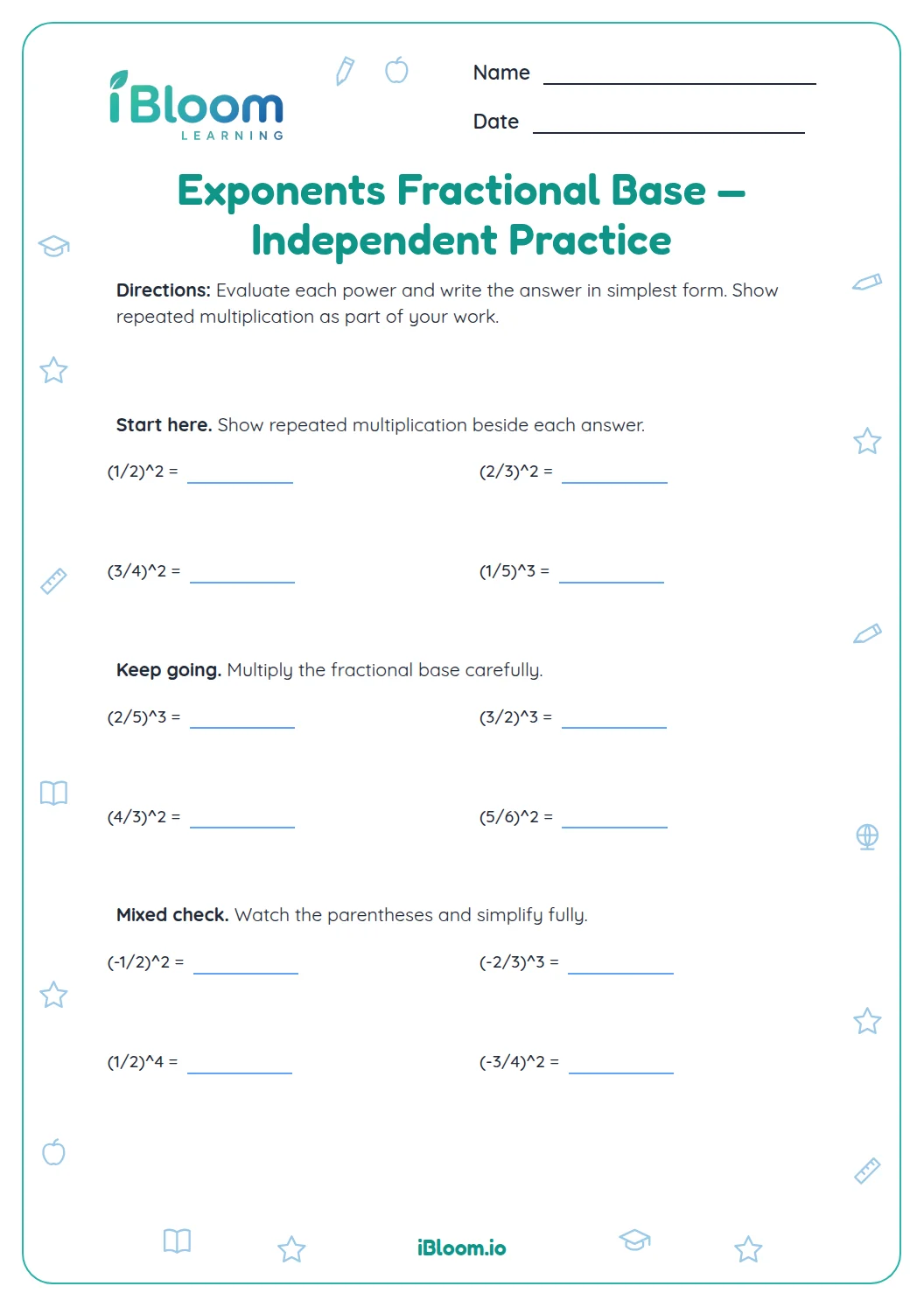
About this worksheet
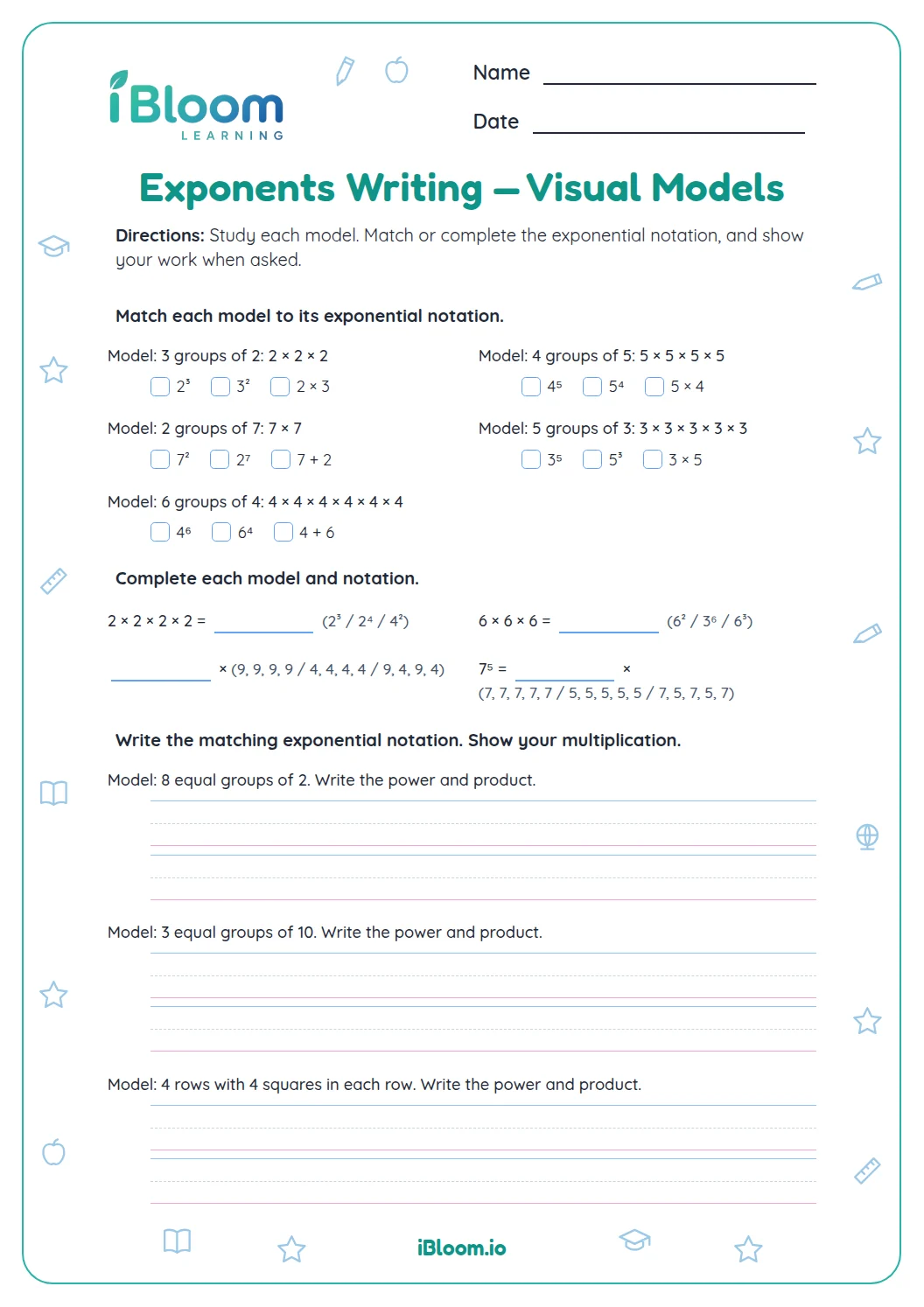
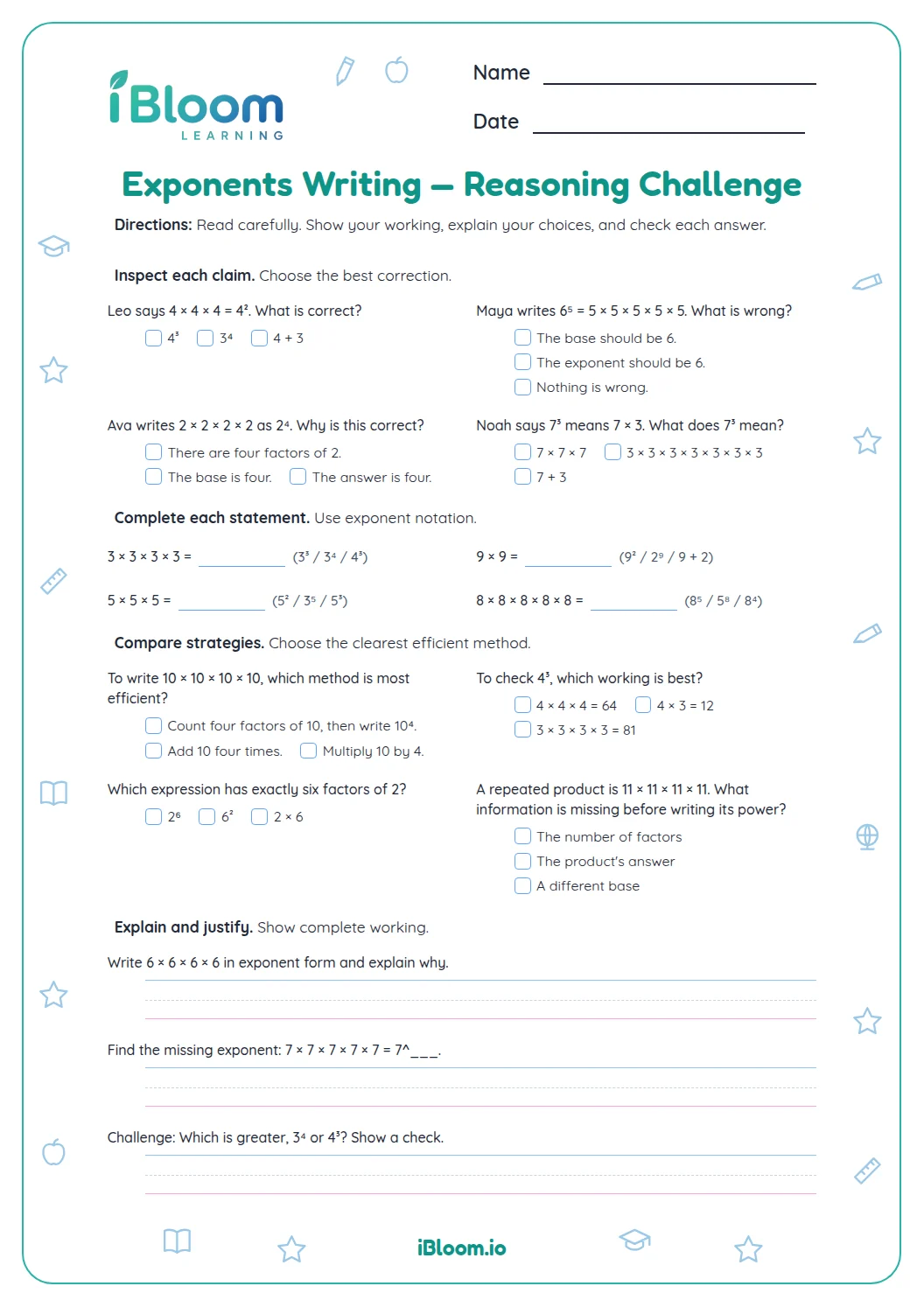
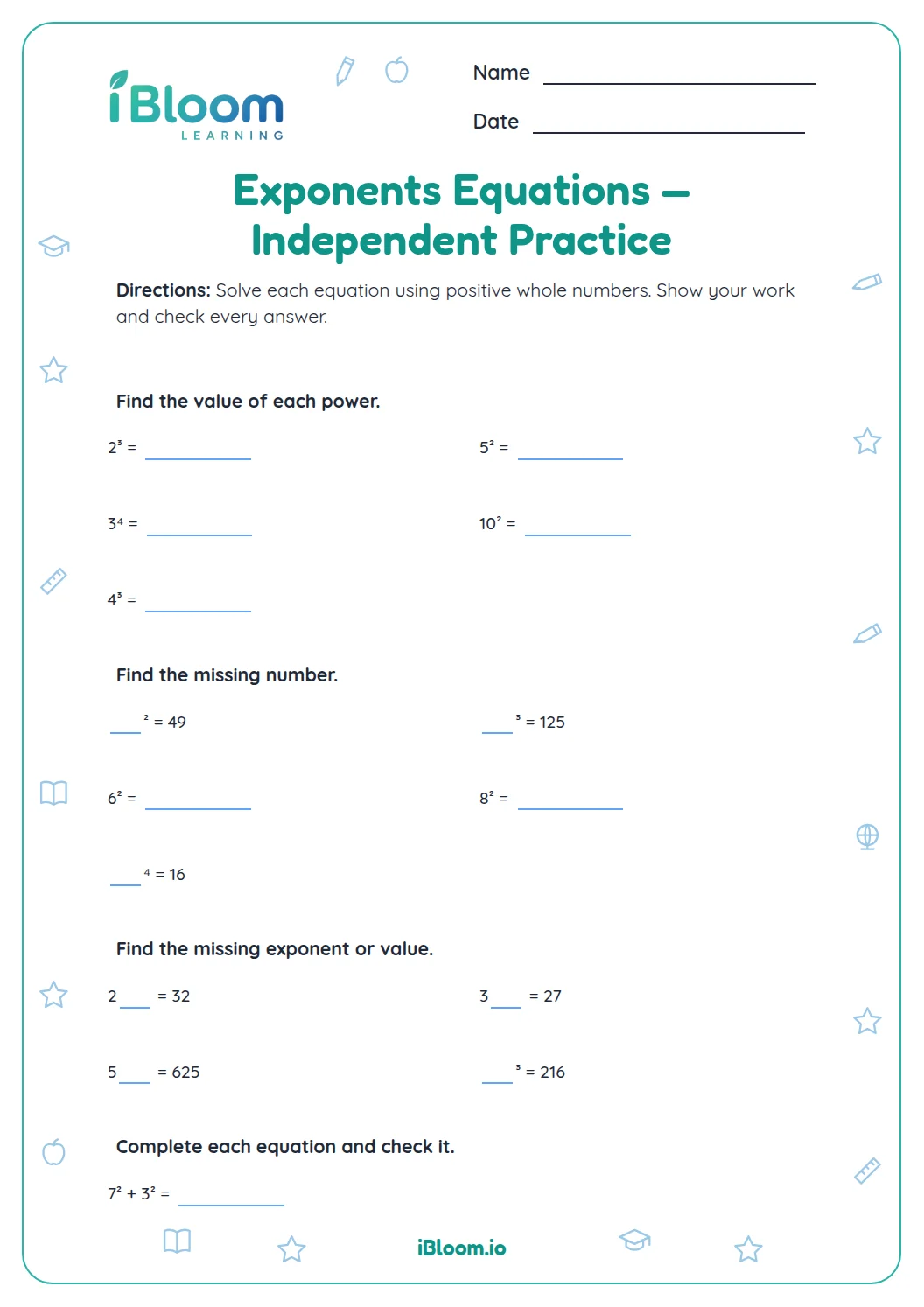
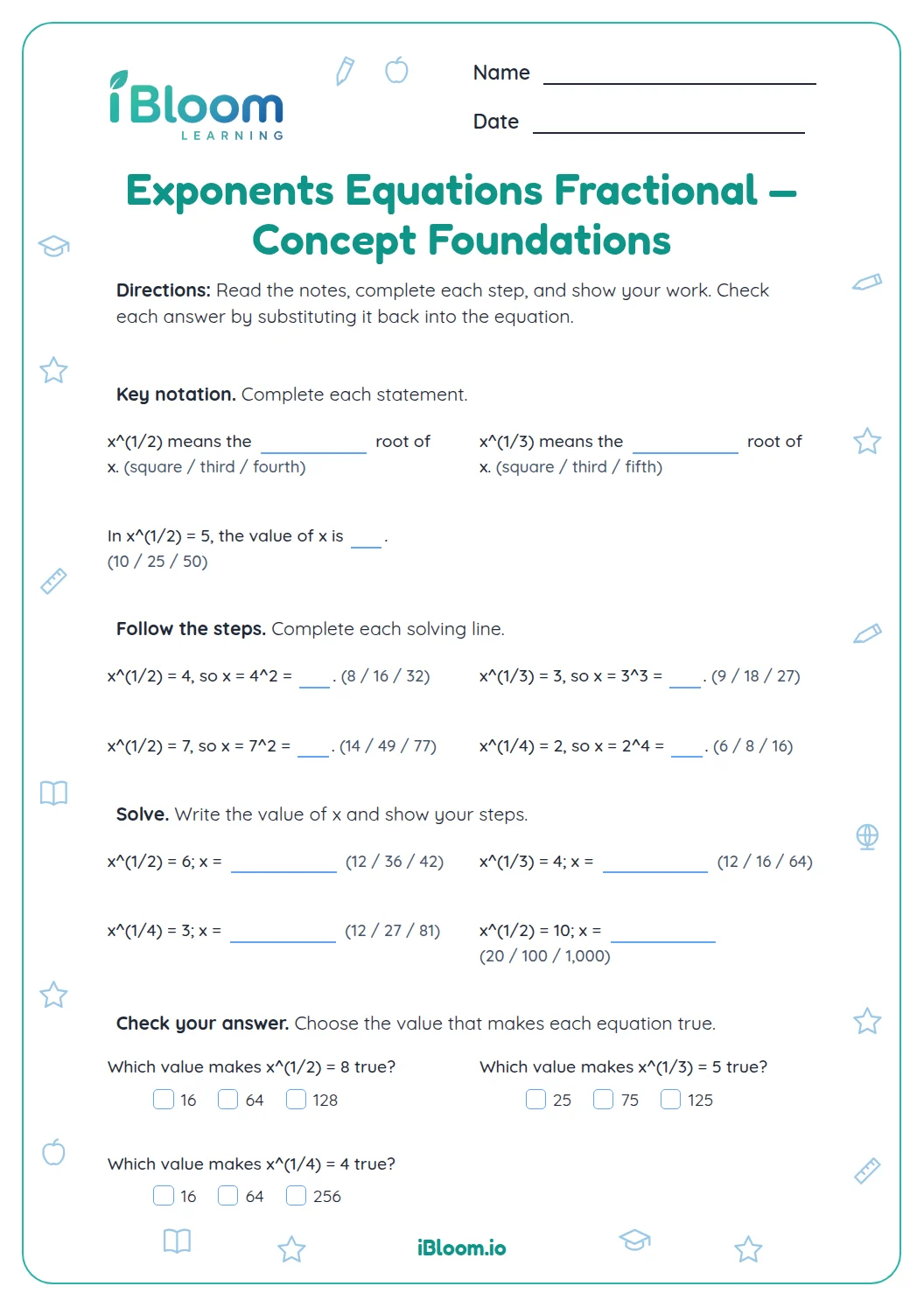
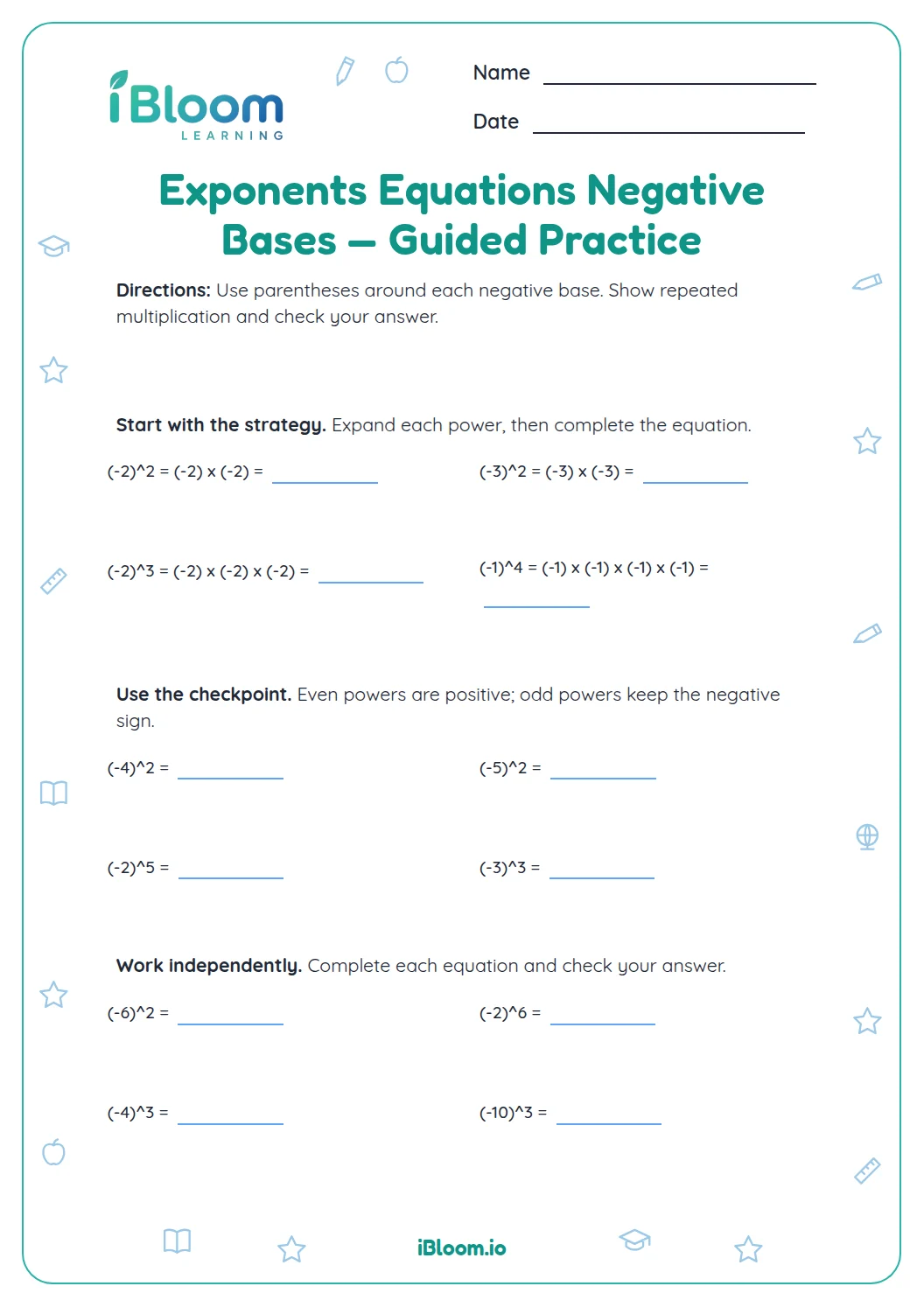
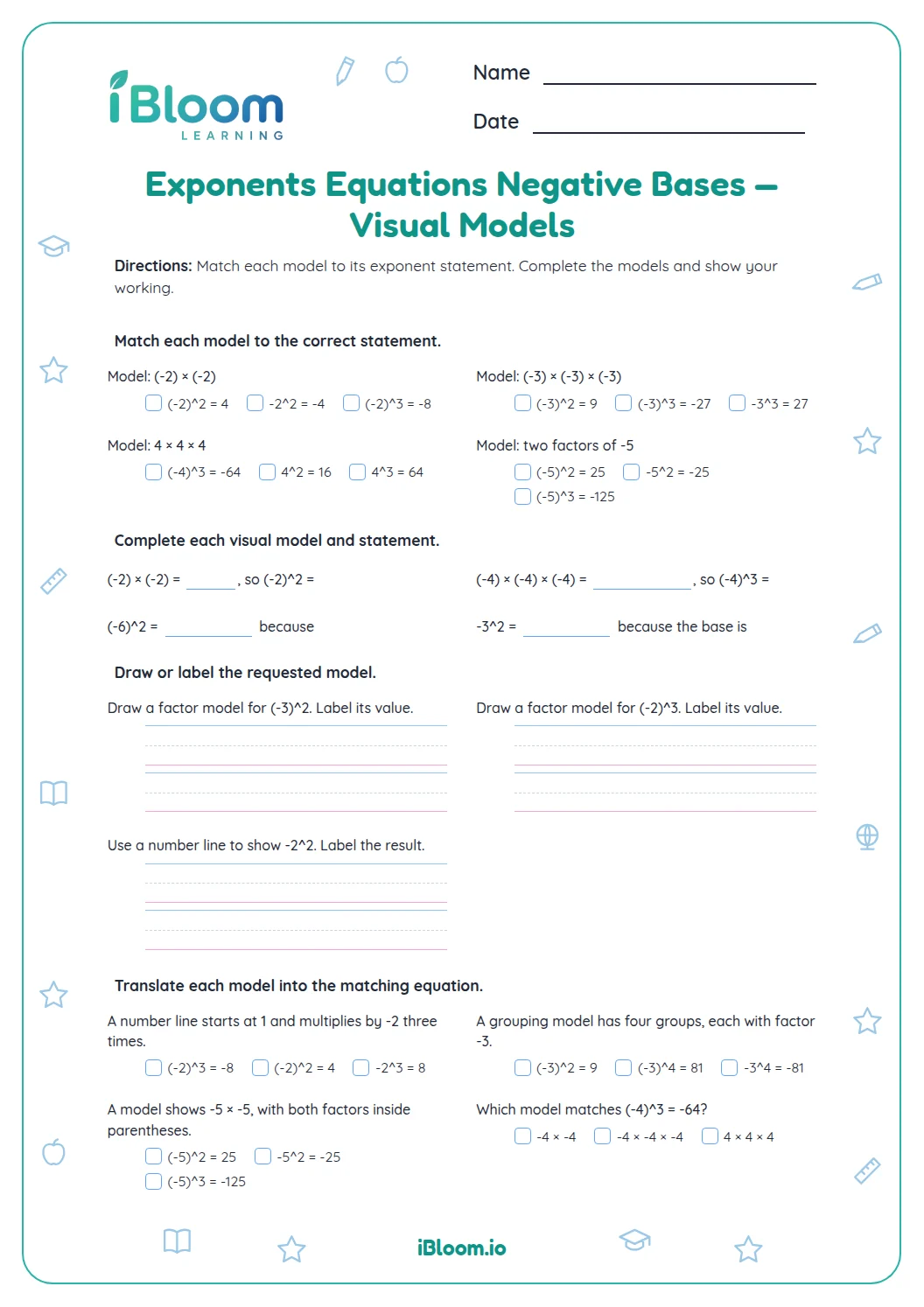
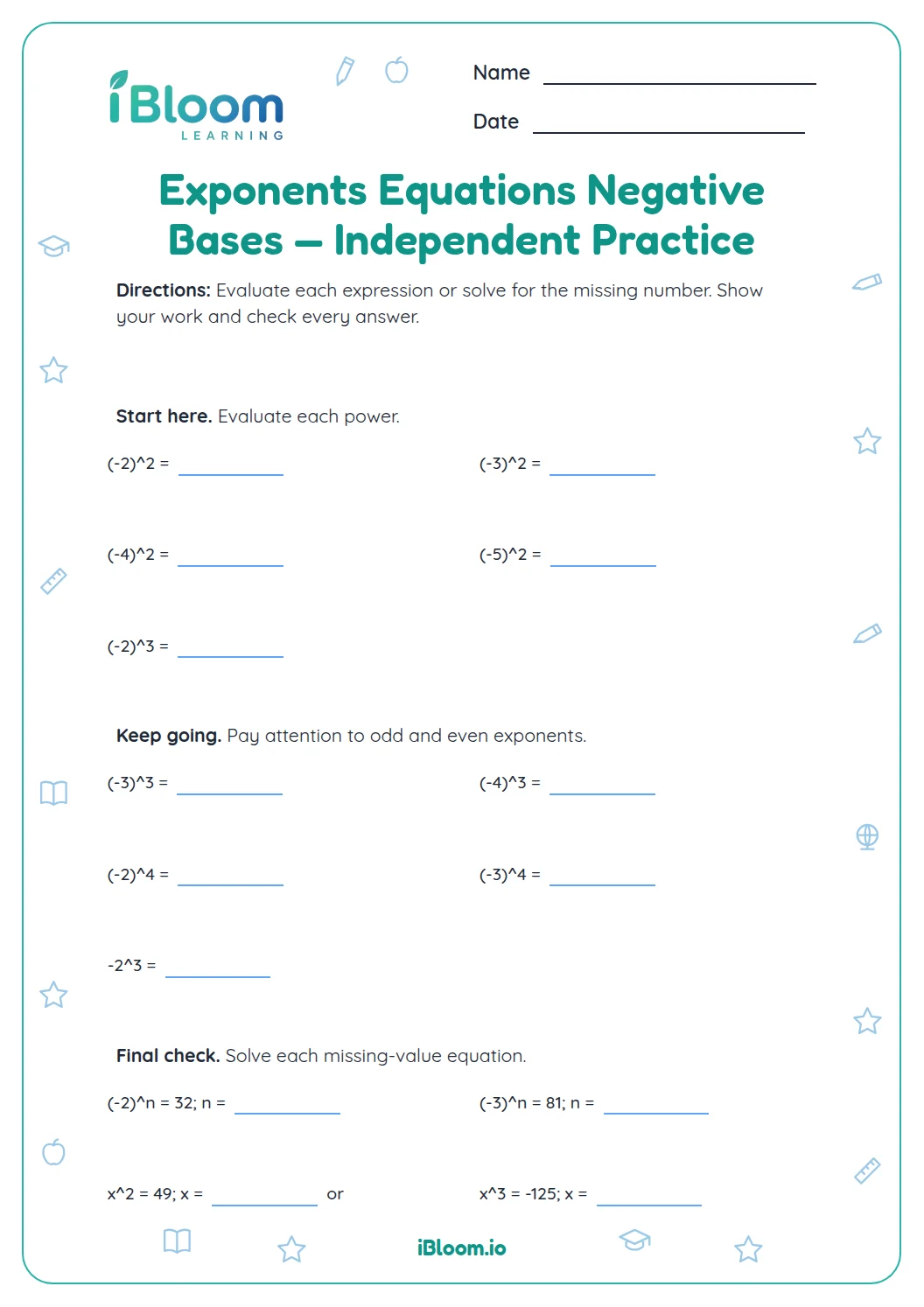
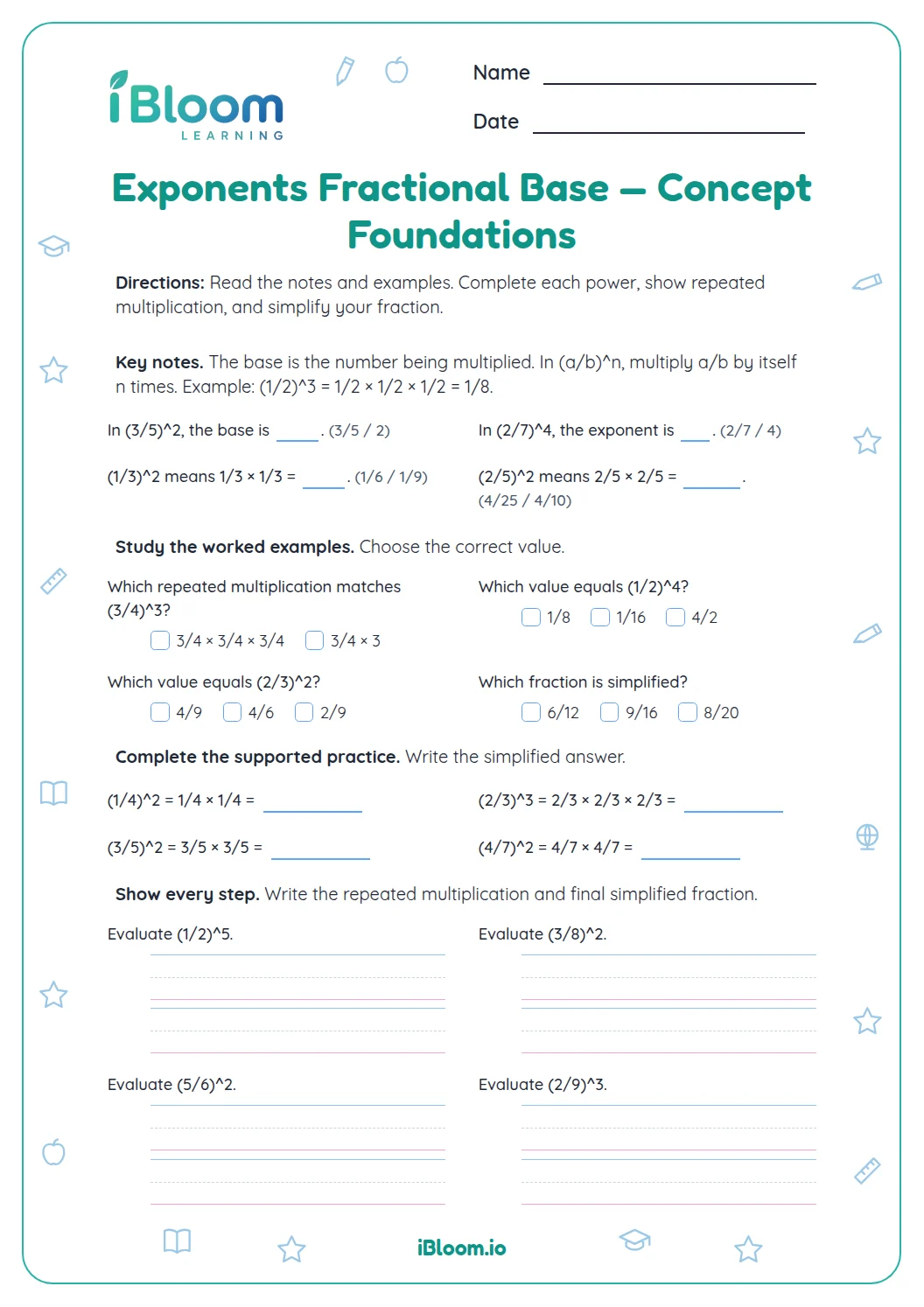
This Grade 6 worksheet builds fluency with whole-number exponents. Learners rewrite repeated multiplication as a power, expand powers into factors, identify a base or exponent, and evaluate numerical expressions. It includes 15 questions across three parts and a separate answer key. These tasks practice CCSS 6.EE.A.1.
Aligned to 6.EE.A.1
What does an exponent tell you?
The exponent counts how many times the base is used as a factor. In 4³, the base is 4 and the exponent 3 means 4 × 4 × 4.
- 1Write 4 × 4 × 4 as a power.
- 2Answer: 4³
How do you evaluate a power?
Expand the power first, then multiply. For 2³, calculate 2 × 2 × 2 = 8; do not multiply 2 by 3.
What is on the practice pages?
The 15 questions move from converting between powers and repeated factors to naming parts and evaluating powers, including a multiple-choice check.
A reliable way to work
- 1Find the base and exponent.
- 2For repeated factors, count equal factors to get the exponent.
- 3For a power, write the base the stated number of times.
- 4Multiply the expanded factors to evaluate.
- 5Check that your answer matches the original expression.
Common exponent errors
The mistake
Multiplying the base by the exponent.
The fix
Expand first: 3⁴ is four 3s multiplied.
The mistake
Using the exponent as the base.
The fix
The larger raised number is the count; the other number is the base.
The mistake
Writing too few repeated factors.
The fix
Count the factors and compare that count with the exponent.
Common Core alignment
This worksheet practices writing and evaluating numerical expressions with whole-number exponents.
Write powers, expand repeated factors, and evaluate whole-number exponents.
On this sheet:
Show the official wordingHide the official wording
Write and evaluate numerical expressions involving whole-number exponents.
What to practice next
Make more practice
Further reading
Questions parents and teachers ask
How many questions are included?
There are 15 questions in three parts. Learners convert repeated factors and powers, identify a base or exponent, then evaluate expressions and check a power against its factors. Reviewing the factor count helps distinguish the exponent from the value of the power.
What does the exponent mean?
The exponent tells how many equal factors to multiply. In 5³, the base 5 appears three times: 5 × 5 × 5. It does not mean 5 multiplied by 3. Writing out the factors is a useful check before evaluating the expression.
Does the worksheet include an answer key?
Yes. The separate key includes the power forms, expanded multiplication, base or exponent values, and evaluated answers. Ask the learner to expand a power when reviewing a missed evaluation. The key is especially useful for checking whether the expanded form has the right number of factors.
Can it be used for independent practice?
Yes. The directions are short and the parts move from writing powers to evaluating them. A parent or teacher can model the first conversion, then have the learner complete the remaining problems. Learners can explain each answer by naming the repeated factor and counting how many times it appears.
What is the difference between a base and exponent?
The base is the repeated factor, and the exponent counts how many times it appears. In 6⁴, 6 is the base and 4 is the exponent. Naming both helps learners expand or evaluate the expression. The sibling pages offer a next step after this independent review of whole-number powers.