



About this worksheet
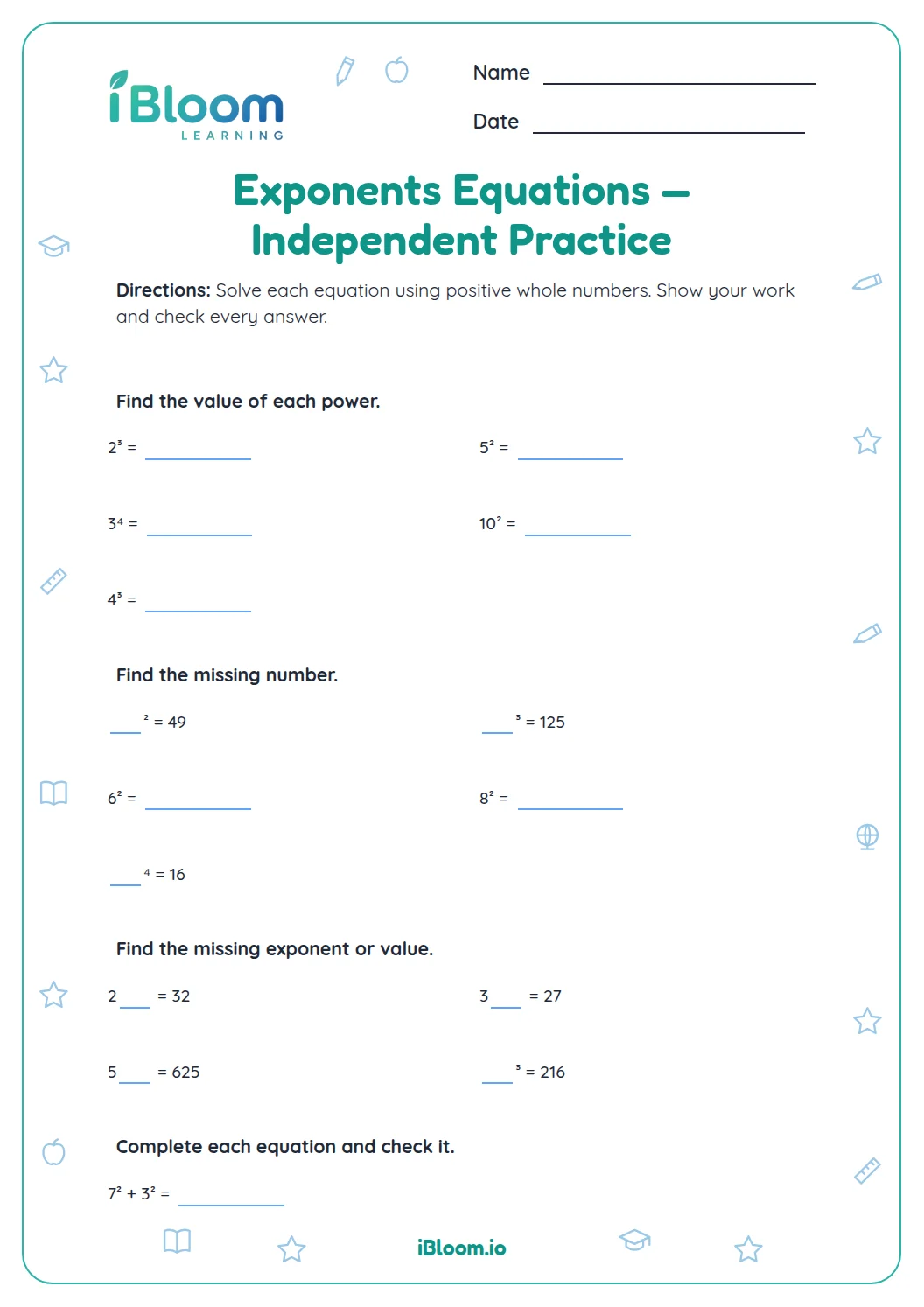
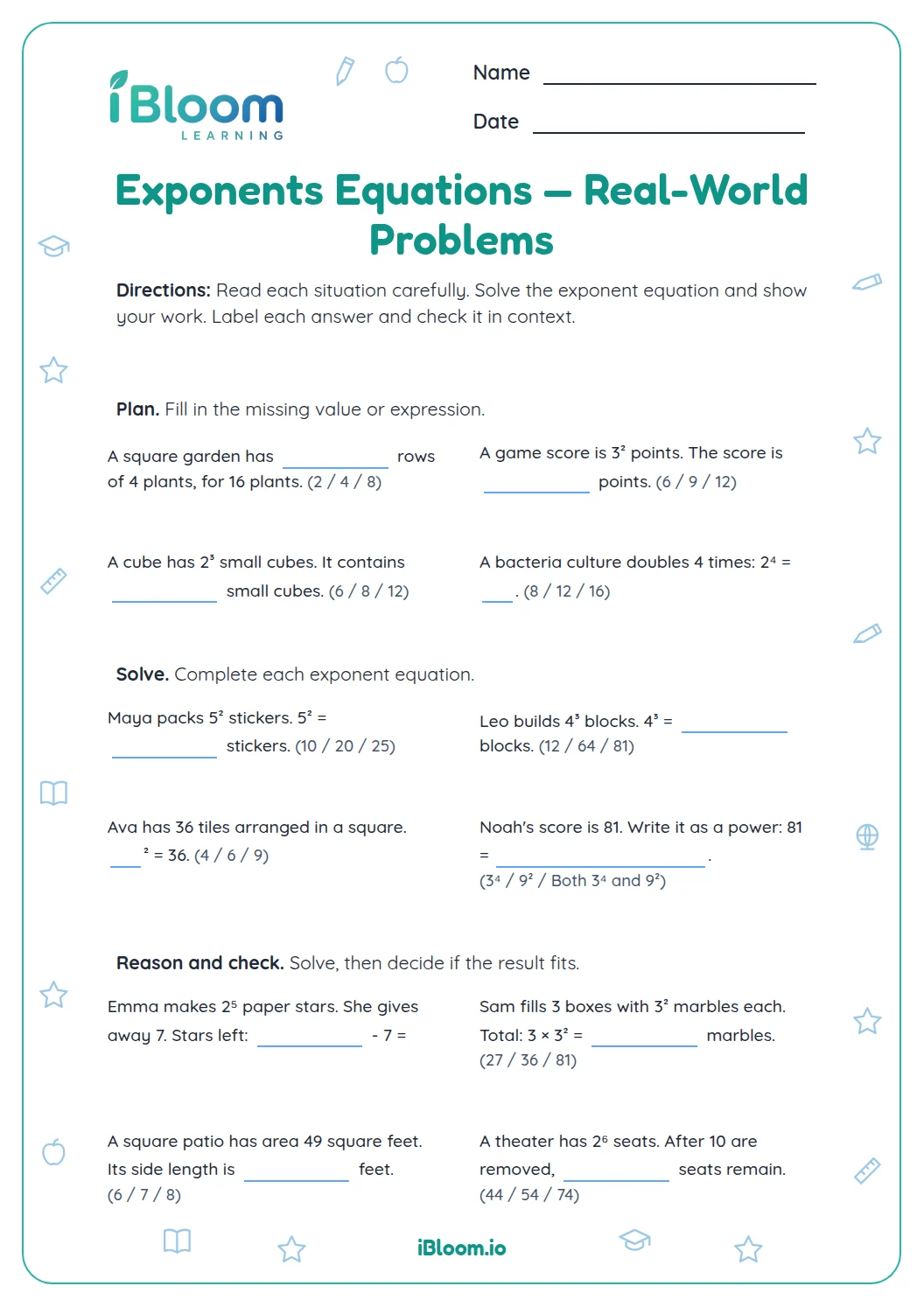
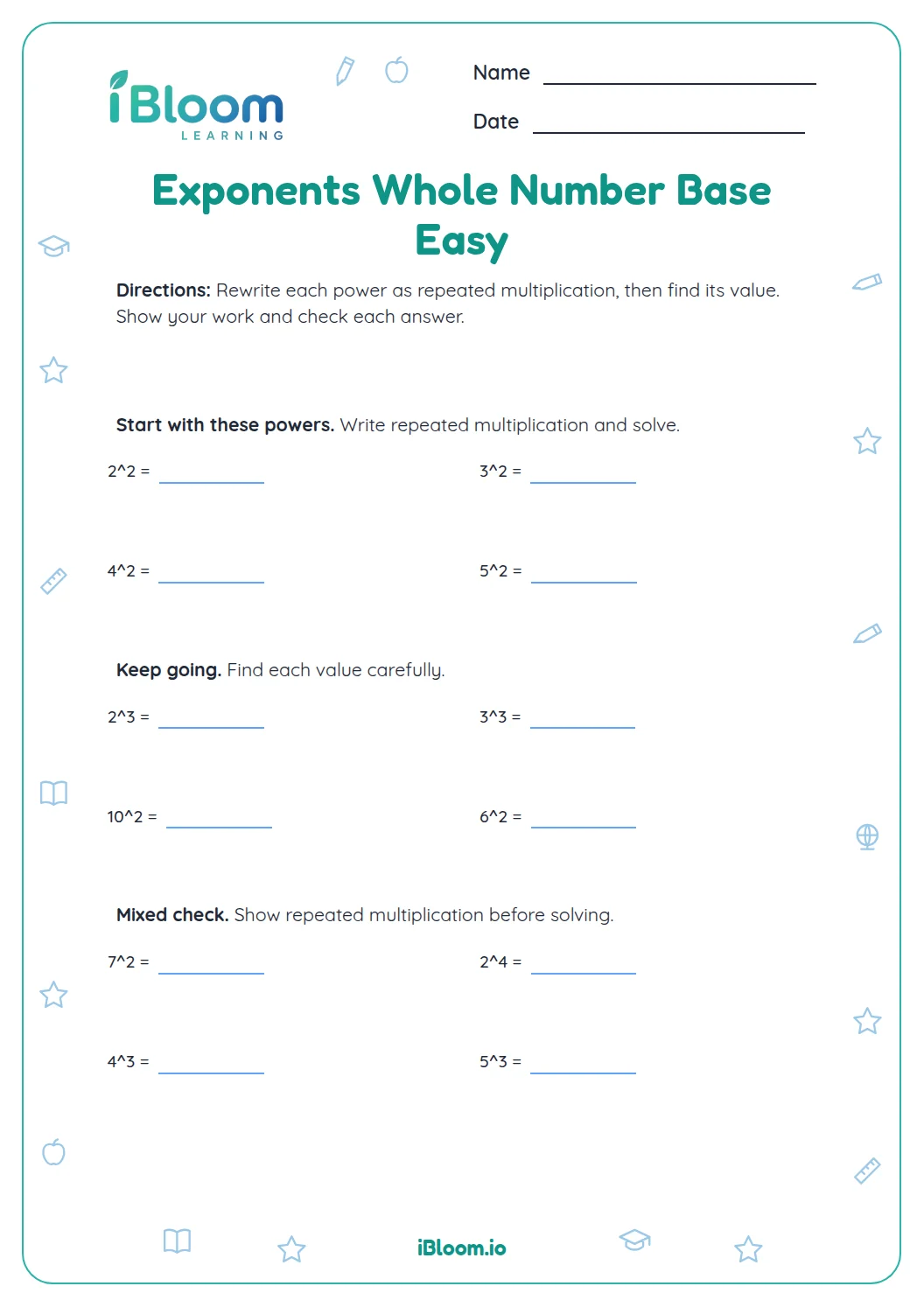
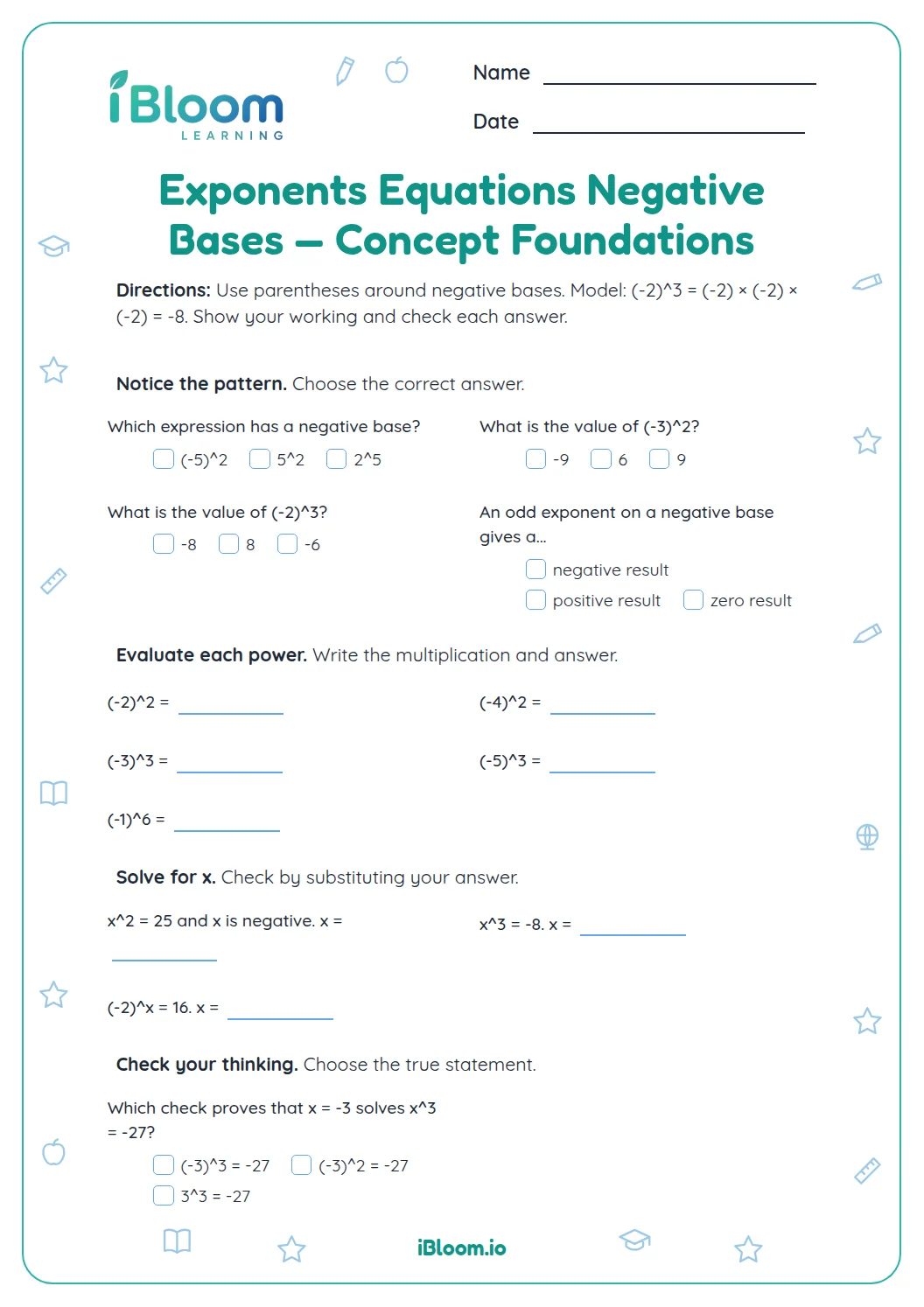
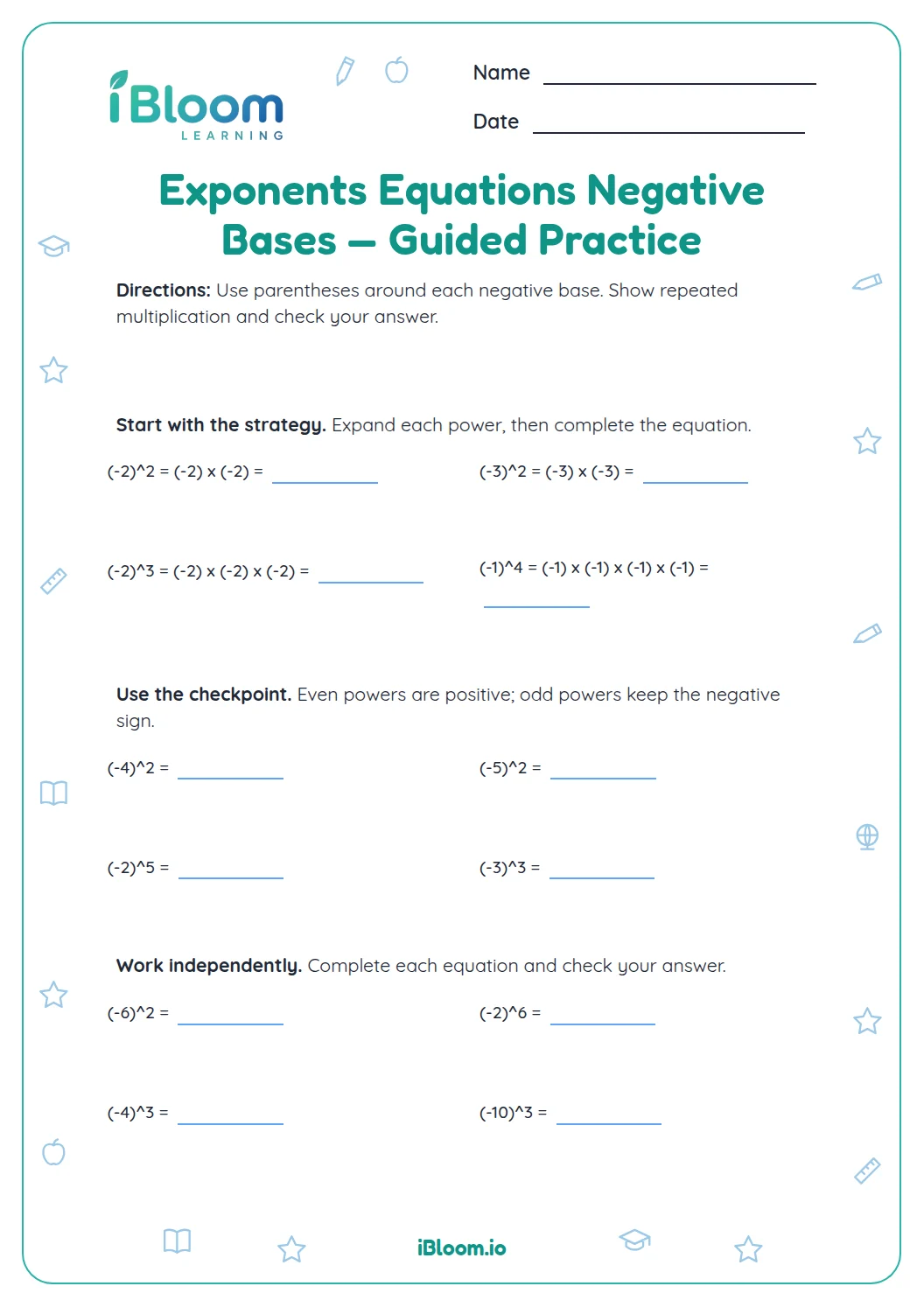
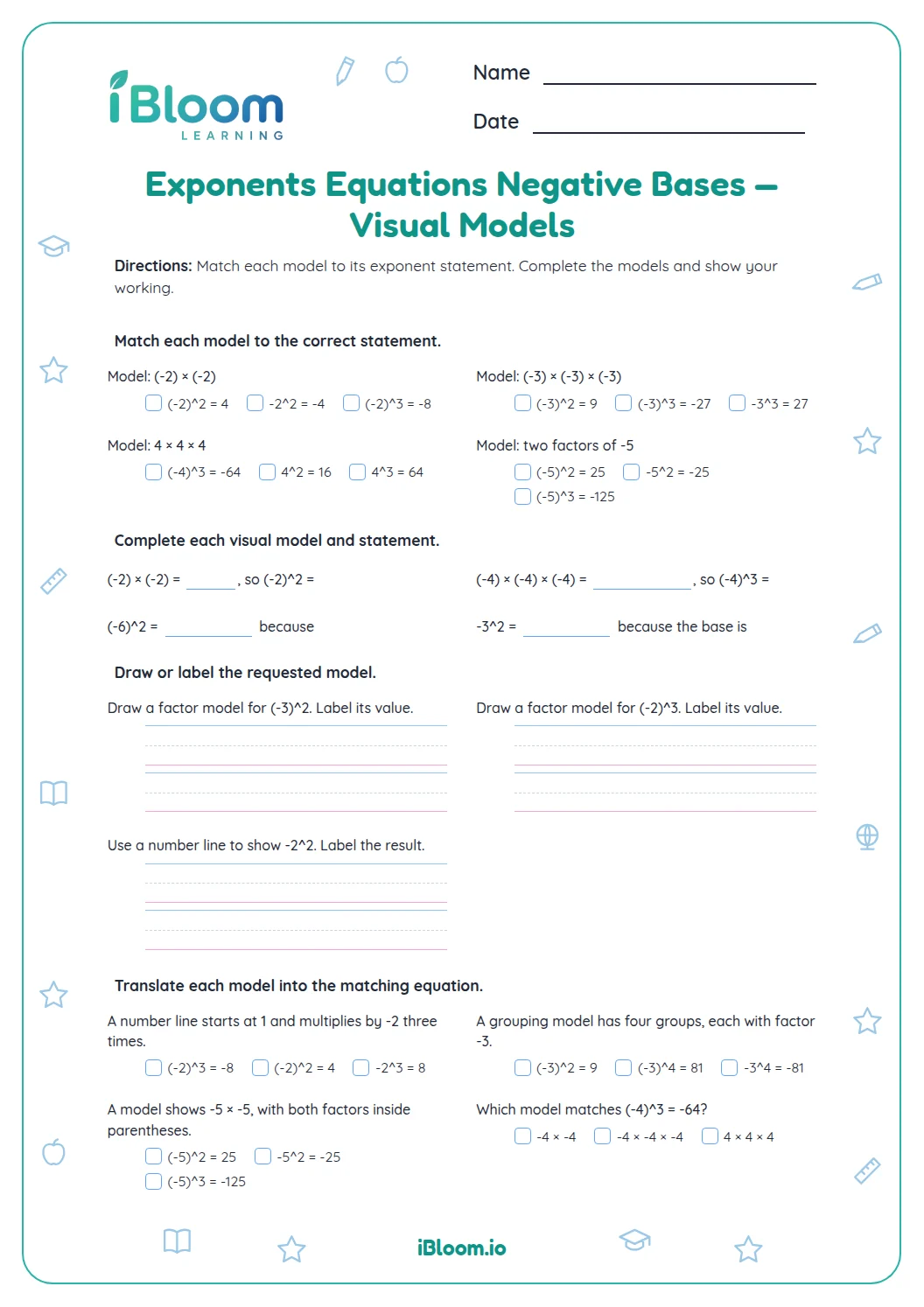
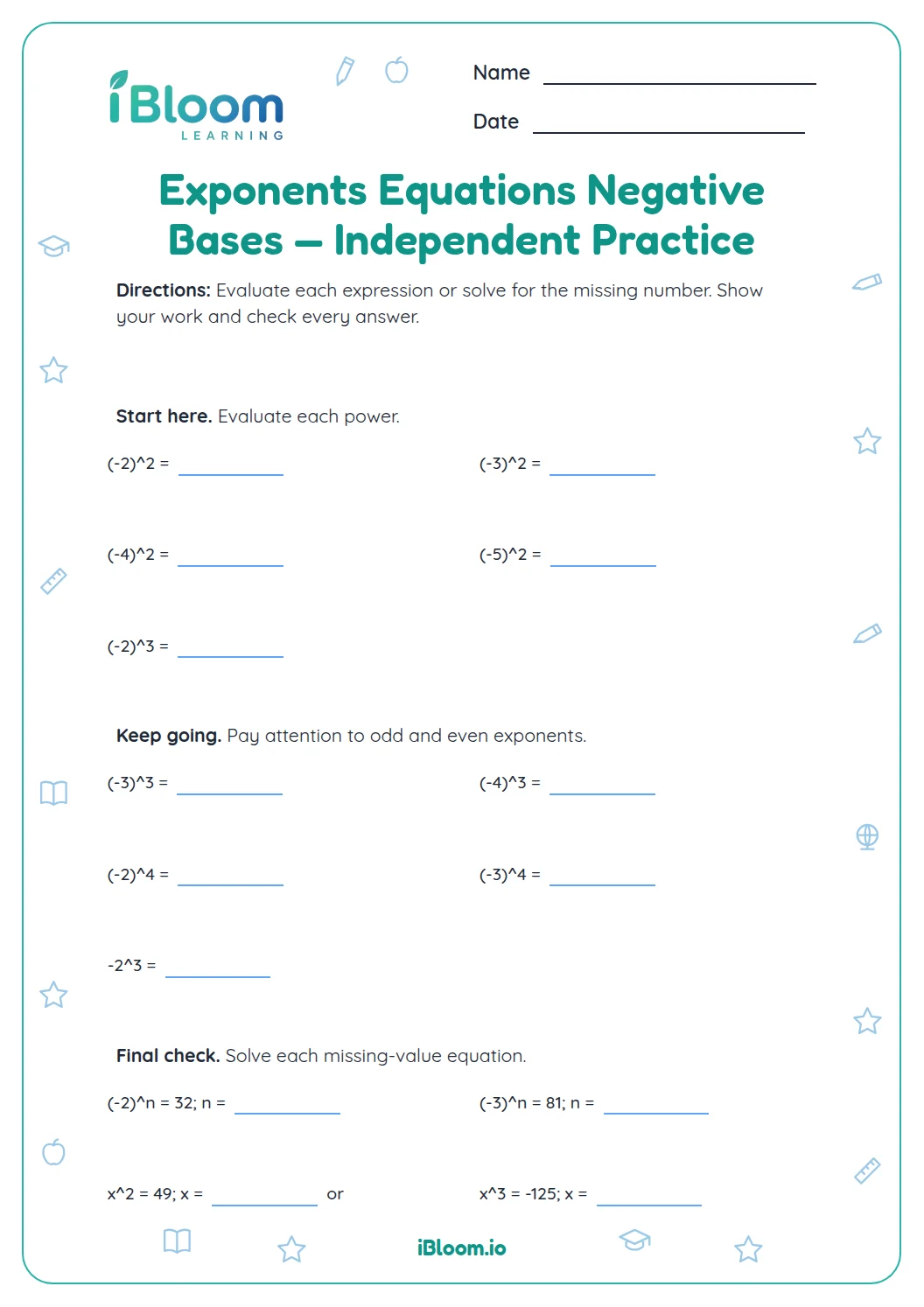
This Grade 6 printable practices evaluating powers with whole-number bases and positive whole-number exponents, then solving equations with a missing base or exponent. Sixteen problems move from direct evaluation to missing values. A separate answer key lists each result.
Aligned to 6.EE.A.1
What does an exponent tell us?
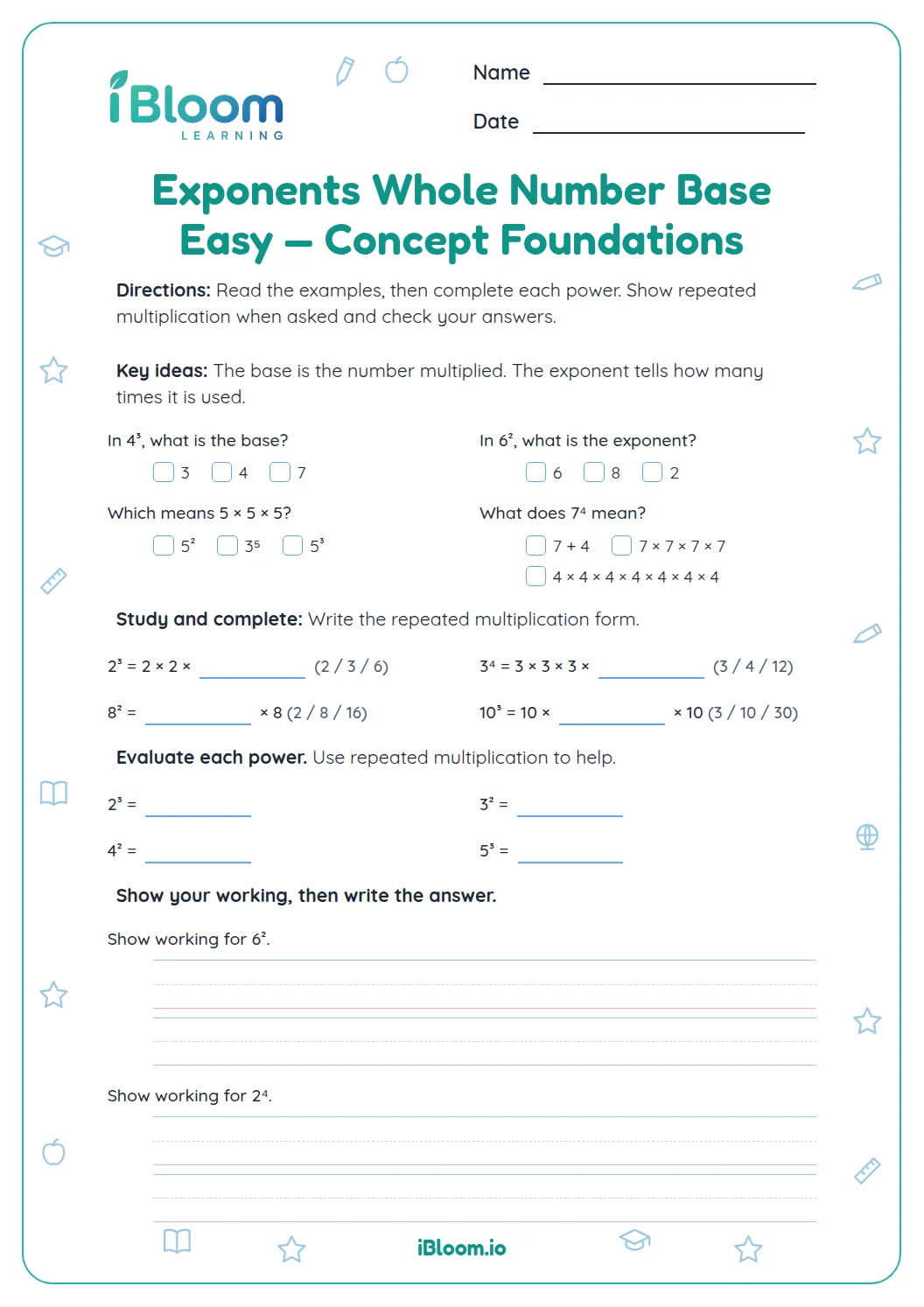
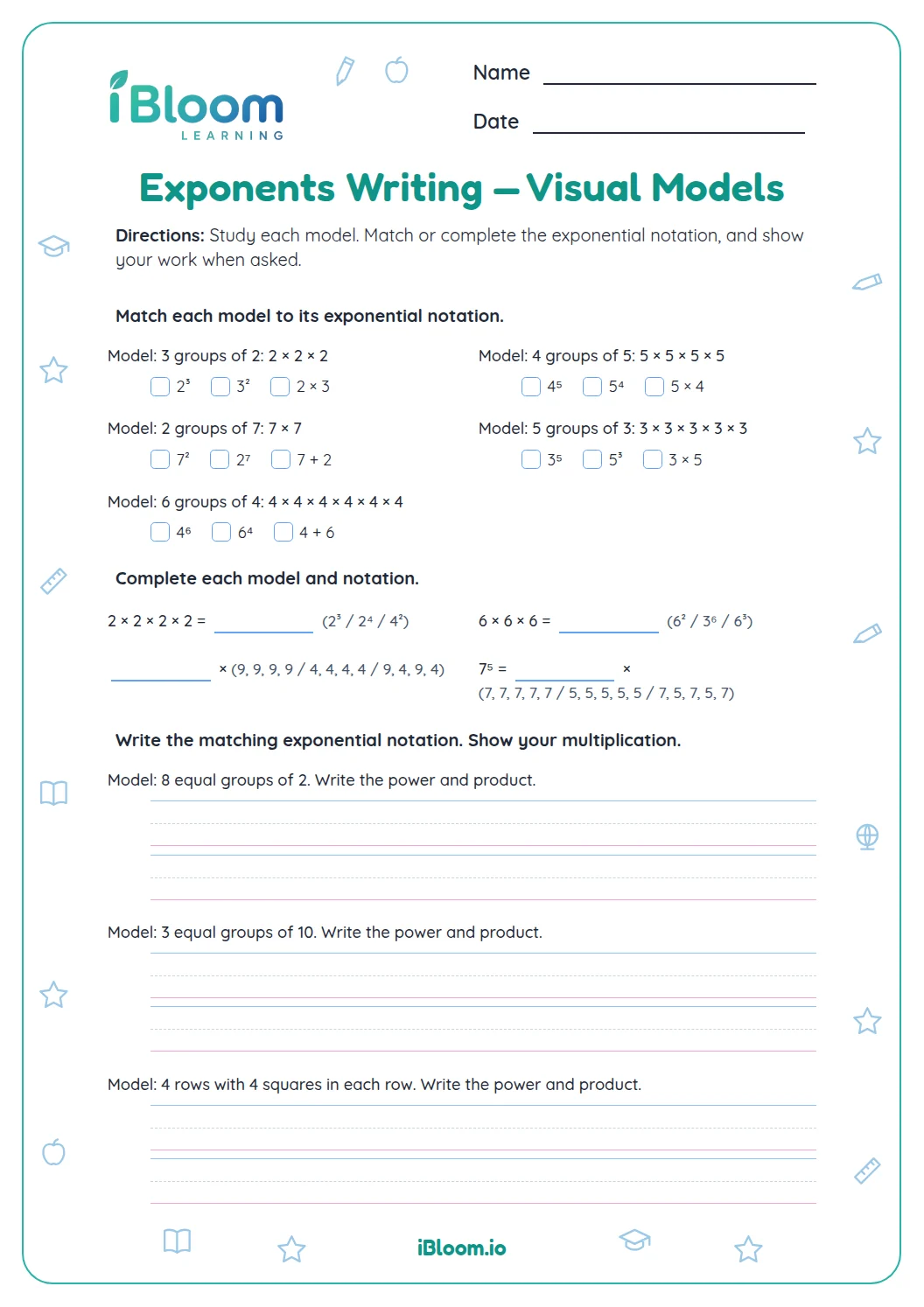
The exponent tells how many times to use the base as a factor. In 3², multiply 3 × 3; the exponent does not mean multiply 3 by 2.
How do I solve a power equation?
For a missing exponent, test how many times the base must be multiplied to make the result. For a missing base, find the number that makes the repeated product.
How is this sheet organized?
Part A has ten powers to evaluate. Part B has six equations with a missing base or exponent.
- 12³ means 2 × 2 × 2
- 22 × 2 × 2 = 8
- 3Answer: 8
How to use this worksheet
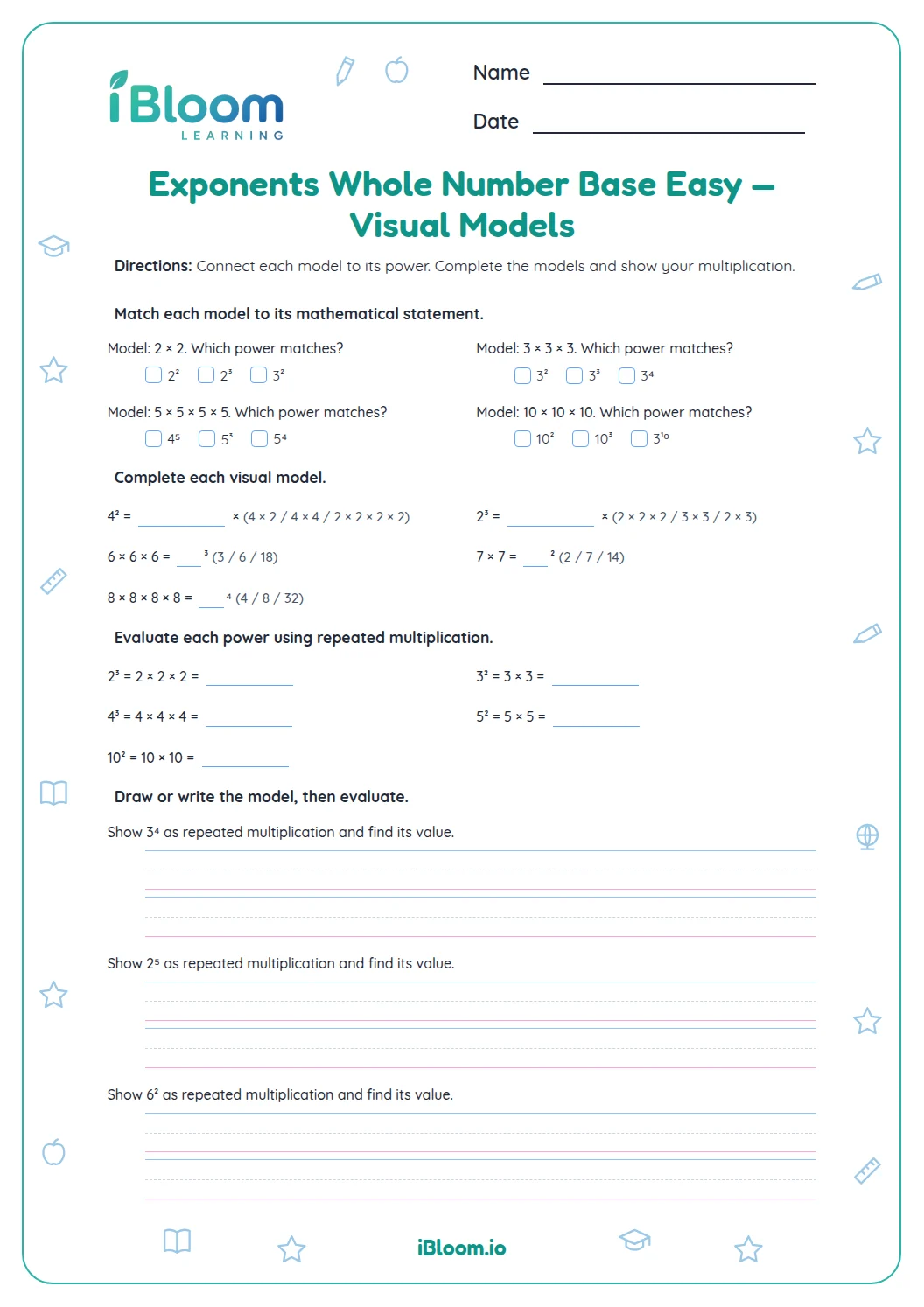
- 1Rewrite each power as repeated factors.
- 2Multiply the factors to evaluate it.
- 3For a missing exponent, build powers of the base until the result matches.
- 4For a missing base, find a repeated factor that gives the result.
- 5Check by substituting your answer into the original equation.
Common mistakes and quick fixes
The mistake
Multiplying the base by the exponent.
The fix
Write the base as a repeated factor before calculating.
The mistake
Treating 3² as 3 × 2.
The fix
Use 3 × 3 because the exponent is the factor count.
The mistake
Stopping one factor too soon.
The fix
Count the repeated factors and compare the product with the target.
Common Core alignment
This sheet builds skill with numerical expressions that use whole-number exponents.
Evaluate numerical expressions with whole-number exponents.
On this sheet: Part A evaluates powers and Part B solves missing-value equations built from whole-number powers.
Show the official wordingHide the official wording
Write and evaluate numerical expressions involving whole-number exponents.
What to practice next
Make more practice
Further reading
Questions parents and teachers ask
What does an exponent mean on this sheet?
The exponent tells how many equal factors to multiply. For example, 2³ means 2 × 2 × 2, which equals 8. It does not mean multiply 2 by 3. The first part gives practice evaluating powers like this.
How many problems are included?
There are 16 equations in two parts. The first ten ask children to evaluate powers, and the last six ask them to find a missing base or exponent. The separate answer key lists all 16 results.
Does the worksheet include an answer key?
Yes. A separate answer key lists the result for every equation, including missing bases and exponents. Children can substitute each answer into the original equation to check it.
How can I help when the exponent is missing?
List powers of the base until the result matches. For 3^___ = 81, calculate 3, 9, 27, then 81; four factors of 3 make the target, so the missing exponent is 4.
What does a missing base mean?
A missing base asks which number, used repeatedly, makes the target. For ___³ = 64, find a number whose cube is 64: 4 × 4 × 4 equals 64, so the missing base is 4.