



About this worksheet
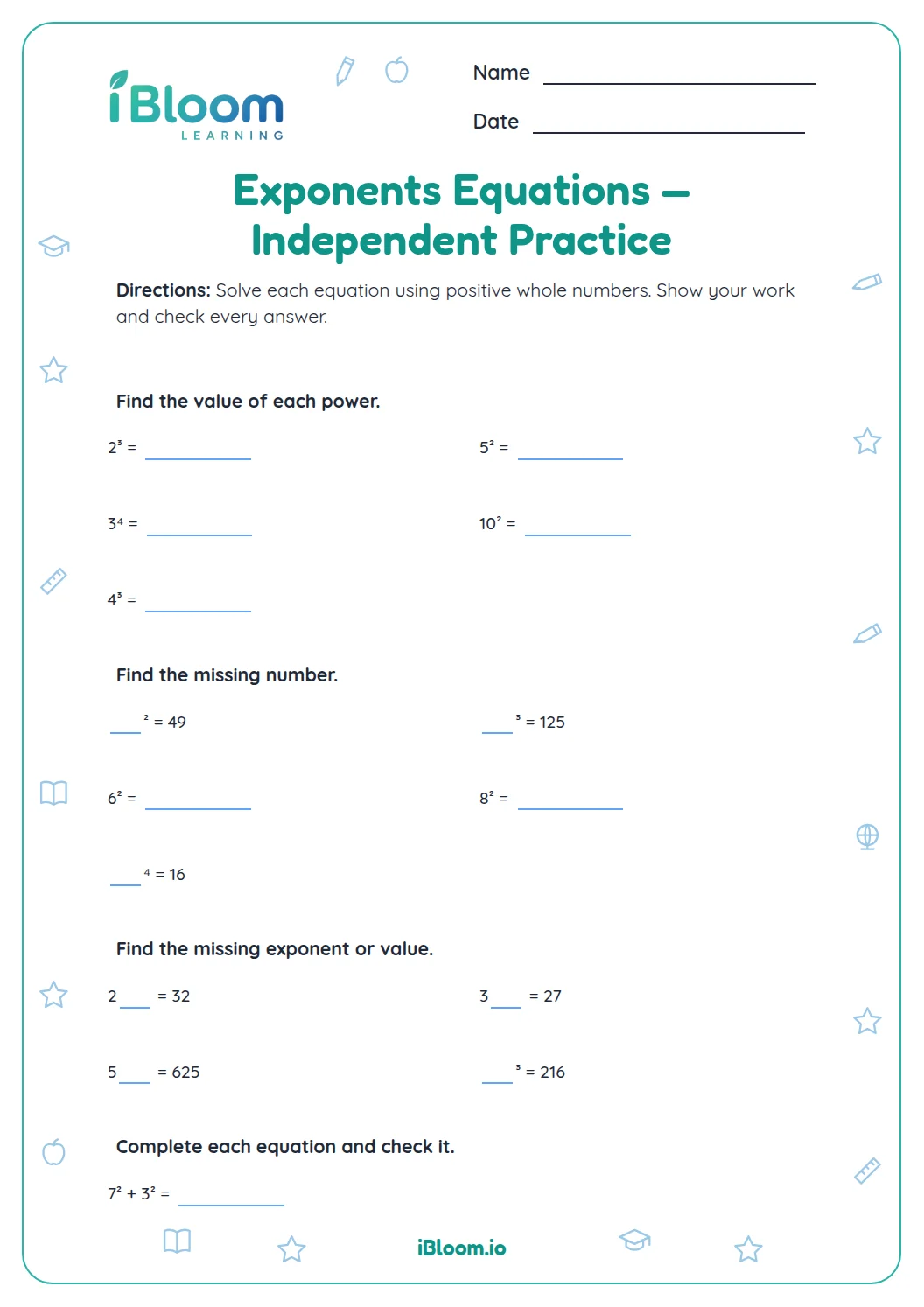
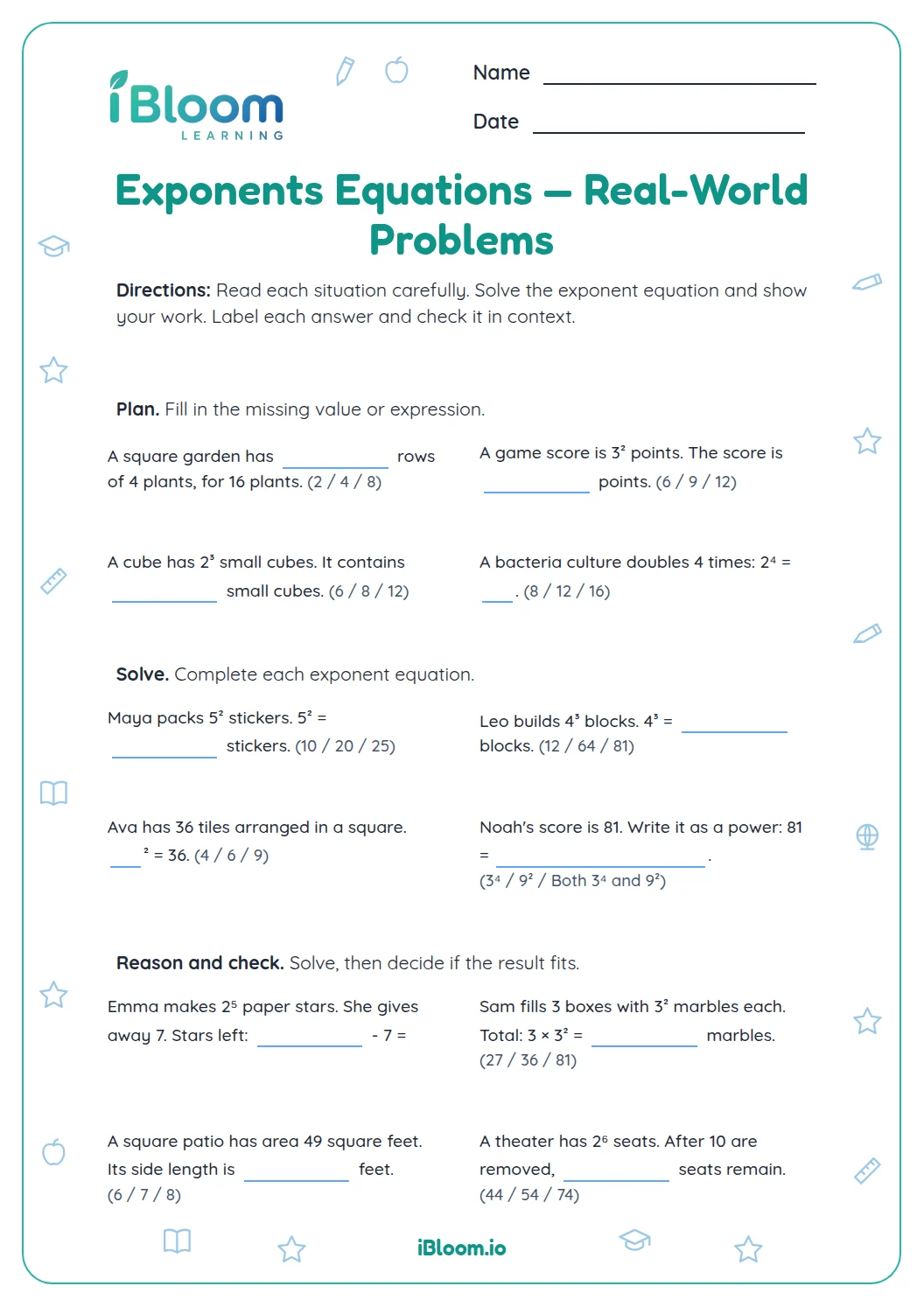
This Grade 6 challenge asks students to explain what an exponent means, catch common errors, evaluate expressions, and solve for missing bases or exponents. The final items connect square numbers to a sticker total and the side length of a square. A separate key gives corrections and sample reasoning.
Aligned to 6.EE.A.1
What exponent mistakes should students catch?
An exponent is the number of equal factors, not a multiplier for the base. Expand the power first, then calculate.
- 13² = 3 × 3 = 9
- 2The exponent 2 means two factors of 3.
How can a power help find a missing value?
Test a base by writing its repeated factors, or build a power from the given base until it matches the target. Check the completed equation.
- 1___² = 49
- 27² = 7 × 7 = 49
How do square numbers describe area?
The area of a square is side length times side length, so it can be written as a squared number. Use the positive side length when a length is requested.
How to use this worksheet
- 1Read the direction for each part before starting.
- 2Work through exponents problems in order and write enough steps to check the result.
- 3Compare each response with the answer key and redo any missed item.
- 4Ask the learner to explain one strategy aloud.
Common mistakes and quick fixes
The mistake
Rushing past a sign or key detail in a exponents problem.
The fix
Read the prompt again, identify the needed exponents step, and check the result.
The mistake
Using a correct method but making a small computation error in exponents.
The fix
Read the prompt again, identify the needed exponents step, and check the result.
The mistake
Writing an answer without checking it against the original question.
The fix
Read the prompt again, identify the needed exponents step, and check the result.
Common Core alignment
Students write and evaluate numerical expressions with whole-number exponents.
Interpret whole-number exponents as repeated factors and evaluate expressions.
On this sheet: Students explain powers as repeated multiplication and evaluate expressions that contain whole-number exponents.
Show the official wordingHide the official wording
Write and evaluate numerical expressions involving whole-number exponents.
What to practice next
Make more practice
Further reading
Questions parents and teachers ask
What does the exponent show?
The exponent tells how many times the base is used as a factor. In 3², the base 3 is used twice: 3 × 3 = 9. It does not mean 3 × 2. Rewriting a power as repeated multiplication makes the exponent’s job clear.
How can a student check a power?
The exponent tells how many times the base is used as a factor. In 3², the base 3 is used twice: 3 × 3 = 9. It does not mean 3 × 2. Rewriting a power as repeated multiplication makes the exponent’s job clear and easier to check.
How do you solve a missing-base equation like ___² = 49?
Find a number that, used as a factor twice, equals 49. Since 7 × 7 = 49, the positive whole-number base is 7. Substitute it into the equation to check. The repeated factors show why 7 is the missing value.
What is the difference between 3n and 3ⁿ?
In 3n, the 3 is a coefficient multiplied by n. In 3ⁿ, n is an exponent that tells how many factors of 3 to multiply. The worksheet includes both exponent expressions and an inverse-operation equation so students distinguish the notation.
How does a square connect to exponents?
The area of a square is side length times side length, so it can be written as s². If the area is 64 square inches, the positive side length is 8 inches because 8 × 8 = 64. Squaring the side gives the area.
What should students include in written responses?
Show the meaning of the exponent or the operation used to solve. For instance, explain 4³ as 4 × 4 × 4 = 64, or explain that dividing both sides of 3n = 27 by 3 gives n = 9. The key provides sample reasoning.