






About this worksheet
This printable Grade 6 worksheet introduces exponent notation through 20 fill-in questions in three parts. Students write repeated factors as powers, evaluate powers, use shared-base rules, and work with zero and negative exponents. The separate answer key includes the value or exponent for every item. The positive whole-number exponent work connects to CCSS.Math.Content.6.EE.A.1.
Aligned to CCSS.Math.Content.6.EE.A.1
What does an exponent tell us?
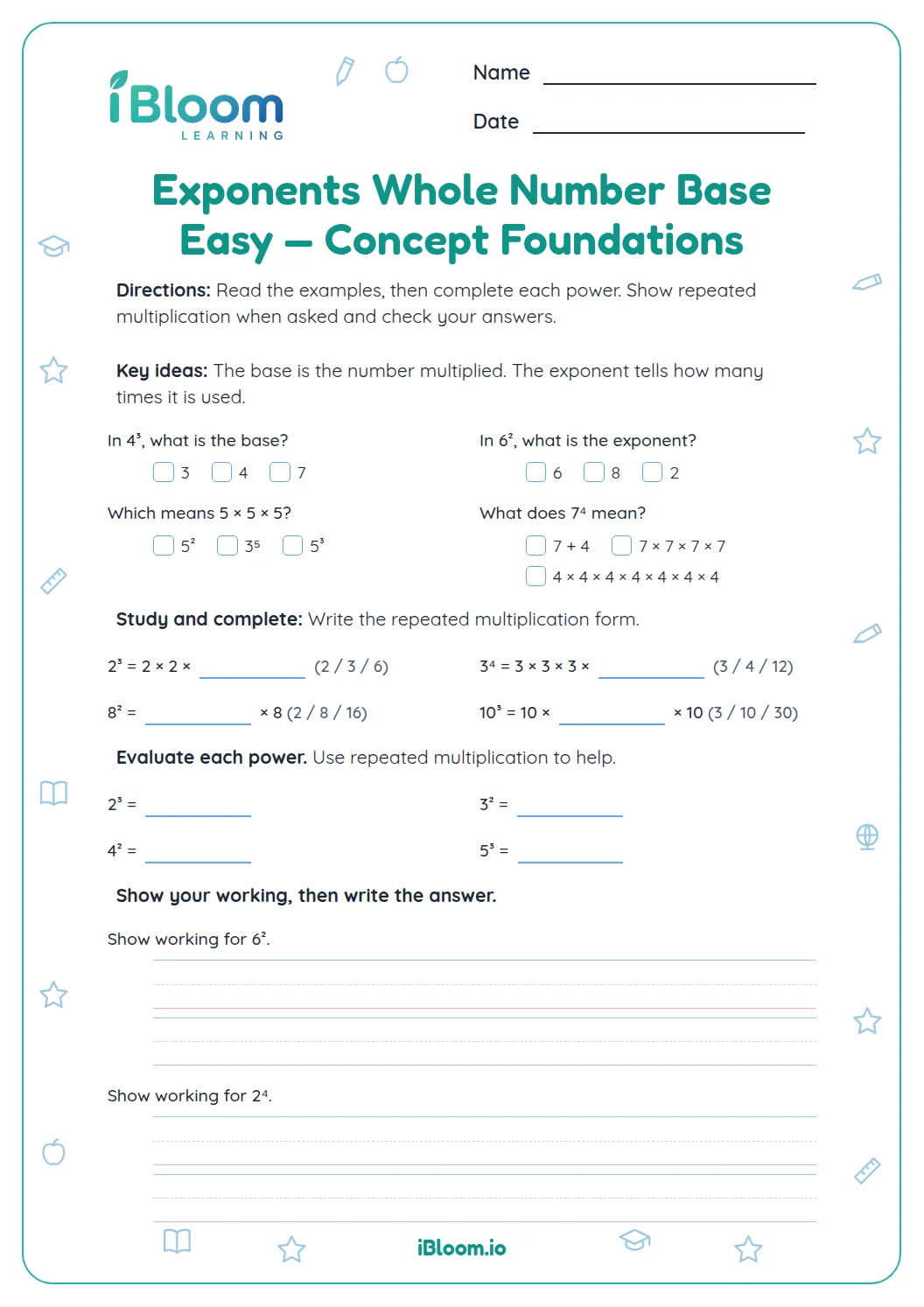
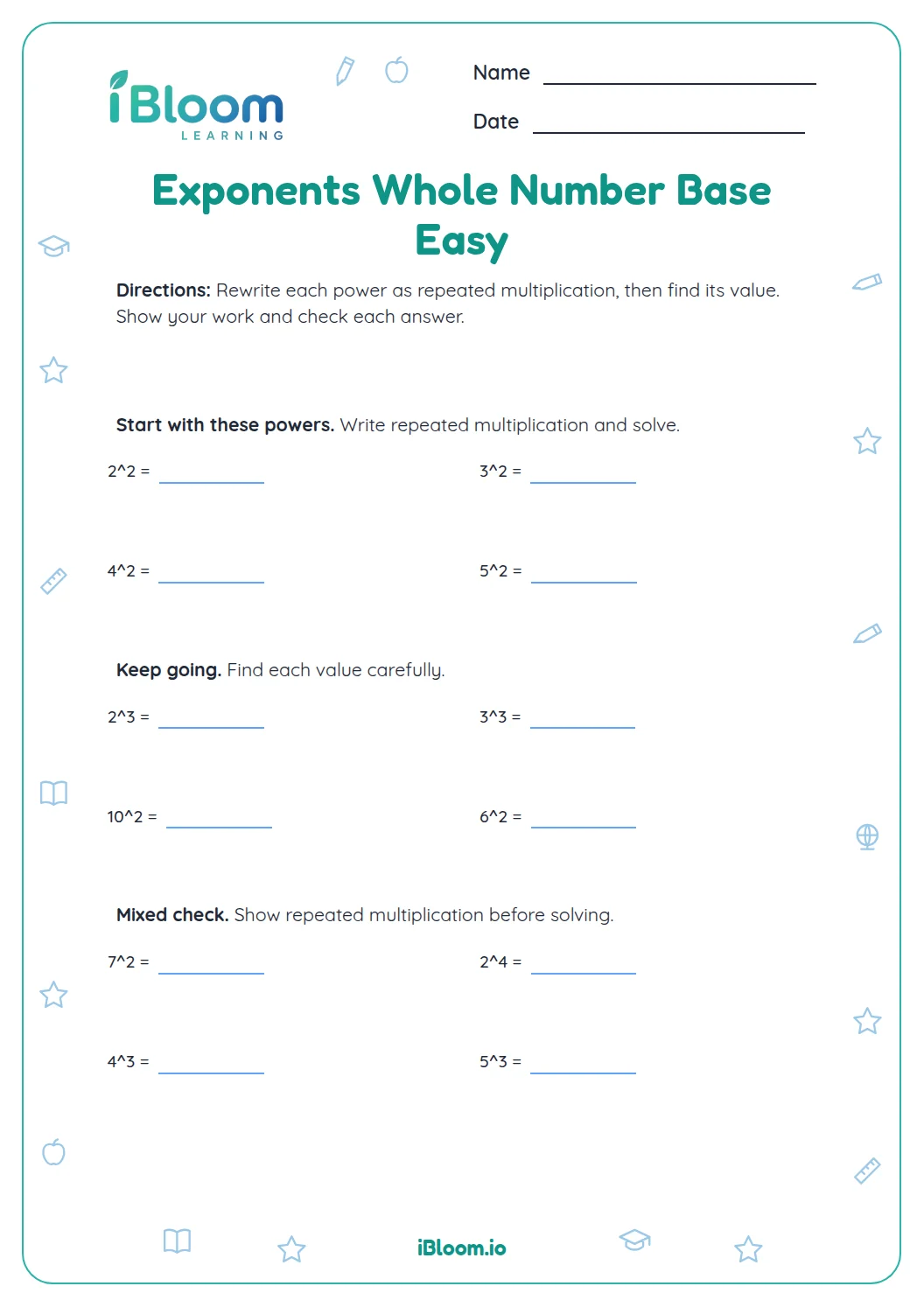
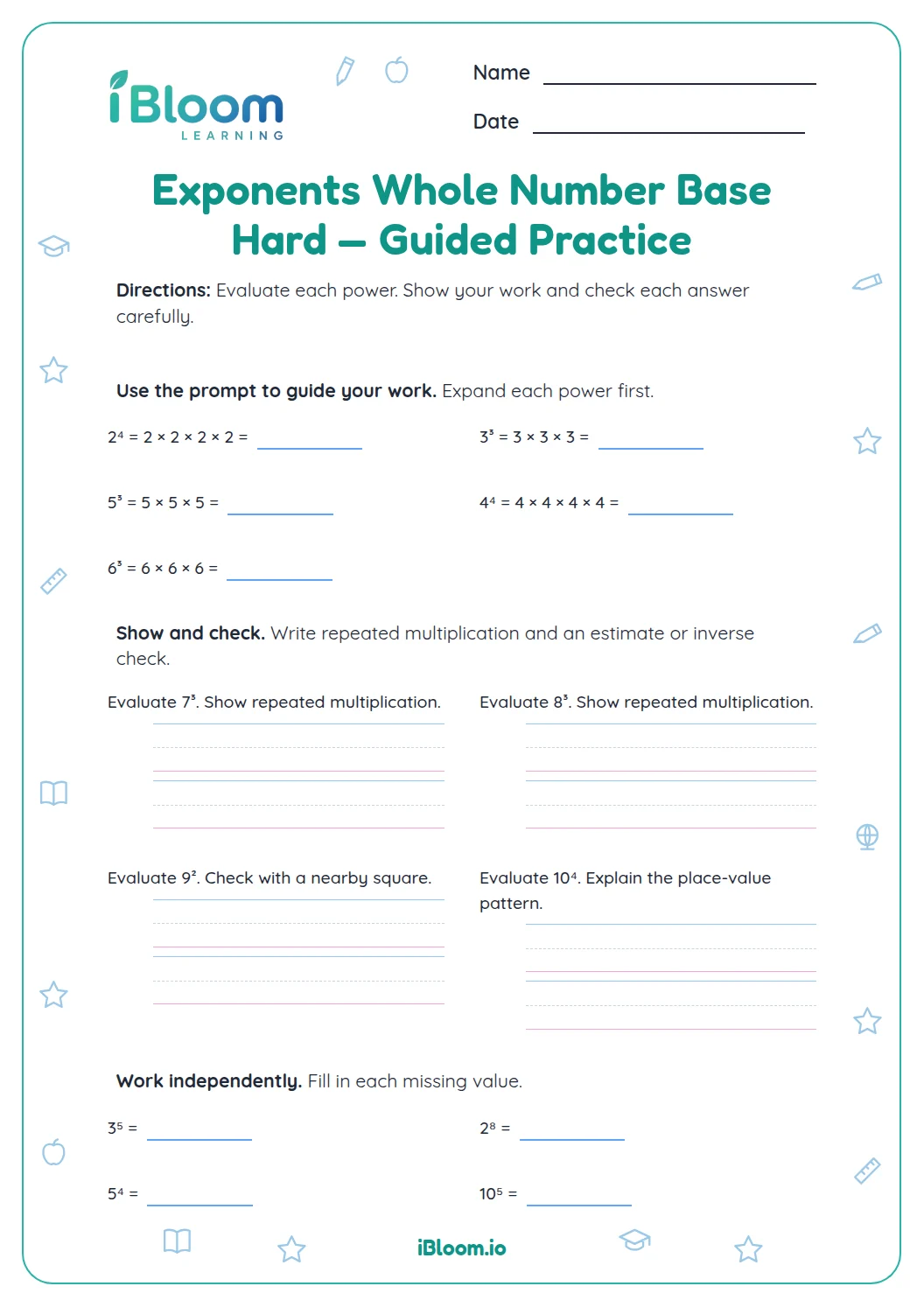
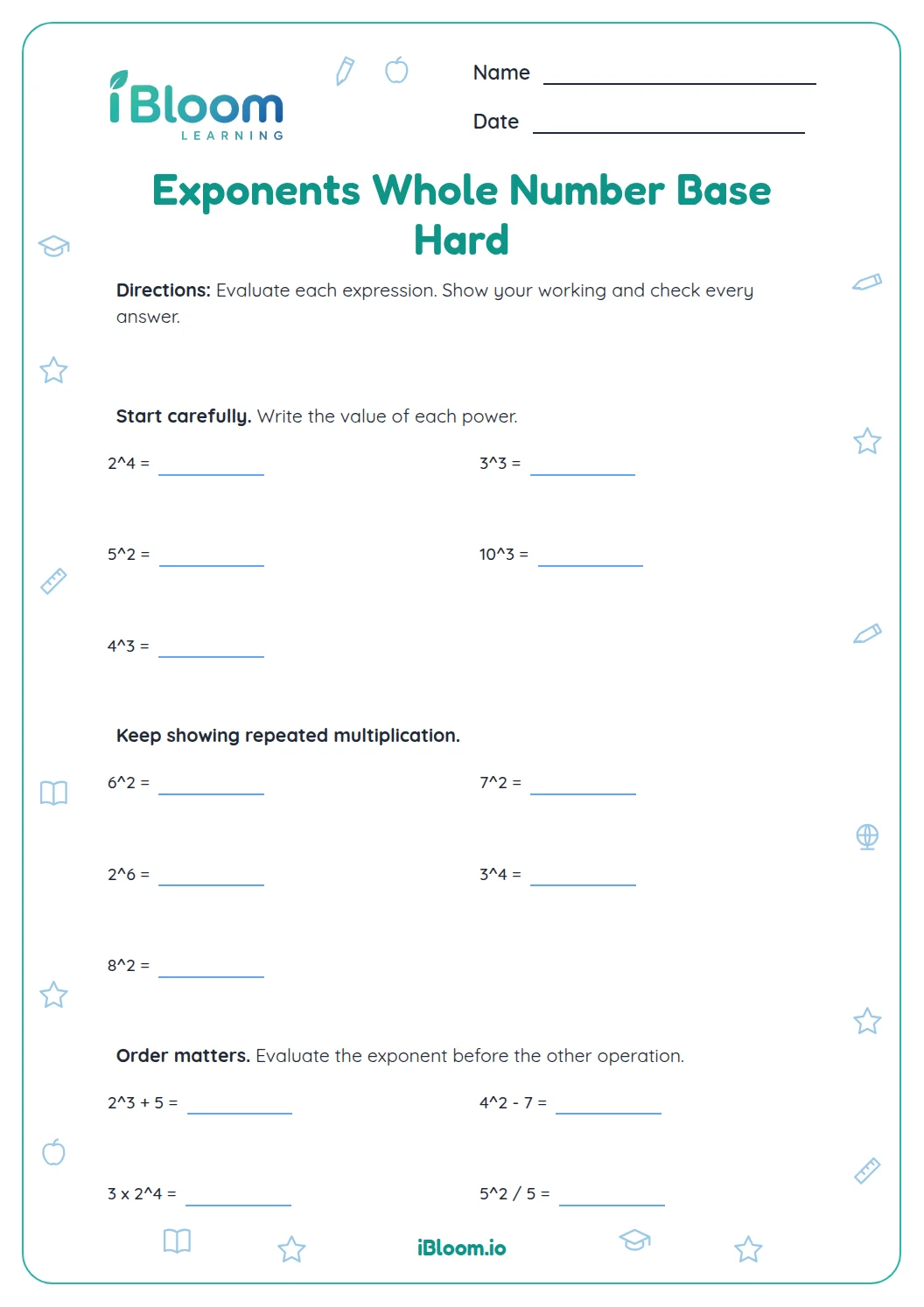
The first part connects repeated multiplication to exponent notation and asks students to evaluate powers. The base is the repeated factor; the exponent tells how many times it appears.
How do shared bases and zero powers work?
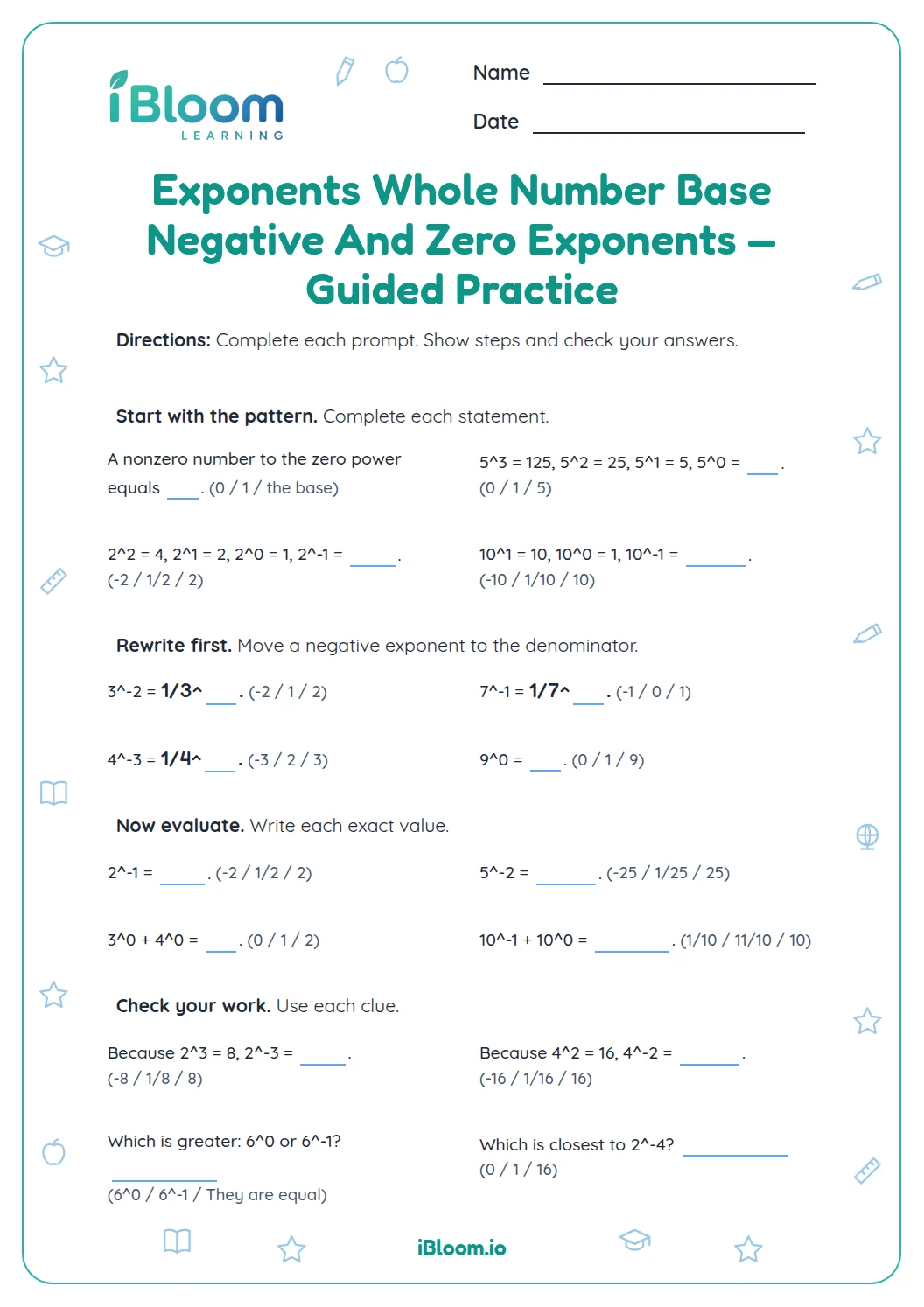
Part B uses multiplication and division with like bases. Students add exponents when multiplying powers and subtract exponents when dividing. Part C applies the zero-power rule and reciprocal form for negative exponents.
How can repeated factors be written as a power?
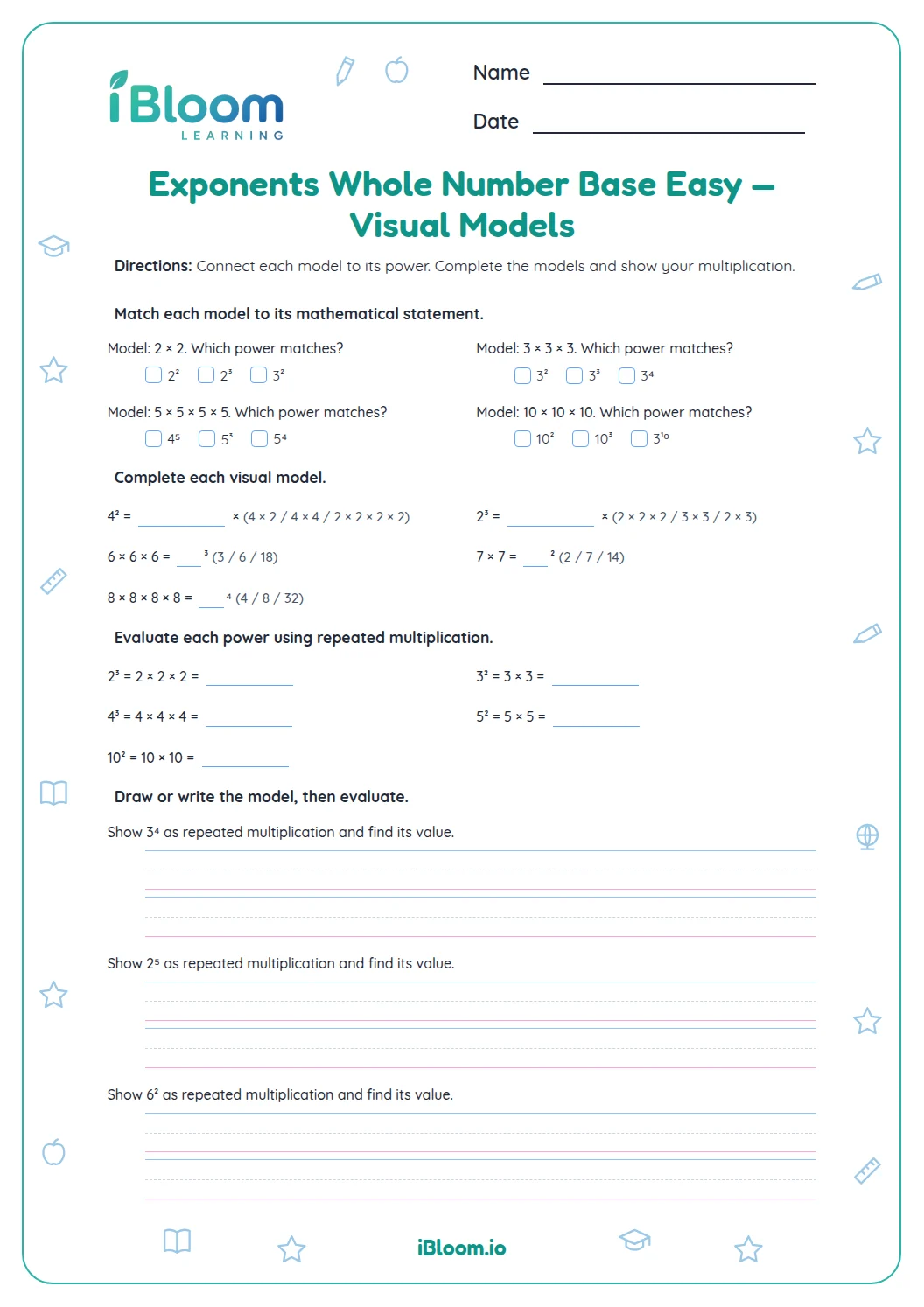
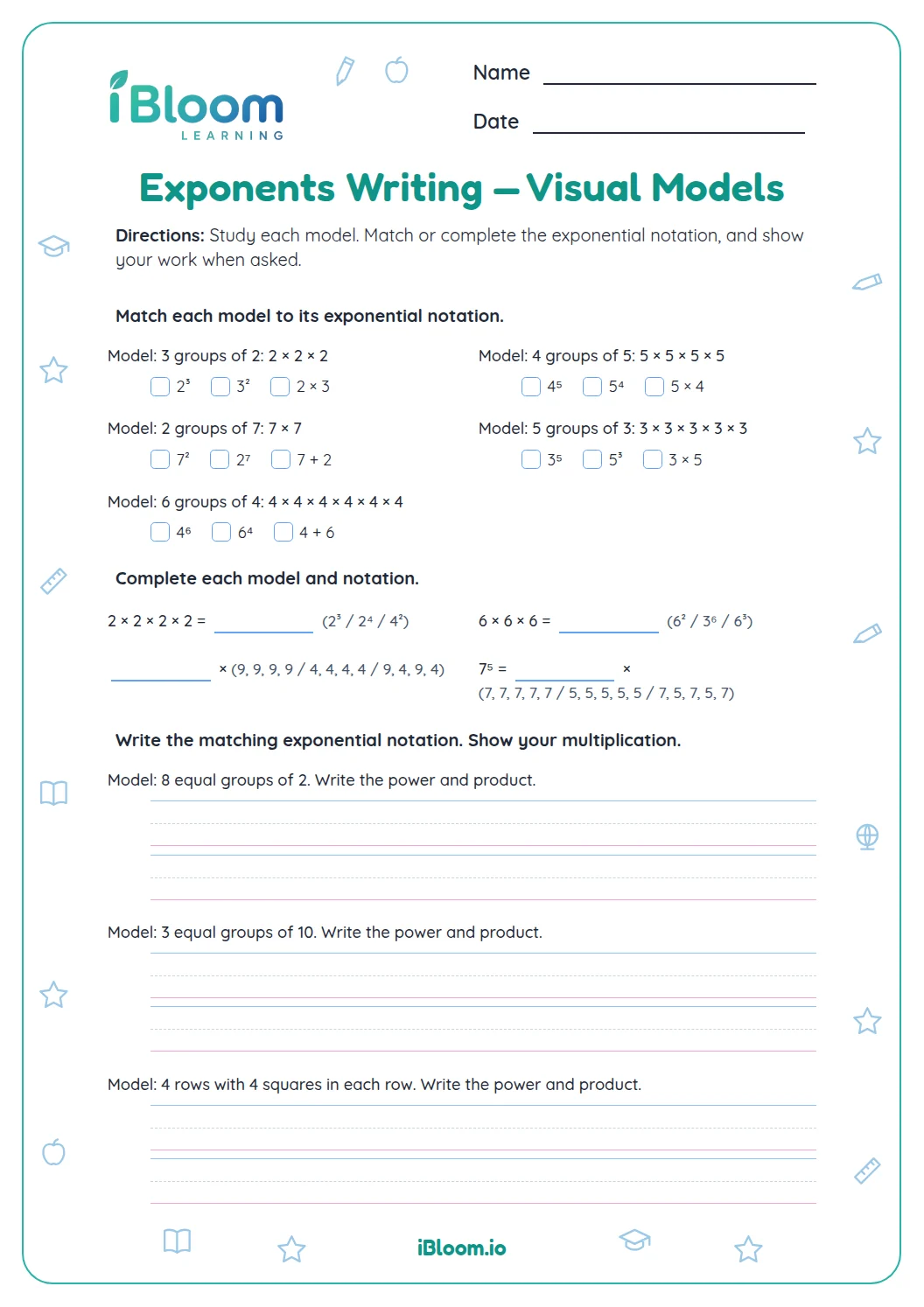
Count how many times the same base is multiplied. Keep the base unchanged and use the count as its exponent.
- 14 × 4 × 4 = 4³. The factor 4 appears three times.
How to use this worksheet
- 1Read the base and exponent in each expression.
- 2Count repeated factors before writing a power.
- 3Evaluate a power by multiplying its base the stated number of times.
- 4For like bases, follow the multiplication or division sign.
- 5Use reciprocal form for a negative exponent.
- 6Check each value or exponent with the key.
Mistakes to watch for
The mistake
Multiplying the base by the exponent.
The fix
Write out the repeated factors before evaluating.
The mistake
Subtracting exponents when the bases are multiplied.
The fix
For like-base multiplication, add the exponents.
The mistake
Treating a negative exponent as a negative value.
The fix
Rewrite it as a reciprocal power, then evaluate.
Curriculum alignment
Students write and evaluate numerical expressions involving whole-number exponents.
Students write and evaluate powers with whole-number exponents in this practice.
On this sheet:
Show the official wordingHide the official wording
Write and evaluate numerical expressions involving whole-number exponents.
What to practice next
Further reading
Questions parents and teachers ask
What does the exponent show?
The exponent tells how many equal factors of the base are multiplied. In 4³, the base 4 appears three times: 4 × 4 × 4. Questions 1–5 ask students to connect this notation with repeated multiplication and numerical values. Try writing out each repeated factor to make the notation clear.
What happens when powers with the same base are multiplied?
Keep the base and add the exponents. For example, 2⁵ × 2² equals 2⁷ because the product contains seven factors of 2. Part B includes shared-base multiplication and division for students to practice these relationships. This rule applies when the bases match.
What is a zero exponent equal to?
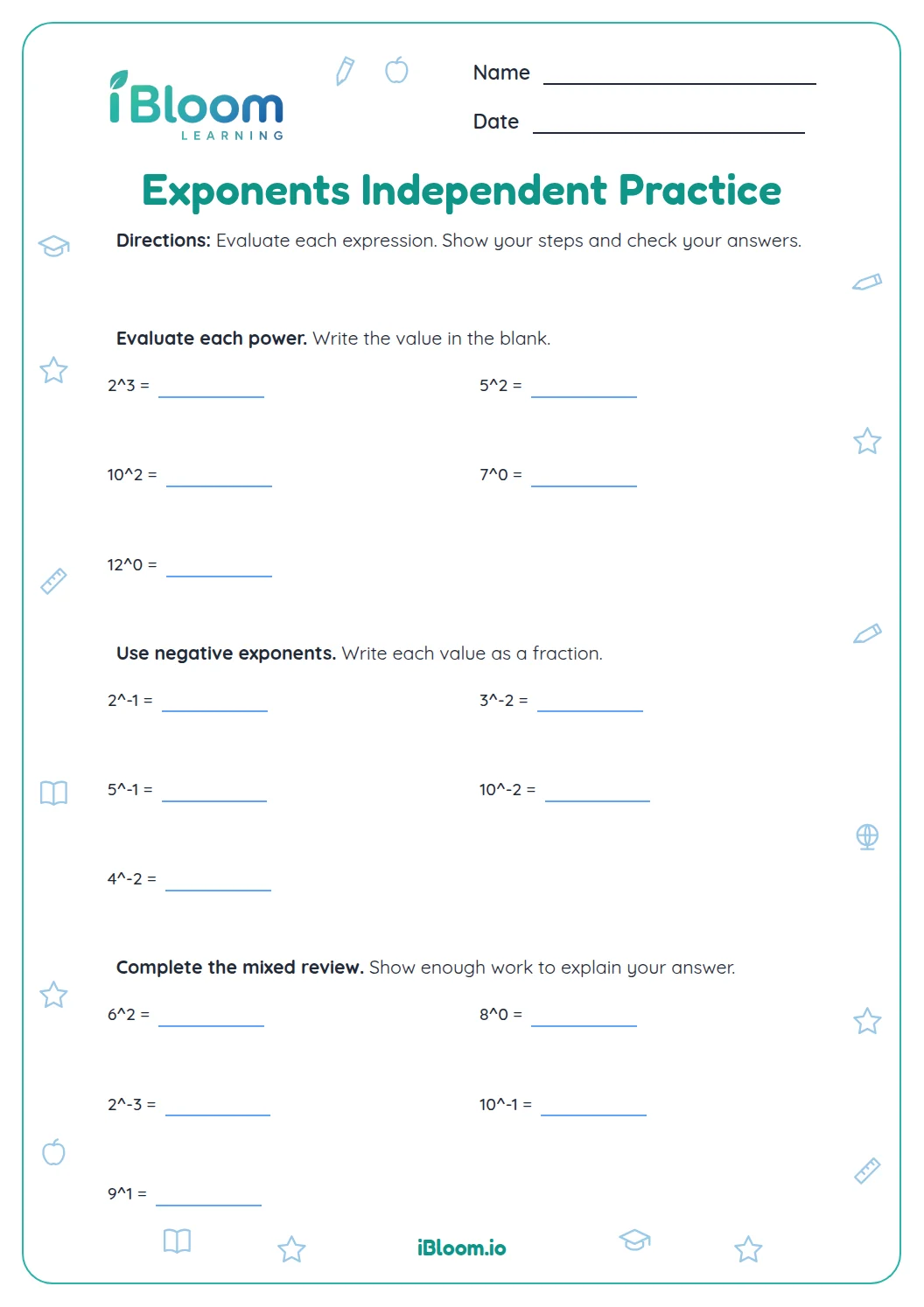
For a nonzero base, a zero exponent has a value of 1. The page asks students to apply that rule to several bases, including 4 and 6. The answer key lists 1 for each of those zero-power expressions. That pattern works for any nonzero base.
How should students read a negative exponent?
A negative exponent indicates a reciprocal: a⁻ⁿ = 1/aⁿ for a nonzero base a. For instance, 2⁻¹ is 1/2. Students use that pattern to find values and to express reciprocal powers in exponent form. The base stays positive while its reciprocal is written as a fraction.
What is on the answer key?
The answer key gives the missing exponent or value for each of the 20 questions. Encourage students to show repeated multiplication or a reciprocal step on scratch paper, then use the key to locate and correct an error. The key follows the question order for quick checking.