



About this worksheet
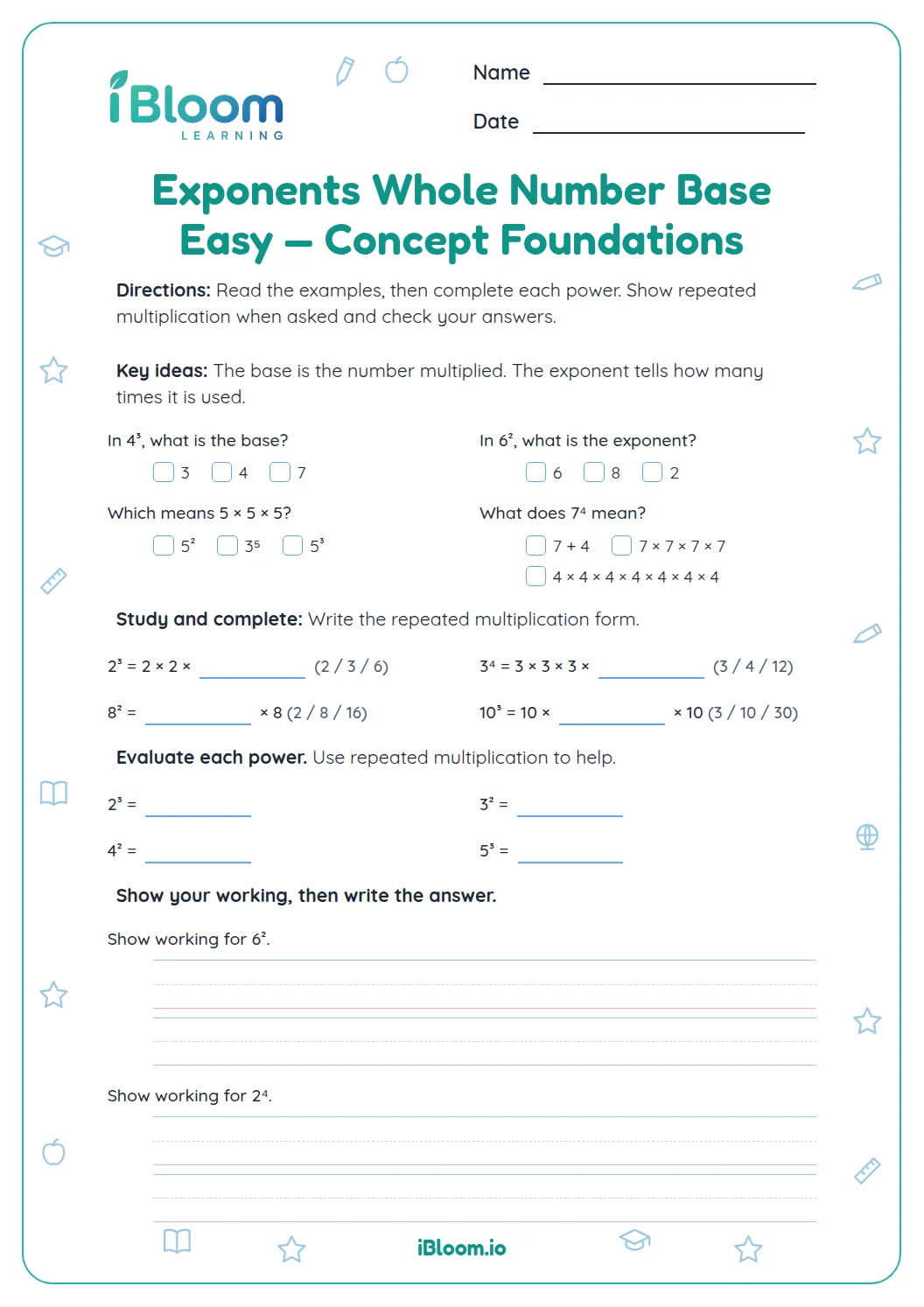
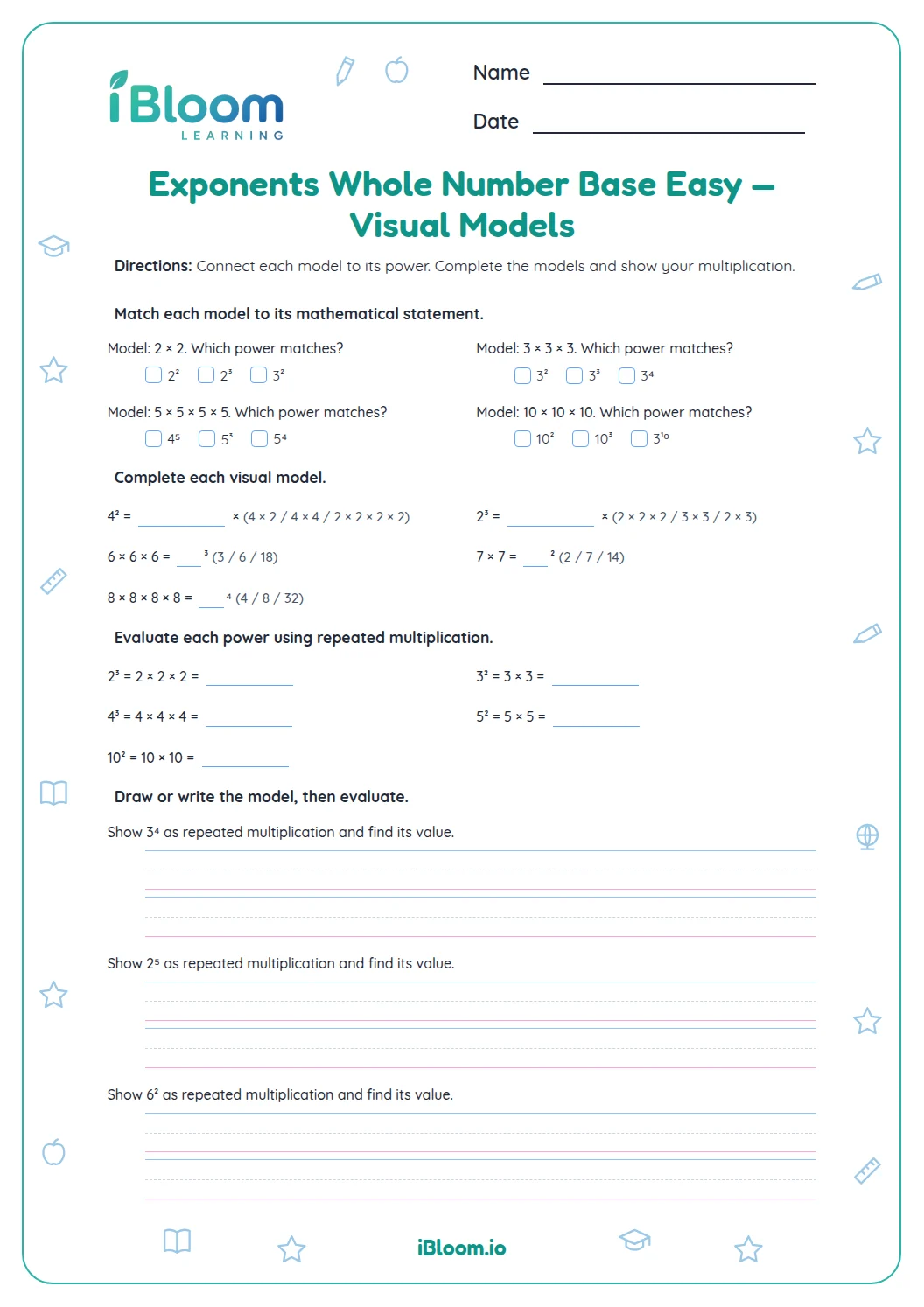
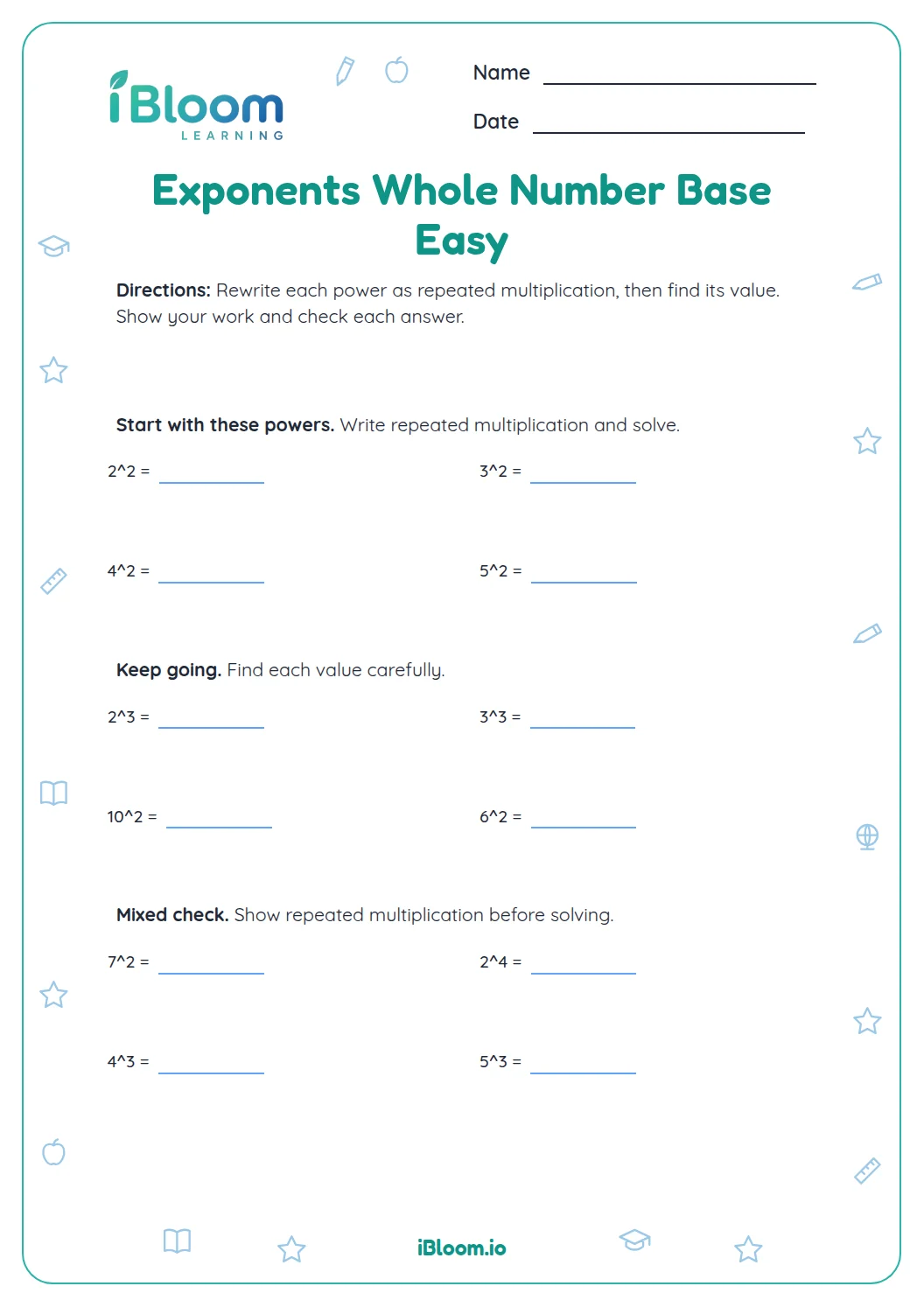
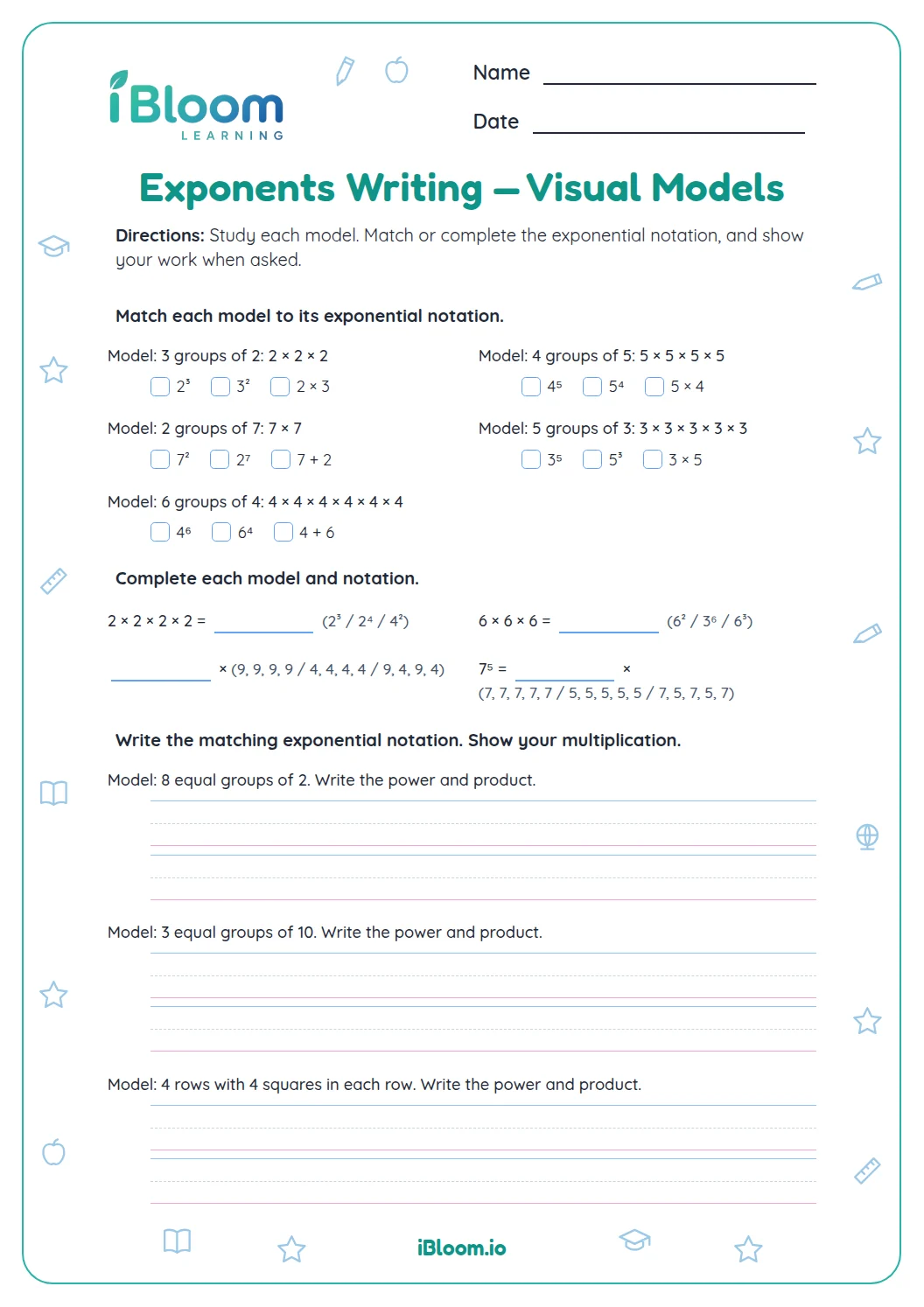
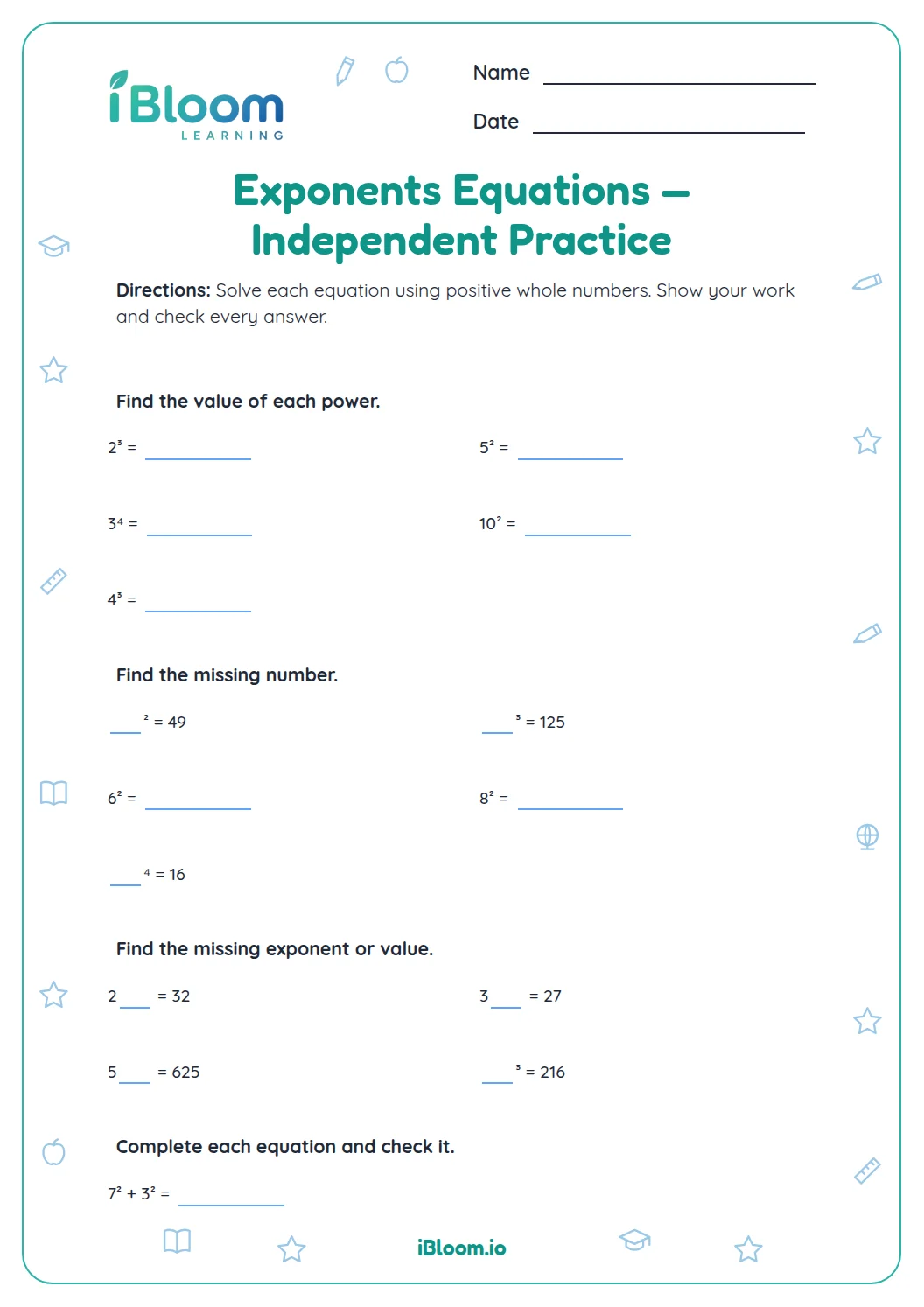
This free Grade 6 math worksheet practices writing and evaluating numerical expressions with whole-number exponents. Students turn repeated multiplication into a power, evaluate squares and cubes, compare powers, correct a common misunderstanding, and apply a square number to an area question. It includes 14 questions and a separate answer key.
Aligned to 6.EE.A.1
What does an exponent count?
An exponent tells how many equal factors appear in a product. In question 1, 2 × 2 × 2 × 2 uses four factors of 2, so it can be written as 2⁴. The base is the repeated factor; the exponent is the number of times it appears.
Students begin by writing repeated multiplication as a power, then evaluate powers with whole-number bases.
- 12 × 2 × 2 × 2
- 2There are four factors of 2.
- 3Write the product as 2⁴.
How can students evaluate and compare powers?
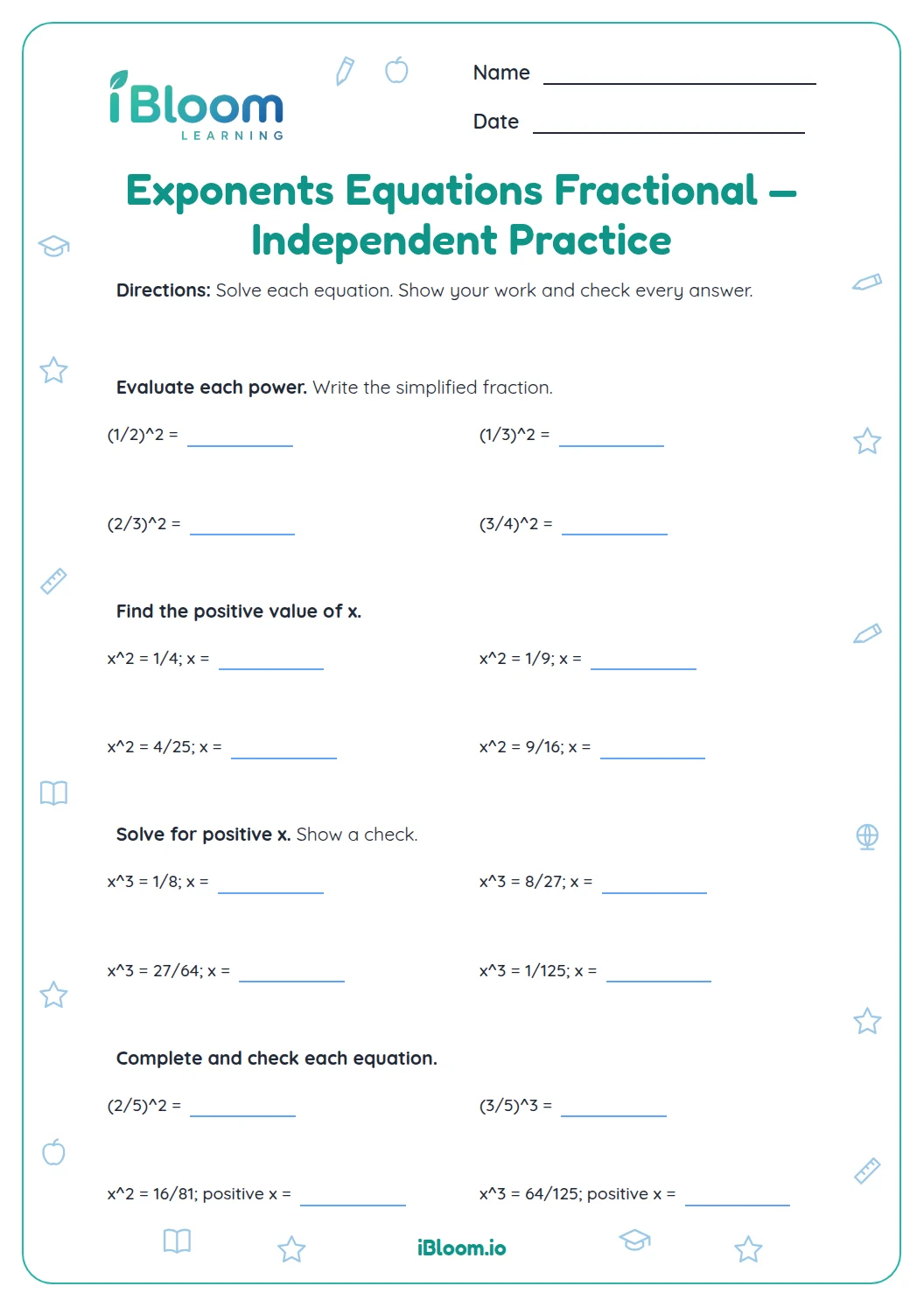
Evaluate each power by multiplying the base by itself the number of times shown. For example, 3³ = 3 × 3 × 3 = 27. For comparisons, calculate both values first; the larger exponent does not automatically mean the larger value.
The multiple-choice questions revisit equal values, a common misconception, and the connection between a repeated product and its power.
Where does a square power appear in the application?
Question 12 describes a square with side length 9 units and gives its area as 9² square units. Since 9 × 9 = 81, the area is 81 square units. Keep the units squared because the question asks for area.
The final response asks students to explain why 5³ means three factors of 5 rather than 5 × 3.
How can students check their work?
Expand a power into repeated multiplication when checking an answer. Then calculate the product or compare the two values directly. The separate answer key shows the numerical answers and a sample explanation.
How to solve the exponent questions
- 1Count the repeated factors before writing an exponent.
- 2For evaluation, write the base as a factor as many times as the exponent says.
- 3Multiply carefully and check the product a second time.
- 4For a comparison, evaluate both powers before selecting the larger one.
- 5In the square-area question, multiply side length by side length and include square units.
Common exponent mistakes
The mistake
Reading 5³ as 5 × 3.
The fix
Use the exponent as a factor count: 5³ = 5 × 5 × 5.
The mistake
Treating 4² as 4 × 2.
The fix
A square exponent means two factors of 4: 4 × 4 = 16.
The mistake
Comparing powers by looking only at their exponents.
The fix
Evaluate both expressions, then compare the values.
Common Core alignment
This worksheet gives students focused practice with the standard below.
Write and evaluate expressions with whole-number exponents.
On this sheet: Students write powers from repeated factors and evaluate powers with whole-number bases.
Show the official wordingHide the official wording
Write and evaluate numerical expressions involving whole-number exponents.
What to practice next
Make more practice
Further reading
Questions parents and teachers ask
How many questions are on the worksheet?
There are 14 questions in four parts: three repeated-factor items, five evaluation items, five multiple-choice reasoning and application items, and one written explanation. The printable uses three worksheet pages and has a separate three-page answer key with the expected values and a model explanation.
What does the exponent tell you?
The exponent tells how many times to use the base as a factor. For example, 2⁴ means 2 × 2 × 2 × 2, which equals 16. The first part of this worksheet asks students to count repeated factors and write the matching power.
How should a student compare two powers?
Evaluate each power first, then compare the resulting numbers. On this sheet, 3² equals 9 and 2³ equals 8, so 3² is greater. Comparing just the small exponent digits can lead to a wrong choice because the bases also affect the value.
Does the worksheet include an application problem?
Yes. One question uses the area of a square with side length 9 units and represents the area as 9² square units. Students evaluate the power to find 81 square units. It connects exponent notation to multiplying a side length by itself.
Is an answer key included?
Yes. A separate answer key accompanies the three worksheet pages. It lists the answers for the power-writing, evaluation, comparison, and area items, and gives a sample explanation for why 5³ is not the same as 5 × 3. Students can expand each power to check the key.