
About this worksheet
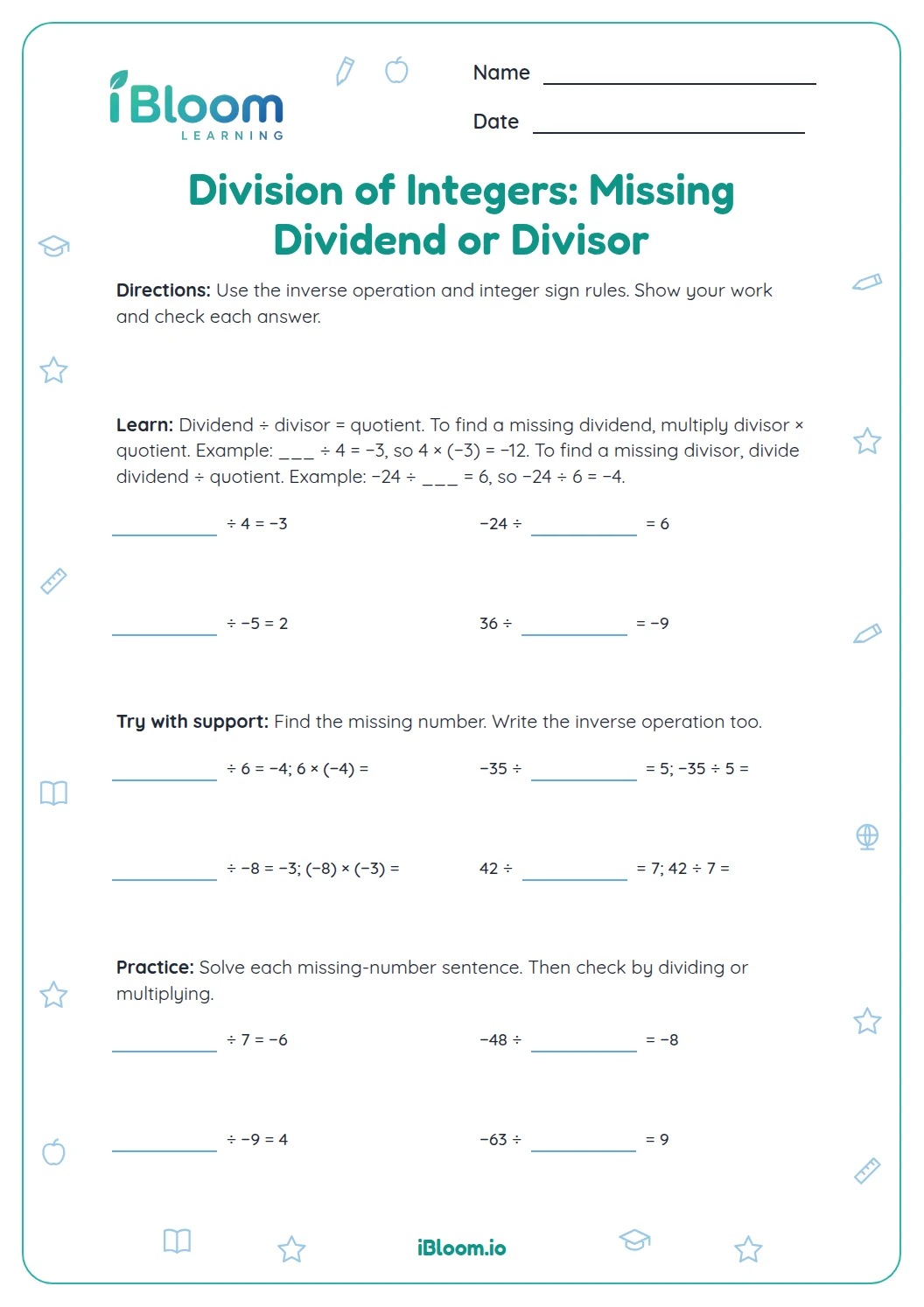
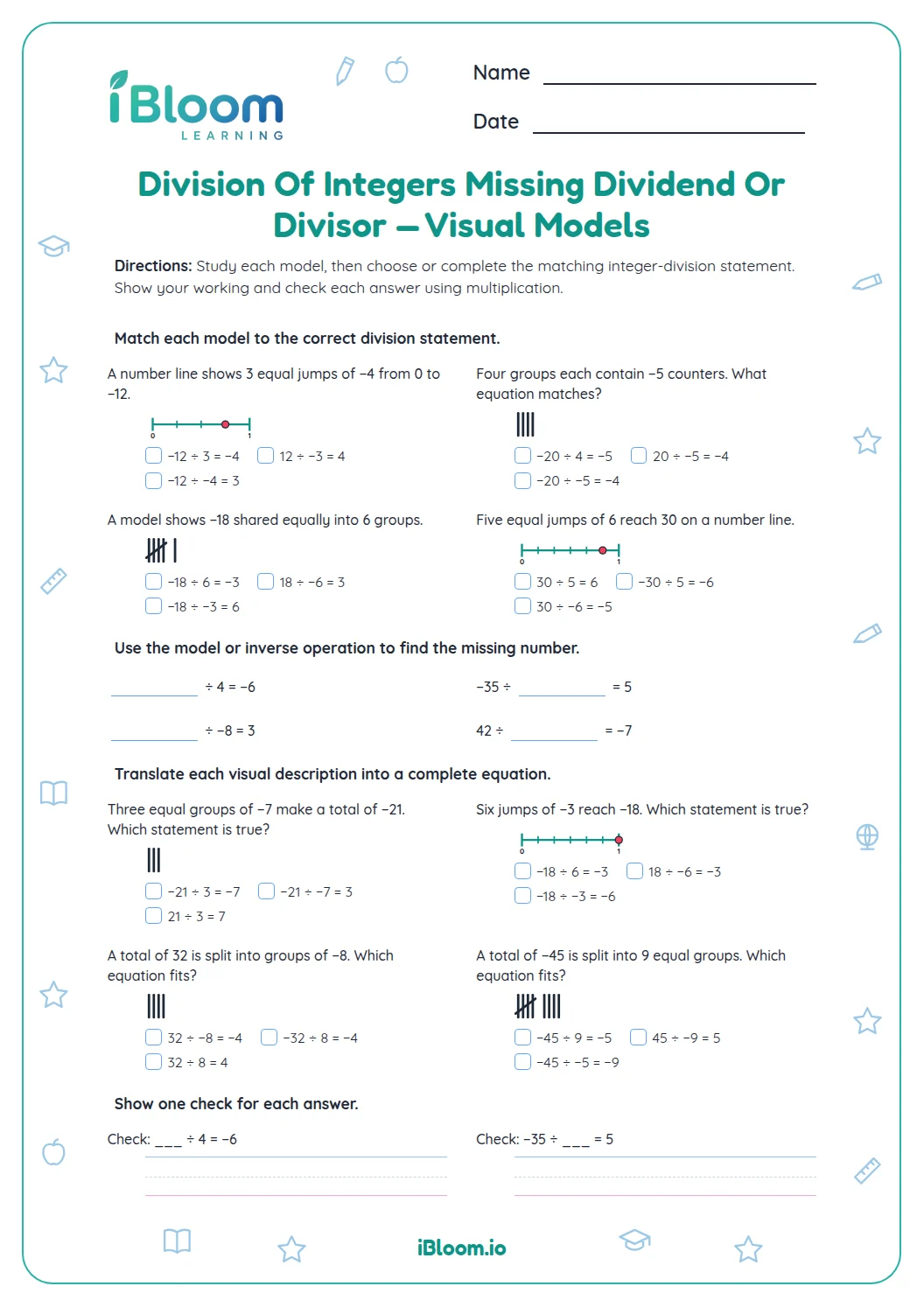
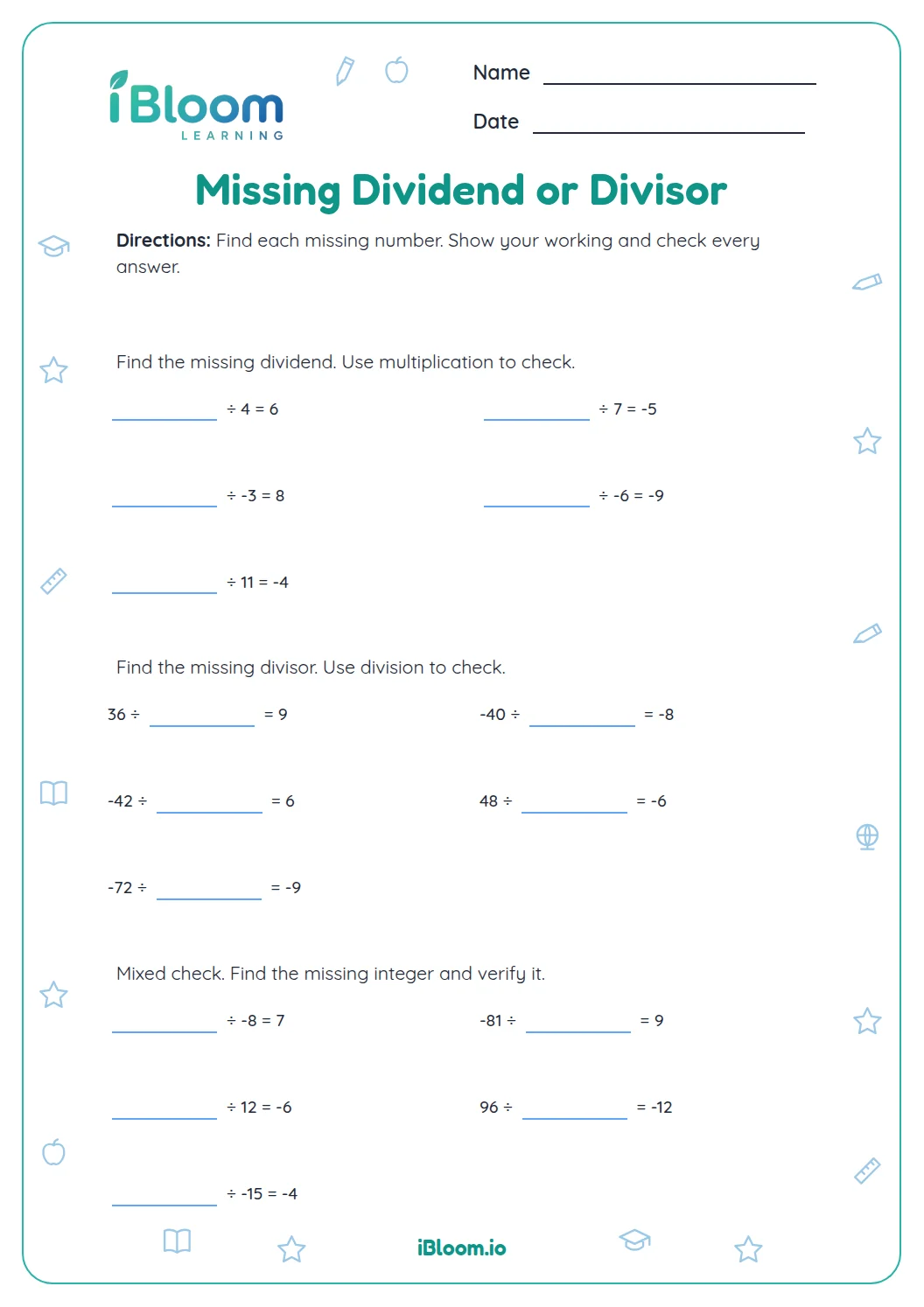
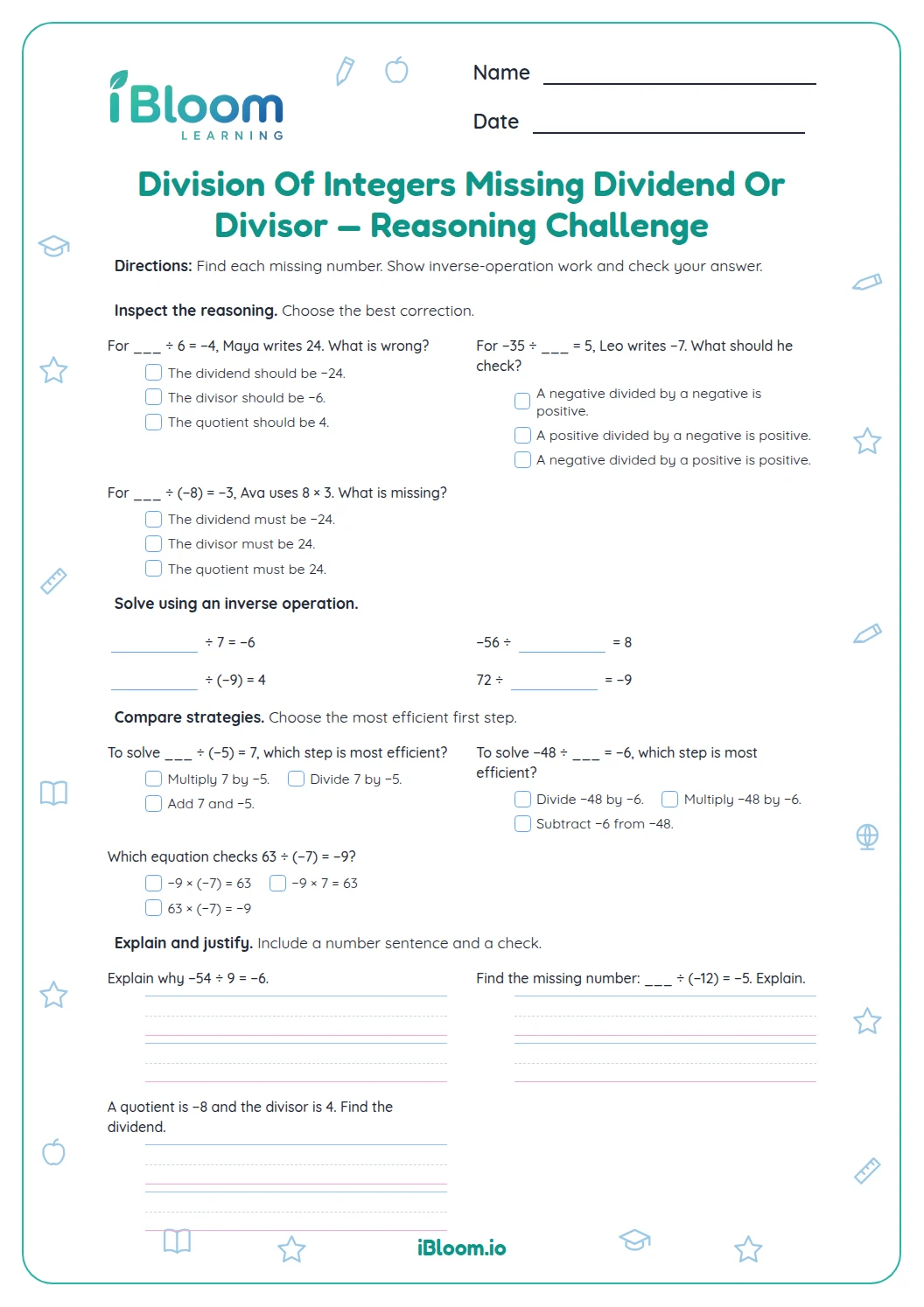
This Grade 6 printable practices integer division when a dividend or divisor is missing. Students use temperature, elevation, money, and other signed changes to complete equations, interpret quotient signs, and check with multiplication. It includes 16 questions across four parts and a separate answer key.
What skill does this worksheet practice?
This Grade 6 printable practices integer division when a dividend or divisor is missing. Students use temperature, elevation, money, and other signed changes to complete equations, interpret quotient signs, and check with multiplication. It includes 16 questions across four parts and a separate answer key.
How can students work through the questions?
Use multiplication to undo division: dividend ÷ divisor = quotient means divisor × quotient = dividend. Then check whether the signs and units make sense in the situation.
- 1___ ÷ 5 = −6
- 2Multiply 5 × −6 to find −30.
- 3Check: −30 ÷ 5 = −6.
How do signs affect a quotient?
A positive and a negative divided together give a negative quotient. Two numbers with the same sign give a positive quotient. The story identifies whether a change is a rise, drop, gain, or loss.
How can multiplication find a blank?
Multiply the known divisor and quotient to find a missing dividend. To find a missing divisor, divide the dividend by the quotient and check the signed equation.
How can a student check the context?
Keep units with the answer and compare the sign with the story. A descent is negative, while a rise is positive; the numerical relationship must also divide evenly in these items.
Common mistakes and quick fixes
The mistake
Choose an operation from one keyword alone.
The fix
Use the quantities and what the story asks you to find.
The mistake
Lose track of the sign or unit.
The fix
Carry it through the equation and check it against the story.
The mistake
Stop after the first step in a multistep item.
The fix
Reread the final question and use every required operation.
What to practice next
Questions parents and teachers ask
What is the missing dividend?
The dividend is the number being divided. In ___ ÷ 5 = −6, multiply 5 by −6 to find −30; then check that −30 ÷ 5 equals −6 and that the negative sign matches the described change. The blank is the dividend. Multiply to verify both the value and its sign.
What is the missing divisor?
The divisor is the number that divides the dividend. In −42 ÷ ___ = −7, the missing value is 6 because −42 ÷ 6 equals −7. Multiplication also checks it: 6 × −7 gives −42, the original dividend. This check reverses division using the quotient and divisor.
How do I know the sign of a quotient?
A quotient is positive when the dividend and divisor have the same sign, and negative when their signs differ. Check the signs with multiplication, then compare the result with the rise, drop, gain, or loss described in the word problem. Multiplication confirms the resulting dividend.
How many problems are included?
The printable contains 16 problems in four parts. Most ask for a missing dividend, divisor, or quotient; the last part applies division to stories and asks students to explain a sign or write an equation. The answer key is separate. Every item has an answer in the separate key.
Why do the stories use negative values?
Negative values represent changes such as descending, losing points, or a balance decreasing. Reading the context helps students decide whether the quotient should describe a positive or negative change per stage, round, or time period. Check the unit too. For example, a decrease is represented by a negative quantity.